
Cold calling vs cold email: which should B2B founders start with?
Cold calling vs cold email has no winner that holds for every B2B company. Lead with the phone when you can reach your buyers' direct numbers, your target accounts are few, your deals are large and someone has hours set aside to dial. Lead with email when the list is large, you have no phone numbers, or you want to test messages cheaply before anyone picks up the phone. If you sell into Germany, both channels are restricted: advertising email to businesses needs prior consent, and a call needs at least presumed consent, which is hard to show for a first cold call. Check with a lawyer there before you start either one.
Most teams end up using both channels together, so the question is which one leads. Your accounts, your market and your calendar answer it.
Cold calling vs cold email: which should you start with?
Start with the channel your situation supports on day 1. The phone needs direct numbers for the right people and a person with blocked hours. Email needs a sending setup and enough contacts to learn from. Check six facts: phone data, list size, deal size, who does the work, how fast you need feedback, and which country your buyers sit in, then use the table below.
The table is our editorial guidance, built from the sources cited below and the way the channels work. It isn't a study, so treat it as a starting point and let your own numbers overrule it after a few weeks.
| If this is true for you | Lead with | Why |
|---|---|---|
| You can get direct or mobile numbers for most of your buyers | Phone | A call only works if it reaches the person who decides (check the calling rules below first) |
| You have no phone numbers, only addresses | You can't call a switchboard into a meeting | |
| Your market is small, accounts you could name individually | Phone | Each account is worth a real conversation, and you can't afford to burn it with bulk sends |
| Your list is large, thousands of similar companies | Written outreach lets you test messages across many accounts before you spend calling hours | |
| Deals are large or complex, with several people involved | Phone | A conversation surfaces the problem and the other people involved faster than a reply |
| Deals are smaller and the offer is easy to explain in writing | A short message can carry the whole offer | |
| You or a rep can block a few hours a day for the phone | Phone | Calling only produces conversations when someone dials |
| Nobody has those hours, but someone can own a sending setup | It runs on setup and a schedule of sends | |
| You need feedback on your message this week | Phone | Every conversation tells you how the offer lands, right away |
| Your buyers are in Germany | Check the rules first | German law restricts both: email needs prior consent, a call needs at least presumed consent |
When rows point in different directions, the phone data row usually decides. A strong set of accounts with no reachable numbers points to writing first. If you have a small set of accounts, direct numbers and can make the calls yourself, start with the phone once the rules check passes, even if every other row is neutral.
If calling wins, our guide on how a B2B cold calling program runs covers list building and the sequence around the calls.
How do phone and email outreach compare side by side?
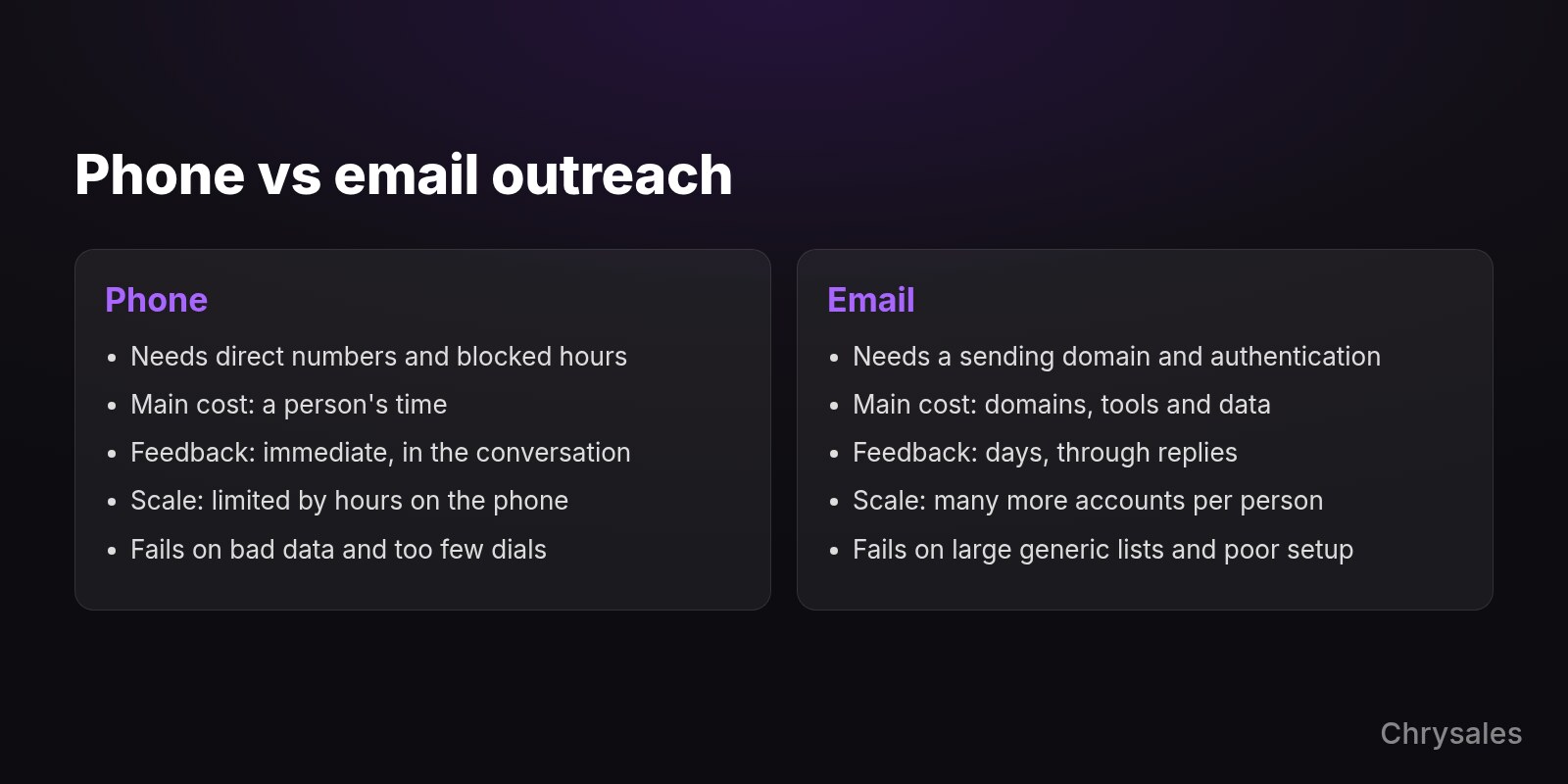
Calling costs a person's hours and gives you fast, live feedback, but one caller can only have so many conversations a day. Written outreach costs setup, domains, tools and data, scales across far more accounts per person, and teaches you slowly through replies. Calls tend to fail on bad numbers and nerves. Written outreach tends to fail on deliverability and generic messages sent to lists that are too large.
| What you compare | Phone | |
|---|---|---|
| What you need first | Direct numbers, target accounts, blocked hours | A sending domain, authentication, verified addresses |
| Main cost | A person's time | Domains, tools and data |
| Speed of feedback | Immediate, in the conversation | Days, through replies |
| Scale per person | Limited by hours on the phone | Many more accounts per person |
| What you learn | Objections, timing, who really decides | Which subject and message gets replies |
| Main risk | Wrong numbers and burned hours | Spam folder and a damaged domain; in both, rule breaches |
| How it usually fails | Too few dials, bad data, a caller who talks too much | Large generic lists and no follow-up |
One survey puts numbers on the scale difference. The Bridge Group, a sales research firm rather than a channel software vendor, surveyed 351 B2B companies, 78% based in North America and 83% B2B SaaS. In its 2025 SDR metrics report, phone-centric SDR teams averaged 56 dials and 4.6 quality conversations a day, against 28 dials and 3.4 for email-centric teams. That sample leans toward North American software teams, so it shows a direction and can't predict your market.
The table also shows why the two channels pair well. Calls tell you what to say, and writing lets you say it to more people.
What do the benchmarks really say about success rates?
Published benchmarks can't settle the choice, because they measure different things. Call figures count connects per dial or meetings per conversation, while inbox figures count replies per message sent, including "no thanks". Most come from companies that sell the channel they measure. Use them to set rough expectations for each channel on its own, then measure your own numbers from the first weeks.
These are the main publishers' figures, with the denominator each one uses.
| Figure | Publisher and what it sells | Counted per | What it doesn't tell you |
|---|---|---|---|
| Average rep connects with 5.4% of prospects, top quartile 13.3%; about 19 calls per conversation | Gong, call-recording and revenue software, 300M+ cold calls (period not stated) | Dials | Market, deal size, list quality |
| Set rate 4.6% for the average rep, 16.7% for top reps | Gong, same article | Conversations | How many meetings were held or turned into deals |
| 9.9% per-dial connect, 24.5% per-prospect connect, 4.6% of conversations book a meeting, roughly one meeting per 370 dials | Belkins, an agency selling calling and email, 175,000+ dials in 2025 | Dials, prospects, conversations | A truly cold first call: many of these calls came after earlier messages |
| Average reply rate 0.45% across 7.5 million emails | Belkins, same agency, 2025 | Messages sent | How many replies were interested or became meetings |
| Average sequence reply rate 4.5%, most replies negative | Hunter, a tool that finds addresses and sends sequences, 31M messages sent by its users in 2025 | Recipients of a sequence (45 replies per 1,000 people emailed) | Meetings, deal size, how interested the replies were |
The reply numbers disagree badly: Belkins reports 0.45% per message sent, Hunter 4.5% per recipient of a sequence, where one recipient can get several messages. At Belkins' rate, 1,000 messages give about 5 replies, before you count how many say no.
Belkins also warns about its own call figure. Its meeting rate "represents a prospect who has already seen your name in their inbox", so it's warmer than a call to a stranger.
Gong's numbers show how much the person on the phone matters. As a rough calculation from Gong's averages, a conversation every 19 dials and a 4.6% set rate work out to roughly a meeting per 400 dials. In that Gong article, Armand Farrokh writes, "Is cold calling dead for the average rep? Yes." He adds: "But for the top reps, cold calling can generate nearly one meeting per hour."
For reply rates in more depth, see what counts as a good cold email response rate. Sabir also has a video on this choice, Cold Email vs Cold Calling: Which Makes You Money Faster?. Its description says it covers when each channel wins, what each one really costs and how to combine both.
What do you need before your first call or email?
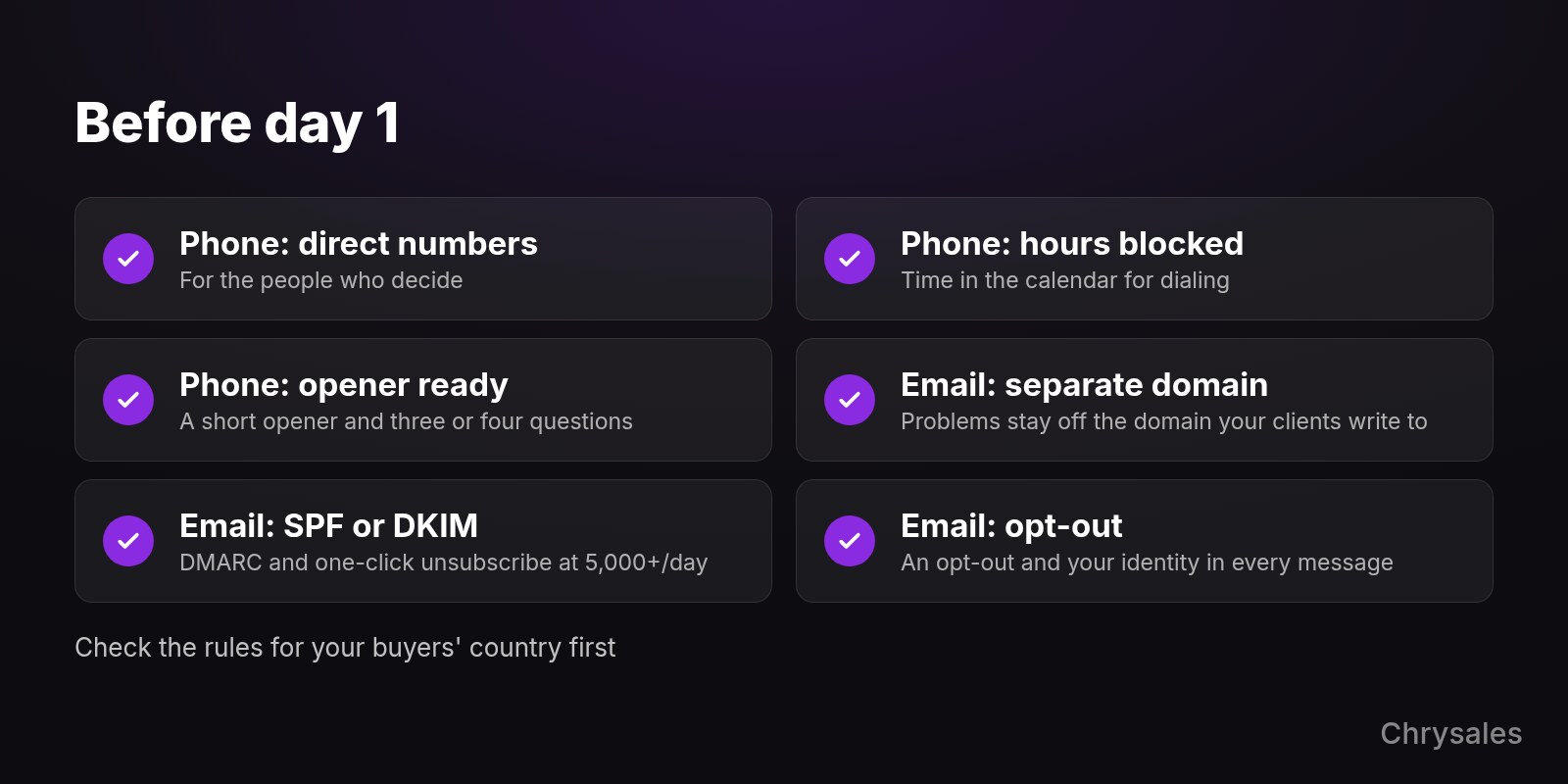
For calling you need direct numbers for the right people, a list, hours blocked in your calendar, a short opener with a few questions, and somewhere to log every outcome. For written outreach you need a separate sending domain, SPF and DKIM set up, small segments, an opt-out and your identity in every message. In both cases, check the rules for your buyers' country before day 1.
Before your first call:
- Direct numbers for the people who decide. A call to a switchboard or a dead line tells you nothing about your offer.
- Target accounts you can work through individually, with the reason each fits.
- Hours blocked in the calendar. Dialing you plan to do "when there's time" rarely happens.
- A short opener and three or four questions. Our guide on why cold call scripts fail in the first seconds covers what to say.
- A place to log each dial, connect, conversation and meeting, so you can judge the channel later.
- A register check where the law asks for one, such as the TPS and CTPS registers in the UK.
Before your first email:
- A separate sending domain, so problems don't land on the domain your clients write to.
- SPF or DKIM authentication. As of November 2026, Google's sender guidelines ask all senders to set up SPF or DKIM, and senders of 5,000 or more messages a day need SPF, DKIM, DMARC and one-click unsubscribe.
- A spam rate you watch. Google asks senders to keep the rate in Postmaster Tools below 0.3%, and ideally below 0.10%, as of November 2026. Those guidelines apply to personal Gmail addresses, not to Google Workspace accounts, but they're still a sensible baseline for B2B sending. Google says it started ramping up enforcement in November 2025.
- Small segments instead of one big blast. In Hunter's 2025 data, sequences with 21-50 recipients got 6.2% replies against 2.4% for 500 or more.
- A custom domain. Hunter reports 2.5% replies for senders using free mailbox addresses and 5.2% from a custom domain.
- An opt-out and your identity in every message. UK law and US CAN-SPAM both require them.
- A message worth replying to. Our guide on how to write a cold email that gets replies goes through it.
If you've never called a stranger about your offer and the phone is what holds you back, it helps to hear real calls before you start. In this live session, Sabir cold calls with real clients and goes through real objections and how to handle them in the moment.
What are the B2B calling and email rules in Germany, the UK and the US?
The rules differ by country and by channel. In Germany, an advertising email to a business needs prior express consent, and a call to a business needs at least presumed consent, which requires concrete signs of interest. In the UK, the consent rule for marketing messages covers individuals and sole traders but not companies. In the US, most B2B calls are exempt from the FTC's telemarketing rule, and CAN-SPAM applies to B2B senders as well.
This section points to the official texts, checked on 5 November 2026. It isn't legal advice: rules change and depend on your case, so check with a lawyer in your buyers' country before you start.
| Country | Calls to businesses | Email to businesses |
|---|---|---|
| Germany | Need at least presumed consent (UWG § 7); calls to consumers need prior express consent | Need prior express consent, for business recipients too; narrow exception for existing customers (UWG § 7 (3)) |
| UK | No marketing calls to numbers on the TPS or CTPS register, or to anyone who asked not to be called (PECR reg. 21) | Consent rule applies to individual subscribers, including sole traders and most partnerships, not to companies (PECR reg. 22); every message must show the sender and a valid opt-out address (reg. 23) |
| US | Most B2B calls are exempt from the FTC Telemarketing Sales Rule, with exceptions; autodialed or prerecorded telemarketing calls to mobile numbers need prior express written consent (47 CFR 64.1200) | CAN-SPAM makes no exception for B2B email: opt-out, physical postal address, opt-outs honored within 10 business days |
Germany needs a closer look, because much of the advice online is written for the US. The Chamber of Commerce and Industry for the Palatinate (IHK Pfalz) has a guidance page on phone advertising. It says "Grundsätzlich unerlaubt sind Werbeanrufe, die allein auf die Gewinnung neuer Aufträge zielen" (original German). That reads "Advertising calls aimed only at winning new orders are in principle not allowed" (our translation).
The same page explains that presumed consent needs concrete circumstances showing a real interest in this kind of contact, and that the caller carries the risk of judging that wrongly.
For advertising by email, IHK Pfalz says it makes no difference whether the messages go to consumers or to businesses: without prior express consent, they're not allowed. GDPR adds a layer on top. Recital 47 says direct marketing may be regarded as a legitimate interest, and Article 21 gives people the right to object, which you must point out at the latest in your first communication. A legitimate interest under GDPR doesn't replace the consent rule in UWG.
The UK consent rule leaving companies out doesn't make UK B2B email rule-free: sender identity and the opt-out still apply, and UK data protection law may also apply to the work addresses of named people. Check your case with a UK lawyer.
The US row covers federal rules only; state laws weren't checked. For Austria, Switzerland and the Nordics, look up the national rules separately.
How do you combine both channels in one sequence?
Pick the lead channel from the decision table, then use the other channel to follow up. In an email-led sequence, the phone comes in for people who haven't replied after the first messages. In a call-led sequence, a short note right after each call or voicemail gives the prospect something to read and answer.
For German recipients, these sequences only apply where you already have consent (for calls to businesses, at least presumed consent), or fall under the narrow existing-customer exception for email. Without that, don't send the first message or make the call.
Belkins publishes how it does this. In its cold calling benchmarks, it writes that calling usually enters its sequences after email silence, as a third or fourth touch rather than a first contact. Belkins is an agency that sells this service, so treat it as one company's practice; it doesn't show that this order wins.
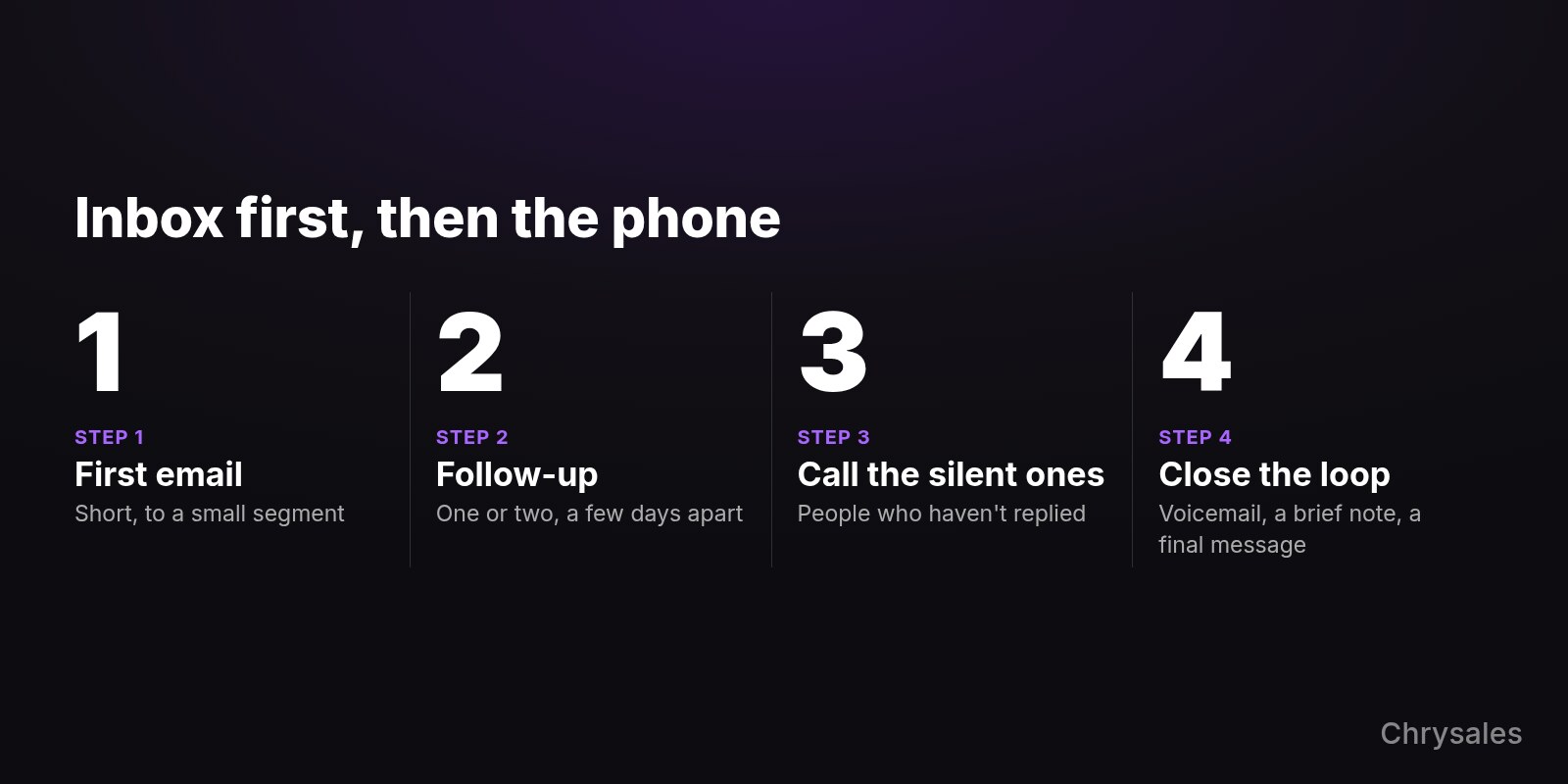
Inbox first, for a small team:
- Open with a short message to a small, well-defined segment. It has to make sense on its own, without the follow-ups.
- Send a follow-up or two a few days apart, each with one new point rather than a reminder.
- Call the people who haven't replied. They've seen your name, which is the warmer situation Belkins' call numbers describe.
- If you don't reach them, leave a short voicemail and send a brief note that refers to it, then close the loop with a final message.
Phone first, the same idea turned around:
- Start with a call to the account, at a time you've blocked for calling.
- Send a short written follow-up right after the call or voicemail, with the main point you wanted to make.
- Call again on another day and at another time.
- Send a last message that makes it easy to say yes, not now, or no.
A single attempt rarely tells you anything. Belkins' per-prospect connect rate of 24.5% against 9.9% per dial suggests that repeat attempts reach more people before you write a prospect off.
How do you know after a few weeks whether the channel works?
Measure conversations and meetings held, not dials made or messages delivered. On the phone, track dials, connects, conversations and meetings. In the inbox, track replies that show real interest, meetings and your spam rate. Before you start, write down how many contacts and touches you'll complete before judging, then decide to continue, fix one thing, or switch the lead channel.
What to track for each channel:
| Channel | Track | Warning sign |
|---|---|---|
| Phone | Dials, connects, conversations, meetings booked and held | Many dials but few connects: check your numbers before you blame the pitch |
| Replies that show interest, meetings booked and held, spam rate | Replies are mostly "unsubscribe" or "not interested": check the list and the segment size | |
| Both | Which accounts turned into meetings, and through which touch | Meetings come only from a single channel's touches |
Our suggestion, which no study backs: change one variable at a time. If dials connect but don't turn into meetings, work on the opener and questions. If they don't connect, work on the data.
If messages land but nobody answers, change the segment or the message before you change the channel. Switch the lead channel only when the facts in the decision table turn out to be different from what you assumed, for example when most of your numbers don't reach the right people.
Even the vendors that publish benchmarks can't agree on what a normal reply rate is, so your own numbers from your own accounts matter more than any average. If the inbox stays your lead channel, read why cold email still works for B2B for how it fits into a wider system.
Common mistakes when choosing between calls and email
Most mistakes come from comparing the wrong numbers, copying advice made for another market, or judging a channel before it had a fair run. The outbound agency SalesFocus argues that execution decides more than the channel. In its words, "A sloppy cold call campaign will lose to a sharp cold email campaign, and a sloppy email campaign will lose to a sharp calling effort just the same."
- Comparing different denominators. A meeting rate per conversation and a reply rate per message sent measure different things. Compare each channel against its own past results.
- Copying US practice into Germany. CAN-SPAM requires no prior consent, only an opt-out and the other basics. Germany's UWG asks for consent beforehand, business recipients included.
- Blasting a single large list. Hunter's data shows small segments getting far more replies than lists of 500 or more, and spam complaints count against Google's limit.
- Judging the phone with bad numbers. If you reach the wrong person or a dead line, the numbers were bad, so the result says nothing about the phone.
- Quitting after a single touch. Per-prospect connect rates are much higher than per-dial rates, so one attempt per account undersells the phone.
- Doing both channels with no time blocked. If you call "in between" other work, you end up with neither channel tested properly.
FAQ
Which has a higher success rate, cold calling or cold email?
There is no fair head-to-head number. Call benchmarks count connects per dial or meetings per conversation, and inbox benchmarks count replies per message sent, including negative ones. Most publishers also sell the channel they measure. Compare each channel against your own results from your own accounts.
Should I call or email first?
Use the facts you have. If you can reach direct numbers, your target accounts are few and someone can block hours for dialing, start on the phone, after checking the calling rules for your buyers' country (Germany is strict). If you only have addresses, a large list or no time for calling, start with email and add calls for the people who don't reply.
Is cold email legal for B2B in Germany?
Under UWG § 7, advertising email needs the recipient's prior express consent, and IHK Pfalz says this applies to business recipients too. There is a narrow exception for existing customers. This isn't legal advice: check your case with a lawyer before you start.
Can one founder do both calls and email?
Yes, if the work is scheduled. Written outreach needs setup time up front and then regular time for replies, while calling needs blocked hours. Start with a single lead channel, get it running, and add the second as follow-up rather than starting both from zero at once.
Is cold calling better for bigger deals?
Often it's the better opening channel for large or complex deals, because a conversation uncovers the problem and the other people involved faster than a written thread. No study backs this; it's our editorial view, and it only holds if you can reach the right people's direct numbers.
Sources
- Gesetze im Internet - UWG § 7, unreasonable nuisance
- IHK Pfalz - Telefonwerbung (phone advertising)
- IHK Pfalz - E-Mail-Werbung (advertising by e-mail)
- GDPR Recital 47 - legitimate interests (gdpr-info.eu)
- GDPR Article 21 - right to object (gdpr-info.eu)
- legislation.gov.uk - PECR regulation 21, unsolicited calls
- legislation.gov.uk - PECR regulation 22, unsolicited electronic mail
- legislation.gov.uk - PECR regulation 23, sender identity and opt-out
- ICO - Business-to-business marketing
- FTC - Complying with the Telemarketing Sales Rule
- eCFR - 47 CFR 64.1200, delivery restrictions
- FTC - CAN-SPAM Act: A Compliance Guide for Business
- Google - Sender guidelines
- Google - Sender guidelines FAQ
- Gong - The hidden power of cold calling: insights from 300M calls
- Belkins - B2B cold calling statistics
- Belkins - Response rate benchmarks
- Hunter - State of outreach report
- The Bridge Group - 2025 SDR Models and Metrics Report
- SalesFocus - Calls vs email
Still deciding which channel should lead for your list and your market? Chrysales can look at your list, your market and your calling capacity with you. Pick your lead channel on a free call
Cold calling vs cold email has no winner that holds for every B2B company. Lead with the phone when you can reach your buyers' direct numbers, your target accounts are few, your deals are large and someone has hours set aside to dial. Lead with email when the list is large, you have no phone numbers, or you want to test messages cheaply before anyone picks up the phone. If you sell into Germany, both channels are restricted: advertising email to businesses needs prior consent, and a call needs at least presumed consent, which is hard to show for a first cold call. Check with a lawyer there before you start either one.
Most teams end up using both channels together, so the question is which one leads. Your accounts, your market and your calendar answer it.
Cold calling vs cold email: which should you start with?
Start with the channel your situation supports on day 1. The phone needs direct numbers for the right people and a person with blocked hours. Email needs a sending setup and enough contacts to learn from. Check six facts: phone data, list size, deal size, who does the work, how fast you need feedback, and which country your buyers sit in, then use the table below.
The table is our editorial guidance, built from the sources cited below and the way the channels work. It isn't a study, so treat it as a starting point and let your own numbers overrule it after a few weeks.
| If this is true for you | Lead with | Why |
|---|---|---|
| You can get direct or mobile numbers for most of your buyers | Phone | A call only works if it reaches the person who decides (check the calling rules below first) |
| You have no phone numbers, only addresses | You can't call a switchboard into a meeting | |
| Your market is small, accounts you could name individually | Phone | Each account is worth a real conversation, and you can't afford to burn it with bulk sends |
| Your list is large, thousands of similar companies | Written outreach lets you test messages across many accounts before you spend calling hours | |
| Deals are large or complex, with several people involved | Phone | A conversation surfaces the problem and the other people involved faster than a reply |
| Deals are smaller and the offer is easy to explain in writing | A short message can carry the whole offer | |
| You or a rep can block a few hours a day for the phone | Phone | Calling only produces conversations when someone dials |
| Nobody has those hours, but someone can own a sending setup | It runs on setup and a schedule of sends | |
| You need feedback on your message this week | Phone | Every conversation tells you how the offer lands, right away |
| Your buyers are in Germany | Check the rules first | German law restricts both: email needs prior consent, a call needs at least presumed consent |
When rows point in different directions, the phone data row usually decides. A strong set of accounts with no reachable numbers points to writing first. If you have a small set of accounts, direct numbers and can make the calls yourself, start with the phone once the rules check passes, even if every other row is neutral.
If calling wins, our guide on how a B2B cold calling program runs covers list building and the sequence around the calls.
How do phone and email outreach compare side by side?
Calling costs a person's hours and gives you fast, live feedback, but one caller can only have so many conversations a day. Written outreach costs setup, domains, tools and data, scales across far more accounts per person, and teaches you slowly through replies. Calls tend to fail on bad numbers and nerves. Written outreach tends to fail on deliverability and generic messages sent to lists that are too large.
| What you compare | Phone | |
|---|---|---|
| What you need first | Direct numbers, target accounts, blocked hours | A sending domain, authentication, verified addresses |
| Main cost | A person's time | Domains, tools and data |
| Speed of feedback | Immediate, in the conversation | Days, through replies |
| Scale per person | Limited by hours on the phone | Many more accounts per person |
| What you learn | Objections, timing, who really decides | Which subject and message gets replies |
| Main risk | Wrong numbers and burned hours | Spam folder and a damaged domain; in both, rule breaches |
| How it usually fails | Too few dials, bad data, a caller who talks too much | Large generic lists and no follow-up |
One survey puts numbers on the scale difference. The Bridge Group, a sales research firm rather than a channel software vendor, surveyed 351 B2B companies, 78% based in North America and 83% B2B SaaS. In its 2025 SDR metrics report, phone-centric SDR teams averaged 56 dials and 4.6 quality conversations a day, against 28 dials and 3.4 for email-centric teams. That sample leans toward North American software teams, so it shows a direction and can't predict your market.
The table also shows why the two channels pair well. Calls tell you what to say, and writing lets you say it to more people.
What do the benchmarks really say about success rates?
Published benchmarks can't settle the choice, because they measure different things. Call figures count connects per dial or meetings per conversation, while inbox figures count replies per message sent, including "no thanks". Most come from companies that sell the channel they measure. Use them to set rough expectations for each channel on its own, then measure your own numbers from the first weeks.
These are the main publishers' figures, with the denominator each one uses.
| Figure | Publisher and what it sells | Counted per | What it doesn't tell you |
|---|---|---|---|
| Average rep connects with 5.4% of prospects, top quartile 13.3%; about 19 calls per conversation | Gong, call-recording and revenue software, 300M+ cold calls (period not stated) | Dials | Market, deal size, list quality |
| Set rate 4.6% for the average rep, 16.7% for top reps | Gong, same article | Conversations | How many meetings were held or turned into deals |
| 9.9% per-dial connect, 24.5% per-prospect connect, 4.6% of conversations book a meeting, roughly one meeting per 370 dials | Belkins, an agency selling calling and email, 175,000+ dials in 2025 | Dials, prospects, conversations | A truly cold first call: many of these calls came after earlier messages |
| Average reply rate 0.45% across 7.5 million emails | Belkins, same agency, 2025 | Messages sent | How many replies were interested or became meetings |
| Average sequence reply rate 4.5%, most replies negative | Hunter, a tool that finds addresses and sends sequences, 31M messages sent by its users in 2025 | Recipients of a sequence (45 replies per 1,000 people emailed) | Meetings, deal size, how interested the replies were |
The reply numbers disagree badly: Belkins reports 0.45% per message sent, Hunter 4.5% per recipient of a sequence, where one recipient can get several messages. At Belkins' rate, 1,000 messages give about 5 replies, before you count how many say no.
Belkins also warns about its own call figure. Its meeting rate "represents a prospect who has already seen your name in their inbox", so it's warmer than a call to a stranger.
Gong's numbers show how much the person on the phone matters. As a rough calculation from Gong's averages, a conversation every 19 dials and a 4.6% set rate work out to roughly a meeting per 400 dials. In that Gong article, Armand Farrokh writes, "Is cold calling dead for the average rep? Yes." He adds: "But for the top reps, cold calling can generate nearly one meeting per hour."
For reply rates in more depth, see what counts as a good cold email response rate. Sabir also has a video on this choice, Cold Email vs Cold Calling: Which Makes You Money Faster?. Its description says it covers when each channel wins, what each one really costs and how to combine both.
What do you need before your first call or email?
For calling you need direct numbers for the right people, a list, hours blocked in your calendar, a short opener with a few questions, and somewhere to log every outcome. For written outreach you need a separate sending domain, SPF and DKIM set up, small segments, an opt-out and your identity in every message. In both cases, check the rules for your buyers' country before day 1.
Before your first call:
- Direct numbers for the people who decide. A call to a switchboard or a dead line tells you nothing about your offer.
- Target accounts you can work through individually, with the reason each fits.
- Hours blocked in the calendar. Dialing you plan to do "when there's time" rarely happens.
- A short opener and three or four questions. Our guide on why cold call scripts fail in the first seconds covers what to say.
- A place to log each dial, connect, conversation and meeting, so you can judge the channel later.
- A register check where the law asks for one, such as the TPS and CTPS registers in the UK.
Before your first email:
- A separate sending domain, so problems don't land on the domain your clients write to.
- SPF or DKIM authentication. As of November 2026, Google's sender guidelines ask all senders to set up SPF or DKIM, and senders of 5,000 or more messages a day need SPF, DKIM, DMARC and one-click unsubscribe.
- A spam rate you watch. Google asks senders to keep the rate in Postmaster Tools below 0.3%, and ideally below 0.10%, as of November 2026. Those guidelines apply to personal Gmail addresses, not to Google Workspace accounts, but they're still a sensible baseline for B2B sending. Google says it started ramping up enforcement in November 2025.
- Small segments instead of one big blast. In Hunter's 2025 data, sequences with 21-50 recipients got 6.2% replies against 2.4% for 500 or more.
- A custom domain. Hunter reports 2.5% replies for senders using free mailbox addresses and 5.2% from a custom domain.
- An opt-out and your identity in every message. UK law and US CAN-SPAM both require them.
- A message worth replying to. Our guide on how to write a cold email that gets replies goes through it.
If you've never called a stranger about your offer and the phone is what holds you back, it helps to hear real calls before you start. In this live session, Sabir cold calls with real clients and goes through real objections and how to handle them in the moment.
What are the B2B calling and email rules in Germany, the UK and the US?
The rules differ by country and by channel. In Germany, an advertising email to a business needs prior express consent, and a call to a business needs at least presumed consent, which requires concrete signs of interest. In the UK, the consent rule for marketing messages covers individuals and sole traders but not companies. In the US, most B2B calls are exempt from the FTC's telemarketing rule, and CAN-SPAM applies to B2B senders as well.
This section points to the official texts, checked on 5 November 2026. It isn't legal advice: rules change and depend on your case, so check with a lawyer in your buyers' country before you start.
| Country | Calls to businesses | Email to businesses |
|---|---|---|
| Germany | Need at least presumed consent (UWG § 7); calls to consumers need prior express consent | Need prior express consent, for business recipients too; narrow exception for existing customers (UWG § 7 (3)) |
| UK | No marketing calls to numbers on the TPS or CTPS register, or to anyone who asked not to be called (PECR reg. 21) | Consent rule applies to individual subscribers, including sole traders and most partnerships, not to companies (PECR reg. 22); every message must show the sender and a valid opt-out address (reg. 23) |
| US | Most B2B calls are exempt from the FTC Telemarketing Sales Rule, with exceptions; autodialed or prerecorded telemarketing calls to mobile numbers need prior express written consent (47 CFR 64.1200) | CAN-SPAM makes no exception for B2B email: opt-out, physical postal address, opt-outs honored within 10 business days |
Germany needs a closer look, because much of the advice online is written for the US. The Chamber of Commerce and Industry for the Palatinate (IHK Pfalz) has a guidance page on phone advertising. It says "Grundsätzlich unerlaubt sind Werbeanrufe, die allein auf die Gewinnung neuer Aufträge zielen" (original German). That reads "Advertising calls aimed only at winning new orders are in principle not allowed" (our translation).
The same page explains that presumed consent needs concrete circumstances showing a real interest in this kind of contact, and that the caller carries the risk of judging that wrongly.
For advertising by email, IHK Pfalz says it makes no difference whether the messages go to consumers or to businesses: without prior express consent, they're not allowed. GDPR adds a layer on top. Recital 47 says direct marketing may be regarded as a legitimate interest, and Article 21 gives people the right to object, which you must point out at the latest in your first communication. A legitimate interest under GDPR doesn't replace the consent rule in UWG.
The UK consent rule leaving companies out doesn't make UK B2B email rule-free: sender identity and the opt-out still apply, and UK data protection law may also apply to the work addresses of named people. Check your case with a UK lawyer.
The US row covers federal rules only; state laws weren't checked. For Austria, Switzerland and the Nordics, look up the national rules separately.
How do you combine both channels in one sequence?
Pick the lead channel from the decision table, then use the other channel to follow up. In an email-led sequence, the phone comes in for people who haven't replied after the first messages. In a call-led sequence, a short note right after each call or voicemail gives the prospect something to read and answer.
For German recipients, these sequences only apply where you already have consent (for calls to businesses, at least presumed consent), or fall under the narrow existing-customer exception for email. Without that, don't send the first message or make the call.
Belkins publishes how it does this. In its cold calling benchmarks, it writes that calling usually enters its sequences after email silence, as a third or fourth touch rather than a first contact. Belkins is an agency that sells this service, so treat it as one company's practice; it doesn't show that this order wins.
Inbox first, for a small team:
- Open with a short message to a small, well-defined segment. It has to make sense on its own, without the follow-ups.
- Send a follow-up or two a few days apart, each with one new point rather than a reminder.
- Call the people who haven't replied. They've seen your name, which is the warmer situation Belkins' call numbers describe.
- If you don't reach them, leave a short voicemail and send a brief note that refers to it, then close the loop with a final message.
Phone first, the same idea turned around:
- Start with a call to the account, at a time you've blocked for calling.
- Send a short written follow-up right after the call or voicemail, with the main point you wanted to make.
- Call again on another day and at another time.
- Send a last message that makes it easy to say yes, not now, or no.
A single attempt rarely tells you anything. Belkins' per-prospect connect rate of 24.5% against 9.9% per dial suggests that repeat attempts reach more people before you write a prospect off.
How do you know after a few weeks whether the channel works?
Measure conversations and meetings held, not dials made or messages delivered. On the phone, track dials, connects, conversations and meetings. In the inbox, track replies that show real interest, meetings and your spam rate. Before you start, write down how many contacts and touches you'll complete before judging, then decide to continue, fix one thing, or switch the lead channel.
What to track for each channel:
| Channel | Track | Warning sign |
|---|---|---|
| Phone | Dials, connects, conversations, meetings booked and held | Many dials but few connects: check your numbers before you blame the pitch |
| Replies that show interest, meetings booked and held, spam rate | Replies are mostly "unsubscribe" or "not interested": check the list and the segment size | |
| Both | Which accounts turned into meetings, and through which touch | Meetings come only from a single channel's touches |
Our suggestion, which no study backs: change one variable at a time. If dials connect but don't turn into meetings, work on the opener and questions. If they don't connect, work on the data.
If messages land but nobody answers, change the segment or the message before you change the channel. Switch the lead channel only when the facts in the decision table turn out to be different from what you assumed, for example when most of your numbers don't reach the right people.
Even the vendors that publish benchmarks can't agree on what a normal reply rate is, so your own numbers from your own accounts matter more than any average. If the inbox stays your lead channel, read why cold email still works for B2B for how it fits into a wider system.
Common mistakes when choosing between calls and email
Most mistakes come from comparing the wrong numbers, copying advice made for another market, or judging a channel before it had a fair run. The outbound agency SalesFocus argues that execution decides more than the channel. In its words, "A sloppy cold call campaign will lose to a sharp cold email campaign, and a sloppy email campaign will lose to a sharp calling effort just the same."
- Comparing different denominators. A meeting rate per conversation and a reply rate per message sent measure different things. Compare each channel against its own past results.
- Copying US practice into Germany. CAN-SPAM requires no prior consent, only an opt-out and the other basics. Germany's UWG asks for consent beforehand, business recipients included.
- Blasting a single large list. Hunter's data shows small segments getting far more replies than lists of 500 or more, and spam complaints count against Google's limit.
- Judging the phone with bad numbers. If you reach the wrong person or a dead line, the numbers were bad, so the result says nothing about the phone.
- Quitting after a single touch. Per-prospect connect rates are much higher than per-dial rates, so one attempt per account undersells the phone.
- Doing both channels with no time blocked. If you call "in between" other work, you end up with neither channel tested properly.
FAQ
Which has a higher success rate, cold calling or cold email?
There is no fair head-to-head number. Call benchmarks count connects per dial or meetings per conversation, and inbox benchmarks count replies per message sent, including negative ones. Most publishers also sell the channel they measure. Compare each channel against your own results from your own accounts.
Should I call or email first?
Use the facts you have. If you can reach direct numbers, your target accounts are few and someone can block hours for dialing, start on the phone, after checking the calling rules for your buyers' country (Germany is strict). If you only have addresses, a large list or no time for calling, start with email and add calls for the people who don't reply.
Is cold email legal for B2B in Germany?
Under UWG § 7, advertising email needs the recipient's prior express consent, and IHK Pfalz says this applies to business recipients too. There is a narrow exception for existing customers. This isn't legal advice: check your case with a lawyer before you start.
Can one founder do both calls and email?
Yes, if the work is scheduled. Written outreach needs setup time up front and then regular time for replies, while calling needs blocked hours. Start with a single lead channel, get it running, and add the second as follow-up rather than starting both from zero at once.
Is cold calling better for bigger deals?
Often it's the better opening channel for large or complex deals, because a conversation uncovers the problem and the other people involved faster than a written thread. No study backs this; it's our editorial view, and it only holds if you can reach the right people's direct numbers.
Sources
- Gesetze im Internet - UWG § 7, unreasonable nuisance
- IHK Pfalz - Telefonwerbung (phone advertising)
- IHK Pfalz - E-Mail-Werbung (advertising by e-mail)
- GDPR Recital 47 - legitimate interests (gdpr-info.eu)
- GDPR Article 21 - right to object (gdpr-info.eu)
- legislation.gov.uk - PECR regulation 21, unsolicited calls
- legislation.gov.uk - PECR regulation 22, unsolicited electronic mail
- legislation.gov.uk - PECR regulation 23, sender identity and opt-out
- ICO - Business-to-business marketing
- FTC - Complying with the Telemarketing Sales Rule
- eCFR - 47 CFR 64.1200, delivery restrictions
- FTC - CAN-SPAM Act: A Compliance Guide for Business
- Google - Sender guidelines
- Google - Sender guidelines FAQ
- Gong - The hidden power of cold calling: insights from 300M calls
- Belkins - B2B cold calling statistics
- Belkins - Response rate benchmarks
- Hunter - State of outreach report
- The Bridge Group - 2025 SDR Models and Metrics Report
- SalesFocus - Calls vs email
Still deciding which channel should lead for your list and your market? Chrysales can look at your list, your market and your calling capacity with you. Pick your lead channel on a free call
Scaling Is Not Hard If You Have The Right Systems
If you’re serious about leveling up your scaling game, you need the right system, the right training, and the right team behind you. We're here to give you the exact tools and strategies top entrepreneurs use to dominate.

Discover the latest tips
View All
Chrysales was formed from the words "chrysalis" the stage where a caterpillar transforms into a butterfly and "sales".
It stands for one thing: sales transformation.Because scaling doesn’t happen by doing more of the same. Scaling only happens when you go through real transformation in your systems, your offer, team and the way you sell.


