.avif)
What Counts as a Good Cold Email Response Rate?
A good cold email response rate is the percentage of recipients who reply to your outreach, typically ranging from 1% to 5% on average and 8% to 12% for strong B2B campaigns. It measures whether your message resonates and drives action, not just whether people open your email.
Most cold email campaigns get ignored. Not because the writing is bad, but because the list is terrible, the timing is off, and the person sending it doesn't know what a good cold email response rate even looks like. Picture this: you spend a week crafting the perfect cold email, hit send to 500 people, and get three replies. Two are out-of-office messages. One is someone asking to unsubscribe. That's not a sales problem. That's a system problem. Understanding cold email response rates, what good looks like, and how to actually improve them is the difference between throwing darts in the dark and building a repeatable B2B lead generation engine.
What Cold Email Response Rates Actually Mean
Let's clear something up first. When people talk about cold email response rates, they're usually mixing up three different metrics: open rate, reply rate, and conversion rate. These are not the same thing.
Open rate is the percentage of people who open your email. The average cold email open rate sits somewhere between 20% and 30%. If you're below 15%, your subject line is probably weak or your sender reputation is shot.
Reply rate is what most people care about. This is the percentage of people who actually respond to your email, whether it's a yes, a no, or a "tell me more." The average cold email response rate is between 1% and 5%. If you're hitting 8% or higher, you're doing something right.
Conversion rate is the percentage of people who take the action you want, like booking a call or signing a contract. This is usually the smallest number of the three.
Common mistake: Celebrating a high open rate when your reply rate is garbage. Opens mean nothing if nobody talks back.
Why Most Teams Get These Numbers Wrong
Most sales teams don't track these numbers properly. They send emails from five different tools, don't tag campaigns consistently, and then wonder why they can't figure out what's working. Without clean data, you're just guessing.
The other issue is confusing "good" with "average." A 3% reply rate might be average, but average doesn't fill your pipeline. If you're running B2B cold outreach and you need 20 new qualified leads a month, a 3% reply rate on a list of 300 contacts only gets you 9 responses. And not all of those are qualified.
Cold Email Benchmarks: What Good Actually Looks Like
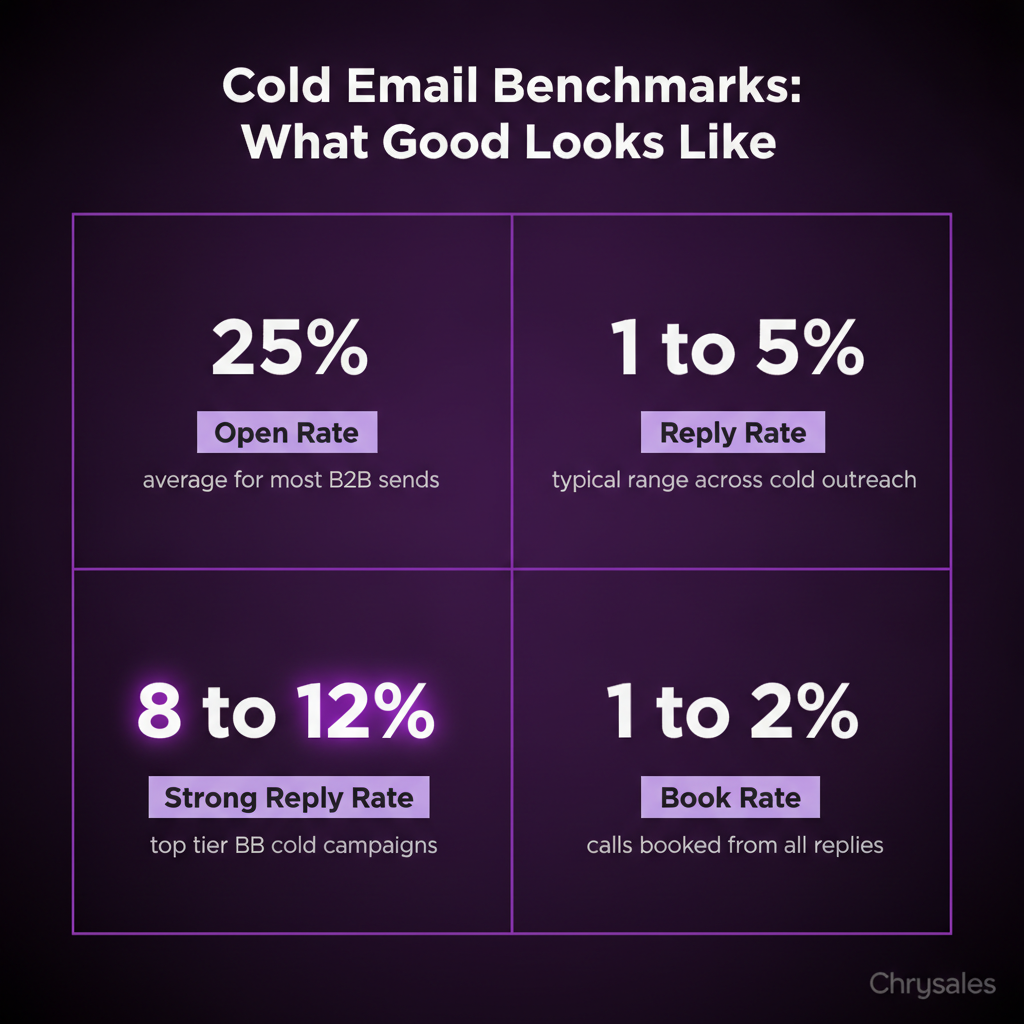
Here's what the data shows across thousands of cold email campaigns. These numbers come from studies tracking millions of emails sent by B2B companies, consulting firms, and marketing agencies.
Industry Benchmarks
- Open rate: 20-30% is average. 35-50% is strong. Above 50% either means you nailed it or your list is tiny and hyper-targeted.
- Reply rate: 1-5% is average. 8-12% is good. Anything above 15% usually means your list is small, super warm, or you're solving a massive pain point.
- Conversion rate: 0.5-2% is typical. 3-5% is excellent.
Pro Tip: A 50-person tech company with a focused niche can hit 10% reply rates by targeting a very specific problem. A 200-person consulting firm going broad might only hit 2%.
What Affects Your Cold Email Response Rate
Your numbers depend on four things:
- List quality. If your list is full of wrong contacts, old email addresses, or people who aren't decision-makers, your reply rate tanks. Most cold emails flop because the list is bad, not the words.
- Personalization. Emails that mention something specific about the recipient's company or role get 2x to 3x better response rates. Generic emails get ignored.
- Timing. Emails sent Tuesday through Thursday between 8 AM and 10 AM in the recipient's timezone perform better. Emails sent Friday afternoon or Monday morning get buried.
- Follow-up cadence. Most replies come after the second or third email, not the first. A single email gets you half the results of a five-email sequence.
Watch out: Sending too many follow-ups (more than five in two weeks) destroys your sender reputation and gets you marked as spam.
Why Your Cold Email Response Rate Is Low
If your reply rate is under 2%, something is broken. Here are the most common reasons.
Your List Is Full of the Wrong People
A bad list kills everything. If you're emailing marketing managers when you need to talk to VPs of Sales, your cold email effectiveness will always be trash. If half your contacts are outdated or wrong, no subject line will save you.
Think of your sales pipeline like a contact list on your phone. If half the numbers don't work, no message gets through. Same thing here.
Your Subject Line Is Boring
Your subject line is the gatekeeper. If it's generic ("Quick question" or "Following up"), it gets skipped. If it's too salesy ("Increase your revenue by 300%!"), it gets deleted.
Good subject lines are specific, short, and make the reader curious. Examples:
- "Saw your post on LinkedIn about hiring"
- "Quick thought on your Q4 pipeline"
- "15-person teams like yours usually face this issue"
Your Email Is About You, Not Them
Most cold emails are disguised sales pitches. "We help companies like yours do XYZ." Nobody cares. The reader wants to know what's in it for them, fast.
Flip it. Instead of "We help B2B companies build sales systems," try "Most 30-person consulting firms waste three months hiring salespeople who quit in 60 days. Here's what the ones who don't do differently."
Common mistake: Writing a five-paragraph email explaining your entire service. Keep it under 100 words. If they're interested, they'll ask for more.
You're Not Following Up
80% of replies come after the first email. If you send one email and stop, you're leaving most of your results on the table.
A good cold outreach sequence has four to five emails spread over 10 to 14 days. Each follow-up should add value, not just say "checking in." Share a case study, a quick tip, or a new angle on their problem.
How to Improve Cold Email Response Rates (Step by Step)

Let's get practical. Here's how to move from a 2% reply rate to 8% or higher.
Step 1: Build a Clean, Targeted List
Start with a narrow list of people who actually match your ideal customer profile. If you sell to marketing agencies with 20 to 50 employees, don't include solo freelancers or 500-person firms. The tighter your list, the higher your cold email response rate.
Use tools to verify email addresses before you send. A 10% bounce rate tanks your sender reputation and kills future campaigns.
Pro Tip: A list of 200 perfect-fit contacts will outperform a list of 2,000 random ones every time.
Step 2: Personalize the First Line
You don't need to personalize the whole email. Just the first line. Mention something specific: a recent LinkedIn post, a company milestone, a mutual connection, or a challenge their industry is facing.
Example: "Saw your team just raised a Series A. Congrats. Most companies at that stage struggle with outbound lead gen while scaling. Here's what worked for a similar fintech we worked with."
This takes 30 seconds per email if you're doing it manually, or you can use AI to pull personalization data at scale. To make this work for B2B lead generation, you need to extract prospect company domain from sales call artifact to enrich your list with accurate company data.
Step 3: Write a Clear, Short Email
Your email should answer three questions in under 100 words:
- Why am I reaching out to you specifically?
- What's in it for you?
- What's the next step?
For a deeper dive into structuring short, value-packed outreach that boosts both open and reply rates, see our guide on how to write cold emails that get replies.
Here's a template:
"Hi [Name], Saw [specific detail about them or their company]. Most [type of company] we talk to struggle with [specific problem]. We helped a [similar company] go from [bad state] to [good state] in [timeframe]. Worth a 15-minute call to see if we can do the same for you? [Your Name]"
That's it. No fluff. No company history. Just value and a clear ask.
Step 4: Send a Follow-Up Sequence
Your sequence should look like this:
- Email 1: Intro and value prop (Day 1)
- Email 2: Add a case study or stat (Day 3)
- Email 3: Share a free resource or quick tip (Day 6)
- Email 4: Different angle or new insight (Day 9)
- Email 5: Breakup email ("Guessing this isn't a priority. Let me know if things change.") (Day 12)
Breakup emails often get the best response rates because they create urgency and feel human. If you struggle to write multiple touchpoints that still add value, swipe proven cold email follow-up templates and adapt them to your market.
Step 5: Track and Test Everything
If you're not tracking open rates, reply rates, and conversions by campaign, you're flying blind. Set up a simple spreadsheet or use a CRM to log:
- What list you sent to
- What subject line you used
- What the reply rate was
- What changed between versions
Test one thing at a time. Change the subject line, keep the body the same. Change the CTA, keep the intro the same. Small tweaks compound over time.
AI and Cold Email Personalization at Scale
Here's where it gets interesting. Most teams think they have to choose between personalized emails and volume. You used to. Not anymore.
AI tools can now pull company data, recent news, LinkedIn activity, and pain points, then write a personalized first line for every contact on your list. This isn't generic mail merge. It's real cold email personalization powered by AI sales prospecting tools.
At Chrysales, we build AI-powered workflows using tools like Gemini to score leads, pull personalization data, and even draft first-line intros. A 40-person marketing agency we worked with went from 2% to 9% reply rates in one quarter by layering AI personalization into their B2B cold outreach.
One key step in this process is to extract prospect company domain from sales call artifact, which feeds accurate domain data into your GTM stack for better client acquisition.
How to Use AI Without Sounding Like a Robot
The key is feeding the AI good inputs. Instead of "write a cold email," try:
"Write a one-sentence intro for a cold email to [Name], who is the VP of Sales at a 30-person SaaS company. Mention their recent LinkedIn post about hiring challenges and connect it to our service, which helps B2B teams hire and train elite closers."
The output won't be perfect, but it's 80% of the way there. You tweak the last 20%.
This approach works for lists of 500+ contacts. As your reply rates improve, you can operationalize everything by learning how to send cold emails at scale with the right tools and data infrastructure.
Common Cold Email Mistakes That Kill Response Rates
Even teams with good systems make these errors. Avoid them and your cold email success rate jumps.
Mistake 1: Sending From a No-Reply Email
If your email comes from noreply@yourcompany.com, you look like spam. Send from a real person's email. Better yet, send from the person who will take the call if they reply.
Mistake 2: Using a Terrible Subject Line
Subject lines like "Checking in" or "Quick question" are dead on arrival. Be specific. Mention their company, their role, or a result.
Mistake 3: Not Segmenting Your List
A one-size-fits-all email gets one-size-fits-all results. Segment by industry, company size, role, or pain point. A 15-person consulting firm has different problems than a 100-person tech company. Your email should reflect that.
Mistake 4: Asking for Too Much Too Soon
Don't ask for a 60-minute strategy call in your first email. Ask for 15 minutes. Lower the barrier. Once they say yes, you can add value and expand from there.
Common mistake: Sending a cold email with a 10-question survey attached. Nobody fills that out.
What to Do After You Get a Reply
Getting replies is half the battle. Turning those replies into booked calls and closed deals is the other half.
When someone replies, respond fast. Within an hour if possible. The longer you wait, the colder the lead gets.
Your reply should:
- Acknowledge what they said
- Offer a time to talk (use a calendar link)
- Set an expectation for what the call will cover
Example: "Thanks for the reply! Here's my calendar: [link]. Let's do 15 minutes Tuesday or Wednesday. I'll walk you through what worked for [similar company] and we can see if it's a fit for you."
Short. Clear. Low pressure.
If they reply but aren't ready to book, don't ghost them. Add them to a nurture sequence. Send value every two weeks. A case study, a blog post, a quick insight. Stay on their radar until timing improves. If you're deciding where to invest your next outbound experiment, watch this breakdown of cold email vs cold calling: which works faster for B2B pipeline to see how response rates, speed to meeting, and deal quality compare.
Frequently Asked Questions
Q: What is a good cold email response rate in 2025?
A good cold email response rate in 2025 is between 8% and 12% for targeted B2B outreach. If you're hitting 5% to 7%, you're above average but there's room to improve with better personalization and list quality. Anything below 2% means your list, offer, or messaging needs major work. Keep in mind that highly targeted campaigns to small, niche audiences can hit 15% or higher, while broad campaigns to large lists rarely break 5%.
Q: How many follow-up emails should I send to improve response rates?
Send four to five follow-up emails over 10 to 14 days. Most replies come after the second or third email, not the first. Each follow-up should add new value like a case study, a quick tip, or a different angle on their problem. Don't just say "checking in." Your fifth email should be a breakup email, something like "Guessing this isn't a priority right now. Let me know if things change." Breakup emails often get strong responses because they create urgency.
Q: Can AI really improve cold email personalization and response rates?
Yes, but only if you use it right. AI tools can pull company data, recent news, and LinkedIn activity to write personalized first lines at scale. This can double or triple your reply rates compared to generic emails. At Chrysales, we've seen clients go from 2% to 9% response rates using AI-powered cold email personalization. The key is feeding the AI good inputs and editing the output so it doesn't sound robotic. AI speeds up the process but can't fix a bad list or weak offer. To scale this in b2b sales, teams must extract prospect company domain from sales call artifact to ensure accurate targeting.
Q: What's the difference between open rate and reply rate in cold emails?
Open rate is the percentage of people who open your email. Reply rate is the percentage who respond. Open rate measures subject line strength and deliverability. Reply rate measures whether your message resonates and prompts action. A high open rate with a low reply rate means people are curious enough to open but not interested enough to respond. Focus on reply rate, it's the metric that actually fills your pipeline. Once your benchmarks are dialed in, you can layer on more advanced cold email strategies for B2B lead generation to scale results without sacrificing quality.
Q: How do I know if my cold email list quality is the problem?
If your bounce rate is above 5%, your list has old or wrong email addresses. If your open rate is below 15%, your list might be hitting spam folders or your sender reputation is damaged. If your reply rate is under 2% but your open rate is decent, your list probably includes people who aren't the right buyers or don't have the pain point you're solving. Test a smaller, hyper-targeted segment of 50 perfect-fit contacts. If that performs better, your main list is too broad or poorly researched. For better lead generation, ensure you extract prospect company domain from sales call artifact to validate your contacts. Cold email works best as one part of a broader engine, so learn how to build a sales system so powerful clients come to you to see where outbound fits in your overall pipeline design.
A good cold email response rate is the percentage of recipients who reply to your outreach, typically ranging from 1% to 5% on average and 8% to 12% for strong B2B campaigns. It measures whether your message resonates and drives action, not just whether people open your email.
Most cold email campaigns get ignored. Not because the writing is bad, but because the list is terrible, the timing is off, and the person sending it doesn't know what a good cold email response rate even looks like. Picture this: you spend a week crafting the perfect cold email, hit send to 500 people, and get three replies. Two are out-of-office messages. One is someone asking to unsubscribe. That's not a sales problem. That's a system problem. Understanding cold email response rates, what good looks like, and how to actually improve them is the difference between throwing darts in the dark and building a repeatable B2B lead generation engine.
What Cold Email Response Rates Actually Mean
Let's clear something up first. When people talk about cold email response rates, they're usually mixing up three different metrics: open rate, reply rate, and conversion rate. These are not the same thing.
Open rate is the percentage of people who open your email. The average cold email open rate sits somewhere between 20% and 30%. If you're below 15%, your subject line is probably weak or your sender reputation is shot.
Reply rate is what most people care about. This is the percentage of people who actually respond to your email, whether it's a yes, a no, or a "tell me more." The average cold email response rate is between 1% and 5%. If you're hitting 8% or higher, you're doing something right.
Conversion rate is the percentage of people who take the action you want, like booking a call or signing a contract. This is usually the smallest number of the three.
Common mistake: Celebrating a high open rate when your reply rate is garbage. Opens mean nothing if nobody talks back.
Why Most Teams Get These Numbers Wrong
Most sales teams don't track these numbers properly. They send emails from five different tools, don't tag campaigns consistently, and then wonder why they can't figure out what's working. Without clean data, you're just guessing.
The other issue is confusing "good" with "average." A 3% reply rate might be average, but average doesn't fill your pipeline. If you're running B2B cold outreach and you need 20 new qualified leads a month, a 3% reply rate on a list of 300 contacts only gets you 9 responses. And not all of those are qualified.
Cold Email Benchmarks: What Good Actually Looks Like
Here's what the data shows across thousands of cold email campaigns. These numbers come from studies tracking millions of emails sent by B2B companies, consulting firms, and marketing agencies.
Industry Benchmarks
- Open rate: 20-30% is average. 35-50% is strong. Above 50% either means you nailed it or your list is tiny and hyper-targeted.
- Reply rate: 1-5% is average. 8-12% is good. Anything above 15% usually means your list is small, super warm, or you're solving a massive pain point.
- Conversion rate: 0.5-2% is typical. 3-5% is excellent.
Pro Tip: A 50-person tech company with a focused niche can hit 10% reply rates by targeting a very specific problem. A 200-person consulting firm going broad might only hit 2%.
What Affects Your Cold Email Response Rate
Your numbers depend on four things:
- List quality. If your list is full of wrong contacts, old email addresses, or people who aren't decision-makers, your reply rate tanks. Most cold emails flop because the list is bad, not the words.
- Personalization. Emails that mention something specific about the recipient's company or role get 2x to 3x better response rates. Generic emails get ignored.
- Timing. Emails sent Tuesday through Thursday between 8 AM and 10 AM in the recipient's timezone perform better. Emails sent Friday afternoon or Monday morning get buried.
- Follow-up cadence. Most replies come after the second or third email, not the first. A single email gets you half the results of a five-email sequence.
Watch out: Sending too many follow-ups (more than five in two weeks) destroys your sender reputation and gets you marked as spam.
Why Your Cold Email Response Rate Is Low
If your reply rate is under 2%, something is broken. Here are the most common reasons.
Your List Is Full of the Wrong People
A bad list kills everything. If you're emailing marketing managers when you need to talk to VPs of Sales, your cold email effectiveness will always be trash. If half your contacts are outdated or wrong, no subject line will save you.
Think of your sales pipeline like a contact list on your phone. If half the numbers don't work, no message gets through. Same thing here.
Your Subject Line Is Boring
Your subject line is the gatekeeper. If it's generic ("Quick question" or "Following up"), it gets skipped. If it's too salesy ("Increase your revenue by 300%!"), it gets deleted.
Good subject lines are specific, short, and make the reader curious. Examples:
- "Saw your post on LinkedIn about hiring"
- "Quick thought on your Q4 pipeline"
- "15-person teams like yours usually face this issue"
Your Email Is About You, Not Them
Most cold emails are disguised sales pitches. "We help companies like yours do XYZ." Nobody cares. The reader wants to know what's in it for them, fast.
Flip it. Instead of "We help B2B companies build sales systems," try "Most 30-person consulting firms waste three months hiring salespeople who quit in 60 days. Here's what the ones who don't do differently."
Common mistake: Writing a five-paragraph email explaining your entire service. Keep it under 100 words. If they're interested, they'll ask for more.
You're Not Following Up
80% of replies come after the first email. If you send one email and stop, you're leaving most of your results on the table.
A good cold outreach sequence has four to five emails spread over 10 to 14 days. Each follow-up should add value, not just say "checking in." Share a case study, a quick tip, or a new angle on their problem.
How to Improve Cold Email Response Rates (Step by Step)
Let's get practical. Here's how to move from a 2% reply rate to 8% or higher.
Step 1: Build a Clean, Targeted List
Start with a narrow list of people who actually match your ideal customer profile. If you sell to marketing agencies with 20 to 50 employees, don't include solo freelancers or 500-person firms. The tighter your list, the higher your cold email response rate.
Use tools to verify email addresses before you send. A 10% bounce rate tanks your sender reputation and kills future campaigns.
Pro Tip: A list of 200 perfect-fit contacts will outperform a list of 2,000 random ones every time.
Step 2: Personalize the First Line
You don't need to personalize the whole email. Just the first line. Mention something specific: a recent LinkedIn post, a company milestone, a mutual connection, or a challenge their industry is facing.
Example: "Saw your team just raised a Series A. Congrats. Most companies at that stage struggle with outbound lead gen while scaling. Here's what worked for a similar fintech we worked with."
This takes 30 seconds per email if you're doing it manually, or you can use AI to pull personalization data at scale. To make this work for B2B lead generation, you need to extract prospect company domain from sales call artifact to enrich your list with accurate company data.
Step 3: Write a Clear, Short Email
Your email should answer three questions in under 100 words:
- Why am I reaching out to you specifically?
- What's in it for you?
- What's the next step?
For a deeper dive into structuring short, value-packed outreach that boosts both open and reply rates, see our guide on how to write cold emails that get replies.
Here's a template:
"Hi [Name], Saw [specific detail about them or their company]. Most [type of company] we talk to struggle with [specific problem]. We helped a [similar company] go from [bad state] to [good state] in [timeframe]. Worth a 15-minute call to see if we can do the same for you? [Your Name]"
That's it. No fluff. No company history. Just value and a clear ask.
Step 4: Send a Follow-Up Sequence
Your sequence should look like this:
- Email 1: Intro and value prop (Day 1)
- Email 2: Add a case study or stat (Day 3)
- Email 3: Share a free resource or quick tip (Day 6)
- Email 4: Different angle or new insight (Day 9)
- Email 5: Breakup email ("Guessing this isn't a priority. Let me know if things change.") (Day 12)
Breakup emails often get the best response rates because they create urgency and feel human. If you struggle to write multiple touchpoints that still add value, swipe proven cold email follow-up templates and adapt them to your market.
Step 5: Track and Test Everything
If you're not tracking open rates, reply rates, and conversions by campaign, you're flying blind. Set up a simple spreadsheet or use a CRM to log:
- What list you sent to
- What subject line you used
- What the reply rate was
- What changed between versions
Test one thing at a time. Change the subject line, keep the body the same. Change the CTA, keep the intro the same. Small tweaks compound over time.
AI and Cold Email Personalization at Scale
Here's where it gets interesting. Most teams think they have to choose between personalized emails and volume. You used to. Not anymore.
AI tools can now pull company data, recent news, LinkedIn activity, and pain points, then write a personalized first line for every contact on your list. This isn't generic mail merge. It's real cold email personalization powered by AI sales prospecting tools.
At Chrysales, we build AI-powered workflows using tools like Gemini to score leads, pull personalization data, and even draft first-line intros. A 40-person marketing agency we worked with went from 2% to 9% reply rates in one quarter by layering AI personalization into their B2B cold outreach.
One key step in this process is to extract prospect company domain from sales call artifact, which feeds accurate domain data into your GTM stack for better client acquisition.
How to Use AI Without Sounding Like a Robot
The key is feeding the AI good inputs. Instead of "write a cold email," try:
"Write a one-sentence intro for a cold email to [Name], who is the VP of Sales at a 30-person SaaS company. Mention their recent LinkedIn post about hiring challenges and connect it to our service, which helps B2B teams hire and train elite closers."
The output won't be perfect, but it's 80% of the way there. You tweak the last 20%.
This approach works for lists of 500+ contacts. As your reply rates improve, you can operationalize everything by learning how to send cold emails at scale with the right tools and data infrastructure.
Common Cold Email Mistakes That Kill Response Rates
Even teams with good systems make these errors. Avoid them and your cold email success rate jumps.
Mistake 1: Sending From a No-Reply Email
If your email comes from noreply@yourcompany.com, you look like spam. Send from a real person's email. Better yet, send from the person who will take the call if they reply.
Mistake 2: Using a Terrible Subject Line
Subject lines like "Checking in" or "Quick question" are dead on arrival. Be specific. Mention their company, their role, or a result.
Mistake 3: Not Segmenting Your List
A one-size-fits-all email gets one-size-fits-all results. Segment by industry, company size, role, or pain point. A 15-person consulting firm has different problems than a 100-person tech company. Your email should reflect that.
Mistake 4: Asking for Too Much Too Soon
Don't ask for a 60-minute strategy call in your first email. Ask for 15 minutes. Lower the barrier. Once they say yes, you can add value and expand from there.
Common mistake: Sending a cold email with a 10-question survey attached. Nobody fills that out.
What to Do After You Get a Reply
Getting replies is half the battle. Turning those replies into booked calls and closed deals is the other half.
When someone replies, respond fast. Within an hour if possible. The longer you wait, the colder the lead gets.
Your reply should:
- Acknowledge what they said
- Offer a time to talk (use a calendar link)
- Set an expectation for what the call will cover
Example: "Thanks for the reply! Here's my calendar: [link]. Let's do 15 minutes Tuesday or Wednesday. I'll walk you through what worked for [similar company] and we can see if it's a fit for you."
Short. Clear. Low pressure.
If they reply but aren't ready to book, don't ghost them. Add them to a nurture sequence. Send value every two weeks. A case study, a blog post, a quick insight. Stay on their radar until timing improves. If you're deciding where to invest your next outbound experiment, watch this breakdown of cold email vs cold calling: which works faster for B2B pipeline to see how response rates, speed to meeting, and deal quality compare.
Frequently Asked Questions
Q: What is a good cold email response rate in 2025?
A good cold email response rate in 2025 is between 8% and 12% for targeted B2B outreach. If you're hitting 5% to 7%, you're above average but there's room to improve with better personalization and list quality. Anything below 2% means your list, offer, or messaging needs major work. Keep in mind that highly targeted campaigns to small, niche audiences can hit 15% or higher, while broad campaigns to large lists rarely break 5%.
Q: How many follow-up emails should I send to improve response rates?
Send four to five follow-up emails over 10 to 14 days. Most replies come after the second or third email, not the first. Each follow-up should add new value like a case study, a quick tip, or a different angle on their problem. Don't just say "checking in." Your fifth email should be a breakup email, something like "Guessing this isn't a priority right now. Let me know if things change." Breakup emails often get strong responses because they create urgency.
Q: Can AI really improve cold email personalization and response rates?
Yes, but only if you use it right. AI tools can pull company data, recent news, and LinkedIn activity to write personalized first lines at scale. This can double or triple your reply rates compared to generic emails. At Chrysales, we've seen clients go from 2% to 9% response rates using AI-powered cold email personalization. The key is feeding the AI good inputs and editing the output so it doesn't sound robotic. AI speeds up the process but can't fix a bad list or weak offer. To scale this in b2b sales, teams must extract prospect company domain from sales call artifact to ensure accurate targeting.
Q: What's the difference between open rate and reply rate in cold emails?
Open rate is the percentage of people who open your email. Reply rate is the percentage who respond. Open rate measures subject line strength and deliverability. Reply rate measures whether your message resonates and prompts action. A high open rate with a low reply rate means people are curious enough to open but not interested enough to respond. Focus on reply rate, it's the metric that actually fills your pipeline. Once your benchmarks are dialed in, you can layer on more advanced cold email strategies for B2B lead generation to scale results without sacrificing quality.
Q: How do I know if my cold email list quality is the problem?
If your bounce rate is above 5%, your list has old or wrong email addresses. If your open rate is below 15%, your list might be hitting spam folders or your sender reputation is damaged. If your reply rate is under 2% but your open rate is decent, your list probably includes people who aren't the right buyers or don't have the pain point you're solving. Test a smaller, hyper-targeted segment of 50 perfect-fit contacts. If that performs better, your main list is too broad or poorly researched. For better lead generation, ensure you extract prospect company domain from sales call artifact to validate your contacts. Cold email works best as one part of a broader engine, so learn how to build a sales system so powerful clients come to you to see where outbound fits in your overall pipeline design.
Scaling Is Not Hard If You Have The Right Systems
If you’re serious about leveling up your scaling game, you need the right system, the right training, and the right team behind you. We're here to give you the exact tools and strategies top entrepreneurs use to dominate.

Discover the latest tips
View All.avif)
Chrysales was formed from the words "chrysalis" the stage where a caterpillar transforms into a butterfly and "sales".
It stands for one thing: sales transformation.Because scaling doesn’t happen by doing more of the same. Scaling only happens when you go through real transformation in your systems, your offer, team and the way you sell.
.avif)


