.avif)
How to Write Cold Emails That Actually Get Replies
How to write cold emails means crafting short, personalized messages that grab attention and prompt replies in b2b sales. It focuses on research, value, and clear next steps to boost response rates from 1% to over 10%.
Most cold emails get ignored. Not because the product is bad or the timing is wrong. They get ignored because the email reads like everyone else's. The average person gets 121 emails a day, and most cold messages sound the same. They start with a vague compliment, drop a feature list, and ask for 15 minutes. No wonder the average cold email reply rate sits around 1% to 3%. That means 97 out of 100 messages you send disappear into the void.
The good news is that learning how to write cold emails that convert is a skill, not luck. When you understand what makes someone stop scrolling and actually respond, your numbers can jump to 8%, 15%, even 25% reply rates. This guide breaks down the exact cold email framework that works in b2b sales today.
Why Most Cold Emails Fail Before Anyone Reads Them
The problem starts before the recipient even opens the message. Cold email subject lines are the first filter. If the subject line is generic, the email dies in the inbox. Lines like "Quick question" or "Thoughts?" or "Following up" get skipped because they offer no reason to care. The same goes for personalization that feels fake. Writing "Hi [First Name], I noticed your company does great work" is not real personalization. It is a mail merge that everyone can spot.
The List Quality Problem
Even a perfect message fails if the list is wrong. Sending cold emails to people who are not a fit, who just switched jobs, or who work at companies going through layoffs wastes time. B2B lead generation starts with a clean, targeted list. A 200-person software company that just announced budget cuts is not a hot lead. A 15-person consulting firm that just raised funding and is hiring might be.
Most teams skip this step and blame the copy when the real issue is the list, which is why it's critical to understand essential sales tips for cold outreach before you even start writing your first message.
The "All About Me" Trap
Most cold outreach emails talk about the sender, not the recipient. They open with "We help companies like yours" or "Our platform enables teams to." The reader does not care what your tool does until they know you understand their problem. Leading with features instead of a pain point is the fastest way to get deleted. B2B cold outreach works when the first two sentences are about the prospect, not about you.
The Anatomy of a Cold Email That Converts
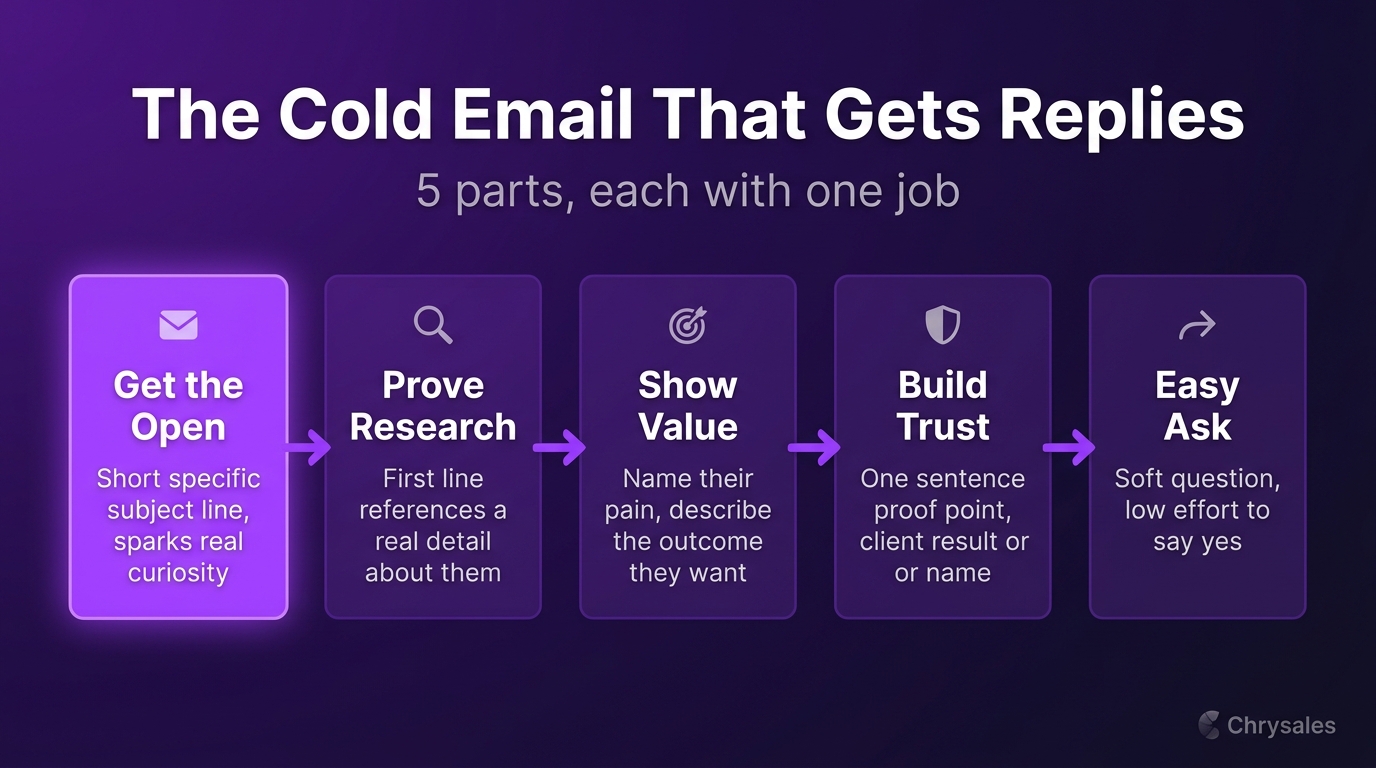
A high-converting cold email has five parts: subject line, opening line, value hook, proof point, and call to action. Each part has one job. The subject line gets the open. The opening line proves you did research. The value hook shows what is in it for them. The proof point builds trust. The cold email call to action makes it easy to say yes. Skip one of these and your reply rate drops.
Craft a Subject Line That Gets Opened
Good cold email subject lines are short, specific, and spark curiosity without being clickbait. Aim for 3 to 7 words. Examples that work: "Quick idea for [Company Name]," "Saw your post on [Topic]," or "[Mutual Connection] suggested I reach out." Avoid all caps, too many emojis, or anything that sounds like spam. Test subject lines by asking yourself: would I open this if I got 100 emails today?
Open With Real Personalization
The first sentence should prove you know something about them. Reference a recent hire, a product launch, a blog post they wrote, or a problem their industry faces right now. For example: "Saw your team just opened an office in Austin" or "Read your post on client retention, the churn metrics you shared were eye-opening." This is cold email personalization that actually works. It shows you are not blasting the same message to 1,000 people.
Lead With a Value Hook, Not a Feature List
After the opening line, explain why this matters to them. Do not list what your service does. Describe the outcome they care about. Instead of "We offer sales training for B2B companies," write "Most consulting firms lose 40% of leads because the discovery call structure is broken. We help fix that in two weeks." The value hook ties your solution to a specific pain point. This is where cold email copywriting separates good from great.
Build a Cold Email Framework You Can Repeat
One-off cold emails do not scale. You need a cold email framework that works across different prospects in the same segment. Start by mapping your target segments. A marketing agency with 10 employees has different pain points than a 50-person IT consulting firm. Write one template per segment, then personalize the first two sentences for each recipient.
The Four-Part Template Structure
Here is a simple structure that works for B2B sales prospecting emails:
- Opening line: one personalized sentence based on research
- Problem statement: one sentence naming a pain point they likely face
- Your approach: one sentence explaining how you solve it, with a quick proof point
- Soft call to action: ask a question or suggest a low-friction next step
Keep the total email under 120 words. Long cold emails get skimmed and ignored. Short emails get read and replied to.
Example Cold Email Breakdown
Subject: Quick idea for [Company Name]
Body: "Saw your team is hiring two new account executives this quarter. Most B2B companies struggle to onboard new sales hires fast enough, so ramp time drags to 90 days. We built a custom onboarding system for a 30-person consulting firm that cut ramp time to 30 days and added $200k in pipeline in month two. Worth a quick call to see if something similar would help your team?"
This email is 68 words. It opens with research, names a pain point, drops a proof point, and ends with a soft question. No fluff, no feature list.
How to Write Cold Emails That Convert at Scale
Once you have a working template, the next step is scaling without losing quality. Sending 500 generic emails kills your domain reputation and gets you marked as spam. Sending 50 personalized emails a day is realistic and effective. Use a simple spreadsheet or CRM to track who you email, when you follow up, and what happens. Most B2B lead generation emails need two or three follow-ups before you get a reply.
Automate the Research, Not the Message
Tools like LinkedIn Sales Navigator, Apollo, or Clay can pull data on prospects so you do not spend an hour researching one person. Export a list of companies that match your ideal customer profile, then pull recent news, job changes, or funding announcements. Use that data to personalize the first line of each email. The rest of the email can follow your template. This is how to write cold emails at scale without sounding robotic.
Segment Your Outreach by Pain Point
Not every prospect cares about the same problem. A marketing agency struggling with client acquisition needs a different message than one trying to hire and train closers. Split your list into segments based on the pain point your research uncovers. Write one template per segment. Your reply rate will double compared to sending the same message to everyone.
Pro Tip: Track reply rates by segment. If one segment replies at 12% and another at 3%, focus on the high-performing segment and test a new angle for the low one.
Improve Cold Email Reply Rates With Better Follow-Ups
Most replies come after the second or third email, not the first. But most people give up after one try. A good cold outreach strategy includes a follow-up sequence. Space follow-ups 3 to 5 days apart. Each follow-up should add new value, not just say "bumping this up."
Follow-Up Email Examples
Follow-Up 1 (3 days later): "Hi [Name], circling back on my note from Tuesday. If hiring and onboarding speed is not a priority right now, no worries. But if it is, happy to share the exact system we used with [Company]. Takes 15 minutes."
Follow-Up 2 (5 days later): "Hi [Name], last note on this. Saw [Competitor] just announced a new sales VP. If you are thinking about scaling your team this year, here is a link to a case study we did with a similar company: [link]. Let me know if it is worth a quick call."
Each follow-up references the original email, adds a new angle, and gives an easy out. This keeps you from sounding pushy.
When to Stop Following Up
If someone does not reply after three follow-ups, move on. Some people are not interested, and that is fine. Mark them as "not now" and revisit the list in six months. B2B sales cycles are long, and timing matters. A company that ignored you in January might respond in June when their budget opens up.
Use Proof Points to Build Trust Fast
Cold emails from strangers need credibility. Drop a quick proof point early in the message. This could be a client name, a result, or a relevant case study. For example: "We worked with a 20-person IT consulting firm that added 30 qualified leads a month using this system" or "Past clients include Amazon and Vodafone." Keep it short. One sentence is enough.
The Power of Specific Numbers
Vague claims like "We help companies grow" do not build trust. Specific numbers do. "We helped a marketing agency go from 2 sales calls a week to 15" is stronger than "We help agencies book more calls." Specificity signals that you know what you are talking about. If you have client testimonials, reference one in your follow-up emails.
Common Cold Email Mistakes and How to Avoid Them
Even experienced sales teams make avoidable mistakes when writing cold emails. Here are the biggest ones and how to fix them, and you can also avoid costly mistakes in your outreach by understanding these patterns early.
Mistake 1: Writing About Features, Not Outcomes
Prospects do not buy features. They buy outcomes. Instead of "We provide sales training and custom systems," write "We help B2B companies close 30% more deals in 90 days." Focus on the change they will see, not the process you use.
Mistake 2: Asking for Too Much Too Soon
Do not ask for a 60-minute strategy call in your first email. Start with a low-friction ask: "Worth a 15-minute call?" or "Should I send over a one-page breakdown?" Small commitments are easier to say yes to. Once they reply, you can move to a bigger conversation.
Mistake 3: Ignoring Mobile Formatting
More than half of emails get opened on mobile. If your email is a wall of text, it is unreadable on a phone. Keep paragraphs to 2 or 3 lines. Use line breaks. Write short sentences. Test your emails by sending them to yourself and opening them on your phone.
Mistake 4: No Clear Next Step
Every cold email needs a single, clear call to action. Do not end with "Let me know your thoughts" or "Looking forward to hearing from you." Those are vague. Instead, ask a question: "Does this sound relevant?" or "Want me to send a quick example?" A question is easier to answer than a statement.
Watch out: Sending cold emails without a clear call to action cuts your reply rate in half. Always tell the reader what to do next.
How Cold Email Fits Into a Bigger Sales System
Cold email is one piece of a full client acquisition system. It works best when combined with other channels like LinkedIn outreach, referrals, and warm introductions. A 15-person consulting firm that only relies on cold email will struggle. But a firm that uses cold email to book 5 calls a week, LinkedIn to stay visible, and referrals to close warm leads will build a steady pipeline.
Understanding when to compare cold email vs cold calling strategies helps you prioritize which channel to invest in first, and learning how to integrate cold email with other outreach channels creates a more powerful client acquisition system than relying on any single tactic.
Integrate Cold Email With Your Offer
The best cold emails tie directly to a strong offer. If your offer is confusing or generic, even a great email will not convert. Before you write a single cold message, make sure your positioning is clear. What problem do you solve? Who do you solve it for? Why should they pick you over doing nothing? A no-brainer offer makes cold email 10 times easier. If the reader thinks "This is exactly what I need," your close rate skyrockets.
Track and Improve Over Time
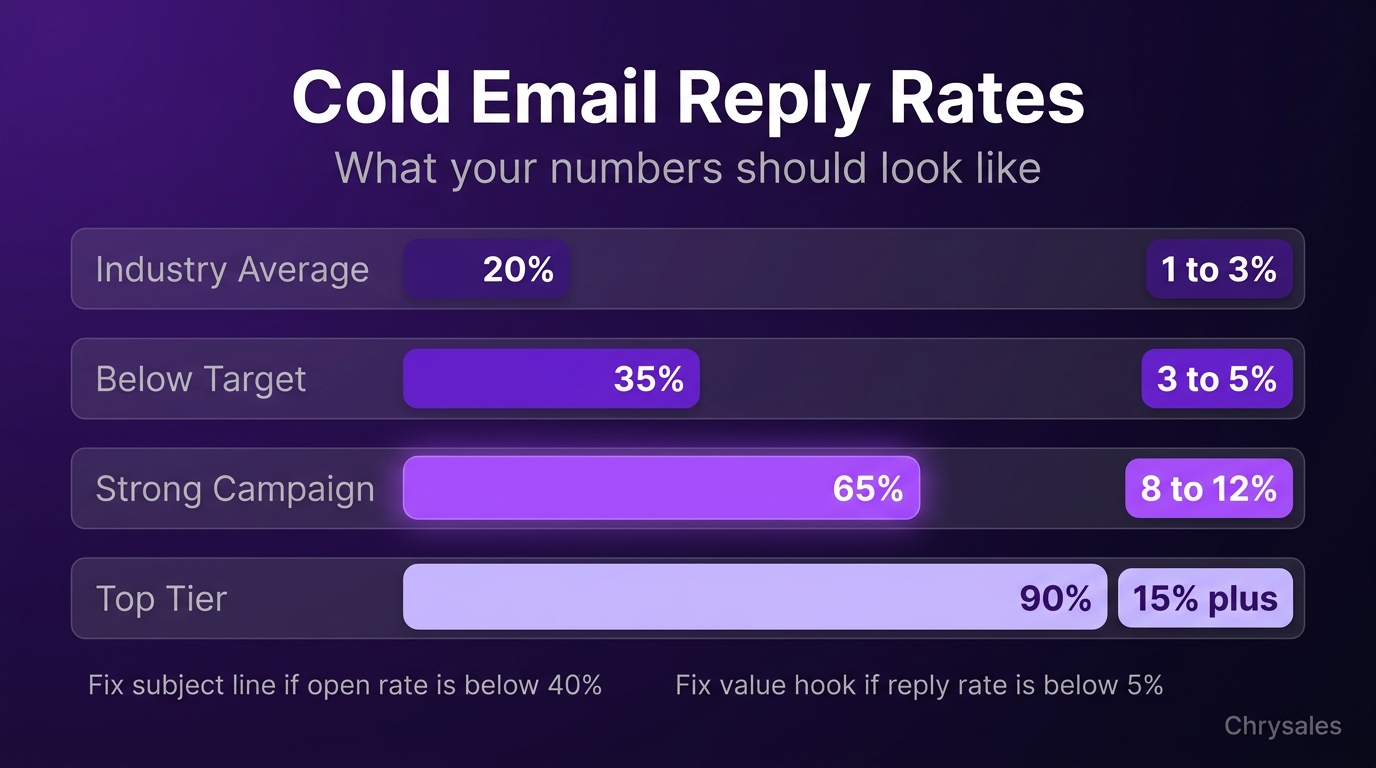
Cold email is not a one-and-done tactic. It is a skill that improves with data. Track open rates, reply rates, and meeting-booked rates for every campaign. If your open rate is below 40%, test new subject lines. If your reply rate is below 5%, rewrite your value hook or tighten your list. Set a simple rule: review your cold email performance every two weeks and make one change. Small tweaks compound into big wins over time, especially when you build a scalable sales system that supports consistent outreach.
Frequently Asked Questions
Q: How long should a cold email be?
Aim for 80 to 120 words. Shorter emails get higher reply rates because they are faster to read. If you need more space, save the detail for a follow-up or a linked resource. The first email should spark interest, not explain everything.
Q: How many follow-ups should I send?
Three follow-ups is the sweet spot. Space them 3 to 5 days apart. Most replies come from follow-up 2 or 3, not the first email. After three tries with no response, move on and revisit the list later.
Q: Should I include links in my first cold email?
Links can hurt deliverability and make your email look spammy. Save links for the second or third email. In the first message, focus on sparking a reply. Once they respond, you can share case studies, calendars, or other resources.
Q: What is a good cold email reply rate?
Industry average is 1% to 3%. A well-targeted, personalized campaign should hit 8% to 12%. If you are seeing 15% or higher, your list and message are very strong. If you are below 5%, revisit your targeting, subject lines, and value hook.
Q: How do I personalize cold emails without spending hours on research?
Use tools to automate data pull: recent funding, job changes, company news, or LinkedIn activity. Spend 2 to 3 minutes per prospect to grab one specific detail, then plug it into your template. Quality beats quantity, but you do not need to write a novel for each person.
Q: Can I use AI to write cold emails?
AI can help generate ideas and speed up drafting, but do not let it write the whole email. AI-generated messages often sound generic. Use AI to outline structure or suggest angles, then rewrite in your own voice. Real cold email personalization still requires human judgment.
Q: What if my cold emails are landing in spam?
Warm up your domain before sending high volumes. Start with 10 to 20 emails a day and slowly increase. Avoid spam trigger words like "free," "guarantee," or "click here." Keep your sender reputation clean by only emailing people who match your target profile. Use a tool like Mail Tester to check your email setup before launching a big campaign.
How to write cold emails means crafting short, personalized messages that grab attention and prompt replies in b2b sales. It focuses on research, value, and clear next steps to boost response rates from 1% to over 10%.
Most cold emails get ignored. Not because the product is bad or the timing is wrong. They get ignored because the email reads like everyone else's. The average person gets 121 emails a day, and most cold messages sound the same. They start with a vague compliment, drop a feature list, and ask for 15 minutes. No wonder the average cold email reply rate sits around 1% to 3%. That means 97 out of 100 messages you send disappear into the void.
The good news is that learning how to write cold emails that convert is a skill, not luck. When you understand what makes someone stop scrolling and actually respond, your numbers can jump to 8%, 15%, even 25% reply rates. This guide breaks down the exact cold email framework that works in b2b sales today.
Why Most Cold Emails Fail Before Anyone Reads Them
The problem starts before the recipient even opens the message. Cold email subject lines are the first filter. If the subject line is generic, the email dies in the inbox. Lines like "Quick question" or "Thoughts?" or "Following up" get skipped because they offer no reason to care. The same goes for personalization that feels fake. Writing "Hi [First Name], I noticed your company does great work" is not real personalization. It is a mail merge that everyone can spot.
The List Quality Problem
Even a perfect message fails if the list is wrong. Sending cold emails to people who are not a fit, who just switched jobs, or who work at companies going through layoffs wastes time. B2B lead generation starts with a clean, targeted list. A 200-person software company that just announced budget cuts is not a hot lead. A 15-person consulting firm that just raised funding and is hiring might be.
Most teams skip this step and blame the copy when the real issue is the list, which is why it's critical to understand essential sales tips for cold outreach before you even start writing your first message.
The "All About Me" Trap
Most cold outreach emails talk about the sender, not the recipient. They open with "We help companies like yours" or "Our platform enables teams to." The reader does not care what your tool does until they know you understand their problem. Leading with features instead of a pain point is the fastest way to get deleted. B2B cold outreach works when the first two sentences are about the prospect, not about you.
The Anatomy of a Cold Email That Converts
A high-converting cold email has five parts: subject line, opening line, value hook, proof point, and call to action. Each part has one job. The subject line gets the open. The opening line proves you did research. The value hook shows what is in it for them. The proof point builds trust. The cold email call to action makes it easy to say yes. Skip one of these and your reply rate drops.
Craft a Subject Line That Gets Opened
Good cold email subject lines are short, specific, and spark curiosity without being clickbait. Aim for 3 to 7 words. Examples that work: "Quick idea for [Company Name]," "Saw your post on [Topic]," or "[Mutual Connection] suggested I reach out." Avoid all caps, too many emojis, or anything that sounds like spam. Test subject lines by asking yourself: would I open this if I got 100 emails today?
Open With Real Personalization
The first sentence should prove you know something about them. Reference a recent hire, a product launch, a blog post they wrote, or a problem their industry faces right now. For example: "Saw your team just opened an office in Austin" or "Read your post on client retention, the churn metrics you shared were eye-opening." This is cold email personalization that actually works. It shows you are not blasting the same message to 1,000 people.
Lead With a Value Hook, Not a Feature List
After the opening line, explain why this matters to them. Do not list what your service does. Describe the outcome they care about. Instead of "We offer sales training for B2B companies," write "Most consulting firms lose 40% of leads because the discovery call structure is broken. We help fix that in two weeks." The value hook ties your solution to a specific pain point. This is where cold email copywriting separates good from great.
Build a Cold Email Framework You Can Repeat
One-off cold emails do not scale. You need a cold email framework that works across different prospects in the same segment. Start by mapping your target segments. A marketing agency with 10 employees has different pain points than a 50-person IT consulting firm. Write one template per segment, then personalize the first two sentences for each recipient.
The Four-Part Template Structure
Here is a simple structure that works for B2B sales prospecting emails:
- Opening line: one personalized sentence based on research
- Problem statement: one sentence naming a pain point they likely face
- Your approach: one sentence explaining how you solve it, with a quick proof point
- Soft call to action: ask a question or suggest a low-friction next step
Keep the total email under 120 words. Long cold emails get skimmed and ignored. Short emails get read and replied to.
Example Cold Email Breakdown
Subject: Quick idea for [Company Name]
Body: "Saw your team is hiring two new account executives this quarter. Most B2B companies struggle to onboard new sales hires fast enough, so ramp time drags to 90 days. We built a custom onboarding system for a 30-person consulting firm that cut ramp time to 30 days and added $200k in pipeline in month two. Worth a quick call to see if something similar would help your team?"
This email is 68 words. It opens with research, names a pain point, drops a proof point, and ends with a soft question. No fluff, no feature list.
How to Write Cold Emails That Convert at Scale
Once you have a working template, the next step is scaling without losing quality. Sending 500 generic emails kills your domain reputation and gets you marked as spam. Sending 50 personalized emails a day is realistic and effective. Use a simple spreadsheet or CRM to track who you email, when you follow up, and what happens. Most B2B lead generation emails need two or three follow-ups before you get a reply.
Automate the Research, Not the Message
Tools like LinkedIn Sales Navigator, Apollo, or Clay can pull data on prospects so you do not spend an hour researching one person. Export a list of companies that match your ideal customer profile, then pull recent news, job changes, or funding announcements. Use that data to personalize the first line of each email. The rest of the email can follow your template. This is how to write cold emails at scale without sounding robotic.
Segment Your Outreach by Pain Point
Not every prospect cares about the same problem. A marketing agency struggling with client acquisition needs a different message than one trying to hire and train closers. Split your list into segments based on the pain point your research uncovers. Write one template per segment. Your reply rate will double compared to sending the same message to everyone.
Pro Tip: Track reply rates by segment. If one segment replies at 12% and another at 3%, focus on the high-performing segment and test a new angle for the low one.
Improve Cold Email Reply Rates With Better Follow-Ups
Most replies come after the second or third email, not the first. But most people give up after one try. A good cold outreach strategy includes a follow-up sequence. Space follow-ups 3 to 5 days apart. Each follow-up should add new value, not just say "bumping this up."
Follow-Up Email Examples
Follow-Up 1 (3 days later): "Hi [Name], circling back on my note from Tuesday. If hiring and onboarding speed is not a priority right now, no worries. But if it is, happy to share the exact system we used with [Company]. Takes 15 minutes."
Follow-Up 2 (5 days later): "Hi [Name], last note on this. Saw [Competitor] just announced a new sales VP. If you are thinking about scaling your team this year, here is a link to a case study we did with a similar company: [link]. Let me know if it is worth a quick call."
Each follow-up references the original email, adds a new angle, and gives an easy out. This keeps you from sounding pushy.
When to Stop Following Up
If someone does not reply after three follow-ups, move on. Some people are not interested, and that is fine. Mark them as "not now" and revisit the list in six months. B2B sales cycles are long, and timing matters. A company that ignored you in January might respond in June when their budget opens up.
Use Proof Points to Build Trust Fast
Cold emails from strangers need credibility. Drop a quick proof point early in the message. This could be a client name, a result, or a relevant case study. For example: "We worked with a 20-person IT consulting firm that added 30 qualified leads a month using this system" or "Past clients include Amazon and Vodafone." Keep it short. One sentence is enough.
The Power of Specific Numbers
Vague claims like "We help companies grow" do not build trust. Specific numbers do. "We helped a marketing agency go from 2 sales calls a week to 15" is stronger than "We help agencies book more calls." Specificity signals that you know what you are talking about. If you have client testimonials, reference one in your follow-up emails.
Common Cold Email Mistakes and How to Avoid Them
Even experienced sales teams make avoidable mistakes when writing cold emails. Here are the biggest ones and how to fix them, and you can also avoid costly mistakes in your outreach by understanding these patterns early.
Mistake 1: Writing About Features, Not Outcomes
Prospects do not buy features. They buy outcomes. Instead of "We provide sales training and custom systems," write "We help B2B companies close 30% more deals in 90 days." Focus on the change they will see, not the process you use.
Mistake 2: Asking for Too Much Too Soon
Do not ask for a 60-minute strategy call in your first email. Start with a low-friction ask: "Worth a 15-minute call?" or "Should I send over a one-page breakdown?" Small commitments are easier to say yes to. Once they reply, you can move to a bigger conversation.
Mistake 3: Ignoring Mobile Formatting
More than half of emails get opened on mobile. If your email is a wall of text, it is unreadable on a phone. Keep paragraphs to 2 or 3 lines. Use line breaks. Write short sentences. Test your emails by sending them to yourself and opening them on your phone.
Mistake 4: No Clear Next Step
Every cold email needs a single, clear call to action. Do not end with "Let me know your thoughts" or "Looking forward to hearing from you." Those are vague. Instead, ask a question: "Does this sound relevant?" or "Want me to send a quick example?" A question is easier to answer than a statement.
Watch out: Sending cold emails without a clear call to action cuts your reply rate in half. Always tell the reader what to do next.
How Cold Email Fits Into a Bigger Sales System
Cold email is one piece of a full client acquisition system. It works best when combined with other channels like LinkedIn outreach, referrals, and warm introductions. A 15-person consulting firm that only relies on cold email will struggle. But a firm that uses cold email to book 5 calls a week, LinkedIn to stay visible, and referrals to close warm leads will build a steady pipeline.
Understanding when to compare cold email vs cold calling strategies helps you prioritize which channel to invest in first, and learning how to integrate cold email with other outreach channels creates a more powerful client acquisition system than relying on any single tactic.
Integrate Cold Email With Your Offer
The best cold emails tie directly to a strong offer. If your offer is confusing or generic, even a great email will not convert. Before you write a single cold message, make sure your positioning is clear. What problem do you solve? Who do you solve it for? Why should they pick you over doing nothing? A no-brainer offer makes cold email 10 times easier. If the reader thinks "This is exactly what I need," your close rate skyrockets.
Track and Improve Over Time
Cold email is not a one-and-done tactic. It is a skill that improves with data. Track open rates, reply rates, and meeting-booked rates for every campaign. If your open rate is below 40%, test new subject lines. If your reply rate is below 5%, rewrite your value hook or tighten your list. Set a simple rule: review your cold email performance every two weeks and make one change. Small tweaks compound into big wins over time, especially when you build a scalable sales system that supports consistent outreach.
Frequently Asked Questions
Q: How long should a cold email be?
Aim for 80 to 120 words. Shorter emails get higher reply rates because they are faster to read. If you need more space, save the detail for a follow-up or a linked resource. The first email should spark interest, not explain everything.
Q: How many follow-ups should I send?
Three follow-ups is the sweet spot. Space them 3 to 5 days apart. Most replies come from follow-up 2 or 3, not the first email. After three tries with no response, move on and revisit the list later.
Q: Should I include links in my first cold email?
Links can hurt deliverability and make your email look spammy. Save links for the second or third email. In the first message, focus on sparking a reply. Once they respond, you can share case studies, calendars, or other resources.
Q: What is a good cold email reply rate?
Industry average is 1% to 3%. A well-targeted, personalized campaign should hit 8% to 12%. If you are seeing 15% or higher, your list and message are very strong. If you are below 5%, revisit your targeting, subject lines, and value hook.
Q: How do I personalize cold emails without spending hours on research?
Use tools to automate data pull: recent funding, job changes, company news, or LinkedIn activity. Spend 2 to 3 minutes per prospect to grab one specific detail, then plug it into your template. Quality beats quantity, but you do not need to write a novel for each person.
Q: Can I use AI to write cold emails?
AI can help generate ideas and speed up drafting, but do not let it write the whole email. AI-generated messages often sound generic. Use AI to outline structure or suggest angles, then rewrite in your own voice. Real cold email personalization still requires human judgment.
Q: What if my cold emails are landing in spam?
Warm up your domain before sending high volumes. Start with 10 to 20 emails a day and slowly increase. Avoid spam trigger words like "free," "guarantee," or "click here." Keep your sender reputation clean by only emailing people who match your target profile. Use a tool like Mail Tester to check your email setup before launching a big campaign.
Scaling Is Not Hard If You Have The Right Systems
If you’re serious about leveling up your scaling game, you need the right system, the right training, and the right team behind you. We're here to give you the exact tools and strategies top entrepreneurs use to dominate.

Discover the latest tips
View All.avif)
Chrysales was formed from the words "chrysalis" the stage where a caterpillar transforms into a butterfly and "sales".
It stands for one thing: sales transformation.Because scaling doesn’t happen by doing more of the same. Scaling only happens when you go through real transformation in your systems, your offer, team and the way you sell.
.avif)


