.avif)
Why Cold Email for B2B Still Works in 2026
Cold email for B2B is a direct outreach method that helps companies start conversations, create lead generation, and support b2b sales. It works best when the list is targeted, the message is clear, and follow-up is consistent.
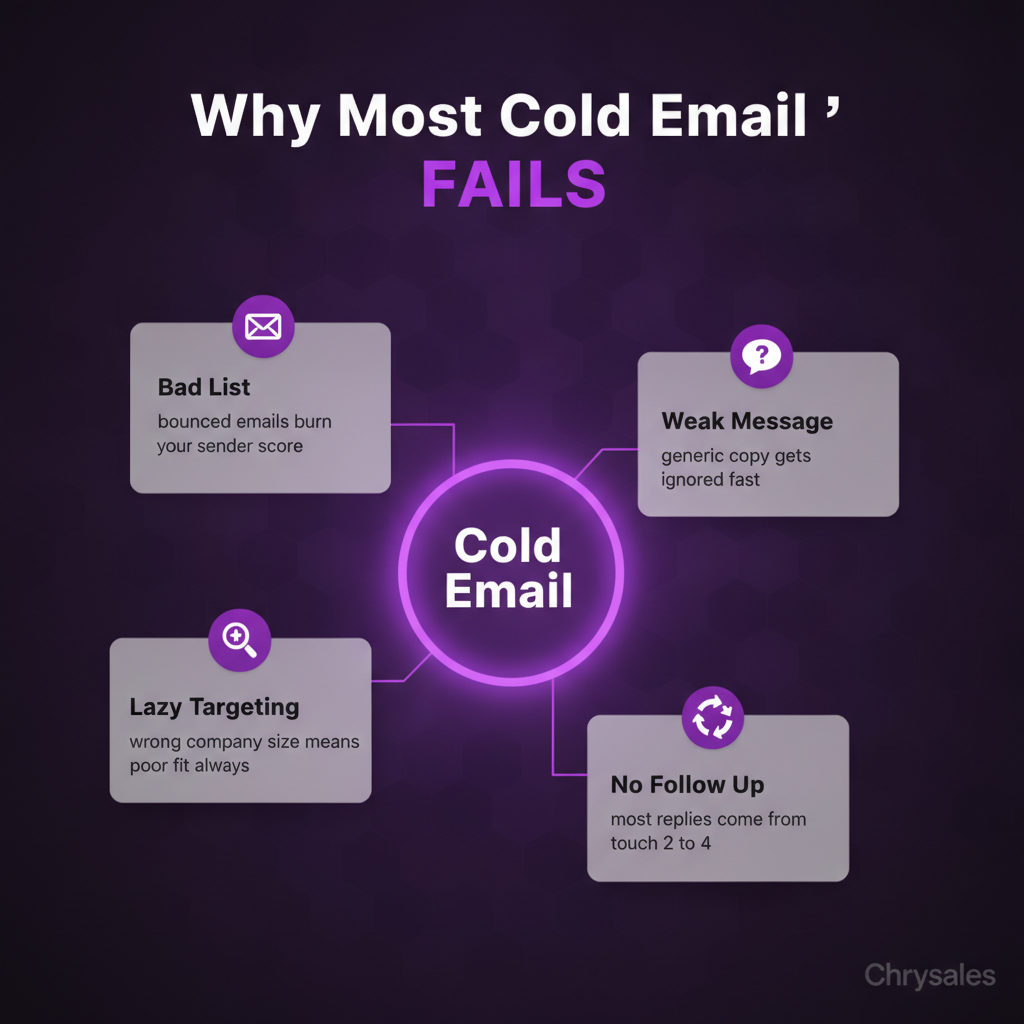
Quick question: when's the last time you opened a cold email from someone you didn't know? If you're like most people, the answer is probably "I can't remember."
Here's the thing: cold email for B2B isn't broken because the channel died. It's broken because most teams are doing it wrong. Bad lists, generic messages, zero follow-up.
The good news? When you fix those three things, cold email still books meetings. We're going to show you exactly how.
Why Cold Email Feels Dead (But Actually Isn't)
Most people think cold email stopped working. The truth is simpler: inbox filters got smarter and lazy outreach got easier. When everyone can blast 10,000 emails with one click, inboxes became war zones. Your message doesn't even get a chance.
But here's where it gets interesting. B2B sales teams that focus on better targeting and smarter systems are still booking 15 to 20 qualified meetings per month from cold outreach. The difference? They're not spraying and praying. They're building a real sales system around their outreach.
The Real Problem: Volume Over Value
Picture this: you spend two weeks writing the perfect cold email template. You tweak every word. You A/B test subject lines. Then you send it to a list of 5,000 contacts you bought online. Reply rate? 0.2%.
Why? Because the list is garbage. Half those emails bounce. The other half are people who don't even match what you sell.
Most cold outreach fails at the list stage, not the message stage. A 200-person company that just did layoffs is not a "hot lead." It's a bad fit, full stop.
Watch out: If your bounce rate is above 5%, your list quality is killing your sender reputation before your message even lands.
What Actually Changed
Spam filters used to look for obvious red flags like "FREE MONEY" in all caps. Now they check engagement patterns. If 90% of people delete your email without opening it, Gmail and Outlook learn fast. Your domain gets flagged. Your next batch of emails goes straight to spam, even if they're good.
This means your B2B lead generation strategy can't rely on one perfect template anymore. You need warmed domains, small daily send volumes, and actual personalization that makes people reply.
The New Cold Email Framework That Books Meetings
Let's get practical. Here's what a working cold outreach strategy looks like in 2026. No theory. Just the steps that actually move the needle.
Step 1: Build a List That Doesn't Suck
Think of your sales pipeline like a phone contact list. If half the numbers don't work, no message gets through. Same with email lists.
Start with these filters:
- Company size matches your ideal client profile (20 to 100 employees, for example)
- Industry or niche you've worked with before
- Recent trigger event: new funding, leadership change, product launch, hiring spree
- Decision-maker title (not just any employee)
A 30-person consulting firm tried this last quarter. They built a list of 300 companies instead of 3,000. Their reply rate jumped from 0.8% to 5.2%. Smaller list, better targeting, more replies.
Pro Tip: Use LinkedIn Sales Navigator or Apollo to find companies that hired someone in the last 60 days. Hiring means growth. Growth means they might need what you sell.
Step 2: Write Emails That Sound Human
Most cold emails sound like a robot trying to sell insurance. Here's a simple fix: read your email out loud. If you wouldn't say it to someone's face, rewrite it.
Keep it under 100 words. One clear point. One easy ask. No attachments (they trigger spam filters). No "just circling back" or "touching base" because those phrases make people's eyes glaze over.
Here's what works:
- Subject line: short, specific, no hype (example: "Quick question about your sales team")
- First line: mention something real about them or their company
- Middle: one sentence about what you do and why it matters to them
- Ask: "Worth a quick call next week?"
That's it. No seven-paragraph life story. No "I hope this email finds you well." If you want a step-by-step breakdown with examples, check out how to write cold emails that get replies.
Step 3: Send From a Warmed Domain
If you've never sent cold emails from your domain before, don't start with 500 emails on day one. Email providers see that as suspicious. Warm up your domain first.
Start by sending 10 to 20 emails per day for two weeks. Gradually increase to 50, then 100. Use a tool like Instantly or Smartlead to automate the warmup process. This builds your sender reputation so your emails actually land in inboxes.
One marketing agency skipped this step and burned their main domain in three days. All their emails, even to existing clients, started landing in spam. Don't be that agency.
Common mistake: Using your main company domain for cold outreach. Set up a secondary domain (like "reachout.yourcompany.com") so if something goes wrong, your primary domain stays clean.
The Follow-Up Sequence Most Teams Skip
Here's the thing nobody tells you: most replies come from follow-ups, not the first email. The first message is just an intro. The follow-ups do the heavy lifting.
What a Real Sequence Looks Like
A proper cold email sequence has four to six touches spread over two to three weeks. Each one adds value or a new angle.
Here's a simple structure:
- Email 1 (Day 1): Intro and value hook
- Email 2 (Day 4): Short case study or result you got for someone like them
- Email 3 (Day 8): Ask if the timing is just off or if they're genuinely not interested
- Email 4 (Day 14): Breakup email ("Should I stop reaching out?")
The breakup email sounds dramatic, but it works. It gets replies because it's honest and gives people an easy out. A lot of people will finally respond just to say "not now" or "maybe in Q2." That's still useful data for your sales training and follow-up calendar.
For ready-to-use templates and exact wording, see our cold email follow-up templates that drive responses.
Automate Without Sounding Robotic
You don't need to manually send every email. Use tools like Lemlist, Instantly, or Smartlead to automate your sequences. But personalize the first line of every email. Mention their LinkedIn post, a recent company announcement, or something specific to their industry.
We worked with a tech company who hired three salespeople in a month. Two quit within 60 days. The fix wasn't more hiring. It was building a repeatable system for client acquisition so the team knew exactly what to do every day. Cold email was part of that system, not the whole thing.
Pro Tip: Set your emails to send during normal business hours in the recipient's time zone. Emails sent at 3 a.m. look automated (because they are) and hurt reply rates.
How to Know If Your Cold Email Actually Works
Most teams send cold emails into the void and hope something happens. That's not a B2B sales strategy. That's gambling.
Here's how to track what's working and what's not.
The Metrics That Matter
Forget vanity metrics like "emails sent." Focus on these:
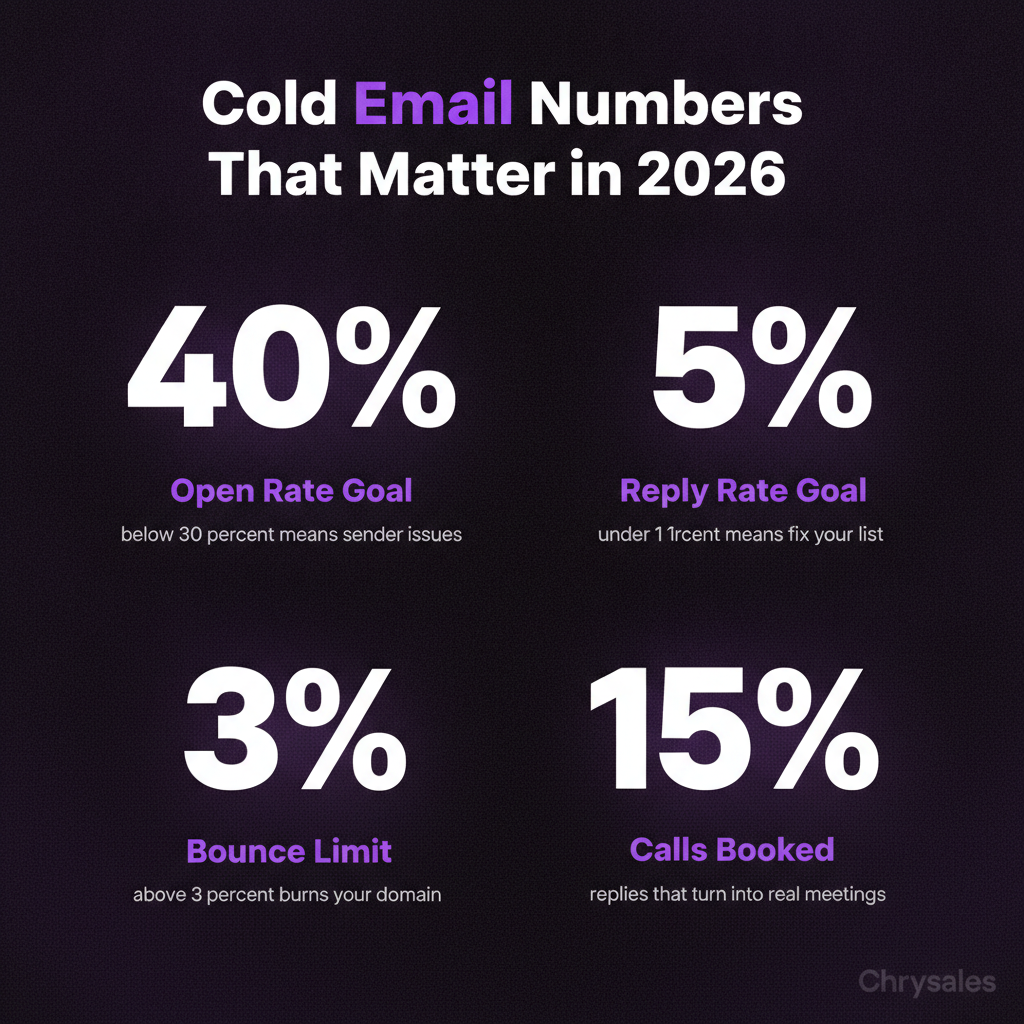
- Open rate: Aim for 40% or higher (below 30% means your subject lines or sender reputation need work)
- Reply rate: 3% to 5% is solid for cold outreach (anything under 1% means your targeting or message is off)
- Bounce rate: Keep it under 3% (higher means bad list quality)
- Meeting booked rate: 10% to 15% of replies should turn into actual calls
If your reply rate is 5% but zero meetings get booked, the problem isn't your email. It's what happens after the reply. That's where objection handling and sales call structure come in.
To see how your numbers stack up against industry standards, review the latest cold email response rates benchmarks.
Track Every Response
Use a simple CRM like HubSpot, Pipedrive, or even a Google Sheet to log every response. Tag replies as "interested," "not now," "not interested," or "out of office."
This helps you see patterns. For example, if 60% of replies say "not now, try me in Q3," that's not a failure. That's a warm lead for later. Add them to a nurture sequence and follow up in two months.
Watch out: Don't ignore "not interested" replies. Read them. If five people say "we already have this handled," maybe your targeting is off. Adjust your list filters.
What to Do Instead of (or Alongside) Cold Email
Cold email for B2B works, but it's not the only channel. The best sales systems combine multiple touchpoints. Think of it like a recipe. One ingredient is fine, but the full dish is better.
LinkedIn Outreach
Send a connection request with a short note. Wait a few days. If they accept, send a message. Keep it casual. Don't pitch in the first message. Just start a conversation.
Pair this with cold email. Send the email, then connect on LinkedIn the next day. This creates a "surround sound" effect where they see your name twice in different places. Reply rates go up 20% to 30% when you combine channels.
You can also watch how multichannel outreach delivers 10x better results than single-channel campaigns for a deeper breakdown of coordinating touchpoints.
Content and Inbound
Not every lead comes from outbound. If you post useful content on LinkedIn or write blogs people actually read, warm leads will reach out to you. This takes longer to build, but the leads are better quality.
One 15-person consulting firm started posting weekly tips on LinkedIn. Within three months, they were getting two to three inbound inquiries per week. They still did cold outreach, but the mix shifted. Less chasing, more choosing.
Referrals and Warm Intros
A warm intro from a mutual connection beats cold email every time. Ask your current clients who else they know that might benefit from what you do. Most people are happy to make an intro if you've done good work for them.
This is part of building a full sales system. Cold email gets you in the door. Good delivery and client success get you referrals. Referrals bring easier closes and higher lifetime value.
According to recent B2B sales trends research, companies that integrate multiple outreach channels see significantly higher conversion rates than those relying on a single method.
How Chrysales Builds Cold Outreach Into Full Sales Systems
Here's where most teams go wrong: they treat cold email as a standalone tactic. They send a bunch of messages, get some replies, book a few calls, and then wonder why nothing scales.
Cold outreach only works long-term when it's part of a bigger system. That means pairing it with a strong offer, a clear sales process, objection scripts, and follow-up sequences. It also means knowing when to automate, when to hire, and when to double down on what's working.
At Chrysales, we've trained over 500 sales teams and helped clients generate more than €10M in revenue. Our 4-step method covers everything from building your offer to hiring elite closers. Cold email is usually step one in lead generation, but it's never the whole picture.
We build custom systems that include cold outreach workflows, AI-based lead scoring (using tools like Gemini), appointment-booking setups, and full sales call structures. We've worked with companies like Amazon, Vodafone, and Deutsche Börse, plus hundreds of smaller B2B companies in tech, consulting, and marketing.
If your cold emails aren't booking meetings, the problem is usually upstream (bad targeting, weak offer) or downstream (no follow-up, bad sales calls). We help you fix the whole chain, not just one piece.
Pro Tip: If you're spending more than two hours per week manually managing cold email, it's time to automate or delegate. Your time is better spent on calls and closing deals.
The Biggest Cold Email Mistakes (And How to Avoid Them)
Let's talk about what kills most cold outreach campaigns. These are the mistakes we see all the time with new clients.
Mistake 1: Pitching Too Early
Your first email is not a sales pitch. It's the start of a conversation. If you try to explain your entire service in the first message, people tune out.
Keep the first email short and focused on one thing: getting a reply. Save the full pitch for the call. The email's only job is to make them curious enough to say yes to a conversation.
Mistake 2: No Clear Call to Action
Don't end your email with "Let me know your thoughts" or "Looking forward to hearing from you." That's vague. People won't reply to vague.
Instead, ask for something specific: "Are you free for a 15-minute call Tuesday or Wednesday?" Give them two options. Make it easy to say yes.
Mistake 3: Ignoring Deliverability
You can write the best email in the world, but if it never reaches the inbox, it doesn't matter. Deliverability is the technical side of cold email, and most teams ignore it until it's too late.
Check your SPF, DKIM, and DMARC records. Use a deliverability tool like GlockApps or MailReach to test your emails before you send them at scale. Keep your daily send volume under 100 emails per inbox.
For comprehensive guidance on technical setup and list quality, review our outbound email marketing best practices.
Common mistake: Sending the same exact email template to everyone. Email providers flag duplicates as spam. Personalize at least the first line so every email is slightly different.
Mistake 4: Giving Up After One Email
One email is not a "campaign." It's a coin flip. Most people don't reply to the first message because they're busy, not because they're not interested.
Follow up. Four to six touches over two to three weeks is the baseline. If someone doesn't reply after six touches, move on. Mark them as "not now" and try again in six months. Don't keep emailing forever. That's just annoying.
If you're wondering whether your approach is too aggressive or too passive, see this comparison of cold email versus cold calling and which drives faster revenue.
Mistake 5: Buying Email Lists
Bought lists are almost always bad quality. Emails bounce. People don't match your target profile. You burn your sender reputation for nothing.
Build your own list using LinkedIn, Apollo, or ZoomInfo. It takes longer, but the quality is 10 times better.
A marketing agency bought a list of 10,000 contacts for $200. They sent one batch and got a 12% bounce rate. Their domain got flagged. They had to start over with a new domain and warm it up from scratch. Don't be that agency.
Industry data from B2B sales statistics analysis shows that companies using verified, self-built lists achieve response rates up to five times higher than those using purchased databases.
Frequently Asked Questions
Q: Is cold email still worth it for B2B companies in 2026?
Yes, but only if you do it right. Cold email for B2B works when you focus on list quality, personalization, and follow-up. Most teams fail because they skip those steps and just blast generic messages. If you build a real system around it, cold email can still book 15 to 20 meetings per month.
Q: How many cold emails should I send per day?
Start with 20 to 30 per day if you're warming up a new domain. Once warmed, you can send 50 to 100 per day per inbox. Don't go higher than that or you risk getting flagged as spam. If you need more volume, set up multiple inboxes with different secondary domains.
Q: What's a good reply rate for cold email?
Aim for 3% to 5% reply rate. Anything above 5% is strong. Below 1% means something is off, either your targeting, your message, or your deliverability. Track your metrics weekly and adjust. Small tweaks can double your reply rate fast.
Q: Should I use AI tools for cold email personalization?
AI tools like ChatGPT or Clay can help you personalize at scale, but don't rely on them 100%. Use AI to draft the first line based on LinkedIn data or recent company news, then read it and make sure it sounds human. AI-generated lines often sound too formal or off-topic. Always review before sending.
Q: How do I get past spam filters and into the inbox?
Warm up your domain before sending high volumes. Keep your bounce rate under 3%. Personalize every email so they're not exact duplicates. Avoid spam trigger words like "free," "guaranteed," or "limited time." Send during normal business hours. Use a secondary domain for cold outreach so your main domain stays clean. Run deliverability tests before you scale.
Cold email for B2B is a direct outreach method that helps companies start conversations, create lead generation, and support b2b sales. It works best when the list is targeted, the message is clear, and follow-up is consistent.
Quick question: when's the last time you opened a cold email from someone you didn't know? If you're like most people, the answer is probably "I can't remember."
Here's the thing: cold email for B2B isn't broken because the channel died. It's broken because most teams are doing it wrong. Bad lists, generic messages, zero follow-up.
The good news? When you fix those three things, cold email still books meetings. We're going to show you exactly how.
Why Cold Email Feels Dead (But Actually Isn't)
Most people think cold email stopped working. The truth is simpler: inbox filters got smarter and lazy outreach got easier. When everyone can blast 10,000 emails with one click, inboxes became war zones. Your message doesn't even get a chance.
But here's where it gets interesting. B2B sales teams that focus on better targeting and smarter systems are still booking 15 to 20 qualified meetings per month from cold outreach. The difference? They're not spraying and praying. They're building a real sales system around their outreach.
The Real Problem: Volume Over Value
Picture this: you spend two weeks writing the perfect cold email template. You tweak every word. You A/B test subject lines. Then you send it to a list of 5,000 contacts you bought online. Reply rate? 0.2%.
Why? Because the list is garbage. Half those emails bounce. The other half are people who don't even match what you sell.
Most cold outreach fails at the list stage, not the message stage. A 200-person company that just did layoffs is not a "hot lead." It's a bad fit, full stop.
Watch out: If your bounce rate is above 5%, your list quality is killing your sender reputation before your message even lands.
What Actually Changed
Spam filters used to look for obvious red flags like "FREE MONEY" in all caps. Now they check engagement patterns. If 90% of people delete your email without opening it, Gmail and Outlook learn fast. Your domain gets flagged. Your next batch of emails goes straight to spam, even if they're good.
This means your B2B lead generation strategy can't rely on one perfect template anymore. You need warmed domains, small daily send volumes, and actual personalization that makes people reply.
The New Cold Email Framework That Books Meetings
Let's get practical. Here's what a working cold outreach strategy looks like in 2026. No theory. Just the steps that actually move the needle.
Step 1: Build a List That Doesn't Suck
Think of your sales pipeline like a phone contact list. If half the numbers don't work, no message gets through. Same with email lists.
Start with these filters:
- Company size matches your ideal client profile (20 to 100 employees, for example)
- Industry or niche you've worked with before
- Recent trigger event: new funding, leadership change, product launch, hiring spree
- Decision-maker title (not just any employee)
A 30-person consulting firm tried this last quarter. They built a list of 300 companies instead of 3,000. Their reply rate jumped from 0.8% to 5.2%. Smaller list, better targeting, more replies.
Pro Tip: Use LinkedIn Sales Navigator or Apollo to find companies that hired someone in the last 60 days. Hiring means growth. Growth means they might need what you sell.
Step 2: Write Emails That Sound Human
Most cold emails sound like a robot trying to sell insurance. Here's a simple fix: read your email out loud. If you wouldn't say it to someone's face, rewrite it.
Keep it under 100 words. One clear point. One easy ask. No attachments (they trigger spam filters). No "just circling back" or "touching base" because those phrases make people's eyes glaze over.
Here's what works:
- Subject line: short, specific, no hype (example: "Quick question about your sales team")
- First line: mention something real about them or their company
- Middle: one sentence about what you do and why it matters to them
- Ask: "Worth a quick call next week?"
That's it. No seven-paragraph life story. No "I hope this email finds you well." If you want a step-by-step breakdown with examples, check out how to write cold emails that get replies.
Step 3: Send From a Warmed Domain
If you've never sent cold emails from your domain before, don't start with 500 emails on day one. Email providers see that as suspicious. Warm up your domain first.
Start by sending 10 to 20 emails per day for two weeks. Gradually increase to 50, then 100. Use a tool like Instantly or Smartlead to automate the warmup process. This builds your sender reputation so your emails actually land in inboxes.
One marketing agency skipped this step and burned their main domain in three days. All their emails, even to existing clients, started landing in spam. Don't be that agency.
Common mistake: Using your main company domain for cold outreach. Set up a secondary domain (like "reachout.yourcompany.com") so if something goes wrong, your primary domain stays clean.
The Follow-Up Sequence Most Teams Skip
Here's the thing nobody tells you: most replies come from follow-ups, not the first email. The first message is just an intro. The follow-ups do the heavy lifting.
What a Real Sequence Looks Like
A proper cold email sequence has four to six touches spread over two to three weeks. Each one adds value or a new angle.
Here's a simple structure:
- Email 1 (Day 1): Intro and value hook
- Email 2 (Day 4): Short case study or result you got for someone like them
- Email 3 (Day 8): Ask if the timing is just off or if they're genuinely not interested
- Email 4 (Day 14): Breakup email ("Should I stop reaching out?")
The breakup email sounds dramatic, but it works. It gets replies because it's honest and gives people an easy out. A lot of people will finally respond just to say "not now" or "maybe in Q2." That's still useful data for your sales training and follow-up calendar.
For ready-to-use templates and exact wording, see our cold email follow-up templates that drive responses.
Automate Without Sounding Robotic
You don't need to manually send every email. Use tools like Lemlist, Instantly, or Smartlead to automate your sequences. But personalize the first line of every email. Mention their LinkedIn post, a recent company announcement, or something specific to their industry.
We worked with a tech company who hired three salespeople in a month. Two quit within 60 days. The fix wasn't more hiring. It was building a repeatable system for client acquisition so the team knew exactly what to do every day. Cold email was part of that system, not the whole thing.
Pro Tip: Set your emails to send during normal business hours in the recipient's time zone. Emails sent at 3 a.m. look automated (because they are) and hurt reply rates.
How to Know If Your Cold Email Actually Works
Most teams send cold emails into the void and hope something happens. That's not a B2B sales strategy. That's gambling.
Here's how to track what's working and what's not.
The Metrics That Matter
Forget vanity metrics like "emails sent." Focus on these:
- Open rate: Aim for 40% or higher (below 30% means your subject lines or sender reputation need work)
- Reply rate: 3% to 5% is solid for cold outreach (anything under 1% means your targeting or message is off)
- Bounce rate: Keep it under 3% (higher means bad list quality)
- Meeting booked rate: 10% to 15% of replies should turn into actual calls
If your reply rate is 5% but zero meetings get booked, the problem isn't your email. It's what happens after the reply. That's where objection handling and sales call structure come in.
To see how your numbers stack up against industry standards, review the latest cold email response rates benchmarks.
Track Every Response
Use a simple CRM like HubSpot, Pipedrive, or even a Google Sheet to log every response. Tag replies as "interested," "not now," "not interested," or "out of office."
This helps you see patterns. For example, if 60% of replies say "not now, try me in Q3," that's not a failure. That's a warm lead for later. Add them to a nurture sequence and follow up in two months.
Watch out: Don't ignore "not interested" replies. Read them. If five people say "we already have this handled," maybe your targeting is off. Adjust your list filters.
What to Do Instead of (or Alongside) Cold Email
Cold email for B2B works, but it's not the only channel. The best sales systems combine multiple touchpoints. Think of it like a recipe. One ingredient is fine, but the full dish is better.
LinkedIn Outreach
Send a connection request with a short note. Wait a few days. If they accept, send a message. Keep it casual. Don't pitch in the first message. Just start a conversation.
Pair this with cold email. Send the email, then connect on LinkedIn the next day. This creates a "surround sound" effect where they see your name twice in different places. Reply rates go up 20% to 30% when you combine channels.
You can also watch how multichannel outreach delivers 10x better results than single-channel campaigns for a deeper breakdown of coordinating touchpoints.
Content and Inbound
Not every lead comes from outbound. If you post useful content on LinkedIn or write blogs people actually read, warm leads will reach out to you. This takes longer to build, but the leads are better quality.
One 15-person consulting firm started posting weekly tips on LinkedIn. Within three months, they were getting two to three inbound inquiries per week. They still did cold outreach, but the mix shifted. Less chasing, more choosing.
Referrals and Warm Intros
A warm intro from a mutual connection beats cold email every time. Ask your current clients who else they know that might benefit from what you do. Most people are happy to make an intro if you've done good work for them.
This is part of building a full sales system. Cold email gets you in the door. Good delivery and client success get you referrals. Referrals bring easier closes and higher lifetime value.
According to recent B2B sales trends research, companies that integrate multiple outreach channels see significantly higher conversion rates than those relying on a single method.
How Chrysales Builds Cold Outreach Into Full Sales Systems
Here's where most teams go wrong: they treat cold email as a standalone tactic. They send a bunch of messages, get some replies, book a few calls, and then wonder why nothing scales.
Cold outreach only works long-term when it's part of a bigger system. That means pairing it with a strong offer, a clear sales process, objection scripts, and follow-up sequences. It also means knowing when to automate, when to hire, and when to double down on what's working.
At Chrysales, we've trained over 500 sales teams and helped clients generate more than €10M in revenue. Our 4-step method covers everything from building your offer to hiring elite closers. Cold email is usually step one in lead generation, but it's never the whole picture.
We build custom systems that include cold outreach workflows, AI-based lead scoring (using tools like Gemini), appointment-booking setups, and full sales call structures. We've worked with companies like Amazon, Vodafone, and Deutsche Börse, plus hundreds of smaller B2B companies in tech, consulting, and marketing.
If your cold emails aren't booking meetings, the problem is usually upstream (bad targeting, weak offer) or downstream (no follow-up, bad sales calls). We help you fix the whole chain, not just one piece.
Pro Tip: If you're spending more than two hours per week manually managing cold email, it's time to automate or delegate. Your time is better spent on calls and closing deals.
The Biggest Cold Email Mistakes (And How to Avoid Them)
Let's talk about what kills most cold outreach campaigns. These are the mistakes we see all the time with new clients.
Mistake 1: Pitching Too Early
Your first email is not a sales pitch. It's the start of a conversation. If you try to explain your entire service in the first message, people tune out.
Keep the first email short and focused on one thing: getting a reply. Save the full pitch for the call. The email's only job is to make them curious enough to say yes to a conversation.
Mistake 2: No Clear Call to Action
Don't end your email with "Let me know your thoughts" or "Looking forward to hearing from you." That's vague. People won't reply to vague.
Instead, ask for something specific: "Are you free for a 15-minute call Tuesday or Wednesday?" Give them two options. Make it easy to say yes.
Mistake 3: Ignoring Deliverability
You can write the best email in the world, but if it never reaches the inbox, it doesn't matter. Deliverability is the technical side of cold email, and most teams ignore it until it's too late.
Check your SPF, DKIM, and DMARC records. Use a deliverability tool like GlockApps or MailReach to test your emails before you send them at scale. Keep your daily send volume under 100 emails per inbox.
For comprehensive guidance on technical setup and list quality, review our outbound email marketing best practices.
Common mistake: Sending the same exact email template to everyone. Email providers flag duplicates as spam. Personalize at least the first line so every email is slightly different.
Mistake 4: Giving Up After One Email
One email is not a "campaign." It's a coin flip. Most people don't reply to the first message because they're busy, not because they're not interested.
Follow up. Four to six touches over two to three weeks is the baseline. If someone doesn't reply after six touches, move on. Mark them as "not now" and try again in six months. Don't keep emailing forever. That's just annoying.
If you're wondering whether your approach is too aggressive or too passive, see this comparison of cold email versus cold calling and which drives faster revenue.
Mistake 5: Buying Email Lists
Bought lists are almost always bad quality. Emails bounce. People don't match your target profile. You burn your sender reputation for nothing.
Build your own list using LinkedIn, Apollo, or ZoomInfo. It takes longer, but the quality is 10 times better.
A marketing agency bought a list of 10,000 contacts for $200. They sent one batch and got a 12% bounce rate. Their domain got flagged. They had to start over with a new domain and warm it up from scratch. Don't be that agency.
Industry data from B2B sales statistics analysis shows that companies using verified, self-built lists achieve response rates up to five times higher than those using purchased databases.
Frequently Asked Questions
Q: Is cold email still worth it for B2B companies in 2026?
Yes, but only if you do it right. Cold email for B2B works when you focus on list quality, personalization, and follow-up. Most teams fail because they skip those steps and just blast generic messages. If you build a real system around it, cold email can still book 15 to 20 meetings per month.
Q: How many cold emails should I send per day?
Start with 20 to 30 per day if you're warming up a new domain. Once warmed, you can send 50 to 100 per day per inbox. Don't go higher than that or you risk getting flagged as spam. If you need more volume, set up multiple inboxes with different secondary domains.
Q: What's a good reply rate for cold email?
Aim for 3% to 5% reply rate. Anything above 5% is strong. Below 1% means something is off, either your targeting, your message, or your deliverability. Track your metrics weekly and adjust. Small tweaks can double your reply rate fast.
Q: Should I use AI tools for cold email personalization?
AI tools like ChatGPT or Clay can help you personalize at scale, but don't rely on them 100%. Use AI to draft the first line based on LinkedIn data or recent company news, then read it and make sure it sounds human. AI-generated lines often sound too formal or off-topic. Always review before sending.
Q: How do I get past spam filters and into the inbox?
Warm up your domain before sending high volumes. Keep your bounce rate under 3%. Personalize every email so they're not exact duplicates. Avoid spam trigger words like "free," "guaranteed," or "limited time." Send during normal business hours. Use a secondary domain for cold outreach so your main domain stays clean. Run deliverability tests before you scale.
Scaling Is Not Hard If You Have The Right Systems
If you’re serious about leveling up your scaling game, you need the right system, the right training, and the right team behind you. We're here to give you the exact tools and strategies top entrepreneurs use to dominate.

Discover the latest tips
View All.avif)
Chrysales was formed from the words "chrysalis" the stage where a caterpillar transforms into a butterfly and "sales".
It stands for one thing: sales transformation.Because scaling doesn’t happen by doing more of the same. Scaling only happens when you go through real transformation in your systems, your offer, team and the way you sell.
.avif)


