.avif)
6 Cold Email Subject Lines Tested: What Actually Won
Cold email subject lines are the short phrases that determine whether a business email gets opened, read, or deleted before the message is seen. Most cold emails don't fail because of what you write in the body. They fail because no one opens them in the first place. We ran a test with six different subject lines across real B2B outreach campaigns to see what actually works. The winner wasn't the cleverest one. It wasn't the most personalized. And it definitely wasn't the one we thought would win.
Why Cold Email Subject Lines Matter More Than You Think
Here's the thing: you can spend hours writing the perfect cold email. Nail the opener, build a great offer, write a killer call to action. But if your subject line is boring, generic, or sounds like spam, none of that matters. The subject line is the gatekeeper.
B2B cold email open rates average around 20 to 25%. The top performers hit 40 to 60%. The difference usually comes down to the first handful of words someone sees in their inbox.
Think of your subject line like the cover of a book. A bad cover gets ignored no matter how good the story is inside. A great cover gets picked up. Same logic.
What Makes Someone Open a Cold Email
People open emails when they recognize the sender or when the subject line triggers curiosity, urgency, or relevance. In cold outreach, they don't know you yet. So you're working with curiosity and relevance only.
Your subject line needs to promise something valuable or make them think "wait, what's this about?" without sounding clickbaity. The sweet spot is specific enough to feel relevant, vague enough to make them curious.
Watch out: Adding "Re:" or "Fwd:" to fake a thread might get opens, but it destroys trust the second they realize it's a trick. Don't do it.
The 6 Cold Email Subject Lines We Tested

We tested these six subject lines across campaigns targeting small sales teams at consulting firms, marketing agencies, and tech companies. Each campaign went to 200 prospects. Same list quality, same time of day, same email body. Only the subject line changed.
Here are the six we tested:
- "Quick question about [Company Name]"
- "[Their Company] + [Your Company]?"
- "Saw your post on LinkedIn"
- "Idea for your Q2 pipeline"
- "15% more demos without more ad spend"
- "[First Name], thoughts?"
We tracked open rates, reply rates, and booked calls for each. The results were not what we expected.
The Open Rate Breakdown
Subject line 5 ("15% more demos without more ad spend") had the highest open rate at 41%. Subject line 4 ("Idea for your Q2 pipeline") came in second at 38%. Subject line 1 ("Quick question about [Company Name]") hit 32%.
The worst performer? Subject line 6 ("[First Name], thoughts?"). It pulled a 14% open rate. Turns out, generic personalization that could apply to anyone doesn't work anymore. Everyone's inbox is full of emails that say their first name and nothing else useful.
Pro Tip: If your only personalization is their name, you're not really personalizing. Reference something specific to them or their company.
The Winner (And Why It Won)
The subject line that booked the most calls wasn't the one with the highest open rate. It was subject line 2: "[Their Company] + [Your Company]?"
This one had a 35% open rate, middle of the pack. But it had a 9% reply rate and booked 11 calls out of 200 emails. That's a 5.5% meeting rate, which crushes the industry average of 1 to 2%.
Why did it win? It set clear expectations. People who opened it knew exactly what the email was about: a potential partnership or collaboration. The ones who weren't interested didn't reply. The ones who were curious replied and asked for more.
Compare that to subject line 5, which had the highest open rate but only booked 4 calls. Lots of people opened it, but most felt misled or uninterested once they read the email. High opens, low conversions.
What This Tells Us About Cold Outreach Subject Lines
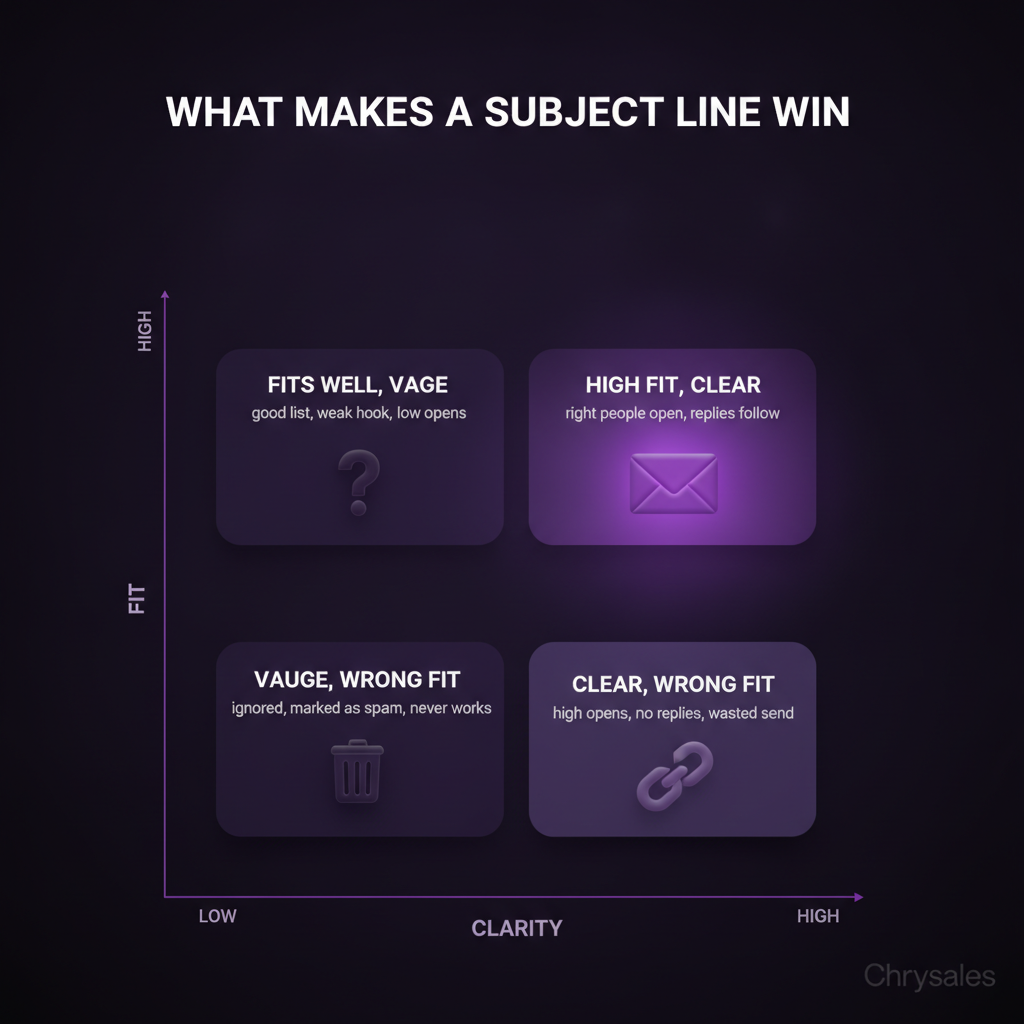
A great subject line doesn't just get opens. It gets the right opens. The people who open and then reply are worth way more than the people who open, skim, and delete.
Subject line 2 worked because it filtered well. It attracted the right people and didn't trick anyone into opening. That's the real goal.
The Lessons: What Actually Works in B2B Cold Email Subject Lines
We pulled four big lessons from this test. If you're doing cold outreach for lead generation or client acquisition, these apply.
Keep It Short and Specific
The best-performing cold email subject lines in our test were all under 10 words. Most were 5 to 7 words. Short subject lines show up fully on mobile. They're easier to scan. And they force you to get to the point.
Specific beats vague every time. "Idea for your Q2 pipeline" is better than "I have an idea for you" because it tells them which part of their business you're talking about.
Use the Prospect's Company Name, Not Just Their First Name
First-name personalization is table stakes now. Everyone does it. It doesn't stand out anymore. Using their company name in the subject line, like we did in subject lines 1 and 2, works better. It shows you know who they are and didn't just pull their email from a random list.
One marketing agency we worked with switched from "[First Name], quick question" to "Quick question about [Company Name]" and saw their open rate jump from 18% to 29% in one week.
Avoid Clickbait and Fake Urgency
Subject line 5 promised a specific outcome: "15% more demos without more ad spend." It got opens, but a lot of those people felt the email didn't deliver on that promise fast enough. They wanted a magic button, not a sales pitch.
Promising too much in the subject line sets expectations you can't meet in 150 words. It gets opens, but kills trust.
Common mistake: Using words like "urgent" or "breaking" when there's no actual urgency. People see through it, and it makes your email feel like spam.
Test the Reply Rate, Not Just the Open Rate
Open rates tell you if your subject line got attention. Reply rates tell you if it got the right attention. A subject line that gets 50% opens and 1% replies is worse than one that gets 30% opens and 8% replies.
Track what matters: meetings booked, replies that move the conversation forward, or any action that gets you closer to a sale.
How to Write Better Cold Email Subject Lines for B2B Sales
You don't need to be a copywriter to write good subject lines. You just need to follow a few simple rules.
Start With the Prospect, Not Your Offer
Bad subject line: "We help agencies scale faster"
Good subject line: "Idea for scaling your sales team"
The second one is about them. The first one is about you. Always lead with what's in it for them.
Reference a Trigger Event or Specific Detail
If you know they just raised funding, mention it. If they posted on LinkedIn about hiring, reference that. If their company just launched a new service, tie your email to that.
Example: "Congrats on the Series A" or "Saw you're hiring SDRs." These work because they prove you did your homework. They don't feel like mass outreach.
Pro Tip: If you can't find a trigger event, reference their industry or role instead. "Question for consulting firms" works better than "Quick question."
A/B Test Every Time You Run a Campaign
We ran six subject lines in this test, but you don't need to test six at once. Start with two. Send the same email to two matched lists with different subject lines. See which one performs better. Use the winner next time.
Over time, you'll learn what works for your audience. A subject line that works for tech companies might flop for consulting firms. Test and learn.
Use Curiosity, Not Confusion
A curious subject line makes someone think "I wonder what this is about." A confusing one makes them think "What is this even trying to say?"
Good curiosity: "[Their Company] + [Your Company]?"
Bad confusion: "You won't believe this opportunity"
The first one is vague enough to create curiosity but specific enough to give context. The second one could be anything. It sounds like spam.
Common Cold Email Subject Line Mistakes That Kill Open Rates
Most people make the same mistakes over and over. Here are the biggest ones we see.
Writing Subject Lines That Sound Like Ads
If your subject line sounds like something you'd see in a Facebook ad, it's probably not going to work in a cold email. Email inboxes and ad feeds are different spaces. People's brains are in different modes.
Bad: "Unlock 3X more pipeline in 30 days"
Better: "Three ideas for your pipeline"
The second one feels like a conversation. The first one feels like a sales pitch.
Overpersonalizing or Underpersonalizing
We already covered this, but it's worth repeating. Using just a first name is underpersonalizing. Mentioning something super obscure that only applies to one person in a campaign to 200 people is overpersonalizing to the point where it's not scalable.
Find the middle ground. Personalize to the company, industry, role, or a recent public event. That scales and still feels relevant.
Ignoring Mobile Preview Length
Most people check email on their phones. If your subject line is 15 words long, they'll only see the first 6 or 7. The rest gets cut off.
Write your subject line so the most important part comes first. If it gets cut off, it should still make sense.
Watch out: Don't front-load with "Re:" or the person's name if that's all they'll see. Lead with the hook.
How This Connects to Your Broader Sales System
Cold email subject lines don't exist in a vacuum. They're part of your full cold outreach strategy. The subject line gets the open. The first line of your email keeps them reading. Your offer gets them interested. Your call to action gets the meeting.
If your subject line is great but your email body is weak, you won't book calls. If your email is great but you're sending it to a bad list, nothing works.
We see this all the time with new clients. They obsess over subject lines and templates but ignore list quality, follow-up cadence, or offer clarity. Those things matter just as much.
A 30-person consulting firm we worked with had a 2% reply rate on cold emails. They thought the problem was their subject line. It wasn't. Their list was full of people who didn't match their ideal customer profile. We helped them clean the list and tighten their targeting. Their reply rate jumped to 6%, same subject line.
Building a Repeatable Cold Email System
Great cold email subject lines are one piece of a repeatable system. The full system includes:
- List building: Targeting the right people, not just any people
- Research: Finding trigger events and reasons to reach out
- Subject lines: Getting opens from the right prospects
- Email body: Keeping them reading and interested
- Offer: Making it clear what's in it for them
- Follow-up: Most replies come after the second or third email, not the first
At Chrysales, we build these systems for B2B companies that need predictable client acquisition. We've trained over 500 sales teams and helped generate more than €10 million in client revenue. We don't just hand you templates. We build the full system with you, from list to close.
Pro Tip: If you're testing subject lines but not tracking which emails get replies or meetings, you're flying blind. Set up simple tracking in your CRM or a spreadsheet. Log subject line, open rate, reply rate, and meetings booked.
What to Do With This Information Right Now
You don't need to overthink this. Pick one or two subject lines from our test and adapt them to your audience. Send 50 emails with each. See which one gets more replies. Use the winner.
If you're already doing cold outreach and your open rates are below 25%, your subject lines probably need work. If your open rates are fine but your reply rates are under 3%, the problem isn't the subject line. It's the email body, the offer, or the list.
Testing cold email subject lines is the fastest way to improve your results. It takes 10 minutes to write two variations and a week to see which one works better. Start there. If you want a deeper look at the fundamentals, you can learn how to write cold emails that get replies, not just opens.
Frequently Asked Questions
Q: How long should a cold email subject line be?
Aim for 5 to 7 words, or under 50 characters total. This makes sure the full subject line shows up on mobile devices. If it's too long, the end gets cut off and people miss the point. Short subject lines are also easier to scan, which matters when someone's going through 100 emails in the morning. If you need more space to explain your idea, save it for the email body. According to research on B2B cold email subject line statistics, brevity consistently outperforms long-winded subject lines in both open and reply rates.
Q: Should I personalize every cold email subject line?
Yes, but not just with their first name. Use their company name, industry, role, or a recent event they posted about. Generic personalization like "Hey [First Name], quick question" doesn't work anymore because everyone does it. Real personalization proves you know who they are and why you're reaching out. If you're sending to a list of 200 people, segment by company size or industry and personalize the subject line to that segment. For more ideas on effective segmentation and targeting, see our guide on cold email strategies for B2B lead generation.
Q: How many cold email subject lines should I test at once?
Start with two. Testing six at once like we did is useful for research, but it's not practical for most sales teams. Pick two subject lines you think will work, send them to matched lists of 50 to 100 people each, and see which performs better. Once you have a winner, test it against a new variation. Over time, you'll build a library of subject lines that work for your audience. You can also watch how to find clients who need your services right now using personalized outreach and segmentation.
Q: What's a good open rate for B2B cold emails?
The average B2B cold email open rate is around 20 to 25%. If you're hitting 30 to 40%, you're doing well. Anything above 50% is excellent. But remember, open rates don't matter if no one replies. A 25% open rate with a 5% reply rate beats a 50% open rate with a 1% reply rate every time. Focus on replies and meetings booked, not just opens. For more on what to aim for, check out the latest cold email response rates benchmarks from real B2B campaigns.
Q: Can I use emojis in cold email subject lines?
You can, but be careful. Emojis work in some industries and feel unprofessional in others. If you're reaching out to creative agencies or startups, a well-placed emoji might help you stand out. If you're reaching out to consulting firms or enterprise tech companies, skip it. Test one campaign with an emoji and one without to see how your specific audience responds. When in doubt, leave it out. For more creative and tested ideas, explore these email subject line ideas for different industries and outreach scenarios.
Cold email subject lines are the short phrases that determine whether a business email gets opened, read, or deleted before the message is seen. Most cold emails don't fail because of what you write in the body. They fail because no one opens them in the first place. We ran a test with six different subject lines across real B2B outreach campaigns to see what actually works. The winner wasn't the cleverest one. It wasn't the most personalized. And it definitely wasn't the one we thought would win.
Why Cold Email Subject Lines Matter More Than You Think
Here's the thing: you can spend hours writing the perfect cold email. Nail the opener, build a great offer, write a killer call to action. But if your subject line is boring, generic, or sounds like spam, none of that matters. The subject line is the gatekeeper.
B2B cold email open rates average around 20 to 25%. The top performers hit 40 to 60%. The difference usually comes down to the first handful of words someone sees in their inbox.
Think of your subject line like the cover of a book. A bad cover gets ignored no matter how good the story is inside. A great cover gets picked up. Same logic.
What Makes Someone Open a Cold Email
People open emails when they recognize the sender or when the subject line triggers curiosity, urgency, or relevance. In cold outreach, they don't know you yet. So you're working with curiosity and relevance only.
Your subject line needs to promise something valuable or make them think "wait, what's this about?" without sounding clickbaity. The sweet spot is specific enough to feel relevant, vague enough to make them curious.
Watch out: Adding "Re:" or "Fwd:" to fake a thread might get opens, but it destroys trust the second they realize it's a trick. Don't do it.
The 6 Cold Email Subject Lines We Tested
We tested these six subject lines across campaigns targeting small sales teams at consulting firms, marketing agencies, and tech companies. Each campaign went to 200 prospects. Same list quality, same time of day, same email body. Only the subject line changed.
Here are the six we tested:
- "Quick question about [Company Name]"
- "[Their Company] + [Your Company]?"
- "Saw your post on LinkedIn"
- "Idea for your Q2 pipeline"
- "15% more demos without more ad spend"
- "[First Name], thoughts?"
We tracked open rates, reply rates, and booked calls for each. The results were not what we expected.
The Open Rate Breakdown
Subject line 5 ("15% more demos without more ad spend") had the highest open rate at 41%. Subject line 4 ("Idea for your Q2 pipeline") came in second at 38%. Subject line 1 ("Quick question about [Company Name]") hit 32%.
The worst performer? Subject line 6 ("[First Name], thoughts?"). It pulled a 14% open rate. Turns out, generic personalization that could apply to anyone doesn't work anymore. Everyone's inbox is full of emails that say their first name and nothing else useful.
Pro Tip: If your only personalization is their name, you're not really personalizing. Reference something specific to them or their company.
The Winner (And Why It Won)
The subject line that booked the most calls wasn't the one with the highest open rate. It was subject line 2: "[Their Company] + [Your Company]?"
This one had a 35% open rate, middle of the pack. But it had a 9% reply rate and booked 11 calls out of 200 emails. That's a 5.5% meeting rate, which crushes the industry average of 1 to 2%.
Why did it win? It set clear expectations. People who opened it knew exactly what the email was about: a potential partnership or collaboration. The ones who weren't interested didn't reply. The ones who were curious replied and asked for more.
Compare that to subject line 5, which had the highest open rate but only booked 4 calls. Lots of people opened it, but most felt misled or uninterested once they read the email. High opens, low conversions.
What This Tells Us About Cold Outreach Subject Lines
A great subject line doesn't just get opens. It gets the right opens. The people who open and then reply are worth way more than the people who open, skim, and delete.
Subject line 2 worked because it filtered well. It attracted the right people and didn't trick anyone into opening. That's the real goal.
The Lessons: What Actually Works in B2B Cold Email Subject Lines
We pulled four big lessons from this test. If you're doing cold outreach for lead generation or client acquisition, these apply.
Keep It Short and Specific
The best-performing cold email subject lines in our test were all under 10 words. Most were 5 to 7 words. Short subject lines show up fully on mobile. They're easier to scan. And they force you to get to the point.
Specific beats vague every time. "Idea for your Q2 pipeline" is better than "I have an idea for you" because it tells them which part of their business you're talking about.
Use the Prospect's Company Name, Not Just Their First Name
First-name personalization is table stakes now. Everyone does it. It doesn't stand out anymore. Using their company name in the subject line, like we did in subject lines 1 and 2, works better. It shows you know who they are and didn't just pull their email from a random list.
One marketing agency we worked with switched from "[First Name], quick question" to "Quick question about [Company Name]" and saw their open rate jump from 18% to 29% in one week.
Avoid Clickbait and Fake Urgency
Subject line 5 promised a specific outcome: "15% more demos without more ad spend." It got opens, but a lot of those people felt the email didn't deliver on that promise fast enough. They wanted a magic button, not a sales pitch.
Promising too much in the subject line sets expectations you can't meet in 150 words. It gets opens, but kills trust.
Common mistake: Using words like "urgent" or "breaking" when there's no actual urgency. People see through it, and it makes your email feel like spam.
Test the Reply Rate, Not Just the Open Rate
Open rates tell you if your subject line got attention. Reply rates tell you if it got the right attention. A subject line that gets 50% opens and 1% replies is worse than one that gets 30% opens and 8% replies.
Track what matters: meetings booked, replies that move the conversation forward, or any action that gets you closer to a sale.
How to Write Better Cold Email Subject Lines for B2B Sales
You don't need to be a copywriter to write good subject lines. You just need to follow a few simple rules.
Start With the Prospect, Not Your Offer
Bad subject line: "We help agencies scale faster"
Good subject line: "Idea for scaling your sales team"
The second one is about them. The first one is about you. Always lead with what's in it for them.
Reference a Trigger Event or Specific Detail
If you know they just raised funding, mention it. If they posted on LinkedIn about hiring, reference that. If their company just launched a new service, tie your email to that.
Example: "Congrats on the Series A" or "Saw you're hiring SDRs." These work because they prove you did your homework. They don't feel like mass outreach.
Pro Tip: If you can't find a trigger event, reference their industry or role instead. "Question for consulting firms" works better than "Quick question."
A/B Test Every Time You Run a Campaign
We ran six subject lines in this test, but you don't need to test six at once. Start with two. Send the same email to two matched lists with different subject lines. See which one performs better. Use the winner next time.
Over time, you'll learn what works for your audience. A subject line that works for tech companies might flop for consulting firms. Test and learn.
Use Curiosity, Not Confusion
A curious subject line makes someone think "I wonder what this is about." A confusing one makes them think "What is this even trying to say?"
Good curiosity: "[Their Company] + [Your Company]?"
Bad confusion: "You won't believe this opportunity"
The first one is vague enough to create curiosity but specific enough to give context. The second one could be anything. It sounds like spam.
Common Cold Email Subject Line Mistakes That Kill Open Rates
Most people make the same mistakes over and over. Here are the biggest ones we see.
Writing Subject Lines That Sound Like Ads
If your subject line sounds like something you'd see in a Facebook ad, it's probably not going to work in a cold email. Email inboxes and ad feeds are different spaces. People's brains are in different modes.
Bad: "Unlock 3X more pipeline in 30 days"
Better: "Three ideas for your pipeline"
The second one feels like a conversation. The first one feels like a sales pitch.
Overpersonalizing or Underpersonalizing
We already covered this, but it's worth repeating. Using just a first name is underpersonalizing. Mentioning something super obscure that only applies to one person in a campaign to 200 people is overpersonalizing to the point where it's not scalable.
Find the middle ground. Personalize to the company, industry, role, or a recent public event. That scales and still feels relevant.
Ignoring Mobile Preview Length
Most people check email on their phones. If your subject line is 15 words long, they'll only see the first 6 or 7. The rest gets cut off.
Write your subject line so the most important part comes first. If it gets cut off, it should still make sense.
Watch out: Don't front-load with "Re:" or the person's name if that's all they'll see. Lead with the hook.
How This Connects to Your Broader Sales System
Cold email subject lines don't exist in a vacuum. They're part of your full cold outreach strategy. The subject line gets the open. The first line of your email keeps them reading. Your offer gets them interested. Your call to action gets the meeting.
If your subject line is great but your email body is weak, you won't book calls. If your email is great but you're sending it to a bad list, nothing works.
We see this all the time with new clients. They obsess over subject lines and templates but ignore list quality, follow-up cadence, or offer clarity. Those things matter just as much.
A 30-person consulting firm we worked with had a 2% reply rate on cold emails. They thought the problem was their subject line. It wasn't. Their list was full of people who didn't match their ideal customer profile. We helped them clean the list and tighten their targeting. Their reply rate jumped to 6%, same subject line.
Building a Repeatable Cold Email System
Great cold email subject lines are one piece of a repeatable system. The full system includes:
- List building: Targeting the right people, not just any people
- Research: Finding trigger events and reasons to reach out
- Subject lines: Getting opens from the right prospects
- Email body: Keeping them reading and interested
- Offer: Making it clear what's in it for them
- Follow-up: Most replies come after the second or third email, not the first
At Chrysales, we build these systems for B2B companies that need predictable client acquisition. We've trained over 500 sales teams and helped generate more than €10 million in client revenue. We don't just hand you templates. We build the full system with you, from list to close.
Pro Tip: If you're testing subject lines but not tracking which emails get replies or meetings, you're flying blind. Set up simple tracking in your CRM or a spreadsheet. Log subject line, open rate, reply rate, and meetings booked.
What to Do With This Information Right Now
You don't need to overthink this. Pick one or two subject lines from our test and adapt them to your audience. Send 50 emails with each. See which one gets more replies. Use the winner.
If you're already doing cold outreach and your open rates are below 25%, your subject lines probably need work. If your open rates are fine but your reply rates are under 3%, the problem isn't the subject line. It's the email body, the offer, or the list.
Testing cold email subject lines is the fastest way to improve your results. It takes 10 minutes to write two variations and a week to see which one works better. Start there. If you want a deeper look at the fundamentals, you can learn how to write cold emails that get replies, not just opens.
Frequently Asked Questions
Q: How long should a cold email subject line be?
Aim for 5 to 7 words, or under 50 characters total. This makes sure the full subject line shows up on mobile devices. If it's too long, the end gets cut off and people miss the point. Short subject lines are also easier to scan, which matters when someone's going through 100 emails in the morning. If you need more space to explain your idea, save it for the email body. According to research on B2B cold email subject line statistics, brevity consistently outperforms long-winded subject lines in both open and reply rates.
Q: Should I personalize every cold email subject line?
Yes, but not just with their first name. Use their company name, industry, role, or a recent event they posted about. Generic personalization like "Hey [First Name], quick question" doesn't work anymore because everyone does it. Real personalization proves you know who they are and why you're reaching out. If you're sending to a list of 200 people, segment by company size or industry and personalize the subject line to that segment. For more ideas on effective segmentation and targeting, see our guide on cold email strategies for B2B lead generation.
Q: How many cold email subject lines should I test at once?
Start with two. Testing six at once like we did is useful for research, but it's not practical for most sales teams. Pick two subject lines you think will work, send them to matched lists of 50 to 100 people each, and see which performs better. Once you have a winner, test it against a new variation. Over time, you'll build a library of subject lines that work for your audience. You can also watch how to find clients who need your services right now using personalized outreach and segmentation.
Q: What's a good open rate for B2B cold emails?
The average B2B cold email open rate is around 20 to 25%. If you're hitting 30 to 40%, you're doing well. Anything above 50% is excellent. But remember, open rates don't matter if no one replies. A 25% open rate with a 5% reply rate beats a 50% open rate with a 1% reply rate every time. Focus on replies and meetings booked, not just opens. For more on what to aim for, check out the latest cold email response rates benchmarks from real B2B campaigns.
Q: Can I use emojis in cold email subject lines?
You can, but be careful. Emojis work in some industries and feel unprofessional in others. If you're reaching out to creative agencies or startups, a well-placed emoji might help you stand out. If you're reaching out to consulting firms or enterprise tech companies, skip it. Test one campaign with an emoji and one without to see how your specific audience responds. When in doubt, leave it out. For more creative and tested ideas, explore these email subject line ideas for different industries and outreach scenarios.
Scaling Is Not Hard If You Have The Right Systems
If you’re serious about leveling up your scaling game, you need the right system, the right training, and the right team behind you. We're here to give you the exact tools and strategies top entrepreneurs use to dominate.

Discover the latest tips
View All.avif)
Chrysales was formed from the words "chrysalis" the stage where a caterpillar transforms into a butterfly and "sales".
It stands for one thing: sales transformation.Because scaling doesn’t happen by doing more of the same. Scaling only happens when you go through real transformation in your systems, your offer, team and the way you sell.
.avif)


