.avif)
What Does a Lead Generation Specialist Actually Do?
A lead generation specialist finds the right prospects, starts the right conversations, and fills your pipeline with qualified leads for b2b sales and client acquisition.
Picture this: you've built a solid service, your pricing makes sense, and your sales deck is ready to go. But when you open your CRM, the pipeline is empty. No new leads coming in. No fresh conversations. Just quiet.
What Does a Lead Generation Specialist Actually Do?
A lead generation specialist is the person who builds your sales pipeline from scratch. They don't wait for leads to show up. They go out and find them.
Their job sits between marketing and sales. Marketing creates content and campaigns that attract interest. Sales closes deals. The specialist bridges the gap by identifying who to talk to, reaching out, and figuring out if there's a real fit before anyone jumps on a call.
Most specialists focus on outbound lead generation, which means cold outreach through email, LinkedIn, or sometimes phone. A few work on inbound, managing leads that come from your website or ads. But the best ones do both, building a full system that doesn't rely on just one channel.
The Core Focus: Quality Over Quantity
Here's the thing: a lead generation specialist isn't just hunting for email addresses. They're hunting for the right email addresses.
A list of 10,000 contacts sounds impressive until you realize 9,500 of them will never buy from you. Good specialists obsess over fit. They ask: Does this company match our ideal customer profile? Is this person actually a decision maker? Are they dealing with a problem we solve?
If the answer is no, they move on. Fast.
Pro Tip: A strong specialist will push back if your ICP is too broad. That's a good sign. It means they care about results, not just activity.
Where They Fit in the Sales Pipeline
Think of your sales pipeline like a phone contact list. If half the numbers don't work, no message gets through. The lead generation specialist makes sure every number is real, active, and belongs to someone who might actually pick up.
They handle the top of the funnel. They research, they reach out, they qualify. Once a lead says "yes, I'm interested," the specialist hands them off to a closer or account exec. Their job is to book the meeting, not run it.
Key Job Duties of a Lead Generation Specialist
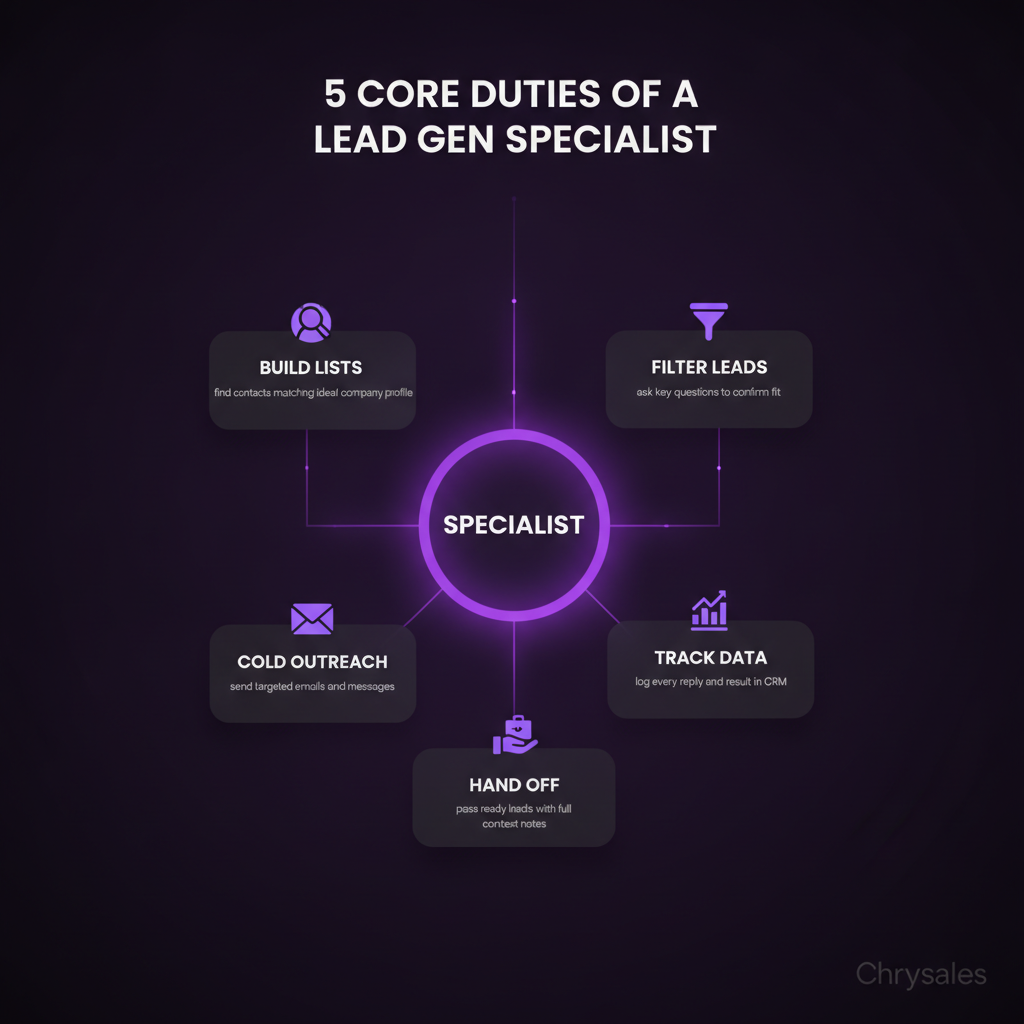
So what does a lead generation specialist actually do day to day? Here's the breakdown.
1. Research and Build Target Lists
Before any outreach happens, the specialist builds a list. This means digging into databases, LinkedIn, company websites, and industry directories to find people who match your ideal customer profile.
They're looking at company size, industry, location, tech stack, recent funding, job titles, and any other signal that says "this could be a fit." A 200-person company that just did layoffs is not a "hot lead." It's a bad fit, full stop.
Most specialists use tools like LinkedIn Sales Navigator, Apollo, ZoomInfo, or Hunter.io to pull contact data. But the tool is only as good as the filter criteria. A specialist who skips this step and buys a generic list is setting you up to fail. To learn the step-by-step process, check out our guide on how to build lead list aligned to your ICP.
2. Run Cold Outreach Campaigns
Once the list is ready, the specialist starts reaching out. That usually means cold email sequences, LinkedIn connection requests with personalized messages, or a combo of both.
Good outreach isn't just "Hey, we do X, want to chat?" It's researched, relevant, and tied to something the prospect actually cares about. A strong specialist will reference a recent hire, a product launch, or a pain point specific to that company's situation.
Common mistake: Sending the same message to 500 people and wondering why nobody replies. Personalization doesn't have to mean writing 500 unique emails, but it does mean segmenting your list and tailoring your angle. Studies show that cold email personalization can significantly boost reply rates compared to generic blasts.
3. Qualify Leads Against Your ICP
Not everyone who replies is a good lead. Some are curious but broke. Some are interested but not decision makers. Some are a terrible fit and just didn't realize it yet.
The specialist's job is to ask a few quick qualifying questions before passing the lead to sales. Questions like:
- What's your current process for [problem you solve]?
- What's your timeline for making a change?
- Who else is involved in this decision?
This is called lead qualification, and it's the difference between a sales team that books 10 demos and closes 1 versus booking 10 demos and closing 5. As explained in this analysis of why lead quality matters more than quantity, quality beats volume every time.
4. Manage CRM Data and Track Pipeline Activity
A good lead generation specialist lives in your CRM. Every outreach email, every reply, every follow-up gets logged. They track open rates, reply rates, meeting booking rates, and which messages are actually working.
This isn't just busywork. Clean CRM data means your sales team knows exactly where each lead stands. It also means you can spot patterns: which industries convert best, which job titles respond most, which subject lines get opened. Understanding lead generation metrics b2b results helps you optimize every part of the pipeline.
Watch out: If your specialist isn't tracking this stuff, you're flying blind. You won't know what's working or why.
5. Pass Sales-Qualified Leads to Closers
Once a lead is qualified and ready to talk, the specialist books the meeting and hands it off. That handoff matters. A sloppy handoff means the closer walks into the call unprepared, and the lead feels like they're repeating themselves.
Strong specialists write quick handoff notes: "Works at X company, 40 employees, uses Y tool now, wants to improve Z, decision maker confirmed, meeting booked for Thursday 2pm."
This is where B2B sales gets smooth. The lead feels heard. The closer feels prepped. The meeting actually goes somewhere.
Must-Have Skills for a Lead Generation Specialist
Not everyone can do this job well. It takes a specific set of skills, and you'll notice fast when someone's missing one.
Research and Prospecting Skills
The best specialists are incredible researchers. They know how to find the signal in the noise. They can look at a company's LinkedIn page, career site, tech stack, and recent news and figure out if it's worth reaching out.
This skill is part detective work, part pattern recognition. A junior specialist might spend an hour building a 50-person list. A senior one builds a 200-person list in the same time and the quality is better.
Strong Written Communication
Most lead generation happens over email or LinkedIn DMs. That means written communication is everything. A specialist needs to write messages that sound human, not like a robot trying to hit a quota.
Good writing here isn't fancy. It's clear, short, and relevant. It sounds like you actually know who you're talking to. A 30-person consulting firm should not get the same message as a 500-person tech company.
CRM and Sales Tool Proficiency
Specialists need to move fast in tools like HubSpot, Salesforce, Pipedrive, Apollo, or whatever CRM your team uses. They should know how to set up sequences, track activity, pull reports, and keep data clean without needing hand-holding.
If they've never used a CRM before, that's a red flag. It's like hiring a driver who's never seen a steering wheel. Research shows that CRM systems in sales management improve tracking and results significantly.
Data Analysis and Pattern Recognition
A great specialist doesn't just send emails and hope. They track what's working and double down. They look at reply rates by industry, by message type, by send time. They notice that prospects in consulting reply more on Tuesday mornings, or that mentioning a specific pain point triples response rates.
Set a simple rule: anything scoring above 70 goes to the top of your call list. Anything below 40 gets dropped or nurtured later.
This kind of thinking separates good specialists from great ones.
Persistence and Resilience
Cold outreach is hard. Most messages get ignored. Most replies are "not interested." A weak specialist gives up after two emails. A strong one knows that the fifth or sixth touchpoint is often where the magic happens.
This job requires thick skin and a short memory. You can't take rejection personally. You just move to the next name on the list.
When Should You Hire a Lead Generation Specialist?
Not every company needs a full-time lead gen person right away. But there are clear signals that it's time.
If your sales team is spending half their time hunting for leads instead of closing deals, you need a specialist. Closers should close. Researchers should research. Mixing the two kills productivity on both sides.
If your pipeline is inconsistent and you're constantly wondering where next month's revenue is coming from, that's another sign. A specialist builds predictable client acquisition. They make sure new leads show up every week, not just when you remember to post on LinkedIn.
Pro Tip: Small sales teams or solo founders often try to do lead gen themselves. That works for a few months. Then it doesn't. If you're spending more than 10 hours a week on outreach and list building, it's time to bring in help. You can watch these 4 Ways To Find Clients Who Need Your Services Right Now to see how specialists proactively target ideal prospects.
How a Lead Generation Specialist Fits Into a Custom Sales System
Here's where most companies get it wrong: they hire a lead generation specialist and expect magic. But a specialist without a system is just someone sending random emails into the void.
At Chrysales, we build full custom sales systems where the specialist is one piece of a bigger machine. That system includes your ideal customer profile, your positioning, your no-brainer offer, your outreach messaging, your qualification criteria, and your CRM workflow.
The specialist plugs into that system and runs it. They're not guessing what to say or who to target. They're following a repeatable process that's been tested and proven to work. To understand the foundation, explore what is lead generation and how it integrates into a full sales system.
When the system is strong, the specialist can focus on execution instead of figuring it out from scratch. We've trained over 500 sales teams and generated more than €10M in client revenue by building these systems first, then adding the right people to run them.
The system comes first. The hire comes second. Not the other way around. You can also learn How To Build a Sales System So Powerful Clients Come To You to see exactly how this approach works in practice.
What Happens When You Skip the System
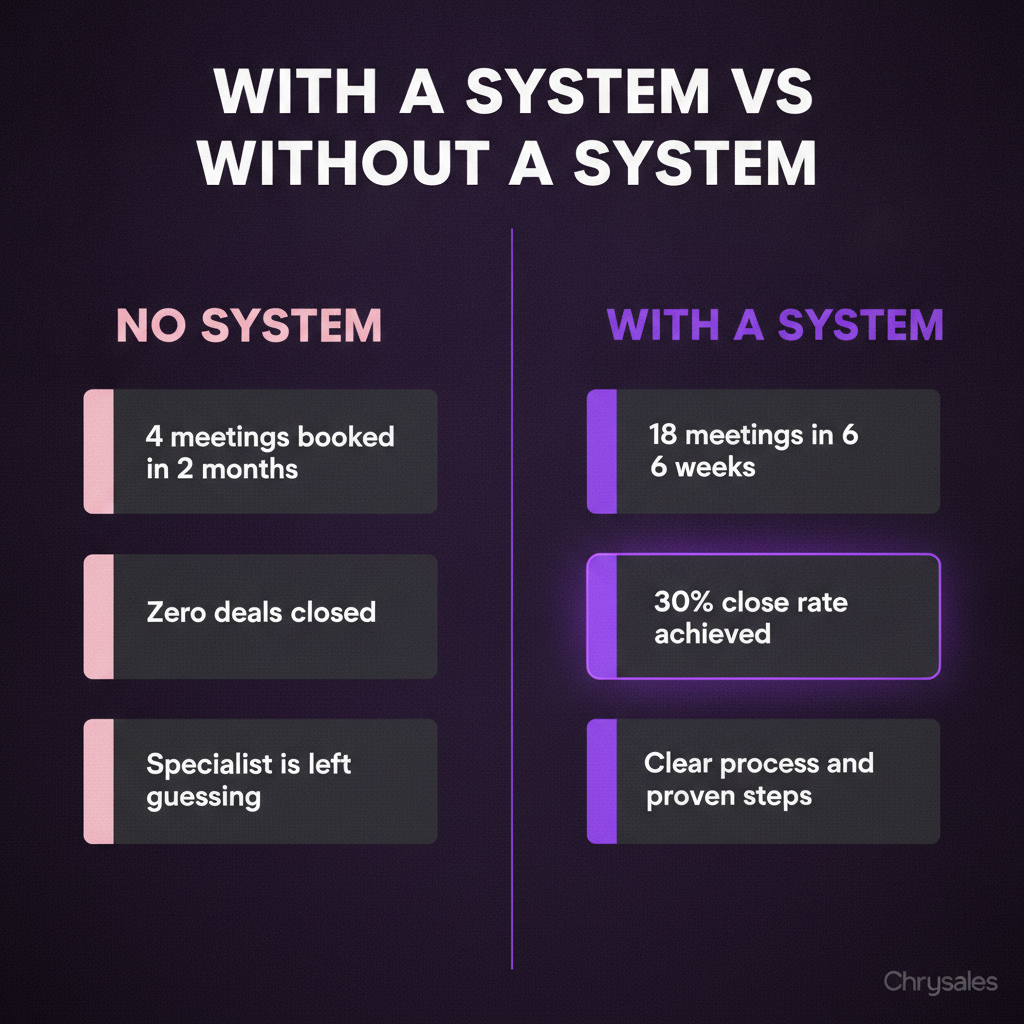
If you hire a lead gen specialist without a system, here's what usually happens: they send a bunch of emails, book a few meetings, and you're not sure if it's working. Reply rates are low. The leads they pass over don't close. After three months, you're wondering if the hire was worth it.
The problem isn't always the person. It's the lack of structure. No clear ICP. No tested messaging. No process for qualification. The specialist is left guessing, and guessing doesn't scale.
A 30-person consulting firm tried this last quarter. They hired someone to "do lead gen" without any framework. After two months, they had booked four meetings and closed zero deals. We rebuilt their system from scratch, gave the specialist a clear process, and within six weeks they booked 18 meetings with a 30% close rate. For a detailed framework, read our guide on how to build a sales system that actually scales.
Common Mistakes When Working With a Lead Generation Specialist
Even when you hire the right person, things can go sideways fast if you make these mistakes.
Mistake 1: No Clear Ideal Customer Profile
If you tell your specialist "target any B2B company with 10 to 500 employees," you're setting them up to fail. That's not an ICP. That's a guess.
A strong ICP includes industry, company size, revenue range, tech stack, growth signals, and specific pain points. The tighter the definition, the better the results.
Mistake 2: Measuring Activity Instead of Outcomes
Some teams measure success by "emails sent" or "LinkedIn requests sent." That's like measuring a chef by how many pans they use instead of how the food tastes.
What matters is meetings booked, leads qualified, and deals closed from those leads. Track the outcomes, not just the activity.
Mistake 3: Not Giving Them the Right Tools
A lead generation specialist without access to LinkedIn Sales Navigator, a good email finder, and a CRM is like a carpenter without a hammer. They'll spend half their day doing things manually that should take five minutes.
Invest in the tools. The ROI shows up fast.
Frequently Asked Questions
Q: What's the difference between a lead generation specialist and a sales rep?
A lead generation specialist focuses on the top of the funnel. They find prospects, reach out, and qualify leads. A sales rep (or closer) takes those qualified leads and closes deals. Some smaller teams have one person doing both, but in most B2B sales setups, splitting the roles makes both sides more effective. The specialist gets really good at research and outreach. The closer gets really good at discovery and negotiation.
Q: How much does it cost to hire a lead generation specialist?
It depends on experience and location. A junior specialist might cost $40,000 to $60,000 per year. A senior one with a proven track record can be $70,000 to $90,000 or more. Freelancers or contractors usually charge $25 to $75 per hour. If you're outsourcing to an agency, expect $2,000 to $5,000 per month depending on volume and service level. The key is making sure they have a system to follow, or you'll burn budget fast with nothing to show.
Q: Can I automate lead generation instead of hiring someone?
You can automate parts of it, but not all of it. Tools can scrape lists, send email sequences, and track responses. But they can't research nuance, write personalized messages that actually land, or have a real conversation when a prospect replies. The best setups use automation for the repetitive stuff and a human specialist for the research, personalization, and qualification. One marketing agency had a 0.5% reply rate using full automation. After adding a specialist who personalized the first touchpoint, it jumped to 4%.
Q: How long does it take to see results from a lead generation specialist?
If the system and messaging are solid, you should see meetings booked within the first two to four weeks. If the specialist is also building the system from scratch, add another few weeks for research and testing. Most teams hit a steady rhythm by month two or three. If you're three months in and still seeing zero traction, either the messaging is off, the list is bad, or the specialist isn't a fit.
Q: Should a lead generation specialist work on inbound or outbound?
Most specialists focus on outbound because that's where the proactive pipeline building happens. But some handle inbound leads too, especially in smaller teams. The skill sets overlap but aren't identical. Outbound requires research and cold outreach skills. Inbound requires speed and qualification instincts since those leads are already warm. If you're getting decent inbound volume, having your specialist handle both can work. If inbound is slow, outbound should be the priority.
A lead generation specialist finds the right prospects, starts the right conversations, and fills your pipeline with qualified leads for b2b sales and client acquisition.
Picture this: you've built a solid service, your pricing makes sense, and your sales deck is ready to go. But when you open your CRM, the pipeline is empty. No new leads coming in. No fresh conversations. Just quiet.
What Does a Lead Generation Specialist Actually Do?
A lead generation specialist is the person who builds your sales pipeline from scratch. They don't wait for leads to show up. They go out and find them.
Their job sits between marketing and sales. Marketing creates content and campaigns that attract interest. Sales closes deals. The specialist bridges the gap by identifying who to talk to, reaching out, and figuring out if there's a real fit before anyone jumps on a call.
Most specialists focus on outbound lead generation, which means cold outreach through email, LinkedIn, or sometimes phone. A few work on inbound, managing leads that come from your website or ads. But the best ones do both, building a full system that doesn't rely on just one channel.
The Core Focus: Quality Over Quantity
Here's the thing: a lead generation specialist isn't just hunting for email addresses. They're hunting for the right email addresses.
A list of 10,000 contacts sounds impressive until you realize 9,500 of them will never buy from you. Good specialists obsess over fit. They ask: Does this company match our ideal customer profile? Is this person actually a decision maker? Are they dealing with a problem we solve?
If the answer is no, they move on. Fast.
Pro Tip: A strong specialist will push back if your ICP is too broad. That's a good sign. It means they care about results, not just activity.
Where They Fit in the Sales Pipeline
Think of your sales pipeline like a phone contact list. If half the numbers don't work, no message gets through. The lead generation specialist makes sure every number is real, active, and belongs to someone who might actually pick up.
They handle the top of the funnel. They research, they reach out, they qualify. Once a lead says "yes, I'm interested," the specialist hands them off to a closer or account exec. Their job is to book the meeting, not run it.
Key Job Duties of a Lead Generation Specialist
So what does a lead generation specialist actually do day to day? Here's the breakdown.
1. Research and Build Target Lists
Before any outreach happens, the specialist builds a list. This means digging into databases, LinkedIn, company websites, and industry directories to find people who match your ideal customer profile.
They're looking at company size, industry, location, tech stack, recent funding, job titles, and any other signal that says "this could be a fit." A 200-person company that just did layoffs is not a "hot lead." It's a bad fit, full stop.
Most specialists use tools like LinkedIn Sales Navigator, Apollo, ZoomInfo, or Hunter.io to pull contact data. But the tool is only as good as the filter criteria. A specialist who skips this step and buys a generic list is setting you up to fail. To learn the step-by-step process, check out our guide on how to build lead list aligned to your ICP.
2. Run Cold Outreach Campaigns
Once the list is ready, the specialist starts reaching out. That usually means cold email sequences, LinkedIn connection requests with personalized messages, or a combo of both.
Good outreach isn't just "Hey, we do X, want to chat?" It's researched, relevant, and tied to something the prospect actually cares about. A strong specialist will reference a recent hire, a product launch, or a pain point specific to that company's situation.
Common mistake: Sending the same message to 500 people and wondering why nobody replies. Personalization doesn't have to mean writing 500 unique emails, but it does mean segmenting your list and tailoring your angle. Studies show that cold email personalization can significantly boost reply rates compared to generic blasts.
3. Qualify Leads Against Your ICP
Not everyone who replies is a good lead. Some are curious but broke. Some are interested but not decision makers. Some are a terrible fit and just didn't realize it yet.
The specialist's job is to ask a few quick qualifying questions before passing the lead to sales. Questions like:
- What's your current process for [problem you solve]?
- What's your timeline for making a change?
- Who else is involved in this decision?
This is called lead qualification, and it's the difference between a sales team that books 10 demos and closes 1 versus booking 10 demos and closing 5. As explained in this analysis of why lead quality matters more than quantity, quality beats volume every time.
4. Manage CRM Data and Track Pipeline Activity
A good lead generation specialist lives in your CRM. Every outreach email, every reply, every follow-up gets logged. They track open rates, reply rates, meeting booking rates, and which messages are actually working.
This isn't just busywork. Clean CRM data means your sales team knows exactly where each lead stands. It also means you can spot patterns: which industries convert best, which job titles respond most, which subject lines get opened. Understanding lead generation metrics b2b results helps you optimize every part of the pipeline.
Watch out: If your specialist isn't tracking this stuff, you're flying blind. You won't know what's working or why.
5. Pass Sales-Qualified Leads to Closers
Once a lead is qualified and ready to talk, the specialist books the meeting and hands it off. That handoff matters. A sloppy handoff means the closer walks into the call unprepared, and the lead feels like they're repeating themselves.
Strong specialists write quick handoff notes: "Works at X company, 40 employees, uses Y tool now, wants to improve Z, decision maker confirmed, meeting booked for Thursday 2pm."
This is where B2B sales gets smooth. The lead feels heard. The closer feels prepped. The meeting actually goes somewhere.
Must-Have Skills for a Lead Generation Specialist
Not everyone can do this job well. It takes a specific set of skills, and you'll notice fast when someone's missing one.
Research and Prospecting Skills
The best specialists are incredible researchers. They know how to find the signal in the noise. They can look at a company's LinkedIn page, career site, tech stack, and recent news and figure out if it's worth reaching out.
This skill is part detective work, part pattern recognition. A junior specialist might spend an hour building a 50-person list. A senior one builds a 200-person list in the same time and the quality is better.
Strong Written Communication
Most lead generation happens over email or LinkedIn DMs. That means written communication is everything. A specialist needs to write messages that sound human, not like a robot trying to hit a quota.
Good writing here isn't fancy. It's clear, short, and relevant. It sounds like you actually know who you're talking to. A 30-person consulting firm should not get the same message as a 500-person tech company.
CRM and Sales Tool Proficiency
Specialists need to move fast in tools like HubSpot, Salesforce, Pipedrive, Apollo, or whatever CRM your team uses. They should know how to set up sequences, track activity, pull reports, and keep data clean without needing hand-holding.
If they've never used a CRM before, that's a red flag. It's like hiring a driver who's never seen a steering wheel. Research shows that CRM systems in sales management improve tracking and results significantly.
Data Analysis and Pattern Recognition
A great specialist doesn't just send emails and hope. They track what's working and double down. They look at reply rates by industry, by message type, by send time. They notice that prospects in consulting reply more on Tuesday mornings, or that mentioning a specific pain point triples response rates.
Set a simple rule: anything scoring above 70 goes to the top of your call list. Anything below 40 gets dropped or nurtured later.
This kind of thinking separates good specialists from great ones.
Persistence and Resilience
Cold outreach is hard. Most messages get ignored. Most replies are "not interested." A weak specialist gives up after two emails. A strong one knows that the fifth or sixth touchpoint is often where the magic happens.
This job requires thick skin and a short memory. You can't take rejection personally. You just move to the next name on the list.
When Should You Hire a Lead Generation Specialist?
Not every company needs a full-time lead gen person right away. But there are clear signals that it's time.
If your sales team is spending half their time hunting for leads instead of closing deals, you need a specialist. Closers should close. Researchers should research. Mixing the two kills productivity on both sides.
If your pipeline is inconsistent and you're constantly wondering where next month's revenue is coming from, that's another sign. A specialist builds predictable client acquisition. They make sure new leads show up every week, not just when you remember to post on LinkedIn.
Pro Tip: Small sales teams or solo founders often try to do lead gen themselves. That works for a few months. Then it doesn't. If you're spending more than 10 hours a week on outreach and list building, it's time to bring in help. You can watch these 4 Ways To Find Clients Who Need Your Services Right Now to see how specialists proactively target ideal prospects.
How a Lead Generation Specialist Fits Into a Custom Sales System
Here's where most companies get it wrong: they hire a lead generation specialist and expect magic. But a specialist without a system is just someone sending random emails into the void.
At Chrysales, we build full custom sales systems where the specialist is one piece of a bigger machine. That system includes your ideal customer profile, your positioning, your no-brainer offer, your outreach messaging, your qualification criteria, and your CRM workflow.
The specialist plugs into that system and runs it. They're not guessing what to say or who to target. They're following a repeatable process that's been tested and proven to work. To understand the foundation, explore what is lead generation and how it integrates into a full sales system.
When the system is strong, the specialist can focus on execution instead of figuring it out from scratch. We've trained over 500 sales teams and generated more than €10M in client revenue by building these systems first, then adding the right people to run them.
The system comes first. The hire comes second. Not the other way around. You can also learn How To Build a Sales System So Powerful Clients Come To You to see exactly how this approach works in practice.
What Happens When You Skip the System
If you hire a lead gen specialist without a system, here's what usually happens: they send a bunch of emails, book a few meetings, and you're not sure if it's working. Reply rates are low. The leads they pass over don't close. After three months, you're wondering if the hire was worth it.
The problem isn't always the person. It's the lack of structure. No clear ICP. No tested messaging. No process for qualification. The specialist is left guessing, and guessing doesn't scale.
A 30-person consulting firm tried this last quarter. They hired someone to "do lead gen" without any framework. After two months, they had booked four meetings and closed zero deals. We rebuilt their system from scratch, gave the specialist a clear process, and within six weeks they booked 18 meetings with a 30% close rate. For a detailed framework, read our guide on how to build a sales system that actually scales.
Common Mistakes When Working With a Lead Generation Specialist
Even when you hire the right person, things can go sideways fast if you make these mistakes.
Mistake 1: No Clear Ideal Customer Profile
If you tell your specialist "target any B2B company with 10 to 500 employees," you're setting them up to fail. That's not an ICP. That's a guess.
A strong ICP includes industry, company size, revenue range, tech stack, growth signals, and specific pain points. The tighter the definition, the better the results.
Mistake 2: Measuring Activity Instead of Outcomes
Some teams measure success by "emails sent" or "LinkedIn requests sent." That's like measuring a chef by how many pans they use instead of how the food tastes.
What matters is meetings booked, leads qualified, and deals closed from those leads. Track the outcomes, not just the activity.
Mistake 3: Not Giving Them the Right Tools
A lead generation specialist without access to LinkedIn Sales Navigator, a good email finder, and a CRM is like a carpenter without a hammer. They'll spend half their day doing things manually that should take five minutes.
Invest in the tools. The ROI shows up fast.
Frequently Asked Questions
Q: What's the difference between a lead generation specialist and a sales rep?
A lead generation specialist focuses on the top of the funnel. They find prospects, reach out, and qualify leads. A sales rep (or closer) takes those qualified leads and closes deals. Some smaller teams have one person doing both, but in most B2B sales setups, splitting the roles makes both sides more effective. The specialist gets really good at research and outreach. The closer gets really good at discovery and negotiation.
Q: How much does it cost to hire a lead generation specialist?
It depends on experience and location. A junior specialist might cost $40,000 to $60,000 per year. A senior one with a proven track record can be $70,000 to $90,000 or more. Freelancers or contractors usually charge $25 to $75 per hour. If you're outsourcing to an agency, expect $2,000 to $5,000 per month depending on volume and service level. The key is making sure they have a system to follow, or you'll burn budget fast with nothing to show.
Q: Can I automate lead generation instead of hiring someone?
You can automate parts of it, but not all of it. Tools can scrape lists, send email sequences, and track responses. But they can't research nuance, write personalized messages that actually land, or have a real conversation when a prospect replies. The best setups use automation for the repetitive stuff and a human specialist for the research, personalization, and qualification. One marketing agency had a 0.5% reply rate using full automation. After adding a specialist who personalized the first touchpoint, it jumped to 4%.
Q: How long does it take to see results from a lead generation specialist?
If the system and messaging are solid, you should see meetings booked within the first two to four weeks. If the specialist is also building the system from scratch, add another few weeks for research and testing. Most teams hit a steady rhythm by month two or three. If you're three months in and still seeing zero traction, either the messaging is off, the list is bad, or the specialist isn't a fit.
Q: Should a lead generation specialist work on inbound or outbound?
Most specialists focus on outbound because that's where the proactive pipeline building happens. But some handle inbound leads too, especially in smaller teams. The skill sets overlap but aren't identical. Outbound requires research and cold outreach skills. Inbound requires speed and qualification instincts since those leads are already warm. If you're getting decent inbound volume, having your specialist handle both can work. If inbound is slow, outbound should be the priority.
Scaling Is Not Hard If You Have The Right Systems
If you’re serious about leveling up your scaling game, you need the right system, the right training, and the right team behind you. We're here to give you the exact tools and strategies top entrepreneurs use to dominate.

Discover the latest tips
View All.avif)
Chrysales was formed from the words "chrysalis" the stage where a caterpillar transforms into a butterfly and "sales".
It stands for one thing: sales transformation.Because scaling doesn’t happen by doing more of the same. Scaling only happens when you go through real transformation in your systems, your offer, team and the way you sell.
.avif)


