.avif)
How to Use Youtube Shorts as a B2B Lead Engine
A YouTube Shorts strategy is a simple way to use short videos for lead generation, b2b sales, and client acquisition through clear content and steady posting. Most B2B companies treat YouTube Shorts like a vanity project. They post once a week, get a few thousand views, and wonder why the phone never rings. Here's the thing nobody tells you: Shorts aren't just about views. They're about building a predictable client acquisition system that runs while you sleep. When done right, short-form video content strategy turns into a lead generation machine that brings qualified prospects to you every single day.
YouTube Shorts Is a Sales Channel, Not a Brand Awareness Experiment
Most teams think YouTube Shorts is about going viral. They watch 10 million view videos and try to copy the format. Then they get discouraged when their industry-specific content doesn't hit the same numbers. Wrong game entirely.
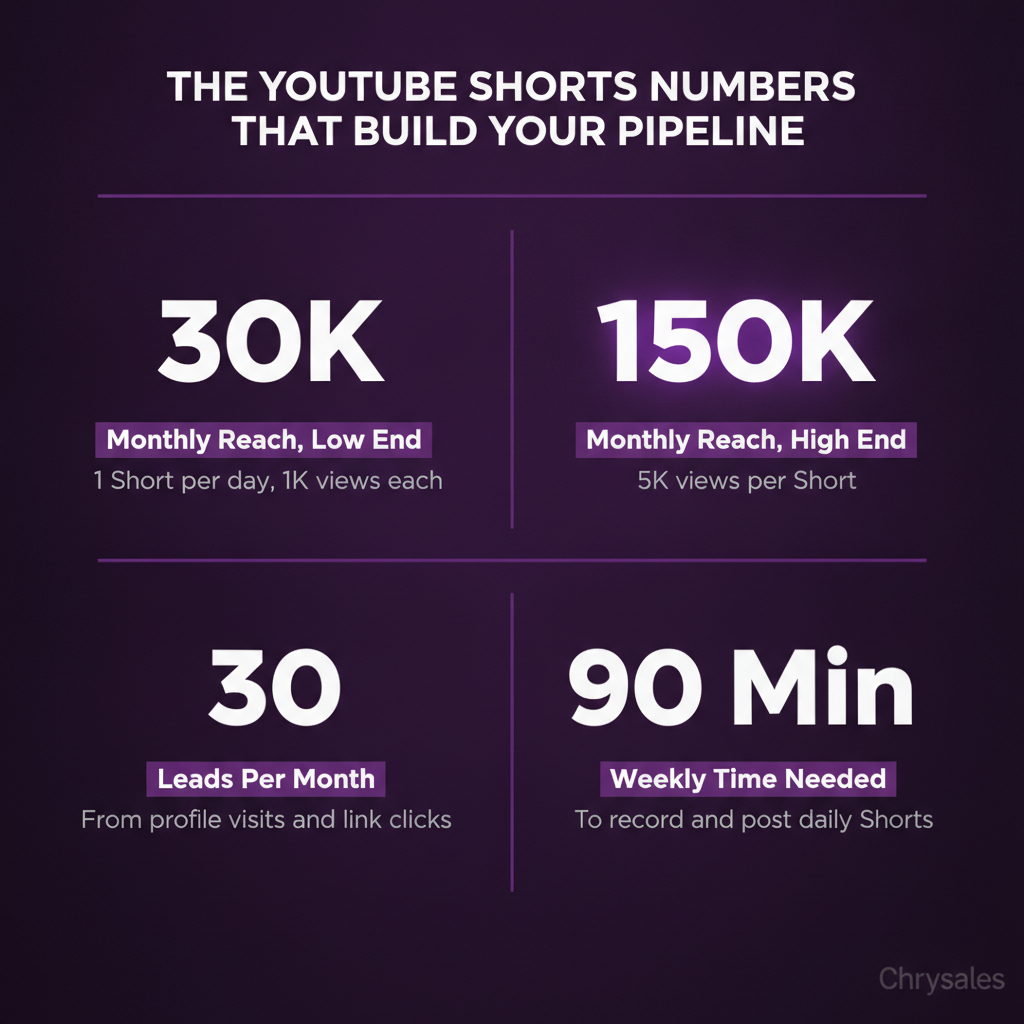
Picture this: A 20-person consulting firm posts three Shorts per week about common client mistakes. Each Short gets 2,000 to 5,000 views. No viral hits. But every week, 2 to 3 people DM them or fill out a contact form. Over a quarter, that's 30 qualified leads. From content that takes 90 minutes a week to make. That's the real YouTube Shorts strategy for B2B lead generation. You're not building an audience to sell ads. You're building a pipeline.
Shorts Work Because They Show Up Everywhere
Here's what makes YouTube Shorts different from TikTok or Instagram Reels. YouTube is a search engine owned by Google. Your Shorts show up in:
- YouTube Shorts feed (like TikTok's For You page)
- YouTube search results
- Google search results
- Suggested videos next to long-form content
A Short you post today can bring in a lead six months from now because someone Googled a problem you solved in 45 seconds. TikTok content dies in 48 hours. Shorts compound over time like blog posts.
The Math Is Simple
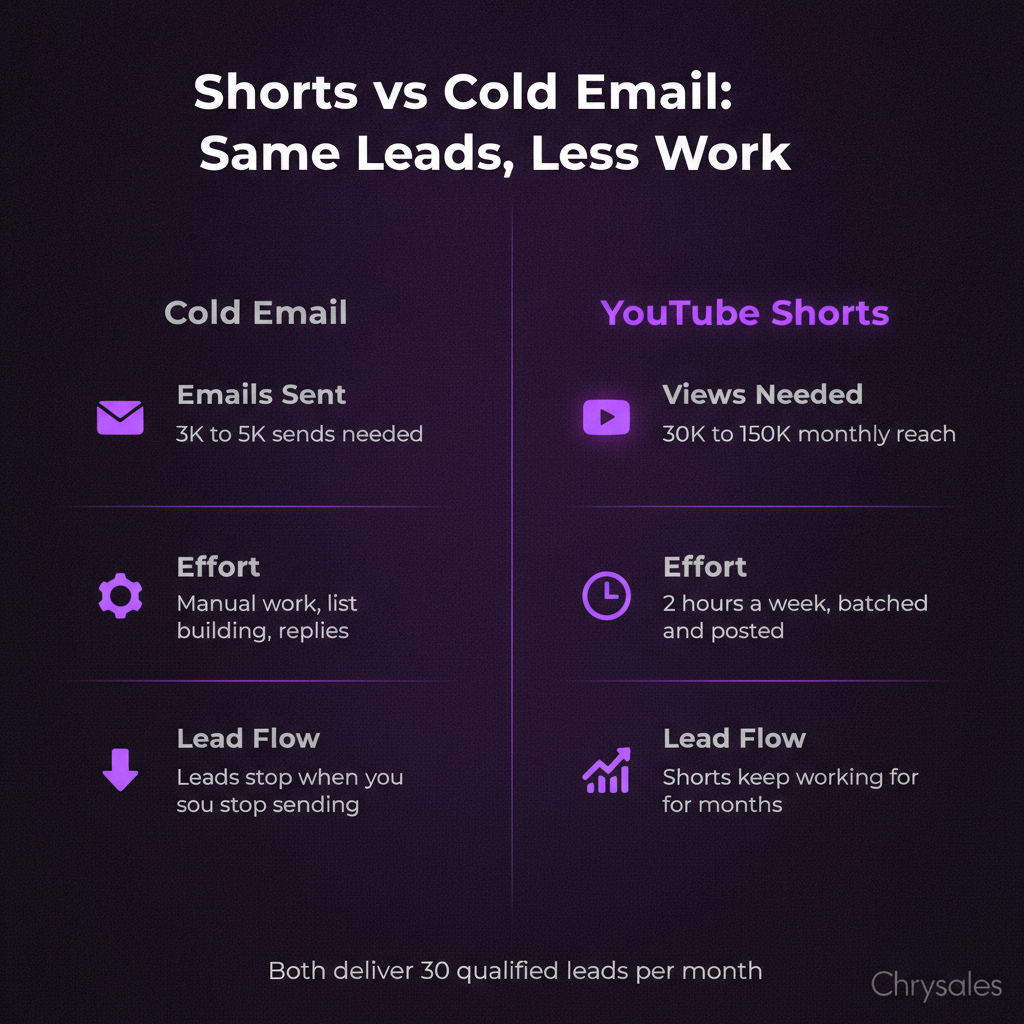
Post one Short per day. Each Short reaches 1,000 to 5,000 people if you know what you're doing. That's 30,000 to 150,000 impressions per month. If 2% click your profile or link, that's 600 to 3,000 profile visits. If 5% of those turn into a lead, you just added 30 to 150 leads to your pipeline.
Now compare that to cold outreach. To get 30 qualified leads from cold email, most teams send 3,000 to 5,000 emails, according to current B2B sales benchmarks. Shorts do the same work, but the leads come to you.
Pro Tip: The best-performing B2B Shorts answer one specific question in under 60 seconds. "How do I know if my sales process is broken?" beats "5 tips to grow your business" every time.
Build Your YouTube Shorts for Client Acquisition in Four Steps
Most people overcomplicate this. You don't need a studio, fancy editing, or a film degree. You need a phone, a quiet room, and a system.
Step 1: Pick Your Core Topics
Start with the five questions prospects ask you most often. Sales training clients ask us things like:
- "How do I know if I need to hire a salesperson or just get better at sales myself?"
- "What's a realistic close rate for B2B deals over $10k?"
- "How do I stop getting ghosted after discovery calls?"
Your list will be different. Write down the questions. Each one becomes 3 to 5 Shorts.
Step 2: Script the First Three Seconds
The YouTube Shorts algorithm rewards watch completion rate more than views. If 60% of people watch your whole Short, it gets pushed to more people. If 20% bail in the first five seconds, it dies.
Your hook needs to stop the scroll. Use these formats:
- The mistake callout: "Most sales teams waste 40% of their time on leads that were never going to buy."
- The bold claim: "You don't need more leads. You need a better list."
- The quick scenario: "Picture this: you spend two weeks writing the perfect pitch, then send it to 500 people who aren't even decision makers."
Test different hooks. The data will tell you what works.
Step 3: Record in Batches
Set aside two hours once a week. Record 7 to 10 Shorts in one sitting. Same background, same outfit, same lighting. You're answering one question per Short. Don't edit much. Jump cuts are fine. Perfect lighting isn't the goal. Clear audio and a useful answer are the goal.
Common mistake: Spending three hours editing one Short to make it look like a TV commercial. Your audience cares about the answer, not the production value.
Step 4: Post Consistently and Track What Converts
Post one Short per day. Same time if possible. YouTube's algorithm loves consistency. But here's where most people stop short: they track views and likes, then wonder why they're not getting clients.
Track this instead:
- Profile visits (shows interest)
- Link clicks (shows intent)
- DMs or contact form fills (actual leads)
A Short with 1,500 views that gets 3 profile visits and 1 lead is better than a Short with 15,000 views and 0 leads. We worked with a marketing agency that posted Shorts about Google Ads mistakes. One Short got 80,000 views and zero inquiries. Another got 3,000 views and 4 discovery calls booked. The difference? The second Short ended with "DM me the word 'audit' and I'll send you a free 10-minute video reviewing your account." Clear call to action tied to their offer.
The YouTube Shorts Algorithm Rewards These Three Things
You don't need to reverse-engineer the whole algorithm. Focus on the three metrics YouTube cares about most.
Watch Completion Rate
If someone watches your whole 45-second Short, that's a signal to YouTube that your content is good. The algorithm pushes it to more people. Keep Shorts between 30 and 50 seconds when you're starting. Easier to hold attention. As you get better, you can stretch to 60 seconds. Cut the fluff. No long intros. No "hey guys, welcome back." Start with the answer.
Replay Rate
If someone watches your Short twice, that's an even stronger signal. YouTube wants content people rewatch. How do you get replays? Pack value into every second. Make the last line a payoff that's worth hearing again.
Example: "So if your close rate is under 20%, the problem isn't your pitch. It's your list. Fix the list first, then fix the pitch." Someone might replay that to write it down or screenshot it.
Click-Through Rate on Your Profile
YouTube tracks how many people watch your Short, then click your channel name to see more. This is where your YouTube Shorts for B2B sales starts turning into lead generation. If your Shorts are good, people want to know more about you. If your profile and channel are set up right, they find your offer.
Watch out: If your channel is empty or messy, you lose them here. Your channel needs a clear headline ("We help B2B companies build predictable sales systems"), a link to book a call or download something, and 3 to 5 longer videos that go deeper on your best topics.
Turn Views Into Leads With a Video Content Sales Funnel
Views don't pay the bills. Leads do. Here's how to connect Shorts to your sales process.
End Every Short With One Clear Next Step
Don't ask people to "follow for more" or "check out my channel." That's vague. Give one specific action:
- "DM me the word 'scorecard' and I'll send you the lead scoring template we use with clients."
- "Link in my bio to book a 15-minute call if you want help fixing this."
- "Comment 'systems' and I'll reply with a free guide to building your first sales process."
Pick one call to action per Short. Make it easy.
Use Your Channel as a Landing Page
When someone clicks your profile after watching a Short, they should know exactly what you do and how to work with you. Your channel banner should say:
- What you do (sales coaching, lead generation, whatever it is)
- Who it's for (B2B companies, consulting firms, etc.)
- How to get started (book a call, download a guide, join a waitlist)
Your About section should have a link. Your pinned comment on every Short should reinforce the call to action.
Bridge Shorts to Long-Form Content
Shorts are the top of the funnel. They get attention. But trust is built in long-form. Post one 8 to 12-minute YouTube video per week on the same topics you cover in Shorts. When someone watches three or four of your Shorts and wants to go deeper, they find your long videos and spend 30 minutes with you. That's when they decide to reach out.
A 15-person IT consulting firm we worked with used this exact setup. Shorts brought traffic. Long videos built trust. A simple calendar link in the video description turned viewers into discovery calls. They booked 18 calls in two months without spending a dollar on ads.
Pro Tip: Repurpose your long videos into Shorts. One 10-minute video becomes 5 to 7 Shorts. You're not making more content, you're chopping it up smarter.
What Actually Works for B2B Video Marketing on YouTube Shorts
Most advice about Shorts comes from lifestyle influencers or e-commerce brands. B2B is different. Here's what works when you're selling sales training, consulting, or high-ticket services.
Teach One Micro-Lesson Per Short
Your Shorts should feel like the answer to a Google search. Someone has a question, you answer it in 40 seconds, they leave smarter. Good Short topics for B2B lead generation:
- "Here's how to tell if a lead is actually qualified in under 60 seconds"
- "The one discovery question that cuts our sales cycle in half"
- "Why your proposals are getting ignored (and the two-line fix)"
Each Short solves a small, specific problem. String 20 of these together and people start to see you as the go-to expert.
Show Your Face and Talk Like a Human
Faceless Shorts with stock footage and text overlays work for some niches. Not for B2B sales. People buy from people. Show your face. Talk to the camera like you're explaining something to a friend. You don't need to be charismatic or polished. You need to sound like you know what you're talking about and you're not reading a script.
Use Real Numbers and Scenarios
Generic advice doesn't get shared. Specific examples do. Instead of: "A good email subject line improves open rates." Say: "We tested 8 subject lines last month. The one that said 'Quick question about your Q3 pipeline' got a 42% open rate. The one that said 'Collaboration opportunity' got 11%. People open emails that sound like a real person wrote them." Real numbers make your Shorts feel credible. Even if the numbers are small.
Don't Try to Go Viral
Chasing viral Shorts is a trap. A video about cats or memes might hit 5 million views. A video about sales automation might hit 8,000 views. But those 8,000 people are your exact audience. We see this all the time with new clients. They post a funny Short that gets 50,000 views and 0 leads. Then they post a boring-but-useful Short about fixing discovery calls that gets 2,000 views and 3 booked calls. The boring one wins every time.
Automate and Scale Your Short-Form Video Lead Generation
Once you've posted 30 to 50 Shorts and you know what works, it's time to turn this into a system that doesn't eat all your time. If you want to build a short-form video strategy for B2B leads that runs on autopilot, these steps will get you there.
Batch Create and Schedule
Use a simple process:
- Week 1: Brainstorm 20 Short ideas (takes 30 minutes)
- Week 2: Script and record 10 Shorts (takes 90 minutes)
- Week 3: Edit and schedule all 10 (takes 60 minutes)
- Week 4: Repeat
You're spending 3 to 4 hours a month on Shorts, and you're posting daily. That's the leverage.
Repurpose Everything
One 15-minute sales training video becomes:
- 6 YouTube Shorts
- 6 LinkedIn posts
- 1 email to your list
- 1 Twitter thread
You're not making new content for every platform. You're chopping up one piece of content six different ways, which is exactly how effective content-driven sales funnels for B2B leads turn one idea into multiple touchpoints across your entire funnel.
Track Performance and Double Down
After 30 Shorts, look at your top 5 by profile visits or link clicks. What do they have in common?
- Same topic? Make 10 more Shorts on that topic.
- Same hook format? Use that hook structure again.
- Same call to action? Keep using it.
Stop posting Shorts that don't convert. Do more of what works. Sounds obvious, but most teams never look at the data.
Common mistake: Posting random topics forever and hoping something sticks. Pick your best 3 topics and go deep.
If you want to see how this all connects to a complete client acquisition engine, watch how to build a sales system so powerful clients come to you for a full walkthrough of the exact system we use with coaching clients.
Frequently Asked Questions
Q: How long does it take to see results from YouTube Shorts for B2B lead generation?
Most teams see their first lead within 30 to 45 days if they post consistently. The algorithm needs time to figure out who your audience is. Post daily or at least 4 times a week for the first two months. After that, you'll start seeing which Shorts drive profile visits and which topics get the most engagement. If you're not seeing any traction after 50 Shorts, your topics or call to action need work, not your posting schedule.
Q: Do I need expensive equipment to make YouTube Shorts that convert?
No. A smartphone with a decent camera and a quiet room are enough. Most high-performing B2B Shorts are shot on an iPhone with natural light and zero editing beyond basic cuts. Your audience cares about the answer you're giving, not your production quality. Spend your time on scripting a strong hook and a clear call to action instead of buying lights and microphones.
Q: What's the best way to turn YouTube Shorts views into actual sales calls?
End every Short with one specific next step. Tell people to DM you a keyword, click the link in your bio, or comment for a free resource. Then make sure your channel profile has a clear headline, a working link, and a few long-form videos that build trust. The Shorts get attention, the long videos build credibility, and the link or DM turns interest into a booked call. Track which Shorts drive the most profile visits and link clicks, then make more Shorts on those topics.
Q: Can YouTube Shorts work for high-ticket B2B offers, or is it only for low-ticket products?
Shorts work for any offer if you're solving real problems and positioning yourself as an expert. We've seen consulting firms, sales training programs, and software companies all book high-ticket clients directly from Shorts, as detailed in our guide on YouTube strategies for high-ticket B2B offers. The key is using Shorts as the top of the funnel to build trust, then guiding people to longer content or a call. A $50k consulting deal won't close from a 40-second video, but it starts there. The Short gets someone interested, the long video builds trust, the call closes the deal.
Q: How often should I post YouTube Shorts to see consistent lead generation results?
Aim for 5 to 7 Shorts per week when you're building momentum. Daily posting is ideal because the algorithm rewards consistency, but if you can only manage 4 per week, that still works. Batch record 7 to 10 Shorts in one session, then schedule them out. Once you have 60 to 80 Shorts published and you know which topics convert, you can dial back to 3 to 4 per week and still see steady leads, as supported by recent B2B sales performance data. Consistency beats volume every time.
Building authority on YouTube goes far beyond Shorts alone. If you want to establish yourself as the go-to expert in your space and support a complete B2B sales funnel, explore our comprehensive approach to YouTube authority building for B2B to leverage both short-form and long-form content together.
A YouTube Shorts strategy is a simple way to use short videos for lead generation, b2b sales, and client acquisition through clear content and steady posting. Most B2B companies treat YouTube Shorts like a vanity project. They post once a week, get a few thousand views, and wonder why the phone never rings. Here's the thing nobody tells you: Shorts aren't just about views. They're about building a predictable client acquisition system that runs while you sleep. When done right, short-form video content strategy turns into a lead generation machine that brings qualified prospects to you every single day.
YouTube Shorts Is a Sales Channel, Not a Brand Awareness Experiment
Most teams think YouTube Shorts is about going viral. They watch 10 million view videos and try to copy the format. Then they get discouraged when their industry-specific content doesn't hit the same numbers. Wrong game entirely.
Picture this: A 20-person consulting firm posts three Shorts per week about common client mistakes. Each Short gets 2,000 to 5,000 views. No viral hits. But every week, 2 to 3 people DM them or fill out a contact form. Over a quarter, that's 30 qualified leads. From content that takes 90 minutes a week to make. That's the real YouTube Shorts strategy for B2B lead generation. You're not building an audience to sell ads. You're building a pipeline.
Shorts Work Because They Show Up Everywhere
Here's what makes YouTube Shorts different from TikTok or Instagram Reels. YouTube is a search engine owned by Google. Your Shorts show up in:
- YouTube Shorts feed (like TikTok's For You page)
- YouTube search results
- Google search results
- Suggested videos next to long-form content
A Short you post today can bring in a lead six months from now because someone Googled a problem you solved in 45 seconds. TikTok content dies in 48 hours. Shorts compound over time like blog posts.
The Math Is Simple
Post one Short per day. Each Short reaches 1,000 to 5,000 people if you know what you're doing. That's 30,000 to 150,000 impressions per month. If 2% click your profile or link, that's 600 to 3,000 profile visits. If 5% of those turn into a lead, you just added 30 to 150 leads to your pipeline.
Now compare that to cold outreach. To get 30 qualified leads from cold email, most teams send 3,000 to 5,000 emails, according to current B2B sales benchmarks. Shorts do the same work, but the leads come to you.
Pro Tip: The best-performing B2B Shorts answer one specific question in under 60 seconds. "How do I know if my sales process is broken?" beats "5 tips to grow your business" every time.
Build Your YouTube Shorts for Client Acquisition in Four Steps
Most people overcomplicate this. You don't need a studio, fancy editing, or a film degree. You need a phone, a quiet room, and a system.
Step 1: Pick Your Core Topics
Start with the five questions prospects ask you most often. Sales training clients ask us things like:
- "How do I know if I need to hire a salesperson or just get better at sales myself?"
- "What's a realistic close rate for B2B deals over $10k?"
- "How do I stop getting ghosted after discovery calls?"
Your list will be different. Write down the questions. Each one becomes 3 to 5 Shorts.
Step 2: Script the First Three Seconds
The YouTube Shorts algorithm rewards watch completion rate more than views. If 60% of people watch your whole Short, it gets pushed to more people. If 20% bail in the first five seconds, it dies.
Your hook needs to stop the scroll. Use these formats:
- The mistake callout: "Most sales teams waste 40% of their time on leads that were never going to buy."
- The bold claim: "You don't need more leads. You need a better list."
- The quick scenario: "Picture this: you spend two weeks writing the perfect pitch, then send it to 500 people who aren't even decision makers."
Test different hooks. The data will tell you what works.
Step 3: Record in Batches
Set aside two hours once a week. Record 7 to 10 Shorts in one sitting. Same background, same outfit, same lighting. You're answering one question per Short. Don't edit much. Jump cuts are fine. Perfect lighting isn't the goal. Clear audio and a useful answer are the goal.
Common mistake: Spending three hours editing one Short to make it look like a TV commercial. Your audience cares about the answer, not the production value.
Step 4: Post Consistently and Track What Converts
Post one Short per day. Same time if possible. YouTube's algorithm loves consistency. But here's where most people stop short: they track views and likes, then wonder why they're not getting clients.
Track this instead:
- Profile visits (shows interest)
- Link clicks (shows intent)
- DMs or contact form fills (actual leads)
A Short with 1,500 views that gets 3 profile visits and 1 lead is better than a Short with 15,000 views and 0 leads. We worked with a marketing agency that posted Shorts about Google Ads mistakes. One Short got 80,000 views and zero inquiries. Another got 3,000 views and 4 discovery calls booked. The difference? The second Short ended with "DM me the word 'audit' and I'll send you a free 10-minute video reviewing your account." Clear call to action tied to their offer.
The YouTube Shorts Algorithm Rewards These Three Things
You don't need to reverse-engineer the whole algorithm. Focus on the three metrics YouTube cares about most.
Watch Completion Rate
If someone watches your whole 45-second Short, that's a signal to YouTube that your content is good. The algorithm pushes it to more people. Keep Shorts between 30 and 50 seconds when you're starting. Easier to hold attention. As you get better, you can stretch to 60 seconds. Cut the fluff. No long intros. No "hey guys, welcome back." Start with the answer.
Replay Rate
If someone watches your Short twice, that's an even stronger signal. YouTube wants content people rewatch. How do you get replays? Pack value into every second. Make the last line a payoff that's worth hearing again.
Example: "So if your close rate is under 20%, the problem isn't your pitch. It's your list. Fix the list first, then fix the pitch." Someone might replay that to write it down or screenshot it.
Click-Through Rate on Your Profile
YouTube tracks how many people watch your Short, then click your channel name to see more. This is where your YouTube Shorts for B2B sales starts turning into lead generation. If your Shorts are good, people want to know more about you. If your profile and channel are set up right, they find your offer.
Watch out: If your channel is empty or messy, you lose them here. Your channel needs a clear headline ("We help B2B companies build predictable sales systems"), a link to book a call or download something, and 3 to 5 longer videos that go deeper on your best topics.
Turn Views Into Leads With a Video Content Sales Funnel
Views don't pay the bills. Leads do. Here's how to connect Shorts to your sales process.
End Every Short With One Clear Next Step
Don't ask people to "follow for more" or "check out my channel." That's vague. Give one specific action:
- "DM me the word 'scorecard' and I'll send you the lead scoring template we use with clients."
- "Link in my bio to book a 15-minute call if you want help fixing this."
- "Comment 'systems' and I'll reply with a free guide to building your first sales process."
Pick one call to action per Short. Make it easy.
Use Your Channel as a Landing Page
When someone clicks your profile after watching a Short, they should know exactly what you do and how to work with you. Your channel banner should say:
- What you do (sales coaching, lead generation, whatever it is)
- Who it's for (B2B companies, consulting firms, etc.)
- How to get started (book a call, download a guide, join a waitlist)
Your About section should have a link. Your pinned comment on every Short should reinforce the call to action.
Bridge Shorts to Long-Form Content
Shorts are the top of the funnel. They get attention. But trust is built in long-form. Post one 8 to 12-minute YouTube video per week on the same topics you cover in Shorts. When someone watches three or four of your Shorts and wants to go deeper, they find your long videos and spend 30 minutes with you. That's when they decide to reach out.
A 15-person IT consulting firm we worked with used this exact setup. Shorts brought traffic. Long videos built trust. A simple calendar link in the video description turned viewers into discovery calls. They booked 18 calls in two months without spending a dollar on ads.
Pro Tip: Repurpose your long videos into Shorts. One 10-minute video becomes 5 to 7 Shorts. You're not making more content, you're chopping it up smarter.
What Actually Works for B2B Video Marketing on YouTube Shorts
Most advice about Shorts comes from lifestyle influencers or e-commerce brands. B2B is different. Here's what works when you're selling sales training, consulting, or high-ticket services.
Teach One Micro-Lesson Per Short
Your Shorts should feel like the answer to a Google search. Someone has a question, you answer it in 40 seconds, they leave smarter. Good Short topics for B2B lead generation:
- "Here's how to tell if a lead is actually qualified in under 60 seconds"
- "The one discovery question that cuts our sales cycle in half"
- "Why your proposals are getting ignored (and the two-line fix)"
Each Short solves a small, specific problem. String 20 of these together and people start to see you as the go-to expert.
Show Your Face and Talk Like a Human
Faceless Shorts with stock footage and text overlays work for some niches. Not for B2B sales. People buy from people. Show your face. Talk to the camera like you're explaining something to a friend. You don't need to be charismatic or polished. You need to sound like you know what you're talking about and you're not reading a script.
Use Real Numbers and Scenarios
Generic advice doesn't get shared. Specific examples do. Instead of: "A good email subject line improves open rates." Say: "We tested 8 subject lines last month. The one that said 'Quick question about your Q3 pipeline' got a 42% open rate. The one that said 'Collaboration opportunity' got 11%. People open emails that sound like a real person wrote them." Real numbers make your Shorts feel credible. Even if the numbers are small.
Don't Try to Go Viral
Chasing viral Shorts is a trap. A video about cats or memes might hit 5 million views. A video about sales automation might hit 8,000 views. But those 8,000 people are your exact audience. We see this all the time with new clients. They post a funny Short that gets 50,000 views and 0 leads. Then they post a boring-but-useful Short about fixing discovery calls that gets 2,000 views and 3 booked calls. The boring one wins every time.
Automate and Scale Your Short-Form Video Lead Generation
Once you've posted 30 to 50 Shorts and you know what works, it's time to turn this into a system that doesn't eat all your time. If you want to build a short-form video strategy for B2B leads that runs on autopilot, these steps will get you there.
Batch Create and Schedule
Use a simple process:
- Week 1: Brainstorm 20 Short ideas (takes 30 minutes)
- Week 2: Script and record 10 Shorts (takes 90 minutes)
- Week 3: Edit and schedule all 10 (takes 60 minutes)
- Week 4: Repeat
You're spending 3 to 4 hours a month on Shorts, and you're posting daily. That's the leverage.
Repurpose Everything
One 15-minute sales training video becomes:
- 6 YouTube Shorts
- 6 LinkedIn posts
- 1 email to your list
- 1 Twitter thread
You're not making new content for every platform. You're chopping up one piece of content six different ways, which is exactly how effective content-driven sales funnels for B2B leads turn one idea into multiple touchpoints across your entire funnel.
Track Performance and Double Down
After 30 Shorts, look at your top 5 by profile visits or link clicks. What do they have in common?
- Same topic? Make 10 more Shorts on that topic.
- Same hook format? Use that hook structure again.
- Same call to action? Keep using it.
Stop posting Shorts that don't convert. Do more of what works. Sounds obvious, but most teams never look at the data.
Common mistake: Posting random topics forever and hoping something sticks. Pick your best 3 topics and go deep.
If you want to see how this all connects to a complete client acquisition engine, watch how to build a sales system so powerful clients come to you for a full walkthrough of the exact system we use with coaching clients.
Frequently Asked Questions
Q: How long does it take to see results from YouTube Shorts for B2B lead generation?
Most teams see their first lead within 30 to 45 days if they post consistently. The algorithm needs time to figure out who your audience is. Post daily or at least 4 times a week for the first two months. After that, you'll start seeing which Shorts drive profile visits and which topics get the most engagement. If you're not seeing any traction after 50 Shorts, your topics or call to action need work, not your posting schedule.
Q: Do I need expensive equipment to make YouTube Shorts that convert?
No. A smartphone with a decent camera and a quiet room are enough. Most high-performing B2B Shorts are shot on an iPhone with natural light and zero editing beyond basic cuts. Your audience cares about the answer you're giving, not your production quality. Spend your time on scripting a strong hook and a clear call to action instead of buying lights and microphones.
Q: What's the best way to turn YouTube Shorts views into actual sales calls?
End every Short with one specific next step. Tell people to DM you a keyword, click the link in your bio, or comment for a free resource. Then make sure your channel profile has a clear headline, a working link, and a few long-form videos that build trust. The Shorts get attention, the long videos build credibility, and the link or DM turns interest into a booked call. Track which Shorts drive the most profile visits and link clicks, then make more Shorts on those topics.
Q: Can YouTube Shorts work for high-ticket B2B offers, or is it only for low-ticket products?
Shorts work for any offer if you're solving real problems and positioning yourself as an expert. We've seen consulting firms, sales training programs, and software companies all book high-ticket clients directly from Shorts, as detailed in our guide on YouTube strategies for high-ticket B2B offers. The key is using Shorts as the top of the funnel to build trust, then guiding people to longer content or a call. A $50k consulting deal won't close from a 40-second video, but it starts there. The Short gets someone interested, the long video builds trust, the call closes the deal.
Q: How often should I post YouTube Shorts to see consistent lead generation results?
Aim for 5 to 7 Shorts per week when you're building momentum. Daily posting is ideal because the algorithm rewards consistency, but if you can only manage 4 per week, that still works. Batch record 7 to 10 Shorts in one session, then schedule them out. Once you have 60 to 80 Shorts published and you know which topics convert, you can dial back to 3 to 4 per week and still see steady leads, as supported by recent B2B sales performance data. Consistency beats volume every time.
Building authority on YouTube goes far beyond Shorts alone. If you want to establish yourself as the go-to expert in your space and support a complete B2B sales funnel, explore our comprehensive approach to YouTube authority building for B2B to leverage both short-form and long-form content together.
Scaling Is Not Hard If You Have The Right Systems
If you’re serious about leveling up your scaling game, you need the right system, the right training, and the right team behind you. We're here to give you the exact tools and strategies top entrepreneurs use to dominate.

Discover the latest tips
View All.avif)
Chrysales was formed from the words "chrysalis" the stage where a caterpillar transforms into a butterfly and "sales".
It stands for one thing: sales transformation.Because scaling doesn’t happen by doing more of the same. Scaling only happens when you go through real transformation in your systems, your offer, team and the way you sell.
.avif)


