.avif)
How to Use Short Form Video to Get Clients
Why Short Form Video Is the Fastest Way to Build Trust with Buyers in 2026
Short form video is a simple way to get clients by showing your value fast, building trust, and turning views into conversations that support lead generation and client acquisition.
Picture this: you send a cold email. No reply. You send a LinkedIn message. Ignored. Then you post a 30 second video explaining one client problem you solve. Three people book calls that week.
That's the power of short form video for client acquisition. It skips the back and forth and lets buyers see you solve problems before they ever talk to you. In 2026, this isn't a nice to have. It's the fastest trust building tool in B2B sales.
Short Form Video Shows, Not Tells
Most B2B lead generation starts with text. Cold emails, LinkedIn pitches, landing pages. All words. The problem? Words require trust before anyone reads them.
Video flips that. People can watch you explain something in 60 seconds and decide if you know your stuff. No commitment needed.
Why Video Builds Trust Faster Than Text
When someone reads your email, they don't know if you're an expert or just good at writing sales copy. When they watch you walk through a sales training concept or break down a lead generation mistake, they see proof. Your tone, your clarity, your examples. It all adds up fast.
A 15 person consulting firm tested this last year. They posted three short form videos per week on LinkedIn for a month. Each video addressed one objection their buyers had. After 30 days, they had 22 inbound messages from people who watched the videos and wanted to talk. Before that, they were relying on cold outreach with a 2% reply rate.
The Barrier to Entry Is Gone
You don't need a production team or fancy equipment. Most phones shoot better video than professional cameras did five years ago. The barrier isn't gear. It's the hesitation to hit record. Once that's gone, you can start building trust at scale.
Pro Tip: Record five videos in one sitting. Pick five common questions your buyers ask. Answer each in under 60 seconds. Schedule them over two weeks. That's your first sprint.
How to Use Short Form Video to Get Clients Without Being Salesy
The mistake most people make with short form video sales strategy is treating it like an ad. They pitch in every video. That kills trust fast. Instead, think of video as the top of your client acquisition system. It gets attention. Your follow up system closes the deal.
The Three Video Formula That Actually Works
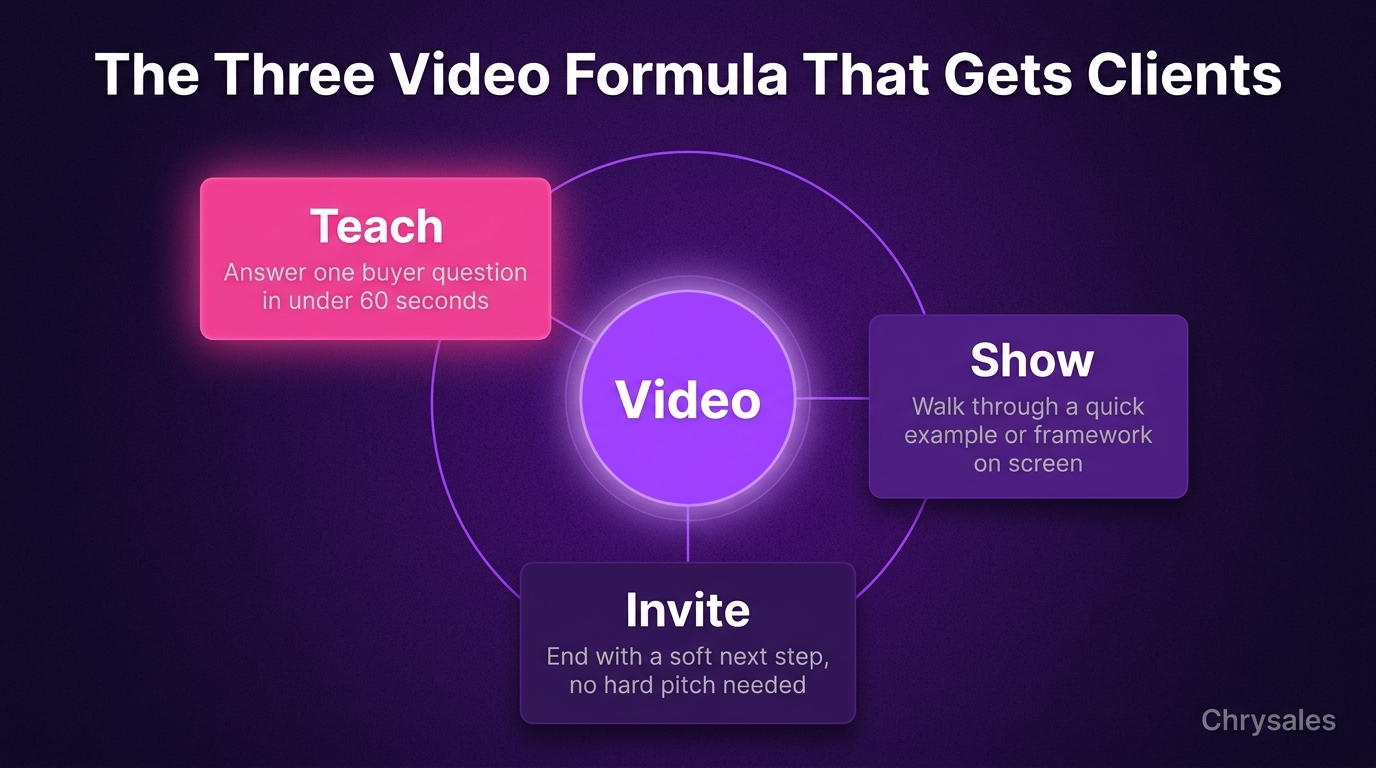
Here's what works for B2B growth: teach, show, invite.
Teach: Answer one question your buyer has. Keep it simple. "Here's why most sales teams struggle with cold outreach." Then explain in 45 seconds.
Show: Walk through a quick example or framework. "Here's the three part email structure we use to book 15 calls a week." Show it on screen or talk through it.
Invite: End with a soft call to action. "If you want the full template, drop me a message." No hard pitch. Just a next step.
One marketing agency used this exact formula on Instagram Reels. They posted 12 videos over six weeks. Eight were pure teaching. Four had a soft invite. They booked 19 discovery calls and closed four new clients. Total ad spend: zero.
Where to Post Your Videos
You don't need to be everywhere. Pick two platforms where your buyers actually spend time. For most B2B sales teams, that's LinkedIn and YouTube Shorts.
LinkedIn gets you decision makers. YouTube gets you search traffic that compounds over time. If you're targeting tech companies, LinkedIn content lead generation profiles work better. If you're going after agencies or consultants, YouTube Shorts and Instagram Reels pull harder because those audiences scroll for education content.
Watch out: Don't spread yourself thin. Two platforms done well beats five platforms done poorly.
What to Say in Your Videos (And What to Skip)
The content matters more than the production quality. A shaky video with a great insight beats a polished video that says nothing. Here's what to focus on.
Topics That Actually Get Watched
People watch short form video content when it solves a specific problem or challenges something they thought was true. That's it. Broad advice doesn't cut through.
Good topics for B2B lead generation with video:
- "Why your cold emails aren't working (it's not the subject line)"
- "The one discovery question that closes 60% more deals"
- "How to build a 30 day sales pipeline from scratch"
- "The biggest hiring mistake small sales teams make"
- "Three signs your offer is too complicated"
Bad topics:
- "How to grow your business"
- "The importance of sales"
- "Tips for success"
See the difference? Specific beats vague every time.
The Hook Matters More Than the Middle
The first three seconds decide if someone keeps watching. Start with a problem, a bold claim, or a quick question. "Most sales calls fail in the first 90 seconds" is stronger than "Today I want to talk about sales calls."
After the hook, deliver on the promise fast. No long intros. No "hey guys, welcome back." Get to the point in five seconds or people scroll.
Common mistake: Spending 15 seconds introducing yourself. Nobody cares who you are until they know you can help them. Flip the order. Give value first, introduce yourself at the end if you need to.
Building a System Around Your Videos
Short form video for client acquisition only works if it's connected to the rest of your sales process. The video gets attention. What happens next is what actually books the call.
The Follow Up Sequence Most People Skip
Let's say someone watches your video and comments or sends a message. What do you do? Most people wing it. That's a mistake. Build a simple follow up system.
Step one: Reply within 24 hours. Thank them for watching. Ask one question related to the video topic. "Glad that landed. Are you running into this with your team right now?"
Step two: If they reply, offer something specific. A template, a quick framework, a 10 minute call. Not a pitch. Just something useful.
Step three: After you send the thing, follow up three days later. "Did that help? Happy to walk through how we'd apply this to your setup if you want."
A 30 person tech company tried this system for two months. They posted three videos a week and followed this exact sequence. They booked 14 calls and closed three new clients. Before that, they were doing only cold outreach with inconsistent results.
Track What Actually Drives Calls
Not all videos perform the same. Some get views but no replies. Others get fewer views but more messages. Pay attention to what drives action, not just what gets likes.
If a video about objection handling gets 500 views and two messages, and a video about pricing gets 200 views and eight messages, make more pricing videos. The goal isn't viral content. It's client acquisition.
Pro Tip: Keep a simple spreadsheet. Track video topic, views, comments, DMs, and calls booked. After 20 videos, you'll see patterns. Double down on what works.
How Short Form Video Fits Into a Full Sales System
Video is powerful, but it's just one part of a repeatable sales system. At Chrysales, we've trained over 1,000 business owners and 500+ sales teams, and the ones who win combine short form video with structured follow up, clear positioning, and strong closing processes.
Video fills the top of the funnel. The rest of the system converts. You can also watch how to build a sales system so powerful clients come to you for a deeper walkthrough of this approach.
The Four Stage Client Acquisition System
Here's how it fits together:
Stage one: Attention (short form video). Post consistent content that educates your buyer. This gets you noticed.
Stage two: Conversation (DMs, comments, replies). Turn views into conversations with a follow up system. This builds the relationship.
Stage three: Discovery (booked calls). Use a structured sales call format to understand their problem and position your offer. This qualifies the lead.
Stage four: Close (proposal, objections, agreement). Handle objections, walk through pricing, and close the deal. This is where sales training and a strong offer matter most.
Most teams stop at stage one. They post videos and hope something happens. The ones who build a sales system that actually scales around the video are the ones booking 10, 15, 20 calls a month.
When to Add Paid Ads to Your Video Content
Once you know which videos drive the most conversations, run ads on them. Organic reach is great, but paid ads scale faster. A video that gets five organic messages in a week might get 20 with $200 in ad spend.
One consulting firm ran LinkedIn ads on their top performing short form video about sales hiring. They spent $500 over two weeks and booked nine calls. Three turned into clients worth a combined €45,000. That's a 90x return.
But don't run ads on every video. Only boost the ones you know convert. Test organic first. Scale what works.
Common Mistakes That Kill Your Video Strategy
Most people mess up short form video for B2B growth in predictable ways. Here's what to avoid.
Posting Once a Week and Expecting Results
Consistency matters more than perfection. Posting one video a week won't build momentum. You need three to five per week for the first 60 days. After that, you can dial it back. But early on, volume matters.
Think of it like building a contact list. If you add five names a month, it takes forever to fill. If you add 50 names a month, you hit critical mass fast. Same with video. More content means more chances to connect.
Watch out: Don't confuse volume with spam. Three helpful videos per week beats seven mediocre ones. Quality still matters.
Making Every Video About You
Nobody wants to watch a 60 second commercial. They want to learn something or see something useful. If every video is "here's what we do" or "check out our service," people tune out.
Flip the ratio. For every one video that mentions your service, post four that just teach. The teaching builds trust. The trust leads to clients.
Ignoring the Data
If no one is watching your videos past the first five seconds, your hooks are weak. If people watch but don't comment or message, your calls to action aren't clear. If you're getting messages but no booked calls, your follow up needs work.
Look at the numbers every two weeks. Adjust based on what you see. This isn't a guessing game. The data tells you what's broken.
How AI Can Speed Up Your Video Production
Creating short form video content five times a week sounds like a lot of work. It can be, unless you use AI to handle the repetitive parts. At Chrysales, we use AI powered workflows to help clients script, edit, and schedule video content faster.
AI for Video Scripts and Hooks
You don't need to stare at a blank page for 30 minutes trying to come up with a hook. Use AI to generate 10 hook ideas in two minutes. Pick the best one. Then outline the video in bullet points. Record it in one take. Done.
Tools like ChatGPT or Gemini can help you brainstorm topics, write first drafts of scripts, and even suggest calls to action. The AI doesn't replace your voice. It speeds up the planning so you can focus on recording.
AI for Lead Scoring After the Video
Once people start watching and engaging, you need to know who's worth following up with. AI can score your leads based on their behavior. Did they watch three videos? Comment twice? Visit your website? That's a hot lead.
We've built Gemini based sales workflows for clients that automatically flag high intent viewers and route them to the right follow up sequence. It takes the guesswork out of who to call first. Learn more about the only AI sales system you need in 2026 to see how automation fits into your entire client acquisition process.
Pro Tip: Set up a simple automation that tracks video engagement and tags leads in your CRM. Anyone who watches three or more videos gets a priority tag. Follow up with them within 24 hours.
Real Results from Teams Using Short Form Video
The theory is nice. The results are better. Here's what happens when teams actually commit to using short form video as part of their client acquisition system.
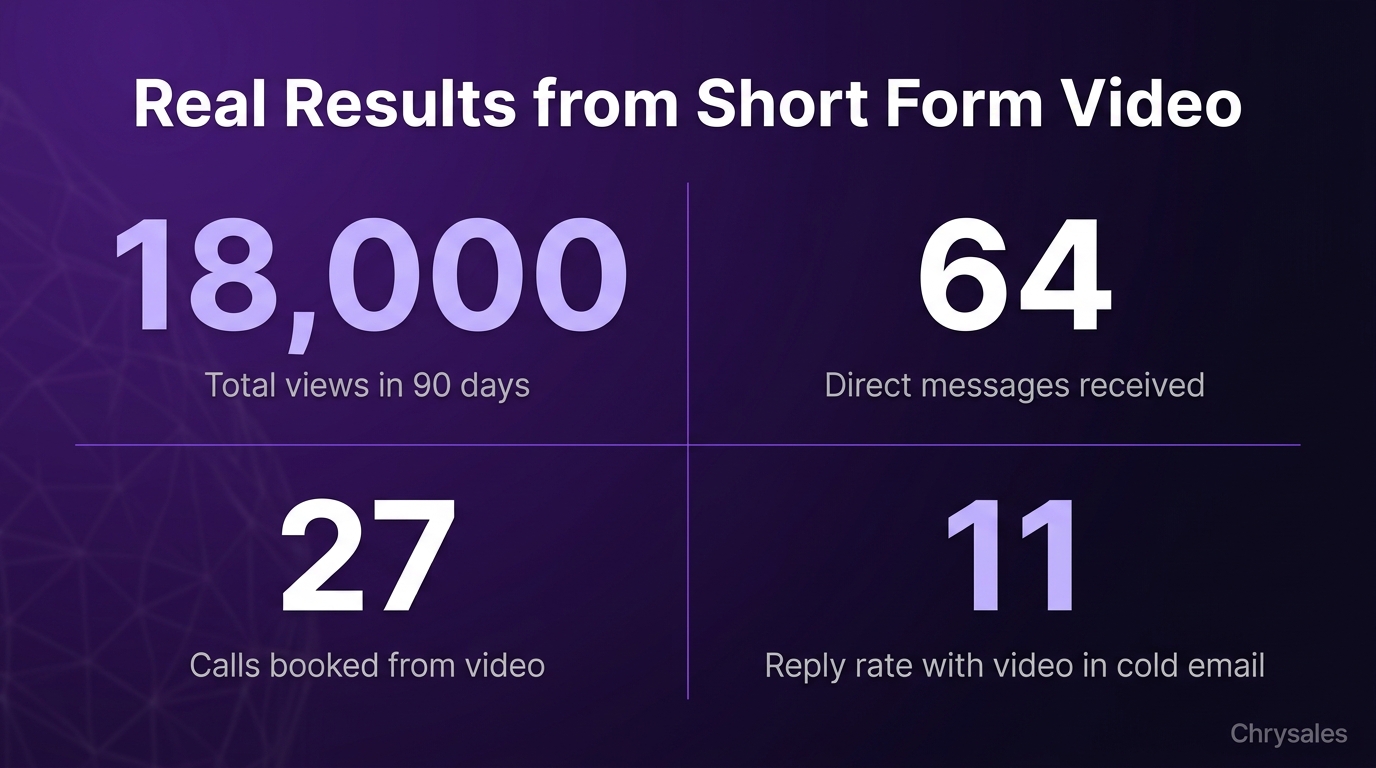
A marketing agency posted four short form videos per week for 90 days. Total views: 18,000. Direct messages: 64. Booked calls: 27. New clients: 6. Revenue from those clients: over €80,000. Cost to produce the videos: time only, no ad spend.
A 20 person consulting firm combined short form video with cold outreach. They sent cold emails to a clean list and included a link to a relevant video in the email. Their reply rate jumped from 3% to 11%. They booked 19 calls in six weeks. Five closed.
A B2B tech company used short form video to train their sales team. They recorded internal training videos on discovery questions, objection handling, and closing techniques. The team watched the videos before calls. Close rate went up 22% in two months. The videos weren't even public. They used the same format to educate their own people.
The 99.4% Client Satisfaction Rate We See
At Chrysales, we've helped clients generate over €10 million in revenue using custom sales systems that include short form video as a core piece. Our satisfaction rate sits at 99.4% because we don't just teach theory. We build the system with you.
From the video topics to the follow up scripts to the call structure, everything is connected. Short form video works when it's part of a bigger plan. That's what we do. We build the plan, train your team, and help you scale. If you're serious about client acquisition, discover four ways to find clients who need your services right now and start applying these strategies today.
Frequently Asked Questions
Q: How long should each short form video be?
Keep most videos between 30 and 90 seconds. That's long enough to make a point and short enough that people watch to the end. If you're walking through something detailed, 90 seconds to two minutes is fine. Anything longer, consider breaking it into parts or switching to a longer format.
Q: Do I need to show my face in every video?
Showing your face builds trust faster, but it's not required. Screen recordings with your voice work well for walkthrough content. Slideshows with a voiceover work too. But if you want to build a personal brand and speed up the trust process, especially for YouTube authority building B2B strategies, show your face most of the time.
Q: What if I'm not good on camera?
Nobody is good on camera at first. It takes 10 to 15 videos to feel natural. Record practice videos and delete them. Do five takes if you need to. The first few will feel awkward. By video 20, you'll be fine. The discomfort is normal. Push through it.
Q: How many videos do I need to post before I see results?
Most people see their first inbound message or comment around video 10 to 15. Booked calls usually happen after 20 to 30 videos if you're posting consistently and following up. If you post three times a week, expect to see traction within two months. Less frequent posting takes longer.
Q: Should I use captions on my videos?
Yes. Most people watch short form video with the sound off, especially on LinkedIn and Instagram. Add captions to every video. It increases watch time and makes your content accessible. Most editing apps auto generate captions now, so it's a quick step.
Q: Can short form video work for complex B2B services?
Absolutely. You're not trying to explain your entire service in 60 seconds. You're addressing one small part of the problem your buyer has. Break complex topics into bite sized pieces. One video per concept. Over time, the full picture comes together. People don't need to understand everything before they book a call. They just need to trust you know what you're talking about.
Q: How do I measure short form video ROI?
Track three things: video views, direct messages or comments, and booked calls. If 1,000 views lead to 10 messages and 3 calls, you know your conversion rate. From there, track how many calls turn into clients. Compare that to your other lead sources. Most teams see short form video outperform cold email and paid ads once they hit consistent posting.
Why Short Form Video Is the Fastest Way to Build Trust with Buyers in 2026
Short form video is a simple way to get clients by showing your value fast, building trust, and turning views into conversations that support lead generation and client acquisition.
Picture this: you send a cold email. No reply. You send a LinkedIn message. Ignored. Then you post a 30 second video explaining one client problem you solve. Three people book calls that week.
That's the power of short form video for client acquisition. It skips the back and forth and lets buyers see you solve problems before they ever talk to you. In 2026, this isn't a nice to have. It's the fastest trust building tool in B2B sales.
Short Form Video Shows, Not Tells
Most B2B lead generation starts with text. Cold emails, LinkedIn pitches, landing pages. All words. The problem? Words require trust before anyone reads them.
Video flips that. People can watch you explain something in 60 seconds and decide if you know your stuff. No commitment needed.
Why Video Builds Trust Faster Than Text
When someone reads your email, they don't know if you're an expert or just good at writing sales copy. When they watch you walk through a sales training concept or break down a lead generation mistake, they see proof. Your tone, your clarity, your examples. It all adds up fast.
A 15 person consulting firm tested this last year. They posted three short form videos per week on LinkedIn for a month. Each video addressed one objection their buyers had. After 30 days, they had 22 inbound messages from people who watched the videos and wanted to talk. Before that, they were relying on cold outreach with a 2% reply rate.
The Barrier to Entry Is Gone
You don't need a production team or fancy equipment. Most phones shoot better video than professional cameras did five years ago. The barrier isn't gear. It's the hesitation to hit record. Once that's gone, you can start building trust at scale.
Pro Tip: Record five videos in one sitting. Pick five common questions your buyers ask. Answer each in under 60 seconds. Schedule them over two weeks. That's your first sprint.
How to Use Short Form Video to Get Clients Without Being Salesy
The mistake most people make with short form video sales strategy is treating it like an ad. They pitch in every video. That kills trust fast. Instead, think of video as the top of your client acquisition system. It gets attention. Your follow up system closes the deal.
The Three Video Formula That Actually Works
Here's what works for B2B growth: teach, show, invite.
Teach: Answer one question your buyer has. Keep it simple. "Here's why most sales teams struggle with cold outreach." Then explain in 45 seconds.
Show: Walk through a quick example or framework. "Here's the three part email structure we use to book 15 calls a week." Show it on screen or talk through it.
Invite: End with a soft call to action. "If you want the full template, drop me a message." No hard pitch. Just a next step.
One marketing agency used this exact formula on Instagram Reels. They posted 12 videos over six weeks. Eight were pure teaching. Four had a soft invite. They booked 19 discovery calls and closed four new clients. Total ad spend: zero.
Where to Post Your Videos
You don't need to be everywhere. Pick two platforms where your buyers actually spend time. For most B2B sales teams, that's LinkedIn and YouTube Shorts.
LinkedIn gets you decision makers. YouTube gets you search traffic that compounds over time. If you're targeting tech companies, LinkedIn content lead generation profiles work better. If you're going after agencies or consultants, YouTube Shorts and Instagram Reels pull harder because those audiences scroll for education content.
Watch out: Don't spread yourself thin. Two platforms done well beats five platforms done poorly.
What to Say in Your Videos (And What to Skip)
The content matters more than the production quality. A shaky video with a great insight beats a polished video that says nothing. Here's what to focus on.
Topics That Actually Get Watched
People watch short form video content when it solves a specific problem or challenges something they thought was true. That's it. Broad advice doesn't cut through.
Good topics for B2B lead generation with video:
- "Why your cold emails aren't working (it's not the subject line)"
- "The one discovery question that closes 60% more deals"
- "How to build a 30 day sales pipeline from scratch"
- "The biggest hiring mistake small sales teams make"
- "Three signs your offer is too complicated"
Bad topics:
- "How to grow your business"
- "The importance of sales"
- "Tips for success"
See the difference? Specific beats vague every time.
The Hook Matters More Than the Middle
The first three seconds decide if someone keeps watching. Start with a problem, a bold claim, or a quick question. "Most sales calls fail in the first 90 seconds" is stronger than "Today I want to talk about sales calls."
After the hook, deliver on the promise fast. No long intros. No "hey guys, welcome back." Get to the point in five seconds or people scroll.
Common mistake: Spending 15 seconds introducing yourself. Nobody cares who you are until they know you can help them. Flip the order. Give value first, introduce yourself at the end if you need to.
Building a System Around Your Videos
Short form video for client acquisition only works if it's connected to the rest of your sales process. The video gets attention. What happens next is what actually books the call.
The Follow Up Sequence Most People Skip
Let's say someone watches your video and comments or sends a message. What do you do? Most people wing it. That's a mistake. Build a simple follow up system.
Step one: Reply within 24 hours. Thank them for watching. Ask one question related to the video topic. "Glad that landed. Are you running into this with your team right now?"
Step two: If they reply, offer something specific. A template, a quick framework, a 10 minute call. Not a pitch. Just something useful.
Step three: After you send the thing, follow up three days later. "Did that help? Happy to walk through how we'd apply this to your setup if you want."
A 30 person tech company tried this system for two months. They posted three videos a week and followed this exact sequence. They booked 14 calls and closed three new clients. Before that, they were doing only cold outreach with inconsistent results.
Track What Actually Drives Calls
Not all videos perform the same. Some get views but no replies. Others get fewer views but more messages. Pay attention to what drives action, not just what gets likes.
If a video about objection handling gets 500 views and two messages, and a video about pricing gets 200 views and eight messages, make more pricing videos. The goal isn't viral content. It's client acquisition.
Pro Tip: Keep a simple spreadsheet. Track video topic, views, comments, DMs, and calls booked. After 20 videos, you'll see patterns. Double down on what works.
How Short Form Video Fits Into a Full Sales System
Video is powerful, but it's just one part of a repeatable sales system. At Chrysales, we've trained over 1,000 business owners and 500+ sales teams, and the ones who win combine short form video with structured follow up, clear positioning, and strong closing processes.
Video fills the top of the funnel. The rest of the system converts. You can also watch how to build a sales system so powerful clients come to you for a deeper walkthrough of this approach.
The Four Stage Client Acquisition System
Here's how it fits together:
Stage one: Attention (short form video). Post consistent content that educates your buyer. This gets you noticed.
Stage two: Conversation (DMs, comments, replies). Turn views into conversations with a follow up system. This builds the relationship.
Stage three: Discovery (booked calls). Use a structured sales call format to understand their problem and position your offer. This qualifies the lead.
Stage four: Close (proposal, objections, agreement). Handle objections, walk through pricing, and close the deal. This is where sales training and a strong offer matter most.
Most teams stop at stage one. They post videos and hope something happens. The ones who build a sales system that actually scales around the video are the ones booking 10, 15, 20 calls a month.
When to Add Paid Ads to Your Video Content
Once you know which videos drive the most conversations, run ads on them. Organic reach is great, but paid ads scale faster. A video that gets five organic messages in a week might get 20 with $200 in ad spend.
One consulting firm ran LinkedIn ads on their top performing short form video about sales hiring. They spent $500 over two weeks and booked nine calls. Three turned into clients worth a combined €45,000. That's a 90x return.
But don't run ads on every video. Only boost the ones you know convert. Test organic first. Scale what works.
Common Mistakes That Kill Your Video Strategy
Most people mess up short form video for B2B growth in predictable ways. Here's what to avoid.
Posting Once a Week and Expecting Results
Consistency matters more than perfection. Posting one video a week won't build momentum. You need three to five per week for the first 60 days. After that, you can dial it back. But early on, volume matters.
Think of it like building a contact list. If you add five names a month, it takes forever to fill. If you add 50 names a month, you hit critical mass fast. Same with video. More content means more chances to connect.
Watch out: Don't confuse volume with spam. Three helpful videos per week beats seven mediocre ones. Quality still matters.
Making Every Video About You
Nobody wants to watch a 60 second commercial. They want to learn something or see something useful. If every video is "here's what we do" or "check out our service," people tune out.
Flip the ratio. For every one video that mentions your service, post four that just teach. The teaching builds trust. The trust leads to clients.
Ignoring the Data
If no one is watching your videos past the first five seconds, your hooks are weak. If people watch but don't comment or message, your calls to action aren't clear. If you're getting messages but no booked calls, your follow up needs work.
Look at the numbers every two weeks. Adjust based on what you see. This isn't a guessing game. The data tells you what's broken.
How AI Can Speed Up Your Video Production
Creating short form video content five times a week sounds like a lot of work. It can be, unless you use AI to handle the repetitive parts. At Chrysales, we use AI powered workflows to help clients script, edit, and schedule video content faster.
AI for Video Scripts and Hooks
You don't need to stare at a blank page for 30 minutes trying to come up with a hook. Use AI to generate 10 hook ideas in two minutes. Pick the best one. Then outline the video in bullet points. Record it in one take. Done.
Tools like ChatGPT or Gemini can help you brainstorm topics, write first drafts of scripts, and even suggest calls to action. The AI doesn't replace your voice. It speeds up the planning so you can focus on recording.
AI for Lead Scoring After the Video
Once people start watching and engaging, you need to know who's worth following up with. AI can score your leads based on their behavior. Did they watch three videos? Comment twice? Visit your website? That's a hot lead.
We've built Gemini based sales workflows for clients that automatically flag high intent viewers and route them to the right follow up sequence. It takes the guesswork out of who to call first. Learn more about the only AI sales system you need in 2026 to see how automation fits into your entire client acquisition process.
Pro Tip: Set up a simple automation that tracks video engagement and tags leads in your CRM. Anyone who watches three or more videos gets a priority tag. Follow up with them within 24 hours.
Real Results from Teams Using Short Form Video
The theory is nice. The results are better. Here's what happens when teams actually commit to using short form video as part of their client acquisition system.
A marketing agency posted four short form videos per week for 90 days. Total views: 18,000. Direct messages: 64. Booked calls: 27. New clients: 6. Revenue from those clients: over €80,000. Cost to produce the videos: time only, no ad spend.
A 20 person consulting firm combined short form video with cold outreach. They sent cold emails to a clean list and included a link to a relevant video in the email. Their reply rate jumped from 3% to 11%. They booked 19 calls in six weeks. Five closed.
A B2B tech company used short form video to train their sales team. They recorded internal training videos on discovery questions, objection handling, and closing techniques. The team watched the videos before calls. Close rate went up 22% in two months. The videos weren't even public. They used the same format to educate their own people.
The 99.4% Client Satisfaction Rate We See
At Chrysales, we've helped clients generate over €10 million in revenue using custom sales systems that include short form video as a core piece. Our satisfaction rate sits at 99.4% because we don't just teach theory. We build the system with you.
From the video topics to the follow up scripts to the call structure, everything is connected. Short form video works when it's part of a bigger plan. That's what we do. We build the plan, train your team, and help you scale. If you're serious about client acquisition, discover four ways to find clients who need your services right now and start applying these strategies today.
Frequently Asked Questions
Q: How long should each short form video be?
Keep most videos between 30 and 90 seconds. That's long enough to make a point and short enough that people watch to the end. If you're walking through something detailed, 90 seconds to two minutes is fine. Anything longer, consider breaking it into parts or switching to a longer format.
Q: Do I need to show my face in every video?
Showing your face builds trust faster, but it's not required. Screen recordings with your voice work well for walkthrough content. Slideshows with a voiceover work too. But if you want to build a personal brand and speed up the trust process, especially for YouTube authority building B2B strategies, show your face most of the time.
Q: What if I'm not good on camera?
Nobody is good on camera at first. It takes 10 to 15 videos to feel natural. Record practice videos and delete them. Do five takes if you need to. The first few will feel awkward. By video 20, you'll be fine. The discomfort is normal. Push through it.
Q: How many videos do I need to post before I see results?
Most people see their first inbound message or comment around video 10 to 15. Booked calls usually happen after 20 to 30 videos if you're posting consistently and following up. If you post three times a week, expect to see traction within two months. Less frequent posting takes longer.
Q: Should I use captions on my videos?
Yes. Most people watch short form video with the sound off, especially on LinkedIn and Instagram. Add captions to every video. It increases watch time and makes your content accessible. Most editing apps auto generate captions now, so it's a quick step.
Q: Can short form video work for complex B2B services?
Absolutely. You're not trying to explain your entire service in 60 seconds. You're addressing one small part of the problem your buyer has. Break complex topics into bite sized pieces. One video per concept. Over time, the full picture comes together. People don't need to understand everything before they book a call. They just need to trust you know what you're talking about.
Q: How do I measure short form video ROI?
Track three things: video views, direct messages or comments, and booked calls. If 1,000 views lead to 10 messages and 3 calls, you know your conversion rate. From there, track how many calls turn into clients. Compare that to your other lead sources. Most teams see short form video outperform cold email and paid ads once they hit consistent posting.
Scaling Is Not Hard If You Have The Right Systems
If you’re serious about leveling up your scaling game, you need the right system, the right training, and the right team behind you. We're here to give you the exact tools and strategies top entrepreneurs use to dominate.

Discover the latest tips
View All.avif)
Chrysales was formed from the words "chrysalis" the stage where a caterpillar transforms into a butterfly and "sales".
It stands for one thing: sales transformation.Because scaling doesn’t happen by doing more of the same. Scaling only happens when you go through real transformation in your systems, your offer, team and the way you sell.
.avif)


