.avif)
Outbound Email Marketing Best Practices That Get Replies
Outbound email marketing is a way to send cold emails that get replies by using good lists, simple personalization, solid deliverability, and clear calls to action. Picture this: you spend three days writing the perfect cold email. You hit send to 500 people. You get two replies, one bounce, and 12 unsubscribes. The rest? Radio silence. Most teams blame the message. The real problem is usually what happened before you typed a single word. Outbound email marketing works when you build it like a system, not a one-off campaign. This guide shows you how to get replies, avoid spam folders, and turn cold outreach into a predictable way to book meetings. If you're still weighing different channels, you can watch our breakdown of cold email vs. cold calling for outbound to see where email fits in your overall strategy.
Why Most Outbound Email Campaigns Fail Before They Start
Here's the thing nobody tells you: the list does most of the heavy lifting. Most cold emails flop because the list is bad, not the words. A sales list is like a phone contact list. If half the numbers don't work, no message gets through. If you're emailing people who aren't buyers, have wrong titles, or work at companies that will never buy from you, your email could be written by a Pulitzer winner and it still won't work.
The Three Big List Problems
Bad data. Emails bounce. Job titles are outdated. The person left the company six months ago. Tools like Apollo, Lusha, and ZoomInfo help, but even the best databases have 10% to 20% decay every quarter. If you don't verify emails before sending, your sender reputation tanks fast.
Wrong people. You're targeting marketing managers when the real buyer is the VP of Sales. Or you're going after startups with five employees when your product only makes sense for teams of 30 or more. Every email to the wrong person hurts your reply rate and trains spam filters that your emails aren't relevant.
No research layer. Sending to a list of 1,000 companies with zero context is lazy. A 200-person company that just did layoffs is not a hot lead. It's a bad fit, full stop. Adding one layer of intent data, recent funding news, hiring signals, or tech stack info turns a generic list into a targeted one.
Pro Tip: Spend as much time building and cleaning your list as you do writing the email. Most teams do the opposite.
How to Build a List That Actually Converts
Start with your ideal customer profile. Write down company size, industry, tech stack, location, and any other hard filters. Then add one or two intent signals: recently hired for a role, posted a job, raised funding, mentioned a problem on LinkedIn, attended a specific event. For a deeper dive into proven tools for building and enriching outbound lists, check out our comparison guide that breaks down the best platforms for your needs.
Use tools like Apollo, Hunter, or Instantly to pull the list. Then verify every email with NeverBounce, ZeroBounce, or Kickbox before you load it into your outreach tool. This step alone can boost deliverability by 15% to 25%.
We worked with a marketing agency last year. They had a 0.5% reply rate on cold outbound. After cleaning the list and tightening the targeting to companies with 20 to 100 employees in three specific industries, the reply rate jumped to 4.2%. Same email template. Better list. You can also learn practical methods for finding clients that match your ICP through our video walkthrough on client targeting.
Personalization That Actually Works in B2B Lead Generation
Most advice on email personalization is garbage. "Use their first name." "Mention their company." That's not personalization. That's mail merge. Real personalization in outbound email marketing means you noticed something specific about them or their business, and you're reaching out because of that thing. Not because their email was in a database.
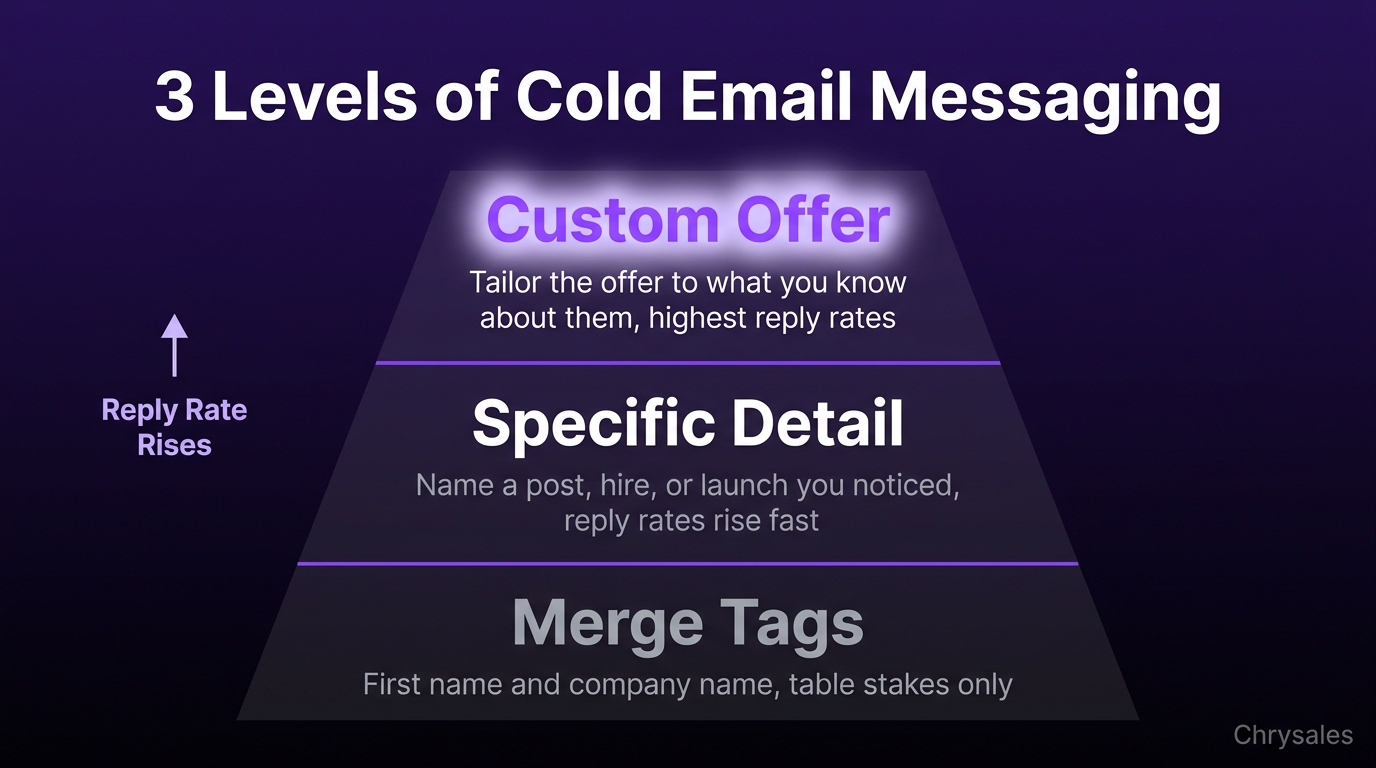
The Three Levels of Personalization
Level 1: Merge tags. First name, company name, industry. This is table stakes. If you're not doing this, you're already losing. But it won't make you stand out.
Level 2: Specific observations. You mention a LinkedIn post they made, a podcast they were on, a recent hire, a product launch, a website change. This takes more work, but it's where reply rates start moving. A 30-person consulting firm we trained added one specific observation to the first line of every email. Their reply rate went from 2% to 6% in three weeks.
Level 3: Custom offers. You change what you're offering based on what you know about them. If they just hired a sales team, you lead with training. If they're scaling fast, you lead with systems. If they're stuck at the same revenue for two years, you lead with client acquisition. This is hard to automate, but it's where the real money is.
Watch out: Don't fake personalization. If you say "I loved your recent LinkedIn post" but didn't actually read it, people can tell. It's worse than no personalization at all.
How Much Personalization Is Enough?
If you're sending 20 emails a day, go deep. Write custom first lines, research every person, tailor the offer. If you're sending 200 emails a day, use Level 2 personalization for the top 20% of your list and Level 1 for the rest. If you're sending 500 emails a day with zero personalization, you're doing spam, not sales.
Most teams try to automate too much. They build a 40 step workflow when 12 steps would do the job. Keep it simple. One good observation beats five generic sentences.
Email Deliverability: The Technical Stuff You Can't Skip
You can write the best cold email in the world. If it lands in spam, it doesn't matter. Email deliverability is the boring technical layer that makes or breaks outbound email marketing. Most teams ignore it until their emails stop working.
The Big Three Deliverability Killers
No domain warm up. You buy a new domain, connect it to Instantly or Smartlead, and blast 500 emails on day one. Gmail and Outlook see this and flag you immediately. You need to warm up every sending domain for at least two weeks before you go hard. Tools like Mailreach, Warmbox, or the built in warm up features in most cold email platforms handle this.
Sending from your main domain. Never send cold outreach from your main company domain. If you get flagged, your whole company's email reputation tanks. Set up secondary domains that are similar to your main one. If your main domain is chrysales.com, use trychrysales.com or hello chrysales.com for outbound. Spread your volume across three to five domains so no single domain sends more than 50 emails per day.
Ignoring spam triggers. Certain words and patterns make spam filters nervous. "Free," "guarantee," "click here," "act now," all caps subject lines, too many exclamation marks, broken links, and huge images all hurt you. Clean, simple, text based emails that look like a normal person wrote them perform best.
Simple Deliverability Checklist
Set up SPF, DKIM, and DMARC records for every sending domain. This tells email providers you're a real sender. Warm up new domains for 14 to 21 days before full send volume. Keep daily send volume under 50 emails per inbox. Use multiple inboxes and rotate sending. Monitor bounce rates and spam complaints. If bounces go over 5%, stop and clean your list. Keep emails under 150 words in the first touch. Plain text or very light HTML works best.
Common mistake: Teams set up everything correctly, then ruin it by sending 300 emails in one day from a brand new domain. Patience pays off. Slow and steady wins the deliverability game.
Building Outbound Sales Sequences That Get Responses
One email rarely works. Most replies come from follow ups. But most sales prospecting emails are too aggressive, too frequent, or too repetitive. The goal of a sequence is to stay visible without being annoying. According to best practices in B2B sales prospecting, the key is balancing persistence with value in every touchpoint.
The Anatomy of a High-Converting Sequence
A good B2B cold email sequence has four to six touches spread over two to three weeks. Email 1 is the intro. Short, specific, one clear question or offer. Email 2 is the value add. Share a resource, a case study, a quick tip related to their business. Email 3 is the pattern interrupt. Different angle, different format, or a quick question. Email 4 is the breakup email. "Should I close your file?" or "Is this just bad timing?" Spacing matters. Day 1, Day 3, Day 7, Day 10, Day 14 is a solid rhythm. Some teams go tighter. Some go wider. Test what works for your audience, but never send two emails in the same day unless it's a specific campaign type.
Pro Tip: The breakup email often gets the highest reply rate. People feel guilty or realize they actually do want to talk. Keep it short and give them an easy out.
What to Say in Each Email
Email 1 should be 50 to 100 words. Open with a specific observation or quick compliment. State why you're reaching out in one sentence. Ask one question or offer one thing. End with a clear call to action, usually a meeting link or a yes or no question. For more detailed examples and templates, explore our guide on cold email writing tactics that convert.
Email 2 should add value without asking for anything. "Saw you're hiring for X role. Here's a quick guide we made on how to onboard sellers fast. No pitch, just thought it might help." This builds trust and separates you from every other email in their inbox.
Email 3 can try a different format. A one sentence email. A quick video. A screenshot. A question about something they posted. Changing the pattern gets attention.
Email 4 is the close out. "Hey [Name], haven't heard back so I'm guessing this isn't a priority right now. Should I close your file, or is it just bad timing?" This gives them permission to say no, which paradoxically gets more replies than another sales pitch. If you want to see proven frameworks in action, check out our cold email follow-up sequence templates that consistently drive responses.
Writing Subject Lines That Get Opened in 2026
Your subject line is the gatekeeper. If it doesn't get opened, the rest doesn't matter. Most subject lines in outbound email marketing try too hard. They sound like ads. The best subject lines sound like a normal email from a colleague.
What Works Right Now
Simple and specific. "Quick question about [their company]" or "Saw your post on [topic]" or "[Mutual connection] suggested I reach out." These feel personal and low pressure. Open rates on these hover around 40% to 50% when the list is good.
Curiosity without clickbait. "Thoughts on this?" or "Is this you?" or "Noticed something interesting." These work if the first line of the email delivers on the curiosity. If it's a bait and switch, people unsubscribe.
Direct value. "[Benefit] for [their company type]" or "Help with [specific problem]." This works when you actually know their problem. A generic "Help with sales" won't cut it. "Help with setter retention" is better if you know they're hiring setters.
Watch out: Avoid anything that sounds like marketing. "Unlock your potential," "transform your sales," or "exclusive offer" all scream spam. Keep it conversational.
Subject Line Testing Framework
Test two subject lines per campaign. Run each on 50 to 100 emails, then pick the winner for the rest of the list. Track open rate, but also track reply rate. A subject line that gets 60% opens but zero replies is worse than one that gets 35% opens and 5% replies. The goal is conversations, not just opens.
Some teams test seven or eight subject lines at once. That's overthinking it. Two variables, clear winner, move on. You'll learn more from sending volume than from endless testing.
Calls to Action That Book Meetings, Not Confusion
The end of your email should tell the reader exactly what to do next. Most cold outreach emails fail here. They either ask for too much, offer too many options, or don't ask for anything at all.
The One Thing Rule
Every email should have one call to action. Not two. Not three. One. Book a meeting, reply yes or no, click a link, watch a video. Pick one. When you give people multiple options, they pick none.
A 15 person consulting firm we worked with was ending every cold email with "Let me know if you'd like to chat, or feel free to check out our website, or I can send over a case study." Their reply rate was under 1%. We changed the CTA to "Worth a 15 minute call? Grab a time here: [link]." Reply rate jumped to 3.8%.
Common mistake: Asking for a call without saying what the call is about. "Got 15 minutes next week?" is weak. "Got 15 minutes next week to talk about how we helped [similar company] add three deals a month?" is better. Specificity reduces friction.
Calendar Links vs. Open Ended Asks
Calendar links work great for warm leads and sequences later in the funnel. For cold email 1, they can feel presumptuous. Test both. Some audiences respond better to "Does this make sense to explore?" with a reply based CTA. Others prefer "Grab a time: [Calendly link]."
If you use a calendar link, make sure it's frictionless. Don't ask for their life story in the booking form. Name, email, one optional question max. Long forms kill conversions.
How AI and Automation Fit Into Outbound Email Best Practices
AI tools are everywhere in B2B sales right now. Some are useful. Most are overrated. The key is knowing where automation helps and where it hurts. Many experts recommend reviving traditional B2B sales strategies with selective digital tools rather than automating everything blindly.
What to Automate
List building and enrichment. Tools like Clay, Apollo, and Instantly can pull lists, enrich data, find emails, and verify them faster than any human. This is a perfect use case for automation. Let the robots do the boring data work.
Sequencing and follow ups. Once you write the emails, let the platform handle the timing and follow ups. You shouldn't be manually sending email 3 of a sequence. Tools like Smartlead, Instantly, Lemlist, and Outreach handle this perfectly.
Lead scoring. AI can score leads based on engagement, reply sentiment, and fit. We use Gemini based workflows to score inbound leads and prioritize who to call first. Anything scoring above 70 goes to the top of the call list. This saves hours of manual filtering.
What Not to Automate
The first touch. AI written first emails sound like AI written first emails. People can tell. Write the first email yourself or use AI to draft, then rewrite it in your voice. The goal is to sound like a human, not a robot.
Replies. Never automate replies to someone who actually responded. If they took the time to write back, you take the time to write back. Automated replies to real humans kill trust instantly.
Offer creation. AI can suggest offers, but it can't build a no brainer offer that actually converts. That takes understanding your market, your positioning, and your buyer's pain points. Do this part yourself.
Pro Tip: Use AI as a research assistant, not a replacement. Let it pull data, summarize LinkedIn profiles, suggest angles. Then you write the email. To see how AI fits into a complete sales framework, read our full breakdown on integrating AI in your sales system the right way.
Tracking, Testing, and Improving Your Outbound Email Marketing System
Outbound email marketing isn't a set it and forget it thing. It's a system that gets better the more you test and refine. Most teams send emails into the void and never look at the numbers. That's leaving money on the table. Research shows that tracking performance metrics closely boosts B2B sales productivity by helping teams double down on what works.
The Metrics That Actually Matter
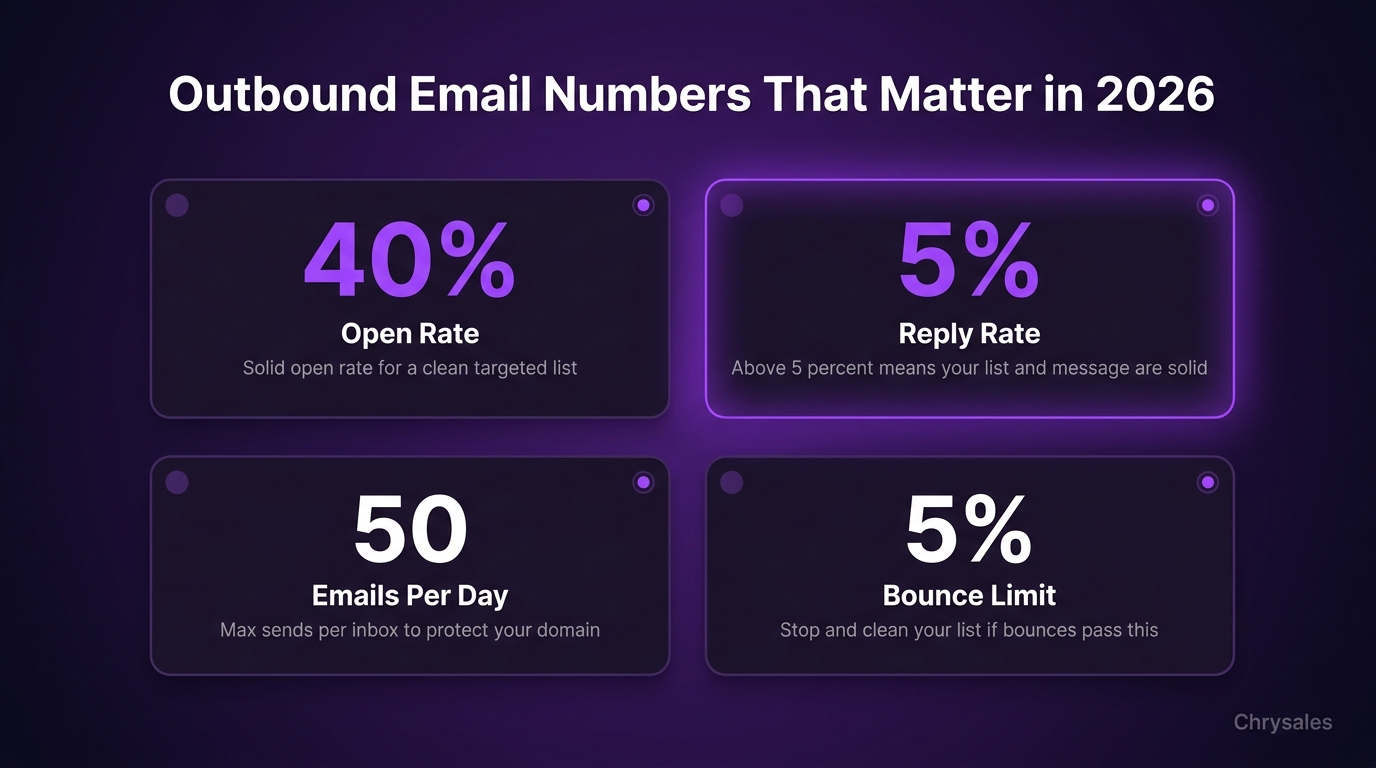
Open rate. Anything above 40% is solid. Above 60% is great. Below 30% means your subject lines need work or your list is bad.
Reply rate. This is the big one. For cold B2B outreach, 2% to 5% is average. 5% to 10% is very good. Above 10% means your list and message are dialed in. Below 2% means something is broken.
Positive reply rate. Not all replies are good. "Unsubscribe" and "not interested" don't count. Track positive replies separately. This tells you how many people actually want to talk.
Meeting booked rate. The final metric. Of the positive replies, how many turn into booked meetings? This should be 40% to 60%. If it's lower, your offer isn't clear or your follow up process is weak.
Bounce rate. Keep this under 5%. Higher means bad data. Fix your list or change your email verification tool.
Simple Testing Framework for Client Acquisition
Pick one variable to test per campaign. Subject line, first sentence, call to action, send time, sequence length. Change one thing, send to two equal segments, compare results. The winner becomes the new control.
Don't test everything at once. You won't know what worked. Test one thing, learn, apply, move to the next variable. Over time, these small improvements compound. A 1% improvement in reply rate across 1,000 emails is 10 more conversations. Do that every month and you're talking real pipeline.
Most teams obsess over testing and never send enough volume. Sending 50 emails with 10 variables is useless. Send 500 emails with two variables. Volume teaches you more than perfection.
Frequently Asked Questions
Q: What's a good reply rate for cold outbound email marketing in 2026?
For cold B2B outreach, 2% to 5% is typical. If you're above 5%, you're doing well. Above 10% is excellent and usually means tight targeting and solid messaging. If you're under 2%, check your list quality first, then your subject lines, then your offer. Most problems live in the list.
Q: How many emails should I send per day per inbox?
Keep it under 50 emails per inbox per day. If you're using multiple inboxes and domains, you can scale up, but never send more than 50 from a single address. This keeps you under spam radar and protects your sender reputation. Patience pays off in deliverability.
Q: Should I buy email lists or build them myself?
Build them yourself using tools like Apollo, Hunter, or Instantly. Bought lists are almost always garbage. Old data, wrong contacts, high bounce rates. Building your own list with filters and intent signals gives you control over quality, which directly impacts reply rates and deliverability.
Q: Do I need separate domains for cold email outreach?
Yes. Never send cold outbound from your main company domain. If you get flagged or marked as spam, it hurts your entire company's email reputation. Set up secondary domains that are similar to your main one and use those for all cold outreach. This is standard practice in B2B lead generation.
Q: How long should my cold emails be?
Keep the first email in a sequence between 50 and 100 words. Shorter is usually better. People are busy. Get to the point fast. Later emails in the sequence can be slightly longer if you're adding value or context, but anything over 150 words in a cold email is pushing it.
Q: What's the best tool for outbound email automation?
Instantly, Smartlead, Lemlist, and Apollo are all solid for cold email automation. The best one depends on your needs. Instantly and Smartlead are great for high volume and deliverability features. Lemlist has strong personalization tools. Apollo combines list building and sending. Test one, learn it well, then scale.
Q: How do I avoid the spam folder with cold emails?
Set up SPF, DKIM, and DMARC records. Warm up new domains for two to three weeks. Keep send volume under 50 per inbox per day. Use clean, simple, text based emails. Avoid spam trigger words. Verify emails before sending. Monitor bounce rates and stop sending if they go over 5%. Deliverability is a system, not a one time fix.
Outbound email marketing is a way to send cold emails that get replies by using good lists, simple personalization, solid deliverability, and clear calls to action. Picture this: you spend three days writing the perfect cold email. You hit send to 500 people. You get two replies, one bounce, and 12 unsubscribes. The rest? Radio silence. Most teams blame the message. The real problem is usually what happened before you typed a single word. Outbound email marketing works when you build it like a system, not a one-off campaign. This guide shows you how to get replies, avoid spam folders, and turn cold outreach into a predictable way to book meetings. If you're still weighing different channels, you can watch our breakdown of cold email vs. cold calling for outbound to see where email fits in your overall strategy.
Why Most Outbound Email Campaigns Fail Before They Start
Here's the thing nobody tells you: the list does most of the heavy lifting. Most cold emails flop because the list is bad, not the words. A sales list is like a phone contact list. If half the numbers don't work, no message gets through. If you're emailing people who aren't buyers, have wrong titles, or work at companies that will never buy from you, your email could be written by a Pulitzer winner and it still won't work.
The Three Big List Problems
Bad data. Emails bounce. Job titles are outdated. The person left the company six months ago. Tools like Apollo, Lusha, and ZoomInfo help, but even the best databases have 10% to 20% decay every quarter. If you don't verify emails before sending, your sender reputation tanks fast.
Wrong people. You're targeting marketing managers when the real buyer is the VP of Sales. Or you're going after startups with five employees when your product only makes sense for teams of 30 or more. Every email to the wrong person hurts your reply rate and trains spam filters that your emails aren't relevant.
No research layer. Sending to a list of 1,000 companies with zero context is lazy. A 200-person company that just did layoffs is not a hot lead. It's a bad fit, full stop. Adding one layer of intent data, recent funding news, hiring signals, or tech stack info turns a generic list into a targeted one.
Pro Tip: Spend as much time building and cleaning your list as you do writing the email. Most teams do the opposite.
How to Build a List That Actually Converts
Start with your ideal customer profile. Write down company size, industry, tech stack, location, and any other hard filters. Then add one or two intent signals: recently hired for a role, posted a job, raised funding, mentioned a problem on LinkedIn, attended a specific event. For a deeper dive into proven tools for building and enriching outbound lists, check out our comparison guide that breaks down the best platforms for your needs.
Use tools like Apollo, Hunter, or Instantly to pull the list. Then verify every email with NeverBounce, ZeroBounce, or Kickbox before you load it into your outreach tool. This step alone can boost deliverability by 15% to 25%.
We worked with a marketing agency last year. They had a 0.5% reply rate on cold outbound. After cleaning the list and tightening the targeting to companies with 20 to 100 employees in three specific industries, the reply rate jumped to 4.2%. Same email template. Better list. You can also learn practical methods for finding clients that match your ICP through our video walkthrough on client targeting.
Personalization That Actually Works in B2B Lead Generation
Most advice on email personalization is garbage. "Use their first name." "Mention their company." That's not personalization. That's mail merge. Real personalization in outbound email marketing means you noticed something specific about them or their business, and you're reaching out because of that thing. Not because their email was in a database.
The Three Levels of Personalization
Level 1: Merge tags. First name, company name, industry. This is table stakes. If you're not doing this, you're already losing. But it won't make you stand out.
Level 2: Specific observations. You mention a LinkedIn post they made, a podcast they were on, a recent hire, a product launch, a website change. This takes more work, but it's where reply rates start moving. A 30-person consulting firm we trained added one specific observation to the first line of every email. Their reply rate went from 2% to 6% in three weeks.
Level 3: Custom offers. You change what you're offering based on what you know about them. If they just hired a sales team, you lead with training. If they're scaling fast, you lead with systems. If they're stuck at the same revenue for two years, you lead with client acquisition. This is hard to automate, but it's where the real money is.
Watch out: Don't fake personalization. If you say "I loved your recent LinkedIn post" but didn't actually read it, people can tell. It's worse than no personalization at all.
How Much Personalization Is Enough?
If you're sending 20 emails a day, go deep. Write custom first lines, research every person, tailor the offer. If you're sending 200 emails a day, use Level 2 personalization for the top 20% of your list and Level 1 for the rest. If you're sending 500 emails a day with zero personalization, you're doing spam, not sales.
Most teams try to automate too much. They build a 40 step workflow when 12 steps would do the job. Keep it simple. One good observation beats five generic sentences.
Email Deliverability: The Technical Stuff You Can't Skip
You can write the best cold email in the world. If it lands in spam, it doesn't matter. Email deliverability is the boring technical layer that makes or breaks outbound email marketing. Most teams ignore it until their emails stop working.
The Big Three Deliverability Killers
No domain warm up. You buy a new domain, connect it to Instantly or Smartlead, and blast 500 emails on day one. Gmail and Outlook see this and flag you immediately. You need to warm up every sending domain for at least two weeks before you go hard. Tools like Mailreach, Warmbox, or the built in warm up features in most cold email platforms handle this.
Sending from your main domain. Never send cold outreach from your main company domain. If you get flagged, your whole company's email reputation tanks. Set up secondary domains that are similar to your main one. If your main domain is chrysales.com, use trychrysales.com or hello chrysales.com for outbound. Spread your volume across three to five domains so no single domain sends more than 50 emails per day.
Ignoring spam triggers. Certain words and patterns make spam filters nervous. "Free," "guarantee," "click here," "act now," all caps subject lines, too many exclamation marks, broken links, and huge images all hurt you. Clean, simple, text based emails that look like a normal person wrote them perform best.
Simple Deliverability Checklist
Set up SPF, DKIM, and DMARC records for every sending domain. This tells email providers you're a real sender. Warm up new domains for 14 to 21 days before full send volume. Keep daily send volume under 50 emails per inbox. Use multiple inboxes and rotate sending. Monitor bounce rates and spam complaints. If bounces go over 5%, stop and clean your list. Keep emails under 150 words in the first touch. Plain text or very light HTML works best.
Common mistake: Teams set up everything correctly, then ruin it by sending 300 emails in one day from a brand new domain. Patience pays off. Slow and steady wins the deliverability game.
Building Outbound Sales Sequences That Get Responses
One email rarely works. Most replies come from follow ups. But most sales prospecting emails are too aggressive, too frequent, or too repetitive. The goal of a sequence is to stay visible without being annoying. According to best practices in B2B sales prospecting, the key is balancing persistence with value in every touchpoint.
The Anatomy of a High-Converting Sequence
A good B2B cold email sequence has four to six touches spread over two to three weeks. Email 1 is the intro. Short, specific, one clear question or offer. Email 2 is the value add. Share a resource, a case study, a quick tip related to their business. Email 3 is the pattern interrupt. Different angle, different format, or a quick question. Email 4 is the breakup email. "Should I close your file?" or "Is this just bad timing?" Spacing matters. Day 1, Day 3, Day 7, Day 10, Day 14 is a solid rhythm. Some teams go tighter. Some go wider. Test what works for your audience, but never send two emails in the same day unless it's a specific campaign type.
Pro Tip: The breakup email often gets the highest reply rate. People feel guilty or realize they actually do want to talk. Keep it short and give them an easy out.
What to Say in Each Email
Email 1 should be 50 to 100 words. Open with a specific observation or quick compliment. State why you're reaching out in one sentence. Ask one question or offer one thing. End with a clear call to action, usually a meeting link or a yes or no question. For more detailed examples and templates, explore our guide on cold email writing tactics that convert.
Email 2 should add value without asking for anything. "Saw you're hiring for X role. Here's a quick guide we made on how to onboard sellers fast. No pitch, just thought it might help." This builds trust and separates you from every other email in their inbox.
Email 3 can try a different format. A one sentence email. A quick video. A screenshot. A question about something they posted. Changing the pattern gets attention.
Email 4 is the close out. "Hey [Name], haven't heard back so I'm guessing this isn't a priority right now. Should I close your file, or is it just bad timing?" This gives them permission to say no, which paradoxically gets more replies than another sales pitch. If you want to see proven frameworks in action, check out our cold email follow-up sequence templates that consistently drive responses.
Writing Subject Lines That Get Opened in 2026
Your subject line is the gatekeeper. If it doesn't get opened, the rest doesn't matter. Most subject lines in outbound email marketing try too hard. They sound like ads. The best subject lines sound like a normal email from a colleague.
What Works Right Now
Simple and specific. "Quick question about [their company]" or "Saw your post on [topic]" or "[Mutual connection] suggested I reach out." These feel personal and low pressure. Open rates on these hover around 40% to 50% when the list is good.
Curiosity without clickbait. "Thoughts on this?" or "Is this you?" or "Noticed something interesting." These work if the first line of the email delivers on the curiosity. If it's a bait and switch, people unsubscribe.
Direct value. "[Benefit] for [their company type]" or "Help with [specific problem]." This works when you actually know their problem. A generic "Help with sales" won't cut it. "Help with setter retention" is better if you know they're hiring setters.
Watch out: Avoid anything that sounds like marketing. "Unlock your potential," "transform your sales," or "exclusive offer" all scream spam. Keep it conversational.
Subject Line Testing Framework
Test two subject lines per campaign. Run each on 50 to 100 emails, then pick the winner for the rest of the list. Track open rate, but also track reply rate. A subject line that gets 60% opens but zero replies is worse than one that gets 35% opens and 5% replies. The goal is conversations, not just opens.
Some teams test seven or eight subject lines at once. That's overthinking it. Two variables, clear winner, move on. You'll learn more from sending volume than from endless testing.
Calls to Action That Book Meetings, Not Confusion
The end of your email should tell the reader exactly what to do next. Most cold outreach emails fail here. They either ask for too much, offer too many options, or don't ask for anything at all.
The One Thing Rule
Every email should have one call to action. Not two. Not three. One. Book a meeting, reply yes or no, click a link, watch a video. Pick one. When you give people multiple options, they pick none.
A 15 person consulting firm we worked with was ending every cold email with "Let me know if you'd like to chat, or feel free to check out our website, or I can send over a case study." Their reply rate was under 1%. We changed the CTA to "Worth a 15 minute call? Grab a time here: [link]." Reply rate jumped to 3.8%.
Common mistake: Asking for a call without saying what the call is about. "Got 15 minutes next week?" is weak. "Got 15 minutes next week to talk about how we helped [similar company] add three deals a month?" is better. Specificity reduces friction.
Calendar Links vs. Open Ended Asks
Calendar links work great for warm leads and sequences later in the funnel. For cold email 1, they can feel presumptuous. Test both. Some audiences respond better to "Does this make sense to explore?" with a reply based CTA. Others prefer "Grab a time: [Calendly link]."
If you use a calendar link, make sure it's frictionless. Don't ask for their life story in the booking form. Name, email, one optional question max. Long forms kill conversions.
How AI and Automation Fit Into Outbound Email Best Practices
AI tools are everywhere in B2B sales right now. Some are useful. Most are overrated. The key is knowing where automation helps and where it hurts. Many experts recommend reviving traditional B2B sales strategies with selective digital tools rather than automating everything blindly.
What to Automate
List building and enrichment. Tools like Clay, Apollo, and Instantly can pull lists, enrich data, find emails, and verify them faster than any human. This is a perfect use case for automation. Let the robots do the boring data work.
Sequencing and follow ups. Once you write the emails, let the platform handle the timing and follow ups. You shouldn't be manually sending email 3 of a sequence. Tools like Smartlead, Instantly, Lemlist, and Outreach handle this perfectly.
Lead scoring. AI can score leads based on engagement, reply sentiment, and fit. We use Gemini based workflows to score inbound leads and prioritize who to call first. Anything scoring above 70 goes to the top of the call list. This saves hours of manual filtering.
What Not to Automate
The first touch. AI written first emails sound like AI written first emails. People can tell. Write the first email yourself or use AI to draft, then rewrite it in your voice. The goal is to sound like a human, not a robot.
Replies. Never automate replies to someone who actually responded. If they took the time to write back, you take the time to write back. Automated replies to real humans kill trust instantly.
Offer creation. AI can suggest offers, but it can't build a no brainer offer that actually converts. That takes understanding your market, your positioning, and your buyer's pain points. Do this part yourself.
Pro Tip: Use AI as a research assistant, not a replacement. Let it pull data, summarize LinkedIn profiles, suggest angles. Then you write the email. To see how AI fits into a complete sales framework, read our full breakdown on integrating AI in your sales system the right way.
Tracking, Testing, and Improving Your Outbound Email Marketing System
Outbound email marketing isn't a set it and forget it thing. It's a system that gets better the more you test and refine. Most teams send emails into the void and never look at the numbers. That's leaving money on the table. Research shows that tracking performance metrics closely boosts B2B sales productivity by helping teams double down on what works.
The Metrics That Actually Matter
Open rate. Anything above 40% is solid. Above 60% is great. Below 30% means your subject lines need work or your list is bad.
Reply rate. This is the big one. For cold B2B outreach, 2% to 5% is average. 5% to 10% is very good. Above 10% means your list and message are dialed in. Below 2% means something is broken.
Positive reply rate. Not all replies are good. "Unsubscribe" and "not interested" don't count. Track positive replies separately. This tells you how many people actually want to talk.
Meeting booked rate. The final metric. Of the positive replies, how many turn into booked meetings? This should be 40% to 60%. If it's lower, your offer isn't clear or your follow up process is weak.
Bounce rate. Keep this under 5%. Higher means bad data. Fix your list or change your email verification tool.
Simple Testing Framework for Client Acquisition
Pick one variable to test per campaign. Subject line, first sentence, call to action, send time, sequence length. Change one thing, send to two equal segments, compare results. The winner becomes the new control.
Don't test everything at once. You won't know what worked. Test one thing, learn, apply, move to the next variable. Over time, these small improvements compound. A 1% improvement in reply rate across 1,000 emails is 10 more conversations. Do that every month and you're talking real pipeline.
Most teams obsess over testing and never send enough volume. Sending 50 emails with 10 variables is useless. Send 500 emails with two variables. Volume teaches you more than perfection.
Frequently Asked Questions
Q: What's a good reply rate for cold outbound email marketing in 2026?
For cold B2B outreach, 2% to 5% is typical. If you're above 5%, you're doing well. Above 10% is excellent and usually means tight targeting and solid messaging. If you're under 2%, check your list quality first, then your subject lines, then your offer. Most problems live in the list.
Q: How many emails should I send per day per inbox?
Keep it under 50 emails per inbox per day. If you're using multiple inboxes and domains, you can scale up, but never send more than 50 from a single address. This keeps you under spam radar and protects your sender reputation. Patience pays off in deliverability.
Q: Should I buy email lists or build them myself?
Build them yourself using tools like Apollo, Hunter, or Instantly. Bought lists are almost always garbage. Old data, wrong contacts, high bounce rates. Building your own list with filters and intent signals gives you control over quality, which directly impacts reply rates and deliverability.
Q: Do I need separate domains for cold email outreach?
Yes. Never send cold outbound from your main company domain. If you get flagged or marked as spam, it hurts your entire company's email reputation. Set up secondary domains that are similar to your main one and use those for all cold outreach. This is standard practice in B2B lead generation.
Q: How long should my cold emails be?
Keep the first email in a sequence between 50 and 100 words. Shorter is usually better. People are busy. Get to the point fast. Later emails in the sequence can be slightly longer if you're adding value or context, but anything over 150 words in a cold email is pushing it.
Q: What's the best tool for outbound email automation?
Instantly, Smartlead, Lemlist, and Apollo are all solid for cold email automation. The best one depends on your needs. Instantly and Smartlead are great for high volume and deliverability features. Lemlist has strong personalization tools. Apollo combines list building and sending. Test one, learn it well, then scale.
Q: How do I avoid the spam folder with cold emails?
Set up SPF, DKIM, and DMARC records. Warm up new domains for two to three weeks. Keep send volume under 50 per inbox per day. Use clean, simple, text based emails. Avoid spam trigger words. Verify emails before sending. Monitor bounce rates and stop sending if they go over 5%. Deliverability is a system, not a one time fix.
Scaling Is Not Hard If You Have The Right Systems
If you’re serious about leveling up your scaling game, you need the right system, the right training, and the right team behind you. We're here to give you the exact tools and strategies top entrepreneurs use to dominate.

Discover the latest tips
View All.avif)
Chrysales was formed from the words "chrysalis" the stage where a caterpillar transforms into a butterfly and "sales".
It stands for one thing: sales transformation.Because scaling doesn’t happen by doing more of the same. Scaling only happens when you go through real transformation in your systems, your offer, team and the way you sell.
.avif)


