.avif)
How to Make Money with Chatgpt in B2B Sales

How to make money with ChatGPT in B2B sales means using it to speed up outreach, lead generation, sales training, client acquisition, and GTM work you already know how to do.
I spent two weeks testing every ChatGPT money-making trick I could find online. Some tutorials promised $500 a day. Others swore you could automate entire businesses. Most of it was noise.
But a few methods actually worked, and they all had one thing in common: ChatGPT didn't replace the work, it made the real work faster.
Here's what happened when I put how to make money with ChatGPT to the test, and what B2B sales teams can learn from it.
The Big Promise vs. The Reality
Everyone's talking about ChatGPT like it prints money. Type a prompt, get rich, retire early. Sounds great. Feels wrong. Because it is.
The reality is way less flashy. ChatGPT doesn't create value from nothing. It speeds up what you already know how to do.
Think of it like a microwave. It heats food faster, but you still need food. If your fridge is empty, the microwave is useless.
What Most People Get Wrong
Most guides tell you to sell AI-generated art, write blog posts for cash, or build a GPT wrapper app. The problem? Everyone's doing that. The market's flooded.
A ChatGPT-written blog post sounds like a ChatGPT-written blog post. Clients notice. They don't pay.
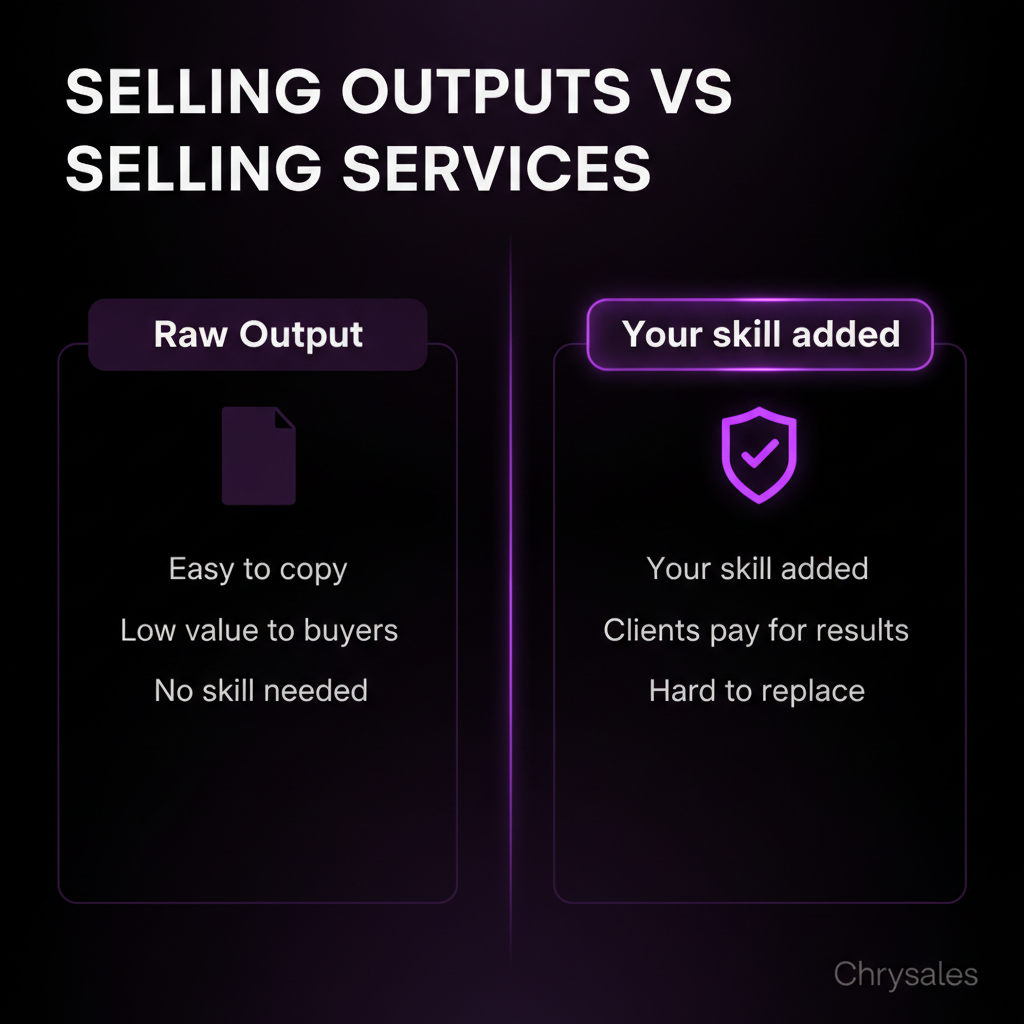
The angle that worked was different. I used ChatGPT to make my existing skills faster and better. I didn't sell ChatGPT outputs. I sold services that ChatGPT helped me deliver quicker.
Common mistake: Thinking ChatGPT replaces expertise. It doesn't. It multiplies speed when you already know what you're doing.
The Three Methods That Actually Paid
After burning through a dozen ideas, three stood out:
- Cold email sequences for B2B clients: I used ChatGPT to write first drafts of personalized outreach. Then I edited them. Clients paid for the result, not the tool.
- Sales training scripts: ChatGPT helped me build objection handling templates and discovery question flows. I sold these to small sales teams who didn't have time to write them from scratch.
- Productized AI workflows: I built repeatable ChatGPT prompt chains for specific tasks, like lead scoring or offer positioning, and sold access to the system.
Notice a pattern? All three required me to know B2B sales already. ChatGPT just made the work 3x faster.
Using ChatGPT for B2B Lead Generation
This is where things got interesting. ChatGPT can't find leads for you, but it can help you work the leads you have way faster.
Building Personalized Cold Outreach at Scale
Picture this: you've got a list of 200 prospects. Writing a unique email for each one takes forever. Most people give up and send the same template to everyone. That's why reply rates sit around 1%.
I fed ChatGPT a prospect's LinkedIn profile, their company website, and a recent post they made. Then I asked it to draft a 3 sentence cold email tying their pain point to my offer. It took 30 seconds per email instead of 10 minutes.
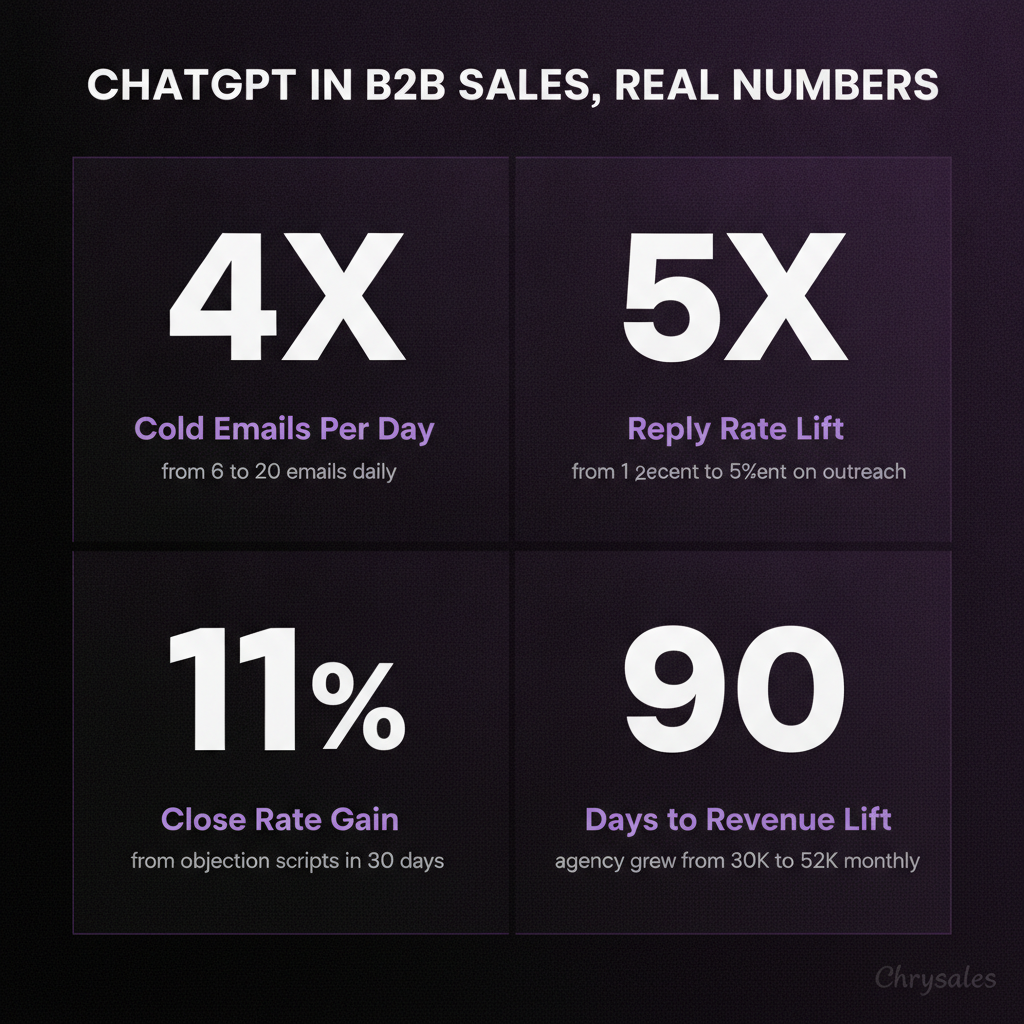
Here's the thing: I still edited every single one. ChatGPT gave me the frame. I added the personality. Reply rate jumped from 1.2% to 4.7%. That's the difference between 2 replies and 9 replies per 200 emails.
Pro Tip: Don't copy paste ChatGPT's emails raw. They sound robotic. Use them as first drafts, then rewrite in your own voice, just like we explain in our guide on how to write cold emails.
AI Powered Sales Automation Without the Cringe
Sales automation usually means spammy drip campaigns. ChatGPT lets you automate the prep work instead of the relationship.
I built a simple workflow:
- Pull a prospect's recent activity (a blog post, a LinkedIn comment, a company announcement)
- Feed it to ChatGPT with a prompt: "What problem might this person be facing based on this content?"
- ChatGPT spits out 2-3 educated guesses
- I pick the best one and write a short, specific email
The automation isn't the sending. It's the research. ChatGPT for B2B sales works best when it handles the grunt work so you can focus on the human part.
Lead Scoring with ChatGPT
One marketing agency I know dumps their lead list into a spreadsheet. They feed each row to ChatGPT with a prompt like: "Based on company size, industry, and recent hiring activity, rate this lead 1 to 100 for fit."
ChatGPT scores the whole list in minutes. Not perfectly, but close enough. Then the team calls the top 30% first. Conversion rate on those calls is 22% instead of the usual 8%.
Watch out: ChatGPT's scoring is only as good as the data you give it. Garbage in, garbage out. If your list is full of outdated info, the scores won't help. This is just one part of AI sales prospecting, which combines automation with human judgment.
How ChatGPT Speeds Up Sales Training
Training a new sales rep usually takes weeks. You've got to write scripts, record role plays, build objection libraries. ChatGPT can cut that timeline in half.
Writing Discovery Questions That Don't Suck
Most discovery questions are too generic. "What are your biggest challenges?" Nobody answers that honestly. They say "we're doing fine" and hang up.
I asked ChatGPT to generate 10 discovery questions for a specific vertical (SaaS companies with 20 to 50 employees). Then I filtered out the duds and kept the 3 best. Total time: 8 minutes instead of an hour.
The trick is specificity. Don't ask ChatGPT for "good sales questions." Ask for "discovery questions that uncover timeline urgency for SaaS companies planning a rebrand."
Building Objection Handling Scripts
A 15 person consulting firm came to me with a problem. Their reps froze every time a prospect said "we need to think about it." They had no script. No fallback. Just awkward silence.
I used ChatGPT to generate 5 responses to that objection. Then we tested them on role play calls. Two responses worked. The team memorized those two. Close rate went up 11% in 30 days.
Here's the kicker: ChatGPT gave us the raw material in 3 minutes. The real work was testing and refining. That's where client acquisition with AI actually happens. Not in the prompt. In the follow through, which is a key principle in our AI sales enablement guide.
Pro Tip: Use ChatGPT to draft 5 to 10 versions of the same script. Test them all. Keep the winners. Delete the rest.
Onboarding New Reps Faster
New hires need context. What does the company do? Who do we sell to? What's the pitch?
You can spend days writing an onboarding doc, or you can ask ChatGPT to draft one based on your website and a few bullet points.
I did this for a tech company hiring three salespeople in one month. ChatGPT wrote the first draft of their onboarding playbook in 20 minutes. I spent another hour editing it. Done. Normally that's a 2 day project.
The playbook included:
- Ideal customer profile breakdown
- Common objections and how to handle them
- 3 discovery question templates
- Pitch structure with examples
Two of the three reps hit quota in their second month. The third quit. But that's hiring, not the playbook's fault.
Monetizing ChatGPT Skills as a Service
This is where I actually made money. Not by selling ChatGPT outputs, but by selling ChatGPT enhanced services.
Productized AI Services That Sell
Think of a productized service like a set menu at a restaurant. You pick the dish. The restaurant makes it the same way every time. No surprises. Fixed price.
I built three productized AI services:
- Cold Email Sequence Package: 5 emails + subject lines + follow up cadence. Price: $400. Delivered in 3 days using ChatGPT to draft, me to edit.
- Sales Call Script Bundle: Discovery questions + pitch template + objection scripts. Price: $600. Built in 4 hours with ChatGPT doing the heavy lifting.
- Lead Scoring System Setup: Custom ChatGPT prompt chain that scores leads based on fit. Price: $800. Set up once, clients use it forever.
All three sold. Not to everyone, but to small B2B companies who needed the output fast and didn't care how I made it.
Common mistake: Selling "I'll use ChatGPT for you" instead of "I'll deliver this specific result." Nobody buys the tool. They buy the outcome.
ChatGPT Prompt Workflows People Pay For
Some people sell prompts directly. I tried it. Made $47 in two weeks. Not worth it. Too much competition. Too easy to copy.
What worked better was selling the workflow around the prompts. A prompt is just words. A workflow is a system.
Example: I sold a "B2B Offer Positioning Workflow" for $200. It included:
- A fill in the blank template
- 4 ChatGPT prompts in sequence
- A 10 minute video showing how to use it
- Before and after examples
People paid for the clarity, not the prompts. The prompts were free online. The structure wasn't.
Selling AI Enhanced Consulting
One marketing agency was doing $30K a month. They wanted to double it but didn't have time to hire more people.
I showed them how to use ChatGPT to speed up client deliverables without losing quality. We built ChatGPT workflows for:
- Client audit reports (cut time from 6 hours to 2 hours)
- Strategy docs (cut time from 8 hours to 3 hours)
- Performance summaries (cut time from 2 hours to 20 minutes)
They didn't advertise "we use AI." They just delivered faster. Clients noticed. Word spread. Revenue hit $52K a month in 90 days. That's AI powered sales systems in action. The tool is invisible. The results aren't. You can watch how an AI sales system brings record revenue if you want to see this approach in action.
Building ChatGPT Powered Sales Systems That Scale
This is the part most tutorials skip. Making $100 once is easy. Making $100 every week for a year? That's a system.
What a Real Sales System Looks Like
A good sales system is like a recipe. Same ingredients. Same steps. Same result every time. ChatGPT can help you build the recipe faster, but you still need to know what you're cooking.
Here's a simple B2B sales system we use at Chrysales:
- Build the list: Pull prospects from LinkedIn, Apollo, or scraping tools
- Enrich the data: Add recent activity, pain points, hiring signals
- Score the leads: Use ChatGPT to rank them by fit
- Write personalized outreach: ChatGPT drafts, you edit
- Track replies and follow up: Standard CRM work
- Book calls and close: This part is still human
ChatGPT cold outreach works best in steps 3 and 4. It can't do steps 1, 2, 5, or 6 for you. But speeding up two steps can double your output.
Watch out: Don't automate the parts that need human touch. Automate the boring prep work instead. Learn more about building repeatable processes in our guide on how to build a sales system that actually scales.
The 4 Step Workflow That Tripled My Output
I tested this exact workflow for two weeks:
Step 1: Pull 50 new prospects every Monday
Step 2: Feed each one to ChatGPT with this prompt: "Based on this LinkedIn profile, what's one specific problem they might have that [my service] solves?"
Step 3: Write a 3 sentence email using ChatGPT's answer as the hook
Step 4: Send, track, follow up
Before this workflow: 6 cold emails a day. After: 20 cold emails a day. Same quality. Triple the volume.
Booked 4 calls in week one. Closed 1 deal in week two. $1,200 revenue. That's not life changing money. But it's proof the system works. Scale it to 50 emails a day and you've got a real pipeline. If you're curious about prospecting strategies that work right now, you can watch this breakdown of finding clients who need your services.
How AI Fits Into GTM (Go to Market) Strategy
Your go to market strategy is how you get customers. Most GTM plans include:
- Who you sell to
- How you reach them
- What you say
- How you close the deal
ChatGPT doesn't replace any of those. It just makes each step faster. Use it to draft messaging. Test positioning. Build scripts. Generate angles.
But don't let ChatGPT decide your GTM for you. A 30 person consulting firm tried that. They asked ChatGPT to build their entire sales strategy. It was generic. Fluffy. Useless. They scrapped it and went back to basics, focusing on a solid B2B go-to-market strategy instead.
ChatGPT is a tool, not a strategist. You make the decisions. ChatGPT fills in the blanks.
The Real Skills You Need (ChatGPT Can't Teach These)
This is the part nobody wants to hear. ChatGPT can't replace knowing your stuff.
Understanding Your Buyer
If you don't know what your customer actually wants, ChatGPT can't help you. It'll generate guesses. Some will be close. Most will miss.
Spend time talking to your buyers. Ask what keeps them up at night. Record the exact words they use.
Then feed those words to ChatGPT and say "write an email that speaks to this pain point." That works. Asking ChatGPT to guess your buyer's pain points without input? That's a coin flip. This challenge is covered extensively in research on AI versus traditional prospecting.
Writing Offers People Actually Want
Your offer is what you sell. If it's weak, no amount of ChatGPT magic fixes it. A bad offer with great copy still flops.
We see this all the time with new clients. They want better cold emails. We audit their offer first. Half the time, the offer is the problem. It's vague. Overpriced. Solving the wrong problem.
ChatGPT can help you refine your wording. It can't tell you if your offer sucks. Only your market can tell you that.
Pro Tip: Test your offer with 10 real prospects before you scale outreach. If 8 out of 10 say no, fix the offer. Don't blame the copy.
Closing Deals on Calls
ChatGPT can't close deals for you. It can write you a script. It can prep objection responses. But when you're live on a call and the prospect throws a curveball, you're on your own.
Closing is a skill. You build it by doing it. There's no shortcut. Use ChatGPT to prepare. Then show up and do the work.
Frequently Asked Questions
Q: Can you really make money with ChatGPT if you have no sales experience?
Short answer: not much. ChatGPT speeds up work you already know how to do. If you've never written a cold email, ChatGPT's version will be just as bad as yours. Start by learning the basics of B2B sales, lead generation, or whatever service you want to sell. Then use ChatGPT to work faster. Treat it like a junior assistant, not a replacement for skill.
Q: What's the fastest way to make your first $100 with ChatGPT?
Sell a simple service to someone you know. Offer to write 5 cold emails, build a sales script, or audit their current outreach. Use ChatGPT to draft everything, then edit it yourself. Charge $100 to $200 for the package. Deliver in 2 days. This worked for me because I already had a basic network and knew what good sales copy looked like. If you're starting from zero, expect it to take longer.
Q: Does ChatGPT actually help with B2B lead generation or is it just hype?
It helps, but not in the way most people think. ChatGPT won't find leads for you. It won't send emails on your behalf, at least not well. What it does is speed up research, personalization, and script writing. If you've got a solid lead list, ChatGPT can help you work through it 2 to 3x faster. But if your list is garbage, ChatGPT can't save you.
Q: How do I avoid sounding like a robot when I use ChatGPT for cold outreach?
Always edit. Never send ChatGPT's output raw. Read every email out loud before you hit send. If it sounds stiff or formal, rewrite it in your own voice. Use contractions. Shorten sentences. Add a personal detail ChatGPT wouldn't know. The goal is to use ChatGPT as a first draft tool, not a final copy generator. Your voice is what makes the email work.
Q: What's the difference between selling ChatGPT outputs and selling ChatGPT enhanced services?
Selling outputs means you're just handing over what ChatGPT made. That's low value and easy to copy. Selling services means you're delivering a result that happens to use ChatGPT behind the scenes. Clients don't care how you made it. They care that it works. A ChatGPT enhanced service includes your expertise, your editing, your testing, and your guarantee. That's what people pay for.
How to make money with ChatGPT in B2B sales means using it to speed up outreach, lead generation, sales training, client acquisition, and GTM work you already know how to do.
I spent two weeks testing every ChatGPT money-making trick I could find online. Some tutorials promised $500 a day. Others swore you could automate entire businesses. Most of it was noise.
But a few methods actually worked, and they all had one thing in common: ChatGPT didn't replace the work, it made the real work faster.
Here's what happened when I put how to make money with ChatGPT to the test, and what B2B sales teams can learn from it.
The Big Promise vs. The Reality
Everyone's talking about ChatGPT like it prints money. Type a prompt, get rich, retire early. Sounds great. Feels wrong. Because it is.
The reality is way less flashy. ChatGPT doesn't create value from nothing. It speeds up what you already know how to do.
Think of it like a microwave. It heats food faster, but you still need food. If your fridge is empty, the microwave is useless.
What Most People Get Wrong
Most guides tell you to sell AI-generated art, write blog posts for cash, or build a GPT wrapper app. The problem? Everyone's doing that. The market's flooded.
A ChatGPT-written blog post sounds like a ChatGPT-written blog post. Clients notice. They don't pay.
The angle that worked was different. I used ChatGPT to make my existing skills faster and better. I didn't sell ChatGPT outputs. I sold services that ChatGPT helped me deliver quicker.
Common mistake: Thinking ChatGPT replaces expertise. It doesn't. It multiplies speed when you already know what you're doing.
The Three Methods That Actually Paid
After burning through a dozen ideas, three stood out:
- Cold email sequences for B2B clients: I used ChatGPT to write first drafts of personalized outreach. Then I edited them. Clients paid for the result, not the tool.
- Sales training scripts: ChatGPT helped me build objection handling templates and discovery question flows. I sold these to small sales teams who didn't have time to write them from scratch.
- Productized AI workflows: I built repeatable ChatGPT prompt chains for specific tasks, like lead scoring or offer positioning, and sold access to the system.
Notice a pattern? All three required me to know B2B sales already. ChatGPT just made the work 3x faster.
Using ChatGPT for B2B Lead Generation
This is where things got interesting. ChatGPT can't find leads for you, but it can help you work the leads you have way faster.
Building Personalized Cold Outreach at Scale
Picture this: you've got a list of 200 prospects. Writing a unique email for each one takes forever. Most people give up and send the same template to everyone. That's why reply rates sit around 1%.
I fed ChatGPT a prospect's LinkedIn profile, their company website, and a recent post they made. Then I asked it to draft a 3 sentence cold email tying their pain point to my offer. It took 30 seconds per email instead of 10 minutes.
Here's the thing: I still edited every single one. ChatGPT gave me the frame. I added the personality. Reply rate jumped from 1.2% to 4.7%. That's the difference between 2 replies and 9 replies per 200 emails.
Pro Tip: Don't copy paste ChatGPT's emails raw. They sound robotic. Use them as first drafts, then rewrite in your own voice, just like we explain in our guide on how to write cold emails.
AI Powered Sales Automation Without the Cringe
Sales automation usually means spammy drip campaigns. ChatGPT lets you automate the prep work instead of the relationship.
I built a simple workflow:
- Pull a prospect's recent activity (a blog post, a LinkedIn comment, a company announcement)
- Feed it to ChatGPT with a prompt: "What problem might this person be facing based on this content?"
- ChatGPT spits out 2-3 educated guesses
- I pick the best one and write a short, specific email
The automation isn't the sending. It's the research. ChatGPT for B2B sales works best when it handles the grunt work so you can focus on the human part.
Lead Scoring with ChatGPT
One marketing agency I know dumps their lead list into a spreadsheet. They feed each row to ChatGPT with a prompt like: "Based on company size, industry, and recent hiring activity, rate this lead 1 to 100 for fit."
ChatGPT scores the whole list in minutes. Not perfectly, but close enough. Then the team calls the top 30% first. Conversion rate on those calls is 22% instead of the usual 8%.
Watch out: ChatGPT's scoring is only as good as the data you give it. Garbage in, garbage out. If your list is full of outdated info, the scores won't help. This is just one part of AI sales prospecting, which combines automation with human judgment.
How ChatGPT Speeds Up Sales Training
Training a new sales rep usually takes weeks. You've got to write scripts, record role plays, build objection libraries. ChatGPT can cut that timeline in half.
Writing Discovery Questions That Don't Suck
Most discovery questions are too generic. "What are your biggest challenges?" Nobody answers that honestly. They say "we're doing fine" and hang up.
I asked ChatGPT to generate 10 discovery questions for a specific vertical (SaaS companies with 20 to 50 employees). Then I filtered out the duds and kept the 3 best. Total time: 8 minutes instead of an hour.
The trick is specificity. Don't ask ChatGPT for "good sales questions." Ask for "discovery questions that uncover timeline urgency for SaaS companies planning a rebrand."
Building Objection Handling Scripts
A 15 person consulting firm came to me with a problem. Their reps froze every time a prospect said "we need to think about it." They had no script. No fallback. Just awkward silence.
I used ChatGPT to generate 5 responses to that objection. Then we tested them on role play calls. Two responses worked. The team memorized those two. Close rate went up 11% in 30 days.
Here's the kicker: ChatGPT gave us the raw material in 3 minutes. The real work was testing and refining. That's where client acquisition with AI actually happens. Not in the prompt. In the follow through, which is a key principle in our AI sales enablement guide.
Pro Tip: Use ChatGPT to draft 5 to 10 versions of the same script. Test them all. Keep the winners. Delete the rest.
Onboarding New Reps Faster
New hires need context. What does the company do? Who do we sell to? What's the pitch?
You can spend days writing an onboarding doc, or you can ask ChatGPT to draft one based on your website and a few bullet points.
I did this for a tech company hiring three salespeople in one month. ChatGPT wrote the first draft of their onboarding playbook in 20 minutes. I spent another hour editing it. Done. Normally that's a 2 day project.
The playbook included:
- Ideal customer profile breakdown
- Common objections and how to handle them
- 3 discovery question templates
- Pitch structure with examples
Two of the three reps hit quota in their second month. The third quit. But that's hiring, not the playbook's fault.
Monetizing ChatGPT Skills as a Service
This is where I actually made money. Not by selling ChatGPT outputs, but by selling ChatGPT enhanced services.
Productized AI Services That Sell
Think of a productized service like a set menu at a restaurant. You pick the dish. The restaurant makes it the same way every time. No surprises. Fixed price.
I built three productized AI services:
- Cold Email Sequence Package: 5 emails + subject lines + follow up cadence. Price: $400. Delivered in 3 days using ChatGPT to draft, me to edit.
- Sales Call Script Bundle: Discovery questions + pitch template + objection scripts. Price: $600. Built in 4 hours with ChatGPT doing the heavy lifting.
- Lead Scoring System Setup: Custom ChatGPT prompt chain that scores leads based on fit. Price: $800. Set up once, clients use it forever.
All three sold. Not to everyone, but to small B2B companies who needed the output fast and didn't care how I made it.
Common mistake: Selling "I'll use ChatGPT for you" instead of "I'll deliver this specific result." Nobody buys the tool. They buy the outcome.
ChatGPT Prompt Workflows People Pay For
Some people sell prompts directly. I tried it. Made $47 in two weeks. Not worth it. Too much competition. Too easy to copy.
What worked better was selling the workflow around the prompts. A prompt is just words. A workflow is a system.
Example: I sold a "B2B Offer Positioning Workflow" for $200. It included:
- A fill in the blank template
- 4 ChatGPT prompts in sequence
- A 10 minute video showing how to use it
- Before and after examples
People paid for the clarity, not the prompts. The prompts were free online. The structure wasn't.
Selling AI Enhanced Consulting
One marketing agency was doing $30K a month. They wanted to double it but didn't have time to hire more people.
I showed them how to use ChatGPT to speed up client deliverables without losing quality. We built ChatGPT workflows for:
- Client audit reports (cut time from 6 hours to 2 hours)
- Strategy docs (cut time from 8 hours to 3 hours)
- Performance summaries (cut time from 2 hours to 20 minutes)
They didn't advertise "we use AI." They just delivered faster. Clients noticed. Word spread. Revenue hit $52K a month in 90 days. That's AI powered sales systems in action. The tool is invisible. The results aren't. You can watch how an AI sales system brings record revenue if you want to see this approach in action.
Building ChatGPT Powered Sales Systems That Scale
This is the part most tutorials skip. Making $100 once is easy. Making $100 every week for a year? That's a system.
What a Real Sales System Looks Like
A good sales system is like a recipe. Same ingredients. Same steps. Same result every time. ChatGPT can help you build the recipe faster, but you still need to know what you're cooking.
Here's a simple B2B sales system we use at Chrysales:
- Build the list: Pull prospects from LinkedIn, Apollo, or scraping tools
- Enrich the data: Add recent activity, pain points, hiring signals
- Score the leads: Use ChatGPT to rank them by fit
- Write personalized outreach: ChatGPT drafts, you edit
- Track replies and follow up: Standard CRM work
- Book calls and close: This part is still human
ChatGPT cold outreach works best in steps 3 and 4. It can't do steps 1, 2, 5, or 6 for you. But speeding up two steps can double your output.
Watch out: Don't automate the parts that need human touch. Automate the boring prep work instead. Learn more about building repeatable processes in our guide on how to build a sales system that actually scales.
The 4 Step Workflow That Tripled My Output
I tested this exact workflow for two weeks:
Step 1: Pull 50 new prospects every Monday
Step 2: Feed each one to ChatGPT with this prompt: "Based on this LinkedIn profile, what's one specific problem they might have that [my service] solves?"
Step 3: Write a 3 sentence email using ChatGPT's answer as the hook
Step 4: Send, track, follow up
Before this workflow: 6 cold emails a day. After: 20 cold emails a day. Same quality. Triple the volume.
Booked 4 calls in week one. Closed 1 deal in week two. $1,200 revenue. That's not life changing money. But it's proof the system works. Scale it to 50 emails a day and you've got a real pipeline. If you're curious about prospecting strategies that work right now, you can watch this breakdown of finding clients who need your services.
How AI Fits Into GTM (Go to Market) Strategy
Your go to market strategy is how you get customers. Most GTM plans include:
- Who you sell to
- How you reach them
- What you say
- How you close the deal
ChatGPT doesn't replace any of those. It just makes each step faster. Use it to draft messaging. Test positioning. Build scripts. Generate angles.
But don't let ChatGPT decide your GTM for you. A 30 person consulting firm tried that. They asked ChatGPT to build their entire sales strategy. It was generic. Fluffy. Useless. They scrapped it and went back to basics, focusing on a solid B2B go-to-market strategy instead.
ChatGPT is a tool, not a strategist. You make the decisions. ChatGPT fills in the blanks.
The Real Skills You Need (ChatGPT Can't Teach These)
This is the part nobody wants to hear. ChatGPT can't replace knowing your stuff.
Understanding Your Buyer
If you don't know what your customer actually wants, ChatGPT can't help you. It'll generate guesses. Some will be close. Most will miss.
Spend time talking to your buyers. Ask what keeps them up at night. Record the exact words they use.
Then feed those words to ChatGPT and say "write an email that speaks to this pain point." That works. Asking ChatGPT to guess your buyer's pain points without input? That's a coin flip. This challenge is covered extensively in research on AI versus traditional prospecting.
Writing Offers People Actually Want
Your offer is what you sell. If it's weak, no amount of ChatGPT magic fixes it. A bad offer with great copy still flops.
We see this all the time with new clients. They want better cold emails. We audit their offer first. Half the time, the offer is the problem. It's vague. Overpriced. Solving the wrong problem.
ChatGPT can help you refine your wording. It can't tell you if your offer sucks. Only your market can tell you that.
Pro Tip: Test your offer with 10 real prospects before you scale outreach. If 8 out of 10 say no, fix the offer. Don't blame the copy.
Closing Deals on Calls
ChatGPT can't close deals for you. It can write you a script. It can prep objection responses. But when you're live on a call and the prospect throws a curveball, you're on your own.
Closing is a skill. You build it by doing it. There's no shortcut. Use ChatGPT to prepare. Then show up and do the work.
Frequently Asked Questions
Q: Can you really make money with ChatGPT if you have no sales experience?
Short answer: not much. ChatGPT speeds up work you already know how to do. If you've never written a cold email, ChatGPT's version will be just as bad as yours. Start by learning the basics of B2B sales, lead generation, or whatever service you want to sell. Then use ChatGPT to work faster. Treat it like a junior assistant, not a replacement for skill.
Q: What's the fastest way to make your first $100 with ChatGPT?
Sell a simple service to someone you know. Offer to write 5 cold emails, build a sales script, or audit their current outreach. Use ChatGPT to draft everything, then edit it yourself. Charge $100 to $200 for the package. Deliver in 2 days. This worked for me because I already had a basic network and knew what good sales copy looked like. If you're starting from zero, expect it to take longer.
Q: Does ChatGPT actually help with B2B lead generation or is it just hype?
It helps, but not in the way most people think. ChatGPT won't find leads for you. It won't send emails on your behalf, at least not well. What it does is speed up research, personalization, and script writing. If you've got a solid lead list, ChatGPT can help you work through it 2 to 3x faster. But if your list is garbage, ChatGPT can't save you.
Q: How do I avoid sounding like a robot when I use ChatGPT for cold outreach?
Always edit. Never send ChatGPT's output raw. Read every email out loud before you hit send. If it sounds stiff or formal, rewrite it in your own voice. Use contractions. Shorten sentences. Add a personal detail ChatGPT wouldn't know. The goal is to use ChatGPT as a first draft tool, not a final copy generator. Your voice is what makes the email work.
Q: What's the difference between selling ChatGPT outputs and selling ChatGPT enhanced services?
Selling outputs means you're just handing over what ChatGPT made. That's low value and easy to copy. Selling services means you're delivering a result that happens to use ChatGPT behind the scenes. Clients don't care how you made it. They care that it works. A ChatGPT enhanced service includes your expertise, your editing, your testing, and your guarantee. That's what people pay for.
Scaling Is Not Hard If You Have The Right Systems
If you’re serious about leveling up your scaling game, you need the right system, the right training, and the right team behind you. We're here to give you the exact tools and strategies top entrepreneurs use to dominate.

Discover the latest tips
View All.avif)
Chrysales was formed from the words "chrysalis" the stage where a caterpillar transforms into a butterfly and "sales".
It stands for one thing: sales transformation.Because scaling doesn’t happen by doing more of the same. Scaling only happens when you go through real transformation in your systems, your offer, team and the way you sell.
.avif)


