.avif)
How to Build a Linkedin Outreach Strategy That Books Calls
A LinkedIn outreach strategy is a repeatable system that combines list building, profile optimization, and human-sounding messages to book B2B sales calls. It focuses on who you target, when you reach out, and the foundation you build before sending the first message.
Picture this: you send 100 connection requests on LinkedIn. 12 people accept. 2 reply to your first message. 0 book a call.
Most people think the message was bad. The real problem? Everything that happened before you hit send.
A good LinkedIn outreach strategy isn't about perfect words. It's about who you're talking to, when you reach out, and what you built before the first message. Get those three things right, and the words almost write themselves. Get them wrong, and even the best copy lands flat.
Why Most LinkedIn Outreach Fails (And It's Not the Templates)
Here's the thing: most cold LinkedIn outreach flops before the message even sends. The list is bad. The profile looks like everyone else's. The timing is random.
You can copy the best template in the world, and it won't matter if the foundation is broken.
Think of LinkedIn outreach like texting someone you want to meet. If you text the wrong number, it doesn't matter how good your opener is. If your contact card shows no photo and a weird job title, they're not replying. If you text at 3 a.m., it's getting ignored.
LinkedIn works the same way.
The Real Bottleneck Is Your List
A 200-person list full of people who aren't buyers will always lose to a 50-person list of perfect fits. We see this all the time with new clients. They come in with 1,000 connections and zero replies. The first thing we do? Cut the list in half. Reply rates jump almost immediately.
Watch out: If you're pulling names from LinkedIn Sales Navigator without filters, you're building a bad list. Job title alone isn't enough. You need to layer in company size, recent activity, tech stack, and timing signals like funding rounds or new hires.
Your Profile Does Half the Work Before You Say Anything
When someone gets your connection request, they click your profile. If it looks like a resume from 2015, they're hitting ignore. If your headline says "Helping businesses grow" or "Sales Expert," same result.
Your profile is the first message. Make it count.
A good profile for b2b lead generation answers three questions in five seconds:
- Who do you help?
- What specific problem do you solve?
- Why should they care right now?
Your headline should sound like this: "Building repeatable sales systems for consulting firms | 500+ teams trained."
Not this: "Sales coach | Entrepreneur | Passionate about helping businesses succeed."
Pro Tip: Add a custom LinkedIn banner that shows a result, a client logo, or a simple one-liner about what you do. Most people leave it blank. That's free real estate.
Building a LinkedIn Outreach Strategy That Actually Books Calls
Most guides treat LinkedIn outreach like a one-off tactic. Send a message, hope for a reply, move on. That's not a strategy. That's spray and pray.
A real linkedin outreach strategy connects lead generation, qualification, and your offer into one system. It's repeatable. You can hand it to someone else and they get the same results.
Here's how to build it.
Step 1: Define Your Ideal Customer Profile (For Real This Time)
An ideal customer profile isn't "B2B companies with 10 to 500 employees." That's way too broad. You need to get specific enough that you can spot them in a crowded room.
Start with these filters:
- Industry: Pick 2 to 3 industries max. Tech consulting, marketing agencies, and SaaS companies have very different problems. You can't solve all of them with one message.
- Company size: A 15-person consulting firm and a 200-person agency need different sales systems. Pick one range.
- Growth signals: Did they just raise money? Hire a VP of Sales? Post a job for account executives? Those are buying signals.
- Pain point timing: If a company just did layoffs, they're not buying sales coaching next month. If they're hiring fast, they might need help scaling a sales team right now.
One marketing agency we worked with was targeting "anyone in marketing." They switched to "10 to 30-person performance marketing agencies that run paid ads for e-commerce clients." Reply rates went from 1% to 6% in two weeks. Same templates. Different list.
If you're looking for more ways to identify the right prospects, you can watch how to find clients who need your services right now for practical ICP definition strategies.
Step 2: Map the Outreach Sequence (Not Just One Message)
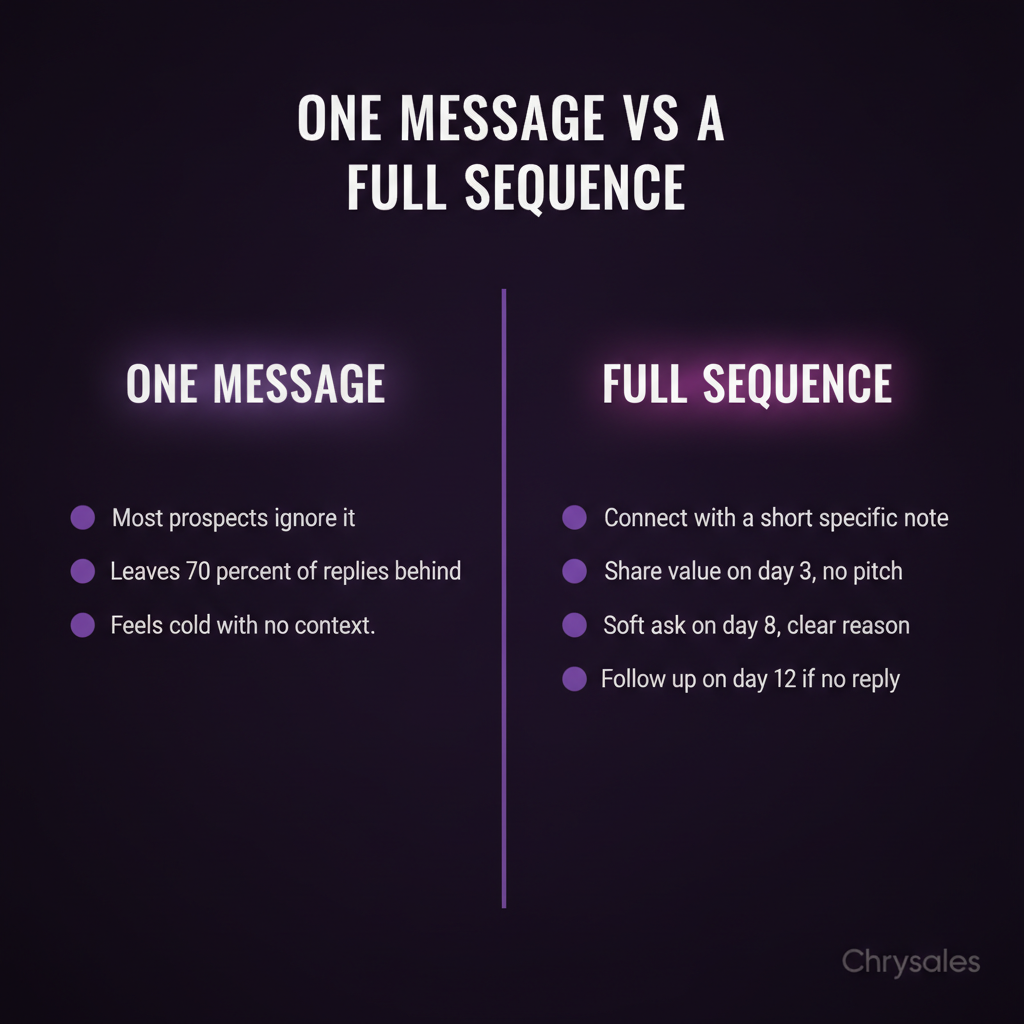
A single cold message on LinkedIn almost never works. The best LinkedIn outreach sequences look like this:
Message 1 (Connection request note): Short, specific, no pitch. Reference something real about them.
Message 2 (2 to 3 days after they accept): Share something useful. A quick observation, a relevant post, a small insight. Still no ask.
Message 3 (4 to 5 days later): Soft call to action. "Would it make sense to chat for 15 minutes about [specific thing]?"
Message 4 (1 week later if no reply): Quick follow-up. "Not sure if this got buried, but wanted to check in."
Most conversions happen on message 2 or 3, not message 1. If you're only sending one message and giving up, you're leaving 70% of replies on the table.
Common mistake: Sending all four messages in four days. That's not persistence, that's spam. Space them out. Give people time to see your profile, check out your posts, and think about it.
Step 3: Write Messages That Sound Like a Human, Not a Sales Bot
Here's a simple test: read your message out loud. If it sounds like something you'd never say in real life, rewrite it.
Bad LinkedIn message: "Hi [Name], I hope this message finds you well. I noticed your impressive background in the SaaS space and wanted to reach out to explore potential synergies between our organizations."
Good LinkedIn message: "Hey [Name], saw your post about scaling your sales team last month. We help consulting firms build repeatable systems for that exact thing. Worth a quick chat?"
The second one is shorter, specific, and sounds like a real person. No fluff. No "synergies." Just a clear reason to talk.
Here's a simple formula that works:
- Personalized opener (reference something specific, not generic)
- What you do in one sentence (for who, solving what)
- Soft CTA (worth a chat? make sense to talk?)
One 30-person tech consulting firm tried this format last quarter. They sent 80 connection requests, got 34 accepts, and booked 9 calls. The messages were almost identical, just swapping the personalized opener each time.
Pro Tip: Use video or voice notes for message 2 or 3. A 20-second Loom saying "Hey, thought this might help" with a quick tip gets way more replies than text. It's different enough that people notice.
Automating LinkedIn Outreach Without Getting Flagged or Banned
LinkedIn has limits. Send too many connection requests too fast, and your account gets restricted. Use the wrong automation tool, and you risk a ban.
But done right, you can automate parts of your linkedin outreach strategy and still sound human.
Safe Daily Limits for LinkedIn Outreach
LinkedIn doesn't publish exact limits, but here's what works without triggering flags:
- Connection requests: 20 to 30 per day max (for newer accounts, start at 10 to 15)
- Messages: 50 to 70 per day max
- Profile views: 100 to 150 per day max
If you're managing outreach for multiple clients or team members, rotate accounts. Don't run 200 connection requests from one profile in a day. Spread it across the week.
Watch out: LinkedIn tracks activity patterns. If you go from 5 connection requests a week to 100 in one day, it looks suspicious. Ramp up slowly over 2 to 3 weeks.
Picking the Right Automation Tools
There are dozens of LinkedIn automation tools. Most do the same thing: send connection requests, follow up with messages, track replies. The difference is how they connect to LinkedIn.
Cloud-based tools (like HeyReach, Expandi, or Lemlist) run in the cloud, so you don't need your computer on. They're easier but slightly riskier because LinkedIn can detect them.
Browser-based tools (like Phantombuster or LinkedHelper) run on your computer and mimic real human behavior better. Safer but less convenient.
For b2b sales teams running serious outbound pipelines, we recommend browser-based tools or hiring someone to do manual outreach. The extra safety is worth it.
To dive deeper into safe automation options and best practices, read our guide on LinkedIn automation tools for B2B outreach.
Personalization at Scale (Yes, It's Possible)
Personalization doesn't mean writing a custom essay for every person. It means swapping in one or two specific details so the message doesn't feel mass-blasted.
Here's what to personalize:
- First name (obvious)
- Company name
- One specific detail (recent post, shared connection, job change, company news)
Use merge tags in your automation tool to pull these in automatically. The opener changes, the rest of the message stays the same.
A small sales team we worked with built a system that pulled recent LinkedIn activity (posts, comments, job changes) and dropped it into message 1. It took 10 minutes to set up. Reply rates went from 2% to 5%. Same templates, just one personalized line at the top.
Combining LinkedIn Outreach with Other Channels for Better Results
LinkedIn outreach works. But LinkedIn outreach plus email plus phone works way better. Most people see your name in multiple places before they reply.
The Multi-Touch Outbound System
Here's a simple multi-channel sequence that consulting firms and agencies use to fill pipelines:
Day 1: Send LinkedIn connection request
Day 3: Connection accepts, send message 1 on LinkedIn
Day 5: Send cold email to the same person
Day 8: LinkedIn message 2 (share something useful)
Day 12: Follow-up email
Day 15: LinkedIn message 3 (soft CTA)
By day 15, they've seen your name four or five times. When you finally ask for a call, it doesn't feel cold anymore. It feels like a natural next step.
One marketing agency ran this exact sequence for a month. Out of 150 people in the sequence, 23 booked calls. That's a 15% conversion rate, which is very high for cold outbound. The secret? They didn't rely on one channel. They stacked touchpoints.
Learn more about how to structure these sequences by exploring multichannel vs omnichannel outreach strategies and how proper channel sequencing drives 10x better results.
Pro Tip: If someone replies on LinkedIn, move the conversation there. If they reply to email, move it there. Don't keep sending messages on both channels once they engage. It's annoying.
Using LinkedIn Content to Warm Up Cold Outreach
People who see your posts before you reach out convert at way higher rates. It's not magic. It's just familiarity. They've seen your name. They know what you talk about. The cold message feels warmer.
If you're planning a big LinkedIn outreach push, start posting 2 to 3 weeks before. Share quick tips, client results, or simple observations about sales, lead generation, or your niche.
You don't need to go viral. You just need your target audience to see your name a few times.
For specific strategies on leveraging your profile and content to warm up prospects before outreach, check out our article on LinkedIn content for lead generation and profiles.
Common mistake: Posting generic motivational content that has nothing to do with your offer. If you help agencies build sales systems, post about sales systems. If you help tech companies hire closers, post about hiring and training sales teams. Stay on topic.
Handling Objections and Replies in LinkedIn DMs
You send 50 messages. 10 people reply. That's great. But now what?
Most people freeze when they get a reply that isn't "yes, let's book a call."
Here are the most common objections you'll see in LinkedIn DMs, and how to handle them:
"Not interested right now"
This isn't a hard no. It's a timing thing.
Reply with: "No worries, totally understand. If anything changes in the next few months, feel free to reach out."
Then move them to a long-term follow-up list. Check back in 3 to 6 months.
"Send me more info"
This usually means "I'm curious but not ready to commit to a call yet."
Send a short message (3 to 4 sentences max) that explains what you do, who it's for, and what the outcome is. Include a link to a case study or client result if you have one.
Watch out: Don't send a 10-paragraph essay or a 40-slide deck. They're not reading it. Keep it short. If they're interested, they'll ask more questions or book a call.
"What's the pricing?"
Pricing questions in DMs are tricky. If you send a number without context, it sounds expensive. If you say "let's hop on a call to discuss," it sounds like you're dodging the question.
Middle ground: "Pricing depends on a few things, like team size and what you're trying to build. Most clients land in the [range] range. Worth a quick 15-minute chat to see if it makes sense?"
You give a rough range so they know it's not $50 or $500,000, but you don't lock into a number before you understand their situation.
"We already have someone handling this"
Great. That means they see the value of what you're selling. They're just already working with someone else.
Reply: "That's awesome. If it's working well, stick with it. If you ever want a second opinion or run into any issues, happy to chat."
Don't fight it. Stay friendly. A lot of deals come from this objection 6 to 12 months later when the other solution stops working.
Measuring What Actually Matters in LinkedIn Outreach
Most people track the wrong numbers. They obsess over connection acceptance rate or reply rate, but those don't pay the bills. The only number that matters is booked calls and closed deals.
The Metrics That Matter for B2B Lead Generation
Here's what to track:
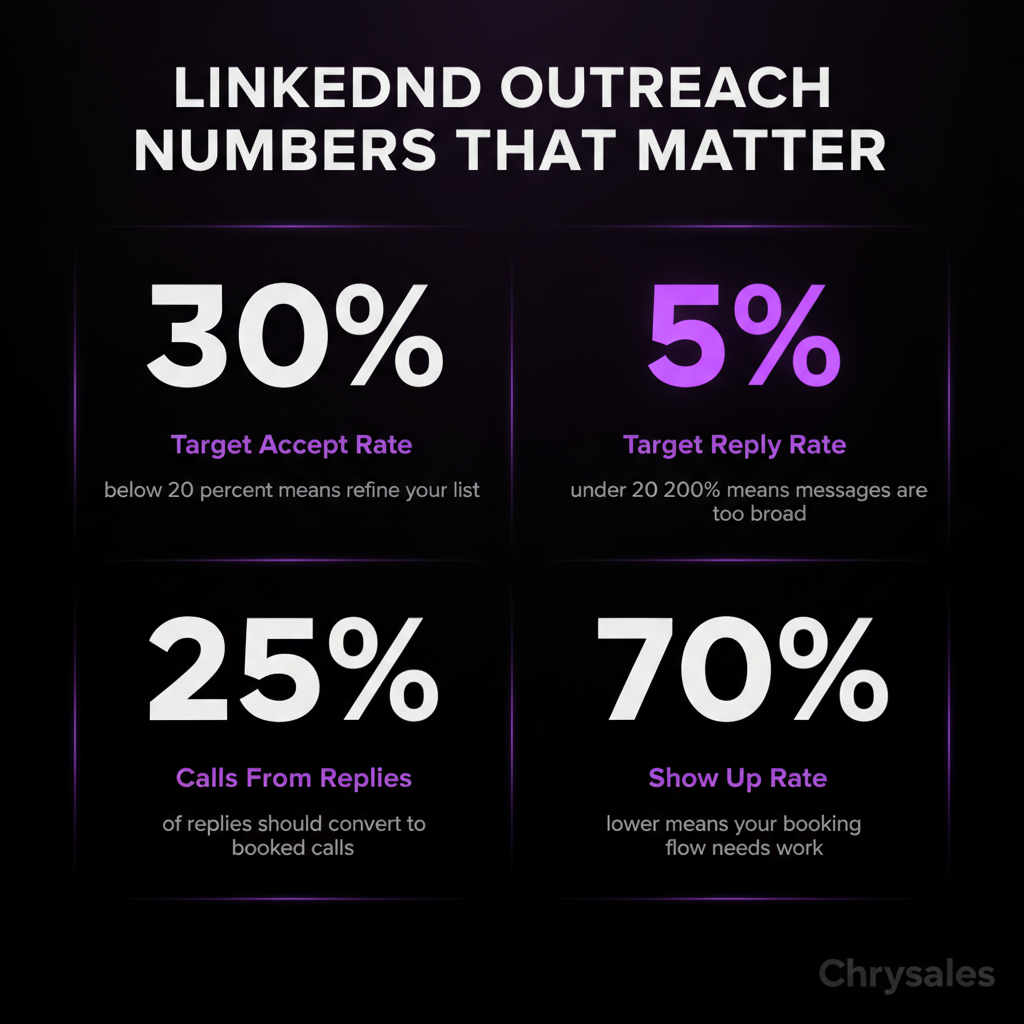
Connection acceptance rate: Aim for 30% to 40%. If you're under 20%, your list is too broad or your profile needs work.
Reply rate: 3% to 8% is normal for cold LinkedIn outreach. If you're under 2%, your messages are too generic or your list is bad. Over 10%? Your list is very tight, or you're doing something right.
Call booking rate: Out of everyone who replies, 20% to 30% should book a call if your qualification is decent. If it's lower, you're talking to the wrong people or your offer isn't clear.
Show-up rate: 60% to 80% of booked calls should show up. Lower than that? Your calendar link is confusing, or people don't remember why they booked.
Close rate: This depends on your offer and sales process, but if fewer than 10% of calls are turning into clients, the problem isn't LinkedIn. It's your offer, your pitch, or your close.
Set a simple rule: if your connection acceptance rate is above 30% and your reply rate is above 4%, the outreach is working. If calls aren't booking, the problem is later in the funnel.
For more detailed benchmarks and how to beat industry averages, see the industry averages for LinkedIn outreach response rates from recent data.
Pro Tip: Track these numbers weekly, not daily. Daily swings don't mean anything. Weekly trends show you what's actually working.
Turning LinkedIn Outreach Into a Repeatable Sales System
LinkedIn outreach isn't a one-time campaign. It's part of a bigger system. The best b2b sales teams treat LinkedIn as one piece of a repeatable pipeline that runs every single week.
What a Full System Looks Like
Here's the setup:
Step 1: Build a clean list of 200 to 300 ideal prospects every month (using Sales Navigator, Apollo, or manual research)
Step 2: Enrich the list with emails, phone numbers, recent activity, and any personalization details
Step 3: Load the list into your LinkedIn automation tool and your email tool
Step 4: Run a 15-day multi-touch sequence (LinkedIn connection, LinkedIn messages, emails, maybe a phone call)
Step 5: Track replies, book calls, move qualified leads into your sales process
Step 6: Follow up with people who didn't reply after 30 to 60 days
This runs every month. You're always adding new people to the top of the funnel. After 3 to 6 months, you have a predictable flow of calls every week.
One consulting firm built this exact system with us. After 90 days, they were booking 8 to 12 calls a week from LinkedIn outreach alone. The messages stayed the same. The system just kept running.
If you want more tactical advice on converting those calls into meetings, explore our guide on LinkedIn outreach that books meetings.
Hiring Someone to Run LinkedIn Outreach for You
At some point, doing outreach yourself stops making sense. If your time is worth $200 an hour and you're spending 10 hours a week on LinkedIn, that's $2,000 a week. You could hire someone for $1,000 to $1,500 a month to do the same thing.
Here's what to hand off:
- List building (finding and cleaning the list each week)
- Sending connection requests and messages
- Tracking replies and booking calls
- Moving warm leads into your CRM
What you should NOT hand off yet:
- The sales calls themselves (unless you hire a trained closer)
- Building the offer and pitch
- Setting the targeting criteria for the list
We've trained over 500 sales teams on this. The teams that scale fastest hire someone to run the outbound system while they focus on closing deals and improving the offer.
Common mistake: Hiring someone with no sales background to run outreach and expecting great results. Outreach isn't just copy-paste. It's qualification, tone, timing, and follow-up. Train them properly or hire someone who already knows b2b sales.
Frequently Asked Questions
Q: How long does it take to see results from LinkedIn outreach?
Most people start seeing replies within the first week. Booked calls usually happen in week 2 to 4. If you're running a solid outreach system with a good list and decent messages, expect 1 to 3 calls booked per 100 connection requests sent. Scale that up over a month, and you're looking at 8 to 15 calls if you're sending 20 to 30 requests a day. The key is consistency. One week of outreach won't do much. Three months of steady outreach builds a real pipeline.
Q: Should I use a personal LinkedIn account or a company page for outreach?
Always use a personal account. Company pages can't send connection requests or DMs. People buy from people, not logos. Your personal profile should make it clear what company you work for and what you do, but the outreach always comes from you as a person. If you're running outreach for a bigger team, each salesperson should have their own optimized profile and run their own outreach. Don't try to do it all from one account.
Q: What's the best time to send LinkedIn messages?
Tuesday, Wednesday, and Thursday mornings between 8 a.m. and 11 a.m. in your prospect's time zone tend to get the best reply rates. Avoid Mondays (people are buried in emails) and Fridays (people are checking out for the weekend). That said, the difference isn't huge. If your message and list are good, timing is a small factor. Don't obsess over it. Just avoid weekends and late nights. For more detailed timing research, check out the best times to send LinkedIn messages in 2026.
Q: Can I use AI to write LinkedIn outreach messages?
Yes, but don't use it to write the whole message from scratch. AI tools like ChatGPT or Gemini are great for generating ideas, rewriting sentences to sound better, or pulling personalization details from a profile. But if you just copy-paste an AI message without editing, it sounds robotic. Use AI to speed up the process, then add your own voice. The best LinkedIn outreach messages sound like something a real person would actually say.
Q: How do I avoid getting my LinkedIn account restricted or banned?
Stick to safe daily limits (20 to 30 connection requests, 50 to 70 messages per day max). Don't use sketchy automation tools that run in the cloud without mimicking human behavior. Ramp up slowly if your account is new. Personalize your messages so people don't report you as spam. If someone says "not interested," respect it and move on. LinkedIn restrictions usually happen when you ignore limits, use bad tools, or send spammy messages that get reported. Stay within the lines and you'll be fine.
A strong linkedin outreach strategy drives client acquisition by turning cold contacts into booked calls. When you pair it with sales training and a clear gtm plan, your pipeline becomes predictable.
This approach works because it treats outreach as a system, not a one-off tactic. Most teams fail because they skip the foundation. They send messages without a refined list, a buyer-ready profile, or a multi-touch sequence. Fix those first, and your linkedin outreach strategy will start booking calls consistently.
Remember: the goal isn't just more replies. It's more qualified conversations that lead to closed deals. A solid linkedin outreach strategy makes that happen by aligning your list, your profile, and your messages around real buyer needs.
If you want to scale b2b lead generation without sounding like a bot, start with this framework. Build your list, optimize your profile, map your sequence, and write human messages. Then automate safely and measure what matters. That's how you turn LinkedIn into a repeatable sales engine.
With the right linkedin outreach strategy, you can fill your pipeline, book more calls, and grow your business without the spammy feel. It's not about perfect words. It's about a system that works every week.
A LinkedIn outreach strategy is a repeatable system that combines list building, profile optimization, and human-sounding messages to book B2B sales calls. It focuses on who you target, when you reach out, and the foundation you build before sending the first message.
Picture this: you send 100 connection requests on LinkedIn. 12 people accept. 2 reply to your first message. 0 book a call.
Most people think the message was bad. The real problem? Everything that happened before you hit send.
A good LinkedIn outreach strategy isn't about perfect words. It's about who you're talking to, when you reach out, and what you built before the first message. Get those three things right, and the words almost write themselves. Get them wrong, and even the best copy lands flat.
Why Most LinkedIn Outreach Fails (And It's Not the Templates)
Here's the thing: most cold LinkedIn outreach flops before the message even sends. The list is bad. The profile looks like everyone else's. The timing is random.
You can copy the best template in the world, and it won't matter if the foundation is broken.
Think of LinkedIn outreach like texting someone you want to meet. If you text the wrong number, it doesn't matter how good your opener is. If your contact card shows no photo and a weird job title, they're not replying. If you text at 3 a.m., it's getting ignored.
LinkedIn works the same way.
The Real Bottleneck Is Your List
A 200-person list full of people who aren't buyers will always lose to a 50-person list of perfect fits. We see this all the time with new clients. They come in with 1,000 connections and zero replies. The first thing we do? Cut the list in half. Reply rates jump almost immediately.
Watch out: If you're pulling names from LinkedIn Sales Navigator without filters, you're building a bad list. Job title alone isn't enough. You need to layer in company size, recent activity, tech stack, and timing signals like funding rounds or new hires.
Your Profile Does Half the Work Before You Say Anything
When someone gets your connection request, they click your profile. If it looks like a resume from 2015, they're hitting ignore. If your headline says "Helping businesses grow" or "Sales Expert," same result.
Your profile is the first message. Make it count.
A good profile for b2b lead generation answers three questions in five seconds:
- Who do you help?
- What specific problem do you solve?
- Why should they care right now?
Your headline should sound like this: "Building repeatable sales systems for consulting firms | 500+ teams trained."
Not this: "Sales coach | Entrepreneur | Passionate about helping businesses succeed."
Pro Tip: Add a custom LinkedIn banner that shows a result, a client logo, or a simple one-liner about what you do. Most people leave it blank. That's free real estate.
Building a LinkedIn Outreach Strategy That Actually Books Calls
Most guides treat LinkedIn outreach like a one-off tactic. Send a message, hope for a reply, move on. That's not a strategy. That's spray and pray.
A real linkedin outreach strategy connects lead generation, qualification, and your offer into one system. It's repeatable. You can hand it to someone else and they get the same results.
Here's how to build it.
Step 1: Define Your Ideal Customer Profile (For Real This Time)
An ideal customer profile isn't "B2B companies with 10 to 500 employees." That's way too broad. You need to get specific enough that you can spot them in a crowded room.
Start with these filters:
- Industry: Pick 2 to 3 industries max. Tech consulting, marketing agencies, and SaaS companies have very different problems. You can't solve all of them with one message.
- Company size: A 15-person consulting firm and a 200-person agency need different sales systems. Pick one range.
- Growth signals: Did they just raise money? Hire a VP of Sales? Post a job for account executives? Those are buying signals.
- Pain point timing: If a company just did layoffs, they're not buying sales coaching next month. If they're hiring fast, they might need help scaling a sales team right now.
One marketing agency we worked with was targeting "anyone in marketing." They switched to "10 to 30-person performance marketing agencies that run paid ads for e-commerce clients." Reply rates went from 1% to 6% in two weeks. Same templates. Different list.
If you're looking for more ways to identify the right prospects, you can watch how to find clients who need your services right now for practical ICP definition strategies.
Step 2: Map the Outreach Sequence (Not Just One Message)
A single cold message on LinkedIn almost never works. The best LinkedIn outreach sequences look like this:
Message 1 (Connection request note): Short, specific, no pitch. Reference something real about them.
Message 2 (2 to 3 days after they accept): Share something useful. A quick observation, a relevant post, a small insight. Still no ask.
Message 3 (4 to 5 days later): Soft call to action. "Would it make sense to chat for 15 minutes about [specific thing]?"
Message 4 (1 week later if no reply): Quick follow-up. "Not sure if this got buried, but wanted to check in."
Most conversions happen on message 2 or 3, not message 1. If you're only sending one message and giving up, you're leaving 70% of replies on the table.
Common mistake: Sending all four messages in four days. That's not persistence, that's spam. Space them out. Give people time to see your profile, check out your posts, and think about it.
Step 3: Write Messages That Sound Like a Human, Not a Sales Bot
Here's a simple test: read your message out loud. If it sounds like something you'd never say in real life, rewrite it.
Bad LinkedIn message: "Hi [Name], I hope this message finds you well. I noticed your impressive background in the SaaS space and wanted to reach out to explore potential synergies between our organizations."
Good LinkedIn message: "Hey [Name], saw your post about scaling your sales team last month. We help consulting firms build repeatable systems for that exact thing. Worth a quick chat?"
The second one is shorter, specific, and sounds like a real person. No fluff. No "synergies." Just a clear reason to talk.
Here's a simple formula that works:
- Personalized opener (reference something specific, not generic)
- What you do in one sentence (for who, solving what)
- Soft CTA (worth a chat? make sense to talk?)
One 30-person tech consulting firm tried this format last quarter. They sent 80 connection requests, got 34 accepts, and booked 9 calls. The messages were almost identical, just swapping the personalized opener each time.
Pro Tip: Use video or voice notes for message 2 or 3. A 20-second Loom saying "Hey, thought this might help" with a quick tip gets way more replies than text. It's different enough that people notice.
Automating LinkedIn Outreach Without Getting Flagged or Banned
LinkedIn has limits. Send too many connection requests too fast, and your account gets restricted. Use the wrong automation tool, and you risk a ban.
But done right, you can automate parts of your linkedin outreach strategy and still sound human.
Safe Daily Limits for LinkedIn Outreach
LinkedIn doesn't publish exact limits, but here's what works without triggering flags:
- Connection requests: 20 to 30 per day max (for newer accounts, start at 10 to 15)
- Messages: 50 to 70 per day max
- Profile views: 100 to 150 per day max
If you're managing outreach for multiple clients or team members, rotate accounts. Don't run 200 connection requests from one profile in a day. Spread it across the week.
Watch out: LinkedIn tracks activity patterns. If you go from 5 connection requests a week to 100 in one day, it looks suspicious. Ramp up slowly over 2 to 3 weeks.
Picking the Right Automation Tools
There are dozens of LinkedIn automation tools. Most do the same thing: send connection requests, follow up with messages, track replies. The difference is how they connect to LinkedIn.
Cloud-based tools (like HeyReach, Expandi, or Lemlist) run in the cloud, so you don't need your computer on. They're easier but slightly riskier because LinkedIn can detect them.
Browser-based tools (like Phantombuster or LinkedHelper) run on your computer and mimic real human behavior better. Safer but less convenient.
For b2b sales teams running serious outbound pipelines, we recommend browser-based tools or hiring someone to do manual outreach. The extra safety is worth it.
To dive deeper into safe automation options and best practices, read our guide on LinkedIn automation tools for B2B outreach.
Personalization at Scale (Yes, It's Possible)
Personalization doesn't mean writing a custom essay for every person. It means swapping in one or two specific details so the message doesn't feel mass-blasted.
Here's what to personalize:
- First name (obvious)
- Company name
- One specific detail (recent post, shared connection, job change, company news)
Use merge tags in your automation tool to pull these in automatically. The opener changes, the rest of the message stays the same.
A small sales team we worked with built a system that pulled recent LinkedIn activity (posts, comments, job changes) and dropped it into message 1. It took 10 minutes to set up. Reply rates went from 2% to 5%. Same templates, just one personalized line at the top.
Combining LinkedIn Outreach with Other Channels for Better Results
LinkedIn outreach works. But LinkedIn outreach plus email plus phone works way better. Most people see your name in multiple places before they reply.
The Multi-Touch Outbound System
Here's a simple multi-channel sequence that consulting firms and agencies use to fill pipelines:
Day 1: Send LinkedIn connection request
Day 3: Connection accepts, send message 1 on LinkedIn
Day 5: Send cold email to the same person
Day 8: LinkedIn message 2 (share something useful)
Day 12: Follow-up email
Day 15: LinkedIn message 3 (soft CTA)
By day 15, they've seen your name four or five times. When you finally ask for a call, it doesn't feel cold anymore. It feels like a natural next step.
One marketing agency ran this exact sequence for a month. Out of 150 people in the sequence, 23 booked calls. That's a 15% conversion rate, which is very high for cold outbound. The secret? They didn't rely on one channel. They stacked touchpoints.
Learn more about how to structure these sequences by exploring multichannel vs omnichannel outreach strategies and how proper channel sequencing drives 10x better results.
Pro Tip: If someone replies on LinkedIn, move the conversation there. If they reply to email, move it there. Don't keep sending messages on both channels once they engage. It's annoying.
Using LinkedIn Content to Warm Up Cold Outreach
People who see your posts before you reach out convert at way higher rates. It's not magic. It's just familiarity. They've seen your name. They know what you talk about. The cold message feels warmer.
If you're planning a big LinkedIn outreach push, start posting 2 to 3 weeks before. Share quick tips, client results, or simple observations about sales, lead generation, or your niche.
You don't need to go viral. You just need your target audience to see your name a few times.
For specific strategies on leveraging your profile and content to warm up prospects before outreach, check out our article on LinkedIn content for lead generation and profiles.
Common mistake: Posting generic motivational content that has nothing to do with your offer. If you help agencies build sales systems, post about sales systems. If you help tech companies hire closers, post about hiring and training sales teams. Stay on topic.
Handling Objections and Replies in LinkedIn DMs
You send 50 messages. 10 people reply. That's great. But now what?
Most people freeze when they get a reply that isn't "yes, let's book a call."
Here are the most common objections you'll see in LinkedIn DMs, and how to handle them:
"Not interested right now"
This isn't a hard no. It's a timing thing.
Reply with: "No worries, totally understand. If anything changes in the next few months, feel free to reach out."
Then move them to a long-term follow-up list. Check back in 3 to 6 months.
"Send me more info"
This usually means "I'm curious but not ready to commit to a call yet."
Send a short message (3 to 4 sentences max) that explains what you do, who it's for, and what the outcome is. Include a link to a case study or client result if you have one.
Watch out: Don't send a 10-paragraph essay or a 40-slide deck. They're not reading it. Keep it short. If they're interested, they'll ask more questions or book a call.
"What's the pricing?"
Pricing questions in DMs are tricky. If you send a number without context, it sounds expensive. If you say "let's hop on a call to discuss," it sounds like you're dodging the question.
Middle ground: "Pricing depends on a few things, like team size and what you're trying to build. Most clients land in the [range] range. Worth a quick 15-minute chat to see if it makes sense?"
You give a rough range so they know it's not $50 or $500,000, but you don't lock into a number before you understand their situation.
"We already have someone handling this"
Great. That means they see the value of what you're selling. They're just already working with someone else.
Reply: "That's awesome. If it's working well, stick with it. If you ever want a second opinion or run into any issues, happy to chat."
Don't fight it. Stay friendly. A lot of deals come from this objection 6 to 12 months later when the other solution stops working.
Measuring What Actually Matters in LinkedIn Outreach
Most people track the wrong numbers. They obsess over connection acceptance rate or reply rate, but those don't pay the bills. The only number that matters is booked calls and closed deals.
The Metrics That Matter for B2B Lead Generation
Here's what to track:
Connection acceptance rate: Aim for 30% to 40%. If you're under 20%, your list is too broad or your profile needs work.
Reply rate: 3% to 8% is normal for cold LinkedIn outreach. If you're under 2%, your messages are too generic or your list is bad. Over 10%? Your list is very tight, or you're doing something right.
Call booking rate: Out of everyone who replies, 20% to 30% should book a call if your qualification is decent. If it's lower, you're talking to the wrong people or your offer isn't clear.
Show-up rate: 60% to 80% of booked calls should show up. Lower than that? Your calendar link is confusing, or people don't remember why they booked.
Close rate: This depends on your offer and sales process, but if fewer than 10% of calls are turning into clients, the problem isn't LinkedIn. It's your offer, your pitch, or your close.
Set a simple rule: if your connection acceptance rate is above 30% and your reply rate is above 4%, the outreach is working. If calls aren't booking, the problem is later in the funnel.
For more detailed benchmarks and how to beat industry averages, see the industry averages for LinkedIn outreach response rates from recent data.
Pro Tip: Track these numbers weekly, not daily. Daily swings don't mean anything. Weekly trends show you what's actually working.
Turning LinkedIn Outreach Into a Repeatable Sales System
LinkedIn outreach isn't a one-time campaign. It's part of a bigger system. The best b2b sales teams treat LinkedIn as one piece of a repeatable pipeline that runs every single week.
What a Full System Looks Like
Here's the setup:
Step 1: Build a clean list of 200 to 300 ideal prospects every month (using Sales Navigator, Apollo, or manual research)
Step 2: Enrich the list with emails, phone numbers, recent activity, and any personalization details
Step 3: Load the list into your LinkedIn automation tool and your email tool
Step 4: Run a 15-day multi-touch sequence (LinkedIn connection, LinkedIn messages, emails, maybe a phone call)
Step 5: Track replies, book calls, move qualified leads into your sales process
Step 6: Follow up with people who didn't reply after 30 to 60 days
This runs every month. You're always adding new people to the top of the funnel. After 3 to 6 months, you have a predictable flow of calls every week.
One consulting firm built this exact system with us. After 90 days, they were booking 8 to 12 calls a week from LinkedIn outreach alone. The messages stayed the same. The system just kept running.
If you want more tactical advice on converting those calls into meetings, explore our guide on LinkedIn outreach that books meetings.
Hiring Someone to Run LinkedIn Outreach for You
At some point, doing outreach yourself stops making sense. If your time is worth $200 an hour and you're spending 10 hours a week on LinkedIn, that's $2,000 a week. You could hire someone for $1,000 to $1,500 a month to do the same thing.
Here's what to hand off:
- List building (finding and cleaning the list each week)
- Sending connection requests and messages
- Tracking replies and booking calls
- Moving warm leads into your CRM
What you should NOT hand off yet:
- The sales calls themselves (unless you hire a trained closer)
- Building the offer and pitch
- Setting the targeting criteria for the list
We've trained over 500 sales teams on this. The teams that scale fastest hire someone to run the outbound system while they focus on closing deals and improving the offer.
Common mistake: Hiring someone with no sales background to run outreach and expecting great results. Outreach isn't just copy-paste. It's qualification, tone, timing, and follow-up. Train them properly or hire someone who already knows b2b sales.
Frequently Asked Questions
Q: How long does it take to see results from LinkedIn outreach?
Most people start seeing replies within the first week. Booked calls usually happen in week 2 to 4. If you're running a solid outreach system with a good list and decent messages, expect 1 to 3 calls booked per 100 connection requests sent. Scale that up over a month, and you're looking at 8 to 15 calls if you're sending 20 to 30 requests a day. The key is consistency. One week of outreach won't do much. Three months of steady outreach builds a real pipeline.
Q: Should I use a personal LinkedIn account or a company page for outreach?
Always use a personal account. Company pages can't send connection requests or DMs. People buy from people, not logos. Your personal profile should make it clear what company you work for and what you do, but the outreach always comes from you as a person. If you're running outreach for a bigger team, each salesperson should have their own optimized profile and run their own outreach. Don't try to do it all from one account.
Q: What's the best time to send LinkedIn messages?
Tuesday, Wednesday, and Thursday mornings between 8 a.m. and 11 a.m. in your prospect's time zone tend to get the best reply rates. Avoid Mondays (people are buried in emails) and Fridays (people are checking out for the weekend). That said, the difference isn't huge. If your message and list are good, timing is a small factor. Don't obsess over it. Just avoid weekends and late nights. For more detailed timing research, check out the best times to send LinkedIn messages in 2026.
Q: Can I use AI to write LinkedIn outreach messages?
Yes, but don't use it to write the whole message from scratch. AI tools like ChatGPT or Gemini are great for generating ideas, rewriting sentences to sound better, or pulling personalization details from a profile. But if you just copy-paste an AI message without editing, it sounds robotic. Use AI to speed up the process, then add your own voice. The best LinkedIn outreach messages sound like something a real person would actually say.
Q: How do I avoid getting my LinkedIn account restricted or banned?
Stick to safe daily limits (20 to 30 connection requests, 50 to 70 messages per day max). Don't use sketchy automation tools that run in the cloud without mimicking human behavior. Ramp up slowly if your account is new. Personalize your messages so people don't report you as spam. If someone says "not interested," respect it and move on. LinkedIn restrictions usually happen when you ignore limits, use bad tools, or send spammy messages that get reported. Stay within the lines and you'll be fine.
A strong linkedin outreach strategy drives client acquisition by turning cold contacts into booked calls. When you pair it with sales training and a clear gtm plan, your pipeline becomes predictable.
This approach works because it treats outreach as a system, not a one-off tactic. Most teams fail because they skip the foundation. They send messages without a refined list, a buyer-ready profile, or a multi-touch sequence. Fix those first, and your linkedin outreach strategy will start booking calls consistently.
Remember: the goal isn't just more replies. It's more qualified conversations that lead to closed deals. A solid linkedin outreach strategy makes that happen by aligning your list, your profile, and your messages around real buyer needs.
If you want to scale b2b lead generation without sounding like a bot, start with this framework. Build your list, optimize your profile, map your sequence, and write human messages. Then automate safely and measure what matters. That's how you turn LinkedIn into a repeatable sales engine.
With the right linkedin outreach strategy, you can fill your pipeline, book more calls, and grow your business without the spammy feel. It's not about perfect words. It's about a system that works every week.
Scaling Is Not Hard If You Have The Right Systems
If you’re serious about leveling up your scaling game, you need the right system, the right training, and the right team behind you. We're here to give you the exact tools and strategies top entrepreneurs use to dominate.

Discover the latest tips
View All.avif)
Chrysales was formed from the words "chrysalis" the stage where a caterpillar transforms into a butterfly and "sales".
It stands for one thing: sales transformation.Because scaling doesn’t happen by doing more of the same. Scaling only happens when you go through real transformation in your systems, your offer, team and the way you sell.
.avif)


