.avif)
How to Get Replies on Linkedin with a DM Sequence
Knowing how to get replies on LinkedIn means using a timed series of messages instead of sending just one. This approach builds trust and gives you multiple chances to connect at the right moment.
Picture this: you send 30 LinkedIn DMs this week. Zero replies. The worst part? You know the people on the other end could actually use what you offer.
The problem isn't that your message is bad. It's that you're sending one message when you need a sequence.
Most people treat LinkedIn like a cold email tool or a job board. It's neither. It's a conversation platform where timing, context, and follow-up do most of the work.
Here's how to get replies on LinkedIn using a simple DM sequence that actually books calls.
Why Single LinkedIn Messages Get Ignored
Most LinkedIn outreach fails before the recipient even reads past the first line. The reason isn't mysterious. People get dozens of pitches every week. Your single message lands in a pile of identical requests, all formatted the same way, all asking for time, all offering something vague.
The Timing Problem
When you send one message, you're gambling that the person sees it at the exact moment they're interested and available. That almost never happens. They might be in a meeting. They might be traveling. They might just be having a bad day.
A single touchpoint gives you one shot at perfect timing. A sequence gives you five or six.
The Trust Problem
Cold outreach on LinkedIn lacks the social proof of a warm intro. One message from a stranger asking for 15 minutes feels like a transaction. A sequence that adds value, references their work, and shows up consistently over two weeks feels like the start of a relationship.
B2B sales decisions happen after multiple touches. Studies show it takes 7 to 13 touchpoints to generate a qualified lead. One LinkedIn DM is just touchpoint number one.
Common mistake: Sending a great first message, getting no reply, and moving on. That's leaving 80% of potential replies on the table.
What Makes a LinkedIn DM Sequence Different From Email
LinkedIn isn't email. The rules are different. The context is different. The way people read messages is different. Treating your LinkedIn outreach like cold email is the fastest way to tank your response rate.
It's a Social Platform First
Email is private. LinkedIn is semi-public. When someone gets your DM, they can click your profile and see your posts, your connections, your recommendations. That means your LinkedIn outreach sequence works best when it's paired with light social engagement.
Comment on their post before you message them. Like their content. Show up in their notifications before you land in their inbox.
Character Limits Change the Game
LinkedIn messages feel more intrusive when they're long. Keep each message in your sequence under 100 words. Ideally closer to 60-75.
Short messages get read. Long ones get skimmed or ignored. This isn't email where you can write three paragraphs and add a P.S. Every message should fit on a phone screen without scrolling.
The Read Receipt Factor
On LinkedIn, you can often see when someone has read your message. That changes your follow-up strategy. If they read your first message and didn't reply, your second message should acknowledge that lightly. If they haven't opened it yet, your follow-up can be a simple bump.
Pro Tip: If someone reads your message and doesn't reply within 48 hours, they're not ignoring you. They're just not sure how to respond yet. Your next message should make responding easier.
The 5-Message LinkedIn DM Sequence That Works
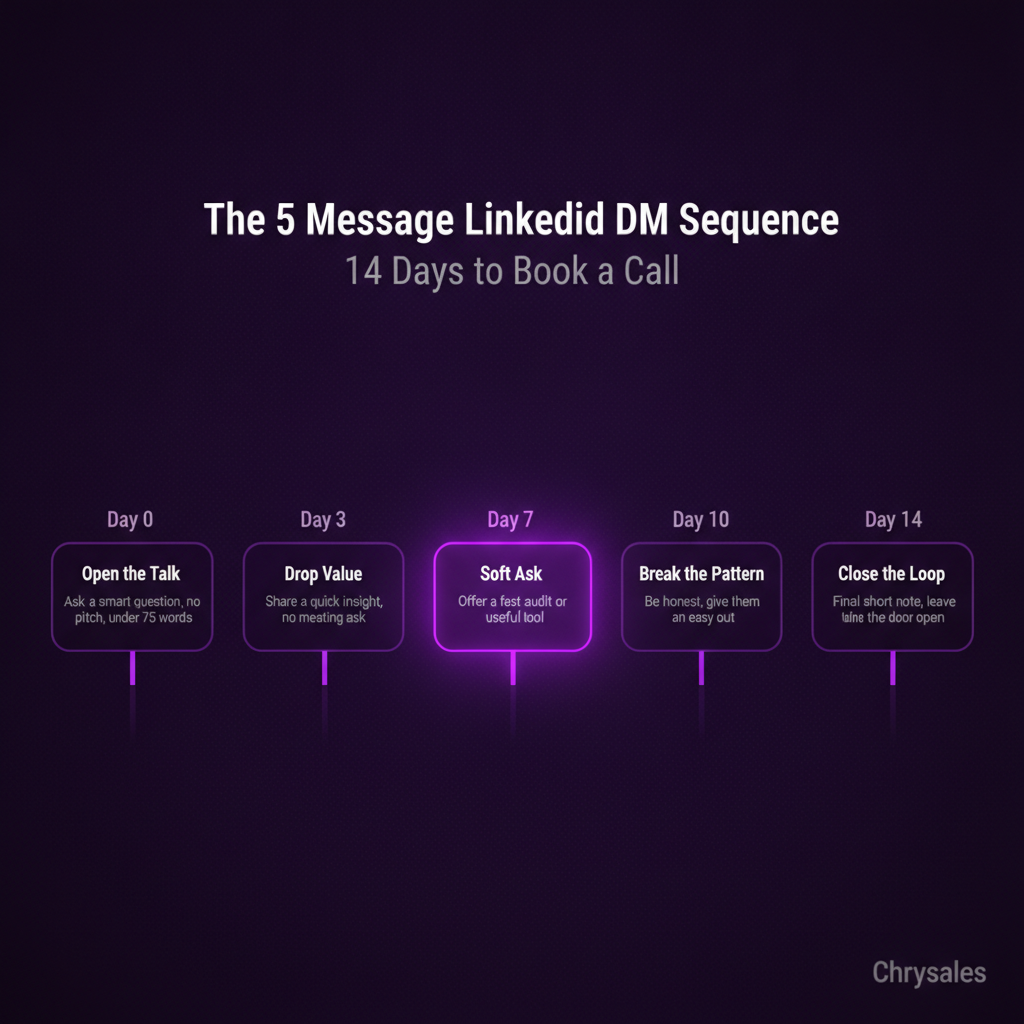
Here's the sequence we use for B2B lead generation at Chrysales. It's built for teams that want predictable client acquisition, not random replies. Five messages over 14 days. Each one has a job. Each one moves the conversation forward.
Message 1: The Personalized Opener (Day 0)
This is not a pitch. It's a reason to start talking. Reference something specific about their profile, their company, or their recent post. Ask a smart question or make a relevant observation. Keep it under 75 words.
Example: "Saw your post about scaling support teams without adding headcount. We're seeing the same challenge with sales teams right now. Curious how you're thinking about AI tools in that mix?"
The goal: start a conversation, not book a call. If they reply, great. Move off-script and talk like a human. If they don't, move to message two.
Message 2: The Value Drop (Day 3)
Three days later, send something useful with no ask attached. A link to a relevant article, a quick insight, a small observation about their industry. This message proves you're not just here to take. You're here to add value.
Example: "Quick thought: just worked with a 20-person consulting firm that cut their sales cycle from 45 days to 22 by changing how they run discovery calls. Happy to share what they did if that's useful. Either way, good luck with the growth push."
No meeting request. No "let me know if you want to chat." Just value and a door left open.
Message 3: The Soft Ask (Day 7)
One week in, it's time to make an ask. But keep it low-pressure. The best soft asks offer something specific in exchange for a small action. Don't ask for a 30-minute call yet. Ask for a reply, a quick answer, or permission to send something.
Example: "We've built a simple 12-question audit that spots gaps in B2B sales systems. Takes about 90 seconds to fill out. Want me to send it over? The output usually flags 2-3 things worth fixing."
This works because it's concrete, it's fast, and it gives them something in return.
Watch out: Don't disguise a sales pitch as a resource. If you say you're sending a guide, send an actual guide. Not a landing page that asks for their credit card.
Message 4: The Pattern Interrupt (Day 10)
Most people stop at three messages. Message four is where you separate yourself from everyone else in their inbox. Use this message to break the pattern. Ask a different kind of question. Share a quick win. Or just be honest.
Example: "Honest question: is this even on your radar right now, or is it just bad timing? If it's not a fit, totally fine to say so. If it is, I'll stop being vague and just send over a time link."
This works because it gives them an out. People hate feeling trapped in a one-sided conversation. When you acknowledge that, they're more likely to respond, even if it's to say no.
Message 5: The Breakup (Day 14)
Two weeks in, it's time to close the loop. This is your last message. Make it short, friendly, and final. The "breakup message" gets some of the highest response rates in any sequence because it signals scarcity. It's their last chance to reply.
Example: "Last note from me. Sounds like the timing isn't right, and that's fine. If anything changes and you want to talk about fixing your LinkedIn outreach or cold outreach process, you know where to find me. Either way, appreciate the connection."
Then stop. Don't send a sixth message. If they don't reply after five, they're not going to. Move on.
How to Personalize LinkedIn Messages Without Spending an Hour Per Prospect
Personalization is the difference between a 2% reply rate and a 15% reply rate. But most people think personalization means writing every message from scratch. It doesn't. It means inserting specific details into a repeatable structure.
The Three-Layer Personalization Model
Layer one: Use their name and company name. Basic, but necessary.
Layer two: Reference something from their profile. A shared connection, a past role, a skill they list, a post they wrote. This takes 15 seconds of scanning.
Layer three: Tie your message to a relevant pain point or outcome based on their industry or role. This is where sales training and client acquisition experience help. You start to recognize patterns fast.
A 30-person consulting firm probably struggles with inconsistent lead generation. A marketing agency likely deals with client churn or trouble scaling past the founder. A tech company might be hiring salespeople but not training them. When you know the patterns, personalization gets faster.
Pro Tip: Build a simple spreadsheet with columns for name, company, LinkedIn post topic, and pain point. Fill it out as you add people to your list. When it's time to write messages, the details are right there.
What to Do When Someone Replies (And What Not to Do)
Getting a reply is the win. But most people blow it in the next message. They either over-pitch or under-deliver. Here's how to handle replies without killing the momentum.
If They Ask a Question
Answer it clearly and briefly. Then ask a question back. Keep the conversation moving. Don't turn your reply into a pitch deck.
If they ask what you do, give a one-sentence answer and ask about their current setup.
Example: "We build custom sales systems for B2B companies, mostly around lead gen and closing. What's working for you right now on the outbound side?"
If They Say They're Interested
Don't send a calendar link in the same message. It's too fast. Acknowledge the interest, share one more piece of context, then offer the meeting.
Example: "Awesome. We've worked with a few marketing agencies in a similar spot. Usually comes down to fixing the offer or tightening up the discovery call structure. Want to jump on a quick 20-minute call this week to see if it's a fit?"
If They Say No or Not Right Now
Thank them and leave the door open. Don't try to overcome the objection in a DM. If they said no, respect it. If they said not right now, ask when to follow up.
Example: "Totally understand. If it makes sense to reconnect in a few months, just let me know. Appreciate the reply."
Common mistake: Treating every reply like a hot lead. Some replies are just polite nos. Let them go.
How to Track and Improve Your LinkedIn Outreach Sequence
You can't improve what you don't measure. If you're serious about using LinkedIn for B2B LinkedIn prospecting, you need to track a few key numbers. Not 47 metrics. Just the ones that matter.
Reply Rate by Message
Track how many people reply after message one, message two, message three, and so on. This tells you where your sequence is working and where it's breaking.
If no one replies to message one, your opener is the problem. If people reply to message two but not message three, your soft ask might be too aggressive.
Connection-to-Reply Rate
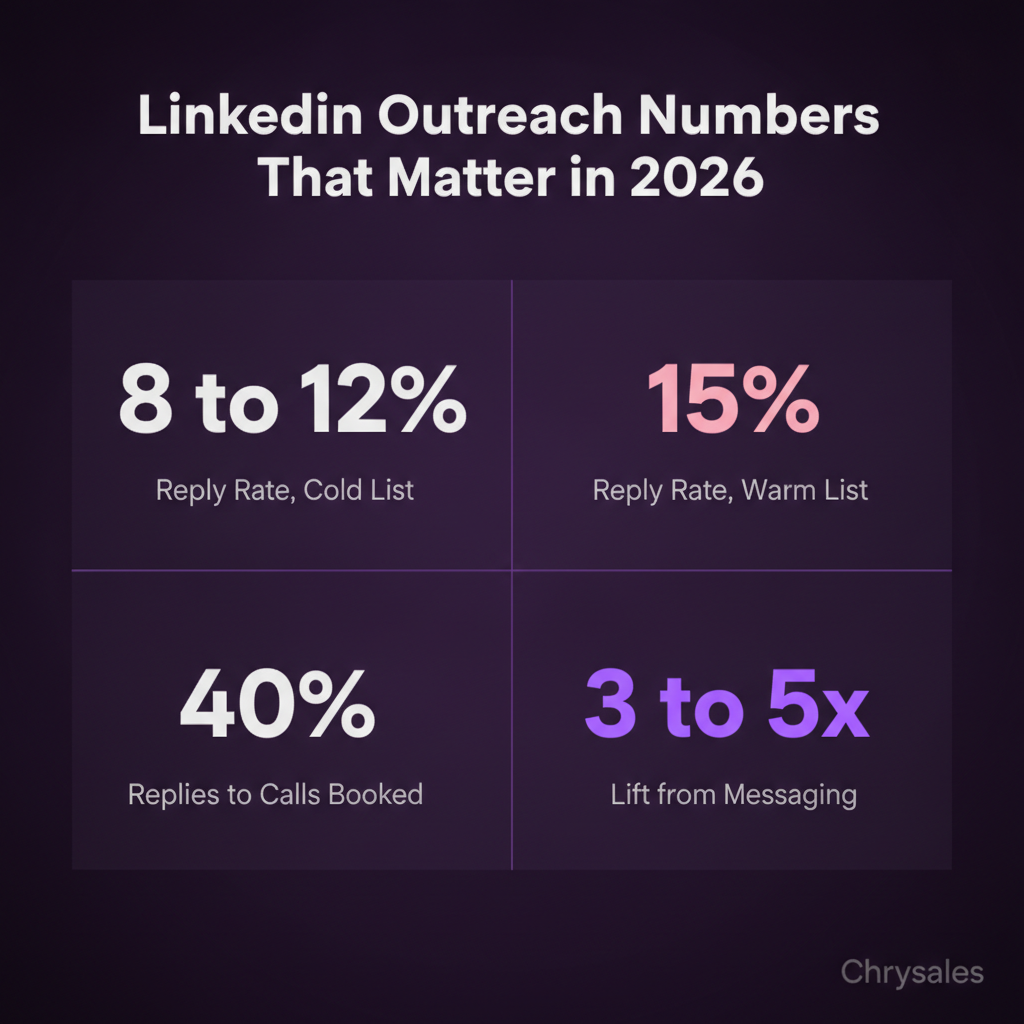
How many of your LinkedIn connections turn into conversations? For cold outreach, 8-12% is solid. Below 5% means something is off. Above 15% means your list is warm or your messaging is very dialed in.
Improving your LinkedIn reply rate for cold outreach requires testing different openers, personalization tactics, and timing strategies until you find what resonates with your target audience.
Reply-to-Call Conversion
How many replies turn into booked calls? This number should be above 40%. If it's lower, you're either attracting the wrong replies or fumbling the transition from DM to calendar.
We worked with a 25-person tech company that was getting replies but no meetings. The issue wasn't the LinkedIn DM strategy. It was what they said after someone replied. They were pitching instead of diagnosing. Once they shifted to asking questions first, their reply-to-call rate jumped from 18% to 52% in four weeks.
If you want to learn how to use LinkedIn outreach to book meetings consistently, focus on diagnosing pain points in your replies rather than pitching your solution immediately.
Pro Tip: Set up a simple dashboard in a spreadsheet or CRM. Log each sequence you run. Date started, messages sent, replies, calls booked. Review it every two weeks and adjust.
Common LinkedIn Outreach Mistakes That Kill Your Response Rate
Even smart, experienced teams make these mistakes. Most of them are invisible until you know what to look for. Here are the big ones.
Connecting Without Context
Sending a connection request with no note, then immediately pitching when they accept. This is the LinkedIn version of a bait-and-switch.
People accept your request because they're curious or polite. Then you hit them with a pitch and they regret it. Always send a short note with your connection request. And wait at least 24 hours after they accept before you send message one of your sequence.
Asking for Too Much Too Soon
Requesting a 30-minute call in your first message is like asking someone to marry you on the first date. It's too big an ask for someone who doesn't know you yet.
Start small. Ask for a reply. Ask if something is relevant. Build up to the meeting request by message three or four.
Using the Same Message for Everyone
Personalized LinkedIn messages get 3-5x more replies than generic ones. If you're copy-pasting the same opener to 50 people, your reply rate will stay below 3%.
Personalization doesn't mean rewriting every message from scratch. It means inserting specific details that prove you looked at their profile for more than five seconds.
Giving Up After Two Messages
Most replies come from messages three, four, or five. Not message one. If you're only sending two messages and moving on, you're missing 60-70% of the people who would've eventually replied.
A proper sequence runs at least five touches over 10-14 days. Understanding LinkedIn message reply rate benchmarks can help you set realistic expectations and optimize your sequence timing for maximum response.
Pitching Instead of Conversing
LinkedIn is not a landing page. It's a conversation. When someone replies, talk to them like a person. Ask questions. Respond to what they say. Don't just keep running your script.
The sequence gets you the reply. The conversation gets you the meeting.
Watch out: Tools that auto-send LinkedIn messages can hurt more than help. LinkedIn's algorithm flags automation. If you get reported or flagged too many times, your account gets restricted.
Send messages manually or use light automation that mimics human behavior. Before investing in LinkedIn automation tools for B2B outreach, weigh the risks of account restrictions against the time savings, and always prioritize tools that respect LinkedIn's platform guidelines.
How This Fits Into a Full B2B Sales System
A LinkedIn DM sequence is one piece of a bigger client acquisition system. It works best when it's not the only thing you're doing. Here's how it fits.
Cold Outreach Mix
Most high-performing B2B sales systems use a multi-channel approach. LinkedIn DMs, cold email, and sometimes cold calls. Each channel reinforces the others.
Someone might ignore your LinkedIn message but open your email two days later. Or they see your name three times across platforms and finally reply on LinkedIn.
If you're wondering which channel to prioritize first, watch this breakdown of Cold Email vs Cold Calling: Which Makes You Money Faster? to understand the ROI and timeline differences between major outbound channels.
Warming Up Cold Lists
If you're doing B2B lead generation at scale, start with LinkedIn engagement before you send the DM. Comment on a post. Like something they shared. This warms them up and increases the chance they'll recognize your name when your message lands.
Pairing Outreach With Content
If you post valuable content on LinkedIn, your outreach sequence works better. People click your profile when you message them. If they see helpful posts, case studies, or real examples, they're more likely to reply.
This is how sales training and thought leadership work together. Your content builds credibility. Your outreach turns that credibility into conversations.
At Chrysales, we've trained over 500 sales teams and generated over €10M in client revenue using systems like this. The LinkedIn sequence is part of a four-step process: learn the market, build repeatable systems, add automation where it makes sense, and hire people to run it when it's working.
The sequence alone won't fix a broken sales process. But when it's part of a real system, it's one of the highest-ROI activities you can do.
To see how LinkedIn outreach fits with email and other channels in a coordinated strategy, learn more about Multichannel vs Omnichannel: Same Channels, 10x Different Results and discover why sequencing across platforms multiplies your response rates.
Frequently Asked Questions
Q: How long should I wait between LinkedIn messages in your sequence?
Wait 2-4 days between messages. Day 0 for message one, day 3 for message two, day 7 for message three, day 10 for message four, and day 14 for message five. This keeps you visible without feeling spammy. If someone replies at any point, stop the sequence and have a real conversation. Don't keep auto-sending scripted messages after they engage.
Q: Should I send a connection request note or connect first and message later?
Always send a short note with your connection request. Something like "Enjoyed your post on sales automation. Would be great to connect." Keep it under 200 characters. Once they accept, wait 24-48 hours before sending your first sequence message. Connecting and immediately pitching feels transactional and kills trust before you start.
Q: What's a good reply rate for cold LinkedIn outreach?
For fully cold outreach, 8-12% is solid. Below 5% means your targeting, messaging, or personalization needs work. Above 15% usually means your list is warm or you have strong social proof on your profile. Track reply rate by message too. Most replies come from messages one, three, and five. If you're getting zero replies across a 20-person test, rewrite your opener before scaling up.
Q: Can I use LinkedIn automation tools for your DM sequence?
Technically yes, but it's risky. LinkedIn actively monitors and restricts accounts that use heavy automation. Light tools that add small delays and mimic human behavior are safer, but manual sending is still the best long-term play. If you're doing high-volume B2B LinkedIn prospecting, hire someone to send messages manually or use a tool very conservatively. Getting your account flagged kills all your outreach overnight.
Q: How do I know if someone is a good fit before I message them on LinkedIn?
Look at three things: their role, their company size, and recent activity. If they're a decision maker at a company that matches your ideal customer profile, they're worth messaging. Recent activity like posts, comments, or job changes gives you personalization angles and shows they're active on the platform. Messaging inactive profiles or wrong-fit prospects tanks your reply rate and wastes time. Build your list carefully before you start your sequence.
If you want to master how to get replies on LinkedIn, this sequence is your starting point. It turns cold outreach into real conversations that drive gtm results.
Knowing how to get replies on LinkedIn means using a timed series of messages instead of sending just one. This approach builds trust and gives you multiple chances to connect at the right moment.
Picture this: you send 30 LinkedIn DMs this week. Zero replies. The worst part? You know the people on the other end could actually use what you offer.
The problem isn't that your message is bad. It's that you're sending one message when you need a sequence.
Most people treat LinkedIn like a cold email tool or a job board. It's neither. It's a conversation platform where timing, context, and follow-up do most of the work.
Here's how to get replies on LinkedIn using a simple DM sequence that actually books calls.
Why Single LinkedIn Messages Get Ignored
Most LinkedIn outreach fails before the recipient even reads past the first line. The reason isn't mysterious. People get dozens of pitches every week. Your single message lands in a pile of identical requests, all formatted the same way, all asking for time, all offering something vague.
The Timing Problem
When you send one message, you're gambling that the person sees it at the exact moment they're interested and available. That almost never happens. They might be in a meeting. They might be traveling. They might just be having a bad day.
A single touchpoint gives you one shot at perfect timing. A sequence gives you five or six.
The Trust Problem
Cold outreach on LinkedIn lacks the social proof of a warm intro. One message from a stranger asking for 15 minutes feels like a transaction. A sequence that adds value, references their work, and shows up consistently over two weeks feels like the start of a relationship.
B2B sales decisions happen after multiple touches. Studies show it takes 7 to 13 touchpoints to generate a qualified lead. One LinkedIn DM is just touchpoint number one.
Common mistake: Sending a great first message, getting no reply, and moving on. That's leaving 80% of potential replies on the table.
What Makes a LinkedIn DM Sequence Different From Email
LinkedIn isn't email. The rules are different. The context is different. The way people read messages is different. Treating your LinkedIn outreach like cold email is the fastest way to tank your response rate.
It's a Social Platform First
Email is private. LinkedIn is semi-public. When someone gets your DM, they can click your profile and see your posts, your connections, your recommendations. That means your LinkedIn outreach sequence works best when it's paired with light social engagement.
Comment on their post before you message them. Like their content. Show up in their notifications before you land in their inbox.
Character Limits Change the Game
LinkedIn messages feel more intrusive when they're long. Keep each message in your sequence under 100 words. Ideally closer to 60-75.
Short messages get read. Long ones get skimmed or ignored. This isn't email where you can write three paragraphs and add a P.S. Every message should fit on a phone screen without scrolling.
The Read Receipt Factor
On LinkedIn, you can often see when someone has read your message. That changes your follow-up strategy. If they read your first message and didn't reply, your second message should acknowledge that lightly. If they haven't opened it yet, your follow-up can be a simple bump.
Pro Tip: If someone reads your message and doesn't reply within 48 hours, they're not ignoring you. They're just not sure how to respond yet. Your next message should make responding easier.
The 5-Message LinkedIn DM Sequence That Works
Here's the sequence we use for B2B lead generation at Chrysales. It's built for teams that want predictable client acquisition, not random replies. Five messages over 14 days. Each one has a job. Each one moves the conversation forward.
Message 1: The Personalized Opener (Day 0)
This is not a pitch. It's a reason to start talking. Reference something specific about their profile, their company, or their recent post. Ask a smart question or make a relevant observation. Keep it under 75 words.
Example: "Saw your post about scaling support teams without adding headcount. We're seeing the same challenge with sales teams right now. Curious how you're thinking about AI tools in that mix?"
The goal: start a conversation, not book a call. If they reply, great. Move off-script and talk like a human. If they don't, move to message two.
Message 2: The Value Drop (Day 3)
Three days later, send something useful with no ask attached. A link to a relevant article, a quick insight, a small observation about their industry. This message proves you're not just here to take. You're here to add value.
Example: "Quick thought: just worked with a 20-person consulting firm that cut their sales cycle from 45 days to 22 by changing how they run discovery calls. Happy to share what they did if that's useful. Either way, good luck with the growth push."
No meeting request. No "let me know if you want to chat." Just value and a door left open.
Message 3: The Soft Ask (Day 7)
One week in, it's time to make an ask. But keep it low-pressure. The best soft asks offer something specific in exchange for a small action. Don't ask for a 30-minute call yet. Ask for a reply, a quick answer, or permission to send something.
Example: "We've built a simple 12-question audit that spots gaps in B2B sales systems. Takes about 90 seconds to fill out. Want me to send it over? The output usually flags 2-3 things worth fixing."
This works because it's concrete, it's fast, and it gives them something in return.
Watch out: Don't disguise a sales pitch as a resource. If you say you're sending a guide, send an actual guide. Not a landing page that asks for their credit card.
Message 4: The Pattern Interrupt (Day 10)
Most people stop at three messages. Message four is where you separate yourself from everyone else in their inbox. Use this message to break the pattern. Ask a different kind of question. Share a quick win. Or just be honest.
Example: "Honest question: is this even on your radar right now, or is it just bad timing? If it's not a fit, totally fine to say so. If it is, I'll stop being vague and just send over a time link."
This works because it gives them an out. People hate feeling trapped in a one-sided conversation. When you acknowledge that, they're more likely to respond, even if it's to say no.
Message 5: The Breakup (Day 14)
Two weeks in, it's time to close the loop. This is your last message. Make it short, friendly, and final. The "breakup message" gets some of the highest response rates in any sequence because it signals scarcity. It's their last chance to reply.
Example: "Last note from me. Sounds like the timing isn't right, and that's fine. If anything changes and you want to talk about fixing your LinkedIn outreach or cold outreach process, you know where to find me. Either way, appreciate the connection."
Then stop. Don't send a sixth message. If they don't reply after five, they're not going to. Move on.
How to Personalize LinkedIn Messages Without Spending an Hour Per Prospect
Personalization is the difference between a 2% reply rate and a 15% reply rate. But most people think personalization means writing every message from scratch. It doesn't. It means inserting specific details into a repeatable structure.
The Three-Layer Personalization Model
Layer one: Use their name and company name. Basic, but necessary.
Layer two: Reference something from their profile. A shared connection, a past role, a skill they list, a post they wrote. This takes 15 seconds of scanning.
Layer three: Tie your message to a relevant pain point or outcome based on their industry or role. This is where sales training and client acquisition experience help. You start to recognize patterns fast.
A 30-person consulting firm probably struggles with inconsistent lead generation. A marketing agency likely deals with client churn or trouble scaling past the founder. A tech company might be hiring salespeople but not training them. When you know the patterns, personalization gets faster.
Pro Tip: Build a simple spreadsheet with columns for name, company, LinkedIn post topic, and pain point. Fill it out as you add people to your list. When it's time to write messages, the details are right there.
What to Do When Someone Replies (And What Not to Do)
Getting a reply is the win. But most people blow it in the next message. They either over-pitch or under-deliver. Here's how to handle replies without killing the momentum.
If They Ask a Question
Answer it clearly and briefly. Then ask a question back. Keep the conversation moving. Don't turn your reply into a pitch deck.
If they ask what you do, give a one-sentence answer and ask about their current setup.
Example: "We build custom sales systems for B2B companies, mostly around lead gen and closing. What's working for you right now on the outbound side?"
If They Say They're Interested
Don't send a calendar link in the same message. It's too fast. Acknowledge the interest, share one more piece of context, then offer the meeting.
Example: "Awesome. We've worked with a few marketing agencies in a similar spot. Usually comes down to fixing the offer or tightening up the discovery call structure. Want to jump on a quick 20-minute call this week to see if it's a fit?"
If They Say No or Not Right Now
Thank them and leave the door open. Don't try to overcome the objection in a DM. If they said no, respect it. If they said not right now, ask when to follow up.
Example: "Totally understand. If it makes sense to reconnect in a few months, just let me know. Appreciate the reply."
Common mistake: Treating every reply like a hot lead. Some replies are just polite nos. Let them go.
How to Track and Improve Your LinkedIn Outreach Sequence
You can't improve what you don't measure. If you're serious about using LinkedIn for B2B LinkedIn prospecting, you need to track a few key numbers. Not 47 metrics. Just the ones that matter.
Reply Rate by Message
Track how many people reply after message one, message two, message three, and so on. This tells you where your sequence is working and where it's breaking.
If no one replies to message one, your opener is the problem. If people reply to message two but not message three, your soft ask might be too aggressive.
Connection-to-Reply Rate
How many of your LinkedIn connections turn into conversations? For cold outreach, 8-12% is solid. Below 5% means something is off. Above 15% means your list is warm or your messaging is very dialed in.
Improving your LinkedIn reply rate for cold outreach requires testing different openers, personalization tactics, and timing strategies until you find what resonates with your target audience.
Reply-to-Call Conversion
How many replies turn into booked calls? This number should be above 40%. If it's lower, you're either attracting the wrong replies or fumbling the transition from DM to calendar.
We worked with a 25-person tech company that was getting replies but no meetings. The issue wasn't the LinkedIn DM strategy. It was what they said after someone replied. They were pitching instead of diagnosing. Once they shifted to asking questions first, their reply-to-call rate jumped from 18% to 52% in four weeks.
If you want to learn how to use LinkedIn outreach to book meetings consistently, focus on diagnosing pain points in your replies rather than pitching your solution immediately.
Pro Tip: Set up a simple dashboard in a spreadsheet or CRM. Log each sequence you run. Date started, messages sent, replies, calls booked. Review it every two weeks and adjust.
Common LinkedIn Outreach Mistakes That Kill Your Response Rate
Even smart, experienced teams make these mistakes. Most of them are invisible until you know what to look for. Here are the big ones.
Connecting Without Context
Sending a connection request with no note, then immediately pitching when they accept. This is the LinkedIn version of a bait-and-switch.
People accept your request because they're curious or polite. Then you hit them with a pitch and they regret it. Always send a short note with your connection request. And wait at least 24 hours after they accept before you send message one of your sequence.
Asking for Too Much Too Soon
Requesting a 30-minute call in your first message is like asking someone to marry you on the first date. It's too big an ask for someone who doesn't know you yet.
Start small. Ask for a reply. Ask if something is relevant. Build up to the meeting request by message three or four.
Using the Same Message for Everyone
Personalized LinkedIn messages get 3-5x more replies than generic ones. If you're copy-pasting the same opener to 50 people, your reply rate will stay below 3%.
Personalization doesn't mean rewriting every message from scratch. It means inserting specific details that prove you looked at their profile for more than five seconds.
Giving Up After Two Messages
Most replies come from messages three, four, or five. Not message one. If you're only sending two messages and moving on, you're missing 60-70% of the people who would've eventually replied.
A proper sequence runs at least five touches over 10-14 days. Understanding LinkedIn message reply rate benchmarks can help you set realistic expectations and optimize your sequence timing for maximum response.
Pitching Instead of Conversing
LinkedIn is not a landing page. It's a conversation. When someone replies, talk to them like a person. Ask questions. Respond to what they say. Don't just keep running your script.
The sequence gets you the reply. The conversation gets you the meeting.
Watch out: Tools that auto-send LinkedIn messages can hurt more than help. LinkedIn's algorithm flags automation. If you get reported or flagged too many times, your account gets restricted.
Send messages manually or use light automation that mimics human behavior. Before investing in LinkedIn automation tools for B2B outreach, weigh the risks of account restrictions against the time savings, and always prioritize tools that respect LinkedIn's platform guidelines.
How This Fits Into a Full B2B Sales System
A LinkedIn DM sequence is one piece of a bigger client acquisition system. It works best when it's not the only thing you're doing. Here's how it fits.
Cold Outreach Mix
Most high-performing B2B sales systems use a multi-channel approach. LinkedIn DMs, cold email, and sometimes cold calls. Each channel reinforces the others.
Someone might ignore your LinkedIn message but open your email two days later. Or they see your name three times across platforms and finally reply on LinkedIn.
If you're wondering which channel to prioritize first, watch this breakdown of Cold Email vs Cold Calling: Which Makes You Money Faster? to understand the ROI and timeline differences between major outbound channels.
Warming Up Cold Lists
If you're doing B2B lead generation at scale, start with LinkedIn engagement before you send the DM. Comment on a post. Like something they shared. This warms them up and increases the chance they'll recognize your name when your message lands.
Pairing Outreach With Content
If you post valuable content on LinkedIn, your outreach sequence works better. People click your profile when you message them. If they see helpful posts, case studies, or real examples, they're more likely to reply.
This is how sales training and thought leadership work together. Your content builds credibility. Your outreach turns that credibility into conversations.
At Chrysales, we've trained over 500 sales teams and generated over €10M in client revenue using systems like this. The LinkedIn sequence is part of a four-step process: learn the market, build repeatable systems, add automation where it makes sense, and hire people to run it when it's working.
The sequence alone won't fix a broken sales process. But when it's part of a real system, it's one of the highest-ROI activities you can do.
To see how LinkedIn outreach fits with email and other channels in a coordinated strategy, learn more about Multichannel vs Omnichannel: Same Channels, 10x Different Results and discover why sequencing across platforms multiplies your response rates.
Frequently Asked Questions
Q: How long should I wait between LinkedIn messages in your sequence?
Wait 2-4 days between messages. Day 0 for message one, day 3 for message two, day 7 for message three, day 10 for message four, and day 14 for message five. This keeps you visible without feeling spammy. If someone replies at any point, stop the sequence and have a real conversation. Don't keep auto-sending scripted messages after they engage.
Q: Should I send a connection request note or connect first and message later?
Always send a short note with your connection request. Something like "Enjoyed your post on sales automation. Would be great to connect." Keep it under 200 characters. Once they accept, wait 24-48 hours before sending your first sequence message. Connecting and immediately pitching feels transactional and kills trust before you start.
Q: What's a good reply rate for cold LinkedIn outreach?
For fully cold outreach, 8-12% is solid. Below 5% means your targeting, messaging, or personalization needs work. Above 15% usually means your list is warm or you have strong social proof on your profile. Track reply rate by message too. Most replies come from messages one, three, and five. If you're getting zero replies across a 20-person test, rewrite your opener before scaling up.
Q: Can I use LinkedIn automation tools for your DM sequence?
Technically yes, but it's risky. LinkedIn actively monitors and restricts accounts that use heavy automation. Light tools that add small delays and mimic human behavior are safer, but manual sending is still the best long-term play. If you're doing high-volume B2B LinkedIn prospecting, hire someone to send messages manually or use a tool very conservatively. Getting your account flagged kills all your outreach overnight.
Q: How do I know if someone is a good fit before I message them on LinkedIn?
Look at three things: their role, their company size, and recent activity. If they're a decision maker at a company that matches your ideal customer profile, they're worth messaging. Recent activity like posts, comments, or job changes gives you personalization angles and shows they're active on the platform. Messaging inactive profiles or wrong-fit prospects tanks your reply rate and wastes time. Build your list carefully before you start your sequence.
If you want to master how to get replies on LinkedIn, this sequence is your starting point. It turns cold outreach into real conversations that drive gtm results.
Scaling Is Not Hard If You Have The Right Systems
If you’re serious about leveling up your scaling game, you need the right system, the right training, and the right team behind you. We're here to give you the exact tools and strategies top entrepreneurs use to dominate.

Discover the latest tips
View All.avif)
Chrysales was formed from the words "chrysalis" the stage where a caterpillar transforms into a butterfly and "sales".
It stands for one thing: sales transformation.Because scaling doesn’t happen by doing more of the same. Scaling only happens when you go through real transformation in your systems, your offer, team and the way you sell.
.avif)


