
Cold email vs LinkedIn: which channel to start with in B2B
Cold email vs LinkedIn comes down to your list size, your deal value, and where your buyers actually answer. A small list with big deals points to LinkedIn first, and a large list with smaller deals points to cold email.
Many B2B teams use both, with one channel in the lead. Test before you commit, because each channel puts something at risk: your LinkedIn account or your email domain (the part after the @).
Cold email vs LinkedIn reply rates
We found no neutral study on this. The largest comparison we found comes from a software vendor, and it leans toward LinkedIn.
A sequence is a planned series of messages to the same person over a few days or weeks. The outreach tool vendor lemlist looked at its own users' campaigns. They covered 586,310 campaigns and 412.6 million messages sent between October 2025 and November 2026.
lemlist counted replies on any channel and grouped each sequence by the channel it started on. In Europe, sequences that started on LinkedIn got about 8% replies, against about 3.4% for sequences that started with email. In the US it was 6.56% against 2.12%.
Those numbers only cover lemlist's users, and lemlist doesn't say exactly what counts as a reply. The company also calls the result correlated, so it doesn't prove LinkedIn caused the gap.
lemlist calls LinkedIn first "the stronger default", but it also lists cases where email should lead. One of them is a list too large for LinkedIn's limits.
How many people each channel reaches
LinkedIn needs little setup, but it limits how many people you can invite. Email needs more setup before the first message.
LinkedIn doesn't publish a weekly number of invitations. Figures like "100 a week" come from users and vendors. If you hit the limit, the restriction typically lasts one week, and you can't buy more invitations while it lasts.
LinkedIn also warns that automation tools risk getting accounts restricted or shut down. So plan to send LinkedIn messages by hand.
On the email side, SPF, DKIM and DMARC are three settings on your domain. They prove the mail really comes from you. For mail to personal Gmail addresses, Google asks every sender to set up SPF or DKIM.
Google also wants your spam rate, the share of people who mark your mail as spam, below 0.1%. That is 1 in 1,000, and it should never reach 0.3%. For volume, see the daily sending limits per inbox.
Pick your channel by list and deal
Count the real buyers you can name, and note what a deal is worth. Then ask where those buyers actually reply.
This is a simple rule of thumb, not a study result. With a small list of big buyers, start on LinkedIn, because you can't afford to waste a single name.
| Your situation | Start with | Why |
|---|---|---|
| Small list, each deal worth a lot | Each person gets real attention | |
| Large list, smaller deals | Cold email | Usually reaches more people |
| Buyers busy on LinkedIn, inboxes full | They answer where they spend time | |
| Buyers rarely open LinkedIn | Cold email | Their inbox is where they answer |
| Still not sure | Both, as a test | Your own numbers decide |
Early B2B companies have won clients both ways. In Lenny Rachitsky's founder interviews, the founders of Zip said they "got our first 10 customers by reaching out for advice on LinkedIn".
Sprig's founder said its first 10 customers all came from cold emails to one clearly defined group of companies.
La Growth Machine, which sells a tool that sends on several channels, puts the "where" question simply. Starting on LinkedIn works "when your prospects are active on the platform and their inboxes are saturated".
If you are weighing the phone instead, see cold calling vs cold email.
Check the email rules where you sell
Germany asks for a clear yes before sales email, even to companies, while the UK and the US allow some business email without one. This is a short look at three countries, not legal advice, so ask a lawyer about your own case.
- In Germany, the unfair competition law (UWG section 7) generally requires a clear yes before you send advertising by email, also to businesses. There is a narrow exception for existing customers. A Düsseldorf local court ruled in November 2025 that a LinkedIn connection is not that yes, as Scheja & Partners explain.
- In the UK, the ICO, the data protection regulator, says you can email companies without asking first. Sole traders and some partnerships count as individuals, so stricter rules apply to them. Always say who you are and offer a way to opt out. Data protection rules can still cover named people's work emails.
- In the US, the CAN-SPAM rules cover business email too. You don't need a yes first, but you must honor a request to stop within 10 business days.
How to run both and test them
Let one channel lead, add the second in a fixed order, and stop as soon as someone replies. If you can't choose a leader, test both on your own buyers for two weeks.
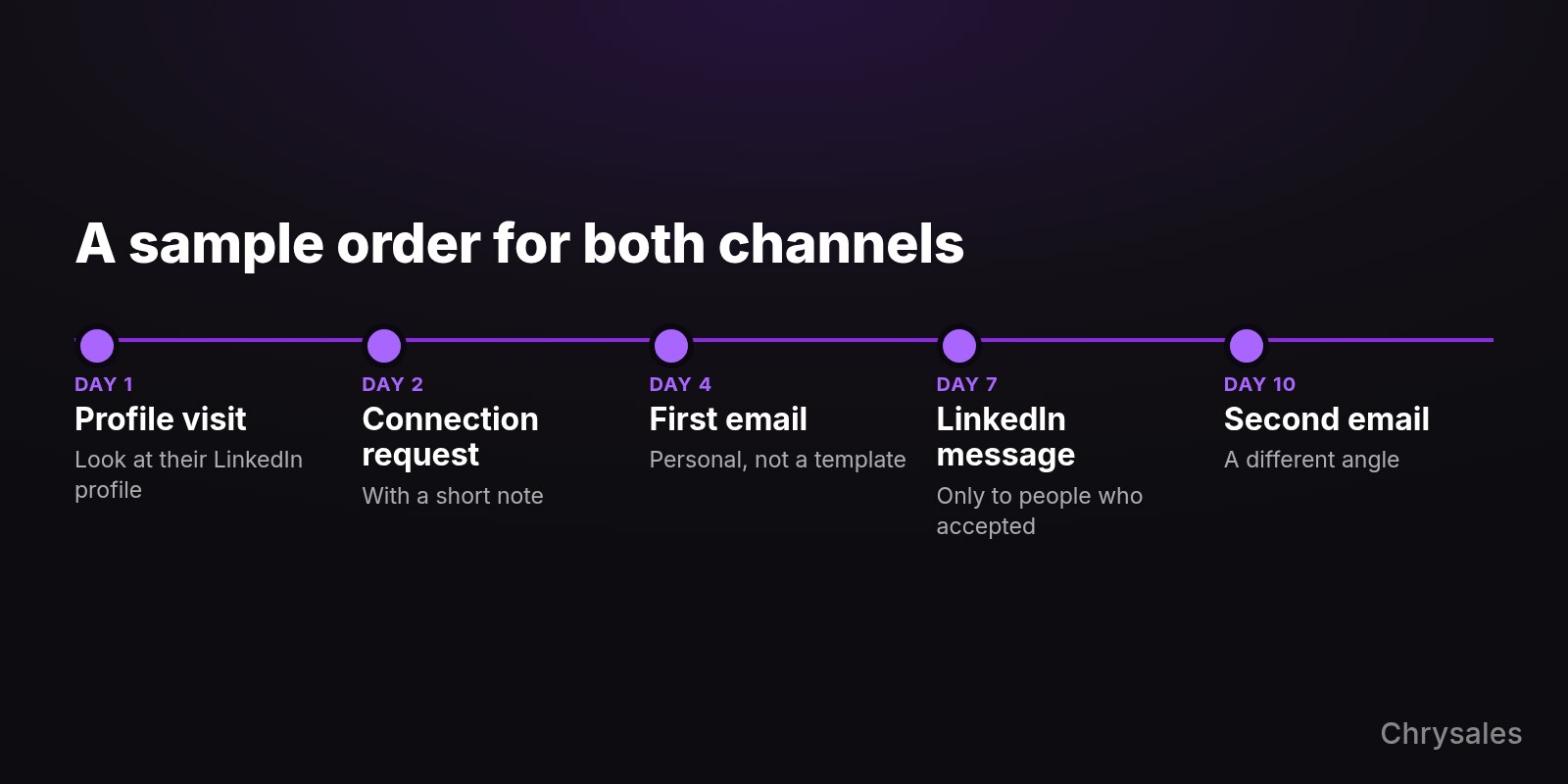
The timeline above is lemlist's sample order for small companies, a vendor template with no result data behind it. Add a rule of your own: when someone replies on either channel, stop the rest of the sequence for that person.
To test which channel should lead:
- Take 100 buyers and split them into two groups of similar companies.
- Message one group on LinkedIn and email the other, with the same offer and the same number of follow-ups.
- After 14 days, count the meetings each group booked. Opens tell you little about real interest.
For follow-up timing, see how follow-up emails work in a sequence.
In this video, Sabir explains how to build sales systems that handle outreach and lead management without a massive team.
Conclusion: Count your list before you choose
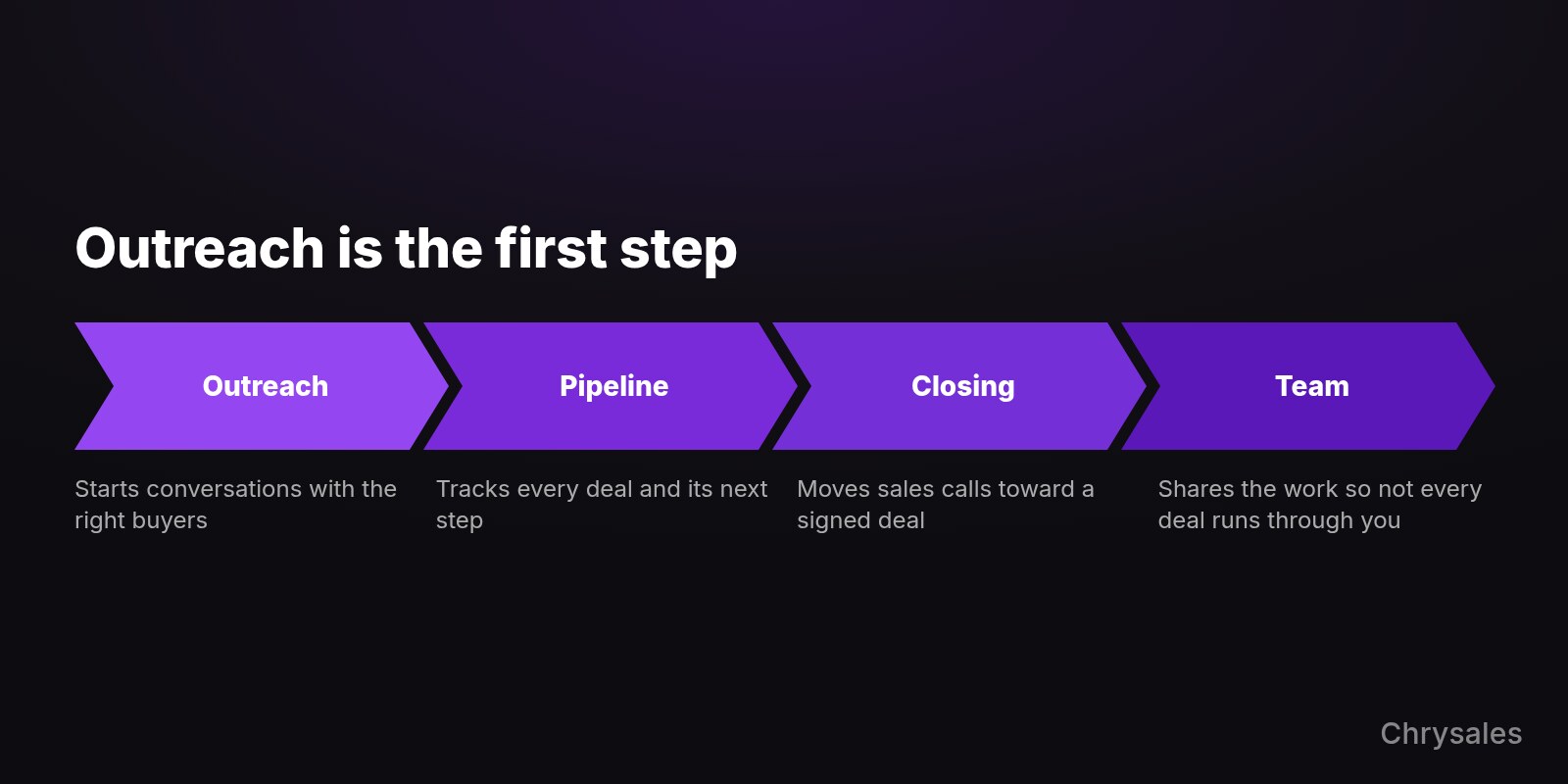
Outreach is only the first step of a client acquisition system. Pipeline, closing and a team come after it, so pick the channel first and then build the rest.
- Write down how many real buyers you can name, and what a deal is worth to you.
- Choose the leading channel from the table on list size and deal value.
- Set up that channel: SPF, DKIM and DMARC for email, or time in your week to send LinkedIn messages by hand. Then run the 2-week test before you scale.
If LinkedIn leads, read how to run LinkedIn outreach step by step next.
Still unsure which channel should lead for your buyers? You can talk it through with Chrysales on a free strategy call. Talk your outreach plan through on a free call
Cold email vs LinkedIn comes down to your list size, your deal value, and where your buyers actually answer. A small list with big deals points to LinkedIn first, and a large list with smaller deals points to cold email.
Many B2B teams use both, with one channel in the lead. Test before you commit, because each channel puts something at risk: your LinkedIn account or your email domain (the part after the @).
Cold email vs LinkedIn reply rates
We found no neutral study on this. The largest comparison we found comes from a software vendor, and it leans toward LinkedIn.
A sequence is a planned series of messages to the same person over a few days or weeks. The outreach tool vendor lemlist looked at its own users' campaigns. They covered 586,310 campaigns and 412.6 million messages sent between October 2025 and November 2026.
lemlist counted replies on any channel and grouped each sequence by the channel it started on. In Europe, sequences that started on LinkedIn got about 8% replies, against about 3.4% for sequences that started with email. In the US it was 6.56% against 2.12%.
Those numbers only cover lemlist's users, and lemlist doesn't say exactly what counts as a reply. The company also calls the result correlated, so it doesn't prove LinkedIn caused the gap.
lemlist calls LinkedIn first "the stronger default", but it also lists cases where email should lead. One of them is a list too large for LinkedIn's limits.
How many people each channel reaches
LinkedIn needs little setup, but it limits how many people you can invite. Email needs more setup before the first message.
LinkedIn doesn't publish a weekly number of invitations. Figures like "100 a week" come from users and vendors. If you hit the limit, the restriction typically lasts one week, and you can't buy more invitations while it lasts.
LinkedIn also warns that automation tools risk getting accounts restricted or shut down. So plan to send LinkedIn messages by hand.
On the email side, SPF, DKIM and DMARC are three settings on your domain. They prove the mail really comes from you. For mail to personal Gmail addresses, Google asks every sender to set up SPF or DKIM.
Google also wants your spam rate, the share of people who mark your mail as spam, below 0.1%. That is 1 in 1,000, and it should never reach 0.3%. For volume, see the daily sending limits per inbox.
Pick your channel by list and deal
Count the real buyers you can name, and note what a deal is worth. Then ask where those buyers actually reply.
This is a simple rule of thumb, not a study result. With a small list of big buyers, start on LinkedIn, because you can't afford to waste a single name.
| Your situation | Start with | Why |
|---|---|---|
| Small list, each deal worth a lot | Each person gets real attention | |
| Large list, smaller deals | Cold email | Usually reaches more people |
| Buyers busy on LinkedIn, inboxes full | They answer where they spend time | |
| Buyers rarely open LinkedIn | Cold email | Their inbox is where they answer |
| Still not sure | Both, as a test | Your own numbers decide |
Early B2B companies have won clients both ways. In Lenny Rachitsky's founder interviews, the founders of Zip said they "got our first 10 customers by reaching out for advice on LinkedIn".
Sprig's founder said its first 10 customers all came from cold emails to one clearly defined group of companies.
La Growth Machine, which sells a tool that sends on several channels, puts the "where" question simply. Starting on LinkedIn works "when your prospects are active on the platform and their inboxes are saturated".
If you are weighing the phone instead, see cold calling vs cold email.
Check the email rules where you sell
Germany asks for a clear yes before sales email, even to companies, while the UK and the US allow some business email without one. This is a short look at three countries, not legal advice, so ask a lawyer about your own case.
- In Germany, the unfair competition law (UWG section 7) generally requires a clear yes before you send advertising by email, also to businesses. There is a narrow exception for existing customers. A Düsseldorf local court ruled in November 2025 that a LinkedIn connection is not that yes, as Scheja & Partners explain.
- In the UK, the ICO, the data protection regulator, says you can email companies without asking first. Sole traders and some partnerships count as individuals, so stricter rules apply to them. Always say who you are and offer a way to opt out. Data protection rules can still cover named people's work emails.
- In the US, the CAN-SPAM rules cover business email too. You don't need a yes first, but you must honor a request to stop within 10 business days.
How to run both and test them
Let one channel lead, add the second in a fixed order, and stop as soon as someone replies. If you can't choose a leader, test both on your own buyers for two weeks.
The timeline above is lemlist's sample order for small companies, a vendor template with no result data behind it. Add a rule of your own: when someone replies on either channel, stop the rest of the sequence for that person.
To test which channel should lead:
- Take 100 buyers and split them into two groups of similar companies.
- Message one group on LinkedIn and email the other, with the same offer and the same number of follow-ups.
- After 14 days, count the meetings each group booked. Opens tell you little about real interest.
For follow-up timing, see how follow-up emails work in a sequence.
In this video, Sabir explains how to build sales systems that handle outreach and lead management without a massive team.
Conclusion: Count your list before you choose
Outreach is only the first step of a client acquisition system. Pipeline, closing and a team come after it, so pick the channel first and then build the rest.
- Write down how many real buyers you can name, and what a deal is worth to you.
- Choose the leading channel from the table on list size and deal value.
- Set up that channel: SPF, DKIM and DMARC for email, or time in your week to send LinkedIn messages by hand. Then run the 2-week test before you scale.
If LinkedIn leads, read how to run LinkedIn outreach step by step next.
Still unsure which channel should lead for your buyers? You can talk it through with Chrysales on a free strategy call. Talk your outreach plan through on a free call
Scaling Is Not Hard If You Have The Right Systems
If you’re serious about leveling up your scaling game, you need the right system, the right training, and the right team behind you. We're here to give you the exact tools and strategies top entrepreneurs use to dominate.

Discover the latest tips
View All
Chrysales was formed from the words "chrysalis" the stage where a caterpillar transforms into a butterfly and "sales".
It stands for one thing: sales transformation.Because scaling doesn’t happen by doing more of the same. Scaling only happens when you go through real transformation in your systems, your offer, team and the way you sell.


