.avif)
Why Your Cold Email Sequence Strategy Stops at Line 3
The 3-Line Cold Email That Outperforms Every Long Sequence
A cold email sequence strategy is a simple way to get replies by making the first email do the real work, with three strong lines that earn attention and action. Most cold email sequences fail because they're solving the wrong problem. You spend hours writing seven perfectly timed emails, setting up automation, A/B testing subject lines, and the reply rate still sits under 1%. Here's what nobody tells you: length isn't the issue. Your cold email sequence strategy works or doesn't based on three lines you write in the first email. Not the follow-ups. Not the breakup email. The first three lines. Get those right, and you need fewer emails. Get them wrong, and no amount of follow-up saves you.
Why Most Cold Email Sequences Are Built Backwards
The standard advice says send 5 to 7 emails over two weeks. Email one introduces you. Email two adds value. Email three drops a case study. Email four handles objections. Email five is the breakup. Sounds logical. The problem? Most people never make it past line two of email one. Your first email isn't competing with other sales emails. It's competing with 47 unread messages, three Slack pings, and a meeting that starts in four minutes. If your opening doesn't grab attention in under five seconds, the sequence dies before it starts.
The Real Conversion Point Nobody Talks About
Here's the thing: cold email reply rates average around 2% to 5% across B2B sales. The emails that hit 8% to 12%? They're not longer. They're not prettier. They nail the first three lines so hard that the reader actually wants to keep going. This is where lead generation starts to work. Think of it like walking past someone at a conference. If their opening line is "Hi, I'm from a company that helps businesses grow," you're already looking for the exit. But if they say "I noticed your team just expanded into Germany, we helped three other companies in your space do the same thing last quarter," you stop walking. Watch out: Most teams optimize the wrong part of the sequence. They obsess over email four when email one is doing all the damage.
What the First Three Lines Actually Need to Do
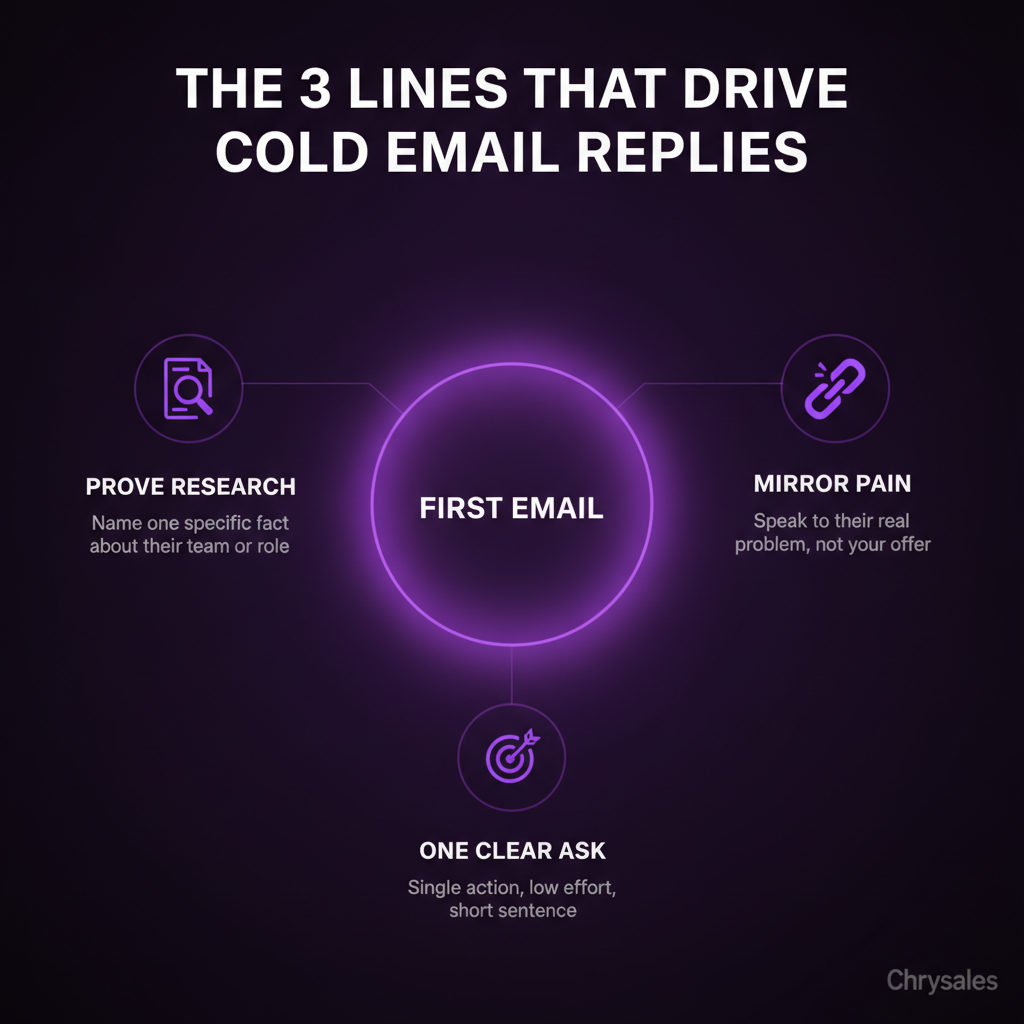
The first three lines of your cold email aren't about you. They're not even really about your offer. They do three jobs, and if any one fails, the email gets deleted.
Line One: Prove You Did Your Homework
This line shows you know something specific about them. Not "I saw you're in the consulting space." That's generic. Try "I saw your company promoted three people to senior consultant last month." That's specific. It takes 30 seconds of LinkedIn research. It's the difference between a cold email and a slightly warm one. Most B2B lead generation fails here. You send 500 emails to a scraped list. Half the contacts aren't even the right person. A quarter left the company. You spent hours on the words and zero time on the list. Bad move.
Line Two: Make It About Them, Not You
This is where most cold outreach for agency owners and B2B sales teams crashes. Line two usually sounds like "We help companies like yours increase revenue." Nobody cares. They care about their problem. Instead: "Most consulting firms we talk to say hiring senior talent without losing margin is their biggest bottleneck right now." Now you're talking about their world. You're not pitching. You're observing something true.
Line Three: One Clear Next Step
The third line is the ask. One sentence. One action. Not "Let me know if you'd like to chat, or feel free to check out our website, or I can send over some resources." That's three asks. Pick one. Try: "Worth a 15-minute call next week?" That's it. Short. Clear. Low friction. If lines one and two did their job, this line closes. Pro Tip: If your first email is longer than seven sentences, you've already lost. Cut it in half. Then cut it again.
Why Follow-Up Emails Exist (And When They Actually Work)
Follow-ups aren't there to convince someone who said no. They're there to catch people who missed email one. Inboxes are chaos. A solid email sent on Monday might get buried by Tuesday. A follow-up on Thursday gives you a second shot at the same person. But here's where it gets interesting. If your first email was bad, your follow-ups won't save it. If your first email was great, your follow-ups are just reminder taps. They don't need to be long. They don't need new angles. They need to re-surface the original message.
The Two-Email System That Actually Converts
Most cold email follow-up strategy suggests five to seven touches. We've seen better results with two or three emails max. Email one does the heavy lifting. Email two, sent three to four days later, is a short bump: "Hey [name], just wanted to make sure this didn't get buried. Still interested in that 15-minute call?" Email three, if you send it at all, is the breakup. "Looks like timing isn't right. I'll close the loop on my end." Paradoxically, breakup emails often get the most replies. They signal you're not going to hound someone forever. That's respectful. People respond to respect. A 20 person tech company we worked with last year cut their sequence from seven emails to three. Their reply rate jumped from 3% to 9%. The difference wasn't volume. It was focus. Fewer emails. Better targeting. Stronger first lines. Common mistake: Sending a follow-up that repeats the first email word for word. If they ignored it once, they'll ignore it again. Change the subject line. Trim the body. Make it feel like a new touch, not a copy paste.
The List Does 70% of the Work (And Most People Ignore This)
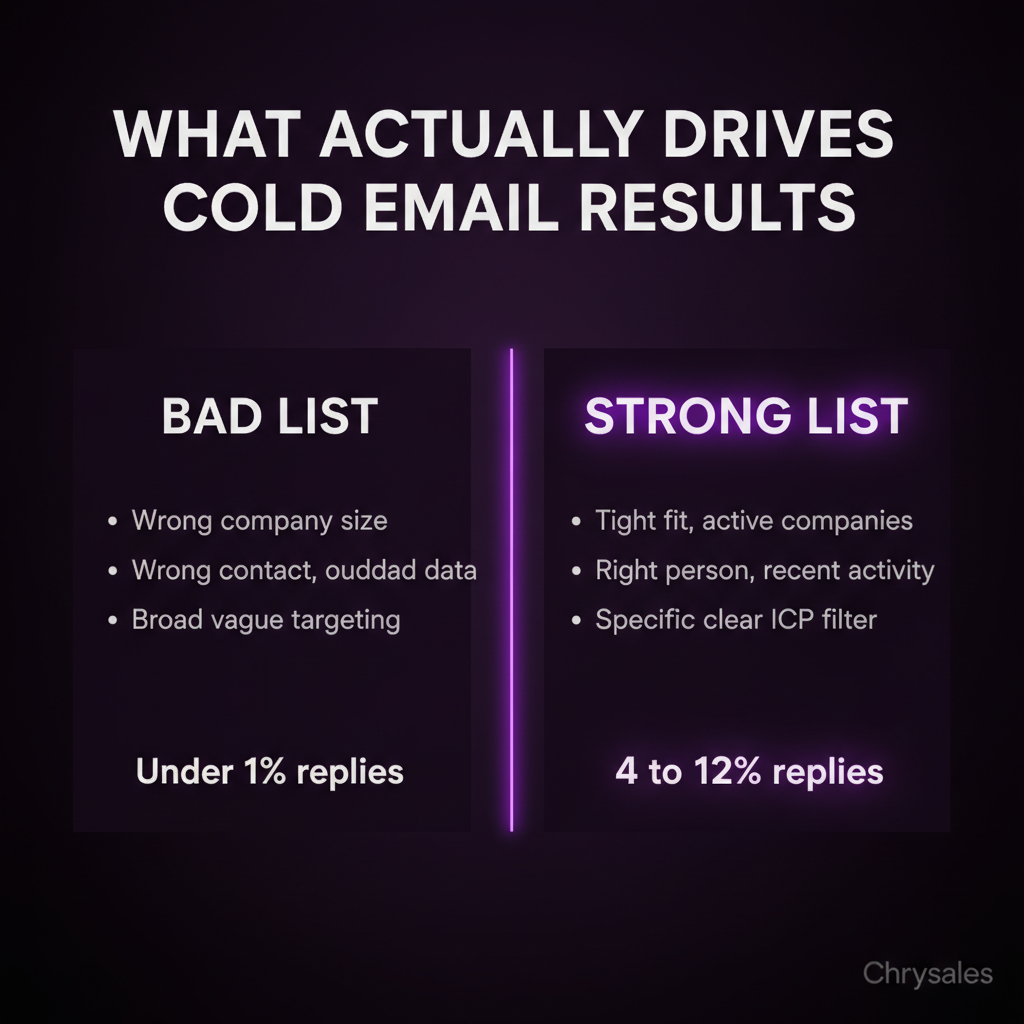
Picture this: you write the perfect three-line email. Subject line is great. Call to action is clear. You send it to 300 people. You get two replies. What happened? The list was bad. You targeted companies too big, too small, wrong industry, wrong person. No amount of good writing fixes a bad list. This is the part of B2B cold email outreach that nobody wants to hear. Research is boring. Writing feels productive. But a great email sent to the wrong 300 people is just noise. In b2b sales, the list matters more than most people think.
How to Build a List That Actually Replies
Start with a tight Ideal Customer Profile. Not "B2B companies with 10 to 500 employees." That's too broad. Try "consulting firms with 15 to 50 people, focused on digital transformation, based in Europe, that hired at least two people in the last six months." Now you have a real filter. Use LinkedIn, Crunchbase, company news, anything that shows recent activity. Companies that just raised funding, just hired, just launched a new service? Those are warmer than companies sitting still. A bad list is like inviting 1,000 random people to a birthday party. Most won't show up. The few who do don't even like cake. One marketing agency we trained had a 0.5% reply rate on cold email. We didn't touch the email copy. We rebuilt the list. Tighter ICP. Better research. Reply rate hit 4.2% in three weeks. Same email. Different list. Pro Tip: If you can't find three specific, recent facts about a company in under two minutes, remove them from the list. They're not warm enough.
When to Automate and When to Stay Manual
Cold email deliverability and automation tools make it tempting to send 1,000 emails a day. Don't. Email providers flag that. Your domain gets a bad reputation. Your emails land in spam. Suddenly your personalized cold email at scale strategy is just spam at scale. Start manual. Send 20 to 30 emails a day. Personalize the first three lines for each one. Yes, it's slower. It's also way more effective. Once you hit consistent 5% to 8% reply rates manually, then you can think about automating parts of it. This kind of sales training helps teams keep the first touch human.
What to Automate (and What Not To)
Automate the scheduling. Automate the follow-up timing. Automate list pulls from LinkedIn or your CRM. Do not automate the first three lines. Those need to be written by a human who actually looked at the prospect's profile. AI tools can help with research. They can pull recent news, job changes, funding rounds. But the line that references that research? Write it yourself. A poorly automated "I saw your recent post" when there was no recent post kills trust instantly. We use AI in our sales systems for lead scoring, research summaries, and follow-up reminders. We do not use it to write the opening lines of cold emails. The ROI isn't there. Personalized beats automated every single time in the first touch. Watch out: Tools that promise "personalization at scale" usually mean "merge tags at scale." That's not the same thing. Real personalization takes research. If the tool didn't research the person, it's not personalized.
How This Fits Into a Real B2B Sales System
A three-line cold email isn't a standalone tactic. It's one piece of a bigger client acquisition system. The email books the call. The call uncovers the need. The pitch closes the deal. The follow-up system keeps them moving. Most small sales teams treat cold email like the whole strategy. It's not. It's the top of the funnel. If your discovery questions are weak, your offer is confusing, or your objection handling is shaky, a great email just gets you to "no" faster.
Connecting Email to the Full Sales Process
Here's what a complete system looks like. Cold email gets the meeting. Your sales call structure takes over from there. You ask discovery questions that surface real pain. You position your offer as the fix. You handle objections with pre-built scripts. You close with a clear next step. Growing B2B companies that treat email as part of a system see 3x better close rates than companies that treat it as a one-off tactic. Why? Because the email sets up the call, and the call is where revenue happens. It also fits the gtm work behind the scenes. At Chrysales, we build the full system. We help you write the email, structure the call, train your team on objections, and set up the follow-up process. Cold email is step one. The rest of the system is what turns replies into revenue. We've trained over 500 sales teams and helped generate over €10M in client revenue using this exact approach. Pro Tip: Track reply rate AND meeting show rate AND close rate. If replies are high but meetings are low, your calendar link or scheduling process is broken. If meetings are high but closes are low, your call structure needs work.
Why Most People Overcomplicate Cold Email (And How to Fix It)
Cold email reply rate optimization isn't about hacks. It's not about the perfect subject line formula or the magic sending time. It's about research, relevance, and brevity. The teams that win at cold email do three things better than everyone else: they build better lists, they write tighter emails, and they follow up without being annoying. You don't need a 10 step email sequence for lead generation. You don't need expensive automation software. You need a good list, three strong lines, and a follow-up plan that respects people's time. Most teams overthink it. They add case studies to email two. They attach PDFs to email three. They write 200 word novels when 50 words would work better. Less is more. A cold email isn't a pitch deck. It's a conversation starter. Start with 30 prospects. Write three lines for each. Send them manually. Track replies. Adjust your list and your lines based on what works. Do that for two weeks. You'll learn more than reading 50 blog posts on cold email subject line formulas. If you want help building a system around this, Chrysales works 1 on 1 with B2B businesses to set up appointment booking systems, write high converting outreach, and train teams to close. We've worked with companies like Amazon, Vodafone, and Deutsche Börse, and we maintain a 99.4% client satisfaction rate. But whether you work with us or not, the principle stays the same: better list, better lines, better results. You can also watch our breakdown of cold email versus cold calling to see which brings revenue faster and how these tactics fit into broader sales systems.
Frequently Asked Questions
Q: How many cold emails should I send per day to avoid spam filters?
Start with 20 to 30 emails per day if you're using a new domain or sender address. Email providers like Gmail and Outlook track sending patterns. A sudden jump from zero to 500 emails a day flags your account. Ramp up slowly over two to three weeks. If you're getting good reply rates and low bounce rates, you can increase to 50 to 75 emails per day. Always warm up new domains before sending cold email sequences at scale to protect your deliverability.
Q: Should I A/B test subject lines or email body copy first?
Test the list first. Seriously. If your list is bad, no subject line saves you. Once you have a list that's tight and well-researched, test subject lines. A good subject line can boost open rates by 20% to 40%. After that, test your opening lines. The body copy matters less than you think if the first three lines don't hook the reader. Most B2B sales teams test the wrong variables in the wrong order.
Q: What's a realistic reply rate for cold email in B2B sales?
Average cold email reply rates sit between 2% and 5%. If you're hitting 8% to 12%, you're in the top tier. Anything above 15% usually means your list is very warm or your offer is extremely relevant. If you're under 1%, your list is probably too broad, your targeting is off, or your email sounds like spam. Fix the list and tighten your first three lines before worrying about follow-ups. For more context on what top performers achieve, check out detailed cold email response rate benchmarks from real campaigns.
Q: How long should I wait between follow-up emails?
Wait three to four days between email one and email two. If someone doesn't reply after email two, wait five to seven days before sending email three. Don't follow up daily. That's annoying, not persistent. Most replies come within 48 hours of the first or second email. After three emails over two weeks with no reply, move on. Your time is better spent finding new prospects than chasing dead leads.
Q: Can I use the same email template for different industries?
No. A cold email that works for consulting firms won't work for tech companies or marketing agencies. The pain points are different. The language is different. The timing is different. You can use the same structure (specific observation, relevance, clear ask), but the content has to change. If your email sounds like it could be sent to anyone, it's too generic. Learn more about how to build targeted prospect lists by industry and ICP to improve relevance and results. Personalization isn't just the name. It's the entire context.
The 3-Line Cold Email That Outperforms Every Long Sequence
A cold email sequence strategy is a simple way to get replies by making the first email do the real work, with three strong lines that earn attention and action. Most cold email sequences fail because they're solving the wrong problem. You spend hours writing seven perfectly timed emails, setting up automation, A/B testing subject lines, and the reply rate still sits under 1%. Here's what nobody tells you: length isn't the issue. Your cold email sequence strategy works or doesn't based on three lines you write in the first email. Not the follow-ups. Not the breakup email. The first three lines. Get those right, and you need fewer emails. Get them wrong, and no amount of follow-up saves you.
Why Most Cold Email Sequences Are Built Backwards
The standard advice says send 5 to 7 emails over two weeks. Email one introduces you. Email two adds value. Email three drops a case study. Email four handles objections. Email five is the breakup. Sounds logical. The problem? Most people never make it past line two of email one. Your first email isn't competing with other sales emails. It's competing with 47 unread messages, three Slack pings, and a meeting that starts in four minutes. If your opening doesn't grab attention in under five seconds, the sequence dies before it starts.
The Real Conversion Point Nobody Talks About
Here's the thing: cold email reply rates average around 2% to 5% across B2B sales. The emails that hit 8% to 12%? They're not longer. They're not prettier. They nail the first three lines so hard that the reader actually wants to keep going. This is where lead generation starts to work. Think of it like walking past someone at a conference. If their opening line is "Hi, I'm from a company that helps businesses grow," you're already looking for the exit. But if they say "I noticed your team just expanded into Germany, we helped three other companies in your space do the same thing last quarter," you stop walking. Watch out: Most teams optimize the wrong part of the sequence. They obsess over email four when email one is doing all the damage.
What the First Three Lines Actually Need to Do
The first three lines of your cold email aren't about you. They're not even really about your offer. They do three jobs, and if any one fails, the email gets deleted.
Line One: Prove You Did Your Homework
This line shows you know something specific about them. Not "I saw you're in the consulting space." That's generic. Try "I saw your company promoted three people to senior consultant last month." That's specific. It takes 30 seconds of LinkedIn research. It's the difference between a cold email and a slightly warm one. Most B2B lead generation fails here. You send 500 emails to a scraped list. Half the contacts aren't even the right person. A quarter left the company. You spent hours on the words and zero time on the list. Bad move.
Line Two: Make It About Them, Not You
This is where most cold outreach for agency owners and B2B sales teams crashes. Line two usually sounds like "We help companies like yours increase revenue." Nobody cares. They care about their problem. Instead: "Most consulting firms we talk to say hiring senior talent without losing margin is their biggest bottleneck right now." Now you're talking about their world. You're not pitching. You're observing something true.
Line Three: One Clear Next Step
The third line is the ask. One sentence. One action. Not "Let me know if you'd like to chat, or feel free to check out our website, or I can send over some resources." That's three asks. Pick one. Try: "Worth a 15-minute call next week?" That's it. Short. Clear. Low friction. If lines one and two did their job, this line closes. Pro Tip: If your first email is longer than seven sentences, you've already lost. Cut it in half. Then cut it again.
Why Follow-Up Emails Exist (And When They Actually Work)
Follow-ups aren't there to convince someone who said no. They're there to catch people who missed email one. Inboxes are chaos. A solid email sent on Monday might get buried by Tuesday. A follow-up on Thursday gives you a second shot at the same person. But here's where it gets interesting. If your first email was bad, your follow-ups won't save it. If your first email was great, your follow-ups are just reminder taps. They don't need to be long. They don't need new angles. They need to re-surface the original message.
The Two-Email System That Actually Converts
Most cold email follow-up strategy suggests five to seven touches. We've seen better results with two or three emails max. Email one does the heavy lifting. Email two, sent three to four days later, is a short bump: "Hey [name], just wanted to make sure this didn't get buried. Still interested in that 15-minute call?" Email three, if you send it at all, is the breakup. "Looks like timing isn't right. I'll close the loop on my end." Paradoxically, breakup emails often get the most replies. They signal you're not going to hound someone forever. That's respectful. People respond to respect. A 20 person tech company we worked with last year cut their sequence from seven emails to three. Their reply rate jumped from 3% to 9%. The difference wasn't volume. It was focus. Fewer emails. Better targeting. Stronger first lines. Common mistake: Sending a follow-up that repeats the first email word for word. If they ignored it once, they'll ignore it again. Change the subject line. Trim the body. Make it feel like a new touch, not a copy paste.
The List Does 70% of the Work (And Most People Ignore This)
Picture this: you write the perfect three-line email. Subject line is great. Call to action is clear. You send it to 300 people. You get two replies. What happened? The list was bad. You targeted companies too big, too small, wrong industry, wrong person. No amount of good writing fixes a bad list. This is the part of B2B cold email outreach that nobody wants to hear. Research is boring. Writing feels productive. But a great email sent to the wrong 300 people is just noise. In b2b sales, the list matters more than most people think.
How to Build a List That Actually Replies
Start with a tight Ideal Customer Profile. Not "B2B companies with 10 to 500 employees." That's too broad. Try "consulting firms with 15 to 50 people, focused on digital transformation, based in Europe, that hired at least two people in the last six months." Now you have a real filter. Use LinkedIn, Crunchbase, company news, anything that shows recent activity. Companies that just raised funding, just hired, just launched a new service? Those are warmer than companies sitting still. A bad list is like inviting 1,000 random people to a birthday party. Most won't show up. The few who do don't even like cake. One marketing agency we trained had a 0.5% reply rate on cold email. We didn't touch the email copy. We rebuilt the list. Tighter ICP. Better research. Reply rate hit 4.2% in three weeks. Same email. Different list. Pro Tip: If you can't find three specific, recent facts about a company in under two minutes, remove them from the list. They're not warm enough.
When to Automate and When to Stay Manual
Cold email deliverability and automation tools make it tempting to send 1,000 emails a day. Don't. Email providers flag that. Your domain gets a bad reputation. Your emails land in spam. Suddenly your personalized cold email at scale strategy is just spam at scale. Start manual. Send 20 to 30 emails a day. Personalize the first three lines for each one. Yes, it's slower. It's also way more effective. Once you hit consistent 5% to 8% reply rates manually, then you can think about automating parts of it. This kind of sales training helps teams keep the first touch human.
What to Automate (and What Not To)
Automate the scheduling. Automate the follow-up timing. Automate list pulls from LinkedIn or your CRM. Do not automate the first three lines. Those need to be written by a human who actually looked at the prospect's profile. AI tools can help with research. They can pull recent news, job changes, funding rounds. But the line that references that research? Write it yourself. A poorly automated "I saw your recent post" when there was no recent post kills trust instantly. We use AI in our sales systems for lead scoring, research summaries, and follow-up reminders. We do not use it to write the opening lines of cold emails. The ROI isn't there. Personalized beats automated every single time in the first touch. Watch out: Tools that promise "personalization at scale" usually mean "merge tags at scale." That's not the same thing. Real personalization takes research. If the tool didn't research the person, it's not personalized.
How This Fits Into a Real B2B Sales System
A three-line cold email isn't a standalone tactic. It's one piece of a bigger client acquisition system. The email books the call. The call uncovers the need. The pitch closes the deal. The follow-up system keeps them moving. Most small sales teams treat cold email like the whole strategy. It's not. It's the top of the funnel. If your discovery questions are weak, your offer is confusing, or your objection handling is shaky, a great email just gets you to "no" faster.
Connecting Email to the Full Sales Process
Here's what a complete system looks like. Cold email gets the meeting. Your sales call structure takes over from there. You ask discovery questions that surface real pain. You position your offer as the fix. You handle objections with pre-built scripts. You close with a clear next step. Growing B2B companies that treat email as part of a system see 3x better close rates than companies that treat it as a one-off tactic. Why? Because the email sets up the call, and the call is where revenue happens. It also fits the gtm work behind the scenes. At Chrysales, we build the full system. We help you write the email, structure the call, train your team on objections, and set up the follow-up process. Cold email is step one. The rest of the system is what turns replies into revenue. We've trained over 500 sales teams and helped generate over €10M in client revenue using this exact approach. Pro Tip: Track reply rate AND meeting show rate AND close rate. If replies are high but meetings are low, your calendar link or scheduling process is broken. If meetings are high but closes are low, your call structure needs work.
Why Most People Overcomplicate Cold Email (And How to Fix It)
Cold email reply rate optimization isn't about hacks. It's not about the perfect subject line formula or the magic sending time. It's about research, relevance, and brevity. The teams that win at cold email do three things better than everyone else: they build better lists, they write tighter emails, and they follow up without being annoying. You don't need a 10 step email sequence for lead generation. You don't need expensive automation software. You need a good list, three strong lines, and a follow-up plan that respects people's time. Most teams overthink it. They add case studies to email two. They attach PDFs to email three. They write 200 word novels when 50 words would work better. Less is more. A cold email isn't a pitch deck. It's a conversation starter. Start with 30 prospects. Write three lines for each. Send them manually. Track replies. Adjust your list and your lines based on what works. Do that for two weeks. You'll learn more than reading 50 blog posts on cold email subject line formulas. If you want help building a system around this, Chrysales works 1 on 1 with B2B businesses to set up appointment booking systems, write high converting outreach, and train teams to close. We've worked with companies like Amazon, Vodafone, and Deutsche Börse, and we maintain a 99.4% client satisfaction rate. But whether you work with us or not, the principle stays the same: better list, better lines, better results. You can also watch our breakdown of cold email versus cold calling to see which brings revenue faster and how these tactics fit into broader sales systems.
Frequently Asked Questions
Q: How many cold emails should I send per day to avoid spam filters?
Start with 20 to 30 emails per day if you're using a new domain or sender address. Email providers like Gmail and Outlook track sending patterns. A sudden jump from zero to 500 emails a day flags your account. Ramp up slowly over two to three weeks. If you're getting good reply rates and low bounce rates, you can increase to 50 to 75 emails per day. Always warm up new domains before sending cold email sequences at scale to protect your deliverability.
Q: Should I A/B test subject lines or email body copy first?
Test the list first. Seriously. If your list is bad, no subject line saves you. Once you have a list that's tight and well-researched, test subject lines. A good subject line can boost open rates by 20% to 40%. After that, test your opening lines. The body copy matters less than you think if the first three lines don't hook the reader. Most B2B sales teams test the wrong variables in the wrong order.
Q: What's a realistic reply rate for cold email in B2B sales?
Average cold email reply rates sit between 2% and 5%. If you're hitting 8% to 12%, you're in the top tier. Anything above 15% usually means your list is very warm or your offer is extremely relevant. If you're under 1%, your list is probably too broad, your targeting is off, or your email sounds like spam. Fix the list and tighten your first three lines before worrying about follow-ups. For more context on what top performers achieve, check out detailed cold email response rate benchmarks from real campaigns.
Q: How long should I wait between follow-up emails?
Wait three to four days between email one and email two. If someone doesn't reply after email two, wait five to seven days before sending email three. Don't follow up daily. That's annoying, not persistent. Most replies come within 48 hours of the first or second email. After three emails over two weeks with no reply, move on. Your time is better spent finding new prospects than chasing dead leads.
Q: Can I use the same email template for different industries?
No. A cold email that works for consulting firms won't work for tech companies or marketing agencies. The pain points are different. The language is different. The timing is different. You can use the same structure (specific observation, relevance, clear ask), but the content has to change. If your email sounds like it could be sent to anyone, it's too generic. Learn more about how to build targeted prospect lists by industry and ICP to improve relevance and results. Personalization isn't just the name. It's the entire context.
Scaling Is Not Hard If You Have The Right Systems
If you’re serious about leveling up your scaling game, you need the right system, the right training, and the right team behind you. We're here to give you the exact tools and strategies top entrepreneurs use to dominate.

Discover the latest tips
View All.avif)
Chrysales was formed from the words "chrysalis" the stage where a caterpillar transforms into a butterfly and "sales".
It stands for one thing: sales transformation.Because scaling doesn’t happen by doing more of the same. Scaling only happens when you go through real transformation in your systems, your offer, team and the way you sell.
.avif)


