.avif)
What Is Lead Generation and How Does It Work?
Lead generation is the process of attracting potential buyers and getting them interested enough to start a conversation about what you sell. It fixes the gap where teams waste weeks chasing people who were never going to buy.
Most sales teams waste weeks chasing people who were never going to buy. The list is bad. The targeting is off. Or worse, no one actually raised their hand. That's the gap lead generation fixes.
It's not about blasting thousands of cold emails and hoping someone bites. Real lead generation is about finding people who match what you sell, getting their attention in a way that doesn't feel pushy, and turning that attention into conversations.
When it works, your pipeline fills with people who are curious, not annoyed. When it doesn't, you burn time on dead ends.
What Lead Generation Actually Means
Lead generation is the process of attracting people who might need what you're selling and getting them interested enough to talk. A lead is someone who fits your customer profile and has shown some signal they care.
That signal could be filling out a form, replying to an email, downloading a guide, or booking a call. It's not just a name on a spreadsheet. It's a person who said "yeah, tell me more."
In B2B sales, lead generation usually means outbound outreach, inbound content, or a mix of both. Outbound is when you go find people. Inbound is when they find you. Both work. Most fast-growing companies do both at the same time.
The Difference Between a Lead and a Prospect
A lead is early stage. They raised their hand, but you don't know much yet. A prospect is someone you've talked to and qualified. They have the problem you solve, the budget to fix it, and the authority to buy.
Lead generation fills the top of your sales pipeline. Qualification turns leads into real prospects.
Watch out: Treating every lead like a hot prospect wastes time. Not everyone who downloads your PDF is ready to buy next week.
Why Lead Generation Matters for B2B Sales
Without a steady flow of new leads, your pipeline dries up. Sales becomes a guessing game. You can't predict revenue. You can't plan hiring. You're stuck reacting instead of building.
A good lead generation system gives you control. You know roughly how many new conversations you'll start each week, which means you can forecast how many will close.
One tech company we worked with had zero structure around lead generation. They'd post on LinkedIn once in a while and hope someone messaged them. Some months they booked five calls. Other months, zero. After building a real system with daily outreach, list targeting, and follow-up sequences, they booked 40+ calls a month. Same team. Same offer. The only difference was intentional lead generation.
The Lead Generation Process: How It Actually Works
Lead generation isn't one big thing. It's a series of steps that move someone from "never heard of you" to "let's talk."
Most teams skip steps or do them out of order, which is why their results are all over the place. Here's the process that actually works.
Step 1: Define Your Ideal Customer Profile
Before you reach out to anyone, you need to know who you're looking for. Your ideal customer profile is a clear picture of the companies and people who get the most value from what you sell.
This means firmographic data like company size, industry, location, and revenue range. It also means role and seniority. Are you selling to the VP of Sales? The founder? The head of marketing?
Pro Tip: Start narrow. A tight ICP means higher reply rates and better conversations. You can always expand later.
Most B2B lead generation fails because the list is too broad. A 200-person consulting firm and a 5-person agency might both be "B2B service companies," but they have totally different needs, budgets, and decision timelines. Lumping them together kills your messaging.
Step 2: Build or Buy Your Lead List
Once you know who you're targeting, you need to find them. You can build a list yourself using LinkedIn Sales Navigator, company websites, and manual research. Or you can buy data from providers like Apollo, ZoomInfo, or Cognism.
Both work. Manual research takes longer but gives you cleaner data. Bought lists are faster but need scrubbing.
The key metric here is accuracy. If 30% of your emails bounce or phone numbers are dead, your whole campaign tanks. Always validate emails before sending. Tools like NeverBounce or ZeroBounce catch bad addresses before they hurt your sender reputation.
Step 3: Craft Your Outreach Message
Your message is what gets someone to stop scrolling and respond. In B2B lead generation, this usually means a cold email, a LinkedIn message, or a short video.
The best messages are personal, specific, and focused on one clear next step. Here's what works:
- Personalized first line: Reference something real about their company or role, not a generic compliment
- Clear problem or opportunity: Show you understand what they're dealing with
- One simple ask: Book a call, reply with a yes/no, watch a 2-minute demo
Here's what doesn't work:
- Long paragraphs about your company history
- Bullet points listing all your features
- Asking them to "circle back when the time is right"
Common mistake: Sending the same template to 500 people and wondering why no one replies. Personalization doesn't mean inserting their first name. It means showing you actually looked at what they do.
Step 4: Follow Up (Multiple Times)
Most replies come after the third or fourth touchpoint, not the first. People are busy. Inboxes are full. One email rarely breaks through.
A smart follow-up sequence touches the same person 5 to 7 times over 2 to 3 weeks, mixing email, LinkedIn, and sometimes a call or video. Each follow-up should add new value or a different angle. Don't just say "bumping this up in your inbox." Share a quick case study. Ask a single question. Point to a relevant resource. Give them a reason to respond now instead of later.
One marketing agency we worked with sent one cold email and gave up when people didn't reply. After we added a 5-touch sequence, their reply rate jumped from 1% to 6%. Same list. Better follow-up.
Inbound vs. Outbound Lead Generation: What's the Difference?
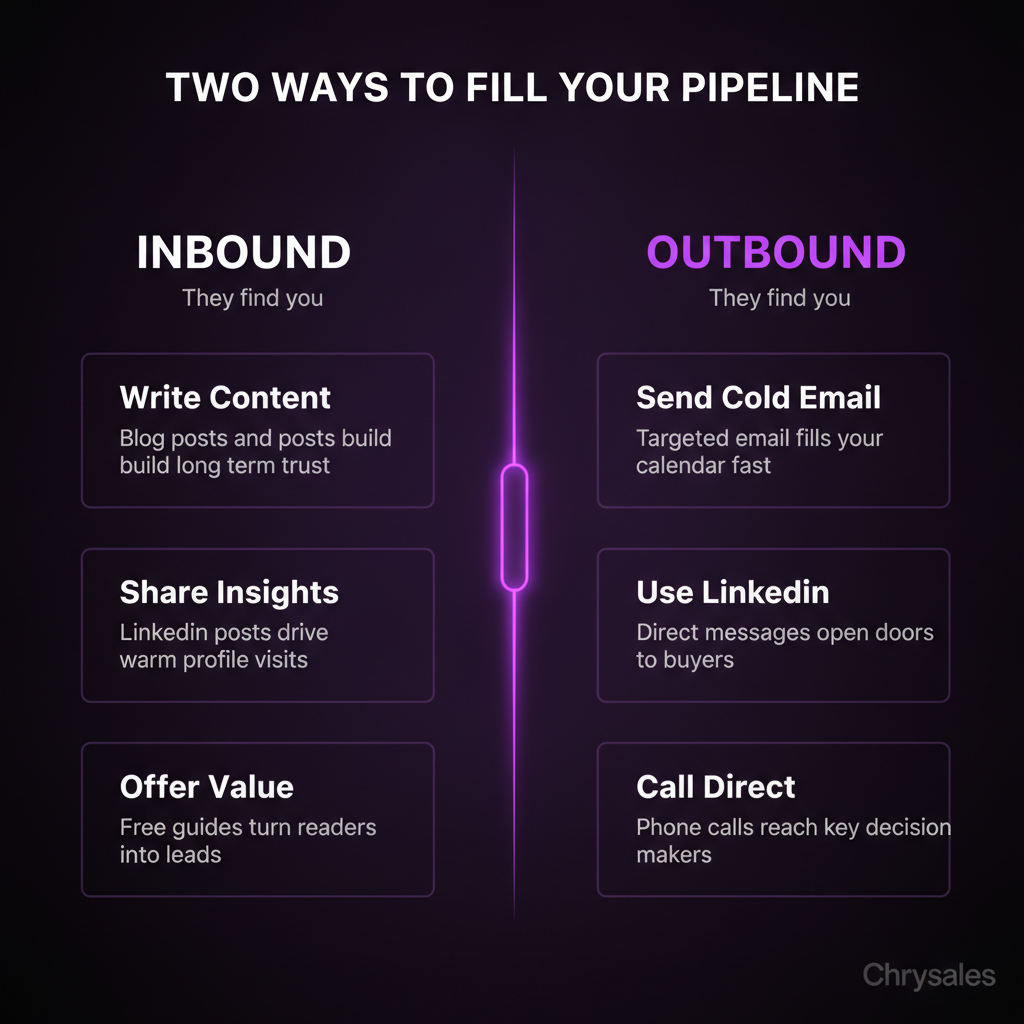
Inbound and outbound are two sides of the same coin. Inbound is when people find you through content, SEO, referrals, or ads. Outbound is when you go directly to them through cold outreach. Both feed your sales pipeline. The best B2B sales systems use both.
Inbound Lead Generation
Inbound lead generation pulls people to you. You create content that answers questions, ranks on Google, or gets shared on LinkedIn. When someone reads your blog, downloads your guide, or watches your video, they enter your world. If they fill out a form or book a call, they become a lead.
Inbound channels include:
- SEO and blog content: Ranking for search terms your ideal customers Google
- LinkedIn posts and thought leadership: Sharing insights that get engagement and profile views
- Lead magnets: Free guides, templates, audits, or tools in exchange for an email
- Webinars and events: Live sessions that attract your target audience
Inbound takes time to build. It's not instant. But once it's working, leads come in while you sleep. The quality is often higher because people are choosing to learn about you, not being interrupted.
Outbound Lead Generation
Outbound lead generation is proactive. You identify targets, reach out directly, and start conversations. It's faster than inbound. You don't wait for someone to find you. You control the volume and timing.
Outbound channels include:
- Cold email campaigns: Targeted sequences to specific ICPs
- LinkedIn outreach: Connection requests and direct messages
- Cold calling: Phone calls to decision makers
- Account-based outreach: Personalized campaigns to specific high-value companies
Outbound gives you predictable pipeline. If you send 100 emails a day with a 5% reply rate, you know you'll get roughly 5 replies. Scale that up, and you can forecast how many calls you'll book each week.
Watch out: Outbound without good targeting is spam. A tight ICP and strong messaging are the only things that separate effective outbound from noise.
Which One Should You Focus On?
Both. Inbound builds long-term authority and trust. Outbound fills your pipeline today. If you're just starting or need revenue fast, go heavy on outbound. If you're playing the long game and want compounding returns, invest in inbound alongside it.
Most successful B2B companies do 60% outbound, 40% inbound, or close to that split. You can also watch how to build a sales system so powerful clients come to you for a deeper walkthrough of balancing these strategies.
Lead Qualification: Not Every Lead Is Worth Your Time
Generating a lead is step one. Figuring out if they're worth pursuing is step two. Lead qualification is the filter that separates real opportunities from tire kickers, students doing research, and people who will never buy.
MQL vs. SQL: Marketing Qualified vs. Sales Qualified
A marketing qualified lead (MQL) is someone who matches your ICP and has shown interest, like downloading a guide or attending a webinar. They're warm, but not ready to buy yet.
A sales qualified lead (SQL) is someone a salesperson has talked to and confirmed has the need, budget, and timeline. SQLs go into active sales conversations. MQLs get nurtured until they're ready.
In smaller teams without a separate marketing function, this distinction matters less. But the principle stays the same: not every interested person is ready to talk sales today.
Simple Lead Scoring
Lead scoring assigns points to actions and traits. Someone at a 500-person company in your target industry gets more points than someone at a 10-person startup outside your niche. Someone who replies to your email and books a call scores higher than someone who just opened it.
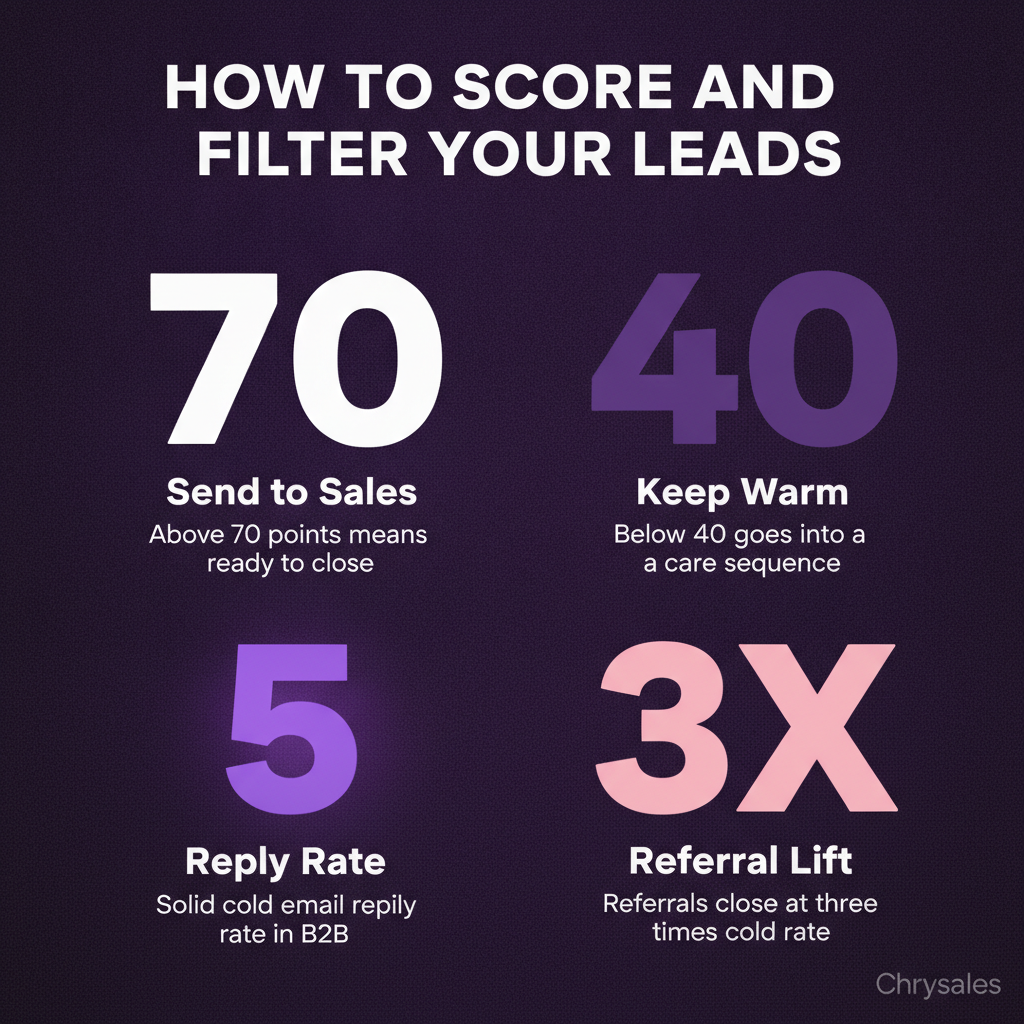
Set a simple rule: anything scoring above 70 goes to the top of your call list. Anything below 40 gets more nurture emails before a salesperson touches it. This keeps your team focused on high-intent leads instead of spinning on people who aren't ready.
Pro Tip: Track where your best customers come from. If 80% of closed deals came from a specific industry or company size, weight your scoring toward that profile. For more guidance on how to structure this process, check out this comprehensive lead qualification framework.
Best Lead Generation Strategies for B2B Sales
There's no single "best" way to do lead generation. What works depends on your market, offer, and resources. But these strategies show up again and again in high-performing B2B sales systems.
Cold Email Outreach Done Right
Cold email still works, but only if you do it right. That means clean lists, tight targeting, personalized first lines, and value-driven messaging. Send from a real person's email, not a no-reply address. Keep your daily volume under 50 emails per inbox to avoid spam filters. A/B test subject lines and opening hooks.
A 15-person consulting firm used cold email to book 20+ discovery calls a month by targeting finance directors at mid-market SaaS companies. Their secret wasn't a magic template. It was a laser-focused ICP and genuine personalization in every first line. Learn how to replicate this with our guide on outbound email marketing best practices.
LinkedIn Outreach and Content
LinkedIn is the best B2B lead generation channel for most industries. You can find decision makers, see what they care about, and reach out directly. Posting valuable content builds visibility. Commenting on other people's posts starts conversations. Sending connection requests with a short, helpful note opens doors.
Common mistake: Sending a connection request, then immediately pitching your service in the first message. It feels like a bait-and-switch. Build a tiny bit of rapport first. For a step-by-step system, explore our LinkedIn outreach strategy for B2B.
Referrals and Partner Networks
Your best leads often come from people who already trust you. Ask happy clients for intros. Build partnerships with companies that serve the same audience but sell something different.
A sales consultant might partner with a marketing agency. When one finds a client who needs both, they refer each other. Referrals convert at 3x to 5x higher rates than cold outreach because trust is already there. Make asking for referrals part of your client onboarding and offboarding process.
You can also discover more tactics in this video on 4 ways to find clients who need your services right now.
Lead Generation Tools That Actually Help
You don't need 47 tools to do lead generation well. You need a few solid ones that handle the core jobs: finding contacts, managing outreach, and tracking what works.
Tools for Finding Leads
- LinkedIn Sales Navigator: Filter by company size, role, industry, and recent activity
- Apollo.io: B2B contact database with email verification built in
- ZoomInfo: Deeper data, better for larger teams with budget
- Crunchbase: Good for targeting startups and funded companies
Tools for Outreach and Follow-Up
- Lemlist or Instantly: Cold email automation with personalization
- HubSpot or Pipedrive: CRM to track every lead and conversation
- Expandi or Phantombuster: LinkedIn automation (use carefully to avoid bans)
Tools for Lead Scoring and Enrichment
- Clearbit: Enriches leads with firmographic and role data
- Clay.com: Pulls data from multiple sources and builds custom workflows
- Custom spreadsheets + Zapier: For smaller teams who want control without complexity
Pro Tip: Start simple. One CRM, one outreach tool, one lead source. Add complexity only when you've maxed out what you're already using.
How Chrysales Approaches Lead Generation Differently
Most lead generation advice treats it like a marketing problem. Build a funnel. Run ads. Nurture leads. That works, but it misses a huge piece: alignment with your sales process.
At Chrysales, we build lead generation as part of a full sales system. The way you generate leads affects how you qualify them, pitch them, and close them. If those pieces don't fit together, you end up with a pipeline full of conversations that go nowhere.
Our approach starts with your offer and positioning. If your offer isn't clear, no amount of cold outreach will save you. We help you define exactly who you serve, what problem you solve, and why someone should talk to you today instead of next quarter.
Then we build the lead generation machine around that. We've trained over 500 sales teams and helped clients generate over €10 million in revenue by connecting lead generation to real sales outcomes, not just top-of-funnel metrics.
We don't just hand you a list and a template. We build the system: the ICP, the messaging, the outreach cadence, the qualification criteria, and the handoff to your sales calls. That's the difference. Lead generation isn't a one-off campaign. It's the engine that keeps your whole sales operation moving. Learn more about our approach in how to build a sales system that actually scales.
Frequently Asked Questions
Q: What is the difference between lead generation and sales prospecting?
Lead generation is the process of attracting and capturing interest from potential buyers, often through content, ads, or outreach campaigns. Sales prospecting is when a salesperson actively researches and reaches out to specific individuals to start a conversation. Lead generation fills the pipeline. Prospecting turns those leads into real opportunities. Both are part of the same process, just different stages.
Q: How long does it take to see results from B2B lead generation?
Outbound lead generation can produce replies and booked calls within the first week if your list and messaging are solid. Inbound lead generation through content and SEO usually takes 3 to 6 months to build momentum. The timeline depends on your offer, market, and how consistent you are. Most teams see real traction around the 60-day mark if they're running daily outreach and refining their approach based on what works.
Q: What is a good reply rate for cold email lead generation?
A reply rate between 3% and 8% is solid for B2B cold email. Anything above 8% means your targeting and messaging are dialed in. Below 2% usually points to a bad list, generic messaging, or deliverability problems. Focus on improving one variable at a time. Start with your ICP and list quality, then tweak your messaging. Small changes in personalization can double your reply rate. For detailed data and experiments, read more about cold email response rates benchmarks.
Q: Can you do lead generation without a big marketing budget?
Yes. Outbound lead generation costs almost nothing except time. You can build lists manually using LinkedIn, send cold emails through free or low-cost tools, and book calls without spending a dollar on ads. Inbound takes more investment, but even there you can start with organic LinkedIn posts and SEO-focused blog content instead of paid ads. The constraint is effort and consistency, not money.
Q: How do you know if a lead is qualified or just curious?
Ask the right discovery questions early. Find out if they have the problem you solve, the budget to fix it, and the authority to make a decision. If they say "just exploring options" or "maybe in six months," they're not qualified yet. Put them in a nurture sequence and focus on leads who have urgency, fit, and buying power. Qualification saves you from wasting weeks on people who were never going to close. For more strategies, explore this lead qualification guide.
Lead generation is the process of attracting potential buyers and getting them interested enough to start a conversation about what you sell. It fixes the gap where teams waste weeks chasing people who were never going to buy.
Most sales teams waste weeks chasing people who were never going to buy. The list is bad. The targeting is off. Or worse, no one actually raised their hand. That's the gap lead generation fixes.
It's not about blasting thousands of cold emails and hoping someone bites. Real lead generation is about finding people who match what you sell, getting their attention in a way that doesn't feel pushy, and turning that attention into conversations.
When it works, your pipeline fills with people who are curious, not annoyed. When it doesn't, you burn time on dead ends.
What Lead Generation Actually Means
Lead generation is the process of attracting people who might need what you're selling and getting them interested enough to talk. A lead is someone who fits your customer profile and has shown some signal they care.
That signal could be filling out a form, replying to an email, downloading a guide, or booking a call. It's not just a name on a spreadsheet. It's a person who said "yeah, tell me more."
In B2B sales, lead generation usually means outbound outreach, inbound content, or a mix of both. Outbound is when you go find people. Inbound is when they find you. Both work. Most fast-growing companies do both at the same time.
The Difference Between a Lead and a Prospect
A lead is early stage. They raised their hand, but you don't know much yet. A prospect is someone you've talked to and qualified. They have the problem you solve, the budget to fix it, and the authority to buy.
Lead generation fills the top of your sales pipeline. Qualification turns leads into real prospects.
Watch out: Treating every lead like a hot prospect wastes time. Not everyone who downloads your PDF is ready to buy next week.
Why Lead Generation Matters for B2B Sales
Without a steady flow of new leads, your pipeline dries up. Sales becomes a guessing game. You can't predict revenue. You can't plan hiring. You're stuck reacting instead of building.
A good lead generation system gives you control. You know roughly how many new conversations you'll start each week, which means you can forecast how many will close.
One tech company we worked with had zero structure around lead generation. They'd post on LinkedIn once in a while and hope someone messaged them. Some months they booked five calls. Other months, zero. After building a real system with daily outreach, list targeting, and follow-up sequences, they booked 40+ calls a month. Same team. Same offer. The only difference was intentional lead generation.
The Lead Generation Process: How It Actually Works
Lead generation isn't one big thing. It's a series of steps that move someone from "never heard of you" to "let's talk."
Most teams skip steps or do them out of order, which is why their results are all over the place. Here's the process that actually works.
Step 1: Define Your Ideal Customer Profile
Before you reach out to anyone, you need to know who you're looking for. Your ideal customer profile is a clear picture of the companies and people who get the most value from what you sell.
This means firmographic data like company size, industry, location, and revenue range. It also means role and seniority. Are you selling to the VP of Sales? The founder? The head of marketing?
Pro Tip: Start narrow. A tight ICP means higher reply rates and better conversations. You can always expand later.
Most B2B lead generation fails because the list is too broad. A 200-person consulting firm and a 5-person agency might both be "B2B service companies," but they have totally different needs, budgets, and decision timelines. Lumping them together kills your messaging.
Step 2: Build or Buy Your Lead List
Once you know who you're targeting, you need to find them. You can build a list yourself using LinkedIn Sales Navigator, company websites, and manual research. Or you can buy data from providers like Apollo, ZoomInfo, or Cognism.
Both work. Manual research takes longer but gives you cleaner data. Bought lists are faster but need scrubbing.
The key metric here is accuracy. If 30% of your emails bounce or phone numbers are dead, your whole campaign tanks. Always validate emails before sending. Tools like NeverBounce or ZeroBounce catch bad addresses before they hurt your sender reputation.
Step 3: Craft Your Outreach Message
Your message is what gets someone to stop scrolling and respond. In B2B lead generation, this usually means a cold email, a LinkedIn message, or a short video.
The best messages are personal, specific, and focused on one clear next step. Here's what works:
- Personalized first line: Reference something real about their company or role, not a generic compliment
- Clear problem or opportunity: Show you understand what they're dealing with
- One simple ask: Book a call, reply with a yes/no, watch a 2-minute demo
Here's what doesn't work:
- Long paragraphs about your company history
- Bullet points listing all your features
- Asking them to "circle back when the time is right"
Common mistake: Sending the same template to 500 people and wondering why no one replies. Personalization doesn't mean inserting their first name. It means showing you actually looked at what they do.
Step 4: Follow Up (Multiple Times)
Most replies come after the third or fourth touchpoint, not the first. People are busy. Inboxes are full. One email rarely breaks through.
A smart follow-up sequence touches the same person 5 to 7 times over 2 to 3 weeks, mixing email, LinkedIn, and sometimes a call or video. Each follow-up should add new value or a different angle. Don't just say "bumping this up in your inbox." Share a quick case study. Ask a single question. Point to a relevant resource. Give them a reason to respond now instead of later.
One marketing agency we worked with sent one cold email and gave up when people didn't reply. After we added a 5-touch sequence, their reply rate jumped from 1% to 6%. Same list. Better follow-up.
Inbound vs. Outbound Lead Generation: What's the Difference?
Inbound and outbound are two sides of the same coin. Inbound is when people find you through content, SEO, referrals, or ads. Outbound is when you go directly to them through cold outreach. Both feed your sales pipeline. The best B2B sales systems use both.
Inbound Lead Generation
Inbound lead generation pulls people to you. You create content that answers questions, ranks on Google, or gets shared on LinkedIn. When someone reads your blog, downloads your guide, or watches your video, they enter your world. If they fill out a form or book a call, they become a lead.
Inbound channels include:
- SEO and blog content: Ranking for search terms your ideal customers Google
- LinkedIn posts and thought leadership: Sharing insights that get engagement and profile views
- Lead magnets: Free guides, templates, audits, or tools in exchange for an email
- Webinars and events: Live sessions that attract your target audience
Inbound takes time to build. It's not instant. But once it's working, leads come in while you sleep. The quality is often higher because people are choosing to learn about you, not being interrupted.
Outbound Lead Generation
Outbound lead generation is proactive. You identify targets, reach out directly, and start conversations. It's faster than inbound. You don't wait for someone to find you. You control the volume and timing.
Outbound channels include:
- Cold email campaigns: Targeted sequences to specific ICPs
- LinkedIn outreach: Connection requests and direct messages
- Cold calling: Phone calls to decision makers
- Account-based outreach: Personalized campaigns to specific high-value companies
Outbound gives you predictable pipeline. If you send 100 emails a day with a 5% reply rate, you know you'll get roughly 5 replies. Scale that up, and you can forecast how many calls you'll book each week.
Watch out: Outbound without good targeting is spam. A tight ICP and strong messaging are the only things that separate effective outbound from noise.
Which One Should You Focus On?
Both. Inbound builds long-term authority and trust. Outbound fills your pipeline today. If you're just starting or need revenue fast, go heavy on outbound. If you're playing the long game and want compounding returns, invest in inbound alongside it.
Most successful B2B companies do 60% outbound, 40% inbound, or close to that split. You can also watch how to build a sales system so powerful clients come to you for a deeper walkthrough of balancing these strategies.
Lead Qualification: Not Every Lead Is Worth Your Time
Generating a lead is step one. Figuring out if they're worth pursuing is step two. Lead qualification is the filter that separates real opportunities from tire kickers, students doing research, and people who will never buy.
MQL vs. SQL: Marketing Qualified vs. Sales Qualified
A marketing qualified lead (MQL) is someone who matches your ICP and has shown interest, like downloading a guide or attending a webinar. They're warm, but not ready to buy yet.
A sales qualified lead (SQL) is someone a salesperson has talked to and confirmed has the need, budget, and timeline. SQLs go into active sales conversations. MQLs get nurtured until they're ready.
In smaller teams without a separate marketing function, this distinction matters less. But the principle stays the same: not every interested person is ready to talk sales today.
Simple Lead Scoring
Lead scoring assigns points to actions and traits. Someone at a 500-person company in your target industry gets more points than someone at a 10-person startup outside your niche. Someone who replies to your email and books a call scores higher than someone who just opened it.
Set a simple rule: anything scoring above 70 goes to the top of your call list. Anything below 40 gets more nurture emails before a salesperson touches it. This keeps your team focused on high-intent leads instead of spinning on people who aren't ready.
Pro Tip: Track where your best customers come from. If 80% of closed deals came from a specific industry or company size, weight your scoring toward that profile. For more guidance on how to structure this process, check out this comprehensive lead qualification framework.
Best Lead Generation Strategies for B2B Sales
There's no single "best" way to do lead generation. What works depends on your market, offer, and resources. But these strategies show up again and again in high-performing B2B sales systems.
Cold Email Outreach Done Right
Cold email still works, but only if you do it right. That means clean lists, tight targeting, personalized first lines, and value-driven messaging. Send from a real person's email, not a no-reply address. Keep your daily volume under 50 emails per inbox to avoid spam filters. A/B test subject lines and opening hooks.
A 15-person consulting firm used cold email to book 20+ discovery calls a month by targeting finance directors at mid-market SaaS companies. Their secret wasn't a magic template. It was a laser-focused ICP and genuine personalization in every first line. Learn how to replicate this with our guide on outbound email marketing best practices.
LinkedIn Outreach and Content
LinkedIn is the best B2B lead generation channel for most industries. You can find decision makers, see what they care about, and reach out directly. Posting valuable content builds visibility. Commenting on other people's posts starts conversations. Sending connection requests with a short, helpful note opens doors.
Common mistake: Sending a connection request, then immediately pitching your service in the first message. It feels like a bait-and-switch. Build a tiny bit of rapport first. For a step-by-step system, explore our LinkedIn outreach strategy for B2B.
Referrals and Partner Networks
Your best leads often come from people who already trust you. Ask happy clients for intros. Build partnerships with companies that serve the same audience but sell something different.
A sales consultant might partner with a marketing agency. When one finds a client who needs both, they refer each other. Referrals convert at 3x to 5x higher rates than cold outreach because trust is already there. Make asking for referrals part of your client onboarding and offboarding process.
You can also discover more tactics in this video on 4 ways to find clients who need your services right now.
Lead Generation Tools That Actually Help
You don't need 47 tools to do lead generation well. You need a few solid ones that handle the core jobs: finding contacts, managing outreach, and tracking what works.
Tools for Finding Leads
- LinkedIn Sales Navigator: Filter by company size, role, industry, and recent activity
- Apollo.io: B2B contact database with email verification built in
- ZoomInfo: Deeper data, better for larger teams with budget
- Crunchbase: Good for targeting startups and funded companies
Tools for Outreach and Follow-Up
- Lemlist or Instantly: Cold email automation with personalization
- HubSpot or Pipedrive: CRM to track every lead and conversation
- Expandi or Phantombuster: LinkedIn automation (use carefully to avoid bans)
Tools for Lead Scoring and Enrichment
- Clearbit: Enriches leads with firmographic and role data
- Clay.com: Pulls data from multiple sources and builds custom workflows
- Custom spreadsheets + Zapier: For smaller teams who want control without complexity
Pro Tip: Start simple. One CRM, one outreach tool, one lead source. Add complexity only when you've maxed out what you're already using.
How Chrysales Approaches Lead Generation Differently
Most lead generation advice treats it like a marketing problem. Build a funnel. Run ads. Nurture leads. That works, but it misses a huge piece: alignment with your sales process.
At Chrysales, we build lead generation as part of a full sales system. The way you generate leads affects how you qualify them, pitch them, and close them. If those pieces don't fit together, you end up with a pipeline full of conversations that go nowhere.
Our approach starts with your offer and positioning. If your offer isn't clear, no amount of cold outreach will save you. We help you define exactly who you serve, what problem you solve, and why someone should talk to you today instead of next quarter.
Then we build the lead generation machine around that. We've trained over 500 sales teams and helped clients generate over €10 million in revenue by connecting lead generation to real sales outcomes, not just top-of-funnel metrics.
We don't just hand you a list and a template. We build the system: the ICP, the messaging, the outreach cadence, the qualification criteria, and the handoff to your sales calls. That's the difference. Lead generation isn't a one-off campaign. It's the engine that keeps your whole sales operation moving. Learn more about our approach in how to build a sales system that actually scales.
Frequently Asked Questions
Q: What is the difference between lead generation and sales prospecting?
Lead generation is the process of attracting and capturing interest from potential buyers, often through content, ads, or outreach campaigns. Sales prospecting is when a salesperson actively researches and reaches out to specific individuals to start a conversation. Lead generation fills the pipeline. Prospecting turns those leads into real opportunities. Both are part of the same process, just different stages.
Q: How long does it take to see results from B2B lead generation?
Outbound lead generation can produce replies and booked calls within the first week if your list and messaging are solid. Inbound lead generation through content and SEO usually takes 3 to 6 months to build momentum. The timeline depends on your offer, market, and how consistent you are. Most teams see real traction around the 60-day mark if they're running daily outreach and refining their approach based on what works.
Q: What is a good reply rate for cold email lead generation?
A reply rate between 3% and 8% is solid for B2B cold email. Anything above 8% means your targeting and messaging are dialed in. Below 2% usually points to a bad list, generic messaging, or deliverability problems. Focus on improving one variable at a time. Start with your ICP and list quality, then tweak your messaging. Small changes in personalization can double your reply rate. For detailed data and experiments, read more about cold email response rates benchmarks.
Q: Can you do lead generation without a big marketing budget?
Yes. Outbound lead generation costs almost nothing except time. You can build lists manually using LinkedIn, send cold emails through free or low-cost tools, and book calls without spending a dollar on ads. Inbound takes more investment, but even there you can start with organic LinkedIn posts and SEO-focused blog content instead of paid ads. The constraint is effort and consistency, not money.
Q: How do you know if a lead is qualified or just curious?
Ask the right discovery questions early. Find out if they have the problem you solve, the budget to fix it, and the authority to make a decision. If they say "just exploring options" or "maybe in six months," they're not qualified yet. Put them in a nurture sequence and focus on leads who have urgency, fit, and buying power. Qualification saves you from wasting weeks on people who were never going to close. For more strategies, explore this lead qualification guide.
Scaling Is Not Hard If You Have The Right Systems
If you’re serious about leveling up your scaling game, you need the right system, the right training, and the right team behind you. We're here to give you the exact tools and strategies top entrepreneurs use to dominate.

Discover the latest tips
View All.avif)
Chrysales was formed from the words "chrysalis" the stage where a caterpillar transforms into a butterfly and "sales".
It stands for one thing: sales transformation.Because scaling doesn’t happen by doing more of the same. Scaling only happens when you go through real transformation in your systems, your offer, team and the way you sell.
.avif)


