.avif)
The Voicemail Strategy That Gets B2B Callbacks
The voicemail strategy for sales is a simple way to leave short messages that work with email and follow up to support lead generation and b2b sales. Most sales reps leave voicemails like they're reading a script to a brick wall. The result? A callback rate under 2%. But here's the thing: the problem isn't voicemails themselves. It's how they're being used. When you treat a voicemail as a standalone tactic instead of one piece of a bigger B2B sales system, you're basically shouting into the void. The real voicemail strategy for sales isn't about leaving the perfect message. It's about building a coordinated outreach sequence where the voicemail, the email, and the timing all work together. Done right, you can turn those crickets into booked meetings.
Why most voicemails fail in B2B lead generation
Walk into any sales floor and you'll hear the same frustration. Reps dial 50 numbers, leave 30 voicemails, and get maybe one callback if they're lucky. The usual explanation? "Nobody checks voicemail anymore." That's half right. People do check voicemail. They just ignore 99% of them because most sound exactly the same: a robotic pitch about a product nobody asked about.
The three mistakes killing your callback rate
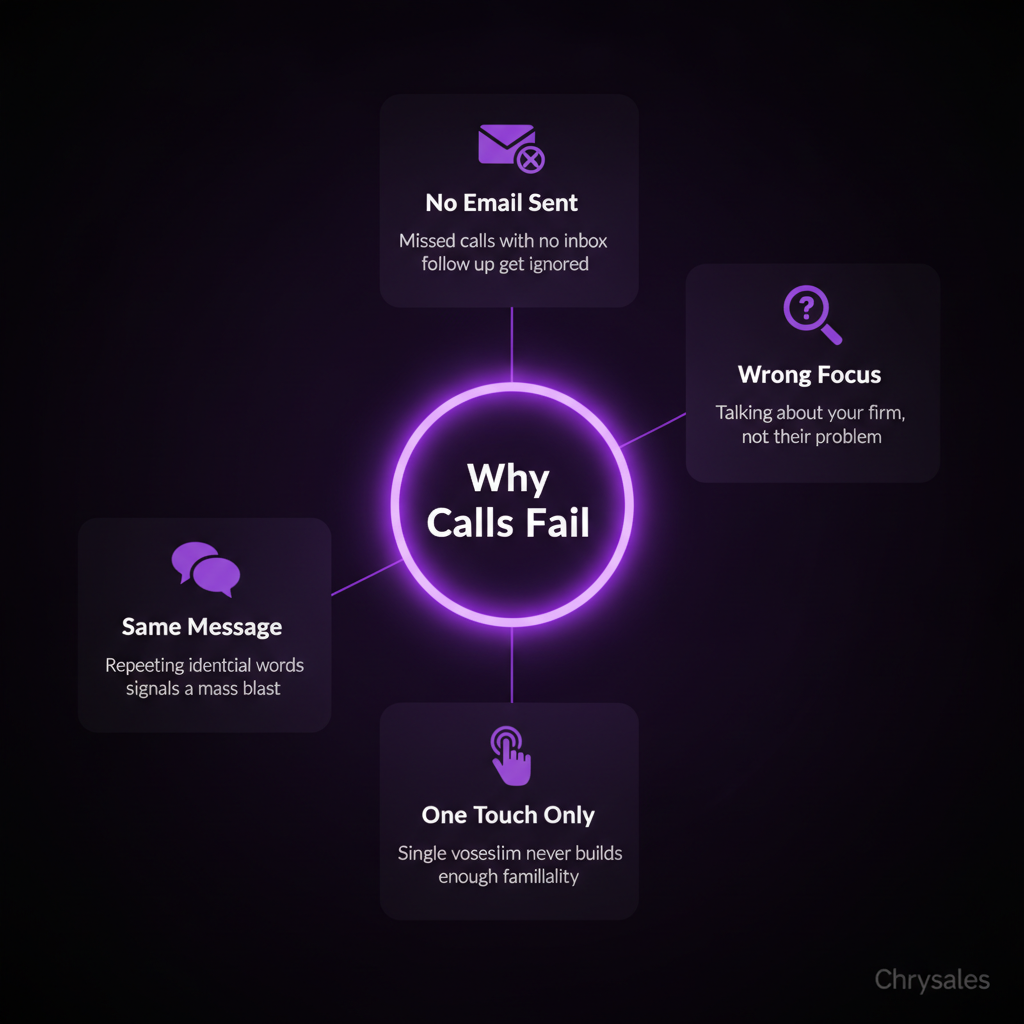
First, leaving a voicemail without sending a matching email. When someone sees a missed call from an unknown number, they're not calling back. They're Googling the number or deleting the notification. If there's no email in their inbox explaining who you are and why you called, that voicemail dies alone.
Second, making the voicemail about your company instead of their problem. A 45 second monologue about your features and clients list? That's an instant delete. The person listening doesn't care about you yet. They care about whether this is worth their time.
Third, treating the voicemail like a one and done move. Cold outreach voicemail works when it's part of a multi touch sales cadence. One voicemail by itself won't move the needle. But a voicemail followed by an email an hour later, then a LinkedIn message two days after that? Now you're building familiarity.
Common mistake: Leaving a voicemail and then calling the same person again the next day to leave another one. That's not persistence. That's annoying. Space your touches across different channels instead.
The voicemail and email sequence that actually works
Here's the setup that turns a 1% callback rate into something you can actually work with. It's simple, but most teams skip half the steps.
Step 1: Call during the right window
Timing matters more than most reps think. The best windows for B2B sales call patterns are Tuesday through Thursday, between 8:00 to 9:30 AM or 4:00 to 5:30 PM. Early morning catches people before meetings pile up. Late afternoon gets them when they're wrapping up and more likely to pick up or listen to messages. Avoid Monday mornings (inbox chaos) and Friday afternoons (nobody's in work mode). If you're calling a consulting firm or marketing agency, aim for the edges of the workday when gatekeepers are less likely to screen calls.
Step 2: Leave a short, specific voicemail
Your voicemail should be under 25 seconds. Not 30. Not 45. Around 20 to 25 seconds is the sweet spot. Here's a working sales voicemail script structure:
Opening: Your name and company in one sentence.
Hook: One specific reason you're calling, tied to something real about their business.
CTA: Tell them to check their email, not to call you back.
Example: "Hey [Name], this is Alex from Chrysales. I noticed your team just posted three new sales roles on LinkedIn. I'm sending over a quick email about how we help consulting firms build training systems for new hires. Check your inbox in the next few minutes."
That's it. No feature dump. No "I'd love to hop on a call." Just a clear reason and a next step.
Pro Tip: Say their name twice. Once at the start, once near the end. It makes the message feel personal, not bulk.
Step 3: Send the matching email within 5 minutes
This is where the magic happens. The voicemail alone won't get a callback. But when someone sees a missed call and then finds an email from the same person in their inbox, it clicks. They think, "Okay, this person is real. Let me see what this is about."
Your email should reference the voicemail in the subject line or opening sentence. Something like:
Subject: Quick voicemail about [specific thing]
Body: "Just left you a voicemail about [the thing]. Here's the short version: [one sentence value prop]. Worth a 15 minute conversation? Let me know."
Keep it under 80 words. The email isn't there to close the deal. It's there to give them an easy way to respond without picking up the phone.
A 30 person consulting firm we worked with tried this sequence last year. They had been leaving voicemails for months with almost zero callbacks. After switching to the voicemail plus email approach, their reply rate jumped from under 1% to 4.2% in three weeks. Same offer, same list. Different system.
What to say in a B2B sales voicemail (and what to skip)
The words you choose matter less than how you sound. If you sound like you're reading a script, it's over. If you sound like a human who actually looked at their company for 30 seconds, you have a shot.
Lead with a specific trigger or observation
Generic voicemails die fast. Specific ones get listened to. The difference is simple: did you do 15 seconds of research or not?
Bad: "Hi, I help companies grow their sales."
Good: "Hi, I saw your company just raised a Series A and you're hiring account execs."
The second one proves you're not spam. It shows you know something real about them. That buys you another 10 seconds of attention.
Watch out: Don't fake specificity. If you say "I saw your recent LinkedIn post" but you didn't actually see it, people can tell. Just pick one real detail. Their recent hiring, a press mention, a product launch. Something true.
Avoid the phrase "I wanted to reach out"
This phrase is the "dear sir or madam" of sales voicemail scripts. It signals a mass blast. Same with "touching base," "circling back," or "just checking in." These phrases tell the listener you're working through a list, not talking to them specifically.
Replace it with a reason: "I'm calling because [specific thing]."
End with a soft CTA, not a hard ask
Don't end with "Give me a call back at this number." That's high friction. Most people won't do it. Instead, point them to something easier. "I sent you an email with more details." "I'll try you again Thursday." "If it makes sense, just reply to my email." You're giving them a low pressure out. That's what gets responses.
How to build a multi touch sales cadence around voicemails
A voicemail by itself is a lottery ticket. A voicemail inside a coordinated sales outreach sequence is a system. The difference is night and day.
The 7 touch framework
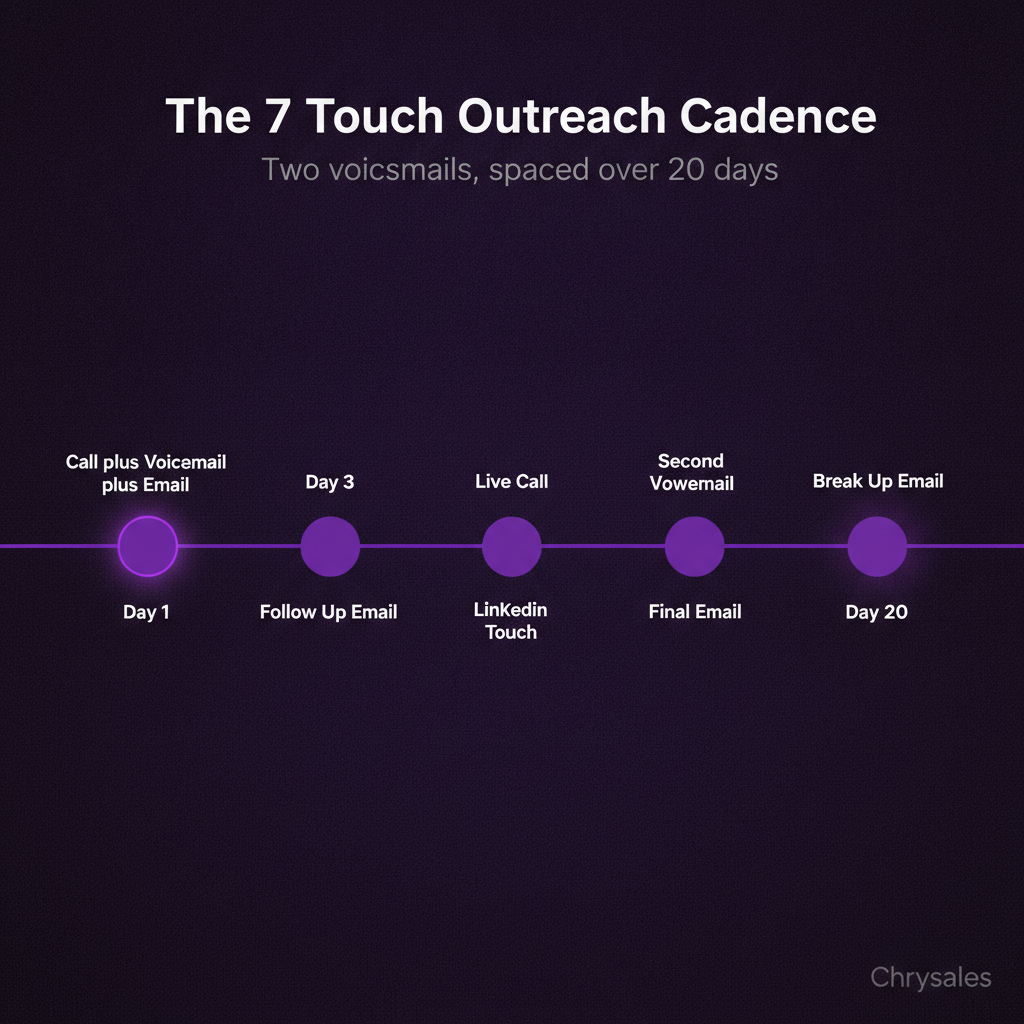
Most sales prospecting techniques recommend between 6 and 10 touches before giving up on a lead. Here's a simple 7 touch cadence that includes voicemails without overdoing it:
- Day 1: Cold call, leave voicemail if no answer, send email within 5 minutes.
- Day 3: Send a follow up email (different angle, maybe a case study or quick stat).
- Day 5: LinkedIn connection request with a short note referencing your previous attempts.
- Day 8: Cold call again (no voicemail this time, just try to catch them live).
- Day 12: Send a final email ("Last note from me...").
- Day 15: One more cold call, leave a short voicemail if no answer.
- Day 20: Break up email ("Looks like timing's not right, let me know if that changes").
This cadence gives you two voicemails, three emails, two live call attempts, and one LinkedIn touch. It's enough to build familiarity without becoming a pest.
Common mistake: Leaving a voicemail on every single call attempt. That's overkill. Two voicemails across a 20 day sequence is plenty.
Why the sequence matters more than the script
Here's what most teams miss: your sales voicemail callback rate isn't about having the perfect words. It's about creating enough touch points that the prospect starts recognizing your name. By the third or fourth touch, they're thinking, "Okay, this person keeps showing up. Maybe I should see what this is about." That's the real goal. Voicemail isn't a closer. It's a familiarity builder. One piece in a bigger outreach system.
A marketing agency we trained had been doing cold calls with no follow up system. They'd call once, maybe twice, then move on. When they switched to a structured multi touch sales cadence with coordinated voicemail and email touches, their booked meeting rate went from 8 meetings a month to 34. Same list size. Same offer. Just a better system around the outreach.
If you want a deeper dive into how multi channel outreach compares to traditional single channel approaches, you can watch this breakdown of multichannel vs omnichannel sales strategies to see how sequencing and channel coordination drive results.
How to use AI and sales automation for smarter voicemail follow-up
Most reps leave voicemails and then forget who they called. By the time they circle back, the moment's gone. This is where sales automation and AI in sales can turn a manual mess into a repeatable system.
Automating the email follow-up
You shouldn't be manually typing an email every time you leave a voicemail. Set up a simple automation that sends a matching email as soon as you log the call. Most CRMs let you do this with a basic workflow or a Zapier trigger.
At Chrysales, we build custom voicemail to email sequences for clients using AI powered sales workflows. When a rep logs a voicemail in the CRM, the system fires off a pre-written email template that pulls the prospect's name, company, and the reason for the call. The rep just reviews it and hits send. Takes 10 seconds instead of 3 minutes.
The result? Reps actually follow through on the email part of the voicemail strategy for sales. When it's automated, it gets done. When it's manual, it gets skipped.
For teams looking to build this kind of system, you can learn more about setting up automated follow-up reminders in a simple CRM to ensure no touch gets missed.
AI lead scoring to decide who gets a voicemail
Not every prospect deserves a voicemail. If your list includes 500 names, you need a system to figure out which 100 are worth the extra effort.
AI lead scoring helps here. You can score leads based on fit signals like company size, recent funding, hiring activity, tech stack, or engagement with your emails. Anything scoring above a certain threshold gets the full voicemail and email treatment. Anything below that gets email only touches.
We use a Gemini based AI lead scoring system for clients that pulls in data from LinkedIn, company websites, and CRM activity. It ranks leads on a 0 to 100 scale. Anything above 70 gets priority calling. Anything 40 to 70 gets emails and LinkedIn touches. Anything under 40 gets skipped or saved for a later campaign.
Pro Tip: Don't overcomplicate your scoring model. Start with three to five simple criteria. Company size, industry match, recent trigger event (like a funding round or executive hire). That's enough to separate the good fits from the tire kickers.
To dive deeper into how AI can prioritize and automate lead gen across multiple channels, check out how AI lead generation channels work in B2B to build smarter outbound systems.
Training your sales team to execute the voicemail strategy
A great strategy on paper means nothing if your team doesn't use it. Most sales training focuses on scripts and objection handling, but it skips the basics of how to actually run a multi touch outreach system day to day.
Role play the voicemail before they go live
Don't just hand someone a sales voicemail script and tell them to start calling. Make them practice it out loud five times before they dial. Record it. Play it back. Most people sound way more robotic than they think.
At Chrysales, we run live role play sessions where reps leave voicemails to each other and we pick apart what works. The feedback is simple: Does this sound like a real person? Did you say their name naturally? Did you sound rushed or relaxed? The reps who practice leave better voicemails. It's that straightforward.
Track the right metrics
Most teams only track calls made and meetings booked. That's not enough detail to know if your voicemail strategy is working. Track these four things:
- Voicemails left per day (are reps actually doing it?)
- Voicemail to email send rate (are they sending the matching email within 5 minutes?)
- Reply rate by touch (which touch in the sequence gets the most responses?)
- Callback rate from voicemail (isolated stat, just to see the baseline)
When you track these, you can see where the system breaks. If voicemails are being left but emails aren't getting sent, that's a process problem. If emails are going out but replies are flat, it's a messaging or list quality issue.
Build a voicemail library for common scenarios
Your team shouldn't be reinventing the wheel every time they leave a voicemail. Build a small library of templates for common situations:
- New lead, no prior contact
- Following up after a cold email
- Reaching out after a LinkedIn connection
- Re engaging a lead who went cold
Make these templates short, specific, and easy to personalize. Reps should be able to grab one, swap in the prospect's name and a company detail, and go.
One tech company we worked with built a 10 template library and trained their SDRs on when to use each one. Their average voicemail length dropped from 38 seconds to 22 seconds, and their callback rate went up. Shorter and more focused beats long and generic every time.
Fixing the most common voicemail mistakes in client acquisition
Even teams that follow the framework mess up the details. Here are the traps we see over and over, and how to fix them fast.
Talking too fast
When you're nervous or working through a big call list, you speed up. The problem? Fast voicemails sound like spam. Slow down. Pause between sentences. If it feels awkwardly slow to you, it probably sounds normal to the listener.
Not saying your phone number clearly (or at all)
If you want a callback, say your number. Say it slowly. Say it twice if the voicemail is under 20 seconds. A lot of reps skip this or mumble through it. Then they wonder why nobody calls back.
Leaving the same voicemail twice
If you call someone, leave a voicemail, and then call them again two days later, do not leave the same message. It's lazy and it signals you're not paying attention. The second voicemail should reference the first one or take a different angle.
Example: "Hey [Name], left you a message Tuesday about [thing]. Just wanted to add that we just worked with [similar company] on the same challenge. Full details in my email. Let me know."
Watch out: If you leave three voicemails and get no response, stop leaving voicemails. Switch to email only touches or try a different decision maker at the company. Persistence is good. Being annoying is not.
Forgetting to tie the voicemail to the email
If your voicemail says one thing and your email says something completely different, you've just confused the prospect. They won't connect the dots. Make sure the hook in the voicemail matches the subject line or opening line of the email. Keep the message consistent across both channels.
For more on how to structure effective follow-up emails after a sales call or voicemail, see how combining cold calling and email enhances B2B outreach for maximum effectiveness.
Using voicemails as a crutch for bad list quality
A killer voicemail strategy won't fix a bad list. If half your contacts are outdated, wrong titles, or companies that aren't a fit, no amount of cold outreach voicemail magic will save you. Fix the list first. Get the right people. Then deploy the strategy.
Picture this: you spend two weeks perfecting your voicemail script, training your team, setting up automation. Then you realize your list is full of people who left the company six months ago. That's the trap. List quality does most of the heavy lifting in B2B lead generation. The voicemail is just the delivery mechanism.
Frequently Asked Questions
Q: How many voicemails should I leave before giving up on a prospect?
Two voicemails across a 15 to 20 day outreach sequence is the sweet spot. Leave one on the first call attempt, pair it with an email, and then leave a second one near the end of your sequence if you still haven't connected. More than two voicemails starts to feel pushy. If they haven't responded after two voicemails and multiple emails, move on or try a different contact at the company. Don't waste time on prospects who clearly aren't engaging.
Q: Should I leave a voicemail if I already sent an email?
Yes, but flip the script. Instead of the email following the voicemail, the voicemail follows the email. Call them a day or two after your first email and reference it in the voicemail. Example: "Hey [Name], sent you a note yesterday about [topic]. Just wanted to make sure it didn't get buried. Check your inbox when you get a chance." This approach works especially well if the email got opened but not replied to. It gives you a reason to call that doesn't feel random.
Q: What if the prospect's voicemail box is full?
Move on to the next touch in your sequence. Send the email anyway and note in your CRM that the voicemail box was full. Try calling again in a week. If the box is still full after two attempts, it's a signal that this person either doesn't use voicemail or isn't checking messages. Focus your energy on email and LinkedIn instead. Some prospects just don't engage with phone outreach, and that's fine. Don't force it.
Q: Do voicemails work better for certain industries or company sizes?
Voicemails tend to work better with mid sized companies (50 to 500 employees) where decision makers are accessible but still busy enough to miss calls. In very large enterprises, you're often leaving voicemails for gatekeepers or assistants, which is less effective. In very small companies (under 20 people), email and LinkedIn often get faster responses because those teams live in their inboxes. That said, the voicemail and email sequence works across most B2B sales environments if the messaging is tight and the list is clean.
Q: Can I use the same voicemail script for every prospect?
You can use the same structure, but you need to personalize the hook. The opening and closing can stay mostly the same, but the middle part (the reason you're calling) has to be specific to them. If you're calling 50 people with the exact same words and zero personalization, your callback rate will stay under 1%. Spend 20 seconds researching each prospect before you dial. Find one specific detail (a recent hire, a funding round, a new product launch) and mention it. That small change makes a huge difference in how the voicemail lands.
The voicemail strategy for sales is a simple way to leave short messages that work with email and follow up to support lead generation and b2b sales. Most sales reps leave voicemails like they're reading a script to a brick wall. The result? A callback rate under 2%. But here's the thing: the problem isn't voicemails themselves. It's how they're being used. When you treat a voicemail as a standalone tactic instead of one piece of a bigger B2B sales system, you're basically shouting into the void. The real voicemail strategy for sales isn't about leaving the perfect message. It's about building a coordinated outreach sequence where the voicemail, the email, and the timing all work together. Done right, you can turn those crickets into booked meetings.
Why most voicemails fail in B2B lead generation
Walk into any sales floor and you'll hear the same frustration. Reps dial 50 numbers, leave 30 voicemails, and get maybe one callback if they're lucky. The usual explanation? "Nobody checks voicemail anymore." That's half right. People do check voicemail. They just ignore 99% of them because most sound exactly the same: a robotic pitch about a product nobody asked about.
The three mistakes killing your callback rate
First, leaving a voicemail without sending a matching email. When someone sees a missed call from an unknown number, they're not calling back. They're Googling the number or deleting the notification. If there's no email in their inbox explaining who you are and why you called, that voicemail dies alone.
Second, making the voicemail about your company instead of their problem. A 45 second monologue about your features and clients list? That's an instant delete. The person listening doesn't care about you yet. They care about whether this is worth their time.
Third, treating the voicemail like a one and done move. Cold outreach voicemail works when it's part of a multi touch sales cadence. One voicemail by itself won't move the needle. But a voicemail followed by an email an hour later, then a LinkedIn message two days after that? Now you're building familiarity.
Common mistake: Leaving a voicemail and then calling the same person again the next day to leave another one. That's not persistence. That's annoying. Space your touches across different channels instead.
The voicemail and email sequence that actually works
Here's the setup that turns a 1% callback rate into something you can actually work with. It's simple, but most teams skip half the steps.
Step 1: Call during the right window
Timing matters more than most reps think. The best windows for B2B sales call patterns are Tuesday through Thursday, between 8:00 to 9:30 AM or 4:00 to 5:30 PM. Early morning catches people before meetings pile up. Late afternoon gets them when they're wrapping up and more likely to pick up or listen to messages. Avoid Monday mornings (inbox chaos) and Friday afternoons (nobody's in work mode). If you're calling a consulting firm or marketing agency, aim for the edges of the workday when gatekeepers are less likely to screen calls.
Step 2: Leave a short, specific voicemail
Your voicemail should be under 25 seconds. Not 30. Not 45. Around 20 to 25 seconds is the sweet spot. Here's a working sales voicemail script structure:
Opening: Your name and company in one sentence.
Hook: One specific reason you're calling, tied to something real about their business.
CTA: Tell them to check their email, not to call you back.
Example: "Hey [Name], this is Alex from Chrysales. I noticed your team just posted three new sales roles on LinkedIn. I'm sending over a quick email about how we help consulting firms build training systems for new hires. Check your inbox in the next few minutes."
That's it. No feature dump. No "I'd love to hop on a call." Just a clear reason and a next step.
Pro Tip: Say their name twice. Once at the start, once near the end. It makes the message feel personal, not bulk.
Step 3: Send the matching email within 5 minutes
This is where the magic happens. The voicemail alone won't get a callback. But when someone sees a missed call and then finds an email from the same person in their inbox, it clicks. They think, "Okay, this person is real. Let me see what this is about."
Your email should reference the voicemail in the subject line or opening sentence. Something like:
Subject: Quick voicemail about [specific thing]
Body: "Just left you a voicemail about [the thing]. Here's the short version: [one sentence value prop]. Worth a 15 minute conversation? Let me know."
Keep it under 80 words. The email isn't there to close the deal. It's there to give them an easy way to respond without picking up the phone.
A 30 person consulting firm we worked with tried this sequence last year. They had been leaving voicemails for months with almost zero callbacks. After switching to the voicemail plus email approach, their reply rate jumped from under 1% to 4.2% in three weeks. Same offer, same list. Different system.
What to say in a B2B sales voicemail (and what to skip)
The words you choose matter less than how you sound. If you sound like you're reading a script, it's over. If you sound like a human who actually looked at their company for 30 seconds, you have a shot.
Lead with a specific trigger or observation
Generic voicemails die fast. Specific ones get listened to. The difference is simple: did you do 15 seconds of research or not?
Bad: "Hi, I help companies grow their sales."
Good: "Hi, I saw your company just raised a Series A and you're hiring account execs."
The second one proves you're not spam. It shows you know something real about them. That buys you another 10 seconds of attention.
Watch out: Don't fake specificity. If you say "I saw your recent LinkedIn post" but you didn't actually see it, people can tell. Just pick one real detail. Their recent hiring, a press mention, a product launch. Something true.
Avoid the phrase "I wanted to reach out"
This phrase is the "dear sir or madam" of sales voicemail scripts. It signals a mass blast. Same with "touching base," "circling back," or "just checking in." These phrases tell the listener you're working through a list, not talking to them specifically.
Replace it with a reason: "I'm calling because [specific thing]."
End with a soft CTA, not a hard ask
Don't end with "Give me a call back at this number." That's high friction. Most people won't do it. Instead, point them to something easier. "I sent you an email with more details." "I'll try you again Thursday." "If it makes sense, just reply to my email." You're giving them a low pressure out. That's what gets responses.
How to build a multi touch sales cadence around voicemails
A voicemail by itself is a lottery ticket. A voicemail inside a coordinated sales outreach sequence is a system. The difference is night and day.
The 7 touch framework
Most sales prospecting techniques recommend between 6 and 10 touches before giving up on a lead. Here's a simple 7 touch cadence that includes voicemails without overdoing it:
- Day 1: Cold call, leave voicemail if no answer, send email within 5 minutes.
- Day 3: Send a follow up email (different angle, maybe a case study or quick stat).
- Day 5: LinkedIn connection request with a short note referencing your previous attempts.
- Day 8: Cold call again (no voicemail this time, just try to catch them live).
- Day 12: Send a final email ("Last note from me...").
- Day 15: One more cold call, leave a short voicemail if no answer.
- Day 20: Break up email ("Looks like timing's not right, let me know if that changes").
This cadence gives you two voicemails, three emails, two live call attempts, and one LinkedIn touch. It's enough to build familiarity without becoming a pest.
Common mistake: Leaving a voicemail on every single call attempt. That's overkill. Two voicemails across a 20 day sequence is plenty.
Why the sequence matters more than the script
Here's what most teams miss: your sales voicemail callback rate isn't about having the perfect words. It's about creating enough touch points that the prospect starts recognizing your name. By the third or fourth touch, they're thinking, "Okay, this person keeps showing up. Maybe I should see what this is about." That's the real goal. Voicemail isn't a closer. It's a familiarity builder. One piece in a bigger outreach system.
A marketing agency we trained had been doing cold calls with no follow up system. They'd call once, maybe twice, then move on. When they switched to a structured multi touch sales cadence with coordinated voicemail and email touches, their booked meeting rate went from 8 meetings a month to 34. Same list size. Same offer. Just a better system around the outreach.
If you want a deeper dive into how multi channel outreach compares to traditional single channel approaches, you can watch this breakdown of multichannel vs omnichannel sales strategies to see how sequencing and channel coordination drive results.
How to use AI and sales automation for smarter voicemail follow-up
Most reps leave voicemails and then forget who they called. By the time they circle back, the moment's gone. This is where sales automation and AI in sales can turn a manual mess into a repeatable system.
Automating the email follow-up
You shouldn't be manually typing an email every time you leave a voicemail. Set up a simple automation that sends a matching email as soon as you log the call. Most CRMs let you do this with a basic workflow or a Zapier trigger.
At Chrysales, we build custom voicemail to email sequences for clients using AI powered sales workflows. When a rep logs a voicemail in the CRM, the system fires off a pre-written email template that pulls the prospect's name, company, and the reason for the call. The rep just reviews it and hits send. Takes 10 seconds instead of 3 minutes.
The result? Reps actually follow through on the email part of the voicemail strategy for sales. When it's automated, it gets done. When it's manual, it gets skipped.
For teams looking to build this kind of system, you can learn more about setting up automated follow-up reminders in a simple CRM to ensure no touch gets missed.
AI lead scoring to decide who gets a voicemail
Not every prospect deserves a voicemail. If your list includes 500 names, you need a system to figure out which 100 are worth the extra effort.
AI lead scoring helps here. You can score leads based on fit signals like company size, recent funding, hiring activity, tech stack, or engagement with your emails. Anything scoring above a certain threshold gets the full voicemail and email treatment. Anything below that gets email only touches.
We use a Gemini based AI lead scoring system for clients that pulls in data from LinkedIn, company websites, and CRM activity. It ranks leads on a 0 to 100 scale. Anything above 70 gets priority calling. Anything 40 to 70 gets emails and LinkedIn touches. Anything under 40 gets skipped or saved for a later campaign.
Pro Tip: Don't overcomplicate your scoring model. Start with three to five simple criteria. Company size, industry match, recent trigger event (like a funding round or executive hire). That's enough to separate the good fits from the tire kickers.
To dive deeper into how AI can prioritize and automate lead gen across multiple channels, check out how AI lead generation channels work in B2B to build smarter outbound systems.
Training your sales team to execute the voicemail strategy
A great strategy on paper means nothing if your team doesn't use it. Most sales training focuses on scripts and objection handling, but it skips the basics of how to actually run a multi touch outreach system day to day.
Role play the voicemail before they go live
Don't just hand someone a sales voicemail script and tell them to start calling. Make them practice it out loud five times before they dial. Record it. Play it back. Most people sound way more robotic than they think.
At Chrysales, we run live role play sessions where reps leave voicemails to each other and we pick apart what works. The feedback is simple: Does this sound like a real person? Did you say their name naturally? Did you sound rushed or relaxed? The reps who practice leave better voicemails. It's that straightforward.
Track the right metrics
Most teams only track calls made and meetings booked. That's not enough detail to know if your voicemail strategy is working. Track these four things:
- Voicemails left per day (are reps actually doing it?)
- Voicemail to email send rate (are they sending the matching email within 5 minutes?)
- Reply rate by touch (which touch in the sequence gets the most responses?)
- Callback rate from voicemail (isolated stat, just to see the baseline)
When you track these, you can see where the system breaks. If voicemails are being left but emails aren't getting sent, that's a process problem. If emails are going out but replies are flat, it's a messaging or list quality issue.
Build a voicemail library for common scenarios
Your team shouldn't be reinventing the wheel every time they leave a voicemail. Build a small library of templates for common situations:
- New lead, no prior contact
- Following up after a cold email
- Reaching out after a LinkedIn connection
- Re engaging a lead who went cold
Make these templates short, specific, and easy to personalize. Reps should be able to grab one, swap in the prospect's name and a company detail, and go.
One tech company we worked with built a 10 template library and trained their SDRs on when to use each one. Their average voicemail length dropped from 38 seconds to 22 seconds, and their callback rate went up. Shorter and more focused beats long and generic every time.
Fixing the most common voicemail mistakes in client acquisition
Even teams that follow the framework mess up the details. Here are the traps we see over and over, and how to fix them fast.
Talking too fast
When you're nervous or working through a big call list, you speed up. The problem? Fast voicemails sound like spam. Slow down. Pause between sentences. If it feels awkwardly slow to you, it probably sounds normal to the listener.
Not saying your phone number clearly (or at all)
If you want a callback, say your number. Say it slowly. Say it twice if the voicemail is under 20 seconds. A lot of reps skip this or mumble through it. Then they wonder why nobody calls back.
Leaving the same voicemail twice
If you call someone, leave a voicemail, and then call them again two days later, do not leave the same message. It's lazy and it signals you're not paying attention. The second voicemail should reference the first one or take a different angle.
Example: "Hey [Name], left you a message Tuesday about [thing]. Just wanted to add that we just worked with [similar company] on the same challenge. Full details in my email. Let me know."
Watch out: If you leave three voicemails and get no response, stop leaving voicemails. Switch to email only touches or try a different decision maker at the company. Persistence is good. Being annoying is not.
Forgetting to tie the voicemail to the email
If your voicemail says one thing and your email says something completely different, you've just confused the prospect. They won't connect the dots. Make sure the hook in the voicemail matches the subject line or opening line of the email. Keep the message consistent across both channels.
For more on how to structure effective follow-up emails after a sales call or voicemail, see how combining cold calling and email enhances B2B outreach for maximum effectiveness.
Using voicemails as a crutch for bad list quality
A killer voicemail strategy won't fix a bad list. If half your contacts are outdated, wrong titles, or companies that aren't a fit, no amount of cold outreach voicemail magic will save you. Fix the list first. Get the right people. Then deploy the strategy.
Picture this: you spend two weeks perfecting your voicemail script, training your team, setting up automation. Then you realize your list is full of people who left the company six months ago. That's the trap. List quality does most of the heavy lifting in B2B lead generation. The voicemail is just the delivery mechanism.
Frequently Asked Questions
Q: How many voicemails should I leave before giving up on a prospect?
Two voicemails across a 15 to 20 day outreach sequence is the sweet spot. Leave one on the first call attempt, pair it with an email, and then leave a second one near the end of your sequence if you still haven't connected. More than two voicemails starts to feel pushy. If they haven't responded after two voicemails and multiple emails, move on or try a different contact at the company. Don't waste time on prospects who clearly aren't engaging.
Q: Should I leave a voicemail if I already sent an email?
Yes, but flip the script. Instead of the email following the voicemail, the voicemail follows the email. Call them a day or two after your first email and reference it in the voicemail. Example: "Hey [Name], sent you a note yesterday about [topic]. Just wanted to make sure it didn't get buried. Check your inbox when you get a chance." This approach works especially well if the email got opened but not replied to. It gives you a reason to call that doesn't feel random.
Q: What if the prospect's voicemail box is full?
Move on to the next touch in your sequence. Send the email anyway and note in your CRM that the voicemail box was full. Try calling again in a week. If the box is still full after two attempts, it's a signal that this person either doesn't use voicemail or isn't checking messages. Focus your energy on email and LinkedIn instead. Some prospects just don't engage with phone outreach, and that's fine. Don't force it.
Q: Do voicemails work better for certain industries or company sizes?
Voicemails tend to work better with mid sized companies (50 to 500 employees) where decision makers are accessible but still busy enough to miss calls. In very large enterprises, you're often leaving voicemails for gatekeepers or assistants, which is less effective. In very small companies (under 20 people), email and LinkedIn often get faster responses because those teams live in their inboxes. That said, the voicemail and email sequence works across most B2B sales environments if the messaging is tight and the list is clean.
Q: Can I use the same voicemail script for every prospect?
You can use the same structure, but you need to personalize the hook. The opening and closing can stay mostly the same, but the middle part (the reason you're calling) has to be specific to them. If you're calling 50 people with the exact same words and zero personalization, your callback rate will stay under 1%. Spend 20 seconds researching each prospect before you dial. Find one specific detail (a recent hire, a funding round, a new product launch) and mention it. That small change makes a huge difference in how the voicemail lands.
Scaling Is Not Hard If You Have The Right Systems
If you’re serious about leveling up your scaling game, you need the right system, the right training, and the right team behind you. We're here to give you the exact tools and strategies top entrepreneurs use to dominate.

Discover the latest tips
View All.avif)
Chrysales was formed from the words "chrysalis" the stage where a caterpillar transforms into a butterfly and "sales".
It stands for one thing: sales transformation.Because scaling doesn’t happen by doing more of the same. Scaling only happens when you go through real transformation in your systems, your offer, team and the way you sell.
.avif)


