.avif)
Why a B2B Reels Strategy Fills Your Sales Pipeline
A B2B reels strategy uses short videos to build trust, drive lead generation, and move buyers toward booked calls, qualified leads, and client acquisition. Most B2B sales teams think short-form video is for dance trends and product unboxings. They're wrong. A 30-second Reel explaining how to fix a common sales problem can book more discovery calls than a month of cold emails. The difference? People actually watch it. Short-form video isn't just content anymore. It's the front door to your sales pipeline. When you use a B2B reels strategy the right way, it builds trust before the first conversation even happens. That trust turns into booked calls, qualified leads, and clients who show up already sold on your expertise.
Short-Form Video Is Where Your Buyers Already Spend Their Time
Your target accounts aren't sitting around waiting for your cold email. They're scrolling Instagram during coffee breaks and watching YouTube Shorts between meetings. The numbers back this up: over 60% of B2B decision makers watch short-form video weekly as part of their research process. That's not B2C behavior bleeding into B2B. That's just where attention lives now. Here's the thing: when someone watches a Reel that teaches them something useful in 45 seconds, they remember it. When that same person sees your name in their inbox three days later, you're not a stranger anymore. You're the person who explained why their discovery calls keep going cold. That shift from unknown sender to recognized expert is what turns a 0.8% email reply rate into a 4% one.
Pro Tip: Post one educational Reel per week that answers a question your prospects Google constantly. Track which topics get the most saves and shares. Those are your next sales conversation starters.
The Trust Gap Closes Faster on Video
Reading a blog builds some credibility. Watching you explain the same concept on camera builds way more. Why? Because video shows how you think, how you talk, and whether you actually know what you're doing. A 60-second breakdown of why most outbound campaigns fail does more trust-building than a 2,000-word case study most people won't finish. We worked with a consulting firm that posted three Reels per week for two months. All educational. No fluff. They booked 18 discovery calls directly from Instagram DMs in that period. Before the Reels? Zero inbound from social. The content wasn't fancy. Just the founder talking through common client problems in plain language.
Video Gives You Multiple Touchpoints Without Being Annoying
When you send five emails in two weeks, you risk looking desperate. When someone sees five of your Reels over two weeks because the algorithm served them up, you look helpful. Same person, same frequency, totally different perception. That's the power of platform-native content. It doesn't interrupt. It shows up where people already hang out.
How Short-Form Content Feeds Lead Generation
Most people think of Reels as awareness plays. That's only half true. A smart B2B reels strategy doesn't just build an audience. It filters that audience into people who have the exact problem you solve. Every Reel is a tiny sales qualification tool. Picture this: you post a Reel about the three reasons sales teams can't close enterprise deals. Someone watches it twice, saves it, and checks your profile. That person just raised their hand. They didn't fill out a form. They didn't book a call yet. But they signaled interest harder than most email opens ever will. Now you've got options. You can follow up with a second Reel that goes deeper. You can DM them something useful. You can retarget them with ads. Or you can just keep posting, knowing they're watching. All of that is lead generation. It just doesn't look like the old playbook.
Turn Views Into Conversations
The call-to-action on a Reel doesn't have to be "book a call now." That's too big an ask from someone who just met you 30 seconds ago. Instead, try "DM me the word 'pipeline' and I'll send you the full breakdown." Simple. Low friction. And it starts a conversation you control. A 15-person consulting firm tried this last quarter. They posted a Reel breaking down the four-step sales call structure they teach clients. CTA: "DM me 'structure' for the full script." They got 42 DMs in five days. Twelve turned into booked calls. Four became clients. That's Instagram B2B lead generation working exactly how it should.
Watch out: Don't make people jump through hoops. If your CTA is "click the link in bio, then scroll to the form, then enter your email, then check your inbox for the PDF," you already lost them. Make the next step brain-dead easy.
What Makes a Reel Actually Work for B2B Sales
Not every Reel drives results. Most don't. The ones that work follow a pattern. They teach something specific in under 60 seconds. They don't tease. They don't hold back the good stuff for a paid course. They just give value, fast. Think of it like this: your Reel is a free sample at the grocery store. If the sample is good, people buy the full product. If the sample is a tiny crumb that leaves them confused, they walk away. Most B2B Reels are crumbs. Be the whole sample.
The Hook Decides Everything
You've got one second to stop the scroll. Maybe two if you're lucky. That means your opening line has to hit hard. "Here's why your cold emails get ignored" works. "In today's video I'm going to talk about email strategy" doesn't. The first one promises a payoff. The second one sounds like homework. Look at the Reels in your niche that have 10x the views of everything else. Almost all of them open with a problem statement, a bold claim, or a question that makes you think "wait, what?" Steal that structure. Don't steal the exact words. Steal the pattern.
Keep It Stupid Simple
If someone needs to rewind your Reel three times to understand the point, it's too complicated. One idea per video. One clear takeaway. If you're explaining a five-step process, break it into five separate Reels. Each one should make sense on its own. A marketing agency we know posts Reels that are just text on screen with a voiceover. No fancy editing. No transitions. Just clear, useful info delivered fast. Their average Reel gets 3,000+ views. Their blogs get 200. Same expertise. Different format. Wildly different reach.
Common mistake: Trying to teach everything in one video. Your Reel isn't a masterclass. It's a teaser that makes people want the masterclass.
How to Build a Short-Form Video System That Feeds Your Sales Pipeline
Random Reels don't build a system. You need a repeatable process that cranks out content and tracks what actually drives client acquisition. Most teams post once, see decent views, then ghost the platform for two months. That's not a strategy. That's a hobby. Here's what a real system looks like. You pick three core topics your ideal clients care about. Every week, you post one Reel per topic. That's three Reels per week. Twelve per month. In 90 days, you've got 36 videos out there working for you while you sleep. Some will flop. Some will hit. The ones that hit become your lead magnets.
Content Buckets That Actually Convert
Not all topics are equal. Some Reels get views but no action. Others get fewer views but higher engagement from the right people. Focus on these three content types:
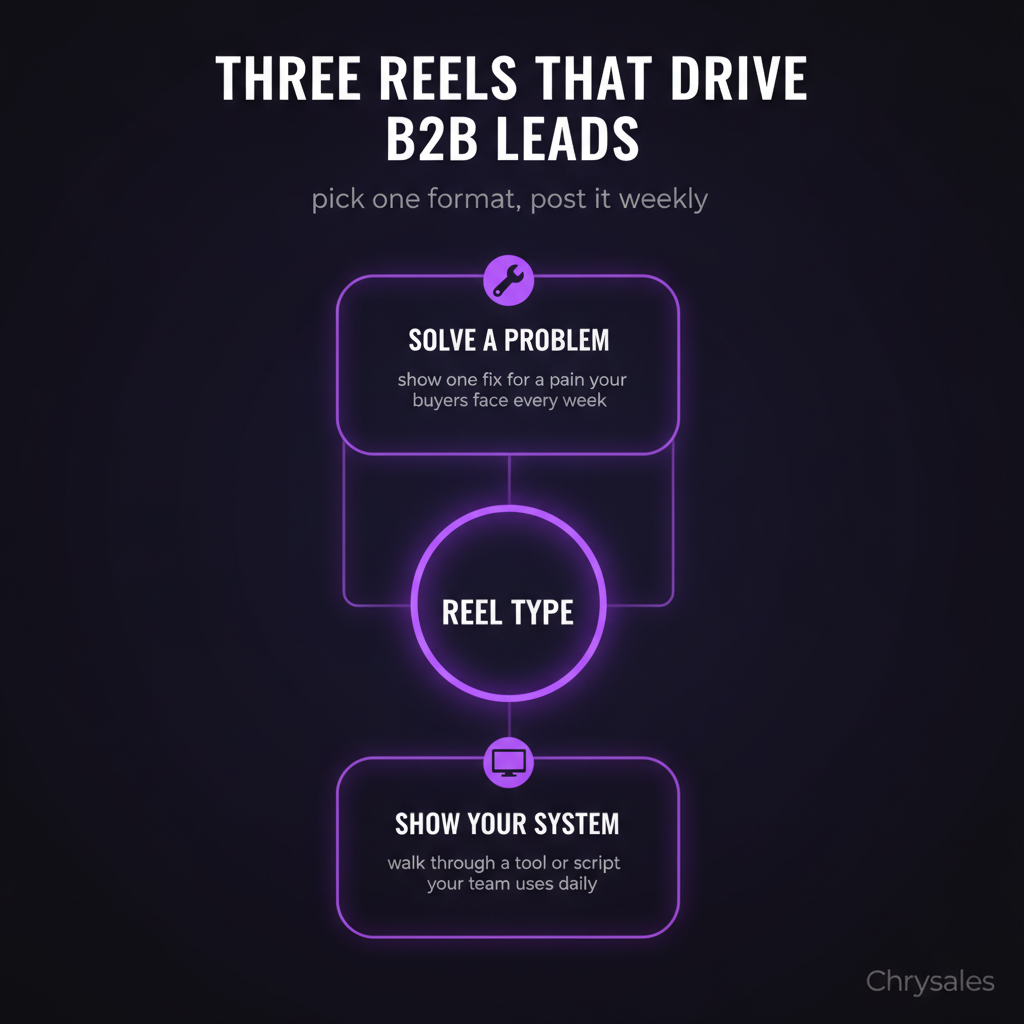
Problem-solution shorts: "Here's why X keeps happening and how to fix it in two steps." These perform because they're immediately useful. A 40-second breakdown of why discovery calls go off the rails will get saved and shared by people who run discovery calls.
Myth-busting content: "Most people think you need a huge team to scale sales. You don't. Here's what you actually need." These work because they challenge common beliefs. They make people stop and reconsider what they thought was true.
Behind-the-scenes systems: Show the actual tools, scripts, or workflows you use. A quick screen recording of how you score leads or structure a follow-up sequence gives people a peek inside your process. It builds authority without feeling like a sales pitch. One tech company posted a Reel showing their lead scoring spreadsheet. Just a 50-second walkthrough. It got 8,000 views and 140 saves. Twenty-three people DM'd asking for a template. Fifteen of those turned into sales calls. That's the power of showing your work.
Frequency Beats Perfection
You don't need a film crew. You need consistency. Three decent Reels per week will outperform one perfect Reel per month every single time. Why? Because the algorithm rewards activity, and your audience needs repetition to remember you exist. Set a simple rule: record five Reels in one sitting every Monday. Post three that week. Bank two for the next. This batching method keeps you from scrambling for content ideas every day. It also means you're never starting from zero.
Pro Tip: Keep a running list of every question a prospect asks you on sales calls. Each question is a Reel topic. You'll never run out of ideas.
Connect Your Reels to Your Sales Process
A Reel that gets 10,000 views but no follow-up is just vanity metrics. The goal isn't virality. The goal is booked calls. That means every piece of short-form content needs a next step that pulls people into your sales system. The simplest version: Reel, Profile visit, Link in bio, Booking page. But you can get smarter than that. Use your Reels to pre-qualify. If your ideal client is a B2B company doing $2M+ in revenue, make a Reel specifically for that segment. Talk about problems only they have. The people who engage are already filtered.
Retargeting Turns Views Into Leads
Here's where short-form video for B2B lead generation gets really interesting. Everyone who watches 75% or more of your Reel can be added to a custom audience. Now you can retarget them with ads that speak directly to what they just learned. They watched a Reel about fixing low close rates? Show them an ad for a free sales call audit. They binged four of your Reels in one session? Hit them with a case study or testimonial. This isn't creepy. It's smart sequencing. We see this all the time with clients who run paid ads. The ones who retarget video viewers get 40-60% lower cost per lead than cold traffic campaigns. Why? Because the video did the heavy lifting. The ad is just the nudge.
Track What Actually Drives Revenue
Views and likes are nice. Booked calls and closed deals matter more. Set up tracking so you know which Reels lead to real business. Use UTM parameters on your bio link. Ask new leads "how'd you find us?" on discovery calls. Check your DMs daily and log where conversations started. A 30-person consulting firm tracks every client back to their first touchpoint. Last quarter, 40% of new clients came from Instagram. Specifically, from Reels. Not ads. Not posts. Just organic short-form content that answered questions better than their competitors did. That data changed their entire content strategy.
How AI and Automation Make This Scalable
Nobody has time to manually reply to 50 DMs, schedule 15 follow-ups, and track which Reel drove which lead. That's where sales automation and AI come in. You can automate the repetitive stuff without losing the personal touch. Use AI to help you write Reel scripts faster. Feed it your best-performing content and ask for variations. Not word-for-word copies. Just structural templates you can tweak. A tool like Gemini can analyze your top Reels and suggest three new hooks in 30 seconds. That's not cheating. That's working smarter. Automate your DM responses with saved replies. When someone messages "pipeline," they instantly get the resource you promised plus a quick question: "What's your biggest sales challenge right now?" That keeps the conversation moving without you glued to your phone.
Lead Scoring Plugs Into Your CRM
Every Instagram interaction is a signal. Someone who watches five Reels, saves two, and visits your profile three times is hotter than someone who scrolled past one video. You can score these behaviors just like email opens and link clicks. Set a simple rule: anything scoring above 70 goes to the top of your call list. Anything below 40 stays in nurture. This is how you turn Instagram from a content platform into a real sales channel. The short-form content brings people in. The system moves them through.
Watch out: Don't automate the actual sales conversations. Automate the lead capture and qualification. The closing? That's still human. Always.
Why Most B2B Companies Get This Wrong
They treat Reels like a side project. They post when they feel like it. They don't track results. They give up after two weeks because "it's not working." Here's the truth: Instagram for B2B marketing works when you treat it like a sales channel, not a creative outlet. The biggest mistake? Making content about you instead of your audience. Nobody cares that you hit a revenue goal or hired a new team member. They care about solving the problem that's costing them sleep. Every Reel should make the viewer think "this person gets it." Another trap: overthinking production quality. You don't need a ring light, a teleprompter, or a video editor. You need a phone, decent lighting, and something useful to say. A talking-head video shot in your office will outperform a beautifully edited montage with no substance every single time.
The Content-to-Conversion Timeline Is Longer in B2B
B2C Reels can convert in 24 hours. Someone sees a product, clicks, buys. B2B sales training and client acquisition timelines are slower. Someone might watch ten of your Reels over six weeks before they book a call. That's normal. That's not a failure. Patience wins here. If you're posting consistently and tracking engagement, you're building a pipeline even if it doesn't feel like it yet. The person who binges your content today might become a client in Q3. Keep showing up. You can also watch how to build a sales system so powerful clients come to you for a deeper walkthrough of this entire process.
Common mistake: Judging Reels by immediate ROI. A video that "only" got 500 views might have been watched by five perfect-fit prospects who will reach out next month. You just don't know yet.
Frequently Asked Questions
Q: How often should I post Reels to see real results in B2B sales?
Three times per week is the sweet spot for most B2B businesses. That's enough to stay visible without burning out. If you're just starting, aim for twice per week and build from there. Consistency matters more than volume. Posting daily for two weeks then disappearing for a month teaches the algorithm to ignore you. Stick to a schedule you can actually maintain long-term, and batch your content so you're not scrambling every day.
Q: Do I need to be on camera or can I use text-based Reels?
Both work, but being on camera usually performs better for sales coaching and B2B content. Why? Because people buy from people they trust, and your face builds that trust faster than text on a screen. That said, if you're camera-shy, start with text and voiceover. A clear explanation with good pacing will still get results. The key is showing expertise, not production value. Test both formats and see what your audience engages with most.
Q: How do I turn Reel views into actual sales conversations?
Make your call-to-action simple and low-pressure. Instead of "book a call now," try "DM me this word for the full resource" or "comment below if this sounds familiar." Start a conversation first. Once someone replies, you can ask a qualifying question and move them toward a discovery call. Also, use your bio link strategically. Send video viewers to a landing page with a clear next step, whether that's a free audit, a case study download, or a booking calendar. For more tactics, explore our Instagram DM strategy for B2B lead generation guide.
Q: What topics actually work for B2B Reels in sales and lead generation?
Focus on problems your ideal clients search for solutions to. Common pain points like "why our close rate dropped," "how to hire salespeople who actually perform," or "what to say when prospects ghost after the demo" make great Reel topics. Myth-busting content works too: challenge assumptions people have about sales systems, outreach strategies, or scaling teams. Behind-the-scenes process videos showing your actual tools and workflows also perform well because they give viewers tangible takeaways they can use immediately. You can also explore proven methods to generate leads from Instagram Reels for additional topic ideas.
Q: How long does it take to start seeing leads from a B2B Reels strategy?
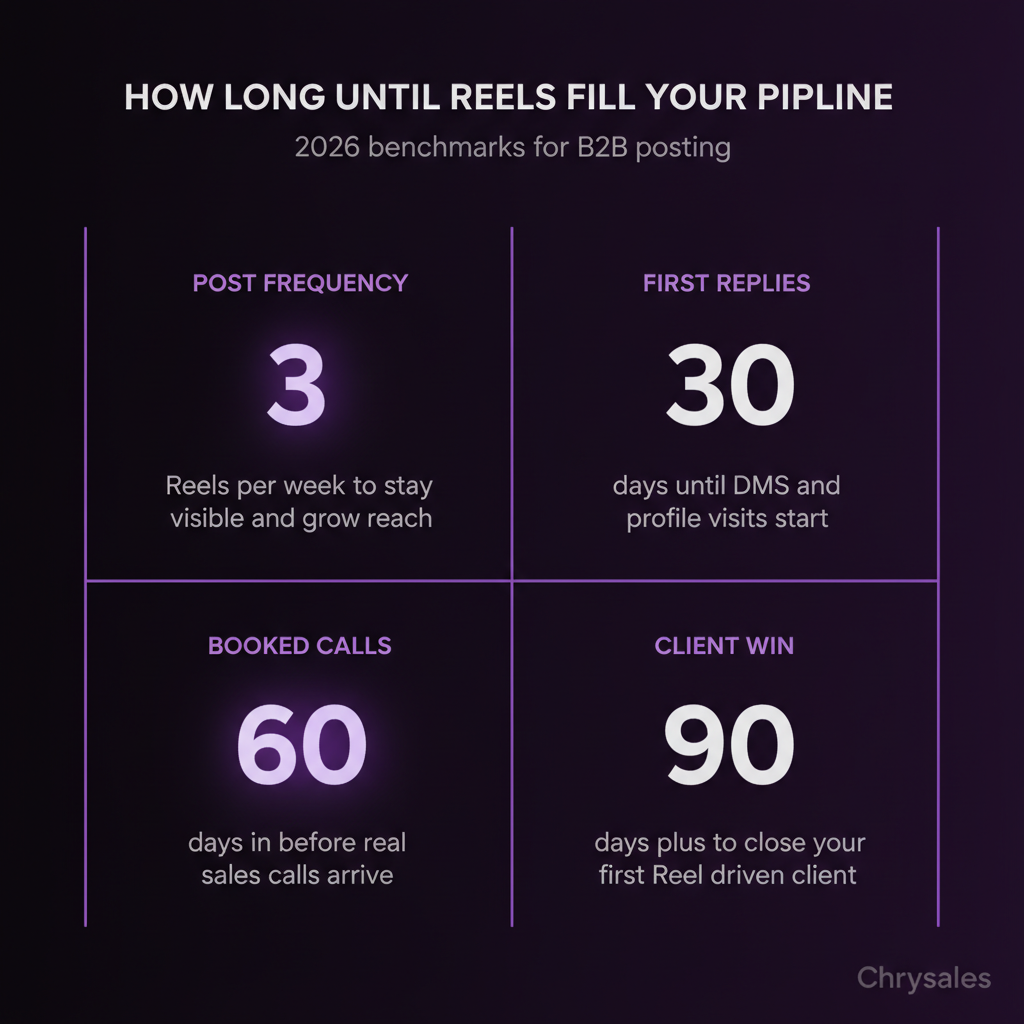
Most businesses see meaningful engagement within 30 to 60 days of consistent posting. That means DMs, profile visits, and people starting to recognize your name. Actual booked calls and clients usually come 60 to 90 days in, once you've built enough content for people to binge and trust you. The timeline depends on posting frequency, content quality, and how well you follow up. If you're only posting once every two weeks with no DM strategy, it'll take longer. If you're posting three times per week and actively engaging, you'll see traction faster. To accelerate your results, learn how to build a sales system that actually scales around your content efforts.
A B2B reels strategy uses short videos to build trust, drive lead generation, and move buyers toward booked calls, qualified leads, and client acquisition. Most B2B sales teams think short-form video is for dance trends and product unboxings. They're wrong. A 30-second Reel explaining how to fix a common sales problem can book more discovery calls than a month of cold emails. The difference? People actually watch it. Short-form video isn't just content anymore. It's the front door to your sales pipeline. When you use a B2B reels strategy the right way, it builds trust before the first conversation even happens. That trust turns into booked calls, qualified leads, and clients who show up already sold on your expertise.
Short-Form Video Is Where Your Buyers Already Spend Their Time
Your target accounts aren't sitting around waiting for your cold email. They're scrolling Instagram during coffee breaks and watching YouTube Shorts between meetings. The numbers back this up: over 60% of B2B decision makers watch short-form video weekly as part of their research process. That's not B2C behavior bleeding into B2B. That's just where attention lives now. Here's the thing: when someone watches a Reel that teaches them something useful in 45 seconds, they remember it. When that same person sees your name in their inbox three days later, you're not a stranger anymore. You're the person who explained why their discovery calls keep going cold. That shift from unknown sender to recognized expert is what turns a 0.8% email reply rate into a 4% one.
Pro Tip: Post one educational Reel per week that answers a question your prospects Google constantly. Track which topics get the most saves and shares. Those are your next sales conversation starters.
The Trust Gap Closes Faster on Video
Reading a blog builds some credibility. Watching you explain the same concept on camera builds way more. Why? Because video shows how you think, how you talk, and whether you actually know what you're doing. A 60-second breakdown of why most outbound campaigns fail does more trust-building than a 2,000-word case study most people won't finish. We worked with a consulting firm that posted three Reels per week for two months. All educational. No fluff. They booked 18 discovery calls directly from Instagram DMs in that period. Before the Reels? Zero inbound from social. The content wasn't fancy. Just the founder talking through common client problems in plain language.
Video Gives You Multiple Touchpoints Without Being Annoying
When you send five emails in two weeks, you risk looking desperate. When someone sees five of your Reels over two weeks because the algorithm served them up, you look helpful. Same person, same frequency, totally different perception. That's the power of platform-native content. It doesn't interrupt. It shows up where people already hang out.
How Short-Form Content Feeds Lead Generation
Most people think of Reels as awareness plays. That's only half true. A smart B2B reels strategy doesn't just build an audience. It filters that audience into people who have the exact problem you solve. Every Reel is a tiny sales qualification tool. Picture this: you post a Reel about the three reasons sales teams can't close enterprise deals. Someone watches it twice, saves it, and checks your profile. That person just raised their hand. They didn't fill out a form. They didn't book a call yet. But they signaled interest harder than most email opens ever will. Now you've got options. You can follow up with a second Reel that goes deeper. You can DM them something useful. You can retarget them with ads. Or you can just keep posting, knowing they're watching. All of that is lead generation. It just doesn't look like the old playbook.
Turn Views Into Conversations
The call-to-action on a Reel doesn't have to be "book a call now." That's too big an ask from someone who just met you 30 seconds ago. Instead, try "DM me the word 'pipeline' and I'll send you the full breakdown." Simple. Low friction. And it starts a conversation you control. A 15-person consulting firm tried this last quarter. They posted a Reel breaking down the four-step sales call structure they teach clients. CTA: "DM me 'structure' for the full script." They got 42 DMs in five days. Twelve turned into booked calls. Four became clients. That's Instagram B2B lead generation working exactly how it should.
Watch out: Don't make people jump through hoops. If your CTA is "click the link in bio, then scroll to the form, then enter your email, then check your inbox for the PDF," you already lost them. Make the next step brain-dead easy.
What Makes a Reel Actually Work for B2B Sales
Not every Reel drives results. Most don't. The ones that work follow a pattern. They teach something specific in under 60 seconds. They don't tease. They don't hold back the good stuff for a paid course. They just give value, fast. Think of it like this: your Reel is a free sample at the grocery store. If the sample is good, people buy the full product. If the sample is a tiny crumb that leaves them confused, they walk away. Most B2B Reels are crumbs. Be the whole sample.
The Hook Decides Everything
You've got one second to stop the scroll. Maybe two if you're lucky. That means your opening line has to hit hard. "Here's why your cold emails get ignored" works. "In today's video I'm going to talk about email strategy" doesn't. The first one promises a payoff. The second one sounds like homework. Look at the Reels in your niche that have 10x the views of everything else. Almost all of them open with a problem statement, a bold claim, or a question that makes you think "wait, what?" Steal that structure. Don't steal the exact words. Steal the pattern.
Keep It Stupid Simple
If someone needs to rewind your Reel three times to understand the point, it's too complicated. One idea per video. One clear takeaway. If you're explaining a five-step process, break it into five separate Reels. Each one should make sense on its own. A marketing agency we know posts Reels that are just text on screen with a voiceover. No fancy editing. No transitions. Just clear, useful info delivered fast. Their average Reel gets 3,000+ views. Their blogs get 200. Same expertise. Different format. Wildly different reach.
Common mistake: Trying to teach everything in one video. Your Reel isn't a masterclass. It's a teaser that makes people want the masterclass.
How to Build a Short-Form Video System That Feeds Your Sales Pipeline
Random Reels don't build a system. You need a repeatable process that cranks out content and tracks what actually drives client acquisition. Most teams post once, see decent views, then ghost the platform for two months. That's not a strategy. That's a hobby. Here's what a real system looks like. You pick three core topics your ideal clients care about. Every week, you post one Reel per topic. That's three Reels per week. Twelve per month. In 90 days, you've got 36 videos out there working for you while you sleep. Some will flop. Some will hit. The ones that hit become your lead magnets.
Content Buckets That Actually Convert
Not all topics are equal. Some Reels get views but no action. Others get fewer views but higher engagement from the right people. Focus on these three content types:
Problem-solution shorts: "Here's why X keeps happening and how to fix it in two steps." These perform because they're immediately useful. A 40-second breakdown of why discovery calls go off the rails will get saved and shared by people who run discovery calls.
Myth-busting content: "Most people think you need a huge team to scale sales. You don't. Here's what you actually need." These work because they challenge common beliefs. They make people stop and reconsider what they thought was true.
Behind-the-scenes systems: Show the actual tools, scripts, or workflows you use. A quick screen recording of how you score leads or structure a follow-up sequence gives people a peek inside your process. It builds authority without feeling like a sales pitch. One tech company posted a Reel showing their lead scoring spreadsheet. Just a 50-second walkthrough. It got 8,000 views and 140 saves. Twenty-three people DM'd asking for a template. Fifteen of those turned into sales calls. That's the power of showing your work.
Frequency Beats Perfection
You don't need a film crew. You need consistency. Three decent Reels per week will outperform one perfect Reel per month every single time. Why? Because the algorithm rewards activity, and your audience needs repetition to remember you exist. Set a simple rule: record five Reels in one sitting every Monday. Post three that week. Bank two for the next. This batching method keeps you from scrambling for content ideas every day. It also means you're never starting from zero.
Pro Tip: Keep a running list of every question a prospect asks you on sales calls. Each question is a Reel topic. You'll never run out of ideas.
Connect Your Reels to Your Sales Process
A Reel that gets 10,000 views but no follow-up is just vanity metrics. The goal isn't virality. The goal is booked calls. That means every piece of short-form content needs a next step that pulls people into your sales system. The simplest version: Reel, Profile visit, Link in bio, Booking page. But you can get smarter than that. Use your Reels to pre-qualify. If your ideal client is a B2B company doing $2M+ in revenue, make a Reel specifically for that segment. Talk about problems only they have. The people who engage are already filtered.
Retargeting Turns Views Into Leads
Here's where short-form video for B2B lead generation gets really interesting. Everyone who watches 75% or more of your Reel can be added to a custom audience. Now you can retarget them with ads that speak directly to what they just learned. They watched a Reel about fixing low close rates? Show them an ad for a free sales call audit. They binged four of your Reels in one session? Hit them with a case study or testimonial. This isn't creepy. It's smart sequencing. We see this all the time with clients who run paid ads. The ones who retarget video viewers get 40-60% lower cost per lead than cold traffic campaigns. Why? Because the video did the heavy lifting. The ad is just the nudge.
Track What Actually Drives Revenue
Views and likes are nice. Booked calls and closed deals matter more. Set up tracking so you know which Reels lead to real business. Use UTM parameters on your bio link. Ask new leads "how'd you find us?" on discovery calls. Check your DMs daily and log where conversations started. A 30-person consulting firm tracks every client back to their first touchpoint. Last quarter, 40% of new clients came from Instagram. Specifically, from Reels. Not ads. Not posts. Just organic short-form content that answered questions better than their competitors did. That data changed their entire content strategy.
How AI and Automation Make This Scalable
Nobody has time to manually reply to 50 DMs, schedule 15 follow-ups, and track which Reel drove which lead. That's where sales automation and AI come in. You can automate the repetitive stuff without losing the personal touch. Use AI to help you write Reel scripts faster. Feed it your best-performing content and ask for variations. Not word-for-word copies. Just structural templates you can tweak. A tool like Gemini can analyze your top Reels and suggest three new hooks in 30 seconds. That's not cheating. That's working smarter. Automate your DM responses with saved replies. When someone messages "pipeline," they instantly get the resource you promised plus a quick question: "What's your biggest sales challenge right now?" That keeps the conversation moving without you glued to your phone.
Lead Scoring Plugs Into Your CRM
Every Instagram interaction is a signal. Someone who watches five Reels, saves two, and visits your profile three times is hotter than someone who scrolled past one video. You can score these behaviors just like email opens and link clicks. Set a simple rule: anything scoring above 70 goes to the top of your call list. Anything below 40 stays in nurture. This is how you turn Instagram from a content platform into a real sales channel. The short-form content brings people in. The system moves them through.
Watch out: Don't automate the actual sales conversations. Automate the lead capture and qualification. The closing? That's still human. Always.
Why Most B2B Companies Get This Wrong
They treat Reels like a side project. They post when they feel like it. They don't track results. They give up after two weeks because "it's not working." Here's the truth: Instagram for B2B marketing works when you treat it like a sales channel, not a creative outlet. The biggest mistake? Making content about you instead of your audience. Nobody cares that you hit a revenue goal or hired a new team member. They care about solving the problem that's costing them sleep. Every Reel should make the viewer think "this person gets it." Another trap: overthinking production quality. You don't need a ring light, a teleprompter, or a video editor. You need a phone, decent lighting, and something useful to say. A talking-head video shot in your office will outperform a beautifully edited montage with no substance every single time.
The Content-to-Conversion Timeline Is Longer in B2B
B2C Reels can convert in 24 hours. Someone sees a product, clicks, buys. B2B sales training and client acquisition timelines are slower. Someone might watch ten of your Reels over six weeks before they book a call. That's normal. That's not a failure. Patience wins here. If you're posting consistently and tracking engagement, you're building a pipeline even if it doesn't feel like it yet. The person who binges your content today might become a client in Q3. Keep showing up. You can also watch how to build a sales system so powerful clients come to you for a deeper walkthrough of this entire process.
Common mistake: Judging Reels by immediate ROI. A video that "only" got 500 views might have been watched by five perfect-fit prospects who will reach out next month. You just don't know yet.
Frequently Asked Questions
Q: How often should I post Reels to see real results in B2B sales?
Three times per week is the sweet spot for most B2B businesses. That's enough to stay visible without burning out. If you're just starting, aim for twice per week and build from there. Consistency matters more than volume. Posting daily for two weeks then disappearing for a month teaches the algorithm to ignore you. Stick to a schedule you can actually maintain long-term, and batch your content so you're not scrambling every day.
Q: Do I need to be on camera or can I use text-based Reels?
Both work, but being on camera usually performs better for sales coaching and B2B content. Why? Because people buy from people they trust, and your face builds that trust faster than text on a screen. That said, if you're camera-shy, start with text and voiceover. A clear explanation with good pacing will still get results. The key is showing expertise, not production value. Test both formats and see what your audience engages with most.
Q: How do I turn Reel views into actual sales conversations?
Make your call-to-action simple and low-pressure. Instead of "book a call now," try "DM me this word for the full resource" or "comment below if this sounds familiar." Start a conversation first. Once someone replies, you can ask a qualifying question and move them toward a discovery call. Also, use your bio link strategically. Send video viewers to a landing page with a clear next step, whether that's a free audit, a case study download, or a booking calendar. For more tactics, explore our Instagram DM strategy for B2B lead generation guide.
Q: What topics actually work for B2B Reels in sales and lead generation?
Focus on problems your ideal clients search for solutions to. Common pain points like "why our close rate dropped," "how to hire salespeople who actually perform," or "what to say when prospects ghost after the demo" make great Reel topics. Myth-busting content works too: challenge assumptions people have about sales systems, outreach strategies, or scaling teams. Behind-the-scenes process videos showing your actual tools and workflows also perform well because they give viewers tangible takeaways they can use immediately. You can also explore proven methods to generate leads from Instagram Reels for additional topic ideas.
Q: How long does it take to start seeing leads from a B2B Reels strategy?
Most businesses see meaningful engagement within 30 to 60 days of consistent posting. That means DMs, profile visits, and people starting to recognize your name. Actual booked calls and clients usually come 60 to 90 days in, once you've built enough content for people to binge and trust you. The timeline depends on posting frequency, content quality, and how well you follow up. If you're only posting once every two weeks with no DM strategy, it'll take longer. If you're posting three times per week and actively engaging, you'll see traction faster. To accelerate your results, learn how to build a sales system that actually scales around your content efforts.
Scaling Is Not Hard If You Have The Right Systems
If you’re serious about leveling up your scaling game, you need the right system, the right training, and the right team behind you. We're here to give you the exact tools and strategies top entrepreneurs use to dominate.

Discover the latest tips
View All.avif)
Chrysales was formed from the words "chrysalis" the stage where a caterpillar transforms into a butterfly and "sales".
It stands for one thing: sales transformation.Because scaling doesn’t happen by doing more of the same. Scaling only happens when you go through real transformation in your systems, your offer, team and the way you sell.
.avif)


