.avif)
Why Are Your Sales Slowing Down and How to Fix It
Slow sales problems causes solutions business are the reasons sales slow down and the simple fixes that help a business get back on track. They usually come from one or two fixable issues, not a dozen. Sales slowing down is one of the most stressful things that can happen in business. One month you're hitting targets, the next month the pipeline dries up and nobody's buying. Most teams panic and start changing everything at once. But here's the thing: slow sales problems usually come from one or two fixable issues, not a dozen. The trick is knowing where to look, what's actually broken, and how to fix it without wasting weeks guessing.
Why Sales Slow Down in the First Place
Most people think a drop in sales means the product is bad or the market changed overnight. That's almost never true. Sales decrease because something in the system broke or never existed in the first place.
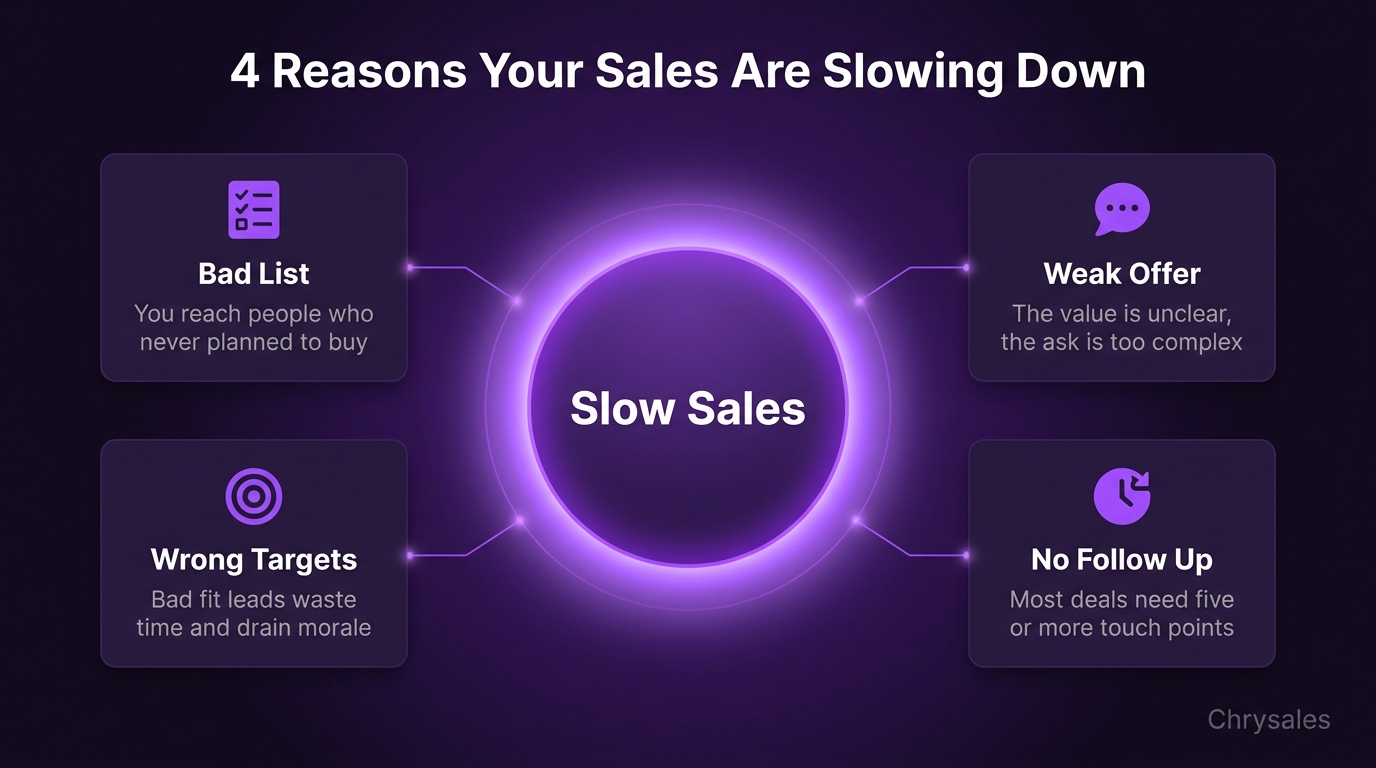
The List Problem
Your outreach list is usually the first place things fall apart. A bad list means you're reaching out to people who were never going to buy. Think of it like texting 500 random phone numbers and hoping someone texts back. You might get lucky once or twice, but most of your effort disappears into the void.
We worked with a 20-person tech company last year. Their reply rate was 0.7%. They thought their messaging was the problem. Turns out, 60% of the contacts on their list didn't match their ideal customer profile at all. After cleaning the list and focusing on the right companies, their reply rate jumped to 3.8% in three weeks.
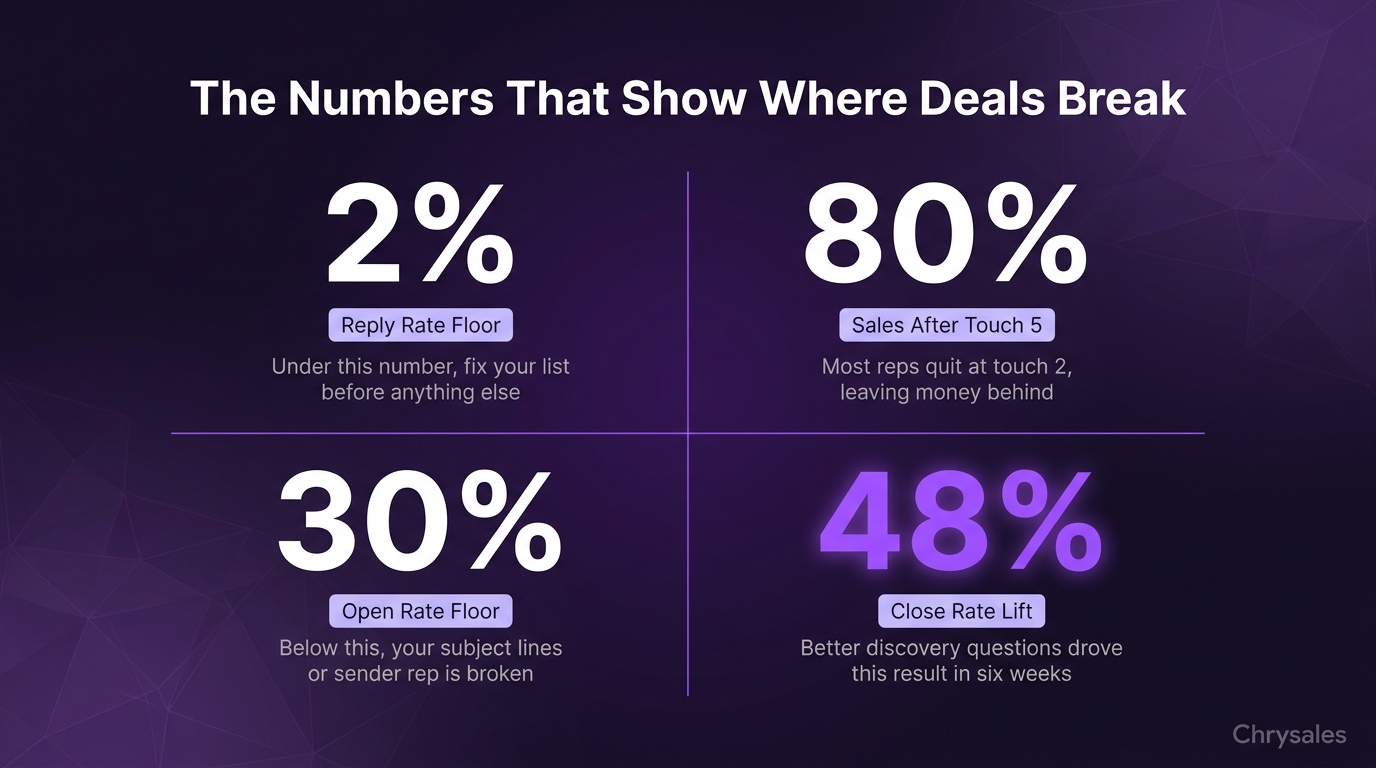
Pro Tip: If your reply rate is under 2%, don't rewrite your emails yet. Check your list first.
The Offer Problem
Your offer is what you're actually selling. If it's confusing, too expensive for what it promises, or doesn't solve a real urgent problem, people won't buy. A weak offer makes every sales conversation harder. It's like trying to sell a $200 umbrella when it's sunny outside. Nobody cares.
Here's a quick test: can you explain what you're selling in one sentence? Can someone repeat it back to you and get it right? If not, your offer is probably too complicated. Simplify it. Make it so obvious that saying no feels dumb.
The Follow-Up Gap
Most deals don't close on the first call. But most teams give up after one or two follow-ups. Studies show that 80% of sales happen after the fifth touchpoint, but 44% of salespeople stop after the first follow-up. That's a huge gap.
Sales are down when follow-up systems don't exist. If your team doesn't have a clear process for staying in touch with leads, you're losing deals that were already interested.
The Hidden Causes of Declining Sales Nobody Talks About
Slow sales problems have obvious causes like bad lists or weak offers. But there are deeper issues that quietly kill revenue without anyone noticing.
No Repeatable Sales System
A repeatable sales system means you can run the same process with different leads and get similar results every time. Most small sales teams don't have this. Every call is different. Every rep has their own style. Every deal feels like starting from scratch.
Picture this: you hire a new salesperson. They ask what to say on calls. You tell them to "just be natural" or "figure it out." That's not a system. That's hoping for the best. Without structure, your sales results swing wildly based on who happens to be good at winging it.
Watch out: If your sales drop every time a top rep goes on vacation, you don't have a system. You have a dependency. To prevent this, you need to build a sales system that actually scales instead of relying on individual talent.
Weak Discovery Questions
Discovery is the part of the call where you ask questions to figure out if the lead is a good fit and what problems they actually need solved. Most reps skip this or ask surface-level questions like "so what are you looking for?" That tells you nothing.
Good discovery digs deeper. It finds the real pain, the cost of not solving it, and who else is involved in the decision. When discovery is weak, you pitch to people who aren't ready to buy, and they ghost you after the call.
A marketing agency we worked with last quarter had a 30% close rate. After we helped them build a discovery script with 12 specific questions, their close rate went to 48% in six weeks. Same leads. Better questions.
Misaligned Targeting
Targeting means knowing exactly who you're selling to and focusing all your energy there. Misaligned targeting is when you go after companies that kind of fit but not really. A 200-person company that just did layoffs is not a hot lead. It's a bad fit, full stop.
When targeting is off, you waste time on leads that were never going to close. Your team gets tired. Morale drops. Sales slow down not because the market is bad, but because you're talking to the wrong people. If your pipeline is drying up because you're talking to the wrong companies, learn how to find clients who need your services right now and rebuild a targeted lead list fast.
How to Diagnose What's Actually Broken
Before you fix anything, you need to know what's causing the decrease in sales. Here's how to figure it out fast.
Check Your Pipeline Stages
Look at where deals are getting stuck. Are leads booking calls but not showing up? That's a top-of-funnel problem. Are they showing up but not moving to the next stage? That's a discovery or pitch problem. Are they saying yes but not signing? That's a closing or urgency problem.
Most CRMs let you see this in about five minutes. If 70% of your deals die at one stage, that's where you focus. Checking your pipeline stages and fixing where deals get stuck is part of mastering how to build a strong sales pipeline that doesn't suddenly dry up.
Review Your Outreach Metrics
Pull the numbers on your cold outreach. How many emails are you sending? What's the open rate? What's the reply rate? What's the percentage of replies that book calls?
If your open rate is under 30%, your subject lines are bad or your sender reputation is shot. If your reply rate is under 2%, your list or your messaging is off. If replies aren't booking calls, your call-to-action is weak or your offer isn't clear.
Common mistake: Focusing on improving your pitch when the real problem is nobody's replying in the first place. Fix the top of the funnel before you touch the middle or bottom.
Talk to the Leads Who Didn't Buy
This one's simple but almost nobody does it. Reach out to 10 leads who said no in the last month. Ask them why they didn't move forward. Keep it casual. Don't try to re-sell them. Just ask.
You'll hear patterns. "Too expensive." "Timing wasn't right." "Didn't understand what you do." Those patterns tell you what to fix. If five people say "too expensive," maybe your offer needs to show more value upfront. If three people say "didn't understand," your pitch is too complicated.
How to Fix Slow Sales Problems Fast
Once you know what's broken, here's how to fix it without starting from scratch.
Build a Better Lead List
Start with your ideal customer profile. Write down the exact type of company that gets the most value from what you sell. Industry, company size, revenue range, location, tech stack, recent events like funding or hiring.
Then build your list based on that profile. Use tools like LinkedIn Sales Navigator, Apollo, or Lusha to find companies that match. If you're doing B2B lead generation, spend more time picking the right 500 companies than writing the perfect email to 5,000 random ones.
A 15-person consulting firm we trained spent two full days building a list of 300 hyper-targeted companies. Their booking rate went from 1.2% to 6% in the first month. The list does most of the heavy lifting.
Simplify Your Offer
Take your current offer and cut it in half. What's the one problem you solve? What's the one outcome people get? Say that first. Everything else is extra detail you can share later.
Here's a format that works: "We help [type of company] get [specific result] in [time frame] without [common pain point]." That's it. One sentence. If you can't fit your offer into that, it's too complicated.
Set Up a Follow-Up System
Create a simple follow-up sequence for every lead that doesn't close right away. Day 1: first follow-up. Day 3: second follow-up with a resource or case study. Day 7: third follow-up with a different angle. Day 14: final check-in.
Automate it if you can. Use a CRM or a tool like HubSpot, Pipedrive, or even a shared spreadsheet with reminders. The key is that it happens automatically so no lead falls through the cracks. To close the follow-up gap and reach that fifth touchpoint and beyond, you can plug in proven cold email follow-up templates instead of writing every message from scratch.
Pro Tip: Add value in every follow-up. Don't just say "checking in." Share a relevant article, a quick tip, or a customer win. Make each touchpoint worth opening.
Train Your Team on Discovery
Write down 10 to 15 discovery questions that get to the real pain. Share them with your team. Role-play them in a meeting. Make everyone practice until the questions feel natural.
Good discovery questions sound like:
- "What's the biggest challenge you're dealing with right now in [area]?"
- "What have you tried so far to fix it?"
- "What happens if this doesn't get solved in the next six months?"
- "Who else is involved in making this decision?"
When your reps ask better questions, they qualify leads faster and pitch better because they know what actually matters.
Tighten Your Targeting
Go back through your last 20 closed deals. What do those companies have in common? Industry, size, problems they had, how they found you, how long the sales cycle was. That's your real ideal customer profile.
Now compare that to your current outreach list. Are you targeting similar companies? If not, shift your focus. Stop chasing leads that don't match the profile, even if they seem interested. Bad-fit clients take longer to close, pay less, and churn faster.
What a Sales System Actually Looks Like
A sales system is just a repeatable way to take a cold lead and turn them into a paying customer. It doesn't have to be fancy. It has to work every time.
The Four Core Pieces
Every B2B sales system needs four things: a way to find leads, a way to start conversations, a way to close deals, and a way to follow up. That's it.
Most growing B2B companies have one or two of these pieces but not all four. They're great at starting conversations but terrible at closing. Or they close well but have no way to consistently find new leads. The system breaks when any piece is missing.
Automation Where It Matters
You don't need to automate everything. But you should automate the repetitive stuff that doesn't need a human touch. Email sequences, follow-up reminders, lead scoring, meeting booking. That's all automatable.
Set a simple rule: anything scoring above 70 goes to the top of your call list. Anything under 40 gets a nurture sequence instead of a live call. This frees up your team to focus on the best leads instead of chasing everyone equally.
Watch out: Don't automate your actual sales conversations. Automated pitches feel robotic. People buy from people, not bots.
How Chrysales Builds Custom Systems
Chrysales works with B2B businesses to build sales systems from scratch or fix the ones that aren't working. We don't sell a course or a software tool. It's 1-on-1 coaching and consulting tailored to what your business actually needs.
The process has four steps. First, you learn the fundamentals of client acquisition and what makes a sales system work. Second, we build the system with you: offer positioning, outreach scripts, discovery frameworks, closing scripts, objection handling. Third, we set up automation so the system runs without you micromanaging every step. Fourth, we help you hire and train a Chief of Staff or sales team to take over execution.
Over the last 12 years, we've trained more than 1,000 business owners and 500+ sales teams. Our clients have generated over €10 million in revenue using the systems we built with them. We work with companies like Amazon, Vodafone, Deutsche Börse, and Cloudification, plus dozens of smaller B2B businesses in tech, consulting, and marketing.
If your sales are declining and you don't know where to start, we can diagnose the problem in one call and show you exactly what needs to change. For a deeper breakdown of the most common issues and how to spot them early, see our article on the key reasons your sales are slowing down.
When to Hire Instead of Fix
Sometimes the problem isn't the system. It's that you don't have enough people running it. If your system works but you're maxed out on bandwidth, it's time to hire.
How to Know You're Ready
You're ready to hire when the system is repeatable and someone else could follow it without you. If you can write down every step of your sales process and a new person could do it with two weeks of training, you're ready.
If you can't, don't hire yet. Hiring into a broken system just means you'll have more people doing the wrong thing. Fix the system first, then scale it with people.
Hiring Elite Setters and Closers
When you do hire, hire for one role at a time. Don't look for a "sales unicorn" who can do everything. Hire a setter who books meetings or a closer who handles demos and signs deals. Keep the roles clear.
Chrysales helps businesses hire and train sales teams that actually perform. We don't just help you post a job ad. We build the job description, screen candidates, run role-play assessments, and train the people you hire so they're ready to execute from day one.
Frequently Asked Questions
Q: What's the fastest way to stop a sales decline?
Fix your lead list first. Most slow sales problems start there. Spend two days building a hyper-targeted list of 200 to 300 ideal companies, then reach out with a simple, clear message. You'll see replies within a week if the list is good.
Q: How do I know if my offer is the problem?
If people are taking calls but not moving forward, your offer is probably the issue. Try explaining what you do in one sentence to someone outside your industry. If they don't get it or don't see why it matters, simplify your offer.
Q: How many follow-ups should I send before giving up?
At least five. Most deals close after the fifth touchpoint. If you stop at two, you're leaving money on the table. Space them out over two to three weeks and add value in each one. For structured guidance, check out best practices for sales follow-up emails.
Q: What's the difference between a sales system and just having a sales process?
A sales process is a list of steps. A sales system is a process that's documented, repeatable, and includes automation and support around each step. A system works without you. A process only works when you're running it.
Q: Can I fix sales problems without hiring an agency or coach?
Yes, but it takes longer. You'll need to learn what good looks like, test a lot of things, and figure out what's broken through trial and error. Coaching speeds it up because someone who's done it 500 times can spot the problem in an hour that might take you six months to find.
Q: How long does it take to see results after fixing a broken sales system?
Usually two to four weeks for B2B lead generation and outreach. If you're fixing discovery or closing, you'll see results as soon as the next few calls. Pipeline changes are slower, usually 30 to 60 days before you see a real revenue impact.
Q: What if my team is resistant to changing how they sell?
Start with the data. Show them the numbers: reply rates, close rates, pipeline velocity. If the current way isn't working, the data makes that obvious. Then involve them in building the new system so it doesn't feel like something being forced on them.
Slow sales problems causes solutions business are the reasons sales slow down and the simple fixes that help a business get back on track. They usually come from one or two fixable issues, not a dozen. Sales slowing down is one of the most stressful things that can happen in business. One month you're hitting targets, the next month the pipeline dries up and nobody's buying. Most teams panic and start changing everything at once. But here's the thing: slow sales problems usually come from one or two fixable issues, not a dozen. The trick is knowing where to look, what's actually broken, and how to fix it without wasting weeks guessing.
Why Sales Slow Down in the First Place
Most people think a drop in sales means the product is bad or the market changed overnight. That's almost never true. Sales decrease because something in the system broke or never existed in the first place.
The List Problem
Your outreach list is usually the first place things fall apart. A bad list means you're reaching out to people who were never going to buy. Think of it like texting 500 random phone numbers and hoping someone texts back. You might get lucky once or twice, but most of your effort disappears into the void.
We worked with a 20-person tech company last year. Their reply rate was 0.7%. They thought their messaging was the problem. Turns out, 60% of the contacts on their list didn't match their ideal customer profile at all. After cleaning the list and focusing on the right companies, their reply rate jumped to 3.8% in three weeks.
Pro Tip: If your reply rate is under 2%, don't rewrite your emails yet. Check your list first.
The Offer Problem
Your offer is what you're actually selling. If it's confusing, too expensive for what it promises, or doesn't solve a real urgent problem, people won't buy. A weak offer makes every sales conversation harder. It's like trying to sell a $200 umbrella when it's sunny outside. Nobody cares.
Here's a quick test: can you explain what you're selling in one sentence? Can someone repeat it back to you and get it right? If not, your offer is probably too complicated. Simplify it. Make it so obvious that saying no feels dumb.
The Follow-Up Gap
Most deals don't close on the first call. But most teams give up after one or two follow-ups. Studies show that 80% of sales happen after the fifth touchpoint, but 44% of salespeople stop after the first follow-up. That's a huge gap.
Sales are down when follow-up systems don't exist. If your team doesn't have a clear process for staying in touch with leads, you're losing deals that were already interested.
The Hidden Causes of Declining Sales Nobody Talks About
Slow sales problems have obvious causes like bad lists or weak offers. But there are deeper issues that quietly kill revenue without anyone noticing.
No Repeatable Sales System
A repeatable sales system means you can run the same process with different leads and get similar results every time. Most small sales teams don't have this. Every call is different. Every rep has their own style. Every deal feels like starting from scratch.
Picture this: you hire a new salesperson. They ask what to say on calls. You tell them to "just be natural" or "figure it out." That's not a system. That's hoping for the best. Without structure, your sales results swing wildly based on who happens to be good at winging it.
Watch out: If your sales drop every time a top rep goes on vacation, you don't have a system. You have a dependency. To prevent this, you need to build a sales system that actually scales instead of relying on individual talent.
Weak Discovery Questions
Discovery is the part of the call where you ask questions to figure out if the lead is a good fit and what problems they actually need solved. Most reps skip this or ask surface-level questions like "so what are you looking for?" That tells you nothing.
Good discovery digs deeper. It finds the real pain, the cost of not solving it, and who else is involved in the decision. When discovery is weak, you pitch to people who aren't ready to buy, and they ghost you after the call.
A marketing agency we worked with last quarter had a 30% close rate. After we helped them build a discovery script with 12 specific questions, their close rate went to 48% in six weeks. Same leads. Better questions.
Misaligned Targeting
Targeting means knowing exactly who you're selling to and focusing all your energy there. Misaligned targeting is when you go after companies that kind of fit but not really. A 200-person company that just did layoffs is not a hot lead. It's a bad fit, full stop.
When targeting is off, you waste time on leads that were never going to close. Your team gets tired. Morale drops. Sales slow down not because the market is bad, but because you're talking to the wrong people. If your pipeline is drying up because you're talking to the wrong companies, learn how to find clients who need your services right now and rebuild a targeted lead list fast.
How to Diagnose What's Actually Broken
Before you fix anything, you need to know what's causing the decrease in sales. Here's how to figure it out fast.
Check Your Pipeline Stages
Look at where deals are getting stuck. Are leads booking calls but not showing up? That's a top-of-funnel problem. Are they showing up but not moving to the next stage? That's a discovery or pitch problem. Are they saying yes but not signing? That's a closing or urgency problem.
Most CRMs let you see this in about five minutes. If 70% of your deals die at one stage, that's where you focus. Checking your pipeline stages and fixing where deals get stuck is part of mastering how to build a strong sales pipeline that doesn't suddenly dry up.
Review Your Outreach Metrics
Pull the numbers on your cold outreach. How many emails are you sending? What's the open rate? What's the reply rate? What's the percentage of replies that book calls?
If your open rate is under 30%, your subject lines are bad or your sender reputation is shot. If your reply rate is under 2%, your list or your messaging is off. If replies aren't booking calls, your call-to-action is weak or your offer isn't clear.
Common mistake: Focusing on improving your pitch when the real problem is nobody's replying in the first place. Fix the top of the funnel before you touch the middle or bottom.
Talk to the Leads Who Didn't Buy
This one's simple but almost nobody does it. Reach out to 10 leads who said no in the last month. Ask them why they didn't move forward. Keep it casual. Don't try to re-sell them. Just ask.
You'll hear patterns. "Too expensive." "Timing wasn't right." "Didn't understand what you do." Those patterns tell you what to fix. If five people say "too expensive," maybe your offer needs to show more value upfront. If three people say "didn't understand," your pitch is too complicated.
How to Fix Slow Sales Problems Fast
Once you know what's broken, here's how to fix it without starting from scratch.
Build a Better Lead List
Start with your ideal customer profile. Write down the exact type of company that gets the most value from what you sell. Industry, company size, revenue range, location, tech stack, recent events like funding or hiring.
Then build your list based on that profile. Use tools like LinkedIn Sales Navigator, Apollo, or Lusha to find companies that match. If you're doing B2B lead generation, spend more time picking the right 500 companies than writing the perfect email to 5,000 random ones.
A 15-person consulting firm we trained spent two full days building a list of 300 hyper-targeted companies. Their booking rate went from 1.2% to 6% in the first month. The list does most of the heavy lifting.
Simplify Your Offer
Take your current offer and cut it in half. What's the one problem you solve? What's the one outcome people get? Say that first. Everything else is extra detail you can share later.
Here's a format that works: "We help [type of company] get [specific result] in [time frame] without [common pain point]." That's it. One sentence. If you can't fit your offer into that, it's too complicated.
Set Up a Follow-Up System
Create a simple follow-up sequence for every lead that doesn't close right away. Day 1: first follow-up. Day 3: second follow-up with a resource or case study. Day 7: third follow-up with a different angle. Day 14: final check-in.
Automate it if you can. Use a CRM or a tool like HubSpot, Pipedrive, or even a shared spreadsheet with reminders. The key is that it happens automatically so no lead falls through the cracks. To close the follow-up gap and reach that fifth touchpoint and beyond, you can plug in proven cold email follow-up templates instead of writing every message from scratch.
Pro Tip: Add value in every follow-up. Don't just say "checking in." Share a relevant article, a quick tip, or a customer win. Make each touchpoint worth opening.
Train Your Team on Discovery
Write down 10 to 15 discovery questions that get to the real pain. Share them with your team. Role-play them in a meeting. Make everyone practice until the questions feel natural.
Good discovery questions sound like:
- "What's the biggest challenge you're dealing with right now in [area]?"
- "What have you tried so far to fix it?"
- "What happens if this doesn't get solved in the next six months?"
- "Who else is involved in making this decision?"
When your reps ask better questions, they qualify leads faster and pitch better because they know what actually matters.
Tighten Your Targeting
Go back through your last 20 closed deals. What do those companies have in common? Industry, size, problems they had, how they found you, how long the sales cycle was. That's your real ideal customer profile.
Now compare that to your current outreach list. Are you targeting similar companies? If not, shift your focus. Stop chasing leads that don't match the profile, even if they seem interested. Bad-fit clients take longer to close, pay less, and churn faster.
What a Sales System Actually Looks Like
A sales system is just a repeatable way to take a cold lead and turn them into a paying customer. It doesn't have to be fancy. It has to work every time.
The Four Core Pieces
Every B2B sales system needs four things: a way to find leads, a way to start conversations, a way to close deals, and a way to follow up. That's it.
Most growing B2B companies have one or two of these pieces but not all four. They're great at starting conversations but terrible at closing. Or they close well but have no way to consistently find new leads. The system breaks when any piece is missing.
Automation Where It Matters
You don't need to automate everything. But you should automate the repetitive stuff that doesn't need a human touch. Email sequences, follow-up reminders, lead scoring, meeting booking. That's all automatable.
Set a simple rule: anything scoring above 70 goes to the top of your call list. Anything under 40 gets a nurture sequence instead of a live call. This frees up your team to focus on the best leads instead of chasing everyone equally.
Watch out: Don't automate your actual sales conversations. Automated pitches feel robotic. People buy from people, not bots.
How Chrysales Builds Custom Systems
Chrysales works with B2B businesses to build sales systems from scratch or fix the ones that aren't working. We don't sell a course or a software tool. It's 1-on-1 coaching and consulting tailored to what your business actually needs.
The process has four steps. First, you learn the fundamentals of client acquisition and what makes a sales system work. Second, we build the system with you: offer positioning, outreach scripts, discovery frameworks, closing scripts, objection handling. Third, we set up automation so the system runs without you micromanaging every step. Fourth, we help you hire and train a Chief of Staff or sales team to take over execution.
Over the last 12 years, we've trained more than 1,000 business owners and 500+ sales teams. Our clients have generated over €10 million in revenue using the systems we built with them. We work with companies like Amazon, Vodafone, Deutsche Börse, and Cloudification, plus dozens of smaller B2B businesses in tech, consulting, and marketing.
If your sales are declining and you don't know where to start, we can diagnose the problem in one call and show you exactly what needs to change. For a deeper breakdown of the most common issues and how to spot them early, see our article on the key reasons your sales are slowing down.
When to Hire Instead of Fix
Sometimes the problem isn't the system. It's that you don't have enough people running it. If your system works but you're maxed out on bandwidth, it's time to hire.
How to Know You're Ready
You're ready to hire when the system is repeatable and someone else could follow it without you. If you can write down every step of your sales process and a new person could do it with two weeks of training, you're ready.
If you can't, don't hire yet. Hiring into a broken system just means you'll have more people doing the wrong thing. Fix the system first, then scale it with people.
Hiring Elite Setters and Closers
When you do hire, hire for one role at a time. Don't look for a "sales unicorn" who can do everything. Hire a setter who books meetings or a closer who handles demos and signs deals. Keep the roles clear.
Chrysales helps businesses hire and train sales teams that actually perform. We don't just help you post a job ad. We build the job description, screen candidates, run role-play assessments, and train the people you hire so they're ready to execute from day one.
Frequently Asked Questions
Q: What's the fastest way to stop a sales decline?
Fix your lead list first. Most slow sales problems start there. Spend two days building a hyper-targeted list of 200 to 300 ideal companies, then reach out with a simple, clear message. You'll see replies within a week if the list is good.
Q: How do I know if my offer is the problem?
If people are taking calls but not moving forward, your offer is probably the issue. Try explaining what you do in one sentence to someone outside your industry. If they don't get it or don't see why it matters, simplify your offer.
Q: How many follow-ups should I send before giving up?
At least five. Most deals close after the fifth touchpoint. If you stop at two, you're leaving money on the table. Space them out over two to three weeks and add value in each one. For structured guidance, check out best practices for sales follow-up emails.
Q: What's the difference between a sales system and just having a sales process?
A sales process is a list of steps. A sales system is a process that's documented, repeatable, and includes automation and support around each step. A system works without you. A process only works when you're running it.
Q: Can I fix sales problems without hiring an agency or coach?
Yes, but it takes longer. You'll need to learn what good looks like, test a lot of things, and figure out what's broken through trial and error. Coaching speeds it up because someone who's done it 500 times can spot the problem in an hour that might take you six months to find.
Q: How long does it take to see results after fixing a broken sales system?
Usually two to four weeks for B2B lead generation and outreach. If you're fixing discovery or closing, you'll see results as soon as the next few calls. Pipeline changes are slower, usually 30 to 60 days before you see a real revenue impact.
Q: What if my team is resistant to changing how they sell?
Start with the data. Show them the numbers: reply rates, close rates, pipeline velocity. If the current way isn't working, the data makes that obvious. Then involve them in building the new system so it doesn't feel like something being forced on them.
Scaling Is Not Hard If You Have The Right Systems
If you’re serious about leveling up your scaling game, you need the right system, the right training, and the right team behind you. We're here to give you the exact tools and strategies top entrepreneurs use to dominate.

Discover the latest tips
View All.avif)
Chrysales was formed from the words "chrysalis" the stage where a caterpillar transforms into a butterfly and "sales".
It stands for one thing: sales transformation.Because scaling doesn’t happen by doing more of the same. Scaling only happens when you go through real transformation in your systems, your offer, team and the way you sell.
.avif)


