.avif)
The Linkedin Post Format That Grows Your B2B Reach
A LinkedIn reach strategy is a specific post format that consistently boosts your B2B visibility by focusing on how you say things rather than just what you say. This approach uses personal stories with business lessons to drive engagement and grow your audience effectively.
You post on LinkedIn. You get 12 likes. Maybe a comment from your mom. Meanwhile, someone else posts a one-liner and gets 10,000 views. What gives?
Here's the thing: most people think LinkedIn reach is about what you say. It's actually about how you say it. The format you choose changes everything.
One specific post format consistently beats everything else for B2B lead generation, and most people never use it. Let's fix that.
Why Most LinkedIn Posts Die in the Feed
LinkedIn's algorithm is ruthless. It shows your post to maybe 2% of your connections at first. If those people ignore it, the post dies. If they engage, it spreads.
The difference between a post that dies and one that goes viral comes down to three things: the hook, the structure, and the engagement trigger.
The First Three Seconds Are Everything
Picture this: you're scrolling LinkedIn at 7 AM with coffee in hand. You see 50 posts in two minutes. Which ones do you actually stop for?
The ones that grab you in the first line. Not the third paragraph. The first line.
Most LinkedIn posts fail because they bury the point. They open with "I've been thinking about..." or "In today's business world..." By the time you get to the actual idea, people scrolled past.
The winning format puts the most interesting sentence first. Always.
Watch out: LinkedIn shows only the first 150 characters before the "see more" button. If your hook doesn't land in that space, you lose 90% of readers.
The Structure That Wins Every Time
Here's what the data shows across millions of LinkedIn posts: short-form storytelling beats everything else. Not long articles. Not bullet lists. Not pure text blocks. Story-driven posts with a specific structure.
The format looks like this:
- Hook: One punchy sentence that makes someone stop scrolling
- Story or observation: 3-4 short paragraphs, each 1-2 sentences
- The lesson or takeaway: What this means in practice
- Call to action or question: Something that makes people comment
A 30-person consulting firm tried this format for two weeks. Their average post went from 300 views to 4,200 views. Same topics. Same person posting. Different structure.
The Format That Beats Everything Else for LinkedIn Reach Strategy
Let's get specific. The post format that consistently gets 10x more reach is the personal story with a business lesson. Not a case study. Not a tip list. A short story about something real that happened, with a clear takeaway someone can use.
Why This Format Works
LinkedIn's algorithm prioritizes posts that keep people on the platform. Stories do that. When you open with "Three years ago I lost a €50K deal because of one email," people read to find out what happened. When you open with "Here are 5 email tips," they scroll past.
The algorithm also rewards comments more than likes. Stories naturally generate comments because people relate and share their own experiences. A good story post gets 3-4x more comments than a tip post, according to research on how the LinkedIn algorithm prioritizes engagement.
Pro Tip: The best LinkedIn stories are under 200 words total. Longer posts get fewer reads. Short stories with white space perform best, as shown in this guide to formatting LinkedIn posts for maximum reach.
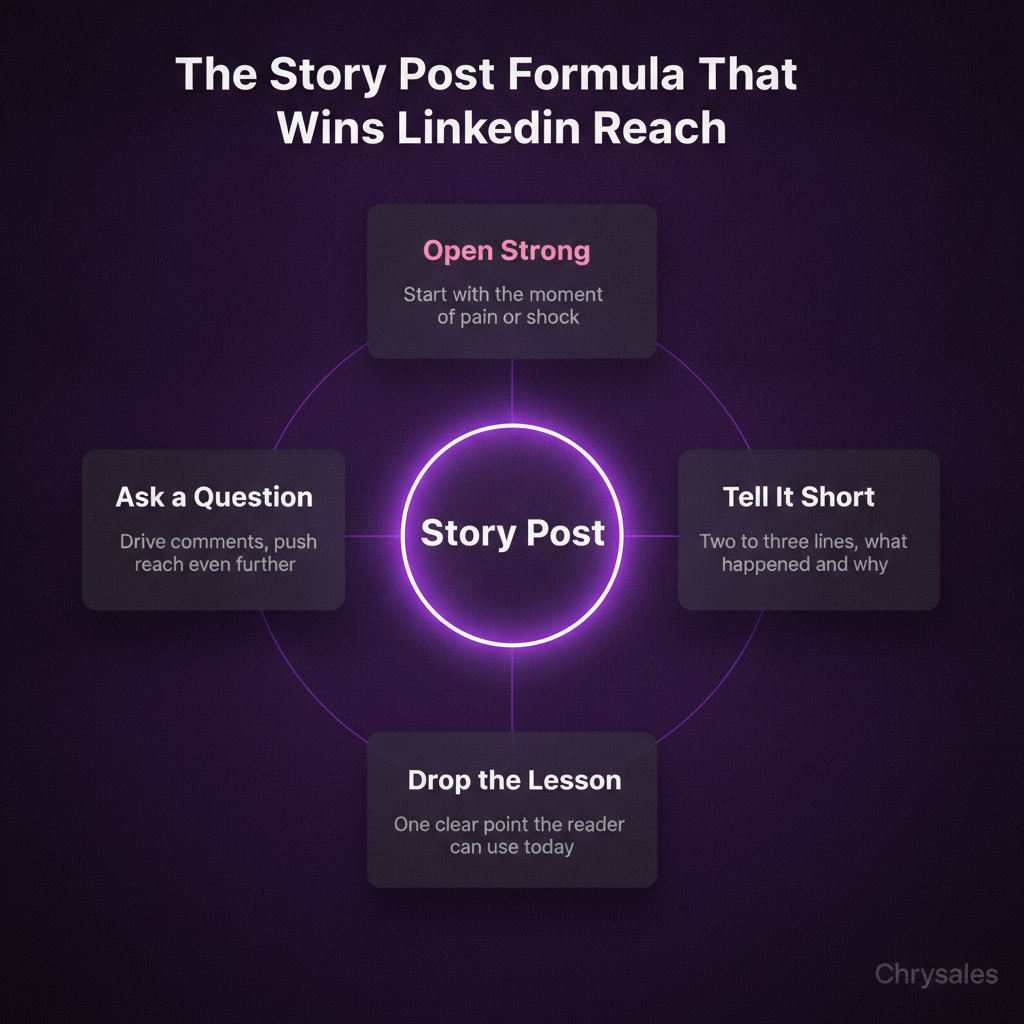
The Four-Part Formula
Here's the exact structure that works:
1. Open with the moment of pain or surprise
Start right in the action. "I bombed a sales call yesterday." "We lost three clients in one week." "A prospect said yes, then ghosted for 60 days." No setup. Just the moment.
2. Add 2-3 lines of what happened
Keep it simple. What you did. What they said. What went wrong or right. Like texting a friend about your day.
3. Drop the lesson
One clear takeaway. "Turns out, people don't ghost because they're rude. They ghost because your follow-up adds no value." Make it something the reader can use today.
4. End with a question
Not "What do you think?" That's boring. Ask something specific. "What's your move when a hot lead goes cold?" or "Ever had a prospect say yes then disappear?" Questions drive comments, and comments drive reach.
One marketing agency posted using this format three times per week. Their LinkedIn reach grew from 2,000 views per month to 38,000 views per month in 90 days. No ads. No hacks. Just this format, repeated.
How to Build Your LinkedIn Organic Growth Engine Around This Format
Knowing the format is step one. Using it consistently to generate B2B leads is step two. Most teams post randomly and hope for reach. Smart teams treat LinkedIn like a content system.
Post Three Times Per Week Minimum
The LinkedIn algorithm rewards consistency more than perfection. If you post once a month with amazing content, you'll get less reach than someone posting three times a week with good content. The algorithm wants to know you're active.
Set a simple schedule. Monday, Wednesday, Friday. Or Tuesday, Thursday, Saturday. Doesn't matter. Pick three days and stick to them for 60 days. Your reach will grow just from showing up.
If you need help building that posting rhythm, a structured content calendar for B2B lead generation will help you operationalize that cadence and never miss a post.
Common mistake: Posting seven times in one week, then nothing for three weeks. The algorithm treats you like a stranger every time you come back. Consistency beats volume.
Mix Story Posts with Value Posts
You can't post stories every single time. People will tune out. The sweet spot is a mix:
- 40% personal stories with business lessons (the 10x format)
- 30% teaching posts (how-tos, tips, breakdowns)
- 20% observations or hot takes on industry trends
- 10% company updates or wins (use sparingly)
This mix keeps your feed interesting and your reach high. The story posts pull people in. The teaching posts position you as someone who knows their stuff. The observations show you're paying attention.
Engage Before and After You Post
Here's what nobody tells you about LinkedIn reach: the algorithm watches what you do before you post. If you comment on five posts in the 30 minutes before you publish, your post gets shown to more people. If you post and disappear, it dies.
The best LinkedIn content strategy includes:
- Spend 10 minutes commenting on other posts before you publish
- Post your content
- Reply to every comment in the first hour
- Comment on five more posts in the two hours after publishing
This signals to LinkedIn that you're active and engaged, not just broadcasting. One tech company started doing this and saw their average post reach jump from 800 views to 5,400 views in three weeks.
Turn LinkedIn Reach Into B2B Sales Pipeline
Reach is cool. Pipeline is better. The whole point of LinkedIn for B2B companies is to book calls and close deals. A viral post that doesn't lead to conversations is just a dopamine hit.
Use Your Best Posts to Start Conversations
When a post hits 3,000+ views, look at who liked or commented. Those are warm leads. They raised their hand by engaging. Most people ignore this goldmine.
Here's the move: send a short DM to people who commented something thoughtful. Not a pitch. Just a "Hey, saw your comment on my post about cold outreach. Curious, what's been working for you lately?"
We see this all the time with clients. A good LinkedIn post can generate 15-30 warm DM conversations. Half of those turn into calls. A quarter of the calls turn into deals. That's a LinkedIn reach strategy that actually feeds your sales system.
To convert those warm conversations into booked meetings, follow the proven strategies outlined in our guide on how to use LinkedIn outreach to book more meetings with qualified prospects.
Pro Tip: Don't DM everyone who likes your post. That's spam. Focus on people who commented or who fit your ideal customer profile.
Build a Content Bank of Your Best Stories
Most B2B sales teams make the same mistakes over and over. Your prospects do too. Every objection you hear, every deal you lose, every lesson you learn is a potential LinkedIn story post.
Start a simple doc. Every time something interesting happens in a sales call, write it down:
- Prospect objection you handled well
- Deal that fell apart and why
- Outreach message that got a reply
- Hiring mistake you made
- System you built that worked
Each one of those is a future post. You don't need to be creative. Just tell what happened and what you learned. Real stories beat invented content every single time.
A 15-person consulting firm built a bank of 40 stories in three months. They rotated through them and never ran out of content. Their LinkedIn became their top lead source, beating referrals and paid ads.
The Hook Library: How to Start Your Posts
The first line is everything. If you nail the hook, the rest of the post gets read. If you don't, it dies in the feed.
Here are the hook formats that work best for B2B LinkedIn outreach and sales content:
Hooks That Stop the Scroll
The mistake admission:
- "I just lost a €30K deal because of a stupid email."
- "We hired the wrong salesperson. Twice."
- "I used to think cold outreach was dead. I was wrong."
The surprising number:
- "We sent 1,000 cold emails last month. 12 people replied."
- "One sales call question boosted our close rate by 40%."
- "Three changes to our outreach. 10x more replies."
The bold statement:
- "Most sales training is useless."
- "You don't need more leads. You need better ones."
- "Hiring salespeople before you have a system is a waste of money."
The relatable moment:
- "Ever had a prospect ghost you after saying they're interested?"
- "That moment when you realize your entire sales pitch is about you, not them."
- "Spent two weeks writing cold emails. Sent them. Crickets."
Pick one hook format and write five different hooks. Post one per week. Track which ones get the most reach. Double down on what works.
What Not to Do in Your Opening Line
Bad hooks kill your reach faster than anything else. Avoid:
- "I've been thinking about..." (boring, everyone scrolls)
- "In today's fast-paced business world..." (sounds like a robot wrote it)
- "Happy Monday everyone!" (no one cares, adds zero value)
- "I want to share something with you..." (just share it, don't announce it)
- Starting with a question that's too broad: "What is sales?" (too vague, not interesting)
Watch out: If your first sentence could apply to any topic or any industry, it's too generic. Make it specific to your point.
How to Use AI to Scale Your LinkedIn Content Without Losing Your Voice
You can't fake authenticity on LinkedIn. People smell AI-written generic posts from a mile away. But you can use AI to speed up your process without sounding like a robot.
AI for Idea Generation, Not Writing
Here's how smart teams use AI for their LinkedIn reach strategy: they use it to organize ideas, not write posts. You feed AI your real stories and lessons, and it helps you structure them or find angles you missed.
For example, you tell AI: "I had a sales call where the prospect kept saying they needed to think about it. I asked them what specifically they needed to think about, and it turned out they were worried about implementation time. We addressed it on the call and closed the deal."
AI can help you turn that into a post outline:
- Hook: "Prospect said 'I need to think about it' three times on one call."
- Story: What you asked, what they actually meant, how you solved it
- Lesson: 'I need to think about it' is never the real objection
- CTA: What's the weirdest objection you've heard?
You still write the post in your voice. AI just helped you see the structure. That's the difference between using AI as a tool versus letting it write generic content that tanks your reach.
Use AI to Analyze What's Working
One of the best ways to improve your B2B lead generation on LinkedIn is to study your own best posts. Most people post and forget. Smart teams track and learn.
Use AI to analyze your top five posts:
- What format did they use?
- What was the hook?
- How long were they?
- What topics performed best?
- What time of day did you post?
AI can spot patterns you'd miss. Maybe your story posts about hiring always crush it. Maybe your posts on cold outreach flop. Maybe Tuesday morning posts get 2x the reach of Friday posts. Use that data to post smarter.
Common Mistakes That Kill Your LinkedIn Reach
Even when you know the format, small mistakes can tank your reach. Let's cover the traps most people fall into so you can avoid them.
Mistake 1: Writing for Everyone
The posts that go viral are usually specific. Not generic. When you try to write for "all business owners" or "anyone in sales," your post becomes bland. When you write for a 20-person B2B company struggling with outbound, your post has teeth.
Specific wins on LinkedIn. "Here's how we fixed our sales process" beats "Sales tips for businesses" every time. People remember the specific story and ignore the generic tip list.
Mistake 2: Posting and Ghosting
You post something great at 9 AM. Someone comments at 9:03 AM. You see it at 6 PM and reply. Too late. The algorithm already decided your post wasn't engaging because you didn't interact.
If you post, you need to babysit the post for the first hour. Reply to every comment. Like every comment. Jump back in when someone else comments. This tells LinkedIn your post is generating conversation, and the algorithm pushes it to more people.
A marketing agency made this one change and saw their average post comments go from four to eighteen. More comments meant more reach, which meant more leads.
Mistake 3: Using LinkedIn Like Twitter
Short punchy one-liners work on Twitter. They die on LinkedIn. LinkedIn's algorithm and audience prefer a bit more substance. Not a 2,000-word essay, but not a single sentence either.
The sweet spot for LinkedIn posts is 100-200 words. Enough to tell a quick story or make a clear point, but not so long people bail halfway through. Test different lengths, but if you're posting one-sentence hot takes, you're leaving reach on the table.
Pro Tip: Add white space. Break your post into short paragraphs. Even a 150-word post feels easier to read when it's broken into six small chunks instead of one big block.
Mistake 4: Ignoring the Comment Section
The comment section of your post is where the real magic happens for B2B sales and client acquisition. That's where prospects reveal what they're struggling with. That's where warm conversations start. That's where deals begin.
When someone comments on your post, don't just reply "Thanks!" Treat it like a mini conversation. Ask a follow-up question. Add a thought. Show you're actually reading what they wrote. This keeps the conversation going, which keeps the algorithm happy, which grows your reach.
How to Measure What Actually Matters
Reach is vanity if it doesn't lead anywhere. Most people celebrate a post with 5,000 views and forget to check if anyone booked a call. Smart teams track what matters for LinkedIn organic growth: conversations and pipeline.
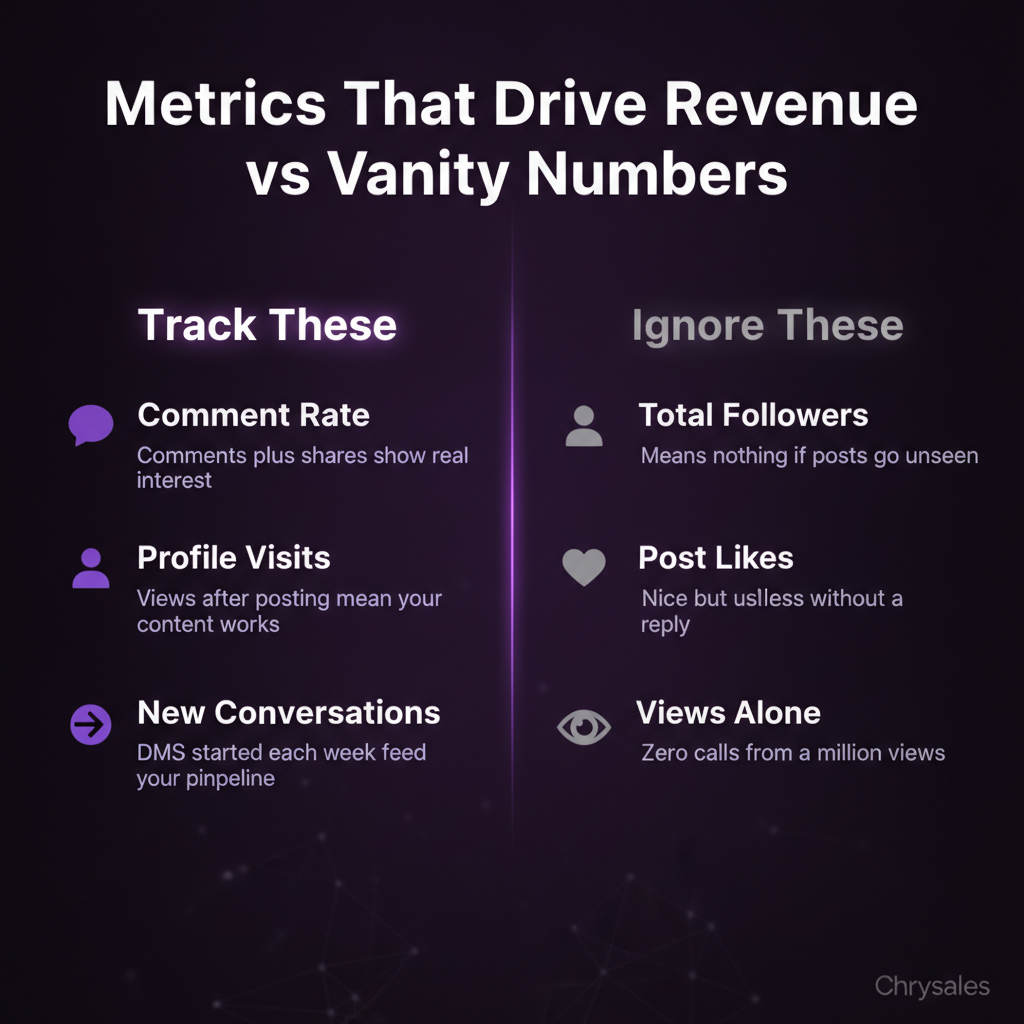
Track These Three Numbers
1. Engagement rate (comments + shares) / impressions
This tells you if people actually care about your content. A post with 2,000 views and 40 comments is better than a post with 10,000 views and 10 comments. High engagement signals the algorithm to push your post further.
2. Profile views after posting
When you post something good, people click your profile. Track how many profile views you get in the 48 hours after a post. If that number is growing week over week, your content is working.
3. DM conversations started
This is the number that feeds your sales system. How many new conversations did your LinkedIn content create this week? Not just likes. Conversations. Someone messaged you, or you messaged someone who engaged, and an actual back-and-forth started.
One tech company tracked this for 90 days. They posted three times per week using the story format. They started an average of eight new DM conversations per week. Four of those turned into calls. Two turned into deals per month. That's predictable client acquisition from LinkedIn content.
If you want to go deeper on measuring how your LinkedIn content translates to closed deals, learn how to track content impact on your sales funnel from top of funnel all the way through to revenue.
What to Ignore
Stop obsessing over these metrics:
- Total follower count: Doesn't matter if they don't see your posts
- Likes: Nice but useless for B2B sales unless they turn into conversations
- Post impressions alone: A million views means nothing if zero people message you
LinkedIn is not Instagram. You're not building an audience to sell a course. You're building relationships to book sales calls. Track the metrics that connect to revenue.
Frequently Asked Questions
Q: How often should I post on LinkedIn to grow my reach?
Three times per week is the sweet spot for most B2B companies. More than that and you risk annoying your connections. Less than that and the algorithm forgets about you. Consistency matters more than volume. Pick three days, post on those days every week for 60 days, and your reach will grow steadily. If you can only manage twice per week, that's fine too, just stick to the schedule.
Q: What if I don't have interesting stories to share?
Every conversation you have is a potential story. Every sales call, every objection, every win, every loss. You're not looking for dramatic movie-plot stories. You're looking for small real moments that taught you something. A prospect who said no and why. A cold email that actually worked. A hire that didn't work out. Write those down as they happen and you'll never run out of content.
Q: Should I use hashtags on LinkedIn?
Use three to five relevant hashtags at the end of your post, not scattered throughout. LinkedIn's algorithm doesn't prioritize hashtags the way Instagram does, but they help a little with discoverability. Focus on writing a great post first. Hashtags are the last 2% of reach optimization, not the first 80%.
Q: How long does it take to see results from posting consistently?
Most people see their reach start to grow around the 30-day mark if they're posting three times per week and engaging in comments. Real business results like DM conversations and booked calls usually show up around 60-90 days. This isn't a quick win. It's a system you build over time. The teams that treat LinkedIn as a 90-day project always beat the teams looking for a viral post in week one.
Q: Can I repost the same content if it performed well?
Yes, but wait at least 90 days and rewrite it slightly. Most of your connections didn't see the post the first time. The algorithm only shows your content to a fraction of your audience. If a story post crushed it six months ago, you can absolutely tell that story again with a fresh angle. Just don't copy-paste the exact same post every month.
Q: What's the best time to post on LinkedIn?
For B2B audiences, Tuesday through Thursday between 7-9 AM and 12-1 PM tend to perform best, but your audience might be different. Test different times for a few weeks and track what gets the most engagement in the first hour. That's your sweet spot. The first hour of engagement matters more than the time of day.
Q: How do I turn LinkedIn engagement into actual sales calls?
When someone comments something thoughtful on your post, send them a short DM thanking them and asking a relevant question about their comment. Not a pitch. A real question. Half of those conversations go nowhere, which is fine. The other half turn into a back-and-forth where you learn about their business. If there's a fit, you suggest a quick call to dive deeper. This is cold outreach on LinkedIn done right, relationship-first instead of pitch-first.
A LinkedIn reach strategy is the key to turning your content into real pipeline. By using this format consistently, you build a sales system that turns LinkedIn reach into inbound demand and supports your B2B sales goals. Once you've built that reach, you can find clients who need your services right now from LinkedIn traffic and convert attention into booked meetings. This LinkedIn reach strategy ensures your posts convert.
A LinkedIn reach strategy is a specific post format that consistently boosts your B2B visibility by focusing on how you say things rather than just what you say. This approach uses personal stories with business lessons to drive engagement and grow your audience effectively.
You post on LinkedIn. You get 12 likes. Maybe a comment from your mom. Meanwhile, someone else posts a one-liner and gets 10,000 views. What gives?
Here's the thing: most people think LinkedIn reach is about what you say. It's actually about how you say it. The format you choose changes everything.
One specific post format consistently beats everything else for B2B lead generation, and most people never use it. Let's fix that.
Why Most LinkedIn Posts Die in the Feed
LinkedIn's algorithm is ruthless. It shows your post to maybe 2% of your connections at first. If those people ignore it, the post dies. If they engage, it spreads.
The difference between a post that dies and one that goes viral comes down to three things: the hook, the structure, and the engagement trigger.
The First Three Seconds Are Everything
Picture this: you're scrolling LinkedIn at 7 AM with coffee in hand. You see 50 posts in two minutes. Which ones do you actually stop for?
The ones that grab you in the first line. Not the third paragraph. The first line.
Most LinkedIn posts fail because they bury the point. They open with "I've been thinking about..." or "In today's business world..." By the time you get to the actual idea, people scrolled past.
The winning format puts the most interesting sentence first. Always.
Watch out: LinkedIn shows only the first 150 characters before the "see more" button. If your hook doesn't land in that space, you lose 90% of readers.
The Structure That Wins Every Time
Here's what the data shows across millions of LinkedIn posts: short-form storytelling beats everything else. Not long articles. Not bullet lists. Not pure text blocks. Story-driven posts with a specific structure.
The format looks like this:
- Hook: One punchy sentence that makes someone stop scrolling
- Story or observation: 3-4 short paragraphs, each 1-2 sentences
- The lesson or takeaway: What this means in practice
- Call to action or question: Something that makes people comment
A 30-person consulting firm tried this format for two weeks. Their average post went from 300 views to 4,200 views. Same topics. Same person posting. Different structure.
The Format That Beats Everything Else for LinkedIn Reach Strategy
Let's get specific. The post format that consistently gets 10x more reach is the personal story with a business lesson. Not a case study. Not a tip list. A short story about something real that happened, with a clear takeaway someone can use.
Why This Format Works
LinkedIn's algorithm prioritizes posts that keep people on the platform. Stories do that. When you open with "Three years ago I lost a €50K deal because of one email," people read to find out what happened. When you open with "Here are 5 email tips," they scroll past.
The algorithm also rewards comments more than likes. Stories naturally generate comments because people relate and share their own experiences. A good story post gets 3-4x more comments than a tip post, according to research on how the LinkedIn algorithm prioritizes engagement.
Pro Tip: The best LinkedIn stories are under 200 words total. Longer posts get fewer reads. Short stories with white space perform best, as shown in this guide to formatting LinkedIn posts for maximum reach.
The Four-Part Formula
Here's the exact structure that works:
1. Open with the moment of pain or surprise
Start right in the action. "I bombed a sales call yesterday." "We lost three clients in one week." "A prospect said yes, then ghosted for 60 days." No setup. Just the moment.
2. Add 2-3 lines of what happened
Keep it simple. What you did. What they said. What went wrong or right. Like texting a friend about your day.
3. Drop the lesson
One clear takeaway. "Turns out, people don't ghost because they're rude. They ghost because your follow-up adds no value." Make it something the reader can use today.
4. End with a question
Not "What do you think?" That's boring. Ask something specific. "What's your move when a hot lead goes cold?" or "Ever had a prospect say yes then disappear?" Questions drive comments, and comments drive reach.
One marketing agency posted using this format three times per week. Their LinkedIn reach grew from 2,000 views per month to 38,000 views per month in 90 days. No ads. No hacks. Just this format, repeated.
How to Build Your LinkedIn Organic Growth Engine Around This Format
Knowing the format is step one. Using it consistently to generate B2B leads is step two. Most teams post randomly and hope for reach. Smart teams treat LinkedIn like a content system.
Post Three Times Per Week Minimum
The LinkedIn algorithm rewards consistency more than perfection. If you post once a month with amazing content, you'll get less reach than someone posting three times a week with good content. The algorithm wants to know you're active.
Set a simple schedule. Monday, Wednesday, Friday. Or Tuesday, Thursday, Saturday. Doesn't matter. Pick three days and stick to them for 60 days. Your reach will grow just from showing up.
If you need help building that posting rhythm, a structured content calendar for B2B lead generation will help you operationalize that cadence and never miss a post.
Common mistake: Posting seven times in one week, then nothing for three weeks. The algorithm treats you like a stranger every time you come back. Consistency beats volume.
Mix Story Posts with Value Posts
You can't post stories every single time. People will tune out. The sweet spot is a mix:
- 40% personal stories with business lessons (the 10x format)
- 30% teaching posts (how-tos, tips, breakdowns)
- 20% observations or hot takes on industry trends
- 10% company updates or wins (use sparingly)
This mix keeps your feed interesting and your reach high. The story posts pull people in. The teaching posts position you as someone who knows their stuff. The observations show you're paying attention.
Engage Before and After You Post
Here's what nobody tells you about LinkedIn reach: the algorithm watches what you do before you post. If you comment on five posts in the 30 minutes before you publish, your post gets shown to more people. If you post and disappear, it dies.
The best LinkedIn content strategy includes:
- Spend 10 minutes commenting on other posts before you publish
- Post your content
- Reply to every comment in the first hour
- Comment on five more posts in the two hours after publishing
This signals to LinkedIn that you're active and engaged, not just broadcasting. One tech company started doing this and saw their average post reach jump from 800 views to 5,400 views in three weeks.
Turn LinkedIn Reach Into B2B Sales Pipeline
Reach is cool. Pipeline is better. The whole point of LinkedIn for B2B companies is to book calls and close deals. A viral post that doesn't lead to conversations is just a dopamine hit.
Use Your Best Posts to Start Conversations
When a post hits 3,000+ views, look at who liked or commented. Those are warm leads. They raised their hand by engaging. Most people ignore this goldmine.
Here's the move: send a short DM to people who commented something thoughtful. Not a pitch. Just a "Hey, saw your comment on my post about cold outreach. Curious, what's been working for you lately?"
We see this all the time with clients. A good LinkedIn post can generate 15-30 warm DM conversations. Half of those turn into calls. A quarter of the calls turn into deals. That's a LinkedIn reach strategy that actually feeds your sales system.
To convert those warm conversations into booked meetings, follow the proven strategies outlined in our guide on how to use LinkedIn outreach to book more meetings with qualified prospects.
Pro Tip: Don't DM everyone who likes your post. That's spam. Focus on people who commented or who fit your ideal customer profile.
Build a Content Bank of Your Best Stories
Most B2B sales teams make the same mistakes over and over. Your prospects do too. Every objection you hear, every deal you lose, every lesson you learn is a potential LinkedIn story post.
Start a simple doc. Every time something interesting happens in a sales call, write it down:
- Prospect objection you handled well
- Deal that fell apart and why
- Outreach message that got a reply
- Hiring mistake you made
- System you built that worked
Each one of those is a future post. You don't need to be creative. Just tell what happened and what you learned. Real stories beat invented content every single time.
A 15-person consulting firm built a bank of 40 stories in three months. They rotated through them and never ran out of content. Their LinkedIn became their top lead source, beating referrals and paid ads.
The Hook Library: How to Start Your Posts
The first line is everything. If you nail the hook, the rest of the post gets read. If you don't, it dies in the feed.
Here are the hook formats that work best for B2B LinkedIn outreach and sales content:
Hooks That Stop the Scroll
The mistake admission:
- "I just lost a €30K deal because of a stupid email."
- "We hired the wrong salesperson. Twice."
- "I used to think cold outreach was dead. I was wrong."
The surprising number:
- "We sent 1,000 cold emails last month. 12 people replied."
- "One sales call question boosted our close rate by 40%."
- "Three changes to our outreach. 10x more replies."
The bold statement:
- "Most sales training is useless."
- "You don't need more leads. You need better ones."
- "Hiring salespeople before you have a system is a waste of money."
The relatable moment:
- "Ever had a prospect ghost you after saying they're interested?"
- "That moment when you realize your entire sales pitch is about you, not them."
- "Spent two weeks writing cold emails. Sent them. Crickets."
Pick one hook format and write five different hooks. Post one per week. Track which ones get the most reach. Double down on what works.
What Not to Do in Your Opening Line
Bad hooks kill your reach faster than anything else. Avoid:
- "I've been thinking about..." (boring, everyone scrolls)
- "In today's fast-paced business world..." (sounds like a robot wrote it)
- "Happy Monday everyone!" (no one cares, adds zero value)
- "I want to share something with you..." (just share it, don't announce it)
- Starting with a question that's too broad: "What is sales?" (too vague, not interesting)
Watch out: If your first sentence could apply to any topic or any industry, it's too generic. Make it specific to your point.
How to Use AI to Scale Your LinkedIn Content Without Losing Your Voice
You can't fake authenticity on LinkedIn. People smell AI-written generic posts from a mile away. But you can use AI to speed up your process without sounding like a robot.
AI for Idea Generation, Not Writing
Here's how smart teams use AI for their LinkedIn reach strategy: they use it to organize ideas, not write posts. You feed AI your real stories and lessons, and it helps you structure them or find angles you missed.
For example, you tell AI: "I had a sales call where the prospect kept saying they needed to think about it. I asked them what specifically they needed to think about, and it turned out they were worried about implementation time. We addressed it on the call and closed the deal."
AI can help you turn that into a post outline:
- Hook: "Prospect said 'I need to think about it' three times on one call."
- Story: What you asked, what they actually meant, how you solved it
- Lesson: 'I need to think about it' is never the real objection
- CTA: What's the weirdest objection you've heard?
You still write the post in your voice. AI just helped you see the structure. That's the difference between using AI as a tool versus letting it write generic content that tanks your reach.
Use AI to Analyze What's Working
One of the best ways to improve your B2B lead generation on LinkedIn is to study your own best posts. Most people post and forget. Smart teams track and learn.
Use AI to analyze your top five posts:
- What format did they use?
- What was the hook?
- How long were they?
- What topics performed best?
- What time of day did you post?
AI can spot patterns you'd miss. Maybe your story posts about hiring always crush it. Maybe your posts on cold outreach flop. Maybe Tuesday morning posts get 2x the reach of Friday posts. Use that data to post smarter.
Common Mistakes That Kill Your LinkedIn Reach
Even when you know the format, small mistakes can tank your reach. Let's cover the traps most people fall into so you can avoid them.
Mistake 1: Writing for Everyone
The posts that go viral are usually specific. Not generic. When you try to write for "all business owners" or "anyone in sales," your post becomes bland. When you write for a 20-person B2B company struggling with outbound, your post has teeth.
Specific wins on LinkedIn. "Here's how we fixed our sales process" beats "Sales tips for businesses" every time. People remember the specific story and ignore the generic tip list.
Mistake 2: Posting and Ghosting
You post something great at 9 AM. Someone comments at 9:03 AM. You see it at 6 PM and reply. Too late. The algorithm already decided your post wasn't engaging because you didn't interact.
If you post, you need to babysit the post for the first hour. Reply to every comment. Like every comment. Jump back in when someone else comments. This tells LinkedIn your post is generating conversation, and the algorithm pushes it to more people.
A marketing agency made this one change and saw their average post comments go from four to eighteen. More comments meant more reach, which meant more leads.
Mistake 3: Using LinkedIn Like Twitter
Short punchy one-liners work on Twitter. They die on LinkedIn. LinkedIn's algorithm and audience prefer a bit more substance. Not a 2,000-word essay, but not a single sentence either.
The sweet spot for LinkedIn posts is 100-200 words. Enough to tell a quick story or make a clear point, but not so long people bail halfway through. Test different lengths, but if you're posting one-sentence hot takes, you're leaving reach on the table.
Pro Tip: Add white space. Break your post into short paragraphs. Even a 150-word post feels easier to read when it's broken into six small chunks instead of one big block.
Mistake 4: Ignoring the Comment Section
The comment section of your post is where the real magic happens for B2B sales and client acquisition. That's where prospects reveal what they're struggling with. That's where warm conversations start. That's where deals begin.
When someone comments on your post, don't just reply "Thanks!" Treat it like a mini conversation. Ask a follow-up question. Add a thought. Show you're actually reading what they wrote. This keeps the conversation going, which keeps the algorithm happy, which grows your reach.
How to Measure What Actually Matters
Reach is vanity if it doesn't lead anywhere. Most people celebrate a post with 5,000 views and forget to check if anyone booked a call. Smart teams track what matters for LinkedIn organic growth: conversations and pipeline.
Track These Three Numbers
1. Engagement rate (comments + shares) / impressions
This tells you if people actually care about your content. A post with 2,000 views and 40 comments is better than a post with 10,000 views and 10 comments. High engagement signals the algorithm to push your post further.
2. Profile views after posting
When you post something good, people click your profile. Track how many profile views you get in the 48 hours after a post. If that number is growing week over week, your content is working.
3. DM conversations started
This is the number that feeds your sales system. How many new conversations did your LinkedIn content create this week? Not just likes. Conversations. Someone messaged you, or you messaged someone who engaged, and an actual back-and-forth started.
One tech company tracked this for 90 days. They posted three times per week using the story format. They started an average of eight new DM conversations per week. Four of those turned into calls. Two turned into deals per month. That's predictable client acquisition from LinkedIn content.
If you want to go deeper on measuring how your LinkedIn content translates to closed deals, learn how to track content impact on your sales funnel from top of funnel all the way through to revenue.
What to Ignore
Stop obsessing over these metrics:
- Total follower count: Doesn't matter if they don't see your posts
- Likes: Nice but useless for B2B sales unless they turn into conversations
- Post impressions alone: A million views means nothing if zero people message you
LinkedIn is not Instagram. You're not building an audience to sell a course. You're building relationships to book sales calls. Track the metrics that connect to revenue.
Frequently Asked Questions
Q: How often should I post on LinkedIn to grow my reach?
Three times per week is the sweet spot for most B2B companies. More than that and you risk annoying your connections. Less than that and the algorithm forgets about you. Consistency matters more than volume. Pick three days, post on those days every week for 60 days, and your reach will grow steadily. If you can only manage twice per week, that's fine too, just stick to the schedule.
Q: What if I don't have interesting stories to share?
Every conversation you have is a potential story. Every sales call, every objection, every win, every loss. You're not looking for dramatic movie-plot stories. You're looking for small real moments that taught you something. A prospect who said no and why. A cold email that actually worked. A hire that didn't work out. Write those down as they happen and you'll never run out of content.
Q: Should I use hashtags on LinkedIn?
Use three to five relevant hashtags at the end of your post, not scattered throughout. LinkedIn's algorithm doesn't prioritize hashtags the way Instagram does, but they help a little with discoverability. Focus on writing a great post first. Hashtags are the last 2% of reach optimization, not the first 80%.
Q: How long does it take to see results from posting consistently?
Most people see their reach start to grow around the 30-day mark if they're posting three times per week and engaging in comments. Real business results like DM conversations and booked calls usually show up around 60-90 days. This isn't a quick win. It's a system you build over time. The teams that treat LinkedIn as a 90-day project always beat the teams looking for a viral post in week one.
Q: Can I repost the same content if it performed well?
Yes, but wait at least 90 days and rewrite it slightly. Most of your connections didn't see the post the first time. The algorithm only shows your content to a fraction of your audience. If a story post crushed it six months ago, you can absolutely tell that story again with a fresh angle. Just don't copy-paste the exact same post every month.
Q: What's the best time to post on LinkedIn?
For B2B audiences, Tuesday through Thursday between 7-9 AM and 12-1 PM tend to perform best, but your audience might be different. Test different times for a few weeks and track what gets the most engagement in the first hour. That's your sweet spot. The first hour of engagement matters more than the time of day.
Q: How do I turn LinkedIn engagement into actual sales calls?
When someone comments something thoughtful on your post, send them a short DM thanking them and asking a relevant question about their comment. Not a pitch. A real question. Half of those conversations go nowhere, which is fine. The other half turn into a back-and-forth where you learn about their business. If there's a fit, you suggest a quick call to dive deeper. This is cold outreach on LinkedIn done right, relationship-first instead of pitch-first.
A LinkedIn reach strategy is the key to turning your content into real pipeline. By using this format consistently, you build a sales system that turns LinkedIn reach into inbound demand and supports your B2B sales goals. Once you've built that reach, you can find clients who need your services right now from LinkedIn traffic and convert attention into booked meetings. This LinkedIn reach strategy ensures your posts convert.
Scaling Is Not Hard If You Have The Right Systems
If you’re serious about leveling up your scaling game, you need the right system, the right training, and the right team behind you. We're here to give you the exact tools and strategies top entrepreneurs use to dominate.

Discover the latest tips
View All.avif)
Chrysales was formed from the words "chrysalis" the stage where a caterpillar transforms into a butterfly and "sales".
It stands for one thing: sales transformation.Because scaling doesn’t happen by doing more of the same. Scaling only happens when you go through real transformation in your systems, your offer, team and the way you sell.
.avif)


