.avif)
Why Your Lead Generation for Consultants Isn't Working
Lead generation for consultants is the process of finding, reaching, and converting potential clients who need specialized advice or support. Most consulting firms spend months building outreach systems, writing perfect cold emails, and tracking metrics. Then they wonder why nobody replies. Here's the thing: the problem isn't your message. It's your list. A 15-person consulting firm could write the best email in the world, but if they're sending it to people who aren't buyers, it doesn't matter. The list does most of the heavy lifting in lead generation for consultants. Get that wrong, and everything else falls apart.
The List Quality Problem Nobody Talks About
When consultants think about B2B lead generation, they usually jump straight to messaging. What should the subject line say? How many follow-ups? Should we use video? All good questions, but they miss the real issue. Picture this: you spend two weeks writing perfect emails, but your list is full of people who aren't even buyers. That's the trap. We see this all the time with new clients who come to us frustrated that their outbound just doesn't work. They've tested 15 different subject lines, tried three different CRM tools, and read every blog about cold outreach. But their list? It's a mess.
What Makes a Good List
A good list for consulting lead generation isn't just a bunch of company names and email addresses. It needs three things: Fit: The company actually needs what you do. A 200-person company that just did layoffs is not a hot lead. It's a bad fit, full stop. Timing: They're in a position to buy. If they just signed with a competitor last month, you're wasting your time. Contact accuracy: The email works, the person is still there, and they actually make decisions. Half the battle is just getting to a real inbox. Most B2B sales teams get one of these right. The best ones get all three.
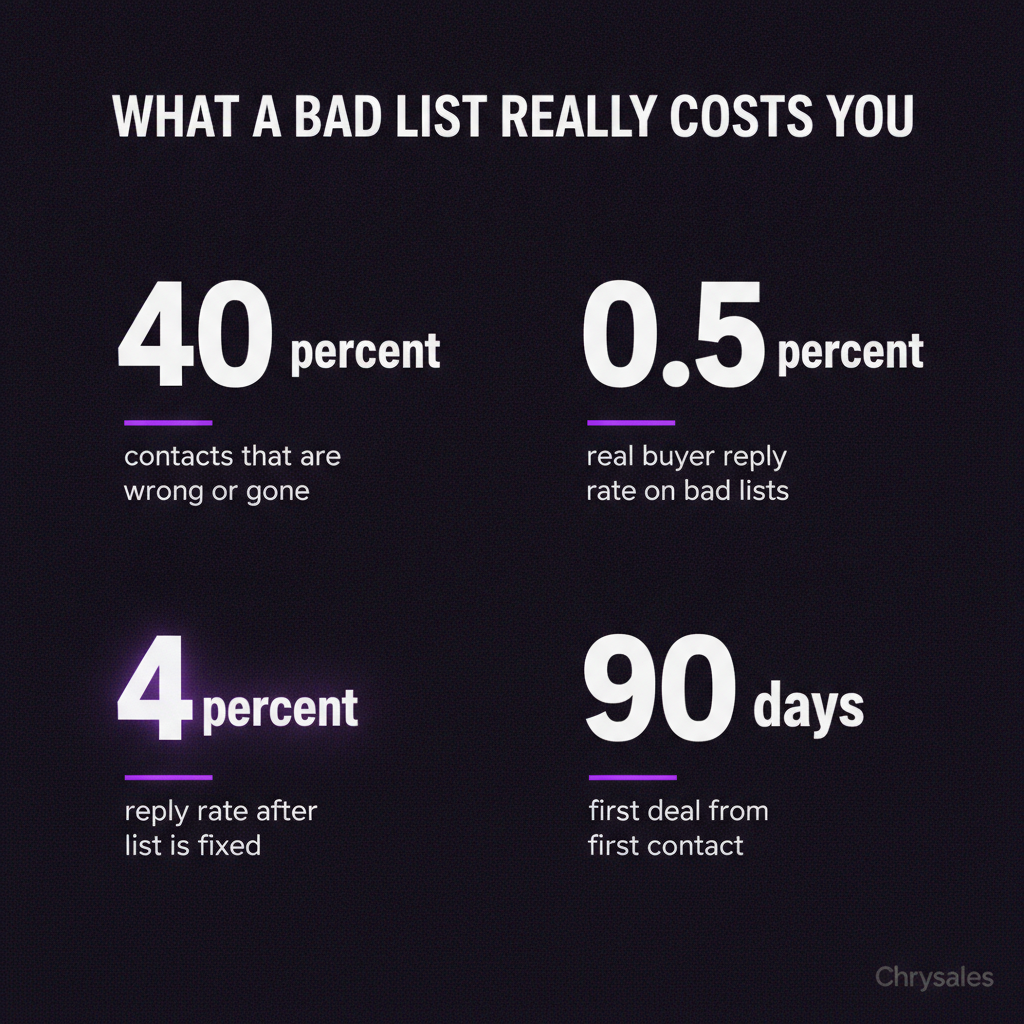
Pro Tip: If you're buying lists, assume 30-40% of the contacts are wrong or outdated based on B2B data accuracy benchmarks. Build your campaigns expecting that, and clean your list every quarter.
The Real Cost of Bad Lists
Let's say you're running a consulting business development campaign. You send 500 cold emails. Your open rate is 22%, your reply rate is 1%. You book two meetings. Sounds normal, right? Now imagine the same campaign, but 200 of those 500 emails bounced or went to people who left the company. You just wasted 40% of your effort on contacts that never had a chance. And the people who did get it? Half of them aren't decision makers. So your real reply rate, based on good contacts, is worse than you think.
One marketing agency we worked with had this exact problem. They were running LinkedIn lead generation using a big database tool. Looked great on paper. In practice, their actual conversation rate with real buyers was under 0.5%. After we rebuilt their list with better fit criteria and verified contacts, it jumped to 4%. Same messaging. Different list.
Building a Lead Generation System That Actually Works
A consulting lead generation strategy isn't just one thing. It's a system. Think of it like a recipe. If you skip steps or use the wrong ingredients, the dish doesn't turn out right. Most teams try to build a 40-step workflow when 12 steps would do the job. Here's what actually matters for predictable lead generation for agencies and consulting firms:
Step 1: Define Your Ideal Client Profile
This sounds basic, but most people skip it or do it halfway. Saying "B2B companies that need sales help" is not a profile. That's everyone. Get specific. What industry? What size? What problem are they actively trying to solve right now? Are they growing or shrinking? Do they have a sales team already, or are they starting from zero? A 30-person consulting firm tried this last quarter. They narrowed their ideal client profile from "tech companies" to "SaaS companies with 20-100 employees, growing at least 30% year-over-year, with at least one salesperson already on the team." Their reply rate went up because their message could speak directly to that situation.
You can also watch how to find clients who need your services right now for a deeper breakdown of identifying qualified prospects.
Step 2: Pick Your Channels (Don't Try Everything)
Cold email, LinkedIn, warm intros, content, events, partnerships. You could spend all day on any of these. The mistake is trying all of them at once. For most consulting firms doing B2B lead generation, the best starting point is cold outreach plus LinkedIn. Why? Because you control the timing. You don't have to wait for someone to find your content or for a referral to come through.
Watch out: Don't spread your effort across five channels when you could go deep on two. A solid outbound lead generation for B2B system on email and LinkedIn will beat a weak presence on six platforms every time.
Step 3: Build Your List the Right Way
Go back to your ideal client profile. Now find 200-500 companies that match it. Not 5,000. Not 50. A few hundred to start. Use tools like LinkedIn Sales Navigator, Apollo, or ZoomInfo to pull the companies. Then verify the contacts. Check LinkedIn to make sure the person is still there. Use an email verification tool to clean bounces before you send anything. This step takes time. Most teams rush it. That's the whole problem.
Step 4: Write Messaging That Speaks to One Problem
Your cold outreach for consultants should sound like you're talking to one person about one specific thing. Not "we help companies grow." That's noise. Try this instead: "I saw you're hiring two new account execs. Most consulting firms hiring that fast hit a wall around onboarding. If you don't have a training system ready, the new hires take 4-6 months to ramp instead of 6-8 weeks. Want to see how we cut that time in half?" That's specific. It shows you did research. It names a real problem. And it offers a clear outcome.
Common mistake: Writing one generic email and sending it to 1,000 people. Personalization doesn't mean using their first name. It means showing you understand their situation, which research shows can significantly boost reply rates.
For a complete guide to crafting effective cold outreach messages, check out how to write cold emails that actually get responses.
Step 5: Test, Measure, Fix
Send your first 100 emails. Track opens, replies, and meetings booked. If your reply rate is under 2%, something's wrong. Either the list is bad, the message is off, or the timing is wrong. Don't wait until you've burned through 1,000 contacts to figure that out. Test small, fix fast, then scale what works. A tech company we worked with was getting 0.8% replies on cold email. We tested three variables: subject line, opening sentence, and call-to-action. Turns out the subject line wasn't the issue. The opening sentence was too long and didn't connect to a real pain point. One change, reply rate jumped to 3.2%.
The Role of Automation (and Where It Breaks)
Sales automation is one of those things that sounds great until you do it wrong. Tools like HubSpot, Lemlist, or Instantly can send hundreds of emails with a few clicks. The problem? If the list is bad, automation just scales the failure.
What to Automate
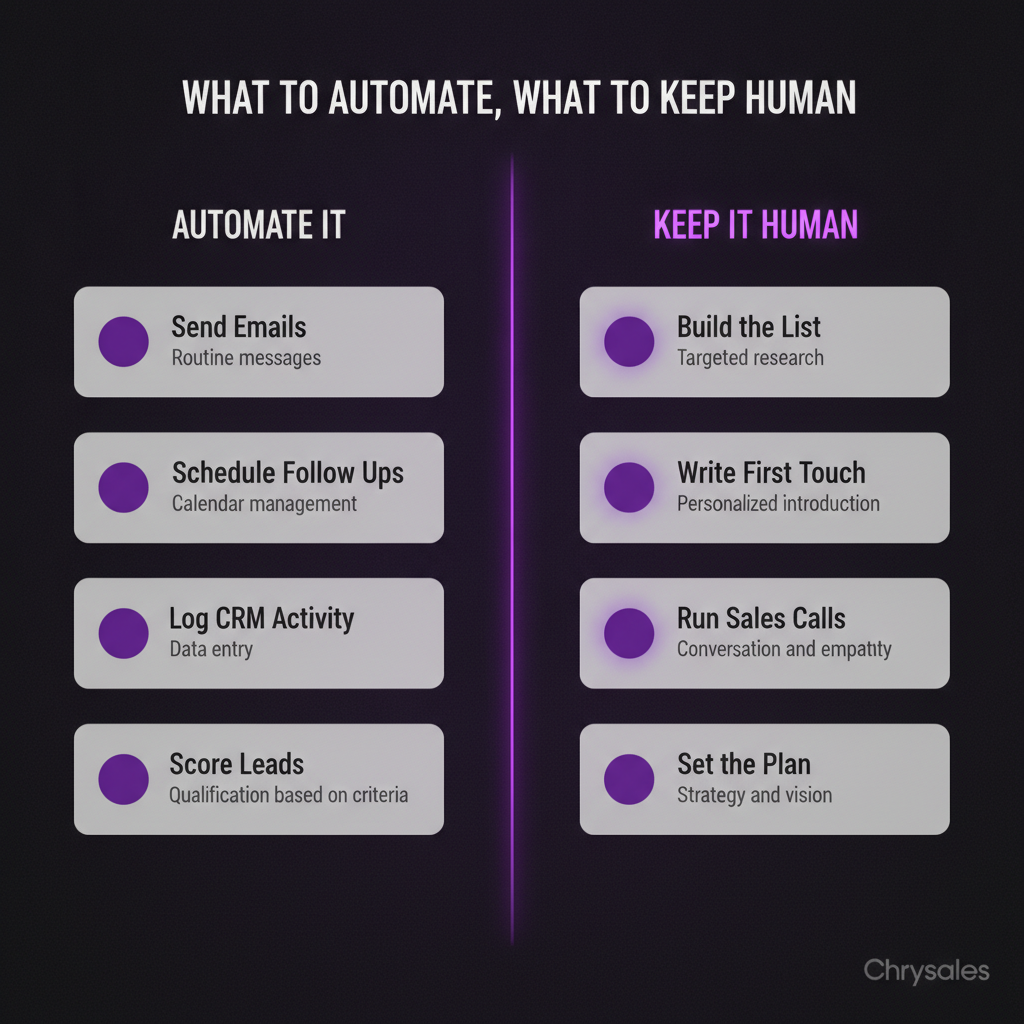
Automate the repetitive stuff. Sending emails. Scheduling follow-ups. Logging activity in your CRM. Updating lead status. All of that should happen without you touching it. But don't automate the thinking. The research, the personalization, the strategy calls. Those need a human.
What Not to Automate
We see consulting firms try to automate discovery calls with chatbots, or send fully automated LinkedIn connection requests with zero personalization. It feels efficient. It also feels robotic, and people can tell. The sweet spot: automate the process, personalize the message. Use AI in sales to write first drafts, score leads, or pull data. But review it before it goes out.
Pro Tip: Set a simple rule for lead scoring. Anything scoring above 70 goes to the top of your call list. Anything under 40 gets nurtured with content for 30 days before outreach. Saves time and focuses effort where it matters.
Closing the Gap Between Leads and Revenue
Here's where most consulting business development strategies fall apart. You generate leads. You even book meetings. But then the leads don't close, or they take six months, or they ghost after the first call. That's not a lead generation problem. That's a sales pipeline for consultants problem. Your lead gen system has to connect to a closing system. If it doesn't, you're just filling a leaky bucket.
To understand how to connect lead generation to pipeline stages, meetings, proposals, and closed revenue, read our guide on how to build a sales pipeline that converts.
What Happens After the First Meeting
You book a discovery call. Great. Now what? Do you have a script? Do you know what questions to ask? Do you know how to position your offer so it sounds like a no-brainer? Most consulting firms wing it. They ask a few questions, talk about their services, send a proposal, and hope. That's not a system. That's a coin flip. A real sales system has structure. Discovery questions that uncover budget, timeline, decision process, and pain level. A pitch that ties your solution directly to what they just told you. Objection scripts for the three or four things people always say. A follow-up sequence that stays top-of-mind without being annoying.
Building Your Offer So It's Easy to Say Yes
Your offer is the menu. Your sales call is the waiter. If the menu is confusing, the waiter has no chance. A good offer for client acquisition is clear, specific, and tied to an outcome. Not "we do sales consulting." Try "we'll build you a lead generation system that books 8-12 qualified meetings per month in 90 days, or we keep working until it does." That's an offer. It has a number, a timeline, and a guarantee. Someone can say yes or no to that. They can't say yes or no to "we help you grow."
Watch out: If your offer sounds like everyone else's offer, you're competing on price. Differentiate on outcome, speed, or guarantee. Make it yours.
Scaling Without Breaking Your System
Once your lead generation system works, the next question is how to do more of it without working 80 hours a week. Most consultants hit a ceiling here. They can generate leads, but they can't close them all. Or they can close deals, but they can't deliver the work. Something gives.
To see how successful firms create repeatable systems before scaling, learn how to build a sales system that brings clients to you.
When to Hire (and Who)
Hiring a salesperson without training them is like giving someone car keys and saying "figure out how to drive." It doesn't work. If your sales system isn't documented, repeatable, and proven, don't hire yet. Fix the system first. Once the system works, hire a setter first. Someone who can book meetings using your script and your list. That frees you up to close deals. Then hire a closer once you have more meetings than you can handle.
One consulting firm hired three salespeople in a month. Two quit within 60 days. The fix wasn't more hiring. It was the system around the hires. We documented the process, built training materials, and set clear expectations. The next hire stayed, hit quota, and referred a friend.
Using a Chief of Staff to Manage the System
This is something we do with clients once their sales training and lead gen system is running. A Chief of Staff isn't a salesperson. They're the person who makes sure the system doesn't break as you scale. They manage the CRM. They check lead quality. They track metrics. They onboard new hires. They handle the operations side so you can focus on closing deals and delivering client work. For a growing B2B company, this role is the difference between scaling smoothly and everything falling apart at 50 clients.
Common Lead Generation Mistakes (and How to Avoid Them)
Let's talk about the stuff that trips people up. These are the patterns we see over and over with new clients who come to us after trying to figure out lead generation on their own.
Mistake 1: Buying a List and Blasting It
You bought a list of 10,000 contacts for $500. Sounds like a deal. You load it into your email tool and hit send. A week later, your domain is flagged for spam and your reply rate is 0.2%. Here's the truth: cheap lists are cheap for a reason. The contacts are old, the fit is random, and half the emails bounce. If you're going to buy a list, buy a small one, verify it, and personalize every message. Better option: build your own list. Takes longer, works better.
Mistake 2: No Follow-Up System
You send one email. No reply. You move on. That's leaving money on the table. Most people don't reply to the first email. Or the second. But by email four or five, if your message is good and the timing is right, they respond. A simple follow-up sequence: email one (intro), email three days later (add value or share a case study), email seven days later (ask a question), email two weeks later (last check-in). Then stop. If they haven't responded by then, they're not interested right now.
According to sales follow-up statistics, most deals require multiple touchpoints before a response. For ready-to-use sequences, check out our cold email follow-up templates that convert.
Mistake 3: Focusing Only on Outbound
Cold outreach for consultants works. But if that's the only thing you do, you're grinding every month. Add some inbound. Post on LinkedIn twice a week. Write one blog a month. Get a referral system going. Outbound fills your pipeline now. Inbound compounds over time. Do both.
Mistake 4: Not Tracking the Right Metrics
Open rates and click rates are fun to look at, but they don't pay the bills. Track meetings booked. Track meetings that show up. Track meetings that turn into proposals. Track proposals that close. If you're getting replies but no meetings, your call-to-action is weak. If you're getting meetings but no closes, your sales process needs work. The metrics tell you where to fix things.
Common mistake: Celebrating a 25% open rate when your meeting-booked rate is 0.5%. Opens don't matter if nobody wants to talk.
Mistake 5: Giving Up Too Early
Lead generation for consultants takes time to dial in. You're not going to send 100 emails and book 20 meetings on your first try. It takes testing. It takes tweaking the list, the message, the offer. Most people quit after two weeks. The ones who stick with it, track what works, and keep improving are the ones who build predictable client acquisition systems that run for years.
Frequently Asked Questions
Q: How long does it take to see results from a lead generation system?
If you're starting from scratch, expect 4-6 weeks to build your list, write your messaging, and start outreach. You should see your first replies within the first week of sending. Meetings usually start booking in weeks 2-3. Closed deals depend on your sales cycle, but for most consulting firms, figure 60-90 days from first contact to signed contract. The key is staying consistent. Send 50-100 emails a week, track what works, and keep going.
Q: Should I focus on LinkedIn or cold email for B2B lead generation?
Both work, but they work differently. Cold email is faster to scale and easier to automate. LinkedIn is better for relationship-building and works well if your ideal clients are active there. Most consulting firms should do both. Use LinkedIn to connect and engage, then follow up with email. Or send a cold email first, then connect on LinkedIn as a follow-up. Don't pick one and ignore the other. Use them together.
Q: How many leads do I need to generate to hit my revenue goals?
Work backwards from your goal. If you want to close 5 new clients a month, and your close rate is 20%, you need 25 qualified sales calls. If 50% of people who reply actually book a call, you need 50 replies. If your reply rate is 5%, you need to send 1,000 emails. Those numbers will vary based on your offer and your market, but the math is simple. Track your conversion rates at each stage and build your lead gen volume around that.
Q: What's the difference between a lead generation agency and sales coaching?
A lead generation agency does the work for you. They build the list, write the emails, send the outreach, and hand you booked meetings. Sales coaching teaches you how to build the system yourself. At Chrysales, we do 1-on-1 coaching and consulting. We don't just hand you leads. We build a custom sales system with you, train your team, and help you scale it. You own the system, so it keeps working long after we're done. Lead gen agencies stop working the day you stop paying them.
Q: Can I use AI for lead generation, and does it actually work?
Yes, and yes. AI tools can help you write email drafts, score leads based on fit, pull company data, and automate follow-ups. We use AI in sales with our clients all the time. Tools like Gemini-based workflows can cut research time in half and help you personalize at scale. But AI isn't magic. It's a tool. You still need a good list, a clear offer, and a real sales process. Use AI to speed up the repetitive stuff, but don't let it replace the strategy or the human touch on sales calls.
Lead generation for consultants is the process of finding, reaching, and converting potential clients who need specialized advice or support. Most consulting firms spend months building outreach systems, writing perfect cold emails, and tracking metrics. Then they wonder why nobody replies. Here's the thing: the problem isn't your message. It's your list. A 15-person consulting firm could write the best email in the world, but if they're sending it to people who aren't buyers, it doesn't matter. The list does most of the heavy lifting in lead generation for consultants. Get that wrong, and everything else falls apart.
The List Quality Problem Nobody Talks About
When consultants think about B2B lead generation, they usually jump straight to messaging. What should the subject line say? How many follow-ups? Should we use video? All good questions, but they miss the real issue. Picture this: you spend two weeks writing perfect emails, but your list is full of people who aren't even buyers. That's the trap. We see this all the time with new clients who come to us frustrated that their outbound just doesn't work. They've tested 15 different subject lines, tried three different CRM tools, and read every blog about cold outreach. But their list? It's a mess.
What Makes a Good List
A good list for consulting lead generation isn't just a bunch of company names and email addresses. It needs three things: Fit: The company actually needs what you do. A 200-person company that just did layoffs is not a hot lead. It's a bad fit, full stop. Timing: They're in a position to buy. If they just signed with a competitor last month, you're wasting your time. Contact accuracy: The email works, the person is still there, and they actually make decisions. Half the battle is just getting to a real inbox. Most B2B sales teams get one of these right. The best ones get all three.
Pro Tip: If you're buying lists, assume 30-40% of the contacts are wrong or outdated based on B2B data accuracy benchmarks. Build your campaigns expecting that, and clean your list every quarter.
The Real Cost of Bad Lists
Let's say you're running a consulting business development campaign. You send 500 cold emails. Your open rate is 22%, your reply rate is 1%. You book two meetings. Sounds normal, right? Now imagine the same campaign, but 200 of those 500 emails bounced or went to people who left the company. You just wasted 40% of your effort on contacts that never had a chance. And the people who did get it? Half of them aren't decision makers. So your real reply rate, based on good contacts, is worse than you think.
One marketing agency we worked with had this exact problem. They were running LinkedIn lead generation using a big database tool. Looked great on paper. In practice, their actual conversation rate with real buyers was under 0.5%. After we rebuilt their list with better fit criteria and verified contacts, it jumped to 4%. Same messaging. Different list.
Building a Lead Generation System That Actually Works
A consulting lead generation strategy isn't just one thing. It's a system. Think of it like a recipe. If you skip steps or use the wrong ingredients, the dish doesn't turn out right. Most teams try to build a 40-step workflow when 12 steps would do the job. Here's what actually matters for predictable lead generation for agencies and consulting firms:
Step 1: Define Your Ideal Client Profile
This sounds basic, but most people skip it or do it halfway. Saying "B2B companies that need sales help" is not a profile. That's everyone. Get specific. What industry? What size? What problem are they actively trying to solve right now? Are they growing or shrinking? Do they have a sales team already, or are they starting from zero? A 30-person consulting firm tried this last quarter. They narrowed their ideal client profile from "tech companies" to "SaaS companies with 20-100 employees, growing at least 30% year-over-year, with at least one salesperson already on the team." Their reply rate went up because their message could speak directly to that situation.
You can also watch how to find clients who need your services right now for a deeper breakdown of identifying qualified prospects.
Step 2: Pick Your Channels (Don't Try Everything)
Cold email, LinkedIn, warm intros, content, events, partnerships. You could spend all day on any of these. The mistake is trying all of them at once. For most consulting firms doing B2B lead generation, the best starting point is cold outreach plus LinkedIn. Why? Because you control the timing. You don't have to wait for someone to find your content or for a referral to come through.
Watch out: Don't spread your effort across five channels when you could go deep on two. A solid outbound lead generation for B2B system on email and LinkedIn will beat a weak presence on six platforms every time.
Step 3: Build Your List the Right Way
Go back to your ideal client profile. Now find 200-500 companies that match it. Not 5,000. Not 50. A few hundred to start. Use tools like LinkedIn Sales Navigator, Apollo, or ZoomInfo to pull the companies. Then verify the contacts. Check LinkedIn to make sure the person is still there. Use an email verification tool to clean bounces before you send anything. This step takes time. Most teams rush it. That's the whole problem.
Step 4: Write Messaging That Speaks to One Problem
Your cold outreach for consultants should sound like you're talking to one person about one specific thing. Not "we help companies grow." That's noise. Try this instead: "I saw you're hiring two new account execs. Most consulting firms hiring that fast hit a wall around onboarding. If you don't have a training system ready, the new hires take 4-6 months to ramp instead of 6-8 weeks. Want to see how we cut that time in half?" That's specific. It shows you did research. It names a real problem. And it offers a clear outcome.
Common mistake: Writing one generic email and sending it to 1,000 people. Personalization doesn't mean using their first name. It means showing you understand their situation, which research shows can significantly boost reply rates.
For a complete guide to crafting effective cold outreach messages, check out how to write cold emails that actually get responses.
Step 5: Test, Measure, Fix
Send your first 100 emails. Track opens, replies, and meetings booked. If your reply rate is under 2%, something's wrong. Either the list is bad, the message is off, or the timing is wrong. Don't wait until you've burned through 1,000 contacts to figure that out. Test small, fix fast, then scale what works. A tech company we worked with was getting 0.8% replies on cold email. We tested three variables: subject line, opening sentence, and call-to-action. Turns out the subject line wasn't the issue. The opening sentence was too long and didn't connect to a real pain point. One change, reply rate jumped to 3.2%.
The Role of Automation (and Where It Breaks)
Sales automation is one of those things that sounds great until you do it wrong. Tools like HubSpot, Lemlist, or Instantly can send hundreds of emails with a few clicks. The problem? If the list is bad, automation just scales the failure.
What to Automate
Automate the repetitive stuff. Sending emails. Scheduling follow-ups. Logging activity in your CRM. Updating lead status. All of that should happen without you touching it. But don't automate the thinking. The research, the personalization, the strategy calls. Those need a human.
What Not to Automate
We see consulting firms try to automate discovery calls with chatbots, or send fully automated LinkedIn connection requests with zero personalization. It feels efficient. It also feels robotic, and people can tell. The sweet spot: automate the process, personalize the message. Use AI in sales to write first drafts, score leads, or pull data. But review it before it goes out.
Pro Tip: Set a simple rule for lead scoring. Anything scoring above 70 goes to the top of your call list. Anything under 40 gets nurtured with content for 30 days before outreach. Saves time and focuses effort where it matters.
Closing the Gap Between Leads and Revenue
Here's where most consulting business development strategies fall apart. You generate leads. You even book meetings. But then the leads don't close, or they take six months, or they ghost after the first call. That's not a lead generation problem. That's a sales pipeline for consultants problem. Your lead gen system has to connect to a closing system. If it doesn't, you're just filling a leaky bucket.
To understand how to connect lead generation to pipeline stages, meetings, proposals, and closed revenue, read our guide on how to build a sales pipeline that converts.
What Happens After the First Meeting
You book a discovery call. Great. Now what? Do you have a script? Do you know what questions to ask? Do you know how to position your offer so it sounds like a no-brainer? Most consulting firms wing it. They ask a few questions, talk about their services, send a proposal, and hope. That's not a system. That's a coin flip. A real sales system has structure. Discovery questions that uncover budget, timeline, decision process, and pain level. A pitch that ties your solution directly to what they just told you. Objection scripts for the three or four things people always say. A follow-up sequence that stays top-of-mind without being annoying.
Building Your Offer So It's Easy to Say Yes
Your offer is the menu. Your sales call is the waiter. If the menu is confusing, the waiter has no chance. A good offer for client acquisition is clear, specific, and tied to an outcome. Not "we do sales consulting." Try "we'll build you a lead generation system that books 8-12 qualified meetings per month in 90 days, or we keep working until it does." That's an offer. It has a number, a timeline, and a guarantee. Someone can say yes or no to that. They can't say yes or no to "we help you grow."
Watch out: If your offer sounds like everyone else's offer, you're competing on price. Differentiate on outcome, speed, or guarantee. Make it yours.
Scaling Without Breaking Your System
Once your lead generation system works, the next question is how to do more of it without working 80 hours a week. Most consultants hit a ceiling here. They can generate leads, but they can't close them all. Or they can close deals, but they can't deliver the work. Something gives.
To see how successful firms create repeatable systems before scaling, learn how to build a sales system that brings clients to you.
When to Hire (and Who)
Hiring a salesperson without training them is like giving someone car keys and saying "figure out how to drive." It doesn't work. If your sales system isn't documented, repeatable, and proven, don't hire yet. Fix the system first. Once the system works, hire a setter first. Someone who can book meetings using your script and your list. That frees you up to close deals. Then hire a closer once you have more meetings than you can handle.
One consulting firm hired three salespeople in a month. Two quit within 60 days. The fix wasn't more hiring. It was the system around the hires. We documented the process, built training materials, and set clear expectations. The next hire stayed, hit quota, and referred a friend.
Using a Chief of Staff to Manage the System
This is something we do with clients once their sales training and lead gen system is running. A Chief of Staff isn't a salesperson. They're the person who makes sure the system doesn't break as you scale. They manage the CRM. They check lead quality. They track metrics. They onboard new hires. They handle the operations side so you can focus on closing deals and delivering client work. For a growing B2B company, this role is the difference between scaling smoothly and everything falling apart at 50 clients.
Common Lead Generation Mistakes (and How to Avoid Them)
Let's talk about the stuff that trips people up. These are the patterns we see over and over with new clients who come to us after trying to figure out lead generation on their own.
Mistake 1: Buying a List and Blasting It
You bought a list of 10,000 contacts for $500. Sounds like a deal. You load it into your email tool and hit send. A week later, your domain is flagged for spam and your reply rate is 0.2%. Here's the truth: cheap lists are cheap for a reason. The contacts are old, the fit is random, and half the emails bounce. If you're going to buy a list, buy a small one, verify it, and personalize every message. Better option: build your own list. Takes longer, works better.
Mistake 2: No Follow-Up System
You send one email. No reply. You move on. That's leaving money on the table. Most people don't reply to the first email. Or the second. But by email four or five, if your message is good and the timing is right, they respond. A simple follow-up sequence: email one (intro), email three days later (add value or share a case study), email seven days later (ask a question), email two weeks later (last check-in). Then stop. If they haven't responded by then, they're not interested right now.
According to sales follow-up statistics, most deals require multiple touchpoints before a response. For ready-to-use sequences, check out our cold email follow-up templates that convert.
Mistake 3: Focusing Only on Outbound
Cold outreach for consultants works. But if that's the only thing you do, you're grinding every month. Add some inbound. Post on LinkedIn twice a week. Write one blog a month. Get a referral system going. Outbound fills your pipeline now. Inbound compounds over time. Do both.
Mistake 4: Not Tracking the Right Metrics
Open rates and click rates are fun to look at, but they don't pay the bills. Track meetings booked. Track meetings that show up. Track meetings that turn into proposals. Track proposals that close. If you're getting replies but no meetings, your call-to-action is weak. If you're getting meetings but no closes, your sales process needs work. The metrics tell you where to fix things.
Common mistake: Celebrating a 25% open rate when your meeting-booked rate is 0.5%. Opens don't matter if nobody wants to talk.
Mistake 5: Giving Up Too Early
Lead generation for consultants takes time to dial in. You're not going to send 100 emails and book 20 meetings on your first try. It takes testing. It takes tweaking the list, the message, the offer. Most people quit after two weeks. The ones who stick with it, track what works, and keep improving are the ones who build predictable client acquisition systems that run for years.
Frequently Asked Questions
Q: How long does it take to see results from a lead generation system?
If you're starting from scratch, expect 4-6 weeks to build your list, write your messaging, and start outreach. You should see your first replies within the first week of sending. Meetings usually start booking in weeks 2-3. Closed deals depend on your sales cycle, but for most consulting firms, figure 60-90 days from first contact to signed contract. The key is staying consistent. Send 50-100 emails a week, track what works, and keep going.
Q: Should I focus on LinkedIn or cold email for B2B lead generation?
Both work, but they work differently. Cold email is faster to scale and easier to automate. LinkedIn is better for relationship-building and works well if your ideal clients are active there. Most consulting firms should do both. Use LinkedIn to connect and engage, then follow up with email. Or send a cold email first, then connect on LinkedIn as a follow-up. Don't pick one and ignore the other. Use them together.
Q: How many leads do I need to generate to hit my revenue goals?
Work backwards from your goal. If you want to close 5 new clients a month, and your close rate is 20%, you need 25 qualified sales calls. If 50% of people who reply actually book a call, you need 50 replies. If your reply rate is 5%, you need to send 1,000 emails. Those numbers will vary based on your offer and your market, but the math is simple. Track your conversion rates at each stage and build your lead gen volume around that.
Q: What's the difference between a lead generation agency and sales coaching?
A lead generation agency does the work for you. They build the list, write the emails, send the outreach, and hand you booked meetings. Sales coaching teaches you how to build the system yourself. At Chrysales, we do 1-on-1 coaching and consulting. We don't just hand you leads. We build a custom sales system with you, train your team, and help you scale it. You own the system, so it keeps working long after we're done. Lead gen agencies stop working the day you stop paying them.
Q: Can I use AI for lead generation, and does it actually work?
Yes, and yes. AI tools can help you write email drafts, score leads based on fit, pull company data, and automate follow-ups. We use AI in sales with our clients all the time. Tools like Gemini-based workflows can cut research time in half and help you personalize at scale. But AI isn't magic. It's a tool. You still need a good list, a clear offer, and a real sales process. Use AI to speed up the repetitive stuff, but don't let it replace the strategy or the human touch on sales calls.
Scaling Is Not Hard If You Have The Right Systems
If you’re serious about leveling up your scaling game, you need the right system, the right training, and the right team behind you. We're here to give you the exact tools and strategies top entrepreneurs use to dominate.

Discover the latest tips
View All.avif)
Chrysales was formed from the words "chrysalis" the stage where a caterpillar transforms into a butterfly and "sales".
It stands for one thing: sales transformation.Because scaling doesn’t happen by doing more of the same. Scaling only happens when you go through real transformation in your systems, your offer, team and the way you sell.
.avif)


