.avif)
How to Build a Sales Pipeline From Scratch

A sales pipeline is a clear process that shows how prospects move from first contact to closed deal, so you can track leads and sales progress. Picture this: you spend weeks chasing random leads, hopping on calls with people who ghost you, and wondering why nothing closes. Most small B2B companies hit this wall not because they're bad at selling, but because they're selling without a system. A sales pipeline fixes that. It turns messy chaos into a repeatable process where you know exactly what to do next, which leads are real, and how much revenue you can actually count on. If you're starting from zero or rebuilding what's broken, this guide walks you through how to build a sales pipeline that actually works.
Why Most Teams Skip Building a Real Sales Pipeline (And Why That Kills Growth)
Here's the thing: most growing B2B companies treat their sales process like a to-do list. Someone reaches out. You reply. Maybe you book a call. Maybe you follow up. Maybe you forget. No structure. No stages. No way to predict what happens next month. Without a defined sales pipeline, you're flying blind. You can't forecast revenue. You can't spot where deals are stalling. You can't train someone else to sell because the process lives in your head. One month you close three deals. Next month, zero. It feels random because it is random.
What a Sales Pipeline Actually Is
A sales pipeline is a visual map of every stage a prospect moves through from first contact to closed deal. Think of it like a recipe. Each stage is a step. Follow the steps in order, and you get the same result every time. Most B2B sales pipelines have 5 to 7 stages. Something like: prospecting, qualification, discovery call, proposal, negotiation, close. The exact names don't matter. What matters is that every deal moves through the same stages, and you track where each one sits.
Why This Matters for Client Acquisition
When you build a sales pipeline, three things happen:
- You know exactly how many prospects you need at the top to hit your revenue goals
- You spot problems fast (if deals pile up at one stage, that stage is broken)
- You make your sales process repeatable, which means you can hire and scale
A 20-person consulting firm we worked with had zero pipeline visibility. They couldn't tell you how many deals were in play or which ones would close. After building a six-stage pipeline and tracking every deal, they booked 18 calls in the first month and closed four new clients in 90 days. Same team. Same offer. Just a system.
Pro Tip: Start simple. Five stages are enough. You can always add more later once you see where deals actually slow down, and if you want to go further, you can watch how to build a sales system so powerful clients come to you for a complete walkthrough.
Step 1: Map Out Your Sales Pipeline Stages (Start With Five)
Most people overcomplicate this. You don't need 12 stages. You need the core steps a prospect actually takes before they buy from you. Look at your last five closed deals. What did every single one of those deals go through? Here's a simple five-stage B2B sales pipeline that works for most service businesses, agencies, and consultancies:
Stage 1: Prospecting
This is where you build your list of potential leads. You're identifying companies or people who fit your ideal customer profile. No contact yet. Just research and list building.
Stage 2: Outreach
You make first contact. Cold email, LinkedIn message, phone call, referral intro. The goal is to get a reply and book a discovery call.
Stage 3: Discovery Call
You get on a call to understand their situation, qualify if they're a fit, and see if there's a real problem you can solve. This is where bad fits get filtered out.
Stage 4: Proposal
You send a proposal, pricing, or scope of work. The prospect is reviewing your offer and deciding if they want to move forward.
Stage 5: Negotiation and Close
Final questions, contract tweaks, pricing discussions. Then they sign, or they don't. That's it. Five stages. Every deal moves left to right. If a deal doesn't move for two weeks, you follow up or mark it dead. For even more practical tactics beyond these core stages, check out our 11 insanely useful sales tips that every business needs.
Watch out: Don't create stages for things that aren't real steps. "Thinking about it" is not a stage. That's just a stalled deal in the proposal stage.
Step 2: Define What Moves a Deal From One Stage to the Next
This is where most sales pipeline attempts fall apart. Teams build stages but never define what actually moves a deal forward. So people guess. And deals sit in the wrong stage for weeks. For each stage, write down the ONE action that moves a deal to the next stage. Make it crystal clear. If someone new joined your team tomorrow, they should know exactly what to do.
Example Action Triggers for Each Stage
- Prospecting to Outreach: You add the lead to your CRM and send the first message
- Outreach to Discovery Call: They reply with interest and you book a time on the calendar
- Discovery Call to Proposal: You finish the call, confirm they're a fit, and they agree to review a proposal
- Proposal to Negotiation: They reply saying they're interested and have questions or want to discuss pricing
- Negotiation to Close: They sign the contract or send the payment
When you define these triggers, your pipeline becomes a checklist. You know exactly what needs to happen. No confusion. No deals stuck in limbo because someone forgot to follow up, and research shows that B2B sales success relies heavily on structured processes.
Common mistake: Treating a reply as a stage change. A reply is engagement, not progress. Only move a deal forward when the prospect takes a real next step (books a call, asks for a proposal, starts negotiation).
Step 3: Build Your Lead List (Because an Empty Pipeline Is Just a Spreadsheet)

You've got stages. You've got triggers. Now you need people to put in the pipeline. This is where B2B lead generation starts. A bad list kills everything. You can write perfect emails and have a flawless sales call structure, but if you're reaching out to people who don't buy what you sell, nothing works. Most cold outreach campaigns fail not because the message is bad, but because the list is bad.
How to Build a Lead List That Actually Converts
Start with your ideal customer profile. Write down the exact type of company or person who gets the most value from what you sell. Be specific. Industry, company size, role, location, tech stack, recent events. Then use tools like LinkedIn Sales Navigator, Apollo, or ZoomInfo to build a list. Filter by your criteria. Pull 200 to 500 contacts to start. Here's what a solid lead list looks like for a B2B sales training company:
- Companies: 20 to 200 employees
- Industry: IT services, consulting, marketing agencies
- Role: Head of Sales, VP of Revenue, Founder
- Location: US, UK, Germany
- Recent signal: posted a job for sales reps, raised funding, launched a new service
One marketing agency we worked with was targeting Fortune 500 companies. They had a 0.2% reply rate. We rebuilt their list to focus on 50 to 150 person companies with active sales hiring. Reply rate jumped to 3.8% in two weeks. Same emails. Different list. If you're evaluating which platforms to use, read our detailed comparison of account list builder tools compared to make the right choice for your business. You can also learn 4 ways to find clients who need your services right now for additional prospecting methods.
Pro Tip: Quality beats quantity every time. A list of 300 perfect-fit leads will outperform a list of 5,000 random contacts.
Step 4: Set Up Lead Qualification Rules (So You Don't Waste Time on Bad Fits)
Not every lead that replies is a good lead. Some are curious but broke. Some are a terrible fit. Some want free advice. If you treat every reply the same, you'll spend all your time on calls that go nowhere. Lead qualification is how you decide which prospects are worth your time. Most teams skip this. Then they wonder why their pipeline is full but nothing closes.
Use a Simple Lead Scoring System
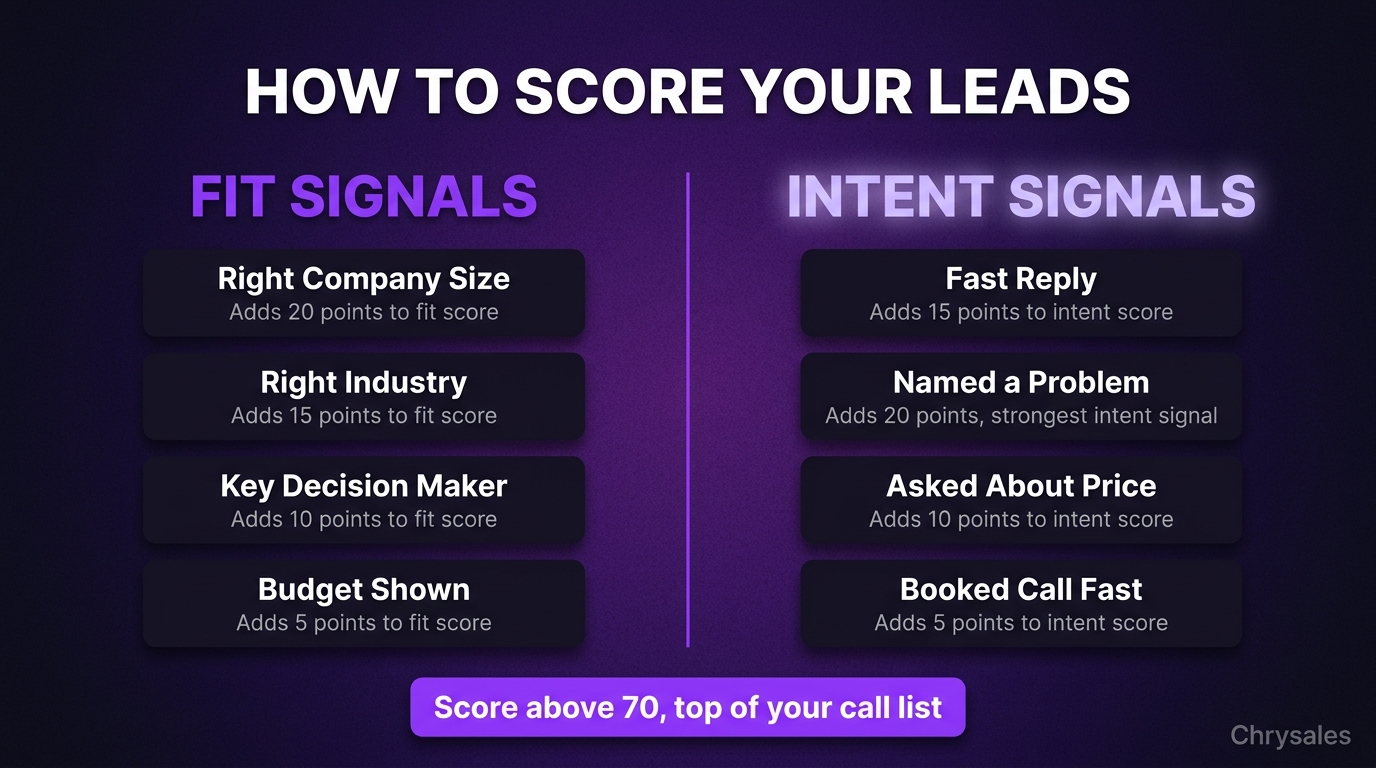
Assign points to each lead based on fit and intent. Here's a basic scoring model for B2B sales:
Fit signals (0 to 50 points):
- Right company size: 20 points
- Right industry: 15 points
- Decision maker or close to it: 10 points
- Budget indicated: 5 points
Intent signals (0 to 50 points):
- Replied within 24 hours: 15 points
- Mentioned a specific problem: 20 points
- Asked about pricing or next steps: 10 points
- Booked a call without hesitation: 5 points
Anything scoring above 70 goes to the top of your call list. Below 40, deprioritize or disqualify.
Ask Qualification Questions Early
On the discovery call, ask three questions in the first five minutes:
- What made you take this call? (intent)
- What's the biggest challenge you're dealing with right now? (problem fit)
- What happens if you don't solve this in the next 90 days? (urgency)
If they can't answer these clearly, they're not ready. Politely end the call and follow up in a month. A 30-person tech consultancy had a 60% no-show rate on discovery calls. After adding a quick qualification step right after the first reply (two questions over email), no-shows dropped to 12% and close rate doubled. They stopped wasting time on tire kickers.
Step 5: Track Every Deal and Follow Up Like Clockwork
You built the pipeline. You've got leads in it. Now you have to actually move them through. This is where discipline beats talent. Most deals don't close because someone forgot to follow up. Seriously. Studies show that 80% of sales need five or more follow-ups, but most salespeople stop after two. Your pipeline is only useful if you actually use it to stay on top of every deal.
Use a CRM to Track Pipeline Movement
You need a CRM. It doesn't have to be fancy. HubSpot, Pipedrive, Monday, even a Google Sheet works if you're just starting. The point is to have one place where every deal lives and you can see what stage it's in. Update your CRM every single day. When someone replies, move the deal. When you send a proposal, move the deal. When you book a call, move the deal. If you don't update it, your pipeline becomes fiction.
Set Follow-Up Cadences for Each Stage
For each pipeline stage, decide how often you follow up if there's no response. Here's a simple cadence that works:
- After first outreach: Follow up every 3 to 4 days, 3 to 5 times total
- After discovery call: Follow up in 24 hours with a proposal or next steps
- After proposal sent: Follow up in 2 days, then 4 days, then weekly
- In negotiation: Follow up daily if they're engaged, every 2 days if they go quiet
Put these follow-ups in your CRM or calendar. Automate reminders. Never rely on memory. If you're doing cold outreach to fill your pipeline, make sure you know how to write cold emails that convert so your follow-ups actually get responses.
Watch out: Following up doesn't mean sending the same "just checking in" email five times. Each follow-up should add value. Share a case study. Answer a question. Offer a quick call.
Step 6: Review Your Sales Pipeline Weekly and Fix What's Broken
A sales pipeline is not a set-it-and-forget-it thing. You have to look at it every week and ask: where are deals piling up? Where are they falling off? What's actually working? This weekly review is how you turn a basic pipeline into a predictable client acquisition system. Most growing companies skip this step. Then six months later, they're confused why their pipeline doesn't work.
What to Look for in Your Weekly Pipeline Review
Block 30 minutes every Friday or Monday. Open your CRM. Look at the numbers.
Check these five things:
- How many deals are in each stage? If 40 deals are stuck in "proposal," your proposal or pricing is the problem.
- How long are deals sitting in each stage? If deals sit in discovery for three weeks, you're not qualifying hard enough.
- What's your conversion rate between stages? If 50% of discovery calls turn into proposals, that's solid. If it's 10%, you're taking bad calls.
- How many new leads entered the pipeline this week? If the answer is zero, lead generation is your problem, not closing.
- Which deals haven't moved in 7+ days? Follow up today or mark them dead.
One consulting firm we worked with had 60 deals in their pipeline but only closed two in a quarter. In the review, we found 40 of those deals hadn't moved in over a month. They were dead. Once we cleaned the pipeline and focused on the 12 real deals, they closed five in six weeks, and data from B2B buying behavior research confirms that focused pipeline management drives better results.
Clean Out Dead Deals Every Month
If a deal hasn't moved in 30 days and the prospect isn't responding, mark it closed lost. Don't let dead deals clog your pipeline. It makes your forecast look fake and wastes your mental energy. You can always reopen a deal later if they come back. But keeping dead deals in your pipeline is like keeping expired food in the fridge. It just takes up space.
Pro Tip: Set a rule. If a deal sits in one stage for more than 2x your average deal cycle, automatically move it to a "stalled" stage or close it. Most deals that stall that long never close.
How Chrysales Builds Custom Sales Pipelines for B2B Teams
At Chrysales, we don't just teach sales theory. We build the entire system for you. That includes designing your custom sales pipeline, setting up your CRM, writing your outreach scripts, training your team on every stage, and building the follow-up cadences that make sure no deal falls through the cracks. We've trained over 500 sales teams and generated more than €10 million in client revenue using this exact approach. Our 4 step methodology (Learn, Build Systems, Automate, Hire Chief of Staff) means you're not guessing. You get a repeatable, predictable sales pipeline built specifically for your business.
Whether you need help with lead generation, closing more deals, or hiring and training your first sales team, we work 1 on 1 with B2B companies to eliminate the guesswork. Our clients include Amazon, Vodafone, Deutsche Börse, and Cloudification. We maintain a 99.4% client satisfaction rate because we build systems that actually work. If you're tired of inconsistent revenue and want a sales pipeline that brings in clients every month, book a call with our team. We'll walk you through exactly what a custom system looks like for your business, and we can help you build a sales system that actually scales beyond just a basic pipeline.
Frequently Asked Questions
Q: How long does it take to build a sales pipeline from scratch?
You can map out your stages and start tracking deals in one afternoon. Building the full system with list building, outreach cadences, and CRM setup usually takes one to two weeks if you're doing it yourself. If you work with a sales consultant, they can build it in days. The key is starting simple. Five stages, one CRM, and a list of 300 leads is enough to get moving. You can refine as you go.
Q: What's the difference between a sales pipeline and a sales funnel?
A sales funnel is a marketing concept. It tracks how many people move from awareness to purchase across your whole audience. A sales pipeline is specific to your sales team. It tracks individual deals and where each one sits in your process. Think of the funnel as the big picture and the pipeline as the step-by-step tracker for each opportunity.
Q: How many leads do I need in my pipeline to hit my revenue goals?
Work backwards from your close rate. Let's say you want to close five deals next month, each worth $10,000. If your close rate is 25%, you need 20 proposals. If 50% of discovery calls turn into proposals, you need 40 calls. If 10% of outreach gets a call booked, you need 400 leads in outreach. Most teams skip this math and wonder why they're short on revenue. Do the math once and you'll know exactly how many leads to add every week.
Q: What CRM should I use for B2B sales pipeline management?
HubSpot and Pipedrive are the most popular for small to mid-size B2B companies. HubSpot has a solid free tier. Pipedrive is simple and visual. If you're just starting, even a Google Sheet works. The tool matters less than the habit of updating it daily. Pick one, set it up with your stages, and use it every single day.
Q: How do I know if a deal in my pipeline is actually going to close?
Look at engagement. Are they replying fast? Are they asking detailed questions? Did they introduce you to other decision makers? Are they giving you real objections instead of vague stalls? High-intent deals move fast and engage deeply. Low-intent deals go quiet after the first call. If you haven't heard from someone in 10 days and they're not responding to follow-ups, that deal is probably dead.
Q: Can I automate my sales pipeline?
You can automate parts of it. Email sequences, follow-up reminders, lead scoring, and CRM updates can all run automatically using tools like HubSpot, Apollo, or Zapier. But the human parts (discovery calls, custom proposals, negotiation) can't be fully automated. The goal is to automate the repetitive stuff so you spend your time on the high-value conversations. A good sales system uses automation to support the process, not replace it.
Q: What's the biggest mistake people make when building a sales pipeline?
Not defining what moves a deal from one stage to the next. People create stages but leave it vague. So deals sit in the wrong place and no one knows what to do next. Fix this by writing down the exact action that triggers each stage change. Make it so clear that anyone could look at your pipeline and know exactly what step comes next.
A sales pipeline is a clear process that shows how prospects move from first contact to closed deal, so you can track leads and sales progress. Picture this: you spend weeks chasing random leads, hopping on calls with people who ghost you, and wondering why nothing closes. Most small B2B companies hit this wall not because they're bad at selling, but because they're selling without a system. A sales pipeline fixes that. It turns messy chaos into a repeatable process where you know exactly what to do next, which leads are real, and how much revenue you can actually count on. If you're starting from zero or rebuilding what's broken, this guide walks you through how to build a sales pipeline that actually works.
Why Most Teams Skip Building a Real Sales Pipeline (And Why That Kills Growth)
Here's the thing: most growing B2B companies treat their sales process like a to-do list. Someone reaches out. You reply. Maybe you book a call. Maybe you follow up. Maybe you forget. No structure. No stages. No way to predict what happens next month. Without a defined sales pipeline, you're flying blind. You can't forecast revenue. You can't spot where deals are stalling. You can't train someone else to sell because the process lives in your head. One month you close three deals. Next month, zero. It feels random because it is random.
What a Sales Pipeline Actually Is
A sales pipeline is a visual map of every stage a prospect moves through from first contact to closed deal. Think of it like a recipe. Each stage is a step. Follow the steps in order, and you get the same result every time. Most B2B sales pipelines have 5 to 7 stages. Something like: prospecting, qualification, discovery call, proposal, negotiation, close. The exact names don't matter. What matters is that every deal moves through the same stages, and you track where each one sits.
Why This Matters for Client Acquisition
When you build a sales pipeline, three things happen:
- You know exactly how many prospects you need at the top to hit your revenue goals
- You spot problems fast (if deals pile up at one stage, that stage is broken)
- You make your sales process repeatable, which means you can hire and scale
A 20-person consulting firm we worked with had zero pipeline visibility. They couldn't tell you how many deals were in play or which ones would close. After building a six-stage pipeline and tracking every deal, they booked 18 calls in the first month and closed four new clients in 90 days. Same team. Same offer. Just a system.
Pro Tip: Start simple. Five stages are enough. You can always add more later once you see where deals actually slow down, and if you want to go further, you can watch how to build a sales system so powerful clients come to you for a complete walkthrough.
Step 1: Map Out Your Sales Pipeline Stages (Start With Five)
Most people overcomplicate this. You don't need 12 stages. You need the core steps a prospect actually takes before they buy from you. Look at your last five closed deals. What did every single one of those deals go through? Here's a simple five-stage B2B sales pipeline that works for most service businesses, agencies, and consultancies:
Stage 1: Prospecting
This is where you build your list of potential leads. You're identifying companies or people who fit your ideal customer profile. No contact yet. Just research and list building.
Stage 2: Outreach
You make first contact. Cold email, LinkedIn message, phone call, referral intro. The goal is to get a reply and book a discovery call.
Stage 3: Discovery Call
You get on a call to understand their situation, qualify if they're a fit, and see if there's a real problem you can solve. This is where bad fits get filtered out.
Stage 4: Proposal
You send a proposal, pricing, or scope of work. The prospect is reviewing your offer and deciding if they want to move forward.
Stage 5: Negotiation and Close
Final questions, contract tweaks, pricing discussions. Then they sign, or they don't. That's it. Five stages. Every deal moves left to right. If a deal doesn't move for two weeks, you follow up or mark it dead. For even more practical tactics beyond these core stages, check out our 11 insanely useful sales tips that every business needs.
Watch out: Don't create stages for things that aren't real steps. "Thinking about it" is not a stage. That's just a stalled deal in the proposal stage.
Step 2: Define What Moves a Deal From One Stage to the Next
This is where most sales pipeline attempts fall apart. Teams build stages but never define what actually moves a deal forward. So people guess. And deals sit in the wrong stage for weeks. For each stage, write down the ONE action that moves a deal to the next stage. Make it crystal clear. If someone new joined your team tomorrow, they should know exactly what to do.
Example Action Triggers for Each Stage
- Prospecting to Outreach: You add the lead to your CRM and send the first message
- Outreach to Discovery Call: They reply with interest and you book a time on the calendar
- Discovery Call to Proposal: You finish the call, confirm they're a fit, and they agree to review a proposal
- Proposal to Negotiation: They reply saying they're interested and have questions or want to discuss pricing
- Negotiation to Close: They sign the contract or send the payment
When you define these triggers, your pipeline becomes a checklist. You know exactly what needs to happen. No confusion. No deals stuck in limbo because someone forgot to follow up, and research shows that B2B sales success relies heavily on structured processes.
Common mistake: Treating a reply as a stage change. A reply is engagement, not progress. Only move a deal forward when the prospect takes a real next step (books a call, asks for a proposal, starts negotiation).
Step 3: Build Your Lead List (Because an Empty Pipeline Is Just a Spreadsheet)
You've got stages. You've got triggers. Now you need people to put in the pipeline. This is where B2B lead generation starts. A bad list kills everything. You can write perfect emails and have a flawless sales call structure, but if you're reaching out to people who don't buy what you sell, nothing works. Most cold outreach campaigns fail not because the message is bad, but because the list is bad.
How to Build a Lead List That Actually Converts
Start with your ideal customer profile. Write down the exact type of company or person who gets the most value from what you sell. Be specific. Industry, company size, role, location, tech stack, recent events. Then use tools like LinkedIn Sales Navigator, Apollo, or ZoomInfo to build a list. Filter by your criteria. Pull 200 to 500 contacts to start. Here's what a solid lead list looks like for a B2B sales training company:
- Companies: 20 to 200 employees
- Industry: IT services, consulting, marketing agencies
- Role: Head of Sales, VP of Revenue, Founder
- Location: US, UK, Germany
- Recent signal: posted a job for sales reps, raised funding, launched a new service
One marketing agency we worked with was targeting Fortune 500 companies. They had a 0.2% reply rate. We rebuilt their list to focus on 50 to 150 person companies with active sales hiring. Reply rate jumped to 3.8% in two weeks. Same emails. Different list. If you're evaluating which platforms to use, read our detailed comparison of account list builder tools compared to make the right choice for your business. You can also learn 4 ways to find clients who need your services right now for additional prospecting methods.
Pro Tip: Quality beats quantity every time. A list of 300 perfect-fit leads will outperform a list of 5,000 random contacts.
Step 4: Set Up Lead Qualification Rules (So You Don't Waste Time on Bad Fits)
Not every lead that replies is a good lead. Some are curious but broke. Some are a terrible fit. Some want free advice. If you treat every reply the same, you'll spend all your time on calls that go nowhere. Lead qualification is how you decide which prospects are worth your time. Most teams skip this. Then they wonder why their pipeline is full but nothing closes.
Use a Simple Lead Scoring System
Assign points to each lead based on fit and intent. Here's a basic scoring model for B2B sales:
Fit signals (0 to 50 points):
- Right company size: 20 points
- Right industry: 15 points
- Decision maker or close to it: 10 points
- Budget indicated: 5 points
Intent signals (0 to 50 points):
- Replied within 24 hours: 15 points
- Mentioned a specific problem: 20 points
- Asked about pricing or next steps: 10 points
- Booked a call without hesitation: 5 points
Anything scoring above 70 goes to the top of your call list. Below 40, deprioritize or disqualify.
Ask Qualification Questions Early
On the discovery call, ask three questions in the first five minutes:
- What made you take this call? (intent)
- What's the biggest challenge you're dealing with right now? (problem fit)
- What happens if you don't solve this in the next 90 days? (urgency)
If they can't answer these clearly, they're not ready. Politely end the call and follow up in a month. A 30-person tech consultancy had a 60% no-show rate on discovery calls. After adding a quick qualification step right after the first reply (two questions over email), no-shows dropped to 12% and close rate doubled. They stopped wasting time on tire kickers.
Step 5: Track Every Deal and Follow Up Like Clockwork
You built the pipeline. You've got leads in it. Now you have to actually move them through. This is where discipline beats talent. Most deals don't close because someone forgot to follow up. Seriously. Studies show that 80% of sales need five or more follow-ups, but most salespeople stop after two. Your pipeline is only useful if you actually use it to stay on top of every deal.
Use a CRM to Track Pipeline Movement
You need a CRM. It doesn't have to be fancy. HubSpot, Pipedrive, Monday, even a Google Sheet works if you're just starting. The point is to have one place where every deal lives and you can see what stage it's in. Update your CRM every single day. When someone replies, move the deal. When you send a proposal, move the deal. When you book a call, move the deal. If you don't update it, your pipeline becomes fiction.
Set Follow-Up Cadences for Each Stage
For each pipeline stage, decide how often you follow up if there's no response. Here's a simple cadence that works:
- After first outreach: Follow up every 3 to 4 days, 3 to 5 times total
- After discovery call: Follow up in 24 hours with a proposal or next steps
- After proposal sent: Follow up in 2 days, then 4 days, then weekly
- In negotiation: Follow up daily if they're engaged, every 2 days if they go quiet
Put these follow-ups in your CRM or calendar. Automate reminders. Never rely on memory. If you're doing cold outreach to fill your pipeline, make sure you know how to write cold emails that convert so your follow-ups actually get responses.
Watch out: Following up doesn't mean sending the same "just checking in" email five times. Each follow-up should add value. Share a case study. Answer a question. Offer a quick call.
Step 6: Review Your Sales Pipeline Weekly and Fix What's Broken
A sales pipeline is not a set-it-and-forget-it thing. You have to look at it every week and ask: where are deals piling up? Where are they falling off? What's actually working? This weekly review is how you turn a basic pipeline into a predictable client acquisition system. Most growing companies skip this step. Then six months later, they're confused why their pipeline doesn't work.
What to Look for in Your Weekly Pipeline Review
Block 30 minutes every Friday or Monday. Open your CRM. Look at the numbers.
Check these five things:
- How many deals are in each stage? If 40 deals are stuck in "proposal," your proposal or pricing is the problem.
- How long are deals sitting in each stage? If deals sit in discovery for three weeks, you're not qualifying hard enough.
- What's your conversion rate between stages? If 50% of discovery calls turn into proposals, that's solid. If it's 10%, you're taking bad calls.
- How many new leads entered the pipeline this week? If the answer is zero, lead generation is your problem, not closing.
- Which deals haven't moved in 7+ days? Follow up today or mark them dead.
One consulting firm we worked with had 60 deals in their pipeline but only closed two in a quarter. In the review, we found 40 of those deals hadn't moved in over a month. They were dead. Once we cleaned the pipeline and focused on the 12 real deals, they closed five in six weeks, and data from B2B buying behavior research confirms that focused pipeline management drives better results.
Clean Out Dead Deals Every Month
If a deal hasn't moved in 30 days and the prospect isn't responding, mark it closed lost. Don't let dead deals clog your pipeline. It makes your forecast look fake and wastes your mental energy. You can always reopen a deal later if they come back. But keeping dead deals in your pipeline is like keeping expired food in the fridge. It just takes up space.
Pro Tip: Set a rule. If a deal sits in one stage for more than 2x your average deal cycle, automatically move it to a "stalled" stage or close it. Most deals that stall that long never close.
How Chrysales Builds Custom Sales Pipelines for B2B Teams
At Chrysales, we don't just teach sales theory. We build the entire system for you. That includes designing your custom sales pipeline, setting up your CRM, writing your outreach scripts, training your team on every stage, and building the follow-up cadences that make sure no deal falls through the cracks. We've trained over 500 sales teams and generated more than €10 million in client revenue using this exact approach. Our 4 step methodology (Learn, Build Systems, Automate, Hire Chief of Staff) means you're not guessing. You get a repeatable, predictable sales pipeline built specifically for your business.
Whether you need help with lead generation, closing more deals, or hiring and training your first sales team, we work 1 on 1 with B2B companies to eliminate the guesswork. Our clients include Amazon, Vodafone, Deutsche Börse, and Cloudification. We maintain a 99.4% client satisfaction rate because we build systems that actually work. If you're tired of inconsistent revenue and want a sales pipeline that brings in clients every month, book a call with our team. We'll walk you through exactly what a custom system looks like for your business, and we can help you build a sales system that actually scales beyond just a basic pipeline.
Frequently Asked Questions
Q: How long does it take to build a sales pipeline from scratch?
You can map out your stages and start tracking deals in one afternoon. Building the full system with list building, outreach cadences, and CRM setup usually takes one to two weeks if you're doing it yourself. If you work with a sales consultant, they can build it in days. The key is starting simple. Five stages, one CRM, and a list of 300 leads is enough to get moving. You can refine as you go.
Q: What's the difference between a sales pipeline and a sales funnel?
A sales funnel is a marketing concept. It tracks how many people move from awareness to purchase across your whole audience. A sales pipeline is specific to your sales team. It tracks individual deals and where each one sits in your process. Think of the funnel as the big picture and the pipeline as the step-by-step tracker for each opportunity.
Q: How many leads do I need in my pipeline to hit my revenue goals?
Work backwards from your close rate. Let's say you want to close five deals next month, each worth $10,000. If your close rate is 25%, you need 20 proposals. If 50% of discovery calls turn into proposals, you need 40 calls. If 10% of outreach gets a call booked, you need 400 leads in outreach. Most teams skip this math and wonder why they're short on revenue. Do the math once and you'll know exactly how many leads to add every week.
Q: What CRM should I use for B2B sales pipeline management?
HubSpot and Pipedrive are the most popular for small to mid-size B2B companies. HubSpot has a solid free tier. Pipedrive is simple and visual. If you're just starting, even a Google Sheet works. The tool matters less than the habit of updating it daily. Pick one, set it up with your stages, and use it every single day.
Q: How do I know if a deal in my pipeline is actually going to close?
Look at engagement. Are they replying fast? Are they asking detailed questions? Did they introduce you to other decision makers? Are they giving you real objections instead of vague stalls? High-intent deals move fast and engage deeply. Low-intent deals go quiet after the first call. If you haven't heard from someone in 10 days and they're not responding to follow-ups, that deal is probably dead.
Q: Can I automate my sales pipeline?
You can automate parts of it. Email sequences, follow-up reminders, lead scoring, and CRM updates can all run automatically using tools like HubSpot, Apollo, or Zapier. But the human parts (discovery calls, custom proposals, negotiation) can't be fully automated. The goal is to automate the repetitive stuff so you spend your time on the high-value conversations. A good sales system uses automation to support the process, not replace it.
Q: What's the biggest mistake people make when building a sales pipeline?
Not defining what moves a deal from one stage to the next. People create stages but leave it vague. So deals sit in the wrong place and no one knows what to do next. Fix this by writing down the exact action that triggers each stage change. Make it so clear that anyone could look at your pipeline and know exactly what step comes next.
Scaling Is Not Hard If You Have The Right Systems
If you’re serious about leveling up your scaling game, you need the right system, the right training, and the right team behind you. We're here to give you the exact tools and strategies top entrepreneurs use to dominate.

Discover the latest tips
View All.avif)
Chrysales was formed from the words "chrysalis" the stage where a caterpillar transforms into a butterfly and "sales".
It stands for one thing: sales transformation.Because scaling doesn’t happen by doing more of the same. Scaling only happens when you go through real transformation in your systems, your offer, team and the way you sell.
.avif)


