.avif)
Why Your First Sales Hire Fails in 90 Days
A first sales hire is the first person you bring in to run sales, and they usually fail when the process, lead generation, and sales training are not in place yet. Picture this: you hire a salesperson. You're excited. They're excited. Three months later, they've booked two meetings, closed zero deals, and you're both wondering what went wrong. Here's the thing nobody tells you: most first sales hire failures happen before the person even starts. The problem isn't the rep. It's that you hired someone to run a system that doesn't exist yet. Let's break down exactly why this happens and what you need to build before you bring anyone on board.
The Real Reason Your First Sales Hire Didn't Work Out
Most teams think hiring a salesperson solves the sales problem. It doesn't. It just exposes all the problems you've been covering up by doing b2b sales yourself. When you're selling your own product, you naturally adjust on the fly. A prospect asks a weird question, you answer it. They push back on price, you reframe the value without thinking twice. You know the product inside out. You understand the customer pain points because you've been living in this space for months or years.
Then you hire someone. They don't have that context. They don't know which objections are real and which ones are smoke screens. They don't know if a lead asking for a discount is testing them or actually can't afford it. They're flying blind, and you're wondering why they can't just "figure it out" like you did.
The System Gap
A full cycle sales rep needs a roadmap. Not a vague "go get clients" instruction. They need to know:
- Who to call (your actual ICP, not a guess)
- What to say in the first 30 seconds
- How to qualify a lead in under five minutes
- Which objections to handle and which ones mean "not a fit"
- When to discount and when to hold firm
- What a good deal looks like versus a time-waster
When these things don't exist as documented steps, every new hire has to invent the process themselves. Some get lucky and figure it out. Most don't, and they leave within 90 days.
The Founder-Led Sales Trap
Here's where it gets tricky. If you've been selling successfully yourself, you might think that means your sales process is working. But what's actually working is your personal ability to improvise, your deep product knowledge, and your passion for the business. That's not a sales system. That's you being good at sales.
A sales system is something someone else can pick up and run without you in the room. If your "process" only works when you're the one doing it, you don't have a process yet. You have a skill, and skills don't transfer to new hires automatically. The moment you notice yourself saying "I don't know why they can't close deals, I close them all the time," that's the red flag. The gap isn't talent, it's a founder-led sales growth bottleneck that hides the missing transferable process.
What Needs to Exist Before You Hire Your First Salesperson
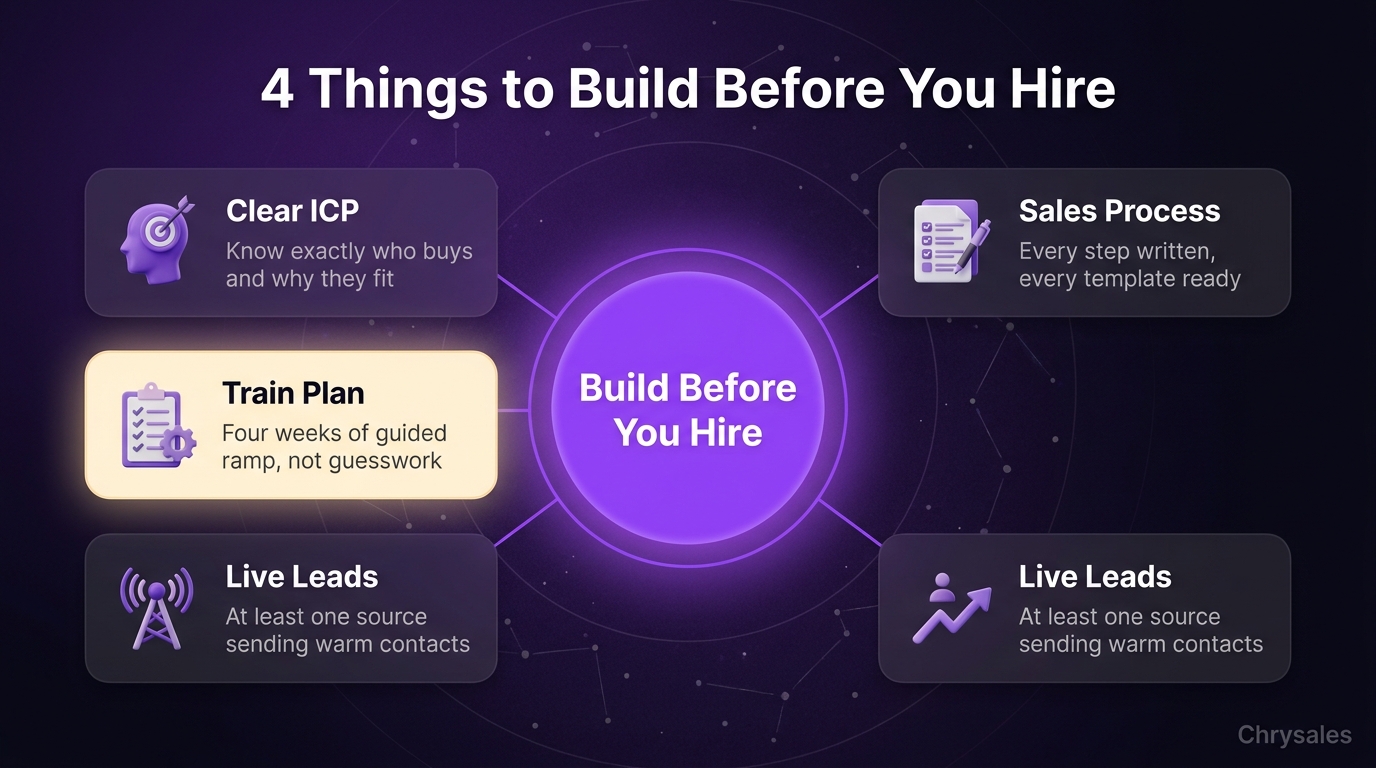
Let's get concrete. Before you post that job description, you need these four things built and documented. Not perfect, just existing and written down.
A Clear Ideal Customer Profile
Not "mid-market B2B companies." That's not clear enough. Try this level of detail:
- 20-100 employees
- Tech or consulting industry
- Selling B2B services, not products
- At least $2M in annual revenue
- Has tried hiring salespeople before and it didn't work
- Currently doing founder-led sales or has one account executive
A 200-person company that just did layoffs is not a "hot lead." It's a bad fit, full stop. Your new hire needs to know the difference on day one, or they'll waste weeks chasing deals that were never going to close.
A Repeatable Sales Process
Your sales process should be simple enough to fit on one page. Most teams overcomplicate this. Here's what a basic B2B sales process looks like:
- Prospecting (how to build the list, where to find leads)
- Outreach (email templates, call scripts, LinkedIn messages)
- First call (discovery questions, qualification checklist)
- Demo or pitch (structure, slides, what to show)
- Objection handling (top 5-7 objections with responses)
- Proposal (format, pricing, terms)
- Close (next steps, contracts, onboarding)
Each step should have a template or example. Not a novel. Just a reference doc your new hire can look at when they're stuck. If you want to learn how to build a sales system that actually scales, start by documenting every step of your current process.
Pro Tip: Record yourself doing three sales calls. Have someone transcribe them. Pull out the questions you ask, the objections you hear, and the ways you respond. That's 80% of your sales playbook right there.
Lead Sources That Actually Work
Your first sales hire can't also be your lead generation system. If you're expecting them to figure out how to generate their own leads from scratch, you're setting them up to fail. Before you hire, you need at least one working lead source:
- A list of 500+ qualified prospects you've validated
- Inbound leads from content, SEO, or ads (even if it's just 5-10 a month)
- A referral system that generates warm intros consistently
- Outbound that's already getting replies (even low volume)
One marketing agency we worked with hired a closer before they had any lead flow. The rep sat around for six weeks waiting for meetings to appear. They quit. The agency didn't need a closer. They needed lead generation first, then a hire. You can watch 4 Ways To Find Clients Who Need Your Services Right Now to understand proven lead generation strategies that work before you bring someone on board.
A Basic Training and Onboarding Plan
Most sales training is "shadow me for a week, then start calling." That's not training. That's hoping they absorb your skills by proximity. Your onboarding plan should cover:
- Week 1: Product training, ICP review, sales process walkthrough
- Week 2: Listen to recorded calls, practice discovery questions
- Week 3: First live calls with you listening, feedback after each one
- Week 4: Solo calls, daily check-ins, objection handling practice
It doesn't have to be fancy. Just structured. Your new hire should know exactly what success looks like in month one, month two, and month three.
The Hiring Timing Mistake Almost Everyone Makes
Quick question: when's the right time to hire your first salesperson? Most people say "when I'm too busy to do sales myself anymore." That's actually too late. The right time is when you've closed 15-20 deals using a process you can write down and explain to someone else in under an hour. Not when you're drowning. Not when you're desperate. When you have a system that works and you need help running it at higher volume.
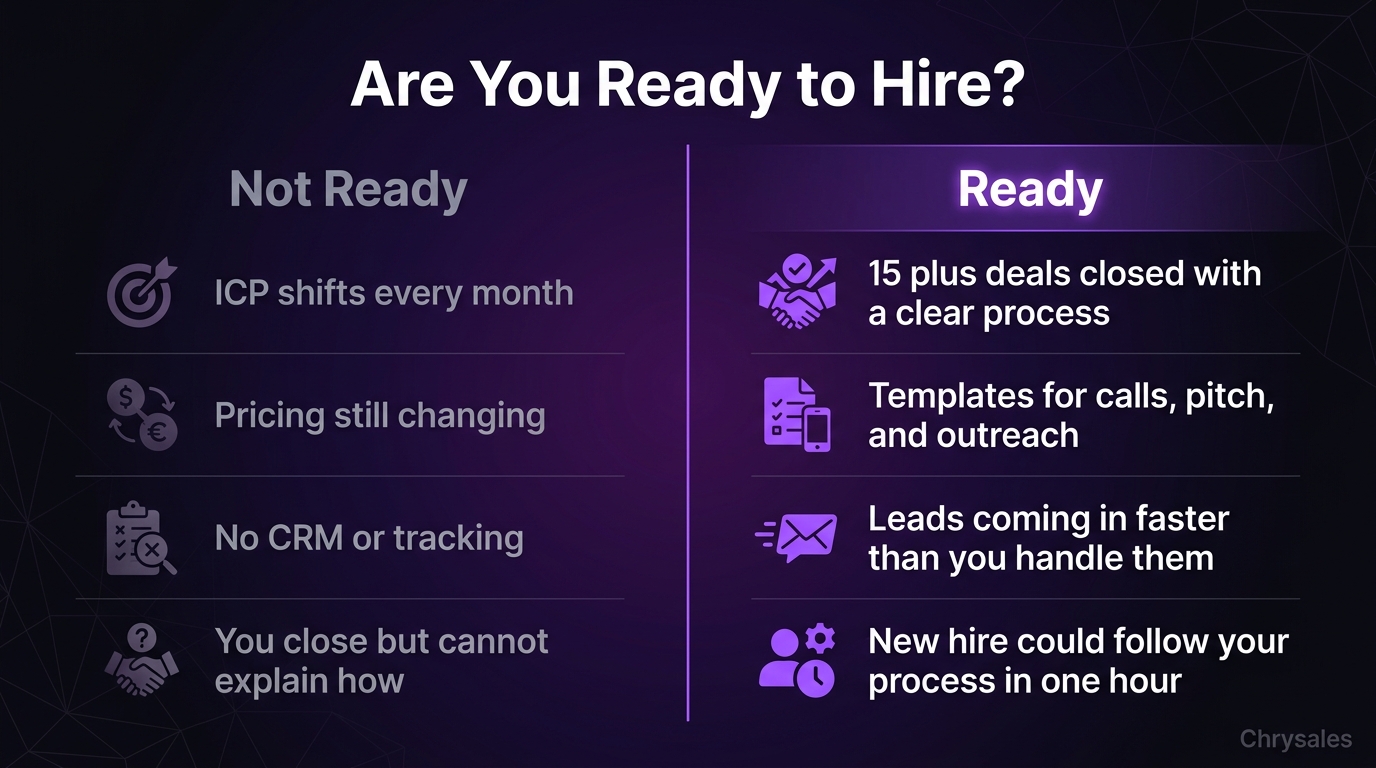
Signs You're Ready
You know you're ready to hire when:
- You can list your top 10 prospects by name and explain why they're a fit in 30 seconds each
- You have templates for your emails, call scripts, and pitch deck
- You've closed at least 10 deals in the last 90 days
- You can explain your sales process to a stranger and they get it
- Leads are coming in faster than you can handle them
Signs You're Not Ready
Don't hire yet if:
- You're still experimenting with pricing
- Your ICP changes every month
- You close deals but can't explain how
- You don't have a CRM or any kind of tracking system
- Your "process" is different for every prospect
Common mistake: Hiring a salesperson to validate product-market fit. That's your job as the business owner, not theirs. A sales hire should scale something that already works, not discover whether it works.
What a Good First Sales Hire Actually Looks Like
Let's say you've built the system. You have your ICP, your process, your lead sources, your training plan. Now you're ready to hire. Who should you actually bring on?
Full Cycle vs. Specialist
Your first sales hire should be a full cycle rep. That means someone who can do everything: prospect, qualify, pitch, handle objections, close, and manage the client relationship after the sale. Don't hire a setter and a closer. Don't hire a business development rep and an account executive. Not yet. You need one person who can own the whole deal from start to finish.
Why? Because splitting the process too early creates handoff problems. The setter books bad meetings. The closer blames the setter. You're now managing two people and a broken process instead of one person and a working one.
Hunter vs. Farmer
A "hunter" finds new business. A "farmer" grows existing accounts. Your first hire should be a hunter. Someone who's comfortable with cold outreach, rejection, and building pipeline from scratch. Farmers are great, but later. Right now you need someone who can go out and bring in new revenue.
Compensation Structure
Most first sales hires fail because the comp plan doesn't match reality. Here's a simple structure that works:
- Base salary: enough to live on (don't lowball this)
- Commission: 10-15% of closed revenue, paid monthly
- Ramp period: lower quota for the first 90 days while they learn
A startup tech company we worked with offered $30K base and 20% commission. Sounds great, right? The problem was it took 6 months to close a deal. The rep ran out of money and quit before they saw a single commission check. Match your comp plan to your actual sales cycle, not your wishful thinking.
How to Set Up Your New Hire for Success in Month One
Your rep starts Monday. What happens next determines whether they make it to month four.
Week One: Immersion
Don't throw them on the phones yet. Spend the first week getting them up to speed:
- Product demo (what you sell, why it matters)
- ICP review (who buys, who doesn't, how to tell the difference)
- Sales process walkthrough (every step, every template)
- CRM training (how to log calls, move deals, update fields)
- Listen to 10 recorded sales calls (good ones and bad ones)
Week Two: Practice
Now they start practicing, but not with real prospects yet:
- Role-play discovery calls (you play the prospect)
- Practice the pitch (record it, give feedback)
- Review objection handling scripts (top 5 objections, how to respond)
- Shadow your live calls (they listen, you sell)
Pro Tip: Have them write out their own version of your pitch in their own words. Don't force them to memorize yours. If they can explain the value in a way that sounds natural to them, that's better than a scripted version that sounds robotic.
Week Three: Live Calls With Training Wheels
Let them start doing real calls, but with support:
- You listen to every call (muted, in the background)
- Debrief after each one (what went well, what to adjust)
- Start with lower-stakes prospects (not your dream accounts)
- Set a goal of 10 calls this week, feedback after each
Week Four: Solo With Check-Ins
By week four, they should be running calls on their own:
- Daily 15-minute check-ins (what's working, what's stuck)
- Weekly pipeline review (what's moving, what's not)
- One shadowed call per week (just to spot any bad habits forming)
- First deal target: close one small deal by end of month two
Most new hires quit between day 60 and day 90 because they feel lost. Daily check-ins in the first month prevent that. It sounds like a lot of handholding, but it's way cheaper than rehiring.
The 90-Day Ramp: What Success Actually Looks Like
Set realistic expectations. Your new hire won't be closing 10 deals a month on day one. Here's what a healthy ramp looks like for a B2B sales hire:
Month One: Learning
- Goal: Understand the product, ICP, and sales process
- Activity: 20-30 discovery calls
- Pipeline: $10K-$20K in qualified opportunities
- Closed deals: 0-1 (if one closes, great, but don't expect it)
Month Two: Building Pipeline
- Goal: Fill the pipeline with real opportunities
- Activity: 40-50 calls, 10-15 demos or pitches
- Pipeline: $30K-$50K in opportunities
- Closed deals: 1-2 small deals
Month Three: Closing
- Goal: Start hitting quota
- Activity: 50+ calls, 15-20 demos, consistent follow-up
- Pipeline: $50K-$75K
- Closed deals: 2-3 deals, getting close to full quota
If your new hire isn't hitting these benchmarks, don't panic yet. Look at the system first. Are the leads good? Is the process clear? Are you giving feedback? Most ramp failures are system failures, not people failures.
Watch out: If they're doing tons of activity but no pipeline is building, that's a targeting problem. If pipeline is building but nothing closes, that's a closing skills problem or an offer problem. Activity without results usually points to slow sales problems that need systematic fixes, not just more effort from your rep.
Common First Sales Hire Mistakes and How to Avoid Them
Let's talk about the traps that kill most first sales hires before they get started.
Mistake One: Hiring Too Early
You don't have product-market fit yet. You're still testing pricing. Your ICP shifts every week. You hire someone anyway because "we need revenue." That hire is going to fail. Not because they're bad at sales. Because there's nothing stable for them to sell yet. Fix: Don't hire until you've personally closed 15-20 deals using a repeatable process. If you can't do it, they definitely can't.
Mistake Two: No Onboarding
You hire someone on Monday. By Tuesday, they're supposed to be booking meetings. By Friday, you're frustrated they haven't closed anything. A salesperson needs at least two weeks to ramp up, usually four. Skipping onboarding doesn't save time. It guarantees failure. Fix: Build a four-week onboarding plan before you post the job description. Week one is learning. Week two is practice. Week three is live calls with support. Week four is solo with check-ins.
Mistake Three: Bad Leads
You hand your new hire a list of 10,000 contacts you scraped from LinkedIn. Half are outdated. Most aren't decision makers. None are warm. Your hire spends six weeks calling dead ends. They get discouraged and quit. Fix: Before you hire, validate your lead source. Call 50 people yourself. If you're getting meetings, the list works. If you're getting crickets, fix the list before you hire. Tools like advanced Google search techniques for B2B prospecting can help you build better targeted lists.
Mistake Four: Unrealistic Quotas
Your average deal takes 90 days to close. You set a quota of 10 deals in month one. Your hire misses quota. You assume they're underperforming. They assume the job was a lie. Both of you are frustrated. Fix: Set ramp quotas. Month one should be learning, not closing. Month two should be 30-50% of full quota. Month three, 70-80%. Full quota by month four. Match expectations to your actual sales cycle.
Mistake Five: Hiring Your Clone
You're great at relationship selling. You hire someone just like you. But your market is shifting toward faster, more transactional deals. Your hire struggles because their style doesn't match the new reality. Fix: Hire for the sales motion you need, not the one you're comfortable with. If you need volume, hire a hunter who loves cold outreach. If you need strategic deals, hire someone who can run long, complex sales cycles. Don't just hire someone who reminds you of yourself.
How Chrysales Helps Teams Build Sales Systems Before They Hire
We've trained over 500 sales teams, and the pattern is always the same. The teams that succeed with their first sales hire are the ones who built the system first. That's where Chrysales comes in. We work 1-on-1 with B2B businesses to build the whole sales system before you post the job ad. Not a course. Not a SaaS tool. Custom systems built for your business.
Here's what that looks like in practice:
Step One: Define Your ICP and Offer
We help you get crystal clear on who buys and why. Not vague demographics. Specific characteristics that predict whether a prospect will close. We also help you build a no-brainer offer that makes the decision easy for your buyer.
Step Two: Build the Sales Process
We document your entire sales process. Discovery questions. Pitch structure. Objection scripts. Proposal templates. Everything a new hire needs to run a call without you in the room. You can also learn How To Build a Sales System So Powerful Clients Come To You to see how we structure systems that work without constant founder involvement.
Step Three: Set Up Lead Generation
We build appointment-booking systems that actually work. Whether it's cold outreach, inbound, or referrals, we make sure you have qualified leads flowing before you hire anyone to close them. According to HubSpot's 2024 marketing statistics, companies with documented lead generation strategies see 50% higher conversion rates than those winging it.
Step Four: Hire and Train
Once the system is built, we help you hire the right person and train them. We've helped clients hire elite setters and closers, and we build custom onboarding plans so your new hire ramps fast.
We've worked with companies like Amazon, Vodafone, and Deutsche Börse, plus hundreds of smaller B2B teams. Our clients have generated over €10M in revenue using the systems we build. And we maintain a 99.4% client satisfaction rate because we focus on what actually works, not theory. If you're thinking about hiring your first salesperson and you want to make sure it works, we can help you build the system first.
Frequently Asked Questions
Q: When should I hire my first sales rep?
Hire your first sales rep when you've closed at least 15-20 deals yourself using a process you can document and explain. If you can't sell the product yourself, a salesperson won't save you. Wait until you have a repeatable system that works, then hire someone to run it at higher volume. Most teams hire too early and wonder why it doesn't work.
Q: Should my first sales hire be a closer or a setter?
Your first sales hire should be a full cycle rep who can do both. Don't split the process into setters and closers until you're at higher volume. Early on, you need one person who owns the whole deal from prospecting to close. Splitting it too soon creates handoff problems and accountability gaps.
Q: How much should I pay my first salesperson?
Pay a base salary they can actually live on, plus 10-15% commission on closed revenue. Don't lowball the base and promise huge commissions. If your sales cycle is long, they'll run out of money before they see a check. Match your comp plan to your sales cycle. A ramp period with lower quotas for the first 90 days helps too.
Q: What if my new hire isn't hitting quota in the first month?
Don't panic. Most new hires take 60-90 days to ramp. Month one should be about learning the product and process, not closing tons of deals. If they're doing activity but not building pipeline, check your lead quality and targeting. If pipeline is building but nothing closes, work on closing skills or revisit your offer.
Q: How do I know if my sales process is ready for a new hire?
Your sales process is ready when you can write it down in one page and someone else can follow it without asking you 50 questions. You should have templates for outreach, discovery calls, pitches, and objection handling. If you're still winging it every time, document what works first, then hire.
Q: What's the biggest mistake teams make with their first sales hire?
Hiring before the system exists. Most teams hire a salesperson hoping they'll figure out how to sell the product. That's backwards. You need to prove the process works first, then hire someone to run it. The second biggest mistake is skipping onboarding. A new hire needs at least two weeks of training before they're effective.
Q: Should I hire someone with industry experience or general sales experience?
It depends on your sales complexity. If your product is technical or your buyers are very niche, industry experience helps. If your sales process is straightforward and your value is easy to explain, general B2B sales experience is fine. Skills matter more than industry background. Look for someone who can handle objections, qualify fast, and close deals in a similar motion to yours.
A first sales hire is the first person you bring in to run sales, and they usually fail when the process, lead generation, and sales training are not in place yet. Picture this: you hire a salesperson. You're excited. They're excited. Three months later, they've booked two meetings, closed zero deals, and you're both wondering what went wrong. Here's the thing nobody tells you: most first sales hire failures happen before the person even starts. The problem isn't the rep. It's that you hired someone to run a system that doesn't exist yet. Let's break down exactly why this happens and what you need to build before you bring anyone on board.
The Real Reason Your First Sales Hire Didn't Work Out
Most teams think hiring a salesperson solves the sales problem. It doesn't. It just exposes all the problems you've been covering up by doing b2b sales yourself. When you're selling your own product, you naturally adjust on the fly. A prospect asks a weird question, you answer it. They push back on price, you reframe the value without thinking twice. You know the product inside out. You understand the customer pain points because you've been living in this space for months or years.
Then you hire someone. They don't have that context. They don't know which objections are real and which ones are smoke screens. They don't know if a lead asking for a discount is testing them or actually can't afford it. They're flying blind, and you're wondering why they can't just "figure it out" like you did.
The System Gap
A full cycle sales rep needs a roadmap. Not a vague "go get clients" instruction. They need to know:
- Who to call (your actual ICP, not a guess)
- What to say in the first 30 seconds
- How to qualify a lead in under five minutes
- Which objections to handle and which ones mean "not a fit"
- When to discount and when to hold firm
- What a good deal looks like versus a time-waster
When these things don't exist as documented steps, every new hire has to invent the process themselves. Some get lucky and figure it out. Most don't, and they leave within 90 days.
The Founder-Led Sales Trap
Here's where it gets tricky. If you've been selling successfully yourself, you might think that means your sales process is working. But what's actually working is your personal ability to improvise, your deep product knowledge, and your passion for the business. That's not a sales system. That's you being good at sales.
A sales system is something someone else can pick up and run without you in the room. If your "process" only works when you're the one doing it, you don't have a process yet. You have a skill, and skills don't transfer to new hires automatically. The moment you notice yourself saying "I don't know why they can't close deals, I close them all the time," that's the red flag. The gap isn't talent, it's a founder-led sales growth bottleneck that hides the missing transferable process.
What Needs to Exist Before You Hire Your First Salesperson
Let's get concrete. Before you post that job description, you need these four things built and documented. Not perfect, just existing and written down.
A Clear Ideal Customer Profile
Not "mid-market B2B companies." That's not clear enough. Try this level of detail:
- 20-100 employees
- Tech or consulting industry
- Selling B2B services, not products
- At least $2M in annual revenue
- Has tried hiring salespeople before and it didn't work
- Currently doing founder-led sales or has one account executive
A 200-person company that just did layoffs is not a "hot lead." It's a bad fit, full stop. Your new hire needs to know the difference on day one, or they'll waste weeks chasing deals that were never going to close.
A Repeatable Sales Process
Your sales process should be simple enough to fit on one page. Most teams overcomplicate this. Here's what a basic B2B sales process looks like:
- Prospecting (how to build the list, where to find leads)
- Outreach (email templates, call scripts, LinkedIn messages)
- First call (discovery questions, qualification checklist)
- Demo or pitch (structure, slides, what to show)
- Objection handling (top 5-7 objections with responses)
- Proposal (format, pricing, terms)
- Close (next steps, contracts, onboarding)
Each step should have a template or example. Not a novel. Just a reference doc your new hire can look at when they're stuck. If you want to learn how to build a sales system that actually scales, start by documenting every step of your current process.
Pro Tip: Record yourself doing three sales calls. Have someone transcribe them. Pull out the questions you ask, the objections you hear, and the ways you respond. That's 80% of your sales playbook right there.
Lead Sources That Actually Work
Your first sales hire can't also be your lead generation system. If you're expecting them to figure out how to generate their own leads from scratch, you're setting them up to fail. Before you hire, you need at least one working lead source:
- A list of 500+ qualified prospects you've validated
- Inbound leads from content, SEO, or ads (even if it's just 5-10 a month)
- A referral system that generates warm intros consistently
- Outbound that's already getting replies (even low volume)
One marketing agency we worked with hired a closer before they had any lead flow. The rep sat around for six weeks waiting for meetings to appear. They quit. The agency didn't need a closer. They needed lead generation first, then a hire. You can watch 4 Ways To Find Clients Who Need Your Services Right Now to understand proven lead generation strategies that work before you bring someone on board.
A Basic Training and Onboarding Plan
Most sales training is "shadow me for a week, then start calling." That's not training. That's hoping they absorb your skills by proximity. Your onboarding plan should cover:
- Week 1: Product training, ICP review, sales process walkthrough
- Week 2: Listen to recorded calls, practice discovery questions
- Week 3: First live calls with you listening, feedback after each one
- Week 4: Solo calls, daily check-ins, objection handling practice
It doesn't have to be fancy. Just structured. Your new hire should know exactly what success looks like in month one, month two, and month three.
The Hiring Timing Mistake Almost Everyone Makes
Quick question: when's the right time to hire your first salesperson? Most people say "when I'm too busy to do sales myself anymore." That's actually too late. The right time is when you've closed 15-20 deals using a process you can write down and explain to someone else in under an hour. Not when you're drowning. Not when you're desperate. When you have a system that works and you need help running it at higher volume.
Signs You're Ready
You know you're ready to hire when:
- You can list your top 10 prospects by name and explain why they're a fit in 30 seconds each
- You have templates for your emails, call scripts, and pitch deck
- You've closed at least 10 deals in the last 90 days
- You can explain your sales process to a stranger and they get it
- Leads are coming in faster than you can handle them
Signs You're Not Ready
Don't hire yet if:
- You're still experimenting with pricing
- Your ICP changes every month
- You close deals but can't explain how
- You don't have a CRM or any kind of tracking system
- Your "process" is different for every prospect
Common mistake: Hiring a salesperson to validate product-market fit. That's your job as the business owner, not theirs. A sales hire should scale something that already works, not discover whether it works.
What a Good First Sales Hire Actually Looks Like
Let's say you've built the system. You have your ICP, your process, your lead sources, your training plan. Now you're ready to hire. Who should you actually bring on?
Full Cycle vs. Specialist
Your first sales hire should be a full cycle rep. That means someone who can do everything: prospect, qualify, pitch, handle objections, close, and manage the client relationship after the sale. Don't hire a setter and a closer. Don't hire a business development rep and an account executive. Not yet. You need one person who can own the whole deal from start to finish.
Why? Because splitting the process too early creates handoff problems. The setter books bad meetings. The closer blames the setter. You're now managing two people and a broken process instead of one person and a working one.
Hunter vs. Farmer
A "hunter" finds new business. A "farmer" grows existing accounts. Your first hire should be a hunter. Someone who's comfortable with cold outreach, rejection, and building pipeline from scratch. Farmers are great, but later. Right now you need someone who can go out and bring in new revenue.
Compensation Structure
Most first sales hires fail because the comp plan doesn't match reality. Here's a simple structure that works:
- Base salary: enough to live on (don't lowball this)
- Commission: 10-15% of closed revenue, paid monthly
- Ramp period: lower quota for the first 90 days while they learn
A startup tech company we worked with offered $30K base and 20% commission. Sounds great, right? The problem was it took 6 months to close a deal. The rep ran out of money and quit before they saw a single commission check. Match your comp plan to your actual sales cycle, not your wishful thinking.
How to Set Up Your New Hire for Success in Month One
Your rep starts Monday. What happens next determines whether they make it to month four.
Week One: Immersion
Don't throw them on the phones yet. Spend the first week getting them up to speed:
- Product demo (what you sell, why it matters)
- ICP review (who buys, who doesn't, how to tell the difference)
- Sales process walkthrough (every step, every template)
- CRM training (how to log calls, move deals, update fields)
- Listen to 10 recorded sales calls (good ones and bad ones)
Week Two: Practice
Now they start practicing, but not with real prospects yet:
- Role-play discovery calls (you play the prospect)
- Practice the pitch (record it, give feedback)
- Review objection handling scripts (top 5 objections, how to respond)
- Shadow your live calls (they listen, you sell)
Pro Tip: Have them write out their own version of your pitch in their own words. Don't force them to memorize yours. If they can explain the value in a way that sounds natural to them, that's better than a scripted version that sounds robotic.
Week Three: Live Calls With Training Wheels
Let them start doing real calls, but with support:
- You listen to every call (muted, in the background)
- Debrief after each one (what went well, what to adjust)
- Start with lower-stakes prospects (not your dream accounts)
- Set a goal of 10 calls this week, feedback after each
Week Four: Solo With Check-Ins
By week four, they should be running calls on their own:
- Daily 15-minute check-ins (what's working, what's stuck)
- Weekly pipeline review (what's moving, what's not)
- One shadowed call per week (just to spot any bad habits forming)
- First deal target: close one small deal by end of month two
Most new hires quit between day 60 and day 90 because they feel lost. Daily check-ins in the first month prevent that. It sounds like a lot of handholding, but it's way cheaper than rehiring.
The 90-Day Ramp: What Success Actually Looks Like
Set realistic expectations. Your new hire won't be closing 10 deals a month on day one. Here's what a healthy ramp looks like for a B2B sales hire:
Month One: Learning
- Goal: Understand the product, ICP, and sales process
- Activity: 20-30 discovery calls
- Pipeline: $10K-$20K in qualified opportunities
- Closed deals: 0-1 (if one closes, great, but don't expect it)
Month Two: Building Pipeline
- Goal: Fill the pipeline with real opportunities
- Activity: 40-50 calls, 10-15 demos or pitches
- Pipeline: $30K-$50K in opportunities
- Closed deals: 1-2 small deals
Month Three: Closing
- Goal: Start hitting quota
- Activity: 50+ calls, 15-20 demos, consistent follow-up
- Pipeline: $50K-$75K
- Closed deals: 2-3 deals, getting close to full quota
If your new hire isn't hitting these benchmarks, don't panic yet. Look at the system first. Are the leads good? Is the process clear? Are you giving feedback? Most ramp failures are system failures, not people failures.
Watch out: If they're doing tons of activity but no pipeline is building, that's a targeting problem. If pipeline is building but nothing closes, that's a closing skills problem or an offer problem. Activity without results usually points to slow sales problems that need systematic fixes, not just more effort from your rep.
Common First Sales Hire Mistakes and How to Avoid Them
Let's talk about the traps that kill most first sales hires before they get started.
Mistake One: Hiring Too Early
You don't have product-market fit yet. You're still testing pricing. Your ICP shifts every week. You hire someone anyway because "we need revenue." That hire is going to fail. Not because they're bad at sales. Because there's nothing stable for them to sell yet. Fix: Don't hire until you've personally closed 15-20 deals using a repeatable process. If you can't do it, they definitely can't.
Mistake Two: No Onboarding
You hire someone on Monday. By Tuesday, they're supposed to be booking meetings. By Friday, you're frustrated they haven't closed anything. A salesperson needs at least two weeks to ramp up, usually four. Skipping onboarding doesn't save time. It guarantees failure. Fix: Build a four-week onboarding plan before you post the job description. Week one is learning. Week two is practice. Week three is live calls with support. Week four is solo with check-ins.
Mistake Three: Bad Leads
You hand your new hire a list of 10,000 contacts you scraped from LinkedIn. Half are outdated. Most aren't decision makers. None are warm. Your hire spends six weeks calling dead ends. They get discouraged and quit. Fix: Before you hire, validate your lead source. Call 50 people yourself. If you're getting meetings, the list works. If you're getting crickets, fix the list before you hire. Tools like advanced Google search techniques for B2B prospecting can help you build better targeted lists.
Mistake Four: Unrealistic Quotas
Your average deal takes 90 days to close. You set a quota of 10 deals in month one. Your hire misses quota. You assume they're underperforming. They assume the job was a lie. Both of you are frustrated. Fix: Set ramp quotas. Month one should be learning, not closing. Month two should be 30-50% of full quota. Month three, 70-80%. Full quota by month four. Match expectations to your actual sales cycle.
Mistake Five: Hiring Your Clone
You're great at relationship selling. You hire someone just like you. But your market is shifting toward faster, more transactional deals. Your hire struggles because their style doesn't match the new reality. Fix: Hire for the sales motion you need, not the one you're comfortable with. If you need volume, hire a hunter who loves cold outreach. If you need strategic deals, hire someone who can run long, complex sales cycles. Don't just hire someone who reminds you of yourself.
How Chrysales Helps Teams Build Sales Systems Before They Hire
We've trained over 500 sales teams, and the pattern is always the same. The teams that succeed with their first sales hire are the ones who built the system first. That's where Chrysales comes in. We work 1-on-1 with B2B businesses to build the whole sales system before you post the job ad. Not a course. Not a SaaS tool. Custom systems built for your business.
Here's what that looks like in practice:
Step One: Define Your ICP and Offer
We help you get crystal clear on who buys and why. Not vague demographics. Specific characteristics that predict whether a prospect will close. We also help you build a no-brainer offer that makes the decision easy for your buyer.
Step Two: Build the Sales Process
We document your entire sales process. Discovery questions. Pitch structure. Objection scripts. Proposal templates. Everything a new hire needs to run a call without you in the room. You can also learn How To Build a Sales System So Powerful Clients Come To You to see how we structure systems that work without constant founder involvement.
Step Three: Set Up Lead Generation
We build appointment-booking systems that actually work. Whether it's cold outreach, inbound, or referrals, we make sure you have qualified leads flowing before you hire anyone to close them. According to HubSpot's 2024 marketing statistics, companies with documented lead generation strategies see 50% higher conversion rates than those winging it.
Step Four: Hire and Train
Once the system is built, we help you hire the right person and train them. We've helped clients hire elite setters and closers, and we build custom onboarding plans so your new hire ramps fast.
We've worked with companies like Amazon, Vodafone, and Deutsche Börse, plus hundreds of smaller B2B teams. Our clients have generated over €10M in revenue using the systems we build. And we maintain a 99.4% client satisfaction rate because we focus on what actually works, not theory. If you're thinking about hiring your first salesperson and you want to make sure it works, we can help you build the system first.
Frequently Asked Questions
Q: When should I hire my first sales rep?
Hire your first sales rep when you've closed at least 15-20 deals yourself using a process you can document and explain. If you can't sell the product yourself, a salesperson won't save you. Wait until you have a repeatable system that works, then hire someone to run it at higher volume. Most teams hire too early and wonder why it doesn't work.
Q: Should my first sales hire be a closer or a setter?
Your first sales hire should be a full cycle rep who can do both. Don't split the process into setters and closers until you're at higher volume. Early on, you need one person who owns the whole deal from prospecting to close. Splitting it too soon creates handoff problems and accountability gaps.
Q: How much should I pay my first salesperson?
Pay a base salary they can actually live on, plus 10-15% commission on closed revenue. Don't lowball the base and promise huge commissions. If your sales cycle is long, they'll run out of money before they see a check. Match your comp plan to your sales cycle. A ramp period with lower quotas for the first 90 days helps too.
Q: What if my new hire isn't hitting quota in the first month?
Don't panic. Most new hires take 60-90 days to ramp. Month one should be about learning the product and process, not closing tons of deals. If they're doing activity but not building pipeline, check your lead quality and targeting. If pipeline is building but nothing closes, work on closing skills or revisit your offer.
Q: How do I know if my sales process is ready for a new hire?
Your sales process is ready when you can write it down in one page and someone else can follow it without asking you 50 questions. You should have templates for outreach, discovery calls, pitches, and objection handling. If you're still winging it every time, document what works first, then hire.
Q: What's the biggest mistake teams make with their first sales hire?
Hiring before the system exists. Most teams hire a salesperson hoping they'll figure out how to sell the product. That's backwards. You need to prove the process works first, then hire someone to run it. The second biggest mistake is skipping onboarding. A new hire needs at least two weeks of training before they're effective.
Q: Should I hire someone with industry experience or general sales experience?
It depends on your sales complexity. If your product is technical or your buyers are very niche, industry experience helps. If your sales process is straightforward and your value is easy to explain, general B2B sales experience is fine. Skills matter more than industry background. Look for someone who can handle objections, qualify fast, and close deals in a similar motion to yours.
Scaling Is Not Hard If You Have The Right Systems
If you’re serious about leveling up your scaling game, you need the right system, the right training, and the right team behind you. We're here to give you the exact tools and strategies top entrepreneurs use to dominate.

Discover the latest tips
View All.avif)
Chrysales was formed from the words "chrysalis" the stage where a caterpillar transforms into a butterfly and "sales".
It stands for one thing: sales transformation.Because scaling doesn’t happen by doing more of the same. Scaling only happens when you go through real transformation in your systems, your offer, team and the way you sell.
.avif)


