
Empty sales pipeline: what to do in the next 30 days
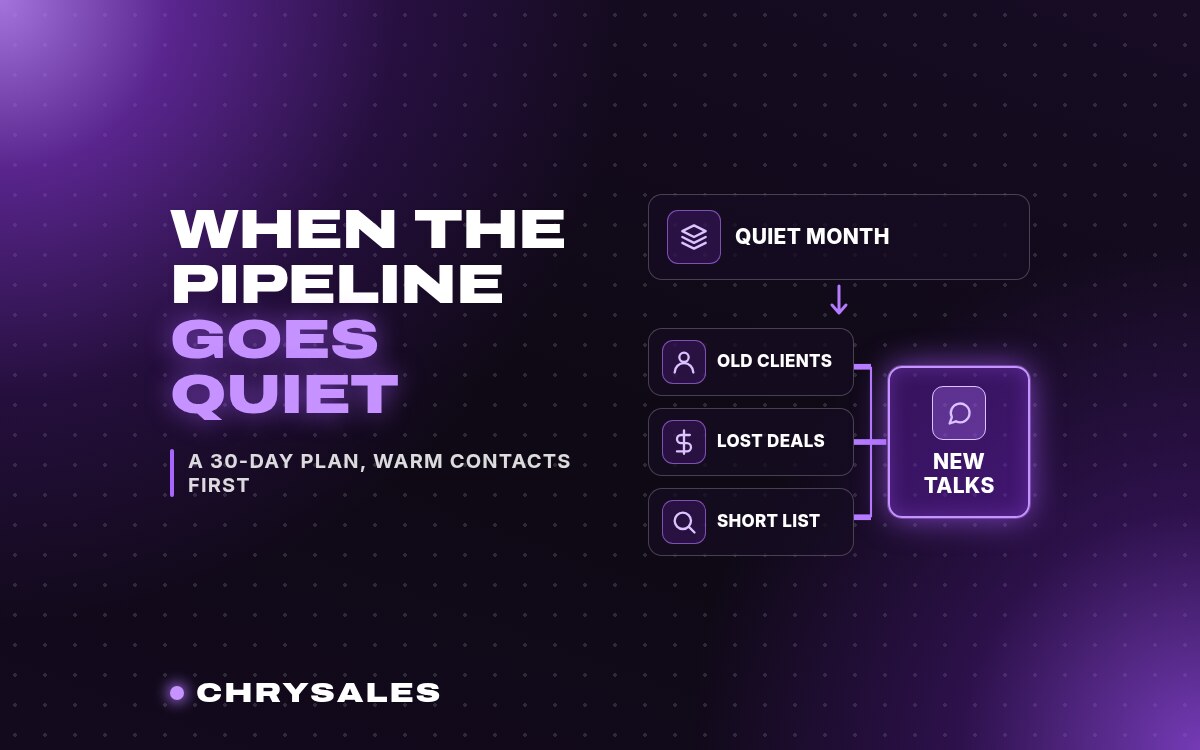
An empty sales pipeline means your list of open deals, the people who might buy soon, is close to blank. For the next 30 days, start with warm contacts: people who already know you, like clients, past clients and stalled deals.
At the same time, start steady outreach to a short list of new prospects. Thirty days won't fill your pipeline, but they can get real sales conversations going again.
Panic is a real risk right now, and a calm plan with a clear order is easier to stick to. It also leaves you with a weekly habit that helps keep the pipeline from running dry.
A 30-day plan for an empty pipeline
Spend the first two weeks on people who know you and the last two on new prospects. Keep following up with everyone who replies the whole time.
| Week | Who to contact | Goal |
|---|---|---|
| 1 | Current and past clients | Restart warm conversations |
| 2 | Stalled and lost deals | Reopen talks, build a new list |
| 3 | 10-15 new prospects | Start steady outreach |
| 4 | Next 10-15, plus all replies | Follow up, book meetings |
Warm contacts come first because buyers are far more open to people they know. In a 2014 LinkedIn survey of B2B buyers, 88% said they engage with someone in their existing network. Only 17% said they engage with sellers who reach out cold.
The survey is old and measures what buyers said, not reply rates. Still, the gap is large.
Start with people who already know you
Your first messages go to people who already trust you. They know your work, so you skip the hardest part of selling to a stranger: proving you're real.
Tim Kilroy of Agency Inner Circle suggests a clear order for an empty pipeline. Start with current clients, then deals you lost in the last 12 months, then former clients from the last 24 months.
Unless a split ended badly, he says to reach out to everyone you used to work with.
Don't open by asking if they have work for you. Ask about them first, then say plainly that you have room. Here is a fictional example.
Hi Anna, I was thinking about the onboarding project we did last spring.
How is it holding up? I have room for new work in the next few weeks,
so if something on your list could use a hand, I'd be glad to talk.
People who used to send you clients belong on this list too. For what to say to them, see how to ask clients for referrals.
Just don't rely on referrals alone. You can't control when they come, so steady outreach is the other half.
In this video, Sabir walks through four ways to find clients who need your services now. It covers why referrals alone cannot scale and where outbound fits.
Reopen stalled and lost deals
Deals that went quiet deserve a second look, because some stalled for reasons that had little to do with you. Reopen them with one short, specific question.
Brian LaManna, an enterprise seller writing on Gong's blog, says most deals don't die over price or value. In his view, they stall because the buyer couldn't get others at their company to agree. So there is often a way back in.
Skip the guilt. In one Gong analysis of follow-up emails, the phrase "never heard back" got more replies but 14% fewer meetings booked.
A cleaner pattern is Dean Jackson's "9-word email". The subject line is just the person's first name, and the body is one plain question about what they wanted, with no pitch.
Here is a B2B version, with a fictional contact.
Subject: Maria

Are you still looking to cut onboarding time this year?
Keep your hopes realistic. Some people won't answer, and that's fine. A few replies from people who already know your work are worth more than a big list of strangers.
Start outreach to a short list
While you reopen old deals in week 2, build a short list of new prospects. Start reaching out to them in week 3, and keep the list small and well researched. Kilroy suggests 10-15 targets at a time.
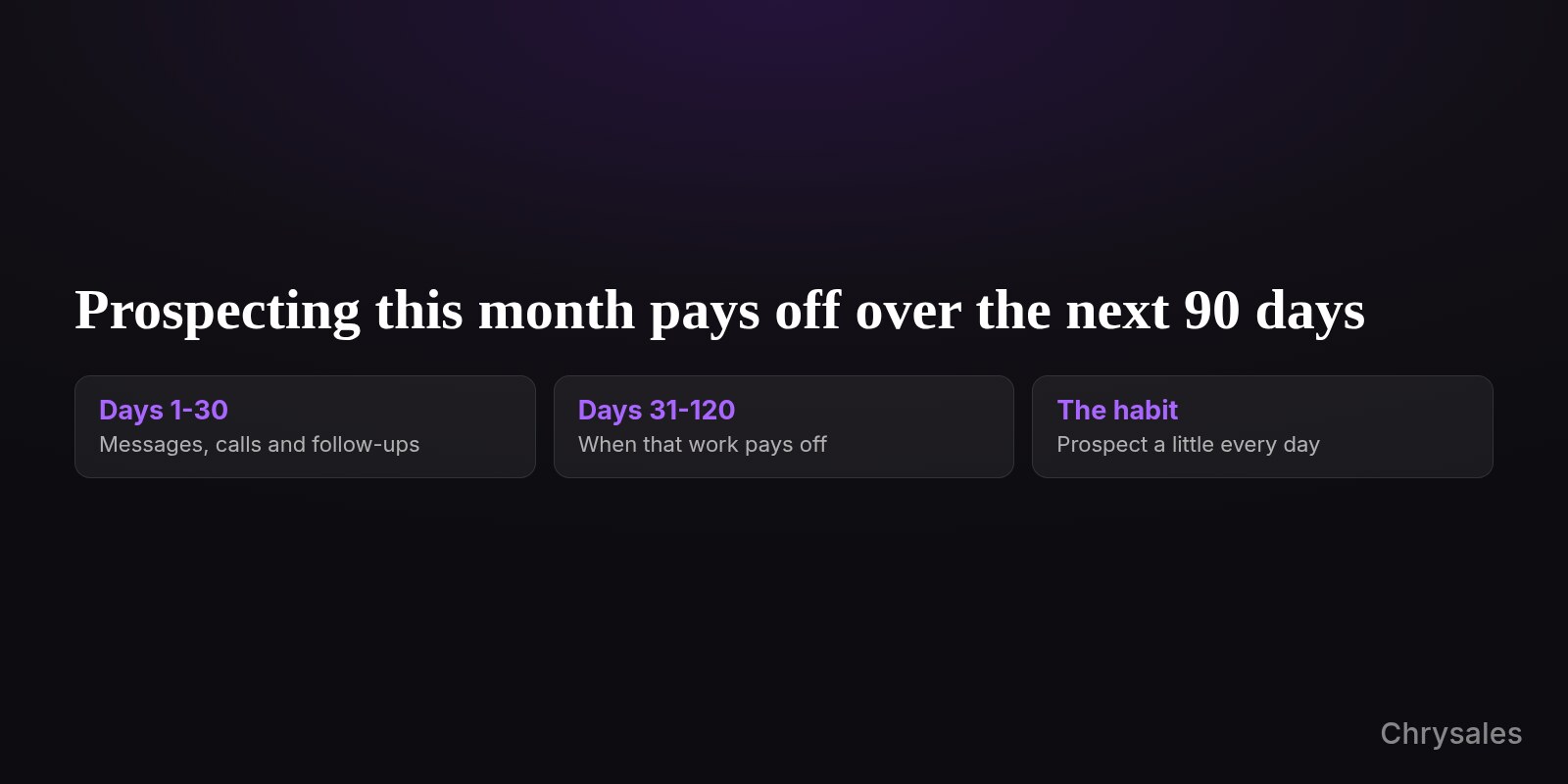
Start now, because reaching out to new people takes time to pay off. The image shows Jeb Blount's 30-day rule and why waiting for the warm list to run out costs you later.
Use two channels, for example email and a phone call or LinkedIn message. Send each person a few messages, and make each one add something new. If you're starting cold email from a fresh address, ramp up new inboxes slowly.
By day 30, expect some conversations and maybe a few meetings, not a full pipeline. One real example shows what steady effort can do over a longer stretch. Sales trainer John Barrows wrote that his own pipeline was empty in April.
He reset his ideal customer profile (the type of buyer he sells to best), updated his messaging and raised his activity. Seven weeks later, he had added over $565,000 back into it.
That is his own result. He is a well-known trainer with a big network, and it's pipeline value, not money in the bank. His activity also included meetings with past clients and talks with partners, not only cold outreach.
Check three numbers every Friday
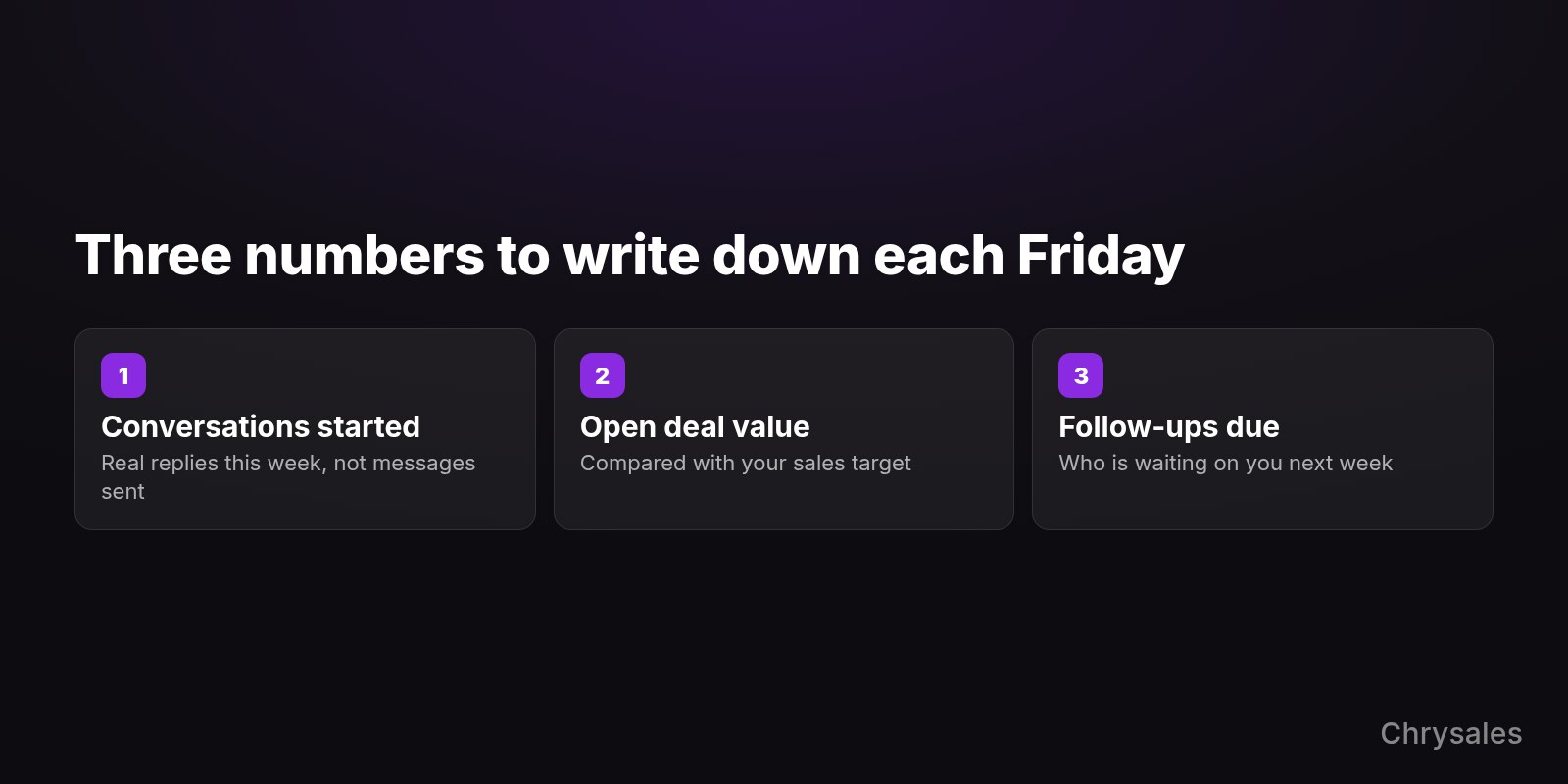
Every Friday, take 15 minutes and write down three numbers: conversations started, open deal value and follow-ups due. The image explains each one.
How much open deal value is enough? Salesloft uses your win rate. If you win 1 deal in 4, you need open deals worth 4 times your sales target.
In a fictional example, a $40,000 target for next quarter means $160,000 in open deals. Salesloft calls the popular 3x rule "a starting point, not a standard."
A few things make an empty pipeline worse:
- Cutting prices in panic. A lower price doesn't create buyers who aren't talking to you, and it's hard to raise again.
- Buying a big lead list. Thousands of strangers give you volume, not conversations.
- Stopping once you're busy again. Jeb Blount calls failing to prospect every day the number one reason for an empty pipeline.
If your pipeline keeps drying up, the cause may sit deeper. Read why your sales slowed down to find it.
Conclusion: List 20 names today
Start with the people who already know you, and put the rest on a calendar.
- Write down 20 names: current clients, past clients, people who referred you and stalled deals.
- Send the first five short, personal messages today.
- Put a 15-minute Friday check in your calendar.
- Block time in week 2 to research your first 10-15 new prospects.
Once conversations restart, build your sales pipeline stages so every deal has a clear next step.
Want a second pair of eyes on your 30-day plan? On a free strategy call, Chrysales can go through who to contact first and how to keep your outreach steady. Plan your next 30 days on a free call
An empty sales pipeline means your list of open deals, the people who might buy soon, is close to blank. For the next 30 days, start with warm contacts: people who already know you, like clients, past clients and stalled deals.
At the same time, start steady outreach to a short list of new prospects. Thirty days won't fill your pipeline, but they can get real sales conversations going again.
Panic is a real risk right now, and a calm plan with a clear order is easier to stick to. It also leaves you with a weekly habit that helps keep the pipeline from running dry.
A 30-day plan for an empty pipeline
Spend the first two weeks on people who know you and the last two on new prospects. Keep following up with everyone who replies the whole time.
| Week | Who to contact | Goal |
|---|---|---|
| 1 | Current and past clients | Restart warm conversations |
| 2 | Stalled and lost deals | Reopen talks, build a new list |
| 3 | 10-15 new prospects | Start steady outreach |
| 4 | Next 10-15, plus all replies | Follow up, book meetings |
Warm contacts come first because buyers are far more open to people they know. In a 2014 LinkedIn survey of B2B buyers, 88% said they engage with someone in their existing network. Only 17% said they engage with sellers who reach out cold.
The survey is old and measures what buyers said, not reply rates. Still, the gap is large.
Start with people who already know you
Your first messages go to people who already trust you. They know your work, so you skip the hardest part of selling to a stranger: proving you're real.
Tim Kilroy of Agency Inner Circle suggests a clear order for an empty pipeline. Start with current clients, then deals you lost in the last 12 months, then former clients from the last 24 months.
Unless a split ended badly, he says to reach out to everyone you used to work with.
Don't open by asking if they have work for you. Ask about them first, then say plainly that you have room. Here is a fictional example.
Hi Anna, I was thinking about the onboarding project we did last spring.
How is it holding up? I have room for new work in the next few weeks,
so if something on your list could use a hand, I'd be glad to talk.
People who used to send you clients belong on this list too. For what to say to them, see how to ask clients for referrals.
Just don't rely on referrals alone. You can't control when they come, so steady outreach is the other half.
In this video, Sabir walks through four ways to find clients who need your services now. It covers why referrals alone cannot scale and where outbound fits.
Reopen stalled and lost deals
Deals that went quiet deserve a second look, because some stalled for reasons that had little to do with you. Reopen them with one short, specific question.
Brian LaManna, an enterprise seller writing on Gong's blog, says most deals don't die over price or value. In his view, they stall because the buyer couldn't get others at their company to agree. So there is often a way back in.
Skip the guilt. In one Gong analysis of follow-up emails, the phrase "never heard back" got more replies but 14% fewer meetings booked.
A cleaner pattern is Dean Jackson's "9-word email". The subject line is just the person's first name, and the body is one plain question about what they wanted, with no pitch.
Here is a B2B version, with a fictional contact.
Subject: Maria

Are you still looking to cut onboarding time this year?
Keep your hopes realistic. Some people won't answer, and that's fine. A few replies from people who already know your work are worth more than a big list of strangers.
Start outreach to a short list
While you reopen old deals in week 2, build a short list of new prospects. Start reaching out to them in week 3, and keep the list small and well researched. Kilroy suggests 10-15 targets at a time.
Start now, because reaching out to new people takes time to pay off. The image shows Jeb Blount's 30-day rule and why waiting for the warm list to run out costs you later.
Use two channels, for example email and a phone call or LinkedIn message. Send each person a few messages, and make each one add something new. If you're starting cold email from a fresh address, ramp up new inboxes slowly.
By day 30, expect some conversations and maybe a few meetings, not a full pipeline. One real example shows what steady effort can do over a longer stretch. Sales trainer John Barrows wrote that his own pipeline was empty in April.
He reset his ideal customer profile (the type of buyer he sells to best), updated his messaging and raised his activity. Seven weeks later, he had added over $565,000 back into it.
That is his own result. He is a well-known trainer with a big network, and it's pipeline value, not money in the bank. His activity also included meetings with past clients and talks with partners, not only cold outreach.
Check three numbers every Friday
Every Friday, take 15 minutes and write down three numbers: conversations started, open deal value and follow-ups due. The image explains each one.
How much open deal value is enough? Salesloft uses your win rate. If you win 1 deal in 4, you need open deals worth 4 times your sales target.
In a fictional example, a $40,000 target for next quarter means $160,000 in open deals. Salesloft calls the popular 3x rule "a starting point, not a standard."
A few things make an empty pipeline worse:
- Cutting prices in panic. A lower price doesn't create buyers who aren't talking to you, and it's hard to raise again.
- Buying a big lead list. Thousands of strangers give you volume, not conversations.
- Stopping once you're busy again. Jeb Blount calls failing to prospect every day the number one reason for an empty pipeline.
If your pipeline keeps drying up, the cause may sit deeper. Read why your sales slowed down to find it.
Conclusion: List 20 names today
Start with the people who already know you, and put the rest on a calendar.
- Write down 20 names: current clients, past clients, people who referred you and stalled deals.
- Send the first five short, personal messages today.
- Put a 15-minute Friday check in your calendar.
- Block time in week 2 to research your first 10-15 new prospects.
Once conversations restart, build your sales pipeline stages so every deal has a clear next step.
Want a second pair of eyes on your 30-day plan? On a free strategy call, Chrysales can go through who to contact first and how to keep your outreach steady. Plan your next 30 days on a free call
Scaling Is Not Hard If You Have The Right Systems
If you’re serious about leveling up your scaling game, you need the right system, the right training, and the right team behind you. We're here to give you the exact tools and strategies top entrepreneurs use to dominate.

Discover the latest tips
View All
Chrysales was formed from the words "chrysalis" the stage where a caterpillar transforms into a butterfly and "sales".
It stands for one thing: sales transformation.Because scaling doesn’t happen by doing more of the same. Scaling only happens when you go through real transformation in your systems, your offer, team and the way you sell.


