.avif)
Email Reply Format Examples That Actually Get Responses
An email reply format example is a simple way to structure a short message so it is easy to read, clear to scan, and more likely to get a response.
Picture this: you send 50 emails and get 3 replies. You tweak the subject line, send 50 more, and get 4 replies. The problem isn't your subject line. It's probably your email reply format example, your list quality, or the fact that your message sounds like every other cold email sitting in someone's inbox.
Most people obsess over the opening line when the real issue is structure. A good B2B sales email follows a format that makes it easy to read, easy to understand, and impossible to ignore. Let's break down exactly how to write cold emails that actually get responses.
Why Most Email Reply Formats Fail Before Anyone Reads Them
Your email reply format example matters more than you think. Most cold emails fail because they look like walls of text. No spacing. No clear point. No reason to care.
If someone opens your email on their phone and sees a paragraph that takes three swipes to get through, they're gone.
Here's the thing: people don't read emails top to bottom anymore. They scan. They look for signals that tell them whether this email is worth their time. If your format doesn't make scanning easy, you lose.
What Makes a Bad Email Reply Format
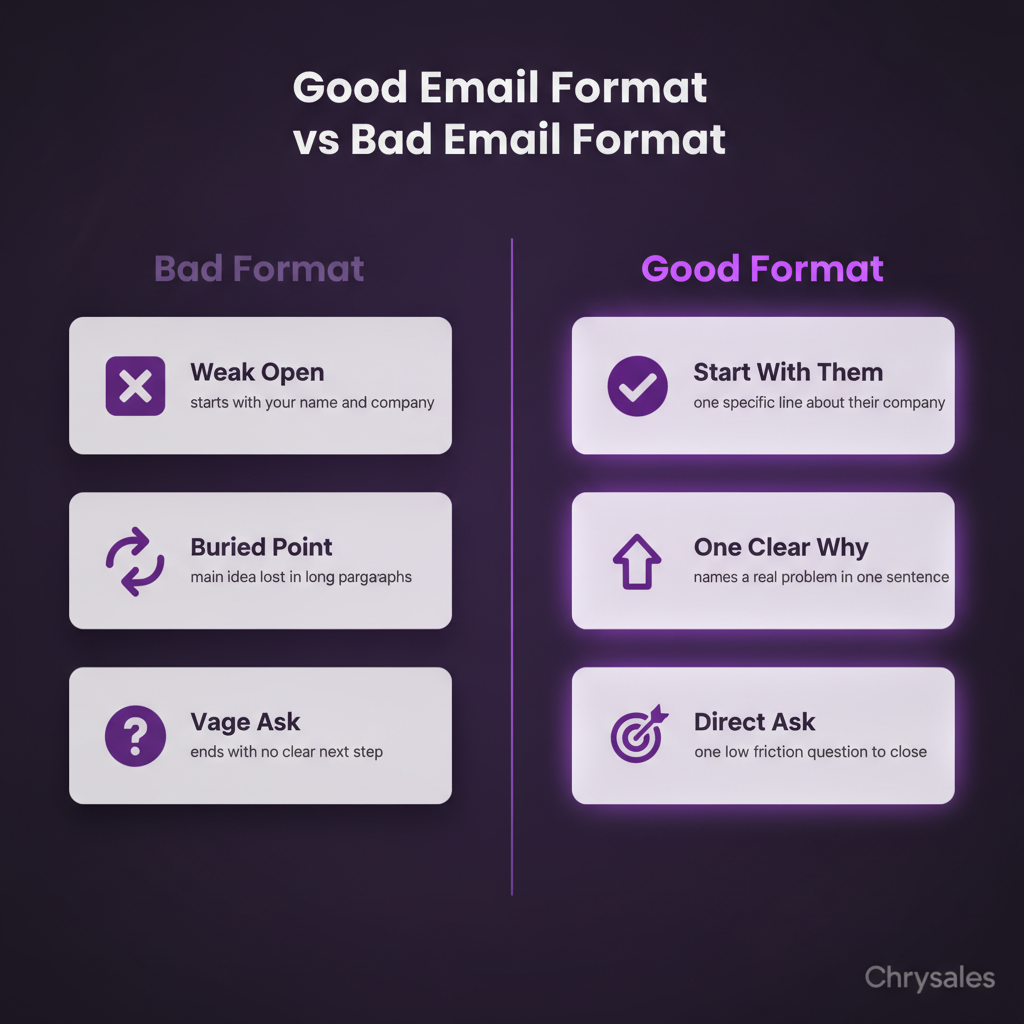
A bad format has no structure. It opens with a long intro about who you are and why you're reaching out. It buries the point in the middle. It ends with a vague question like "Would love to chat sometime."
The reader has to work to figure out what you want. Most won't bother.
Common mistake: Opening with "I hope this email finds you well" or "My name is [Name] and I work at [Company]." Nobody cares yet. You haven't given them a reason to.
What Makes a Good Email Reply Format
A good format does three things fast:
- Gets to the point in the first sentence. No fluff.
- Uses short paragraphs and white space. Easy to scan on any device.
- Ends with one clear, low-friction call to action. Not "let me know your thoughts." Something specific like "Does Thursday at 2pm work for 15 minutes?"
Think of your email like a text message to a busy friend. You wouldn't send them a five-paragraph essay. You'd get to the point, keep it short, and ask a simple question.
The Best Email Reply Format Example for B2B Lead Generation
Most B2B sales emails need the same basic structure. This format works whether you're doing cold outreach, following up after a call, or replying to an inbound inquiry, and it aligns with proven outbound email marketing best practices used by high-performing sales teams.
Here's what it looks like in practice:
The Opening Line: Start With Them, Not You
Your first sentence should mention something specific about the person or their company. Not generic praise. Something that shows you did 30 seconds of research.
Good example: "Saw you just expanded your team in Berlin."
Bad example: "I came across your profile and was impressed by your work."
The good version is specific. The bad version could apply to anyone. If your opening line could be copy-pasted into 100 other emails, rewrite it.
The Why: One Sentence About the Problem You Solve
After the opening, tell them why you're reaching out. One sentence. Focus on the problem, not your product.
Good example: "Most consulting firms we work with waste 20+ hours a week on outreach that doesn't book meetings."
Bad example: "We're a sales coaching agency that helps B2B companies grow revenue through proven systems and strategies."
The first version names a real problem. The second version is a pitch disguised as an intro. Save the pitch for later.
The Proof: A Quick Data Point or Example
This is where you drop one piece of proof. A number, a quick case example, or a result. Keep it to one or two sentences.
Example: "We helped a 15-person consulting firm go from 2 booked calls a month to 12 in three weeks by fixing their list and their offer."
Notice it's specific. Not "we've helped hundreds of companies." Specific numbers, specific results, specific type of company. According to recent B2B sales benchmarks, personalized outreach with concrete proof points can improve response rates significantly.
Pro Tip: Use round numbers that feel real. "12 calls in 3 weeks" sounds believable. "14.2 calls on average over 22 days" sounds made up.
The Ask: One Clear Next Step
End with one question or one clear action. Not two options. Not "let me know if you're interested." One thing.
Good example: "Want to see the exact email template we used? I can send it over today."
Bad example: "Would love to hop on a call sometime to discuss how we might be able to help you achieve your goals."
The good version is easy to say yes to. The bad version feels like a sales trap. For more templates that get replies, check out these cold email follow-up templates that have proven results.
The Full Email Reply Format Example
Here's what the whole thing looks like together. You can also watch this breakdown of cold email versus cold calling to see which channel drives faster results for your specific situation, and learn how to build a sales system so powerful clients come to you instead of relying solely on outbound.
An email reply format example is a simple way to structure a short message so it is easy to read, clear to scan, and more likely to get a response.
Picture this: you send 50 emails and get 3 replies. You tweak the subject line, send 50 more, and get 4 replies. The problem isn't your subject line. It's probably your email reply format example, your list quality, or the fact that your message sounds like every other cold email sitting in someone's inbox.
Most people obsess over the opening line when the real issue is structure. A good B2B sales email follows a format that makes it easy to read, easy to understand, and impossible to ignore. Let's break down exactly how to write cold emails that actually get responses.
Why Most Email Reply Formats Fail Before Anyone Reads Them
Your email reply format example matters more than you think. Most cold emails fail because they look like walls of text. No spacing. No clear point. No reason to care.
If someone opens your email on their phone and sees a paragraph that takes three swipes to get through, they're gone.
Here's the thing: people don't read emails top to bottom anymore. They scan. They look for signals that tell them whether this email is worth their time. If your format doesn't make scanning easy, you lose.
What Makes a Bad Email Reply Format
A bad format has no structure. It opens with a long intro about who you are and why you're reaching out. It buries the point in the middle. It ends with a vague question like "Would love to chat sometime."
The reader has to work to figure out what you want. Most won't bother.
Common mistake: Opening with "I hope this email finds you well" or "My name is [Name] and I work at [Company]." Nobody cares yet. You haven't given them a reason to.
What Makes a Good Email Reply Format
A good format does three things fast:
- Gets to the point in the first sentence. No fluff.
- Uses short paragraphs and white space. Easy to scan on any device.
- Ends with one clear, low-friction call to action. Not "let me know your thoughts." Something specific like "Does Thursday at 2pm work for 15 minutes?"
Think of your email like a text message to a busy friend. You wouldn't send them a five-paragraph essay. You'd get to the point, keep it short, and ask a simple question.
The Best Email Reply Format Example for B2B Lead Generation
Most B2B sales emails need the same basic structure. This format works whether you're doing cold outreach, following up after a call, or replying to an inbound inquiry, and it aligns with proven outbound email marketing best practices used by high-performing sales teams.
Here's what it looks like in practice:
The Opening Line: Start With Them, Not You
Your first sentence should mention something specific about the person or their company. Not generic praise. Something that shows you did 30 seconds of research.
Good example: "Saw you just expanded your team in Berlin."
Bad example: "I came across your profile and was impressed by your work."
The good version is specific. The bad version could apply to anyone. If your opening line could be copy-pasted into 100 other emails, rewrite it.
The Why: One Sentence About the Problem You Solve
After the opening, tell them why you're reaching out. One sentence. Focus on the problem, not your product.
Good example: "Most consulting firms we work with waste 20+ hours a week on outreach that doesn't book meetings."
Bad example: "We're a sales coaching agency that helps B2B companies grow revenue through proven systems and strategies."
The first version names a real problem. The second version is a pitch disguised as an intro. Save the pitch for later.
The Proof: A Quick Data Point or Example
This is where you drop one piece of proof. A number, a quick case example, or a result. Keep it to one or two sentences.
Example: "We helped a 15-person consulting firm go from 2 booked calls a month to 12 in three weeks by fixing their list and their offer."
Notice it's specific. Not "we've helped hundreds of companies." Specific numbers, specific results, specific type of company. According to recent B2B sales benchmarks, personalized outreach with concrete proof points can improve response rates significantly.
Pro Tip: Use round numbers that feel real. "12 calls in 3 weeks" sounds believable. "14.2 calls on average over 22 days" sounds made up.
The Ask: One Clear Next Step
End with one question or one clear action. Not two options. Not "let me know if you're interested." One thing.
Good example: "Want to see the exact email template we used? I can send it over today."
Bad example: "Would love to hop on a call sometime to discuss how we might be able to help you achieve your goals."
The good version is easy to say yes to. The bad version feels like a sales trap. For more templates that get replies, check out these cold email follow-up templates that have proven results.
The Full Email Reply Format Example
Here's what the whole thing looks like together. You can also watch this breakdown of cold email versus cold calling to see which channel drives faster results for your specific situation, and learn how to build a sales system so powerful clients come to you instead of relying solely on outbound.
Scaling Is Not Hard If You Have The Right Systems
If you’re serious about leveling up your scaling game, you need the right system, the right training, and the right team behind you. We're here to give you the exact tools and strategies top entrepreneurs use to dominate.

Discover the latest tips
View All.avif)
Chrysales was formed from the words "chrysalis" the stage where a caterpillar transforms into a butterfly and "sales".
It stands for one thing: sales transformation.Because scaling doesn’t happen by doing more of the same. Scaling only happens when you go through real transformation in your systems, your offer, team and the way you sell.
.avif)


