.avif)
How to Write a Cold Email That Books More Meetings
A cold email is a short, targeted message sent to someone who hasn't asked for it, designed to spark a reply and book a meeting. It works best when built as a repeatable process focused on the right list, clear message, and smart follow-up.
Most cold emails get ignored. But one email script landed 47 meetings in a single month. The difference wasn't the words. It was the system behind those words.
Here's the thing: cold email works when you treat it like a process, not a lottery. This breakdown shows you what went into that email, the list that made it work, and the steps you can copy to build your own version. No fluff. Just what worked.
Why Most Cold Emails Die in the Inbox
Picture this: you spend two hours writing the perfect cold email. You hit send to 500 people. Three reply. One books a call. The rest? Silence.
The problem isn't that cold email is dead. It's that most people skip the steps that make cold email work. They write a decent message and blast it to a bad list. Or they send it to the right people but at the wrong time. Or they nail the list and timing but bury the ask in paragraph three.
Cold outreach works when three things line up: the right list, the right message, and the right follow-up system. Miss one, and your reply rate tanks. Miss two, and you're wasting time.
Common mistake: Thinking the subject line or opening line is the make-or-break part. It matters, but if your list is full of people who don't need what you sell, no subject line saves you.
The List Does Most of the Heavy Lifting
A 200-person company that just did layoffs is not a hot lead. It's a bad fit, full stop. Same with someone who already uses a competitor and signed a three-year contract last month. Your email to them is noise, not signal.
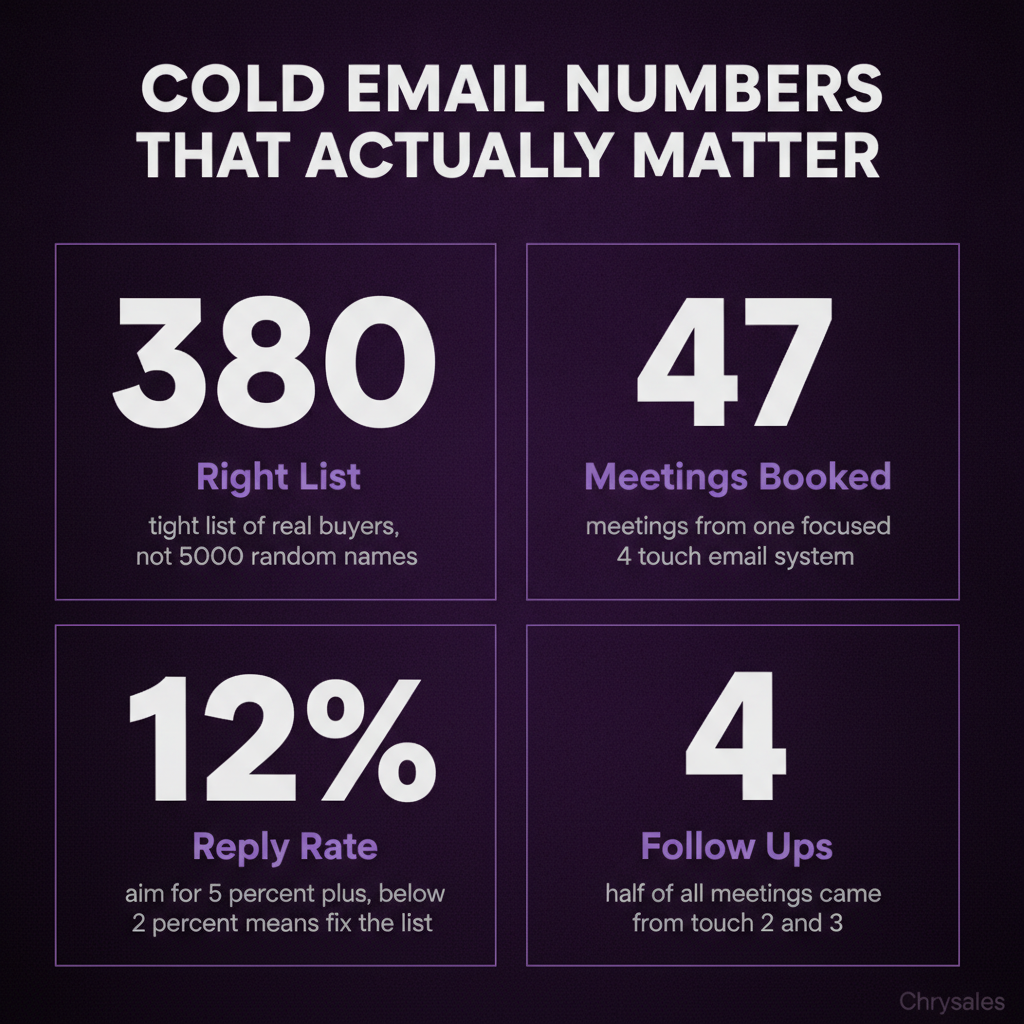
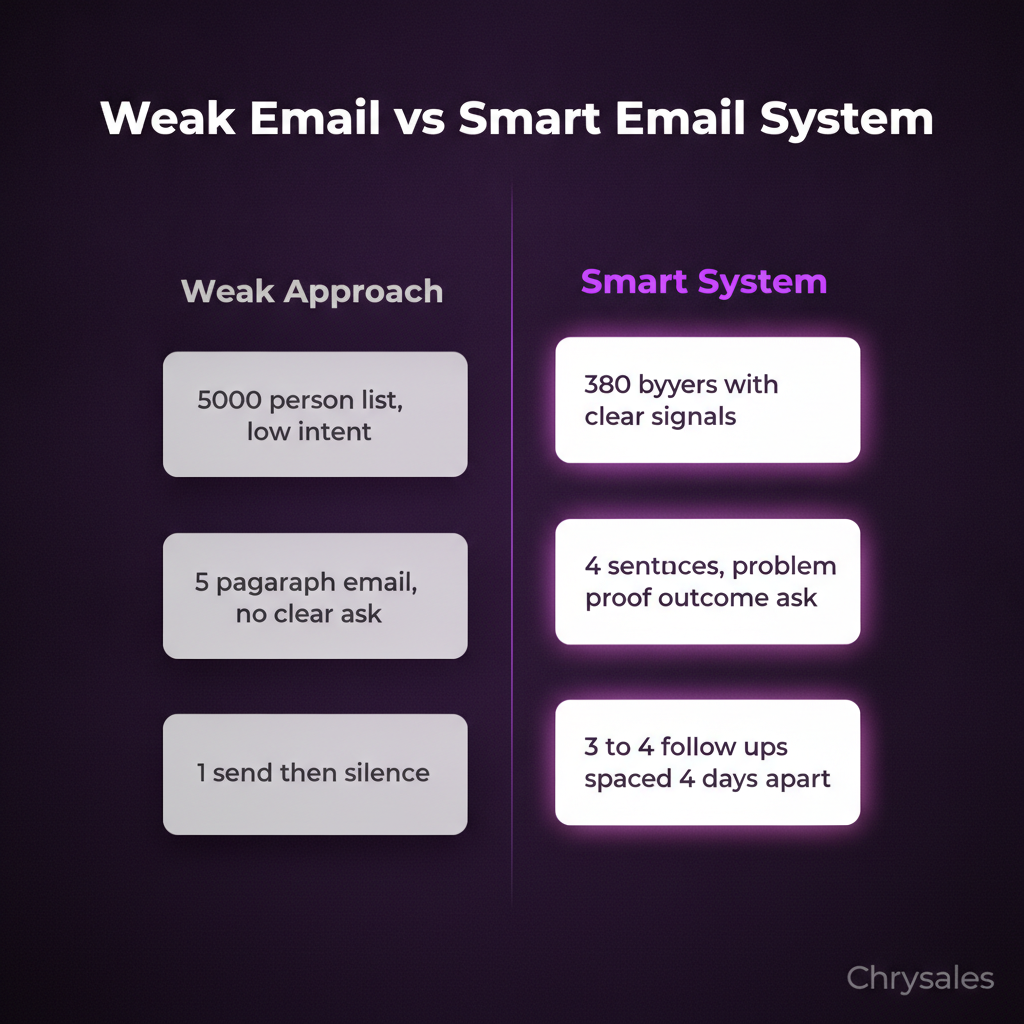
The email that booked 47 meetings started with a list of 380 people. Not 5,000. Not 10,000. Just 380. Each one fit three rules: they had the problem, they had budget, and they were in buying mode. That's it.
Pro Tip: Spend as much time building your list as you do writing your cold email. A tight list of 300 beats a loose list of 3,000 every time. Before you write your 4-sentence email, watch how to find clients who actually need your help right now so you can identify the best prospects first.
The Message Was Short and Specific
The email was 87 words. Four sentences. No fluff. No story about how the sender started their business. No paragraph about "what we do." Just this:
- One sentence about a problem the reader actually has
- One sentence showing proof someone like them solved it
- One sentence with a specific outcome
- One question asking for 15 minutes
That's the whole thing. Most people write five paragraphs. The winning email cut everything that didn't move the reader toward saying yes.
What the 47-Meeting Email Actually Looked Like
The structure was simple. Here's the breakdown:
Opening line: Called out a specific problem tied to the reader's industry. Not "I noticed your company" or "I saw your LinkedIn post." Something like: "Most consulting firms lose deals because their proposals take three weeks to turn around."
Proof line: Dropped a quick example. "A 15-person consulting firm cut their proposal time to 48 hours and closed 9 deals in two months."
Outcome line: Tied it to the reader. "If you're spending more than a week on proposals, we can show you how to cut that in half."
Ask line: Made it easy. "Worth a 15-minute call next week?"
No long paragraphs. No background. No "I'd love to pick your brain" or "Let me know if you're interested." Just a clear problem, proof it's solvable, and a low-friction ask.
Watch out: Adding too much detail kills cold email. The email isn't the pitch. The email is the invitation to the pitch.
Why This Email Hit Different
It passed the five-second test. Most people skim a cold email in five seconds and decide if it's worth reading. This one made the decision easy. The reader could see the problem, the proof, and the ask without scrolling or rereading.
It also avoided the biggest cold email trap: talking about the sender instead of the reader. No "we're a leading provider" or "our platform helps businesses." Every sentence was about the reader's world, not the sender's.
A marketing agency we worked with tried this format last quarter. Their old cold email had a 0.8% reply rate. The new one hit 4.2%. Same list. Same offer. Different message structure.
How to Build Your Own 47-Meeting Email
Start with the list. If your list is weak, your email is pointless. Build a list of people who fit your ideal customer profile and show at least one buying signal. Buying signals include things like: they just raised funding, they posted a job for a role your product helps with, or they mentioned the problem you solve on LinkedIn.
Step 1: Pick 200-400 people who match your ICP. Use LinkedIn Sales Navigator, Apollo, or manual research. Quality beats volume. A tight list of 300 people who actually need your help will outperform a loose list of 5,000 every time.
Step 2: Write your cold email in four sentences. Use the structure above: problem, proof, outcome, ask. Cut everything else. If a sentence doesn't move the reader toward booking a call, delete it. For more examples and templates that use short, problem-focused copy and a single clear ask, see this guide on how to write cold emails step by step.
Step 3: Test your subject line. Keep it under 50 characters. Avoid spammy words like "free," "urgent," or "limited time." Try curiosity-driven subject lines like "Quick question about [specific problem]" or benefit-forward ones like "Cut proposal time in half."
Step 4: Set up your follow-up system before you send email one. Most people quit after the first email. The 47-meeting campaign sent three follow-ups over two weeks. Half the meetings came from follow-up two or three.
Pro Tip: Space follow-ups three to four days apart. Each follow-up should add new value, not just say "bumping this up" or "following up." Share a quick tip, a relevant case study, or a new angle on the problem.
The Follow-Up System That Closed the Deal
The first email booked 18 meetings. The second follow-up booked 14. The third follow-up booked another 12. The rest came from the fourth touch. Without follow-ups, this campaign would've landed 18 meetings, not 47.
What the Follow-Ups Said
Follow-up one (day three): Added a new data point. "Saw that firms in [industry] are dealing with [specific trend]. That proposal speed issue gets worse when [reason]. Still worth a quick call?"
Follow-up two (day seven): Shared a quick win. "Just helped a company like yours cut proposal time from 12 days to 2. Want to see how they did it?"
Follow-up three (day 11): Made it even easier. "If the timing's wrong, no worries. But if this is on your radar at all, I can send over a two-minute breakdown instead of a call. Let me know."
Each follow-up was short. Each one gave the reader a reason to reply that wasn't just "you didn't answer me." And each one stayed focused on the reader's problem, not the sender's need for a meeting.
Common mistake: Sending the same follow-up email three times with different subject lines. It feels lazy and gets ignored. Change the angle or add new information every time. When you're ready to build your own follow-up system, use these cold email follow-up templates you can plug into a 3 to 4 touch sequence.
How to Automate This Without Losing the Personal Touch
You can't manually send 380 cold emails and four follow-ups each. You need automation. But automation that feels robotic kills response rates. The trick is to automate the system, not the personality.
Use a tool like Lemlist, Instantly, or Smartlead to schedule your cold email and follow-ups. These tools let you personalize each email with merge tags (first name, company name, industry) and space out your sends so you don't hit 380 inboxes at the same time.
Set up your sequence once. Load your list. Let the tool handle the timing. But write each email like you're sending it to one person. No "Dear Sir/Madam." No "I hope this email finds you well." Just real sentences that sound like a human wrote them.
Pro Tip: Send your emails from a warmed-up domain. If you blast 380 cold emails from a brand-new email address, you'll land in spam. Warm up your domain for two weeks first by sending low-volume emails to people who will reply.
AI Can Help You Personalize at Scale
One of the biggest cold outreach problems is personalization. Writing a custom first line for 380 people takes forever. AI tools like ChatGPT or Gemini can scan a LinkedIn profile and write a relevant first line in seconds.
Feed the AI a simple prompt: "Write a one-sentence cold email opener for [name] who works at [company] in [role] and recently posted about [topic]." Review the output. Tweak it if it sounds generic. Add it to your email. Move to the next person.
This is how you personalize 380 emails without spending 40 hours. The AI handles the research and first draft. You handle the final polish and quality control.
A 30-person consulting firm used this method last quarter and cut their email prep time from six days to one. To operationalize this into a repeatable system with tools and automation, check out how to send cold emails at scale without losing personalization.
Measuring What Actually Matters in Cold Email
Open rates don't matter. Reply rates do. The 47-meeting email had a 62% open rate and a 12% reply rate. The reply rate is the stat that counts. That's the number that tells you if your message landed.
Track these four numbers:
- Reply rate: How many people respond at all, even if it's "not interested." Aim for 5% or higher. Below 2% means your list or message is broken.
- Positive reply rate: How many replies move toward a meeting. Aim for 2-4%. This tells you if your offer resonates.
- Meeting booking rate: How many replies turn into booked calls. Aim for 50% of positive replies. If fewer than half your positive replies book a call, your ask is too vague or your offer isn't clear.
- Meeting show rate: How many booked calls actually happen. Aim for 70% or higher. Below 60% means you're booking low-intent meetings or your confirmation system is weak.
Watch out: High open rates with low reply rates usually mean your subject line is good but your email body is weak. Fix the body first.
What to Do When Reply Rates Tank
If your reply rate drops below 2%, stop. Don't keep sending. Fix the list or the message first. Most teams keep blasting emails hoping it gets better. It doesn't.
Run a quick test. Send your email to 50 people. Check the reply rate. If it's above 4%, scale it. If it's below 2%, rewrite the email or rebuild the list. Testing on 50 people saves you from wasting 500 sends.
A marketing agency we worked with had a 0.5% reply rate. We rebuilt their list, rewrote their email using the four-sentence structure, and tested it on 60 people. Reply rate jumped to 5.8%. Then we scaled it to 400 sends and booked 19 meetings in three weeks. If you want to compare your reply and meeting rates against other B2B teams, this breakdown of cold email response rate benchmarks and what good looks like will help.
Building a Cold Email System That Compounds Over Time
One great cold email won't build a sales pipeline. A system that sends great cold emails every week will. The difference between a one-time win and a predictable client acquisition system is repeatability.
Here's what a repeatable cold email system looks like:
Monday: Build or update your list. Add 100-200 new names that fit your ICP. Remove anyone who replied "not interested" or bounced.
Tuesday: Write or tweak your email. Use the four-sentence structure. Personalize the first line for each batch. Load the sequence into your automation tool.
Wednesday: Launch the sequence. Let it run for two weeks. Monitor replies daily.
Thursday-Friday: Handle replies. Book meetings. Move positive replies into your CRM. Follow up with people who asked for more info.
Repeat every week. Each cycle adds 10-20 meetings to your pipeline. Over 12 weeks, that's 120-240 meetings. That's how you go from "cold email sometimes works" to "we book 15 meetings a month from cold outreach."
Pro Tip: Track which industries, job titles, and company sizes reply most. Double down on those. Stop emailing the segments that ignore you. A cold email system gets better when you let the data tell you what's working.
When to Hire Someone to Run This for You
If you're spending more than 10 hours a week on cold email, it's time to hire a sales development rep or a lead generation specialist. The system should be repeatable enough that someone else can run it without you.
Document your process. Write down how you build lists, what tools you use, how you write emails, and how you track results. Turn it into a simple checklist. Then hand it off.
Most small sales teams wait too long to hire for this role. They burn out on cold outreach and quit before the system pays off. The fix isn't working harder. It's building a system someone else can run while you close deals.
Frequently Asked Questions
Q: How long should a cold email be?
Keep it under 100 words. Most cold emails that work are 75-100 words, or about four to five sentences. The reader should be able to skim it in five seconds and know what you're offering and what you're asking. If your email takes more than 10 seconds to read, it's too long. Cut anything that doesn't directly answer "why should I care" or "what's the next step." Research on optimal cold email length and data-backed best practices supports keeping messages short and focused.
Q: How many follow-ups should I send?
Send three to four follow-ups spaced three to four days apart. Most meetings come from follow-ups, not the first email. Stop after the fourth follow-up if you get no reply. After that, you're just annoying. Each follow-up should add new information or a new angle, not just repeat the first email. If someone replies and says "not interested," respect it and move on. You can find more proven cold email follow-up examples and timing strategies that help boost response rates without being pushy.
Q: What's a good cold email reply rate?
Aim for 5% or higher. Below 2% means something's broken, either your list or your message. A 10% reply rate is excellent. A 15% reply rate means your list is tight and your message resonates. If you're getting 1% or lower, stop sending and fix your targeting or rewrite your email. Volume won't save a bad message.
Q: Can I use cold email for B2B lead generation if my product is technical?
Yes. Cold email works for technical products if you focus on the problem, not the product. Don't explain how your software works in the first email. Explain the pain point it solves and the outcome the reader gets. Save the technical details for the call. A SaaS company we worked with tripled their meeting booking rate by rewriting their cold email to focus on the business problem instead of the product features. To see how cold email fits into your overall outbound strategy, watch this comparison of cold email versus other outbound channels like cold calling.
Q: How do I personalize cold emails without spending hours on research?
Use AI tools to scan LinkedIn profiles and write custom first lines. Tools like ChatGPT or Gemini can pull relevant details (recent posts, job changes, company news) and draft a one-sentence opener in seconds. Review and tweak each one so it sounds natural, not robotic. This cuts research time from five minutes per email to 30 seconds. For a list of 300, that's 20 hours saved. Case studies on using targeted personalization to increase cold email reply rates show how this approach drives real results.
A cold email is a short, targeted message sent to someone who hasn't asked for it, designed to spark a reply and book a meeting. It works best when built as a repeatable process focused on the right list, clear message, and smart follow-up.
Most cold emails get ignored. But one email script landed 47 meetings in a single month. The difference wasn't the words. It was the system behind those words.
Here's the thing: cold email works when you treat it like a process, not a lottery. This breakdown shows you what went into that email, the list that made it work, and the steps you can copy to build your own version. No fluff. Just what worked.
Why Most Cold Emails Die in the Inbox
Picture this: you spend two hours writing the perfect cold email. You hit send to 500 people. Three reply. One books a call. The rest? Silence.
The problem isn't that cold email is dead. It's that most people skip the steps that make cold email work. They write a decent message and blast it to a bad list. Or they send it to the right people but at the wrong time. Or they nail the list and timing but bury the ask in paragraph three.
Cold outreach works when three things line up: the right list, the right message, and the right follow-up system. Miss one, and your reply rate tanks. Miss two, and you're wasting time.
Common mistake: Thinking the subject line or opening line is the make-or-break part. It matters, but if your list is full of people who don't need what you sell, no subject line saves you.
The List Does Most of the Heavy Lifting
A 200-person company that just did layoffs is not a hot lead. It's a bad fit, full stop. Same with someone who already uses a competitor and signed a three-year contract last month. Your email to them is noise, not signal.
The email that booked 47 meetings started with a list of 380 people. Not 5,000. Not 10,000. Just 380. Each one fit three rules: they had the problem, they had budget, and they were in buying mode. That's it.
Pro Tip: Spend as much time building your list as you do writing your cold email. A tight list of 300 beats a loose list of 3,000 every time. Before you write your 4-sentence email, watch how to find clients who actually need your help right now so you can identify the best prospects first.
The Message Was Short and Specific
The email was 87 words. Four sentences. No fluff. No story about how the sender started their business. No paragraph about "what we do." Just this:
- One sentence about a problem the reader actually has
- One sentence showing proof someone like them solved it
- One sentence with a specific outcome
- One question asking for 15 minutes
That's the whole thing. Most people write five paragraphs. The winning email cut everything that didn't move the reader toward saying yes.
What the 47-Meeting Email Actually Looked Like
The structure was simple. Here's the breakdown:
Opening line: Called out a specific problem tied to the reader's industry. Not "I noticed your company" or "I saw your LinkedIn post." Something like: "Most consulting firms lose deals because their proposals take three weeks to turn around."
Proof line: Dropped a quick example. "A 15-person consulting firm cut their proposal time to 48 hours and closed 9 deals in two months."
Outcome line: Tied it to the reader. "If you're spending more than a week on proposals, we can show you how to cut that in half."
Ask line: Made it easy. "Worth a 15-minute call next week?"
No long paragraphs. No background. No "I'd love to pick your brain" or "Let me know if you're interested." Just a clear problem, proof it's solvable, and a low-friction ask.
Watch out: Adding too much detail kills cold email. The email isn't the pitch. The email is the invitation to the pitch.
Why This Email Hit Different
It passed the five-second test. Most people skim a cold email in five seconds and decide if it's worth reading. This one made the decision easy. The reader could see the problem, the proof, and the ask without scrolling or rereading.
It also avoided the biggest cold email trap: talking about the sender instead of the reader. No "we're a leading provider" or "our platform helps businesses." Every sentence was about the reader's world, not the sender's.
A marketing agency we worked with tried this format last quarter. Their old cold email had a 0.8% reply rate. The new one hit 4.2%. Same list. Same offer. Different message structure.
How to Build Your Own 47-Meeting Email
Start with the list. If your list is weak, your email is pointless. Build a list of people who fit your ideal customer profile and show at least one buying signal. Buying signals include things like: they just raised funding, they posted a job for a role your product helps with, or they mentioned the problem you solve on LinkedIn.
Step 1: Pick 200-400 people who match your ICP. Use LinkedIn Sales Navigator, Apollo, or manual research. Quality beats volume. A tight list of 300 people who actually need your help will outperform a loose list of 5,000 every time.
Step 2: Write your cold email in four sentences. Use the structure above: problem, proof, outcome, ask. Cut everything else. If a sentence doesn't move the reader toward booking a call, delete it. For more examples and templates that use short, problem-focused copy and a single clear ask, see this guide on how to write cold emails step by step.
Step 3: Test your subject line. Keep it under 50 characters. Avoid spammy words like "free," "urgent," or "limited time." Try curiosity-driven subject lines like "Quick question about [specific problem]" or benefit-forward ones like "Cut proposal time in half."
Step 4: Set up your follow-up system before you send email one. Most people quit after the first email. The 47-meeting campaign sent three follow-ups over two weeks. Half the meetings came from follow-up two or three.
Pro Tip: Space follow-ups three to four days apart. Each follow-up should add new value, not just say "bumping this up" or "following up." Share a quick tip, a relevant case study, or a new angle on the problem.
The Follow-Up System That Closed the Deal
The first email booked 18 meetings. The second follow-up booked 14. The third follow-up booked another 12. The rest came from the fourth touch. Without follow-ups, this campaign would've landed 18 meetings, not 47.
What the Follow-Ups Said
Follow-up one (day three): Added a new data point. "Saw that firms in [industry] are dealing with [specific trend]. That proposal speed issue gets worse when [reason]. Still worth a quick call?"
Follow-up two (day seven): Shared a quick win. "Just helped a company like yours cut proposal time from 12 days to 2. Want to see how they did it?"
Follow-up three (day 11): Made it even easier. "If the timing's wrong, no worries. But if this is on your radar at all, I can send over a two-minute breakdown instead of a call. Let me know."
Each follow-up was short. Each one gave the reader a reason to reply that wasn't just "you didn't answer me." And each one stayed focused on the reader's problem, not the sender's need for a meeting.
Common mistake: Sending the same follow-up email three times with different subject lines. It feels lazy and gets ignored. Change the angle or add new information every time. When you're ready to build your own follow-up system, use these cold email follow-up templates you can plug into a 3 to 4 touch sequence.
How to Automate This Without Losing the Personal Touch
You can't manually send 380 cold emails and four follow-ups each. You need automation. But automation that feels robotic kills response rates. The trick is to automate the system, not the personality.
Use a tool like Lemlist, Instantly, or Smartlead to schedule your cold email and follow-ups. These tools let you personalize each email with merge tags (first name, company name, industry) and space out your sends so you don't hit 380 inboxes at the same time.
Set up your sequence once. Load your list. Let the tool handle the timing. But write each email like you're sending it to one person. No "Dear Sir/Madam." No "I hope this email finds you well." Just real sentences that sound like a human wrote them.
Pro Tip: Send your emails from a warmed-up domain. If you blast 380 cold emails from a brand-new email address, you'll land in spam. Warm up your domain for two weeks first by sending low-volume emails to people who will reply.
AI Can Help You Personalize at Scale
One of the biggest cold outreach problems is personalization. Writing a custom first line for 380 people takes forever. AI tools like ChatGPT or Gemini can scan a LinkedIn profile and write a relevant first line in seconds.
Feed the AI a simple prompt: "Write a one-sentence cold email opener for [name] who works at [company] in [role] and recently posted about [topic]." Review the output. Tweak it if it sounds generic. Add it to your email. Move to the next person.
This is how you personalize 380 emails without spending 40 hours. The AI handles the research and first draft. You handle the final polish and quality control.
A 30-person consulting firm used this method last quarter and cut their email prep time from six days to one. To operationalize this into a repeatable system with tools and automation, check out how to send cold emails at scale without losing personalization.
Measuring What Actually Matters in Cold Email
Open rates don't matter. Reply rates do. The 47-meeting email had a 62% open rate and a 12% reply rate. The reply rate is the stat that counts. That's the number that tells you if your message landed.
Track these four numbers:
- Reply rate: How many people respond at all, even if it's "not interested." Aim for 5% or higher. Below 2% means your list or message is broken.
- Positive reply rate: How many replies move toward a meeting. Aim for 2-4%. This tells you if your offer resonates.
- Meeting booking rate: How many replies turn into booked calls. Aim for 50% of positive replies. If fewer than half your positive replies book a call, your ask is too vague or your offer isn't clear.
- Meeting show rate: How many booked calls actually happen. Aim for 70% or higher. Below 60% means you're booking low-intent meetings or your confirmation system is weak.
Watch out: High open rates with low reply rates usually mean your subject line is good but your email body is weak. Fix the body first.
What to Do When Reply Rates Tank
If your reply rate drops below 2%, stop. Don't keep sending. Fix the list or the message first. Most teams keep blasting emails hoping it gets better. It doesn't.
Run a quick test. Send your email to 50 people. Check the reply rate. If it's above 4%, scale it. If it's below 2%, rewrite the email or rebuild the list. Testing on 50 people saves you from wasting 500 sends.
A marketing agency we worked with had a 0.5% reply rate. We rebuilt their list, rewrote their email using the four-sentence structure, and tested it on 60 people. Reply rate jumped to 5.8%. Then we scaled it to 400 sends and booked 19 meetings in three weeks. If you want to compare your reply and meeting rates against other B2B teams, this breakdown of cold email response rate benchmarks and what good looks like will help.
Building a Cold Email System That Compounds Over Time
One great cold email won't build a sales pipeline. A system that sends great cold emails every week will. The difference between a one-time win and a predictable client acquisition system is repeatability.
Here's what a repeatable cold email system looks like:
Monday: Build or update your list. Add 100-200 new names that fit your ICP. Remove anyone who replied "not interested" or bounced.
Tuesday: Write or tweak your email. Use the four-sentence structure. Personalize the first line for each batch. Load the sequence into your automation tool.
Wednesday: Launch the sequence. Let it run for two weeks. Monitor replies daily.
Thursday-Friday: Handle replies. Book meetings. Move positive replies into your CRM. Follow up with people who asked for more info.
Repeat every week. Each cycle adds 10-20 meetings to your pipeline. Over 12 weeks, that's 120-240 meetings. That's how you go from "cold email sometimes works" to "we book 15 meetings a month from cold outreach."
Pro Tip: Track which industries, job titles, and company sizes reply most. Double down on those. Stop emailing the segments that ignore you. A cold email system gets better when you let the data tell you what's working.
When to Hire Someone to Run This for You
If you're spending more than 10 hours a week on cold email, it's time to hire a sales development rep or a lead generation specialist. The system should be repeatable enough that someone else can run it without you.
Document your process. Write down how you build lists, what tools you use, how you write emails, and how you track results. Turn it into a simple checklist. Then hand it off.
Most small sales teams wait too long to hire for this role. They burn out on cold outreach and quit before the system pays off. The fix isn't working harder. It's building a system someone else can run while you close deals.
Frequently Asked Questions
Q: How long should a cold email be?
Keep it under 100 words. Most cold emails that work are 75-100 words, or about four to five sentences. The reader should be able to skim it in five seconds and know what you're offering and what you're asking. If your email takes more than 10 seconds to read, it's too long. Cut anything that doesn't directly answer "why should I care" or "what's the next step." Research on optimal cold email length and data-backed best practices supports keeping messages short and focused.
Q: How many follow-ups should I send?
Send three to four follow-ups spaced three to four days apart. Most meetings come from follow-ups, not the first email. Stop after the fourth follow-up if you get no reply. After that, you're just annoying. Each follow-up should add new information or a new angle, not just repeat the first email. If someone replies and says "not interested," respect it and move on. You can find more proven cold email follow-up examples and timing strategies that help boost response rates without being pushy.
Q: What's a good cold email reply rate?
Aim for 5% or higher. Below 2% means something's broken, either your list or your message. A 10% reply rate is excellent. A 15% reply rate means your list is tight and your message resonates. If you're getting 1% or lower, stop sending and fix your targeting or rewrite your email. Volume won't save a bad message.
Q: Can I use cold email for B2B lead generation if my product is technical?
Yes. Cold email works for technical products if you focus on the problem, not the product. Don't explain how your software works in the first email. Explain the pain point it solves and the outcome the reader gets. Save the technical details for the call. A SaaS company we worked with tripled their meeting booking rate by rewriting their cold email to focus on the business problem instead of the product features. To see how cold email fits into your overall outbound strategy, watch this comparison of cold email versus other outbound channels like cold calling.
Q: How do I personalize cold emails without spending hours on research?
Use AI tools to scan LinkedIn profiles and write custom first lines. Tools like ChatGPT or Gemini can pull relevant details (recent posts, job changes, company news) and draft a one-sentence opener in seconds. Review and tweak each one so it sounds natural, not robotic. This cuts research time from five minutes per email to 30 seconds. For a list of 300, that's 20 hours saved. Case studies on using targeted personalization to increase cold email reply rates show how this approach drives real results.
Scaling Is Not Hard If You Have The Right Systems
If you’re serious about leveling up your scaling game, you need the right system, the right training, and the right team behind you. We're here to give you the exact tools and strategies top entrepreneurs use to dominate.

Discover the latest tips
View All.avif)
Chrysales was formed from the words "chrysalis" the stage where a caterpillar transforms into a butterfly and "sales".
It stands for one thing: sales transformation.Because scaling doesn’t happen by doing more of the same. Scaling only happens when you go through real transformation in your systems, your offer, team and the way you sell.
.avif)


