
How many cold calls a day? Plan by the hour, not the dial
How many cold calls a day should you make? Full-time callers make dozens, but calling is their whole job. As a founder, plan by time instead. Block 60 to 90 minutes, make as many dials (call attempts) as fit, and track what happens for about two weeks.
Your right number is the one that gets you enough meetings at your own rates. Two weeks of tracking will show it.
How many cold calls a day is normal?
Full-time sales reps make dozens of calls a day. Your normal is whatever fits into one protected block.
The usual benchmarks come from SDRs (sales development reps), people whose whole job is booking meetings. The Bridge Group's 2025 survey of B2B companies found SDRs make a median of 44 phone touches a day, meaning calls they make.
Teams built around the phone go higher. The same report says phone-focused SDR teams average 56 dials a day.
Those numbers describe full-time jobs. If you copy that quota with one free hour, you will likely miss it in week one and stop calling. Block the time in your calendar instead, because dialing "when there's time" rarely happens.
Still deciding which channel to start with? Read our guide on whether to start with calls or email.
What happens to your dials
Most dials never reach a person. Of those that do, only some turn into a real talk, and a small share of those end in a meeting.
| Step | What it means | Benchmark |
|---|---|---|
| Dial | One call attempt, answered or not | Your own count |
| Connect | A person picks up | 5.4% (Gong), 9.9% (Belkins) |
| Conversation | The call turns into a real talk | 58% of connects (Belkins) |
| Meeting | The talk ends in a booked meeting | 4.6% of conversations (Gong, Belkins) |
The Gong figures come from its study of more than 300M cold calls and describe the average rep. The Belkins figures come from its own 2025 dial data.
The connect rates differ because the two sources count different things. Gong counts calls a prospect answered, while Belkins counts dials where a live human picked up. Compare your own numbers to one source, not a mix.
End to end, Belkins puts it at roughly one meeting per 370 dials. That is an average from their data, not a forecast for your list.
Work back from the meetings you need
Start from the meetings you want, then work out the dials. Your rates decide how many dials that takes.
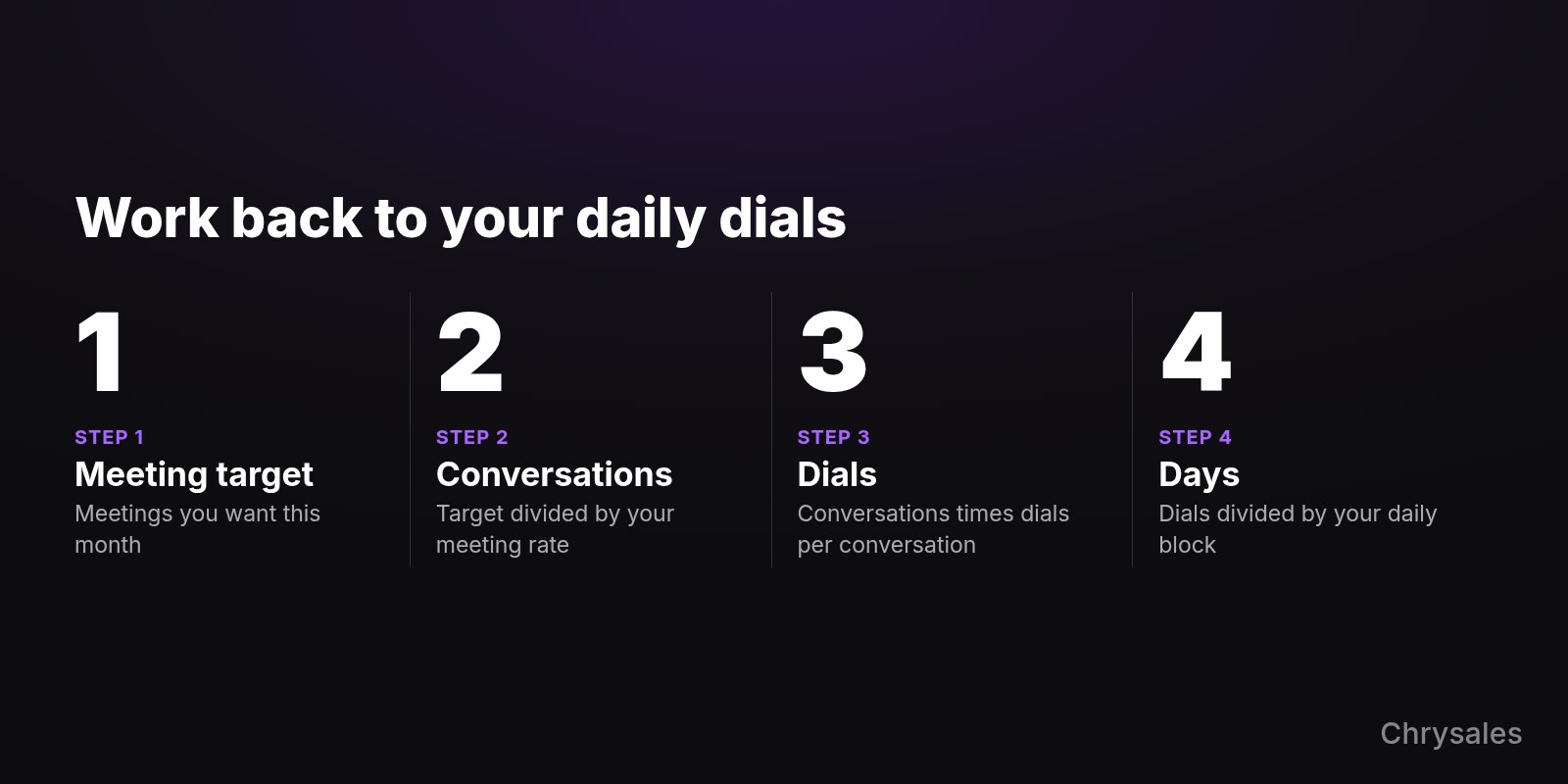
Gong shows this with a simple model. The same 800 dials in a month bring the average rep about 2 meetings and the top rep 18, depending on their rates.
Now do the same math for your own calling time. Software vendors say one person dialing by hand manages about 15 to 25 calls an hour. JustCall notes that no independent study has measured it.
So a 60-90 minute block gives you about 15 to 35 dials a day. Over 20 working days, that's 300 to 700 dials a month.
At Gong's average rates, that brings about 1 to 2 meetings a month.
At the top reps' rates, it's roughly 6 to 15. Both are our estimates from benchmark averages, not promises.
Gong says its top reps call direct numbers first, mark their bad numbers and target the prospects most likely to buy.
Once you have two weeks of your own rates, redo this math with them. The same math for email works the same way.
A daily calling block you can keep
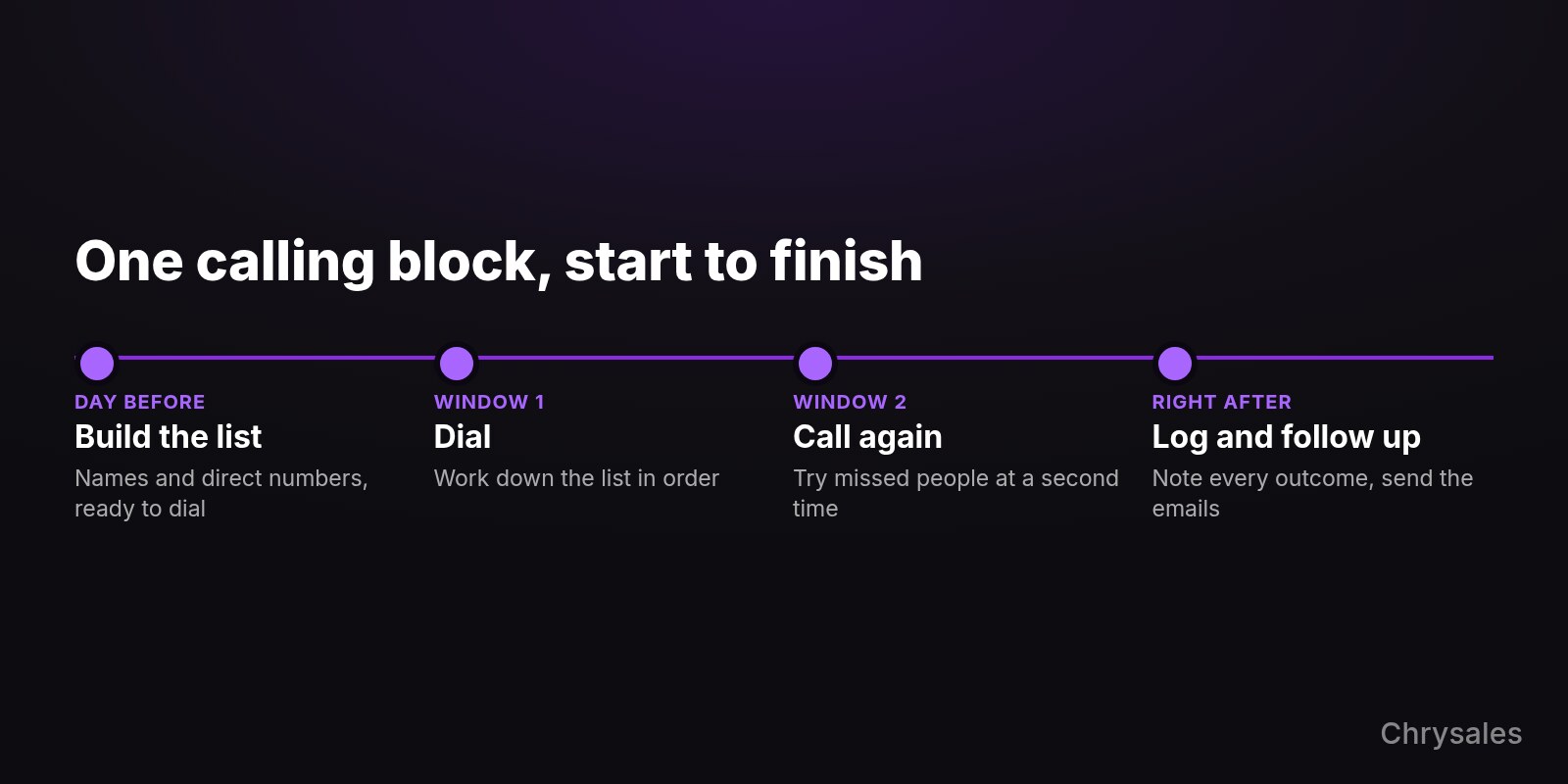
A simple routine we suggest: one block a day, split into two short calling windows, with the list built the day before. Keep the block short enough that you never skip it.
Check the calling rules before your first block. In Germany, UWG §7 allows sales calls to other businesses only with at least their presumed consent. As of November 2026, the UK's ICO says business calls must be screened against the national do-not-call lists, the TPS and the CTPS.
The US, the Nordic countries and Switzerland have their own rules too. This is not legal advice, so check with a lawyer before you call a new country.
Call each person up to three times, on different days, before you move on. Cognism's 2025 report, based on data from the sales agency WHAM, found that by the third call you have had 93% of all conversations.
After a missed call, leave a voicemail and send a short email. In Gong's data, prospects who also got a call replied to emails almost twice as often, even when nobody picked up.
Studies disagree on the best hour, partly because they measure different things. Test two time windows of your own.
Founder Trista Li wrote about a slow start. "I only got to speak with 2 people in a 2-hour block," Li wrote.
Li then capped daily calling time, mostly called in two fixed weekly slots and hung up quickly when no real person answered. A short, fixed block is easier to keep than open-ended calling.
In this live session, Sabir makes real cold calls and works through real objections and responses.
Change the method before adding calls
Give your block about two weeks and at least 100 dials before you judge it. After 20 or 30 calls, you only see noise.
Then read your numbers in order:
- Few connects, well under 5 in 100 dials. Fix the list and the phone numbers first.
- Connects, but few conversations. Fix the first seconds of the call, starting with how you open the call.
- Conversations, but no meetings. Fix the offer and the question you ask at the end.
- Meetings are coming in. Now more dials make sense, so think about a second block.
Conclusion: Book your first calling block
Put one 60-minute calling block in your calendar for every workday this week. Keep the list work for the day before, so the block is only for dialing.
Write down the four numbers from the table each day. After two weeks, find the weak step and fix it before you add calls.
For one worked example of a 100-call test, read what 100 calls to CEOs showed.
Want a calling routine that doesn't depend on you being at the phone every day? Chrysales can build the outreach system around it with you. Talk it through on a free strategy call
How many cold calls a day should you make? Full-time callers make dozens, but calling is their whole job. As a founder, plan by time instead. Block 60 to 90 minutes, make as many dials (call attempts) as fit, and track what happens for about two weeks.
Your right number is the one that gets you enough meetings at your own rates. Two weeks of tracking will show it.
How many cold calls a day is normal?
Full-time sales reps make dozens of calls a day. Your normal is whatever fits into one protected block.
The usual benchmarks come from SDRs (sales development reps), people whose whole job is booking meetings. The Bridge Group's 2025 survey of B2B companies found SDRs make a median of 44 phone touches a day, meaning calls they make.
Teams built around the phone go higher. The same report says phone-focused SDR teams average 56 dials a day.
Those numbers describe full-time jobs. If you copy that quota with one free hour, you will likely miss it in week one and stop calling. Block the time in your calendar instead, because dialing "when there's time" rarely happens.
Still deciding which channel to start with? Read our guide on whether to start with calls or email.
What happens to your dials
Most dials never reach a person. Of those that do, only some turn into a real talk, and a small share of those end in a meeting.
| Step | What it means | Benchmark |
|---|---|---|
| Dial | One call attempt, answered or not | Your own count |
| Connect | A person picks up | 5.4% (Gong), 9.9% (Belkins) |
| Conversation | The call turns into a real talk | 58% of connects (Belkins) |
| Meeting | The talk ends in a booked meeting | 4.6% of conversations (Gong, Belkins) |
The Gong figures come from its study of more than 300M cold calls and describe the average rep. The Belkins figures come from its own 2025 dial data.
The connect rates differ because the two sources count different things. Gong counts calls a prospect answered, while Belkins counts dials where a live human picked up. Compare your own numbers to one source, not a mix.
End to end, Belkins puts it at roughly one meeting per 370 dials. That is an average from their data, not a forecast for your list.
Work back from the meetings you need
Start from the meetings you want, then work out the dials. Your rates decide how many dials that takes.
Gong shows this with a simple model. The same 800 dials in a month bring the average rep about 2 meetings and the top rep 18, depending on their rates.
Now do the same math for your own calling time. Software vendors say one person dialing by hand manages about 15 to 25 calls an hour. JustCall notes that no independent study has measured it.
So a 60-90 minute block gives you about 15 to 35 dials a day. Over 20 working days, that's 300 to 700 dials a month.
At Gong's average rates, that brings about 1 to 2 meetings a month.
At the top reps' rates, it's roughly 6 to 15. Both are our estimates from benchmark averages, not promises.
Gong says its top reps call direct numbers first, mark their bad numbers and target the prospects most likely to buy.
Once you have two weeks of your own rates, redo this math with them. The same math for email works the same way.
A daily calling block you can keep
A simple routine we suggest: one block a day, split into two short calling windows, with the list built the day before. Keep the block short enough that you never skip it.
Check the calling rules before your first block. In Germany, UWG §7 allows sales calls to other businesses only with at least their presumed consent. As of November 2026, the UK's ICO says business calls must be screened against the national do-not-call lists, the TPS and the CTPS.
The US, the Nordic countries and Switzerland have their own rules too. This is not legal advice, so check with a lawyer before you call a new country.
Call each person up to three times, on different days, before you move on. Cognism's 2025 report, based on data from the sales agency WHAM, found that by the third call you have had 93% of all conversations.
After a missed call, leave a voicemail and send a short email. In Gong's data, prospects who also got a call replied to emails almost twice as often, even when nobody picked up.
Studies disagree on the best hour, partly because they measure different things. Test two time windows of your own.
Founder Trista Li wrote about a slow start. "I only got to speak with 2 people in a 2-hour block," Li wrote.
Li then capped daily calling time, mostly called in two fixed weekly slots and hung up quickly when no real person answered. A short, fixed block is easier to keep than open-ended calling.
In this live session, Sabir makes real cold calls and works through real objections and responses.
Change the method before adding calls
Give your block about two weeks and at least 100 dials before you judge it. After 20 or 30 calls, you only see noise.
Then read your numbers in order:
- Few connects, well under 5 in 100 dials. Fix the list and the phone numbers first.
- Connects, but few conversations. Fix the first seconds of the call, starting with how you open the call.
- Conversations, but no meetings. Fix the offer and the question you ask at the end.
- Meetings are coming in. Now more dials make sense, so think about a second block.
Conclusion: Book your first calling block
Put one 60-minute calling block in your calendar for every workday this week. Keep the list work for the day before, so the block is only for dialing.
Write down the four numbers from the table each day. After two weeks, find the weak step and fix it before you add calls.
For one worked example of a 100-call test, read what 100 calls to CEOs showed.
Want a calling routine that doesn't depend on you being at the phone every day? Chrysales can build the outreach system around it with you. Talk it through on a free strategy call
Scaling Is Not Hard If You Have The Right Systems
If you’re serious about leveling up your scaling game, you need the right system, the right training, and the right team behind you. We're here to give you the exact tools and strategies top entrepreneurs use to dominate.

Discover the latest tips
View All
Chrysales was formed from the words "chrysalis" the stage where a caterpillar transforms into a butterfly and "sales".
It stands for one thing: sales transformation.Because scaling doesn’t happen by doing more of the same. Scaling only happens when you go through real transformation in your systems, your offer, team and the way you sell.


