.avif)
Is Cold Calling Dead or Still Worth Doing in 2026?
Cold calling is a direct sales method where you reach out to new prospects by phone, often for lead generation, b2b sales, and client acquisition. Quick question: if cold calling is so dead, why are the fastest-growing B2B companies still doing it?
Here's what actually changed. Cold calling isn't dead. Bad cold calling is. The difference comes down to whether you're dialing into a system or just winging it.
Most teams think the script is the problem. The real issue is everything that happens before the call.
Let's break down what cold calling looks like when it's done right in 2026.
The Real Reason Most Cold Calls Fail
Picture this: you spend three days writing the perfect cold call script. You practice your tonality. You set aside two hours to make calls. You dial 40 numbers. You get four conversations. None of them go anywhere.
The problem wasn't your script. It was your list.
Most cold calling flop because the targeting is wrong from the start. A 200-person company that just did layoffs is not a "hot lead." It's a bad fit, full stop.
When your list is packed with bad-fit prospects, no amount of smooth talking fixes it.
Start with the Right People
Before you pick up the phone, answer three questions:
- Does this company actually need what you sell right now?
- Can they afford it?
- Are you talking to someone who can say yes?
If any answer is no, remove them from the list. Your connect rate will drop, but your booking rate will climb. That's the trade you want.
Research Beats Charm Every Time
Here's the thing: cold calling in 2026 is not really cold anymore. You can see who just raised funding. You can see who posted on LinkedIn about a problem you solve. You can see who hired three salespeople last month.
Spend 90 seconds researching before each call. Find one real reason to reach out. That's your opener. Not "I was hoping to pick your brain." Not "I wanted to see if you'd be open to a quick chat." A real reason.
Pro Tip: If you can't find a real reason in 90 seconds, skip the call and move to the next name.
What a Cold Calling Strategy Actually Looks Like

A cold calling strategy is not a script doc saved in Google Drive. It's a system with five working parts.
The List Build
You need 200 to 300 qualified contacts to start. Not scraped emails. Not random LinkedIn exports. People who match your ideal customer profile and have a reason to care right now.
We see teams waste weeks calling into lists where 60% of contacts are wrong titles or wrong company sizes. Clean your list first. Make calls second.
The Offer Clarity
Your offer is what you're actually proposing on the call. Not your full service menu. One clear thing.
Most cold calls die because the caller tries to explain everything at once. A confused prospect says no. A clear offer gets a yes or a real objection you can handle.
The Opening Hook
Your first 10 seconds decide everything. Open with something that proves you did homework and gets them curious.
Bad opener: "I'm calling from [company], we help businesses with sales."
Good opener: "Saw you're hiring a sales lead right now. Most companies hiring their first sales manager make the same three mistakes. Want to hear them?"
One gets hung up on. One gets "okay, go ahead."
The Objection Handling
You'll hear the same five objections 80% of the time:
- Not interested
- Send me an email
- We're all set
- Call me back in three months
- I need to talk to my team
Write a response for each. Practice it until it sounds natural. Don't argue. Don't pitch harder. Ask a question that uncovers the real reason behind the objection.
Common mistake: Treating "send me an email" as a real request. It's a polite brush-off. Instead, say: "Happy to send something over. Quick question first so I send the right thing, what's your biggest challenge with [relevant topic] right now?"
The Follow-Up Sequence
One call never closes a deal. You need a sequence: call, email, LinkedIn touch, call again, email again.
Most B2B sales take 5 to 12 touches before someone agrees to a meeting. Cold calling works when it's part of a sequence, not a one-shot attempt.
Why B2B Cold Calling Still Works in 2026
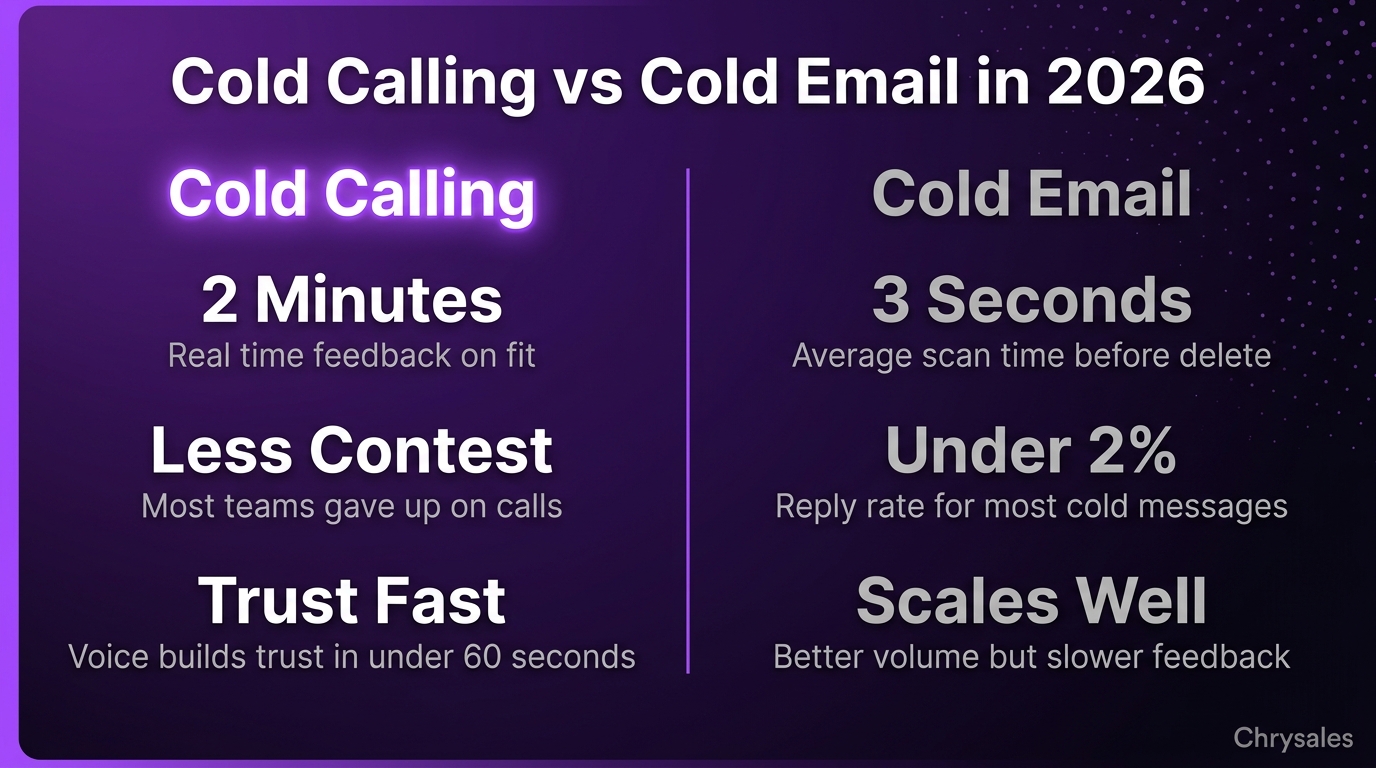
Email open rates are dropping. LinkedIn reply rates are under 2% for most outbound messages. Everyone's inbox is a warzone.
But phone calls? They still cut through.
Here's why cold calling is more powerful now than five years ago. There's less competition. Most sales teams gave up on calls and went all-in on email and LinkedIn. That made the phone a clearer channel.
The Attention Advantage
A cold call forces attention for 30 seconds to two minutes. An email gets scanned in three seconds.
On a call, you can read tone. You can adjust in real time. You can ask questions and actually hear the answers.
That real-time interaction is the edge. You learn more in one two-minute call than in 10 emails back and forth.
The Trust Signal
Picking up the phone and calling someone still signals confidence. It shows you're willing to have a real conversation, not hide behind a template.
People buy from people they trust. A voice does more to build trust in 60 seconds than a cold email ever will.
The Speed Factor
A 30-person consulting firm tried this last quarter. They shifted half their outbound time from email to calls. They booked 12 new calls in three weeks. Before that, they were averaging four bookings a month from 200 emails a week.
The speed of feedback is the key. You know in two minutes if someone is a fit. You don't wait three days for an email reply that never comes.
The Cold Outreach System: Calls Plus Everything Else
Cold calling works best when it's not alone. Think of your sales outreach like a contact list on your phone. If you only try one number once, you'll miss most people. You need multiple ways to reach them.
Multi-Channel Sequences
Here's a simple sequence that works:
- Research the prospect (90 seconds)
- Call them (leave a voicemail if no answer)
- Send a short email referencing the call
- Connect on LinkedIn with a note
- Call again two days later
- Send a second email with a case study or quick win
- Call again four days later
This is not spam. This is persistent, professional follow-up. Most people are busy. They're not ignoring you. They just didn't see it the first time.
If you're deciding how much time to invest in calls versus email, this cold email vs cold calling breakdown shows how each channel contributes to pipeline and where the phone still wins on speed of feedback.
Voicemail Strategy
Leave a voicemail every time. Keep it under 20 seconds. Say your name, your company, one sentence about why you're calling, and your number twice.
Bad voicemail: "Hi, this is John from Acme Corp. We help companies with sales solutions. Give me a call back when you get a chance."
Good voicemail: "Hi, this is John from Acme. Saw you just hired two account execs. I work with sales teams on onboarding systems. Call me back at 555-1234. Again, that's 555-1234."
Watch out: Don't pitch in a voicemail. Just give them a reason to call back.
Email Backup
Your email after a call should be short. Three sentences max.
"Hi [Name], just tried calling you. [One sentence about why]. If Thursday at 2 p.m. works, here's my calendar link: [link]."
That's it. No five-paragraph essay. No attachments. Just a quick follow-up that matches the call.
If you're not sure how to write emails that back up your calls, learn how to craft cold emails that work together with your calling as part of your outbound motion.
Sales Prospecting: How to Build Your Call List
Your call list is the foundation. Most sales prospecting fails because teams build lists based on job titles and company size, then stop there.
You need three layers of filtering:
Layer One: Firmographics
Start with the basics. Company size, industry, location, revenue range.
This gets you a rough universe of possible fits. For example: B2B software companies, 20 to 100 employees, based in Europe or North America, at least €2M in revenue.
Layer Two: Behavioral Signals
Now add signals that show intent or timing. Did they just raise funding? Did they post a job for a role you help with? Did someone from the company engage with your content?
One marketing agency we worked with had a 0.5% reply rate on cold emails. After adding behavioral signals to their list build, their reply rate jumped to 4%. Same emails. Different list.
Instead of static lists, you should build smarter prospect lists with intent and hiring signals so every dial has a reason behind it.
Layer Three: Individual Research
This is the 90-second check before each call. Look at the person's LinkedIn. See what they posted recently. Check the company's news page. Find one specific reason to reach out to them specifically.
This layer turns a cold call into a warm-ish call. It's still outbound. But it doesn't feel random.
Pro Tip: Use a simple scoring system. Give each prospect a score from 1 to 100 based on fit, signals, and research. Anything scoring above 70 goes to the top of your call list.
Cold Calling Scripts That Actually Work
A cold call script is not a word-for-word teleprompter speech. It's a flexible structure with key phrases you can lean on when your brain blanks.
The Five-Part Structure
Here's the framework that works across industries:
1. Pattern Interrupt (5 seconds)Say something that breaks their expectation of a sales call.
"Quick question, do you handle sales hiring, or is that someone else on your team?"
2. Permission (3 seconds)Ask if they have a minute. Sounds small, but it flips the power dynamic.
"Did I catch you at a bad time, or do you have two minutes?"
3. Reason (10 seconds)Say why you're calling. Be specific. Tie it to something real about them or their company.
"I'm calling because you just hired three account execs, and most companies scaling that fast hit the same onboarding bottleneck. I work with sales teams on exactly that."
4. Value Tease (10 seconds)Hint at what you help with, but don't explain everything. Create a little curiosity.
"We've helped 15 companies in your space cut ramp time in half. I'm not sure if it's a fit, but worth a quick conversation."
5. Ask (5 seconds)Propose the next step. Usually a 15 or 20 minute call.
"Does Thursday at 3 p.m. work for 20 minutes?"
That's it. The whole call is 30 to 45 seconds if they say yes. Two minutes if they ask a question or give an objection.
Tonality Matters More Than Words
You can say the perfect script and still get hung up on if your tone is wrong.
You want to sound curious and relaxed, not desperate or overly hyped. Think about how you'd talk to a friend when you're genuinely interested in something they said. That's the tone. Conversational. Confident. Not robotic.
The Role of AI and Automation in Cold Calling
AI is changing how cold calling works, but not in the way most people think. AI won't replace the call itself. It replaces the grunt work around the call.
AI Lead Scoring
You can use AI to score your list automatically. Feed it signals like company growth, hiring activity, tech stack, recent funding, and social engagement. It spits out a score for each contact.
This cuts list-building time from hours to minutes. We use Gemini-based workflows with clients to score 500 leads in under 10 minutes. Then the team calls the top 50.
AI Call Prep
Before each call, AI can pull a summary of the company, recent news, and the contact's LinkedIn activity. It's like having a research assistant for every dial.
You still do the call. But you walk in knowing exactly what to say in the first 10 seconds.
Post-Call Follow-Up Automation
After the call, AI can log notes into your CRM, draft a follow-up email, and schedule the next touch. You focus on the conversation. The system handles the admin.
If you want practical workflows, see how to use AI for scoring, research, and follow-up without losing the human touch on the phone.
Watch out: Don't use AI to write your entire script. It sounds like AI. Use it for research, scoring, and follow-up. The words you say on the call should be yours.
Outbound Sales Systems: Building the Machine Around the Calls
Cold calling is one tool. An outbound sales system is the full machine. Most teams make calls without a system and wonder why results are inconsistent.
Here's what a full system looks like:
The Offer Layer
Before you call anyone, you need a no-brainer offer. This is what you're proposing when they say yes to a meeting.
A weak offer: "Let's talk about how we can help your business."
A strong offer: "Let's do a 20 minute call where I'll show you the three highest-impact fixes for onboarding new salespeople, even if we never work together."
The clearer your offer, the easier the call.
The Pipeline Layer
You need a simple CRM or spreadsheet tracking every contact through stages: cold, contacted, replied, meeting booked, meeting held, proposal sent, closed.
When you can see your pipeline, you know where to focus. If 50 people are stuck at "contacted" with no reply, you need better follow-up. If 20 meetings happened but no proposals went out, you need better discovery.
The Feedback Layer
After every 25 calls, review what worked and what didn't. Which objections came up most? Which openers got the best response? Which contacts were total dead ends?
This feedback loop is how you get better. Most teams make 200 calls, see mediocre results, and give up. The best teams make 200 calls, adjust, and make 200 more.
If you want to build a repeatable outbound engine, you need to build a sales system around your calls, not just scripts.
Training Your Team to Make Cold Calls
If you're building a sales team, cold calling is a skill you have to train. Handing someone a script and saying "start calling" is like giving someone car keys and saying "figure out how to drive."
Role-Playing
Before anyone makes a real call, they should practice 20 to 30 calls in role-play. You play the prospect. They practice the script. You throw objections at them.
This builds muscle memory. When a real prospect says "not interested," they don't freeze. They've heard it 15 times already in practice.
Live Call Coaching
Sit with new reps on their first 10 to 20 live calls. Listen in. Take notes. Debrief after each one.
What did they do well? Where did they stumble? What objection caught them off guard?
This real-time feedback is how they improve fast.
Call Recording and Review
Record every call (with permission where required). Review the best calls and the worst calls each week.
The best calls show what good looks like. The worst calls show where the gaps are. Both are useful.
Common mistake: Skipping training and hiring "experienced" reps who already know how to sell. Every company's cold call is different. Every offer is different. Even experienced reps need onboarding on your specific system.
Frequently Asked Questions
Q: Is cold calling dead in 2026?
No. Cold calling is not dead. Bad cold calling is dead. The kind where you call random people with no research and a generic pitch. That doesn't work anymore. But calling the right people, with a real reason, and a clear offer? That still works better than most channels. The competition is lower because everyone else gave up.
Q: How many cold calls does it take to book a meeting?
It depends on your list quality and your offer. A good benchmark is 30 to 50 calls to book one meeting. If you're way above that, your targeting is probably off or your offer isn't clear. If you're below that, you're doing something right. Track your numbers weekly and adjust.
Q: Should I use cold calling or cold email for B2B lead generation?
Use both. Cold calling and cold email work best together. Call first, email after. Or email first, call two days later. The multi-touch sequence is what books meetings, not one channel alone. Calls get faster feedback. Emails scale better. Combine them.
Q: What's the best time to make cold calls?
Mornings between 9 a.m. and 11 a.m. and late afternoons between 4 p.m. and 5 p.m. tend to work best for B2B. People are at their desks but not deep in meetings yet. Avoid Mondays before 10 a.m. and Fridays after 3 p.m. Test your own audience, though. Some industries have different rhythms.
Q: How do you handle objections on cold calls?
Don't argue. Don't push harder. Ask a question. If they say "not interested," ask "What are you doing now for [problem you solve]?" If they say "send me an email," say "Happy to, what's the one thing you'd want to see in it?" Most objections are autopilot responses. A good question gets them thinking instead of deflecting.
Q: Can AI make cold calls for me?
AI can help with research, scoring, and follow-up, but it can't replace the human conversation yet. AI voices sound robotic and prospects hang up. Use AI to prepare better and follow up faster. Do the actual call yourself. That's where trust gets built and real conversations happen.
Q: How long should a cold call last?
Aim for 30 seconds to two minutes. You're not closing a deal on the call. You're booking a meeting. Say why you're calling, give a quick value tease, handle one objection if it comes up, and ask for the meeting. If the call goes longer because they're asking questions, great. But don't drag it out trying to pitch everything.
Cold calling is a direct sales method where you reach out to new prospects by phone, often for lead generation, b2b sales, and client acquisition. Quick question: if cold calling is so dead, why are the fastest-growing B2B companies still doing it?
Here's what actually changed. Cold calling isn't dead. Bad cold calling is. The difference comes down to whether you're dialing into a system or just winging it.
Most teams think the script is the problem. The real issue is everything that happens before the call.
Let's break down what cold calling looks like when it's done right in 2026.
The Real Reason Most Cold Calls Fail
Picture this: you spend three days writing the perfect cold call script. You practice your tonality. You set aside two hours to make calls. You dial 40 numbers. You get four conversations. None of them go anywhere.
The problem wasn't your script. It was your list.
Most cold calling flop because the targeting is wrong from the start. A 200-person company that just did layoffs is not a "hot lead." It's a bad fit, full stop.
When your list is packed with bad-fit prospects, no amount of smooth talking fixes it.
Start with the Right People
Before you pick up the phone, answer three questions:
- Does this company actually need what you sell right now?
- Can they afford it?
- Are you talking to someone who can say yes?
If any answer is no, remove them from the list. Your connect rate will drop, but your booking rate will climb. That's the trade you want.
Research Beats Charm Every Time
Here's the thing: cold calling in 2026 is not really cold anymore. You can see who just raised funding. You can see who posted on LinkedIn about a problem you solve. You can see who hired three salespeople last month.
Spend 90 seconds researching before each call. Find one real reason to reach out. That's your opener. Not "I was hoping to pick your brain." Not "I wanted to see if you'd be open to a quick chat." A real reason.
Pro Tip: If you can't find a real reason in 90 seconds, skip the call and move to the next name.
What a Cold Calling Strategy Actually Looks Like
A cold calling strategy is not a script doc saved in Google Drive. It's a system with five working parts.
The List Build
You need 200 to 300 qualified contacts to start. Not scraped emails. Not random LinkedIn exports. People who match your ideal customer profile and have a reason to care right now.
We see teams waste weeks calling into lists where 60% of contacts are wrong titles or wrong company sizes. Clean your list first. Make calls second.
The Offer Clarity
Your offer is what you're actually proposing on the call. Not your full service menu. One clear thing.
Most cold calls die because the caller tries to explain everything at once. A confused prospect says no. A clear offer gets a yes or a real objection you can handle.
The Opening Hook
Your first 10 seconds decide everything. Open with something that proves you did homework and gets them curious.
Bad opener: "I'm calling from [company], we help businesses with sales."
Good opener: "Saw you're hiring a sales lead right now. Most companies hiring their first sales manager make the same three mistakes. Want to hear them?"
One gets hung up on. One gets "okay, go ahead."
The Objection Handling
You'll hear the same five objections 80% of the time:
- Not interested
- Send me an email
- We're all set
- Call me back in three months
- I need to talk to my team
Write a response for each. Practice it until it sounds natural. Don't argue. Don't pitch harder. Ask a question that uncovers the real reason behind the objection.
Common mistake: Treating "send me an email" as a real request. It's a polite brush-off. Instead, say: "Happy to send something over. Quick question first so I send the right thing, what's your biggest challenge with [relevant topic] right now?"
The Follow-Up Sequence
One call never closes a deal. You need a sequence: call, email, LinkedIn touch, call again, email again.
Most B2B sales take 5 to 12 touches before someone agrees to a meeting. Cold calling works when it's part of a sequence, not a one-shot attempt.
Why B2B Cold Calling Still Works in 2026
Email open rates are dropping. LinkedIn reply rates are under 2% for most outbound messages. Everyone's inbox is a warzone.
But phone calls? They still cut through.
Here's why cold calling is more powerful now than five years ago. There's less competition. Most sales teams gave up on calls and went all-in on email and LinkedIn. That made the phone a clearer channel.
The Attention Advantage
A cold call forces attention for 30 seconds to two minutes. An email gets scanned in three seconds.
On a call, you can read tone. You can adjust in real time. You can ask questions and actually hear the answers.
That real-time interaction is the edge. You learn more in one two-minute call than in 10 emails back and forth.
The Trust Signal
Picking up the phone and calling someone still signals confidence. It shows you're willing to have a real conversation, not hide behind a template.
People buy from people they trust. A voice does more to build trust in 60 seconds than a cold email ever will.
The Speed Factor
A 30-person consulting firm tried this last quarter. They shifted half their outbound time from email to calls. They booked 12 new calls in three weeks. Before that, they were averaging four bookings a month from 200 emails a week.
The speed of feedback is the key. You know in two minutes if someone is a fit. You don't wait three days for an email reply that never comes.
The Cold Outreach System: Calls Plus Everything Else
Cold calling works best when it's not alone. Think of your sales outreach like a contact list on your phone. If you only try one number once, you'll miss most people. You need multiple ways to reach them.
Multi-Channel Sequences
Here's a simple sequence that works:
- Research the prospect (90 seconds)
- Call them (leave a voicemail if no answer)
- Send a short email referencing the call
- Connect on LinkedIn with a note
- Call again two days later
- Send a second email with a case study or quick win
- Call again four days later
This is not spam. This is persistent, professional follow-up. Most people are busy. They're not ignoring you. They just didn't see it the first time.
If you're deciding how much time to invest in calls versus email, this cold email vs cold calling breakdown shows how each channel contributes to pipeline and where the phone still wins on speed of feedback.
Voicemail Strategy
Leave a voicemail every time. Keep it under 20 seconds. Say your name, your company, one sentence about why you're calling, and your number twice.
Bad voicemail: "Hi, this is John from Acme Corp. We help companies with sales solutions. Give me a call back when you get a chance."
Good voicemail: "Hi, this is John from Acme. Saw you just hired two account execs. I work with sales teams on onboarding systems. Call me back at 555-1234. Again, that's 555-1234."
Watch out: Don't pitch in a voicemail. Just give them a reason to call back.
Email Backup
Your email after a call should be short. Three sentences max.
"Hi [Name], just tried calling you. [One sentence about why]. If Thursday at 2 p.m. works, here's my calendar link: [link]."
That's it. No five-paragraph essay. No attachments. Just a quick follow-up that matches the call.
If you're not sure how to write emails that back up your calls, learn how to craft cold emails that work together with your calling as part of your outbound motion.
Sales Prospecting: How to Build Your Call List
Your call list is the foundation. Most sales prospecting fails because teams build lists based on job titles and company size, then stop there.
You need three layers of filtering:
Layer One: Firmographics
Start with the basics. Company size, industry, location, revenue range.
This gets you a rough universe of possible fits. For example: B2B software companies, 20 to 100 employees, based in Europe or North America, at least €2M in revenue.
Layer Two: Behavioral Signals
Now add signals that show intent or timing. Did they just raise funding? Did they post a job for a role you help with? Did someone from the company engage with your content?
One marketing agency we worked with had a 0.5% reply rate on cold emails. After adding behavioral signals to their list build, their reply rate jumped to 4%. Same emails. Different list.
Instead of static lists, you should build smarter prospect lists with intent and hiring signals so every dial has a reason behind it.
Layer Three: Individual Research
This is the 90-second check before each call. Look at the person's LinkedIn. See what they posted recently. Check the company's news page. Find one specific reason to reach out to them specifically.
This layer turns a cold call into a warm-ish call. It's still outbound. But it doesn't feel random.
Pro Tip: Use a simple scoring system. Give each prospect a score from 1 to 100 based on fit, signals, and research. Anything scoring above 70 goes to the top of your call list.
Cold Calling Scripts That Actually Work
A cold call script is not a word-for-word teleprompter speech. It's a flexible structure with key phrases you can lean on when your brain blanks.
The Five-Part Structure
Here's the framework that works across industries:
1. Pattern Interrupt (5 seconds)Say something that breaks their expectation of a sales call.
"Quick question, do you handle sales hiring, or is that someone else on your team?"
2. Permission (3 seconds)Ask if they have a minute. Sounds small, but it flips the power dynamic.
"Did I catch you at a bad time, or do you have two minutes?"
3. Reason (10 seconds)Say why you're calling. Be specific. Tie it to something real about them or their company.
"I'm calling because you just hired three account execs, and most companies scaling that fast hit the same onboarding bottleneck. I work with sales teams on exactly that."
4. Value Tease (10 seconds)Hint at what you help with, but don't explain everything. Create a little curiosity.
"We've helped 15 companies in your space cut ramp time in half. I'm not sure if it's a fit, but worth a quick conversation."
5. Ask (5 seconds)Propose the next step. Usually a 15 or 20 minute call.
"Does Thursday at 3 p.m. work for 20 minutes?"
That's it. The whole call is 30 to 45 seconds if they say yes. Two minutes if they ask a question or give an objection.
Tonality Matters More Than Words
You can say the perfect script and still get hung up on if your tone is wrong.
You want to sound curious and relaxed, not desperate or overly hyped. Think about how you'd talk to a friend when you're genuinely interested in something they said. That's the tone. Conversational. Confident. Not robotic.
The Role of AI and Automation in Cold Calling
AI is changing how cold calling works, but not in the way most people think. AI won't replace the call itself. It replaces the grunt work around the call.
AI Lead Scoring
You can use AI to score your list automatically. Feed it signals like company growth, hiring activity, tech stack, recent funding, and social engagement. It spits out a score for each contact.
This cuts list-building time from hours to minutes. We use Gemini-based workflows with clients to score 500 leads in under 10 minutes. Then the team calls the top 50.
AI Call Prep
Before each call, AI can pull a summary of the company, recent news, and the contact's LinkedIn activity. It's like having a research assistant for every dial.
You still do the call. But you walk in knowing exactly what to say in the first 10 seconds.
Post-Call Follow-Up Automation
After the call, AI can log notes into your CRM, draft a follow-up email, and schedule the next touch. You focus on the conversation. The system handles the admin.
If you want practical workflows, see how to use AI for scoring, research, and follow-up without losing the human touch on the phone.
Watch out: Don't use AI to write your entire script. It sounds like AI. Use it for research, scoring, and follow-up. The words you say on the call should be yours.
Outbound Sales Systems: Building the Machine Around the Calls
Cold calling is one tool. An outbound sales system is the full machine. Most teams make calls without a system and wonder why results are inconsistent.
Here's what a full system looks like:
The Offer Layer
Before you call anyone, you need a no-brainer offer. This is what you're proposing when they say yes to a meeting.
A weak offer: "Let's talk about how we can help your business."
A strong offer: "Let's do a 20 minute call where I'll show you the three highest-impact fixes for onboarding new salespeople, even if we never work together."
The clearer your offer, the easier the call.
The Pipeline Layer
You need a simple CRM or spreadsheet tracking every contact through stages: cold, contacted, replied, meeting booked, meeting held, proposal sent, closed.
When you can see your pipeline, you know where to focus. If 50 people are stuck at "contacted" with no reply, you need better follow-up. If 20 meetings happened but no proposals went out, you need better discovery.
The Feedback Layer
After every 25 calls, review what worked and what didn't. Which objections came up most? Which openers got the best response? Which contacts were total dead ends?
This feedback loop is how you get better. Most teams make 200 calls, see mediocre results, and give up. The best teams make 200 calls, adjust, and make 200 more.
If you want to build a repeatable outbound engine, you need to build a sales system around your calls, not just scripts.
Training Your Team to Make Cold Calls
If you're building a sales team, cold calling is a skill you have to train. Handing someone a script and saying "start calling" is like giving someone car keys and saying "figure out how to drive."
Role-Playing
Before anyone makes a real call, they should practice 20 to 30 calls in role-play. You play the prospect. They practice the script. You throw objections at them.
This builds muscle memory. When a real prospect says "not interested," they don't freeze. They've heard it 15 times already in practice.
Live Call Coaching
Sit with new reps on their first 10 to 20 live calls. Listen in. Take notes. Debrief after each one.
What did they do well? Where did they stumble? What objection caught them off guard?
This real-time feedback is how they improve fast.
Call Recording and Review
Record every call (with permission where required). Review the best calls and the worst calls each week.
The best calls show what good looks like. The worst calls show where the gaps are. Both are useful.
Common mistake: Skipping training and hiring "experienced" reps who already know how to sell. Every company's cold call is different. Every offer is different. Even experienced reps need onboarding on your specific system.
Frequently Asked Questions
Q: Is cold calling dead in 2026?
No. Cold calling is not dead. Bad cold calling is dead. The kind where you call random people with no research and a generic pitch. That doesn't work anymore. But calling the right people, with a real reason, and a clear offer? That still works better than most channels. The competition is lower because everyone else gave up.
Q: How many cold calls does it take to book a meeting?
It depends on your list quality and your offer. A good benchmark is 30 to 50 calls to book one meeting. If you're way above that, your targeting is probably off or your offer isn't clear. If you're below that, you're doing something right. Track your numbers weekly and adjust.
Q: Should I use cold calling or cold email for B2B lead generation?
Use both. Cold calling and cold email work best together. Call first, email after. Or email first, call two days later. The multi-touch sequence is what books meetings, not one channel alone. Calls get faster feedback. Emails scale better. Combine them.
Q: What's the best time to make cold calls?
Mornings between 9 a.m. and 11 a.m. and late afternoons between 4 p.m. and 5 p.m. tend to work best for B2B. People are at their desks but not deep in meetings yet. Avoid Mondays before 10 a.m. and Fridays after 3 p.m. Test your own audience, though. Some industries have different rhythms.
Q: How do you handle objections on cold calls?
Don't argue. Don't push harder. Ask a question. If they say "not interested," ask "What are you doing now for [problem you solve]?" If they say "send me an email," say "Happy to, what's the one thing you'd want to see in it?" Most objections are autopilot responses. A good question gets them thinking instead of deflecting.
Q: Can AI make cold calls for me?
AI can help with research, scoring, and follow-up, but it can't replace the human conversation yet. AI voices sound robotic and prospects hang up. Use AI to prepare better and follow up faster. Do the actual call yourself. That's where trust gets built and real conversations happen.
Q: How long should a cold call last?
Aim for 30 seconds to two minutes. You're not closing a deal on the call. You're booking a meeting. Say why you're calling, give a quick value tease, handle one objection if it comes up, and ask for the meeting. If the call goes longer because they're asking questions, great. But don't drag it out trying to pitch everything.
Scaling Is Not Hard If You Have The Right Systems
If you’re serious about leveling up your scaling game, you need the right system, the right training, and the right team behind you. We're here to give you the exact tools and strategies top entrepreneurs use to dominate.

Discover the latest tips
View All.avif)
Chrysales was formed from the words "chrysalis" the stage where a caterpillar transforms into a butterfly and "sales".
It stands for one thing: sales transformation.Because scaling doesn’t happen by doing more of the same. Scaling only happens when you go through real transformation in your systems, your offer, team and the way you sell.
.avif)


