.avif)
What Cold Calling 100 Ceos Actually Taught Me About B2B

Cold calling for B2B is a way to reach people by phone, start real conversations, and create lead generation opportunities for b2b sales. It can support b2b lead generation, sales training, client acquisition, and gtm work. Picture this: 100 calls. One day. Zero warm leads. Just me, a phone, and a list of CEOs who didn't ask to hear from me. Most people think cold calling for B2B is dead. After those 100 calls, I can tell you it's not dead. But it's also not what you think. The results were surprising, the lessons were clear, and the patterns that showed up were different than what most sales training teaches. Here's what I learned from calling 100 CEOs in a single day, and what actually worked.
The Setup: Why I Did This in the First Place
This wasn't a stunt. It was research. We were building a new B2B sales system for a client and needed real data on how decision makers respond to cold calls in 2024. Not theories from a blog post. Not best practices from 2018. Real reactions, real objections, real conversations. The target list was simple: 100 CEOs at companies between 15 and 150 people. Mix of tech companies, marketing agencies, and consulting firms. All in the US and UK. All had a business model where b2b lead generation mattered. None of them knew me. None of them were warm leads. That was the point.
Pro Tip: If you're going to test cold calling, pick a narrow list. Calling 100 random companies teaches you nothing. Calling 100 similar companies shows you patterns.
The List Made All the Difference
Here's the thing: the list quality mattered more than my script. Half the battle was just getting someone on the phone. I used a list enrichment tool to verify phone numbers and filter out companies that had just done layoffs or funding rounds. A company that just raised $10M is not picking up unknown calls. A company that's been stable for 18 months and is hiring? Much better odds. Most cold calling advice skips this part. They tell you how to talk. They don't tell you who to call. That's backwards. The list does most of the heavy lifting.
I Called Between 10 AM and 2 PM
Timing mattered. Early morning? People are in meetings or haven't started yet. After 3 PM? Most CEOs are checked out or in back-to-back calls. The sweet spot was between 10 AM and 2 PM local time. I split the day into two blocks: US East Coast in the morning, UK in the afternoon. Out of 100 calls, I got through to a human 47 times. That's a 47% connect rate, which is consistent with published B2B cold calling benchmarks for well-timed B2B cold calling. The other 53 calls? Voicemail, gatekeeper hang-ups, or wrong numbers.
What Happened on the First 10 Calls
The first 10 calls were rough. Not because the script was bad. Because I sounded nervous. You can hear it in your own voice when you're not confident. The first few people I reached could tell I was reading something. One person said, "Are you reading a script?" and hung up before I could answer. By call 8, I stopped looking at the script. I knew the opening line. I knew the two questions I wanted to ask. I knew the offer. That's when things got smoother.
The Opening Line That Worked
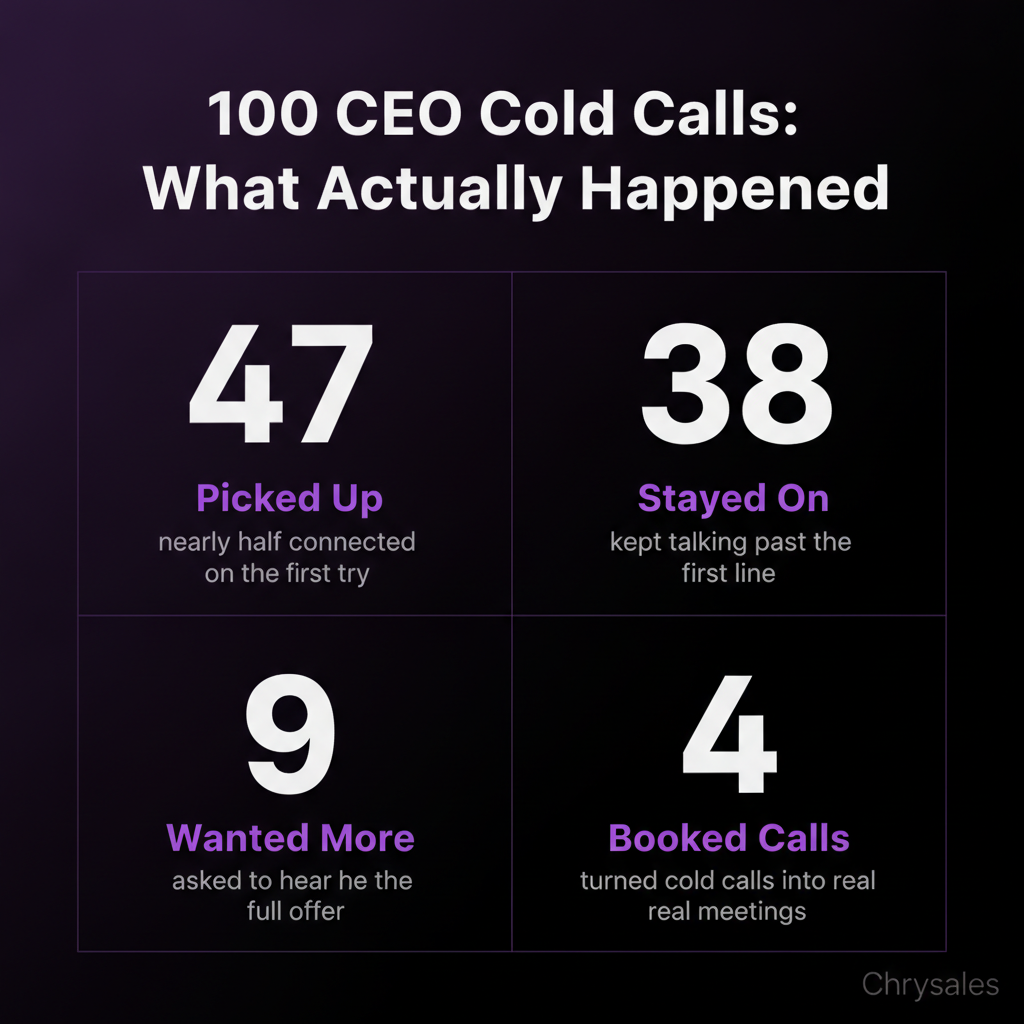
Most cold calling scripts start with, "Hi, my name is [name], I'm with [company], we help businesses with [thing]." It's boring. It sounds like every other call they've gotten that week. I opened with this instead: "Hey [name], this is Sabir. Quick question before I explain why I'm calling, are you still handling sales yourself or did you bring someone in?" That opening did three things. It used their name. It asked a real question. It implied I might actually know something about their business. Out of the 47 people I reached, 38 stayed on the line past that first sentence. That's an 81% engagement rate just from the opener. For more examples that keep decision-makers engaged, check out these proven cold call opener strategies for B2B sales.
Watch out: If your opening sounds like a telemarketer, people will treat you like one. Lead with a question, not a pitch.
The 10-Second Rule
If I didn't establish relevance in the first 10 seconds, the call was over. The fastest hang-up I got was 4 seconds. The longest conversation was 18 minutes. The difference? How fast I made it about them, not me. Most people think cold calling is about explaining your service. It's not. It's about asking the right question fast enough that they want to answer it. If you can get someone talking about their business in the first 15 seconds, you've won half the battle.
The Objections I Heard Over and Over
Out of 47 conversations, I heard the same objections on repeat. "We're all set." "Not interested right now." "Send me an email." These aren't real objections. They're reflex responses. People say them because they don't know what else to say when a stranger calls. The real objection is always the same: "Why should I care?" If you don't answer that in the first 20 seconds, nothing else matters.
"We're All Set" Is Not a Real Objection
When someone says "we're all set," they're not saying they don't have problems. They're saying they don't think you can solve them. Or they don't want to deal with a sales call right now. Most sales reps hear "we're all set" and give up. I heard it 22 times. I responded the same way every time: "That's great. Quick question, are you booking enough calls each week or is pipeline a priority right now?" Nine of those 22 people kept talking. They weren't all set. They just didn't want to admit they had a problem until I asked a better question.
Common mistake: Treating "we're all set" like a hard no. It's a soft no. Ask one more question before you hang up.
"Send Me an Email" Means You Lost Them
I got "send me an email" 14 times. That's code for "I want to get off this call but I don't want to be rude." I sent 14 emails. Zero responses. If someone asks you to send an email on a cold call, you didn't build enough interest to keep them on the phone. That's not their fault. That's your opening. The fix? Don't let them off the phone without booking a follow-up. If they say "send me an email," I said, "Happy to. Before I do, can I ask one quick question so I send the right info?" That kept 4 of the 14 people talking long enough to turn the call into something useful.
What Worked Better Than I Expected

Three things worked way better than I thought they would. None of them were in the original script. All of them came from just talking to people and noticing what got them to open up.
Asking About Hiring
One of the questions I asked was, "Are you planning to hire a salesperson in the next few months, or are you handling sales yourself?" That question hit different. Out of 47 people, 19 said they were thinking about hiring or had just hired someone. That's 40% of the people I talked to. When someone is hiring for sales, they know they have a problem. They're not defensive. They're looking for help. That made the rest of the conversation way easier. I wasn't selling them on the problem. They already knew the problem existed. A 30-person consulting firm told me they'd just hired two salespeople and neither one was hitting quota. That turned into an 18-minute conversation about sales training and whether their onboarding process was the issue. We booked a follow-up call on the spot.
Pro Tip: If someone just hired a salesperson, that's a signal. They're either looking for support or realizing they need a system around that hire.
Mentioning a Specific Company Type
Instead of saying "we work with B2B companies," I said "we work with marketing agencies and consulting firms that are trying to scale past $50K a month." That specificity mattered. People want to know you've worked with businesses like theirs, not just "businesses." When I said "marketing agencies," the people at marketing agencies perked up. When I said "consulting firms," the consultants stayed on the line longer. It's a small thing, but it signals you're not just dialing random numbers. You picked them for a reason.
The "What's Working Right Now" Question
Halfway through the day, I started asking, "What's working for you right now in terms of client acquisition?" That question opened up more honest conversations than anything else I tried. People love talking about what's working. It's way easier than admitting what's broken. One CEO at a tech company told me cold email was getting them a 2% reply rate. I asked if that was good enough to hit their revenue goals. He paused and said, "Honestly, no." That pause was the buying signal. We talked for another 12 minutes about building a better B2B lead generation system. If you're curious how cold email stacks up against calling, you can watch a detailed comparison of cold email vs cold calling benchmarks to see which channel drives revenue faster.
The Numbers Breakdown
Out of 100 calls, here's what happened:
- 47 people picked up or called me back
- 38 stayed on the line past the opener
- 19 had a real conversation (more than 2 minutes)
- 9 were interested enough to hear more
- 4 booked a follow-up call
That's a 4% conversion rate from calls to booked meetings. Is that good? Depends on your offer and your list. For a cold list of CEOs who didn't know me, 4% is solid. Most cold outreach for agency owners or B2B sales teams sees conversion rates between 1% and 5%, so this was right in the middle. If I'd had a warmer list, people who engaged with content, visited the website, or fit a tighter ICP, those numbers would have been higher. But the point wasn't to close deals. It was to see what happened when you called 100 CEOs with a decent script and a good list.
The Calls That Went Nowhere
Most of the calls went nowhere. That's normal. Out of 47 conversations, 28 were polite but uninterested. They didn't hang up on me. They just weren't in buying mode. Some said "call me in a few months." Some said "we just signed with someone else." Some said "we're too small right now." That's fine. Cold calling for B2B isn't about closing everyone. It's about finding the few people who are in the market right now. If you expect every call to turn into a meeting, you'll burn out fast.
Watch out: If 90% of your calls go nowhere, don't blame the tactic. Check your list. You might be calling the wrong people.
The Follow-Up Is Where It Gets Real
Out of the 4 booked calls, 3 showed up. One turned into a client. That's a 25% close rate from follow-up to client, which is way higher than most cold outreach campaigns. Why? Because the people who agreed to a follow-up call were already interested. They weren't cold by the time we got on Zoom. They were warm. The lesson? Cold calling doesn't close deals on the first call. It warms people up. The real sales conversation happens later. If you're trying to close on a 3-minute cold call, you're doing it wrong. To see how top performers navigate those later conversations, learn how to close busy CEOs who never reply to your messages.
What I'd Do Differently Next Time
If I ran this again, I'd change three things. The list would be tighter. The timing would be more strategic. And I'd use a local number instead of my actual phone number.
Tighten the List Even More
100 companies between 15 and 150 people is still too broad. Next time, I'd go narrower: 100 companies between 20 and 50 people, all in the same industry, all with the same revenue range. The tighter the list, the better the script fits. The better the script fits, the higher the conversion rate. A small sales team at a 20-person agency has different problems than a 100-person consulting firm. When you're calling both, your message has to be generic. When you're calling just one, you can get specific. Specific wins.
Call the Same Person Twice
Out of the 53 people who didn't pick up, I left voicemails for about half of them. I didn't call any of them back. That was a mistake. Studies show that calling the same person 2 or 3 times increases your connect rate by 30% or more. Most people don't pick up the first time because they're busy, not because they're avoiding you. Next time, I'd call everyone twice. Once in the morning, once two days later. If they don't pick up after two tries, move on. But one call isn't enough to know if someone's reachable.
Use a Local Number
I called from my regular number. It showed up as a random area code that didn't match anyone's location. That hurt my pickup rate. People are way more likely to answer a local number. If I ran this again, I'd use a tool that shows a local caller ID based on where the person is located. One CEO told me he almost didn't pick up because he thought it was spam. He only answered because he was waiting for another call. That's a close call. Don't leave it to chance. Use a local number.
How This Connects to a Real B2B Sales System
Here's the thing nobody tells you: cold calling is just one piece. It's not a strategy by itself. It's a tactic inside a bigger system. The people who picked up the phone were great. But the people who didn't pick up still matter. They went into a follow-up sequence. Some got emails. Some got LinkedIn messages. Some got added to a nurture list. A B2B sales system isn't just about making calls. It's about what happens before the call, during the call, and after the call. The list. The script. The follow-up. The CRM. The offer. All of it has to work together. Cold calling works when it's part of a system. It fails when it's a random tactic you try once and give up on.
The System Around the Call Matters More Than the Call
Most people think the call is the hard part. It's not. The hard part is building a system that makes the call worth making. If your offer is weak, the call won't save it. If your follow-up process is broken, the call won't matter. If your list is bad, the call is a waste of time. We see this all the time with new clients. They hire a salesperson, give them a list and a script, and expect results. Two months later, the salesperson isn't hitting quota and they don't know why. The issue isn't the person. It's the system around the person. This is why understanding why the first sales hire often fails is critical before you start scaling outbound efforts.
Pro Tip: If you're going to cold call, build the system first. Figure out your ICP, your offer, your follow-up process, and your CRM setup. Then make the calls. Not the other way around.
Cold Calling Still Works, But It's Not Magic
After 100 calls, here's what I know: cold calling for B2B still works. But it's not a magic bullet. It's a grind. You have to make a lot of calls to get a few conversations. You have to have a few conversations to get one meeting. You have to have a few meetings to get one client. If you go into it expecting every call to turn into a deal, you'll quit after 20 calls. If you go into it knowing that most calls go nowhere, and you're just looking for the few that go somewhere, you'll stick with it long enough to see results. The ROI on those 100 calls? One client worth about $15K. Four hours of calling. That's a pretty good return. But it only worked because the list was decent, the offer was clear, and the follow-up system was in place. Take one of those away and the whole thing falls apart. For a complete breakdown of how to structure everything from lead qualification to follow-up sequences, see this guide on cold calling for B2B lead generation.
Frequently Asked Questions
Q: How many cold calls should I make before I see results?
Most people quit after 20 or 30 calls because they don't see immediate results. That's not enough. You need at least 100 calls to see patterns. If you're not getting any conversations after 100 calls, the issue is probably your list or your opener, not the tactic itself. Cold calling for B2B works, but it takes volume. Expect to make 50 to 100 calls to book 2 to 5 meetings, depending on your offer and your list quality. If your numbers are way lower than that, tighten your ICP and improve your script.
Q: Should I leave a voicemail if no one picks up?
Yes, but keep it short. Most people won't call you back from a voicemail, but some will. Leave a 20 second message that says who you are, why you're calling, and your number. Don't pitch in the voicemail. Just give them a reason to call back or pick up next time you call. A decent voicemail might get you a 2 to 5% callback rate. That's low, but it's better than nothing. The real value is that it warms them up for your second call.
Q: What if I hate cold calling and it feels awkward?
It's awkward for the first 20 calls. Then it gets easier. The discomfort comes from not knowing what to say and feeling like you're bothering people. Once you've done it enough times, you realize most people are polite, some are interested, and a few are rude but that's fine. If you really hate it, don't force it. Hire someone who's good at it or focus on cold email and LinkedIn instead. But don't avoid it just because it's uncomfortable. Sales training always includes getting comfortable with rejection and awkward conversations. That's part of the job.
Q: Can I cold call without a script?
You can, but you shouldn't. A script gives you a structure so you don't ramble. You don't have to read it word for word. In fact, you shouldn't. But knowing your opener, your questions, and your offer before you dial makes the call way smoother. After 30 or 40 calls, you won't need the script anymore because you'll have it memorized. But starting without one usually means you sound unprepared. Write a simple script, practice it a few times, then use it as a guide, not a crutch.
Q: How do I know if my cold calling results are good or bad?
Compare your numbers to benchmarks. A good connect rate is 30 to 50%. A good conversation rate (people who stay on the line past your opener) is 60 to 80% of people who pick up. A good meeting booking rate is 2 to 5% of total calls, or 10 to 20% of real conversations. If your numbers are way below that, look at your list first, then your opener, then your offer. If your numbers are in that range, keep going. Client acquisition through cold calling takes consistency, not perfection. To understand how calling fits into your broader go-to-market motion, explore this resource on building a scalable sales system.
Cold calling for B2B is a way to reach people by phone, start real conversations, and create lead generation opportunities for b2b sales. It can support b2b lead generation, sales training, client acquisition, and gtm work. Picture this: 100 calls. One day. Zero warm leads. Just me, a phone, and a list of CEOs who didn't ask to hear from me. Most people think cold calling for B2B is dead. After those 100 calls, I can tell you it's not dead. But it's also not what you think. The results were surprising, the lessons were clear, and the patterns that showed up were different than what most sales training teaches. Here's what I learned from calling 100 CEOs in a single day, and what actually worked.
The Setup: Why I Did This in the First Place
This wasn't a stunt. It was research. We were building a new B2B sales system for a client and needed real data on how decision makers respond to cold calls in 2024. Not theories from a blog post. Not best practices from 2018. Real reactions, real objections, real conversations. The target list was simple: 100 CEOs at companies between 15 and 150 people. Mix of tech companies, marketing agencies, and consulting firms. All in the US and UK. All had a business model where b2b lead generation mattered. None of them knew me. None of them were warm leads. That was the point.
Pro Tip: If you're going to test cold calling, pick a narrow list. Calling 100 random companies teaches you nothing. Calling 100 similar companies shows you patterns.
The List Made All the Difference
Here's the thing: the list quality mattered more than my script. Half the battle was just getting someone on the phone. I used a list enrichment tool to verify phone numbers and filter out companies that had just done layoffs or funding rounds. A company that just raised $10M is not picking up unknown calls. A company that's been stable for 18 months and is hiring? Much better odds. Most cold calling advice skips this part. They tell you how to talk. They don't tell you who to call. That's backwards. The list does most of the heavy lifting.
I Called Between 10 AM and 2 PM
Timing mattered. Early morning? People are in meetings or haven't started yet. After 3 PM? Most CEOs are checked out or in back-to-back calls. The sweet spot was between 10 AM and 2 PM local time. I split the day into two blocks: US East Coast in the morning, UK in the afternoon. Out of 100 calls, I got through to a human 47 times. That's a 47% connect rate, which is consistent with published B2B cold calling benchmarks for well-timed B2B cold calling. The other 53 calls? Voicemail, gatekeeper hang-ups, or wrong numbers.
What Happened on the First 10 Calls
The first 10 calls were rough. Not because the script was bad. Because I sounded nervous. You can hear it in your own voice when you're not confident. The first few people I reached could tell I was reading something. One person said, "Are you reading a script?" and hung up before I could answer. By call 8, I stopped looking at the script. I knew the opening line. I knew the two questions I wanted to ask. I knew the offer. That's when things got smoother.
The Opening Line That Worked
Most cold calling scripts start with, "Hi, my name is [name], I'm with [company], we help businesses with [thing]." It's boring. It sounds like every other call they've gotten that week. I opened with this instead: "Hey [name], this is Sabir. Quick question before I explain why I'm calling, are you still handling sales yourself or did you bring someone in?" That opening did three things. It used their name. It asked a real question. It implied I might actually know something about their business. Out of the 47 people I reached, 38 stayed on the line past that first sentence. That's an 81% engagement rate just from the opener. For more examples that keep decision-makers engaged, check out these proven cold call opener strategies for B2B sales.
Watch out: If your opening sounds like a telemarketer, people will treat you like one. Lead with a question, not a pitch.
The 10-Second Rule
If I didn't establish relevance in the first 10 seconds, the call was over. The fastest hang-up I got was 4 seconds. The longest conversation was 18 minutes. The difference? How fast I made it about them, not me. Most people think cold calling is about explaining your service. It's not. It's about asking the right question fast enough that they want to answer it. If you can get someone talking about their business in the first 15 seconds, you've won half the battle.
The Objections I Heard Over and Over
Out of 47 conversations, I heard the same objections on repeat. "We're all set." "Not interested right now." "Send me an email." These aren't real objections. They're reflex responses. People say them because they don't know what else to say when a stranger calls. The real objection is always the same: "Why should I care?" If you don't answer that in the first 20 seconds, nothing else matters.
"We're All Set" Is Not a Real Objection
When someone says "we're all set," they're not saying they don't have problems. They're saying they don't think you can solve them. Or they don't want to deal with a sales call right now. Most sales reps hear "we're all set" and give up. I heard it 22 times. I responded the same way every time: "That's great. Quick question, are you booking enough calls each week or is pipeline a priority right now?" Nine of those 22 people kept talking. They weren't all set. They just didn't want to admit they had a problem until I asked a better question.
Common mistake: Treating "we're all set" like a hard no. It's a soft no. Ask one more question before you hang up.
"Send Me an Email" Means You Lost Them
I got "send me an email" 14 times. That's code for "I want to get off this call but I don't want to be rude." I sent 14 emails. Zero responses. If someone asks you to send an email on a cold call, you didn't build enough interest to keep them on the phone. That's not their fault. That's your opening. The fix? Don't let them off the phone without booking a follow-up. If they say "send me an email," I said, "Happy to. Before I do, can I ask one quick question so I send the right info?" That kept 4 of the 14 people talking long enough to turn the call into something useful.
What Worked Better Than I Expected
Three things worked way better than I thought they would. None of them were in the original script. All of them came from just talking to people and noticing what got them to open up.
Asking About Hiring
One of the questions I asked was, "Are you planning to hire a salesperson in the next few months, or are you handling sales yourself?" That question hit different. Out of 47 people, 19 said they were thinking about hiring or had just hired someone. That's 40% of the people I talked to. When someone is hiring for sales, they know they have a problem. They're not defensive. They're looking for help. That made the rest of the conversation way easier. I wasn't selling them on the problem. They already knew the problem existed. A 30-person consulting firm told me they'd just hired two salespeople and neither one was hitting quota. That turned into an 18-minute conversation about sales training and whether their onboarding process was the issue. We booked a follow-up call on the spot.
Pro Tip: If someone just hired a salesperson, that's a signal. They're either looking for support or realizing they need a system around that hire.
Mentioning a Specific Company Type
Instead of saying "we work with B2B companies," I said "we work with marketing agencies and consulting firms that are trying to scale past $50K a month." That specificity mattered. People want to know you've worked with businesses like theirs, not just "businesses." When I said "marketing agencies," the people at marketing agencies perked up. When I said "consulting firms," the consultants stayed on the line longer. It's a small thing, but it signals you're not just dialing random numbers. You picked them for a reason.
The "What's Working Right Now" Question
Halfway through the day, I started asking, "What's working for you right now in terms of client acquisition?" That question opened up more honest conversations than anything else I tried. People love talking about what's working. It's way easier than admitting what's broken. One CEO at a tech company told me cold email was getting them a 2% reply rate. I asked if that was good enough to hit their revenue goals. He paused and said, "Honestly, no." That pause was the buying signal. We talked for another 12 minutes about building a better B2B lead generation system. If you're curious how cold email stacks up against calling, you can watch a detailed comparison of cold email vs cold calling benchmarks to see which channel drives revenue faster.
The Numbers Breakdown
Out of 100 calls, here's what happened:
- 47 people picked up or called me back
- 38 stayed on the line past the opener
- 19 had a real conversation (more than 2 minutes)
- 9 were interested enough to hear more
- 4 booked a follow-up call
That's a 4% conversion rate from calls to booked meetings. Is that good? Depends on your offer and your list. For a cold list of CEOs who didn't know me, 4% is solid. Most cold outreach for agency owners or B2B sales teams sees conversion rates between 1% and 5%, so this was right in the middle. If I'd had a warmer list, people who engaged with content, visited the website, or fit a tighter ICP, those numbers would have been higher. But the point wasn't to close deals. It was to see what happened when you called 100 CEOs with a decent script and a good list.
The Calls That Went Nowhere
Most of the calls went nowhere. That's normal. Out of 47 conversations, 28 were polite but uninterested. They didn't hang up on me. They just weren't in buying mode. Some said "call me in a few months." Some said "we just signed with someone else." Some said "we're too small right now." That's fine. Cold calling for B2B isn't about closing everyone. It's about finding the few people who are in the market right now. If you expect every call to turn into a meeting, you'll burn out fast.
Watch out: If 90% of your calls go nowhere, don't blame the tactic. Check your list. You might be calling the wrong people.
The Follow-Up Is Where It Gets Real
Out of the 4 booked calls, 3 showed up. One turned into a client. That's a 25% close rate from follow-up to client, which is way higher than most cold outreach campaigns. Why? Because the people who agreed to a follow-up call were already interested. They weren't cold by the time we got on Zoom. They were warm. The lesson? Cold calling doesn't close deals on the first call. It warms people up. The real sales conversation happens later. If you're trying to close on a 3-minute cold call, you're doing it wrong. To see how top performers navigate those later conversations, learn how to close busy CEOs who never reply to your messages.
What I'd Do Differently Next Time
If I ran this again, I'd change three things. The list would be tighter. The timing would be more strategic. And I'd use a local number instead of my actual phone number.
Tighten the List Even More
100 companies between 15 and 150 people is still too broad. Next time, I'd go narrower: 100 companies between 20 and 50 people, all in the same industry, all with the same revenue range. The tighter the list, the better the script fits. The better the script fits, the higher the conversion rate. A small sales team at a 20-person agency has different problems than a 100-person consulting firm. When you're calling both, your message has to be generic. When you're calling just one, you can get specific. Specific wins.
Call the Same Person Twice
Out of the 53 people who didn't pick up, I left voicemails for about half of them. I didn't call any of them back. That was a mistake. Studies show that calling the same person 2 or 3 times increases your connect rate by 30% or more. Most people don't pick up the first time because they're busy, not because they're avoiding you. Next time, I'd call everyone twice. Once in the morning, once two days later. If they don't pick up after two tries, move on. But one call isn't enough to know if someone's reachable.
Use a Local Number
I called from my regular number. It showed up as a random area code that didn't match anyone's location. That hurt my pickup rate. People are way more likely to answer a local number. If I ran this again, I'd use a tool that shows a local caller ID based on where the person is located. One CEO told me he almost didn't pick up because he thought it was spam. He only answered because he was waiting for another call. That's a close call. Don't leave it to chance. Use a local number.
How This Connects to a Real B2B Sales System
Here's the thing nobody tells you: cold calling is just one piece. It's not a strategy by itself. It's a tactic inside a bigger system. The people who picked up the phone were great. But the people who didn't pick up still matter. They went into a follow-up sequence. Some got emails. Some got LinkedIn messages. Some got added to a nurture list. A B2B sales system isn't just about making calls. It's about what happens before the call, during the call, and after the call. The list. The script. The follow-up. The CRM. The offer. All of it has to work together. Cold calling works when it's part of a system. It fails when it's a random tactic you try once and give up on.
The System Around the Call Matters More Than the Call
Most people think the call is the hard part. It's not. The hard part is building a system that makes the call worth making. If your offer is weak, the call won't save it. If your follow-up process is broken, the call won't matter. If your list is bad, the call is a waste of time. We see this all the time with new clients. They hire a salesperson, give them a list and a script, and expect results. Two months later, the salesperson isn't hitting quota and they don't know why. The issue isn't the person. It's the system around the person. This is why understanding why the first sales hire often fails is critical before you start scaling outbound efforts.
Pro Tip: If you're going to cold call, build the system first. Figure out your ICP, your offer, your follow-up process, and your CRM setup. Then make the calls. Not the other way around.
Cold Calling Still Works, But It's Not Magic
After 100 calls, here's what I know: cold calling for B2B still works. But it's not a magic bullet. It's a grind. You have to make a lot of calls to get a few conversations. You have to have a few conversations to get one meeting. You have to have a few meetings to get one client. If you go into it expecting every call to turn into a deal, you'll quit after 20 calls. If you go into it knowing that most calls go nowhere, and you're just looking for the few that go somewhere, you'll stick with it long enough to see results. The ROI on those 100 calls? One client worth about $15K. Four hours of calling. That's a pretty good return. But it only worked because the list was decent, the offer was clear, and the follow-up system was in place. Take one of those away and the whole thing falls apart. For a complete breakdown of how to structure everything from lead qualification to follow-up sequences, see this guide on cold calling for B2B lead generation.
Frequently Asked Questions
Q: How many cold calls should I make before I see results?
Most people quit after 20 or 30 calls because they don't see immediate results. That's not enough. You need at least 100 calls to see patterns. If you're not getting any conversations after 100 calls, the issue is probably your list or your opener, not the tactic itself. Cold calling for B2B works, but it takes volume. Expect to make 50 to 100 calls to book 2 to 5 meetings, depending on your offer and your list quality. If your numbers are way lower than that, tighten your ICP and improve your script.
Q: Should I leave a voicemail if no one picks up?
Yes, but keep it short. Most people won't call you back from a voicemail, but some will. Leave a 20 second message that says who you are, why you're calling, and your number. Don't pitch in the voicemail. Just give them a reason to call back or pick up next time you call. A decent voicemail might get you a 2 to 5% callback rate. That's low, but it's better than nothing. The real value is that it warms them up for your second call.
Q: What if I hate cold calling and it feels awkward?
It's awkward for the first 20 calls. Then it gets easier. The discomfort comes from not knowing what to say and feeling like you're bothering people. Once you've done it enough times, you realize most people are polite, some are interested, and a few are rude but that's fine. If you really hate it, don't force it. Hire someone who's good at it or focus on cold email and LinkedIn instead. But don't avoid it just because it's uncomfortable. Sales training always includes getting comfortable with rejection and awkward conversations. That's part of the job.
Q: Can I cold call without a script?
You can, but you shouldn't. A script gives you a structure so you don't ramble. You don't have to read it word for word. In fact, you shouldn't. But knowing your opener, your questions, and your offer before you dial makes the call way smoother. After 30 or 40 calls, you won't need the script anymore because you'll have it memorized. But starting without one usually means you sound unprepared. Write a simple script, practice it a few times, then use it as a guide, not a crutch.
Q: How do I know if my cold calling results are good or bad?
Compare your numbers to benchmarks. A good connect rate is 30 to 50%. A good conversation rate (people who stay on the line past your opener) is 60 to 80% of people who pick up. A good meeting booking rate is 2 to 5% of total calls, or 10 to 20% of real conversations. If your numbers are way below that, look at your list first, then your opener, then your offer. If your numbers are in that range, keep going. Client acquisition through cold calling takes consistency, not perfection. To understand how calling fits into your broader go-to-market motion, explore this resource on building a scalable sales system.
Scaling Is Not Hard If You Have The Right Systems
If you’re serious about leveling up your scaling game, you need the right system, the right training, and the right team behind you. We're here to give you the exact tools and strategies top entrepreneurs use to dominate.

Discover the latest tips
View All.avif)
Chrysales was formed from the words "chrysalis" the stage where a caterpillar transforms into a butterfly and "sales".
It stands for one thing: sales transformation.Because scaling doesn’t happen by doing more of the same. Scaling only happens when you go through real transformation in your systems, your offer, team and the way you sell.
.avif)


