.avif)
15 Best AI Tools to Make Money in B2B Sales

The best ai tools to make money help businesses find leads, close deals, save time, and improve b2b sales without needing a large sales team.
Most people think the best AI tools to make money are the shiny ones everyone talks about. ChatGPT, Midjourney, stuff like that. They're good, but here's what nobody mentions: the real money comes from AI tools that fix boring, money-losing problems in your business.
The Real Way AI Tools Help You Make Money
Most blog posts list AI tools like a shopping catalog. Cool feature, nice interface, moving on. That's useless. The best ai tools to make money do one of three things: they find you better leads, they help you close more deals, or they save you enough time to do both.
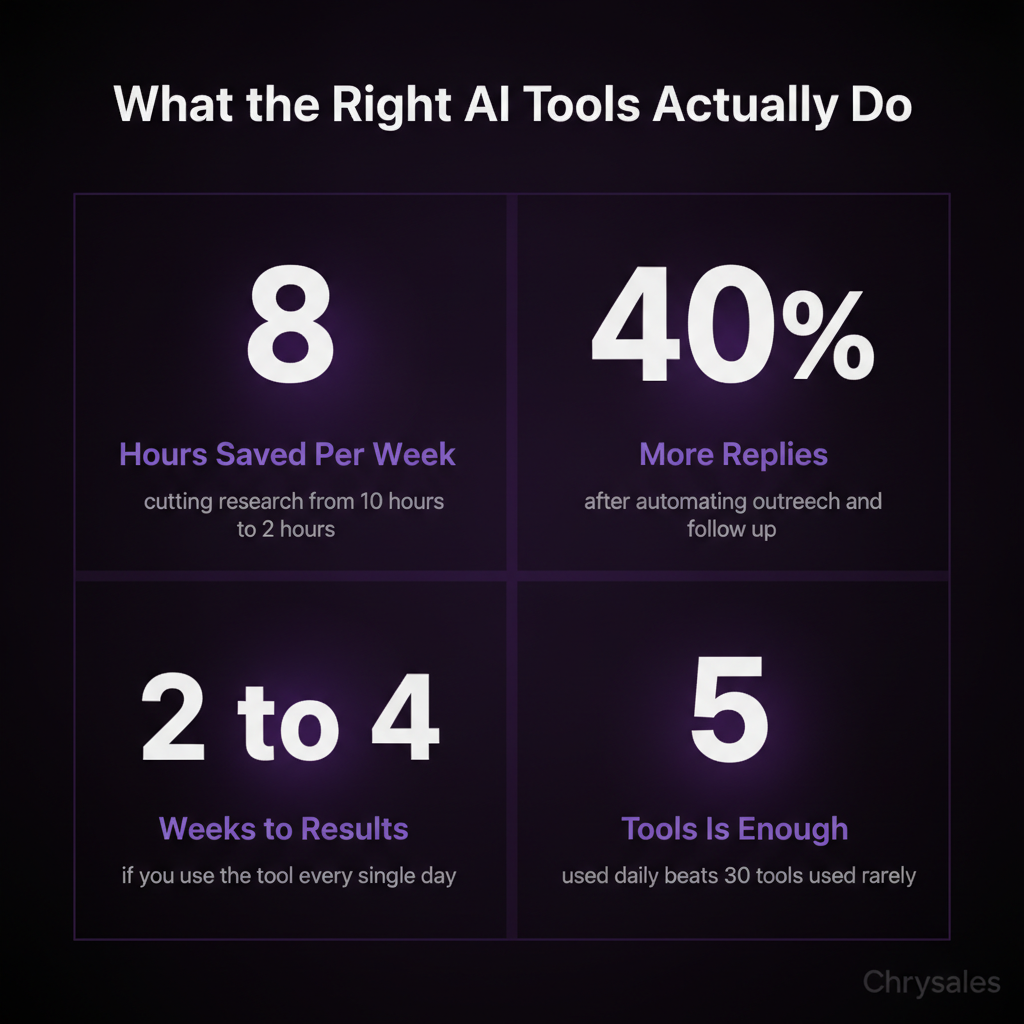
Think of it like this: if you spend 10 hours a week manually researching leads, and an AI tool cuts that to 2 hours, you just bought yourself 8 hours to actually sell. That's the ROI.
B2B sales is where AI tools really shine because the workflow is repetitive. Same list building. Same email sequences. Same discovery questions. Same objections. AI doesn't get bored. It doesn't forget to follow up. It just runs the system.
AI for Lead Generation and Prospecting
Lead generation is the first domino. Bad list, bad results. Period. You can write the world's best cold email, but if it's going to a 200-person company that just did layoffs, you're wasting your time. AI tools for lead generation do two things really well: they find people who actually fit your offer, and they tell you which ones to call first.
AI for Sales Automation and Follow-Up
Most deals die in follow-up. Someone says "circle back in a month," and the rep forgets. Or they remember but send a generic "just checking in" email that gets ignored. AI sales automation tools keep the pipeline moving without you babysitting it. They track who opened what, when to ping them again, and what to say based on where they are in the process.
AI for Closing Deals and Objection Handling
This is where good teams become great teams. AI tools can't close deals for you, but they can give your reps the exact script, the right case study, or the pricing angle that works for that specific prospect.
One marketing agency we worked with had reps who kept losing deals on price. We built an AI sales system that automated research and objection handling, pulling past wins from similar companies and suggesting three different ways to position the offer. Reply rates went up 40% in six weeks.
Pro Tip: The best ai tools to make money are the ones you actually use every day, not the ones that sit in your bookmarks folder looking impressive.
1. Clay (AI-Powered Lead Enrichment and List Building)
Clay is what happens when you take 50 different data sources and let AI pick the best info from all of them at once. You give it a rough list of companies or people, and it fills in everything: emails, phone numbers, job changes, funding rounds, tech stack, recent hires. It's like having a research assistant who never sleeps and never complains.
Here's why it matters for B2B lead generation: most lists are 30% to 50% bad data according to data decay research from enterprise databases. Wrong emails. People who left the company. Titles that don't match the role. Clay fixes that before you send a single message. We've seen teams cut their bounce rate from 18% to under 5% just by running their list through Clay first.
How It Makes You Money
You can build a hyper-targeted list of 500 companies in 20 minutes instead of 2 days. That's 2 days you spend actually reaching out instead of googling LinkedIn profiles. Clay also scores leads based on signals like recent funding, tech stack, or hiring activity. So you know who to call first.
Best Use Case
Small sales teams or solo founders who need clean lists fast. If you're doing cold outreach and your reply rate is under 2%, your list is probably the problem, not your email copy. For more detailed examples of how to leverage this platform, check out our guide on Clay lead enrichment use cases and workflows.
Watch out: Clay has a learning curve. Spend an hour watching tutorials before you dive in, or you'll waste time building workflows that don't actually help.
2. Instantly.ai (AI Cold Email Outreach at Scale)
Cold email still works, but only if you do it right. Instantly.ai is built for b2b sales teams who need to send hundreds or thousands of emails without landing in spam. It rotates domains, warms up inboxes, tracks opens and replies, and uses AI to suggest subject lines and follow-up timing.
The AI piece is subtle but powerful. It learns which subject lines get opens in your niche, what time of day gets replies, and how long to wait before the second or third follow-up.
A 15-person consulting firm we worked with used Instantly to send 1,200 emails a week. They booked 9 qualified calls in the first two weeks, compared to 3 calls the month before using manual outreach.
How It Makes You Money
More emails sent means more replies, which means more booked calls. But the real win is deliverability. If your emails hit spam, it doesn't matter how many you send. Instantly keeps your sender reputation clean so your emails actually land.
Best Use Case
Anyone doing cold outreach who needs to scale past 50 emails a day. If you're still sending one email at a time from Gmail, you're leaving money on the table. Learn more about proven cold email strategies for B2B lead generation to maximize your results.
3. Bardeen (AI Workflow Automation Without Code)
Bardeen connects your apps and automates the boring stuff. Think: scraping LinkedIn profiles into a Google Sheet, pulling contact info from a website, sending Slack messages when a lead books a call, updating your CRM after every meeting. It's like Zapier but with AI that can actually understand what you're trying to do.
Sales teams waste hours on data entry. Someone books a call, you copy-paste their info into your CRM, then into your meeting notes, then into a follow-up task. Bardeen does all of that in one click. We worked with a tech company that saved 6 hours a week per rep just by automating CRM updates.
How It Makes You Money
Time saved is money made. If your reps spend 30% of their day on admin work, Bardeen buys that time back for actual selling. It also reduces human error. No more forgetting to log a call or losing a lead because someone didn't update the sheet.
Best Use Case
Teams juggling multiple tools (CRM, email, LinkedIn, Slack, Sheets) who are tired of copying and pasting the same info everywhere. If you find yourself doing the same 5 clicks every time you get a new lead, Bardeen can automate it.
Common mistake: People build 40-step Bardeen workflows when 12 steps would do the job. Start simple. Automate one annoying task first, then build from there.
4. Perplexity AI (AI-Powered Research Assistant)
Perplexity is like ChatGPT but specifically for research. You ask it a question, and it searches the web, pulls real sources, and gives you a summary with citations. It's insanely fast and way more accurate than scrolling through 10 Google results.
For client acquisition and sales training, Perplexity is a secret weapon. Before a sales call, you can ask it: "What are the biggest challenges in [industry] right now?" or "What tech stack does [company] use?" It pulls fresh data in seconds.
One rep we trained used Perplexity before every discovery call. His close rate jumped from 18% to 29% in three months because he sounded like he actually understood the prospect's business.
How It Makes You Money
Better research means better conversations. Better conversations mean more closed deals. If you walk into a sales call knowing the prospect's recent product launch, their competitor landscape, and their likely pain points, you're not just another cold caller. You're someone worth talking to.
Best Use Case
Anyone doing discovery calls, writing proposals, or pitching high-ticket services. If your offer is above $5K, spending 10 minutes researching the prospect is non-negotiable. Perplexity makes it easy.
5. Gemini (Google's AI for Sales Workflow Integration)
Gemini is Google's AI, and it plugs directly into Gmail, Google Docs, Sheets, and Calendar. You can ask it to draft emails, summarize meeting notes, pull data from a Sheet, or even write a proposal based on a 3-sentence prompt. It's not as hyped as ChatGPT, but for sales teams already living in Google Workspace, it's way more useful.
We use Gemini-based sales workflows at Chrysales. A rep finishes a call, Gemini pulls the transcript, writes a summary, updates the CRM, and drafts the follow-up email. The rep just reviews and sends. That's 20 minutes saved per call. Multiply that by 10 calls a week, and you just bought back 3 hours.
How It Makes You Money
Integration is everything. Gemini lives where your work already happens, so there's no copy-pasting between tools. It also reduces the "I forgot to follow up" problem. If the AI drafts the follow-up email right after the call, you just hit send. No friction means more consistency, which means more deals closed.
Best Use Case
Sales teams using Google Workspace who want AI without learning a whole new platform. If your team already uses Gmail and Sheets, Gemini is the easiest win.
Pro Tip: Set up a simple Gemini prompt library. Save your 5 most-used prompts (email draft, call summary, objection response) so reps can use them in one click.
6. Apollo.io (AI Lead Scoring and Contact Database)
Apollo is a massive B2B contact database with built-in AI lead scoring. You search for companies that match your ideal customer profile, Apollo surfaces contacts with verified emails, and the AI scores them based on how likely they are to buy. It also tracks engagement: who opened your email, who clicked, who visited your website.
The lead scoring piece is the real game-changer. Picture this: you have a list of 300 companies. Half of them are bad fits, but you don't know which half. Apollo's AI looks at signals like company size, recent funding, tech stack, and hiring activity, then gives each lead a score. Anything above 70 goes to the top of your call list. That's the difference between wasting a week on dead leads and closing 3 deals in the same time.
How It Makes You Money
Better targeting means higher close rates. If you're only calling leads that score high, you're not burning time on companies that were never going to buy. Apollo also integrates with most CRMs, so the data flows straight into your pipeline without manual work.
Best Use Case
B2B sales teams doing high-volume outreach who need clean contact data and smart prioritization. If you're calling 50+ leads a week, Apollo tells you which 15 to call first. You can also watch our breakdown of four ways to find clients who need your services right now for practical prospecting strategies.
7. Otter.ai (AI Meeting Transcription and Call Analysis)
Otter joins your sales calls, transcribes everything in real time, and highlights key moments. After the call, it gives you a summary, action items, and even pulls out objections or questions the prospect asked. Reps can focus on the conversation instead of frantically taking notes.
Here's the bigger play: if you're training a sales team, Otter is gold. You can review calls, see exactly where a rep lost the prospect, and coach them on the specific moment they missed. We've used this with clients who were hiring and scaling sales teams. One agency owner listened to 12 recorded calls in an afternoon and realized his reps were skipping discovery and jumping straight to pitch. That one insight fixed a $40K revenue gap.
How It Makes You Money
Better calls mean more deals. If your reps are too busy writing notes to listen, they miss buying signals. Otter handles the notes so they can actually sell. It also makes onboarding new reps way faster because they can listen to top performers' calls and copy what works.
Best Use Case
Anyone doing sales calls, especially teams training new hires. If you're scaling and need to get new reps up to speed fast, recorded calls with AI summaries cut training time in half. For a comprehensive approach to training and coaching, explore our AI sales enablement guide for modern teams.
8. Zapier with AI Actions (Connecting Everything Automatically)
Zapier is the glue between your apps. Someone fills out a form, Zapier adds them to your CRM. A lead books a call, Zapier sends a Slack notification and updates your pipeline. The new AI actions take it further: Zapier can now extract data from emails, categorize leads, or even draft responses based on what happened.
Most sales teams use 6+ tools: CRM, email, calendar, Slack, Sheets, landing page software. Zapier makes them talk to each other so nothing falls through the cracks. A 30-person consulting firm we worked with had leads getting lost between their landing page and their CRM. They set up a Zap that auto-added every form submission to their pipeline and notified the right rep in Slack. They went from losing 15% of inbound leads to losing zero.
How It Makes You Money
No lost leads, no forgotten follow-ups, no manual data entry. Every lead gets into your system and gets followed up. That's predictable client acquisition.
Best Use Case
Sales teams juggling multiple tools who are tired of things slipping through the cracks. If you've ever had a lead say "I filled out your form a week ago and never heard back," Zapier fixes that.
Watch out: Don't over-automate. Start with 2 to 3 critical Zaps (form to CRM, call booked to Slack, deal closed to invoice). You can add more later.
Why Most AI Tools Don't Actually Make You Money (and What to Do Instead)
Here's what nobody tells you: most AI tools are solutions looking for a problem. They're cool, but they don't move the needle. You download them, use them twice, then forget they exist.
The best ai tools to make money are the ones that fix a specific, expensive problem in your sales process. Ask yourself: where are you losing money right now? Is it bad leads? Low reply rates? Reps forgetting to follow up? Deals dying in the pipeline? Pick the AI tool that solves that one problem. Use it for a month. Measure the results. If it works, keep it. If it doesn't, drop it and try something else.
We see this all the time with new clients. They have 15 tools and use none of them well. We strip it down to 4 or 5 tools that actually matter for their process, and revenue jumps in 60 days. It's not about having the most tools. It's about using the right ones every single day.
The 80/20 of AI Tools for Sales
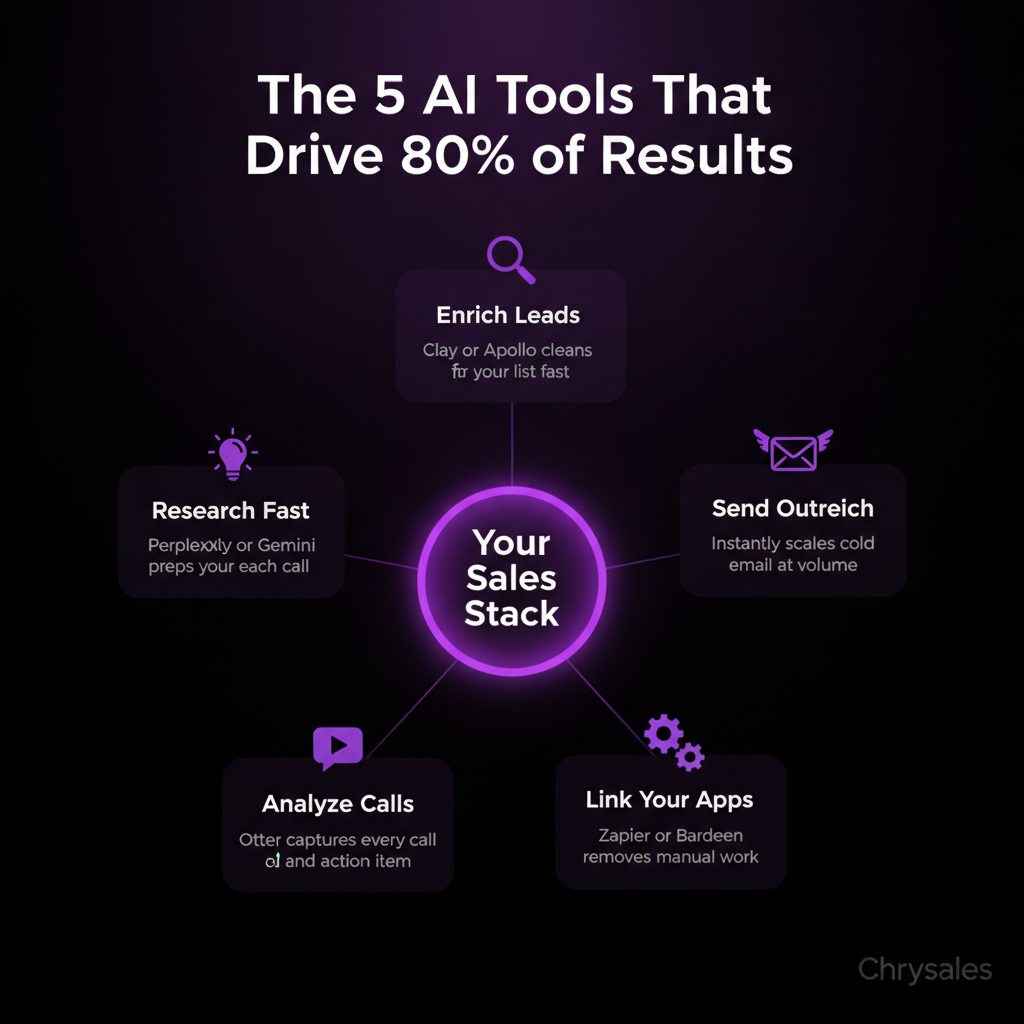
20% of tools drive 80% of results, a principle supported by recent research on AI adoption in B2B sales teams. For most B2B sales teams, that's:
- One tool for lead enrichment (Clay or Apollo)
- One tool for cold outreach (Instantly or a similar email platform)
- One tool for automation (Bardeen or Zapier)
- One tool for call analysis (Otter)
- One AI assistant for research and drafting (Perplexity or Gemini)
That's it. Five tools, used daily, will do more than 30 tools sitting in your bookmarks. The teams making real money with AI aren't the ones with the longest tool stack. They're the ones who picked 5 tools, built them into their daily process, and actually stuck with it. You can watch how an AI sales system generates record revenue with unlimited demand to see this approach in action.
Frequently Asked Questions
Q: Do I need to pay for AI tools to make money, or are free versions enough?
Most AI tools have free versions that work fine for solo founders or small teams just starting out. ChatGPT free, Perplexity basic, and Bardeen's free tier can cover a lot. But once you're doing serious volume, like sending 500+ cold emails a week or managing 50+ leads at a time, the paid versions save you enough time to justify the cost. If a $50/month tool saves you 5 hours a week, that's a no-brainer. Start free, upgrade when it's clearly worth it.
Q: Can AI tools replace my sales team?
No, and you shouldn't try. AI tools handle the repetitive stuff: building lists, scoring leads, sending follow-ups, taking notes. But closing deals still needs a human who can listen, adapt, and build trust. Think of AI as the support system that makes your reps 2x more effective, not as a replacement. The best setups we've seen pair a strong salesperson with a tight AI-powered system. That combo beats a bigger team with no system every time.
Q: Which AI tool should I start with if I'm doing B2B sales?
If you're doing cold outreach, start with a lead enrichment tool like Clay or Apollo. Bad lists kill more deals than bad emails. If you're already getting leads but struggling to follow up, start with Zapier or Bardeen to automate your CRM updates and follow-up reminders. If you're doing a lot of calls, Otter is the easiest win because it saves you 15 minutes per call. Pick the tool that fixes your biggest bottleneck right now, not the one that sounds coolest.
Q: How long does it take to see results from AI tools?
If you're using the tool daily, you'll see results in 2 to 4 weeks. A better lead list shows up in higher reply rates within the first week. Automation tools save time immediately, but the revenue impact takes a month or two to compound. The key is consistency. Using an AI tool once a week won't move the needle. Using it every single day will. Set a reminder, build it into your workflow, and give it a full month before you decide if it's working.
Q: Are AI tools worth it for small teams or solo founders?
Yes, especially for small teams. When you're doing everything yourself, AI tools are the closest thing to hiring help without actually hiring. One person with the right 5 AI tools can outpace a 3-person team with no system. We've worked with solo founders who book 10+ qualified calls a month using Clay for lists, Instantly for outreach, and Zapier for follow-up. The ROI is even better when you're small because every hour saved is an hour you can spend selling.
The best ai tools to make money help businesses find leads, close deals, save time, and improve b2b sales without needing a large sales team.
Most people think the best AI tools to make money are the shiny ones everyone talks about. ChatGPT, Midjourney, stuff like that. They're good, but here's what nobody mentions: the real money comes from AI tools that fix boring, money-losing problems in your business.
The Real Way AI Tools Help You Make Money
Most blog posts list AI tools like a shopping catalog. Cool feature, nice interface, moving on. That's useless. The best ai tools to make money do one of three things: they find you better leads, they help you close more deals, or they save you enough time to do both.
Think of it like this: if you spend 10 hours a week manually researching leads, and an AI tool cuts that to 2 hours, you just bought yourself 8 hours to actually sell. That's the ROI.
B2B sales is where AI tools really shine because the workflow is repetitive. Same list building. Same email sequences. Same discovery questions. Same objections. AI doesn't get bored. It doesn't forget to follow up. It just runs the system.
AI for Lead Generation and Prospecting
Lead generation is the first domino. Bad list, bad results. Period. You can write the world's best cold email, but if it's going to a 200-person company that just did layoffs, you're wasting your time. AI tools for lead generation do two things really well: they find people who actually fit your offer, and they tell you which ones to call first.
AI for Sales Automation and Follow-Up
Most deals die in follow-up. Someone says "circle back in a month," and the rep forgets. Or they remember but send a generic "just checking in" email that gets ignored. AI sales automation tools keep the pipeline moving without you babysitting it. They track who opened what, when to ping them again, and what to say based on where they are in the process.
AI for Closing Deals and Objection Handling
This is where good teams become great teams. AI tools can't close deals for you, but they can give your reps the exact script, the right case study, or the pricing angle that works for that specific prospect.
One marketing agency we worked with had reps who kept losing deals on price. We built an AI sales system that automated research and objection handling, pulling past wins from similar companies and suggesting three different ways to position the offer. Reply rates went up 40% in six weeks.
Pro Tip: The best ai tools to make money are the ones you actually use every day, not the ones that sit in your bookmarks folder looking impressive.
1. Clay (AI-Powered Lead Enrichment and List Building)
Clay is what happens when you take 50 different data sources and let AI pick the best info from all of them at once. You give it a rough list of companies or people, and it fills in everything: emails, phone numbers, job changes, funding rounds, tech stack, recent hires. It's like having a research assistant who never sleeps and never complains.
Here's why it matters for B2B lead generation: most lists are 30% to 50% bad data according to data decay research from enterprise databases. Wrong emails. People who left the company. Titles that don't match the role. Clay fixes that before you send a single message. We've seen teams cut their bounce rate from 18% to under 5% just by running their list through Clay first.
How It Makes You Money
You can build a hyper-targeted list of 500 companies in 20 minutes instead of 2 days. That's 2 days you spend actually reaching out instead of googling LinkedIn profiles. Clay also scores leads based on signals like recent funding, tech stack, or hiring activity. So you know who to call first.
Best Use Case
Small sales teams or solo founders who need clean lists fast. If you're doing cold outreach and your reply rate is under 2%, your list is probably the problem, not your email copy. For more detailed examples of how to leverage this platform, check out our guide on Clay lead enrichment use cases and workflows.
Watch out: Clay has a learning curve. Spend an hour watching tutorials before you dive in, or you'll waste time building workflows that don't actually help.
2. Instantly.ai (AI Cold Email Outreach at Scale)
Cold email still works, but only if you do it right. Instantly.ai is built for b2b sales teams who need to send hundreds or thousands of emails without landing in spam. It rotates domains, warms up inboxes, tracks opens and replies, and uses AI to suggest subject lines and follow-up timing.
The AI piece is subtle but powerful. It learns which subject lines get opens in your niche, what time of day gets replies, and how long to wait before the second or third follow-up.
A 15-person consulting firm we worked with used Instantly to send 1,200 emails a week. They booked 9 qualified calls in the first two weeks, compared to 3 calls the month before using manual outreach.
How It Makes You Money
More emails sent means more replies, which means more booked calls. But the real win is deliverability. If your emails hit spam, it doesn't matter how many you send. Instantly keeps your sender reputation clean so your emails actually land.
Best Use Case
Anyone doing cold outreach who needs to scale past 50 emails a day. If you're still sending one email at a time from Gmail, you're leaving money on the table. Learn more about proven cold email strategies for B2B lead generation to maximize your results.
3. Bardeen (AI Workflow Automation Without Code)
Bardeen connects your apps and automates the boring stuff. Think: scraping LinkedIn profiles into a Google Sheet, pulling contact info from a website, sending Slack messages when a lead books a call, updating your CRM after every meeting. It's like Zapier but with AI that can actually understand what you're trying to do.
Sales teams waste hours on data entry. Someone books a call, you copy-paste their info into your CRM, then into your meeting notes, then into a follow-up task. Bardeen does all of that in one click. We worked with a tech company that saved 6 hours a week per rep just by automating CRM updates.
How It Makes You Money
Time saved is money made. If your reps spend 30% of their day on admin work, Bardeen buys that time back for actual selling. It also reduces human error. No more forgetting to log a call or losing a lead because someone didn't update the sheet.
Best Use Case
Teams juggling multiple tools (CRM, email, LinkedIn, Slack, Sheets) who are tired of copying and pasting the same info everywhere. If you find yourself doing the same 5 clicks every time you get a new lead, Bardeen can automate it.
Common mistake: People build 40-step Bardeen workflows when 12 steps would do the job. Start simple. Automate one annoying task first, then build from there.
4. Perplexity AI (AI-Powered Research Assistant)
Perplexity is like ChatGPT but specifically for research. You ask it a question, and it searches the web, pulls real sources, and gives you a summary with citations. It's insanely fast and way more accurate than scrolling through 10 Google results.
For client acquisition and sales training, Perplexity is a secret weapon. Before a sales call, you can ask it: "What are the biggest challenges in [industry] right now?" or "What tech stack does [company] use?" It pulls fresh data in seconds.
One rep we trained used Perplexity before every discovery call. His close rate jumped from 18% to 29% in three months because he sounded like he actually understood the prospect's business.
How It Makes You Money
Better research means better conversations. Better conversations mean more closed deals. If you walk into a sales call knowing the prospect's recent product launch, their competitor landscape, and their likely pain points, you're not just another cold caller. You're someone worth talking to.
Best Use Case
Anyone doing discovery calls, writing proposals, or pitching high-ticket services. If your offer is above $5K, spending 10 minutes researching the prospect is non-negotiable. Perplexity makes it easy.
5. Gemini (Google's AI for Sales Workflow Integration)
Gemini is Google's AI, and it plugs directly into Gmail, Google Docs, Sheets, and Calendar. You can ask it to draft emails, summarize meeting notes, pull data from a Sheet, or even write a proposal based on a 3-sentence prompt. It's not as hyped as ChatGPT, but for sales teams already living in Google Workspace, it's way more useful.
We use Gemini-based sales workflows at Chrysales. A rep finishes a call, Gemini pulls the transcript, writes a summary, updates the CRM, and drafts the follow-up email. The rep just reviews and sends. That's 20 minutes saved per call. Multiply that by 10 calls a week, and you just bought back 3 hours.
How It Makes You Money
Integration is everything. Gemini lives where your work already happens, so there's no copy-pasting between tools. It also reduces the "I forgot to follow up" problem. If the AI drafts the follow-up email right after the call, you just hit send. No friction means more consistency, which means more deals closed.
Best Use Case
Sales teams using Google Workspace who want AI without learning a whole new platform. If your team already uses Gmail and Sheets, Gemini is the easiest win.
Pro Tip: Set up a simple Gemini prompt library. Save your 5 most-used prompts (email draft, call summary, objection response) so reps can use them in one click.
6. Apollo.io (AI Lead Scoring and Contact Database)
Apollo is a massive B2B contact database with built-in AI lead scoring. You search for companies that match your ideal customer profile, Apollo surfaces contacts with verified emails, and the AI scores them based on how likely they are to buy. It also tracks engagement: who opened your email, who clicked, who visited your website.
The lead scoring piece is the real game-changer. Picture this: you have a list of 300 companies. Half of them are bad fits, but you don't know which half. Apollo's AI looks at signals like company size, recent funding, tech stack, and hiring activity, then gives each lead a score. Anything above 70 goes to the top of your call list. That's the difference between wasting a week on dead leads and closing 3 deals in the same time.
How It Makes You Money
Better targeting means higher close rates. If you're only calling leads that score high, you're not burning time on companies that were never going to buy. Apollo also integrates with most CRMs, so the data flows straight into your pipeline without manual work.
Best Use Case
B2B sales teams doing high-volume outreach who need clean contact data and smart prioritization. If you're calling 50+ leads a week, Apollo tells you which 15 to call first. You can also watch our breakdown of four ways to find clients who need your services right now for practical prospecting strategies.
7. Otter.ai (AI Meeting Transcription and Call Analysis)
Otter joins your sales calls, transcribes everything in real time, and highlights key moments. After the call, it gives you a summary, action items, and even pulls out objections or questions the prospect asked. Reps can focus on the conversation instead of frantically taking notes.
Here's the bigger play: if you're training a sales team, Otter is gold. You can review calls, see exactly where a rep lost the prospect, and coach them on the specific moment they missed. We've used this with clients who were hiring and scaling sales teams. One agency owner listened to 12 recorded calls in an afternoon and realized his reps were skipping discovery and jumping straight to pitch. That one insight fixed a $40K revenue gap.
How It Makes You Money
Better calls mean more deals. If your reps are too busy writing notes to listen, they miss buying signals. Otter handles the notes so they can actually sell. It also makes onboarding new reps way faster because they can listen to top performers' calls and copy what works.
Best Use Case
Anyone doing sales calls, especially teams training new hires. If you're scaling and need to get new reps up to speed fast, recorded calls with AI summaries cut training time in half. For a comprehensive approach to training and coaching, explore our AI sales enablement guide for modern teams.
8. Zapier with AI Actions (Connecting Everything Automatically)
Zapier is the glue between your apps. Someone fills out a form, Zapier adds them to your CRM. A lead books a call, Zapier sends a Slack notification and updates your pipeline. The new AI actions take it further: Zapier can now extract data from emails, categorize leads, or even draft responses based on what happened.
Most sales teams use 6+ tools: CRM, email, calendar, Slack, Sheets, landing page software. Zapier makes them talk to each other so nothing falls through the cracks. A 30-person consulting firm we worked with had leads getting lost between their landing page and their CRM. They set up a Zap that auto-added every form submission to their pipeline and notified the right rep in Slack. They went from losing 15% of inbound leads to losing zero.
How It Makes You Money
No lost leads, no forgotten follow-ups, no manual data entry. Every lead gets into your system and gets followed up. That's predictable client acquisition.
Best Use Case
Sales teams juggling multiple tools who are tired of things slipping through the cracks. If you've ever had a lead say "I filled out your form a week ago and never heard back," Zapier fixes that.
Watch out: Don't over-automate. Start with 2 to 3 critical Zaps (form to CRM, call booked to Slack, deal closed to invoice). You can add more later.
Why Most AI Tools Don't Actually Make You Money (and What to Do Instead)
Here's what nobody tells you: most AI tools are solutions looking for a problem. They're cool, but they don't move the needle. You download them, use them twice, then forget they exist.
The best ai tools to make money are the ones that fix a specific, expensive problem in your sales process. Ask yourself: where are you losing money right now? Is it bad leads? Low reply rates? Reps forgetting to follow up? Deals dying in the pipeline? Pick the AI tool that solves that one problem. Use it for a month. Measure the results. If it works, keep it. If it doesn't, drop it and try something else.
We see this all the time with new clients. They have 15 tools and use none of them well. We strip it down to 4 or 5 tools that actually matter for their process, and revenue jumps in 60 days. It's not about having the most tools. It's about using the right ones every single day.
The 80/20 of AI Tools for Sales
20% of tools drive 80% of results, a principle supported by recent research on AI adoption in B2B sales teams. For most B2B sales teams, that's:
- One tool for lead enrichment (Clay or Apollo)
- One tool for cold outreach (Instantly or a similar email platform)
- One tool for automation (Bardeen or Zapier)
- One tool for call analysis (Otter)
- One AI assistant for research and drafting (Perplexity or Gemini)
That's it. Five tools, used daily, will do more than 30 tools sitting in your bookmarks. The teams making real money with AI aren't the ones with the longest tool stack. They're the ones who picked 5 tools, built them into their daily process, and actually stuck with it. You can watch how an AI sales system generates record revenue with unlimited demand to see this approach in action.
Frequently Asked Questions
Q: Do I need to pay for AI tools to make money, or are free versions enough?
Most AI tools have free versions that work fine for solo founders or small teams just starting out. ChatGPT free, Perplexity basic, and Bardeen's free tier can cover a lot. But once you're doing serious volume, like sending 500+ cold emails a week or managing 50+ leads at a time, the paid versions save you enough time to justify the cost. If a $50/month tool saves you 5 hours a week, that's a no-brainer. Start free, upgrade when it's clearly worth it.
Q: Can AI tools replace my sales team?
No, and you shouldn't try. AI tools handle the repetitive stuff: building lists, scoring leads, sending follow-ups, taking notes. But closing deals still needs a human who can listen, adapt, and build trust. Think of AI as the support system that makes your reps 2x more effective, not as a replacement. The best setups we've seen pair a strong salesperson with a tight AI-powered system. That combo beats a bigger team with no system every time.
Q: Which AI tool should I start with if I'm doing B2B sales?
If you're doing cold outreach, start with a lead enrichment tool like Clay or Apollo. Bad lists kill more deals than bad emails. If you're already getting leads but struggling to follow up, start with Zapier or Bardeen to automate your CRM updates and follow-up reminders. If you're doing a lot of calls, Otter is the easiest win because it saves you 15 minutes per call. Pick the tool that fixes your biggest bottleneck right now, not the one that sounds coolest.
Q: How long does it take to see results from AI tools?
If you're using the tool daily, you'll see results in 2 to 4 weeks. A better lead list shows up in higher reply rates within the first week. Automation tools save time immediately, but the revenue impact takes a month or two to compound. The key is consistency. Using an AI tool once a week won't move the needle. Using it every single day will. Set a reminder, build it into your workflow, and give it a full month before you decide if it's working.
Q: Are AI tools worth it for small teams or solo founders?
Yes, especially for small teams. When you're doing everything yourself, AI tools are the closest thing to hiring help without actually hiring. One person with the right 5 AI tools can outpace a 3-person team with no system. We've worked with solo founders who book 10+ qualified calls a month using Clay for lists, Instantly for outreach, and Zapier for follow-up. The ROI is even better when you're small because every hour saved is an hour you can spend selling.
Scaling Is Not Hard If You Have The Right Systems
If you’re serious about leveling up your scaling game, you need the right system, the right training, and the right team behind you. We're here to give you the exact tools and strategies top entrepreneurs use to dominate.

Discover the latest tips
View All.avif)
Chrysales was formed from the words "chrysalis" the stage where a caterpillar transforms into a butterfly and "sales".
It stands for one thing: sales transformation.Because scaling doesn’t happen by doing more of the same. Scaling only happens when you go through real transformation in your systems, your offer, team and the way you sell.
.avif)


