.avif)
How to Close 30% of Discovery Calls with a Script
Closing techniques are proven methods used to guide a prospect from interest to a signed agreement during a sales call. They turn a hesitant conversation into a clear decision by addressing objections and confirming fit early. Most sales calls die in the last five minutes. You did the discovery. You built rapport. The prospect is nodding. Then you try to close and it falls apart. They say they need to think about it, or check with their team, or they'll get back to you next month. The problem isn't your product. It's that you don't have a real closing system. A good closing script doesn't feel like pressure. It feels like the natural next step. Here's the exact framework that top B2B sales teams use to convert 30% or more of their discovery calls.
Why Most closing techniques Fail in B2B Sales
Picture this: you spend 45 minutes on a discovery call. The prospect loves what you do. They say all the right things. Then you ask if they want to move forward and they freeze. Most people think this is a closing problem. It's not. It's a discovery problem. Here's the thing: closing starts the second the call begins. If you didn't set up the close during discovery, no magic words will save you at the end. The best B2B sales closing strategies build momentum from the first question.
You're Asking for the Sale Too Late
Most teams wait until the end of the call to talk about next steps. By then, the prospect has mentally checked out. They're thinking about their next meeting or what's for lunch. You need to plant the idea of moving forward early. Try this: about 10 minutes into the call, after you understand their situation, say something like "Based on what you're telling me, this sounds like a good fit. If we both agree by the end of this call, what would your timeline look like to get started?" You just made closing a two-way decision, not a one-sided ask.
You're Not Handling Objections During Discovery
A 15-person consulting firm came to us with a 12% close rate. They thought they needed better closing lines. We listened to their calls. The real issue? They never addressed price concerns or decision-making process during discovery. Every objection hit them at the end like a surprise. This is one of the 5 costly mistakes killing your deals (and how to fix them) that we see teams make repeatedly.
Pro Tip: Ask about budget, decision makers, and timeline in the first 15 minutes. Not at the end. If they say "I need to talk to my partner," you should already know that before you pitch.
The 30% Closing Script Framework (Step by Step)
This isn't a word-for-word script you read like a robot. It's a structure. A repeatable system that works across industries. We've seen it used for high-ticket sales closing in consulting, software, and agency services. The framework has five parts. Each one builds on the last.
Part 1: Set the Agenda (First 2 Minutes)
Start every call by saying what's going to happen. Most people skip this. It's a mistake. Here's what it sounds like: "Thanks for jumping on. Here's how I thought we'd use the next 30 minutes. I'll ask you a few questions to understand what's going on with your sales process. Then I'll share how we've helped companies in a similar spot. If it makes sense for both of us, we'll talk about what working together looks like. If it's not a fit, I'll tell you. Sound good?" You just did three things. You took control. You made it collaborative. You gave them permission to say no. That last part is huge. When people know they can say no, they relax.
Part 2: Discovery with Built-In Closing Questions (Minutes 3-20)
This is where you separate good salespeople from great ones. Ask questions that uncover pain and also set up the close. Here's a list of the best discovery questions for B2B deal closing:
- "What's happening right now with your sales process that made you want to take this call?"
- "If nothing changes in the next six months, what does that cost you?"
- "Who else is involved in making this decision?"
- "What would need to be true for you to move forward with something like this?"
- "If we solve this, what does that unlock for your business?"
Notice how the last two questions are closing questions disguised as discovery. You're getting them to tell you exactly what it takes to close the deal. Research shows that effective discovery call frameworks directly impact close rates by uncovering the real decision criteria early.
Watch out: Don't rush through discovery to get to your pitch. The longer you spend here, the easier the close becomes.
Part 3: Tie Your Solution Directly to Their Words (Minutes 20-25)
This is the shortest part of the call. You're not doing a 30-slide pitch deck. You're connecting dots. Say something like: "Okay, so you said your sales team isn't hitting quota and you're not sure if it's a people problem or a process problem. You also mentioned you need to fix this in the next 90 days because Q4 is coming. Here's how we'd approach that." Then explain your solution in 3-4 sentences. Use their exact words. If they said "we're leaving money on the table," say "we'll plug the holes so you stop leaving money on the table." Salesforce and other top sales training programs call this mirroring. It works because people believe you understand them when you repeat their language back.
Part 4: The Assumptive Close (Minutes 25-28)
This is where most people mess up. They say "so what do you think?" or "does this sound interesting?" Those are weak. They invite hesitation. Instead, use an assumptive close. You assume they're moving forward and you just confirm logistics. It sounds like this: "Based on everything we talked about, this sounds like a strong fit. The next step would be to kick off in the next week or two. I'd send over the agreement today, we'd schedule your onboarding call, and we'd start building your sales system. Does starting next week or the week after work better for you?" You didn't ask if they want to buy. You asked when they want to start. That's the assumptive close in action. It's one of the most effective closing techniques for B2B sales because it moves the conversation forward without feeling pushy.
Common mistake: Using the assumptive close when the prospect hasn't confirmed fit yet. If they're still asking basic questions about what you do, you're not ready for this step. Learn more about how assumptive closing works in B2B contexts to refine your timing.
Part 5: Handle Objections and Close Again (Minutes 28-30)
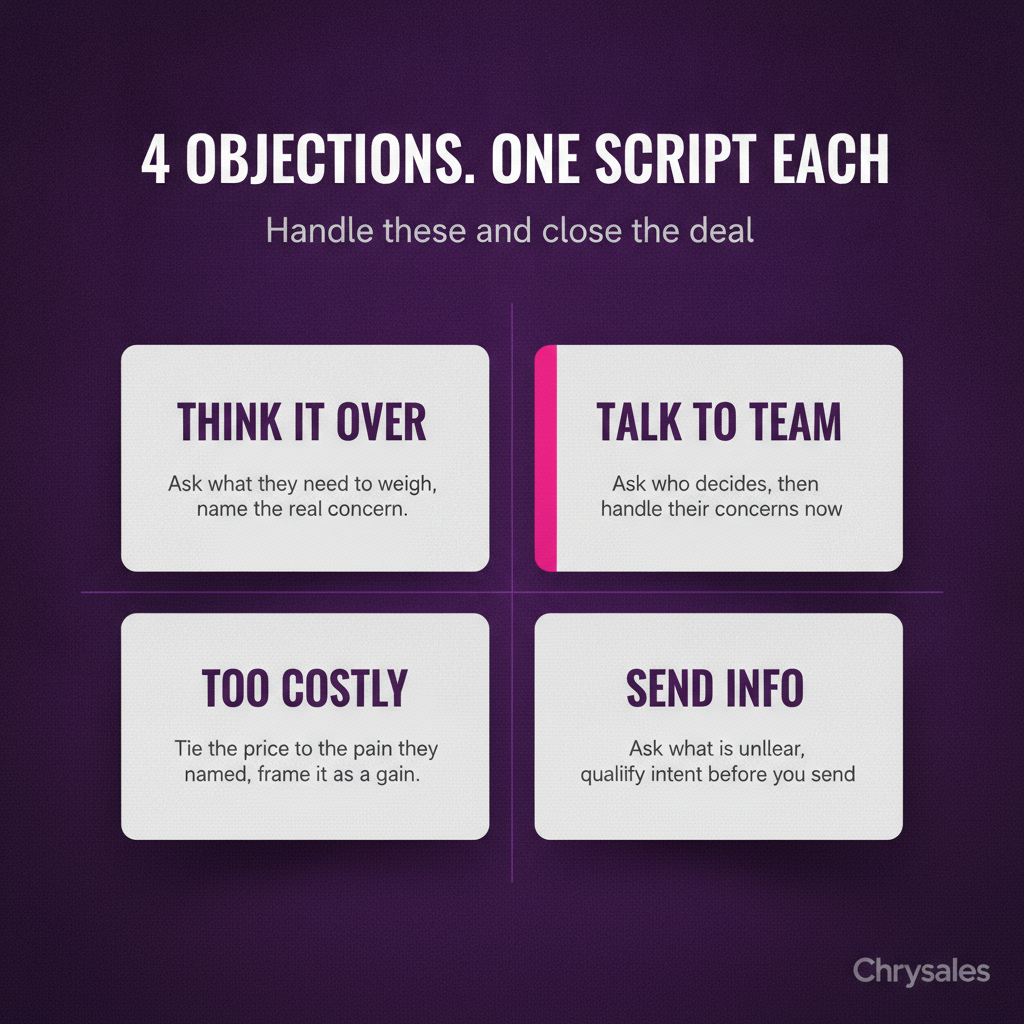
Even with a perfect discovery, you'll get objections. Most objections fall into four buckets: price, timing, decision maker, or trust. Here's how to handle each one without sounding defensive.
"I need to think about it." "Totally fair. What specifically do you need to think through? Is it the price, the timeline, or something else?" Get them to name the real objection. Then handle that.
"I need to talk to my team." "Makes sense. Who else is involved in this decision?" You should already know this from discovery. If you don't, you skipped a step. "What concerns do you think they'll have?" Then address those concerns now.
"It's too expensive." "I hear you. Let me ask, earlier you said this problem is costing you [X]. If we solve that in the next 90 days, what's that worth to you?" Reframe price as an investment tied to their pain.
"Can you send me some information?" This one means no. They're being polite. Your response: "Of course. Just so I send the right stuff, what's the main thing you're still unclear on?" If they can't name it, they're not interested. Move on.
After you handle the objection, close again. "So if [objection] isn't an issue, are you good to move forward?" Don't end the call without a clear yes or no. For more techniques on handling objections effectively, check out these proven objection handling frameworks that work across industries.
How to Adapt This Script for Different Sales Scenarios
A 200-person tech company closing enterprise deals won't sound the same as a small consulting firm closing $5k projects. But the structure stays the same. Here's how to adjust it.
For High-Ticket Sales Closing (Over $10k)
Slow everything down. Add a second call. Your first call is pure discovery. Your second call is the pitch and close. On the first call, end by saying "I want to take what you shared and put together a custom plan. Let's reconnect in two days and I'll walk you through exactly how we'd approach this." This gives you time to build a tailored proposal and makes the close feel more consultative. High-ticket buyers expect this.
For Fast Sales Cycles (Under $5k, Decision in One Call)
Compress the timeline. Cut discovery to 10 minutes. Get to the assumptive close by minute 20. These deals move fast because the financial risk is lower. Don't overthink it. One marketing agency we worked with was spending 45 minutes on $3k deals. We cut their calls to 25 minutes and their close rate went up. Shorter calls signal confidence.
For Multi-Stakeholder B2B Deals
Ask "who else is involved in this decision?" in the first five minutes. If the answer is "my co-founder" or "our CFO," say "great, can we get them on the call now or should we reschedule when they're available?" Multi-stakeholder deals die when you close one person and then their team kills it later. Get everyone on the call or don't waste your time.
Pro Tip: If you can't get all decision makers on the first call, your closing script should include "what's the process for getting buy-in from [other person]?" Then walk them through how to sell it internally.
Common Mistakes That Kill Your Closing Rate (And How to Fix Them)
We've listened to hundreds of sales calls. The same mistakes show up over and over. Here are the big ones.
Talking Too Much
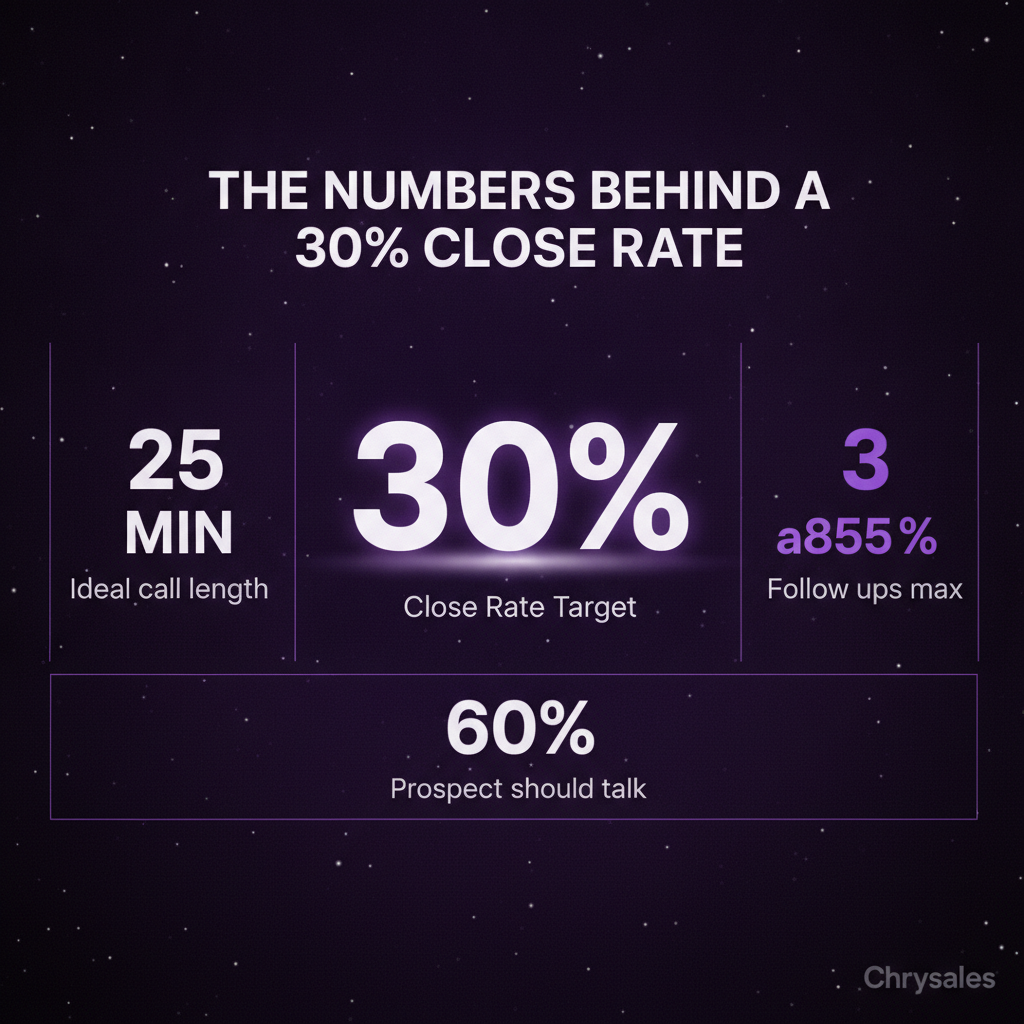
Most salespeople talk for 60-70% of the call. That's backwards. The prospect should talk for 60-70%. The more they talk, the more they sell themselves. Your job is to ask good questions and listen. A quick test: record your next three calls. Time how long you talk versus how long they talk. If you're over 50%, you're talking too much. Understanding b2b sales call patterns and talk-time ratios can help you calibrate your approach.
Not Confirming Budget Early
Asking about budget feels awkward. Do it anyway. If they can't afford you, you need to know that in minute five, not minute 40. Here's an easy way to ask: "Just so I don't waste your time, most of our clients invest between $X and $Y to work with us. Is that in the ballpark of what you were thinking?" If they say no, you can end the call or adjust your offer. Either way, you didn't waste 30 minutes.
Ending the Call Without a Clear Next Step
Every call should end with a decision. Yes, no, or a scheduled follow-up with a specific agenda. "Let me think about it" is not a next step. If they're not ready to decide, say "I get that. Let's schedule 15 minutes on Thursday to revisit this. In the meantime, what's the one thing you need to figure out?" Then send a calendar invite immediately.
Watch out: If someone reschedules more than once, they're not buying. Move on.
The Role of Lead Generation in Your Closing Success
Here's something most sales training programs won't tell you: if your lead generation is bad, no closing technique will save you. A consultative closing technique only works if the person on the call is actually a good fit. We see this all the time. A company books 20 calls a month and closes two. They think they need better closing skills. Then we look at their leads. Half of them aren't even the right company size. A quarter aren't decision makers. The real problem is upstream.
Why Your Closing Rate Depends on List Quality
Think of your sales pipeline like a phone contact list. If half the numbers don't work, no message gets through. If your leads are low-quality, your closing rate will stay low no matter how good your script is. Here's a simple rule: score your leads before you call them. Give points for things like company size, industry, recent funding, job title, and engagement with your content. Anything scoring above 70 goes to the top of your call list. Everything below 50 gets a cold email first.
How to Use AI to Pre-Qualify Leads
Most teams waste hours manually researching leads. AI tools like Gemini can do this in seconds. You can build a system that pulls company data, scores leads, and even drafts personalized outreach. One tech company we worked with cut their lead research time from two hours a day to 15 minutes. That freed up time for more calls, which meant more closes. The closing script stayed the same. They just fed it better leads.
How Chrysales Builds Custom Sales Systems Around Closing
Most sales training teaches you closing techniques as isolated tactics. That's not how real client acquisition works. Closing is one part of a bigger system. At Chrysales, we've trained over 500 sales teams and generated over €10M in client revenue. The teams that hit 30%+ close rates don't just have a good script. They have a full sales system: the right leads, a no-brainer offer, a clear call structure, objection scripts, follow-up cadence, and CRM tracking. Everything works together.
If your close rate is under 20%, the fix probably isn't your closing script. It's the system around it. That's where we come in. We build custom sales systems for B2B companies: lead generation, closing frameworks, team training, and AI automation. It's 1-on-1 coaching, not a course. We work with consulting firms, marketing agencies, and tech companies across Europe and beyond. You can watch How To Build a Sales System So Powerful Clients Come To You to see how a complete system amplifies your closing success.
Our process is simple: Learn (we audit your current sales process), Build Systems (we create your custom sales playbook), Automate (we integrate AI tools to save time), and Hire (we help you bring on elite closers if you need them). The result is a predictable, repeatable way to win clients. We've worked with companies like Amazon, Vodafone, and Deutsche Börse. Our client satisfaction rate is 99.4%. If you want help building a sales system that actually works, reach out. Learn more about how to build a sales system that actually scales and delivers consistent results.
Frequently Asked Questions
Q: How long should a discovery call be to use this closing script effectively?
Most discovery calls should run 25-35 minutes. Any shorter and you don't have time for real discovery. Any longer and you're probably talking too much. If you're going over 40 minutes regularly, cut your pitch section. The prospect doesn't need to hear everything you do. They need to hear how you solve their specific problem. Keep it tight.
Q: What if the prospect says yes but then ghosts after the call?
This happens when you got a soft yes instead of a hard yes. A real yes includes a signed agreement or a scheduled onboarding call before you hang up. If someone says they're ready to move forward, send the contract while you're still on the call and ask them to sign it today. If they hesitate, they weren't actually ready. Go back and handle the real objection.
Q: Can I use this script for cold calls or only for discovery calls?
This script is built for discovery calls where the prospect already agreed to talk to you. Cold calls need a different structure because you don't have permission yet. For cold calls, your only goal is to book the discovery call. Use the first 10 seconds to say who you are and why you're calling, then ask one qualifying question. If they're interested, book the meeting. Don't try to close on a cold call.
Q: How do I handle prospects who want to negotiate price at the end of the call?
Price objections usually mean one of two things: they don't see enough value, or they're testing you to see if you'll fold. First, reframe the price as an investment tied to the outcome they want. If they still push back, ask what budget they had in mind. If it's close, you can adjust scope. If it's way off, they're not the right client. Don't discount just to close. It sets a bad precedent and attracts low-quality clients. If you're still struggling with closes, explore these 3 hidden sales tactics to close 6-8x more deals that high performers use consistently.
Q: What's the difference between an assumptive close and being pushy?
An assumptive close assumes mutual fit based on what you learned in discovery. Being pushy ignores what the prospect said and tries to force a sale. If someone told you they have a problem you can solve, they have the budget, and they want to fix it soon, assuming they'll move forward isn't pushy. It's logical. If you skipped discovery and jumped straight to "let's get started," that's pushy. The difference is whether you earned the assumptive close.
Q: How many follow-ups should I do if they don't decide on the first call?
Three follow-ups max. First follow-up the same day with a recap email and next steps. Second follow-up two days later asking if they have questions. Third follow-up one week later with a simple "are you still interested or should I close your file?" If they don't respond after three tries, they're not buying. Move on. Your time is better spent on new leads.
Q: Should I send a proposal before or after the discovery call?
After. Always after. Sending a proposal before the call means you're guessing at what they need. You'll either overshoot or undershoot. Do discovery first, understand their exact situation, then send a proposal that speaks directly to their pain points. Better yet, walk them through the proposal live on a second call so you can handle objections in real time. Proposals sent over email die in inboxes.
Closing techniques are proven methods used to guide a prospect from interest to a signed agreement during a sales call. They turn a hesitant conversation into a clear decision by addressing objections and confirming fit early. Most sales calls die in the last five minutes. You did the discovery. You built rapport. The prospect is nodding. Then you try to close and it falls apart. They say they need to think about it, or check with their team, or they'll get back to you next month. The problem isn't your product. It's that you don't have a real closing system. A good closing script doesn't feel like pressure. It feels like the natural next step. Here's the exact framework that top B2B sales teams use to convert 30% or more of their discovery calls.
Why Most closing techniques Fail in B2B Sales
Picture this: you spend 45 minutes on a discovery call. The prospect loves what you do. They say all the right things. Then you ask if they want to move forward and they freeze. Most people think this is a closing problem. It's not. It's a discovery problem. Here's the thing: closing starts the second the call begins. If you didn't set up the close during discovery, no magic words will save you at the end. The best B2B sales closing strategies build momentum from the first question.
You're Asking for the Sale Too Late
Most teams wait until the end of the call to talk about next steps. By then, the prospect has mentally checked out. They're thinking about their next meeting or what's for lunch. You need to plant the idea of moving forward early. Try this: about 10 minutes into the call, after you understand their situation, say something like "Based on what you're telling me, this sounds like a good fit. If we both agree by the end of this call, what would your timeline look like to get started?" You just made closing a two-way decision, not a one-sided ask.
You're Not Handling Objections During Discovery
A 15-person consulting firm came to us with a 12% close rate. They thought they needed better closing lines. We listened to their calls. The real issue? They never addressed price concerns or decision-making process during discovery. Every objection hit them at the end like a surprise. This is one of the 5 costly mistakes killing your deals (and how to fix them) that we see teams make repeatedly.
Pro Tip: Ask about budget, decision makers, and timeline in the first 15 minutes. Not at the end. If they say "I need to talk to my partner," you should already know that before you pitch.
The 30% Closing Script Framework (Step by Step)
This isn't a word-for-word script you read like a robot. It's a structure. A repeatable system that works across industries. We've seen it used for high-ticket sales closing in consulting, software, and agency services. The framework has five parts. Each one builds on the last.
Part 1: Set the Agenda (First 2 Minutes)
Start every call by saying what's going to happen. Most people skip this. It's a mistake. Here's what it sounds like: "Thanks for jumping on. Here's how I thought we'd use the next 30 minutes. I'll ask you a few questions to understand what's going on with your sales process. Then I'll share how we've helped companies in a similar spot. If it makes sense for both of us, we'll talk about what working together looks like. If it's not a fit, I'll tell you. Sound good?" You just did three things. You took control. You made it collaborative. You gave them permission to say no. That last part is huge. When people know they can say no, they relax.
Part 2: Discovery with Built-In Closing Questions (Minutes 3-20)
This is where you separate good salespeople from great ones. Ask questions that uncover pain and also set up the close. Here's a list of the best discovery questions for B2B deal closing:
- "What's happening right now with your sales process that made you want to take this call?"
- "If nothing changes in the next six months, what does that cost you?"
- "Who else is involved in making this decision?"
- "What would need to be true for you to move forward with something like this?"
- "If we solve this, what does that unlock for your business?"
Notice how the last two questions are closing questions disguised as discovery. You're getting them to tell you exactly what it takes to close the deal. Research shows that effective discovery call frameworks directly impact close rates by uncovering the real decision criteria early.
Watch out: Don't rush through discovery to get to your pitch. The longer you spend here, the easier the close becomes.
Part 3: Tie Your Solution Directly to Their Words (Minutes 20-25)
This is the shortest part of the call. You're not doing a 30-slide pitch deck. You're connecting dots. Say something like: "Okay, so you said your sales team isn't hitting quota and you're not sure if it's a people problem or a process problem. You also mentioned you need to fix this in the next 90 days because Q4 is coming. Here's how we'd approach that." Then explain your solution in 3-4 sentences. Use their exact words. If they said "we're leaving money on the table," say "we'll plug the holes so you stop leaving money on the table." Salesforce and other top sales training programs call this mirroring. It works because people believe you understand them when you repeat their language back.
Part 4: The Assumptive Close (Minutes 25-28)
This is where most people mess up. They say "so what do you think?" or "does this sound interesting?" Those are weak. They invite hesitation. Instead, use an assumptive close. You assume they're moving forward and you just confirm logistics. It sounds like this: "Based on everything we talked about, this sounds like a strong fit. The next step would be to kick off in the next week or two. I'd send over the agreement today, we'd schedule your onboarding call, and we'd start building your sales system. Does starting next week or the week after work better for you?" You didn't ask if they want to buy. You asked when they want to start. That's the assumptive close in action. It's one of the most effective closing techniques for B2B sales because it moves the conversation forward without feeling pushy.
Common mistake: Using the assumptive close when the prospect hasn't confirmed fit yet. If they're still asking basic questions about what you do, you're not ready for this step. Learn more about how assumptive closing works in B2B contexts to refine your timing.
Part 5: Handle Objections and Close Again (Minutes 28-30)
Even with a perfect discovery, you'll get objections. Most objections fall into four buckets: price, timing, decision maker, or trust. Here's how to handle each one without sounding defensive.
"I need to think about it." "Totally fair. What specifically do you need to think through? Is it the price, the timeline, or something else?" Get them to name the real objection. Then handle that.
"I need to talk to my team." "Makes sense. Who else is involved in this decision?" You should already know this from discovery. If you don't, you skipped a step. "What concerns do you think they'll have?" Then address those concerns now.
"It's too expensive." "I hear you. Let me ask, earlier you said this problem is costing you [X]. If we solve that in the next 90 days, what's that worth to you?" Reframe price as an investment tied to their pain.
"Can you send me some information?" This one means no. They're being polite. Your response: "Of course. Just so I send the right stuff, what's the main thing you're still unclear on?" If they can't name it, they're not interested. Move on.
After you handle the objection, close again. "So if [objection] isn't an issue, are you good to move forward?" Don't end the call without a clear yes or no. For more techniques on handling objections effectively, check out these proven objection handling frameworks that work across industries.
How to Adapt This Script for Different Sales Scenarios
A 200-person tech company closing enterprise deals won't sound the same as a small consulting firm closing $5k projects. But the structure stays the same. Here's how to adjust it.
For High-Ticket Sales Closing (Over $10k)
Slow everything down. Add a second call. Your first call is pure discovery. Your second call is the pitch and close. On the first call, end by saying "I want to take what you shared and put together a custom plan. Let's reconnect in two days and I'll walk you through exactly how we'd approach this." This gives you time to build a tailored proposal and makes the close feel more consultative. High-ticket buyers expect this.
For Fast Sales Cycles (Under $5k, Decision in One Call)
Compress the timeline. Cut discovery to 10 minutes. Get to the assumptive close by minute 20. These deals move fast because the financial risk is lower. Don't overthink it. One marketing agency we worked with was spending 45 minutes on $3k deals. We cut their calls to 25 minutes and their close rate went up. Shorter calls signal confidence.
For Multi-Stakeholder B2B Deals
Ask "who else is involved in this decision?" in the first five minutes. If the answer is "my co-founder" or "our CFO," say "great, can we get them on the call now or should we reschedule when they're available?" Multi-stakeholder deals die when you close one person and then their team kills it later. Get everyone on the call or don't waste your time.
Pro Tip: If you can't get all decision makers on the first call, your closing script should include "what's the process for getting buy-in from [other person]?" Then walk them through how to sell it internally.
Common Mistakes That Kill Your Closing Rate (And How to Fix Them)
We've listened to hundreds of sales calls. The same mistakes show up over and over. Here are the big ones.
Talking Too Much
Most salespeople talk for 60-70% of the call. That's backwards. The prospect should talk for 60-70%. The more they talk, the more they sell themselves. Your job is to ask good questions and listen. A quick test: record your next three calls. Time how long you talk versus how long they talk. If you're over 50%, you're talking too much. Understanding b2b sales call patterns and talk-time ratios can help you calibrate your approach.
Not Confirming Budget Early
Asking about budget feels awkward. Do it anyway. If they can't afford you, you need to know that in minute five, not minute 40. Here's an easy way to ask: "Just so I don't waste your time, most of our clients invest between $X and $Y to work with us. Is that in the ballpark of what you were thinking?" If they say no, you can end the call or adjust your offer. Either way, you didn't waste 30 minutes.
Ending the Call Without a Clear Next Step
Every call should end with a decision. Yes, no, or a scheduled follow-up with a specific agenda. "Let me think about it" is not a next step. If they're not ready to decide, say "I get that. Let's schedule 15 minutes on Thursday to revisit this. In the meantime, what's the one thing you need to figure out?" Then send a calendar invite immediately.
Watch out: If someone reschedules more than once, they're not buying. Move on.
The Role of Lead Generation in Your Closing Success
Here's something most sales training programs won't tell you: if your lead generation is bad, no closing technique will save you. A consultative closing technique only works if the person on the call is actually a good fit. We see this all the time. A company books 20 calls a month and closes two. They think they need better closing skills. Then we look at their leads. Half of them aren't even the right company size. A quarter aren't decision makers. The real problem is upstream.
Why Your Closing Rate Depends on List Quality
Think of your sales pipeline like a phone contact list. If half the numbers don't work, no message gets through. If your leads are low-quality, your closing rate will stay low no matter how good your script is. Here's a simple rule: score your leads before you call them. Give points for things like company size, industry, recent funding, job title, and engagement with your content. Anything scoring above 70 goes to the top of your call list. Everything below 50 gets a cold email first.
How to Use AI to Pre-Qualify Leads
Most teams waste hours manually researching leads. AI tools like Gemini can do this in seconds. You can build a system that pulls company data, scores leads, and even drafts personalized outreach. One tech company we worked with cut their lead research time from two hours a day to 15 minutes. That freed up time for more calls, which meant more closes. The closing script stayed the same. They just fed it better leads.
How Chrysales Builds Custom Sales Systems Around Closing
Most sales training teaches you closing techniques as isolated tactics. That's not how real client acquisition works. Closing is one part of a bigger system. At Chrysales, we've trained over 500 sales teams and generated over €10M in client revenue. The teams that hit 30%+ close rates don't just have a good script. They have a full sales system: the right leads, a no-brainer offer, a clear call structure, objection scripts, follow-up cadence, and CRM tracking. Everything works together.
If your close rate is under 20%, the fix probably isn't your closing script. It's the system around it. That's where we come in. We build custom sales systems for B2B companies: lead generation, closing frameworks, team training, and AI automation. It's 1-on-1 coaching, not a course. We work with consulting firms, marketing agencies, and tech companies across Europe and beyond. You can watch How To Build a Sales System So Powerful Clients Come To You to see how a complete system amplifies your closing success.
Our process is simple: Learn (we audit your current sales process), Build Systems (we create your custom sales playbook), Automate (we integrate AI tools to save time), and Hire (we help you bring on elite closers if you need them). The result is a predictable, repeatable way to win clients. We've worked with companies like Amazon, Vodafone, and Deutsche Börse. Our client satisfaction rate is 99.4%. If you want help building a sales system that actually works, reach out. Learn more about how to build a sales system that actually scales and delivers consistent results.
Frequently Asked Questions
Q: How long should a discovery call be to use this closing script effectively?
Most discovery calls should run 25-35 minutes. Any shorter and you don't have time for real discovery. Any longer and you're probably talking too much. If you're going over 40 minutes regularly, cut your pitch section. The prospect doesn't need to hear everything you do. They need to hear how you solve their specific problem. Keep it tight.
Q: What if the prospect says yes but then ghosts after the call?
This happens when you got a soft yes instead of a hard yes. A real yes includes a signed agreement or a scheduled onboarding call before you hang up. If someone says they're ready to move forward, send the contract while you're still on the call and ask them to sign it today. If they hesitate, they weren't actually ready. Go back and handle the real objection.
Q: Can I use this script for cold calls or only for discovery calls?
This script is built for discovery calls where the prospect already agreed to talk to you. Cold calls need a different structure because you don't have permission yet. For cold calls, your only goal is to book the discovery call. Use the first 10 seconds to say who you are and why you're calling, then ask one qualifying question. If they're interested, book the meeting. Don't try to close on a cold call.
Q: How do I handle prospects who want to negotiate price at the end of the call?
Price objections usually mean one of two things: they don't see enough value, or they're testing you to see if you'll fold. First, reframe the price as an investment tied to the outcome they want. If they still push back, ask what budget they had in mind. If it's close, you can adjust scope. If it's way off, they're not the right client. Don't discount just to close. It sets a bad precedent and attracts low-quality clients. If you're still struggling with closes, explore these 3 hidden sales tactics to close 6-8x more deals that high performers use consistently.
Q: What's the difference between an assumptive close and being pushy?
An assumptive close assumes mutual fit based on what you learned in discovery. Being pushy ignores what the prospect said and tries to force a sale. If someone told you they have a problem you can solve, they have the budget, and they want to fix it soon, assuming they'll move forward isn't pushy. It's logical. If you skipped discovery and jumped straight to "let's get started," that's pushy. The difference is whether you earned the assumptive close.
Q: How many follow-ups should I do if they don't decide on the first call?
Three follow-ups max. First follow-up the same day with a recap email and next steps. Second follow-up two days later asking if they have questions. Third follow-up one week later with a simple "are you still interested or should I close your file?" If they don't respond after three tries, they're not buying. Move on. Your time is better spent on new leads.
Q: Should I send a proposal before or after the discovery call?
After. Always after. Sending a proposal before the call means you're guessing at what they need. You'll either overshoot or undershoot. Do discovery first, understand their exact situation, then send a proposal that speaks directly to their pain points. Better yet, walk them through the proposal live on a second call so you can handle objections in real time. Proposals sent over email die in inboxes.
Scaling Is Not Hard If You Have The Right Systems
If you’re serious about leveling up your scaling game, you need the right system, the right training, and the right team behind you. We're here to give you the exact tools and strategies top entrepreneurs use to dominate.

Discover the latest tips
View All.avif)
Chrysales was formed from the words "chrysalis" the stage where a caterpillar transforms into a butterfly and "sales".
It stands for one thing: sales transformation.Because scaling doesn’t happen by doing more of the same. Scaling only happens when you go through real transformation in your systems, your offer, team and the way you sell.
.avif)


