.avif)
Clay Lead Scoring: How to Qualify B2B Leads Before Outreach

Most B2B sales teams burn through outreach budgets because they treat every lead the same. Cold lists get blasted, reply rates stay flat, and pipeline forecasts collapse by quarter end. The fix is not more volume, it is smarter qualification before a single message goes out. Clay lead scoring solves this by enriching, ranking, and prioritizing prospects so your team only spends time on accounts that actually fit.
This guide walks through how to score B2B leads with Clay before outreach, the buyer attributes that matter, the enrichment workflow that powers it, and the execution mistakes that quietly destroy results.
Why Clay buyer scoring attributes and implementation matter for modern lead generation
Lead scoring is the difference between a pipeline that compounds and one that stalls. According to HubSpot's sales statistics roundup, sales reps spend less than a third of their time actually selling, and a large share of wasted hours go into chasing prospects who were never qualified in the first place. Clay closes that gap by combining live data sources, intent signals, and firmographic filters into one scoring layer.
When you score leads inside Clay before outreach, three things change immediately. Reply rates rise because messages land with the right buyer profile. Sales cycles shorten because reps are not educating unqualified accounts. Forecast accuracy improves because pipeline volume reflects real fit, not list size. For a deeper look at why prioritization is the real lever for revenue growth, watch this breakdown on scaling revenue through lead scoring and qualification.
Core buyer scoring attributes inside Clay
- Firmographics: company size, industry, revenue band, geography
- Technographics: tools the company uses, stack maturity, integrations
- Hiring signals: open roles that indicate budget and pain
- Funding and growth: recent rounds, headcount growth, expansion markets
- Persona fit: seniority, decision authority, function alignment
- Intent signals: website visits, content engagement, third party intent data
Each attribute is weighted based on what your closed-won data actually shows, not what the team assumes. The output is a numerical score per lead that determines whether it goes to outbound, nurture, or rejection.
Step-by-step Clay enrichment workflow for accurate scoring

A scoring model is only as good as the data underneath it. Clay's strength is layered enrichment, where multiple providers fill in different fields in sequence so every lead is fully hydrated before scoring runs. This is one of the reasons Clay enrichment workflows integrated into modern sales systems have become the default for teams that want predictable outbound results.
The five stage enrichment flow
- Stage 1, source: pull accounts from Apollo, LinkedIn Sales Navigator, or a CRM export
- Stage 2, validate: verify the company is active, the domain resolves, and the entity is real
- Stage 3, enrich firmographics: append size, revenue, industry codes, and location
- Stage 4, enrich signals: layer hiring data, funding, technographics, and intent
- Stage 5, score and route: apply the weighted scoring formula and push leads into tiered sequences
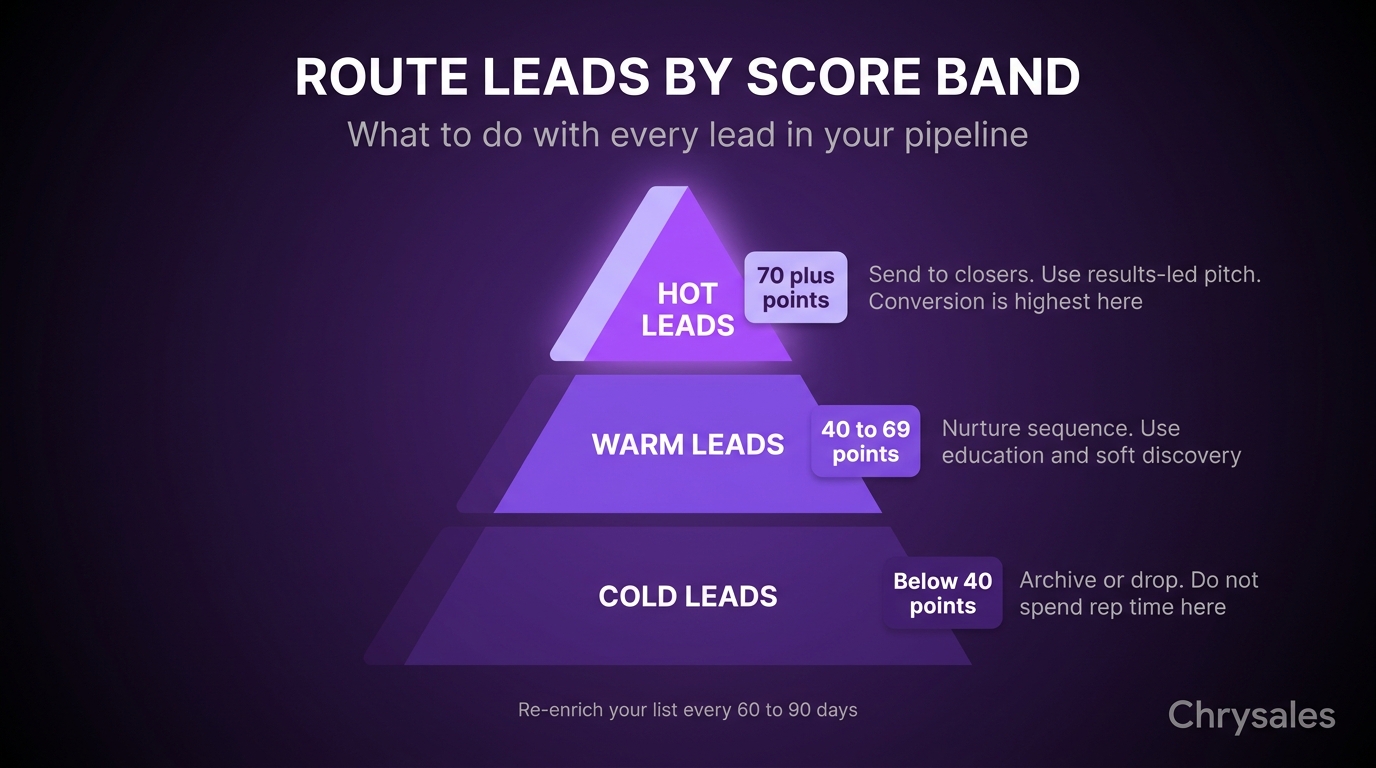
The scoring formula itself lives inside a Clay column using a conditional expression. Tier A leads (score above 80) go to direct sales outreach. Tier B (50 to 80) go to a longer nurture sequence. Tier C (under 50) get parked or removed entirely.
Validating the model before scaling
Before you push thousands of leads through, run the model against 200 closed-won and 200 closed-lost accounts from the past year. If your top scores correlate with closed-won, the weighting is right. If they do not, adjust the attribute weights until the historical data tells the right story. Skipping this step is one of the most expensive errors teams make.
Common mistakes in Clay GTM engineering and how to fix them
Even with the right tools, execution gaps quietly destroy outbound performance. The same patterns show up across teams, and they overlap heavily with the common execution gaps in Clay GTM engineering that we see kill deals before outreach even begins.
Mistake one: scoring without a feedback loop
Teams build a scoring model on day one and never touch it again. Markets shift, ICP evolves, and the model decays. Schedule a monthly review where closed-won and closed-lost data feed back into attribute weights.
Mistake two: over-enriching low value fields
Every Clay credit spent on a field that does not influence the score is wasted budget. Audit which fields actually move the score and cut the rest.
Mistake three: ignoring intent signals
Firmographic fit alone produces decent lists, but intent signals are what separate a 5 percent reply rate from a 15 percent one. Layer in tools like Clearbit Reveal, G2 intent, or LinkedIn engagement data.
Mistake four: dumping all leads into one sequence
If a Tier A and a Tier C lead receive the same email, your scoring did nothing. Tiered routing is non-negotiable.
Mistake five: no human review on top accounts
Automation should not replace judgment on your top 50 accounts. Reps should manually review and personalize the highest scoring leads before sending.
Building a repeatable lead generation system around Clay
A scoring model is a tool. A system is what makes it produce revenue every month without depending on one person. The shift from tool to system requires three things: documentation, automation, and ownership. The principles behind building a repeatable lead generation system apply directly to how Clay should sit inside your GTM stack.
Document every step of the enrichment flow, from source query to scoring formula to sequence routing. Automate the handoffs so leads move from Clay into the CRM and outbound tool without manual exports. Assign one owner who is responsible for the model's accuracy, not five people who all touch it. To see how this looks in practice, watch this walkthrough on building repeatable lead generation systems with Clay and predictable client acquisition.
What a mature Clay system looks like
- Source lists refresh weekly without manual pulls
- Enrichment runs nightly on new accounts
- Scoring updates whenever new signals appear
- Tiered routing pushes leads into the right sequence automatically
- A weekly dashboard shows score distribution, reply rate by tier, and pipeline created
When all five are in place, the team stops debating which leads to work and starts focusing on conversations that close.
Frequently asked questions
Q1: How long does it take to set up Clay lead scoring?
A functional model takes around two to three weeks for a small team, including ICP definition, attribute selection, enrichment setup, and historical validation. Scaling and refining the model is ongoing.
Q2: How many attributes should a scoring model use?
Between six and twelve weighted attributes is the sweet spot. Fewer and the model is too blunt, more and the signal gets diluted by noise.
Q3: Can Clay replace a CRM scoring system?
Clay handles enrichment and pre-outreach scoring better than most CRMs, but the CRM still owns deal-stage scoring once a lead is in pipeline. The two work together, they do not replace each other.
Q4: What is the biggest predictor of close rate in a Clay model?
Across most B2B teams, persona fit combined with a recent intent signal predicts close rate better than any single firmographic. Hiring signals and funding events are close behind.
Q5: How often should the scoring model be updated?
Review weights monthly using fresh closed-won and closed-lost data. Rebuild the model from scratch every six to twelve months, or whenever your ICP shifts meaningfully.
Most B2B sales teams burn through outreach budgets because they treat every lead the same. Cold lists get blasted, reply rates stay flat, and pipeline forecasts collapse by quarter end. The fix is not more volume, it is smarter qualification before a single message goes out. Clay lead scoring solves this by enriching, ranking, and prioritizing prospects so your team only spends time on accounts that actually fit.
This guide walks through how to score B2B leads with Clay before outreach, the buyer attributes that matter, the enrichment workflow that powers it, and the execution mistakes that quietly destroy results.
Why Clay buyer scoring attributes and implementation matter for modern lead generation
Lead scoring is the difference between a pipeline that compounds and one that stalls. According to HubSpot's sales statistics roundup, sales reps spend less than a third of their time actually selling, and a large share of wasted hours go into chasing prospects who were never qualified in the first place. Clay closes that gap by combining live data sources, intent signals, and firmographic filters into one scoring layer.
When you score leads inside Clay before outreach, three things change immediately. Reply rates rise because messages land with the right buyer profile. Sales cycles shorten because reps are not educating unqualified accounts. Forecast accuracy improves because pipeline volume reflects real fit, not list size. For a deeper look at why prioritization is the real lever for revenue growth, watch this breakdown on scaling revenue through lead scoring and qualification.
Core buyer scoring attributes inside Clay
- Firmographics: company size, industry, revenue band, geography
- Technographics: tools the company uses, stack maturity, integrations
- Hiring signals: open roles that indicate budget and pain
- Funding and growth: recent rounds, headcount growth, expansion markets
- Persona fit: seniority, decision authority, function alignment
- Intent signals: website visits, content engagement, third party intent data
Each attribute is weighted based on what your closed-won data actually shows, not what the team assumes. The output is a numerical score per lead that determines whether it goes to outbound, nurture, or rejection.
Step-by-step Clay enrichment workflow for accurate scoring
A scoring model is only as good as the data underneath it. Clay's strength is layered enrichment, where multiple providers fill in different fields in sequence so every lead is fully hydrated before scoring runs. This is one of the reasons Clay enrichment workflows integrated into modern sales systems have become the default for teams that want predictable outbound results.
The five stage enrichment flow
- Stage 1, source: pull accounts from Apollo, LinkedIn Sales Navigator, or a CRM export
- Stage 2, validate: verify the company is active, the domain resolves, and the entity is real
- Stage 3, enrich firmographics: append size, revenue, industry codes, and location
- Stage 4, enrich signals: layer hiring data, funding, technographics, and intent
- Stage 5, score and route: apply the weighted scoring formula and push leads into tiered sequences
The scoring formula itself lives inside a Clay column using a conditional expression. Tier A leads (score above 80) go to direct sales outreach. Tier B (50 to 80) go to a longer nurture sequence. Tier C (under 50) get parked or removed entirely.
Validating the model before scaling
Before you push thousands of leads through, run the model against 200 closed-won and 200 closed-lost accounts from the past year. If your top scores correlate with closed-won, the weighting is right. If they do not, adjust the attribute weights until the historical data tells the right story. Skipping this step is one of the most expensive errors teams make.
Common mistakes in Clay GTM engineering and how to fix them
Even with the right tools, execution gaps quietly destroy outbound performance. The same patterns show up across teams, and they overlap heavily with the common execution gaps in Clay GTM engineering that we see kill deals before outreach even begins.
Mistake one: scoring without a feedback loop
Teams build a scoring model on day one and never touch it again. Markets shift, ICP evolves, and the model decays. Schedule a monthly review where closed-won and closed-lost data feed back into attribute weights.
Mistake two: over-enriching low value fields
Every Clay credit spent on a field that does not influence the score is wasted budget. Audit which fields actually move the score and cut the rest.
Mistake three: ignoring intent signals
Firmographic fit alone produces decent lists, but intent signals are what separate a 5 percent reply rate from a 15 percent one. Layer in tools like Clearbit Reveal, G2 intent, or LinkedIn engagement data.
Mistake four: dumping all leads into one sequence
If a Tier A and a Tier C lead receive the same email, your scoring did nothing. Tiered routing is non-negotiable.
Mistake five: no human review on top accounts
Automation should not replace judgment on your top 50 accounts. Reps should manually review and personalize the highest scoring leads before sending.
Building a repeatable lead generation system around Clay
A scoring model is a tool. A system is what makes it produce revenue every month without depending on one person. The shift from tool to system requires three things: documentation, automation, and ownership. The principles behind building a repeatable lead generation system apply directly to how Clay should sit inside your GTM stack.
Document every step of the enrichment flow, from source query to scoring formula to sequence routing. Automate the handoffs so leads move from Clay into the CRM and outbound tool without manual exports. Assign one owner who is responsible for the model's accuracy, not five people who all touch it. To see how this looks in practice, watch this walkthrough on building repeatable lead generation systems with Clay and predictable client acquisition.
What a mature Clay system looks like
- Source lists refresh weekly without manual pulls
- Enrichment runs nightly on new accounts
- Scoring updates whenever new signals appear
- Tiered routing pushes leads into the right sequence automatically
- A weekly dashboard shows score distribution, reply rate by tier, and pipeline created
When all five are in place, the team stops debating which leads to work and starts focusing on conversations that close.
Frequently asked questions
Q1: How long does it take to set up Clay lead scoring?
A functional model takes around two to three weeks for a small team, including ICP definition, attribute selection, enrichment setup, and historical validation. Scaling and refining the model is ongoing.
Q2: How many attributes should a scoring model use?
Between six and twelve weighted attributes is the sweet spot. Fewer and the model is too blunt, more and the signal gets diluted by noise.
Q3: Can Clay replace a CRM scoring system?
Clay handles enrichment and pre-outreach scoring better than most CRMs, but the CRM still owns deal-stage scoring once a lead is in pipeline. The two work together, they do not replace each other.
Q4: What is the biggest predictor of close rate in a Clay model?
Across most B2B teams, persona fit combined with a recent intent signal predicts close rate better than any single firmographic. Hiring signals and funding events are close behind.
Q5: How often should the scoring model be updated?
Review weights monthly using fresh closed-won and closed-lost data. Rebuild the model from scratch every six to twelve months, or whenever your ICP shifts meaningfully.
Discover the latest tips
View All.avif)
Chrysales was formed from the words "chrysalis" the stage where a caterpillar transforms into a butterfly and "sales".
It stands for one thing: sales transformation.Because scaling doesn’t happen by doing more of the same. Scaling only happens when you go through real transformation in your systems, your offer, team and the way you sell.
.avif)


