.avif)
Clay Lead Scoring: How to Qualify B2B Leads Before Outreach

Most B2B sales teams waste hours every week chasing leads that were never going to convert. The problem is not the outreach copy or the channel, it is the list. When you skip lead scoring and push raw data straight into sequences, reply rates collapse and your team burns out chasing ghosts. Clay changes that by giving you a structured way to enrich, score, and qualify leads before a single message goes out.
This guide walks through how to score B2B leads with Clay, what attributes actually matter, the workflow to set it up, and the mistakes that quietly destroy pipeline. If you want predictable outbound, scoring has to come before sending.
Why Clay buyer scoring attributes and implementation matter for modern lead generation
Outbound has fundamentally changed. Inboxes are crowded, buyers are skeptical, and generic blasts get filtered or ignored. According to HubSpot sales statistics, prospects need multiple relevant touchpoints before they engage, and relevance only happens when you understand who you are reaching out to. That is the entire point of scoring.
Clay buyer scoring attributes let you rank accounts and contacts by fit signals like company size, tech stack, hiring activity, funding events, intent data, and role seniority. Instead of treating every lead the same, you concentrate effort on the top 10 to 20 percent that actually look like your best customers. This is the bottleneck that keeps most teams stuck, and you can see this principle play out in this breakdown on scaling revenue through lead scoring and qualification.
Implementation matters as much as the attributes themselves. A scoring model that lives in someone's head is not a system. It needs to be documented, weighted, and automated inside Clay so every new lead gets the same treatment without manual intervention.
Step-by-step Clay enrichment workflow for accurate scoring

Building a reliable scoring workflow in Clay follows a predictable sequence. Each step compounds the one before it, so skipping any of them produces noisy, unreliable scores.
Step 1: Define your ideal customer profile in writing
Before you touch Clay, write down what a high-fit account looks like. Industry, headcount, revenue range, geography, tech stack, and trigger events. Without this, no enrichment workflow can score accurately because there is no benchmark to score against.
Step 2: Pull source data into Clay
Import your target list from Apollo, LinkedIn Sales Navigator, a CRM export, or a CSV. Clay accepts almost any structured input and becomes the central enrichment layer.
Step 3: Layer enrichment providers
Use Clay's waterfall enrichment to verify emails, pull firmographics, identify technologies, and flag hiring or funding signals. Layering providers means if one source is missing data, another fills the gap, which dramatically improves coverage. This is exactly the kind of Clay enrichment workflows integrated into modern sales systems that high-performing teams rely on to keep data accurate at scale.
Step 4: Build a scoring formula
Use Clay's formula columns or AI columns to assign points to each attribute. For example: 20 points for matching industry, 15 points for headcount in range, 10 points for using a relevant tool, 25 points for a recent hiring signal. Total the score in a final column.
Step 5: Segment and route
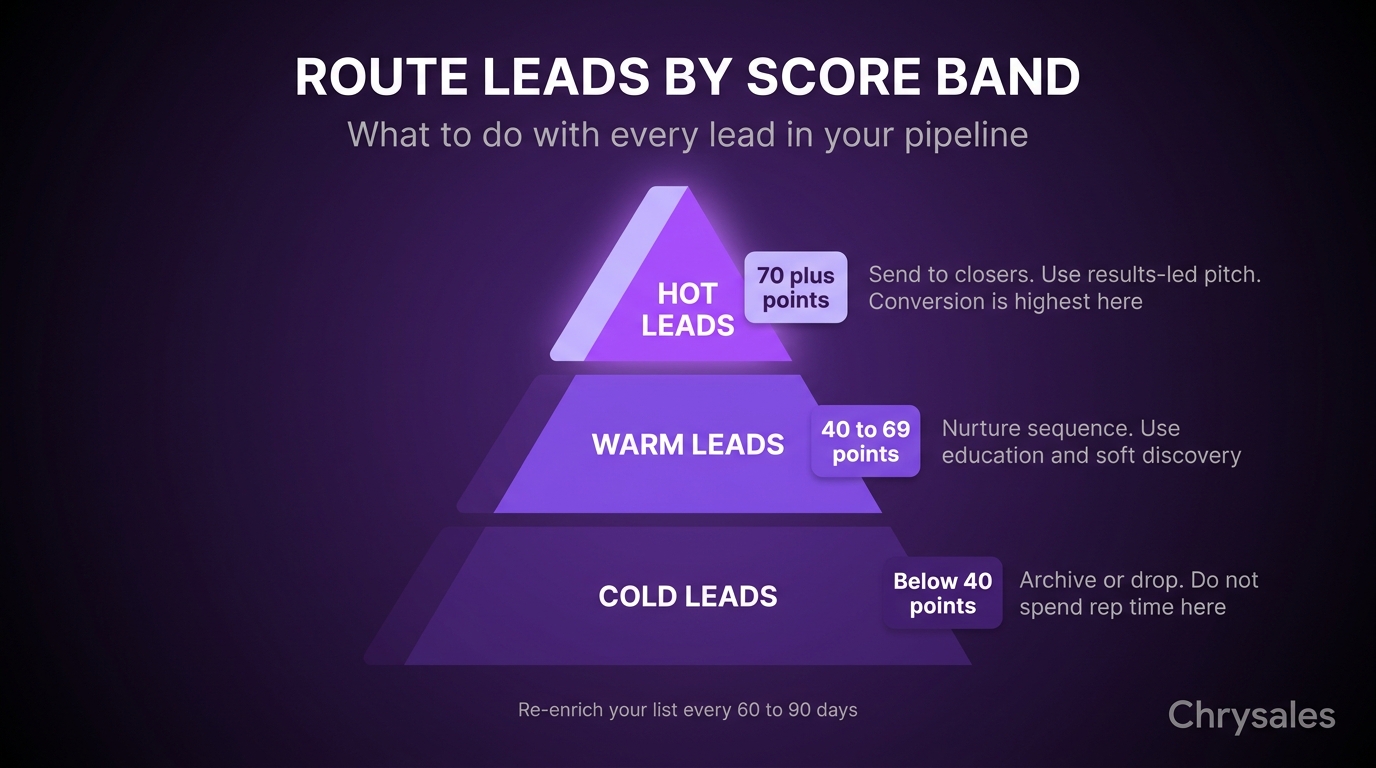
Filter leads into tiers. A-tier leads (80+ points) get personalized outreach, B-tier (50 to 79) goes into a lighter sequence, and anything below threshold is excluded or nurtured passively. According to B2B sales benchmarks, segmented outreach consistently outperforms flat list sending by significant margins.
Common mistakes in Clay GTM engineering and how to fix them
Even teams that adopt Clay still leak pipeline because of avoidable execution errors. These are the common execution gaps in Clay GTM engineering that quietly kill deals before they start.
- Over-enriching without a purpose: Pulling 30 columns of data you never use wastes credits and slows workflows. Only enrich what feeds your score.
- Flat scoring weights: Treating every attribute as equally important produces meaningless totals. A funding event should weigh more than a job title match.
- No negative scoring: Failing to subtract points for disqualifiers (wrong industry, too small, competitor) lets bad leads slip into A-tier.
- Skipping verification: Sending to unverified emails tanks domain reputation. Always verify before export.
- One-time setup mentality: Scoring models drift. Review and recalibrate monthly based on which leads actually closed.
Building a repeatable lead generation system around Clay
Clay is a tool, not a strategy. The real leverage comes from wrapping it inside a documented, repeatable system that anyone on your team can run. That means clear ownership, standard operating procedures, and automation that removes manual handoffs. Teams serious about building a repeatable lead generation system treat Clay as the enrichment engine inside a larger machine that includes ICP definition, sequencing, response handling, and reporting.
Documentation is what separates a team that scales from one that depends on a single operator. Every scoring rule, weight, and exception should live in a shared doc so the workflow survives turnover and grows with the business. For a deeper walkthrough on this, building repeatable lead generation systems with Clay shows how documentation, automation, and ownership combine into a system that actually compounds over time.
Once the system is in place, scoring stops being a project and becomes a quiet, ongoing process. New leads enter, get enriched, get scored, get routed, and the only thing the sales team sees is a clean, prioritized list every morning.
Frequently asked questions
Q1: How many attributes should I score on in Clay?
Start with 5 to 8 high-signal attributes. More than that and weighting becomes guesswork. You can always add complexity later once you see which signals actually predict closed revenue.
Q2: Should I score accounts or contacts first?
Score accounts first to confirm fit, then score contacts within qualified accounts to find the right buyer. Scoring contacts inside unqualified accounts wastes enrichment credits and time.
Q3: How often should I update my Clay scoring model?
Review it every 30 to 60 days. Compare which scored tiers actually booked meetings and closed deals, then adjust weights. Scoring is a living system, not a one-time build.
Q4: Can Clay replace my CRM lead scoring?
Clay is best used for pre-outreach scoring on cold lists. Your CRM should still handle behavior-based scoring for engaged leads. The two work together, not against each other.
Q5: What is the minimum score threshold for outreach?
It depends on your model, but a common rule is to only contact leads in the top 30 percent of scored results. Below that, the math on response rates rarely justifies the effort.
Most B2B sales teams waste hours every week chasing leads that were never going to convert. The problem is not the outreach copy or the channel, it is the list. When you skip lead scoring and push raw data straight into sequences, reply rates collapse and your team burns out chasing ghosts. Clay changes that by giving you a structured way to enrich, score, and qualify leads before a single message goes out.
This guide walks through how to score B2B leads with Clay, what attributes actually matter, the workflow to set it up, and the mistakes that quietly destroy pipeline. If you want predictable outbound, scoring has to come before sending.
Why Clay buyer scoring attributes and implementation matter for modern lead generation
Outbound has fundamentally changed. Inboxes are crowded, buyers are skeptical, and generic blasts get filtered or ignored. According to HubSpot sales statistics, prospects need multiple relevant touchpoints before they engage, and relevance only happens when you understand who you are reaching out to. That is the entire point of scoring.
Clay buyer scoring attributes let you rank accounts and contacts by fit signals like company size, tech stack, hiring activity, funding events, intent data, and role seniority. Instead of treating every lead the same, you concentrate effort on the top 10 to 20 percent that actually look like your best customers. This is the bottleneck that keeps most teams stuck, and you can see this principle play out in this breakdown on scaling revenue through lead scoring and qualification.
Implementation matters as much as the attributes themselves. A scoring model that lives in someone's head is not a system. It needs to be documented, weighted, and automated inside Clay so every new lead gets the same treatment without manual intervention.
Step-by-step Clay enrichment workflow for accurate scoring
Building a reliable scoring workflow in Clay follows a predictable sequence. Each step compounds the one before it, so skipping any of them produces noisy, unreliable scores.
Step 1: Define your ideal customer profile in writing
Before you touch Clay, write down what a high-fit account looks like. Industry, headcount, revenue range, geography, tech stack, and trigger events. Without this, no enrichment workflow can score accurately because there is no benchmark to score against.
Step 2: Pull source data into Clay
Import your target list from Apollo, LinkedIn Sales Navigator, a CRM export, or a CSV. Clay accepts almost any structured input and becomes the central enrichment layer.
Step 3: Layer enrichment providers
Use Clay's waterfall enrichment to verify emails, pull firmographics, identify technologies, and flag hiring or funding signals. Layering providers means if one source is missing data, another fills the gap, which dramatically improves coverage. This is exactly the kind of Clay enrichment workflows integrated into modern sales systems that high-performing teams rely on to keep data accurate at scale.
Step 4: Build a scoring formula
Use Clay's formula columns or AI columns to assign points to each attribute. For example: 20 points for matching industry, 15 points for headcount in range, 10 points for using a relevant tool, 25 points for a recent hiring signal. Total the score in a final column.
Step 5: Segment and route
Filter leads into tiers. A-tier leads (80+ points) get personalized outreach, B-tier (50 to 79) goes into a lighter sequence, and anything below threshold is excluded or nurtured passively. According to B2B sales benchmarks, segmented outreach consistently outperforms flat list sending by significant margins.
Common mistakes in Clay GTM engineering and how to fix them
Even teams that adopt Clay still leak pipeline because of avoidable execution errors. These are the common execution gaps in Clay GTM engineering that quietly kill deals before they start.
- Over-enriching without a purpose: Pulling 30 columns of data you never use wastes credits and slows workflows. Only enrich what feeds your score.
- Flat scoring weights: Treating every attribute as equally important produces meaningless totals. A funding event should weigh more than a job title match.
- No negative scoring: Failing to subtract points for disqualifiers (wrong industry, too small, competitor) lets bad leads slip into A-tier.
- Skipping verification: Sending to unverified emails tanks domain reputation. Always verify before export.
- One-time setup mentality: Scoring models drift. Review and recalibrate monthly based on which leads actually closed.
Building a repeatable lead generation system around Clay
Clay is a tool, not a strategy. The real leverage comes from wrapping it inside a documented, repeatable system that anyone on your team can run. That means clear ownership, standard operating procedures, and automation that removes manual handoffs. Teams serious about building a repeatable lead generation system treat Clay as the enrichment engine inside a larger machine that includes ICP definition, sequencing, response handling, and reporting.
Documentation is what separates a team that scales from one that depends on a single operator. Every scoring rule, weight, and exception should live in a shared doc so the workflow survives turnover and grows with the business. For a deeper walkthrough on this, building repeatable lead generation systems with Clay shows how documentation, automation, and ownership combine into a system that actually compounds over time.
Once the system is in place, scoring stops being a project and becomes a quiet, ongoing process. New leads enter, get enriched, get scored, get routed, and the only thing the sales team sees is a clean, prioritized list every morning.
Frequently asked questions
Q1: How many attributes should I score on in Clay?
Start with 5 to 8 high-signal attributes. More than that and weighting becomes guesswork. You can always add complexity later once you see which signals actually predict closed revenue.
Q2: Should I score accounts or contacts first?
Score accounts first to confirm fit, then score contacts within qualified accounts to find the right buyer. Scoring contacts inside unqualified accounts wastes enrichment credits and time.
Q3: How often should I update my Clay scoring model?
Review it every 30 to 60 days. Compare which scored tiers actually booked meetings and closed deals, then adjust weights. Scoring is a living system, not a one-time build.
Q4: Can Clay replace my CRM lead scoring?
Clay is best used for pre-outreach scoring on cold lists. Your CRM should still handle behavior-based scoring for engaged leads. The two work together, not against each other.
Q5: What is the minimum score threshold for outreach?
It depends on your model, but a common rule is to only contact leads in the top 30 percent of scored results. Below that, the math on response rates rarely justifies the effort.
Discover the latest tips
View All.avif)
Chrysales was formed from the words "chrysalis" the stage where a caterpillar transforms into a butterfly and "sales".
It stands for one thing: sales transformation.Because scaling doesn’t happen by doing more of the same. Scaling only happens when you go through real transformation in your systems, your offer, team and the way you sell.
.avif)


