.avif)
When Is the Best Time to Send an Email?
Best Time to Send an Email: Why That Tuesday Morning Myth Is Hurting Your Cold Outreach
The best time to send an email is the send window that gets the most opens and replies from your specific audience, based on their inbox habits and buyer role.
Picture this: you spend three hours perfecting a cold email. You wait until 10 AM on a Tuesday because that's what every marketing blog says is the best time to send an email. You hit send to 200 prospects. Six people open it. One replies asking to unsubscribe.
Sound familiar?
Here's the thing nobody tells you: the timing advice you've been following is built on data that has nothing to do with how B2B cold outreach actually works. Most of those "best time" studies look at newsletter subscribers who already want to hear from brands, not strangers trying to book a sales call.
The real answer is messier, smarter, and way more useful once you get it.
The Tuesday 10 AM Rule Is Based on Marketing Data, Not Sales Data
Walk into any sales team meeting and someone will mention the magic Tuesday morning send time. It's become sales gospel.
The problem? That advice comes from email marketing platforms analyzing millions of newsletter sends to subscribed audiences.
A person who signed up for a brand's newsletter behaves completely differently than a prospect getting a cold email from someone they've never heard of. Marketing emails go to warm audiences. People on those lists expect the email. They might even look forward to it. Cold outreach is the opposite. You're reaching out to someone who didn't ask to hear from you. The inbox psychology is totally different.
Why Marketing Benchmarks Don't Transfer to Cold Email
When MailerLite or Mailchimp publish studies showing Tuesday through Thursday mornings get the best open rates, they're measuring opted in subscribers. These people tolerate more email volume. They check their inbox with a different mindset.
A B2B decision maker sorting through 80 unopened emails at 10 AM on a Tuesday isn't thinking "I wonder which newsletters arrived today." They're thinking "which of these actually matters to my job right now?"
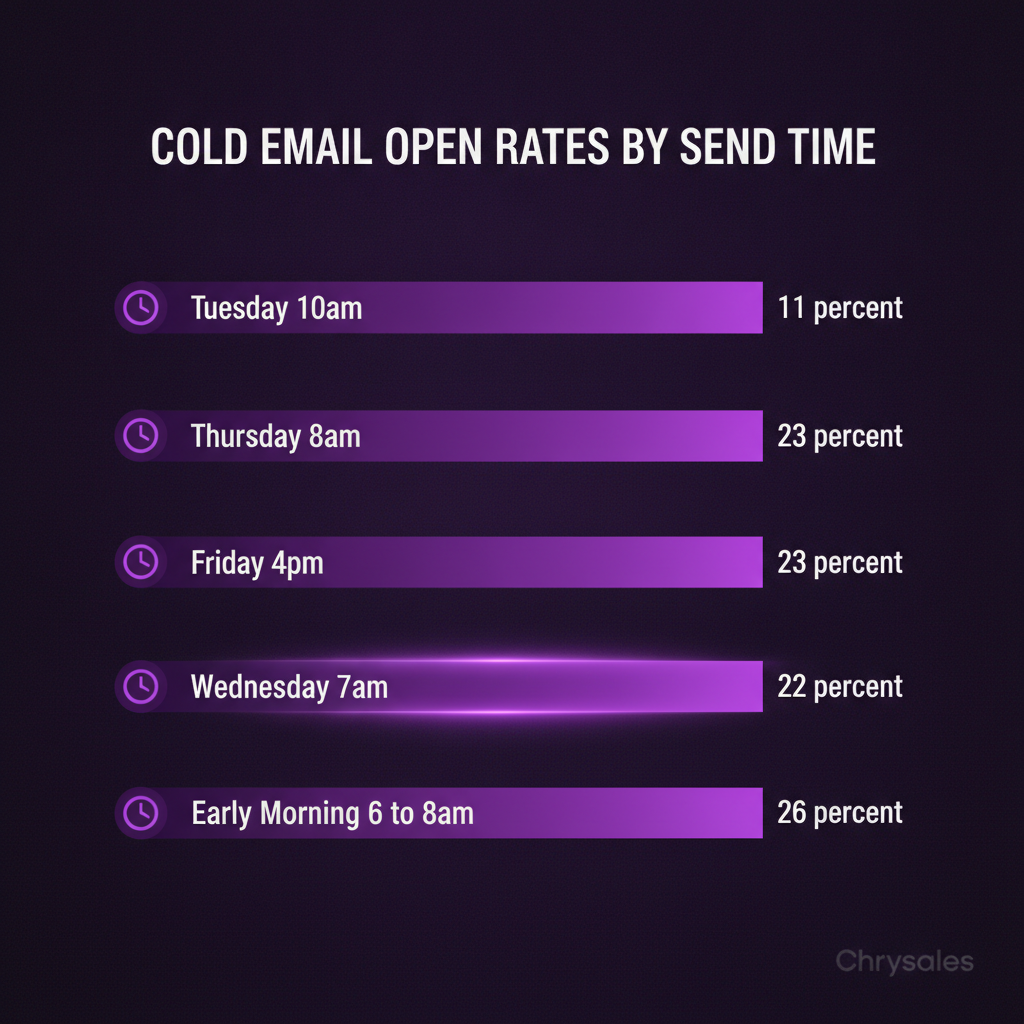
One consulting firm we worked with tested this exact thing. They sent the same cold email to 400 prospects, split into four time blocks: Tuesday 10 AM, Wednesday 2 PM, Thursday 8 AM, and Friday 4 PM. The Tuesday 10 AM batch had the worst open rate at 11%. Thursday 8 AM and Friday 4 PM both hit 23%. Same email. Same list. Different timing.
Watch out: If you're using send time advice built for newsletters, you're optimizing for the wrong inbox behavior.
Early Morning and End of Day Actually Work Better for B2B Cold Outreach
Most sales pros who've done serious cold outreach will tell you the same thing: early morning before meetings start, or late afternoon when people are wrapping up, tend to perform best.
The reason makes sense when you think about how busy people manage their inbox. Between 9 AM and 4 PM, most people at growing companies are in back to back meetings, working on projects, or firefighting problems. Email becomes a quick scan for urgent items only. A cold outreach message doesn't register as urgent, so it gets skipped. By the time they circle back, your email is buried under 30 new ones.
The 6 to 8 AM Window
Send before the workday chaos starts and your email sits near the top of the inbox when someone first opens their laptop with coffee. They're in scanning mode, but they haven't been pulled into meetings yet. There's a small window where they're processing overnight emails and deciding what the day looks like.
A 15 person tech consulting firm tested early sends for a month. Their average open rate jumped from 14% to 26% just by moving their cold email sends from 11 AM to 7 AM. Same subject lines. Same prospects. The inbox position made the difference.
The 4 to 5 PM Window
End of day works for a different reason. People are wrapping up, checking email one last time before they log off. They're often in a clearer headspace than mid morning when they're slammed. Some will leave interesting emails unread to deal with tomorrow morning, which means your message stays near the top overnight.
Pro Tip: If you send at 4:30 PM, your email is often still in the top 10 unread messages when someone opens their inbox at 8 AM the next day. You get two visibility windows for one send.
Wednesday and Thursday Beat Tuesday for B2B Sales Emails
Here's where the conventional wisdom gets one thing half right: mid week sends do perform better than Mondays or Fridays, but Tuesday isn't the magic day for cold outreach. Wednesday and Thursday consistently show stronger performance in B2B sales contexts.
Monday inboxes are a war zone. People return from the weekend to 100+ emails. Nobody has mental space for a cold pitch. Friday afternoons, people are checking out mentally. They're not making decisions about new vendors or booking calls for next week.
Why Wednesday Works
By Wednesday, the Monday email avalanche is cleared. People are in the flow of their work week. They're thinking about the quarter, about projects, about problems they need to solve. A well timed cold email that addresses a real pain point has a better chance of landing.
One marketing agency tracked 90 days of cold email sends across different days and tracked detailed cold email response rate benchmarks by day of week. Their Wednesday sends had a 19% open rate and a 4.2% reply rate. Tuesday sends hit 16% open and 3.1% reply. Not a massive difference, but consistent week after week.
Thursday as the Sleeper Best Day
Thursday has one underrated advantage: it's late enough in the week that people are thinking about wrapping projects, but early enough that they're still making decisions. If someone sees your email Thursday afternoon and thinks "this could be useful," they're more likely to reply or book a call for the following week than if they see it on Friday.
Common mistake: Assuming the day matters more than the actual email quality. A great offer sent Thursday will beat a weak offer sent Tuesday every single time. Timing is the fine tuning, not the foundation.
Testing Your Actual Audience Beats Following Generic Best Practices
The single biggest mistake teams make with email send times is treating it like a one size fits all question. The best time to send cold emails depends entirely on who you're emailing and what they do all day.
A sales director at a SaaS company has a completely different inbox rhythm than a partner at a consulting firm. Someone managing a remote team across time zones checks email differently than someone in an office from 9 to 5. Your best send time is whatever works for your specific audience, and the only way to know is to test.
How to Run a Simple Send Time Test
Pick 300 to 400 prospects from your list. Split them into three or four equal groups. Send the same email to each group at different times over the same week. Track open rates and reply rates for each batch.
Don't overthink the test. You're not looking for scientific perfection. You're looking for a pattern. If one time window consistently beats the others by 5 percentage points or more, that's your signal.
A 30 person consulting firm ran this test over two weeks. They tested Tuesday 10 AM, Wednesday 7 AM, Thursday 3 PM, and Friday 8 AM. Wednesday 7 AM won both weeks with a 22% open rate compared to 14 to 16% for the other windows. They shifted all cold outreach to Wednesday early mornings and saw their monthly booked calls increase from 8 to 14.
Segment by Job Role and Industry
Different buyer types have different schedules. Executives often check email early morning and late evening from their phone. Mid level managers are in meetings all day and batch process email in chunks. Founders of small companies might have totally erratic schedules.
If you're reaching out to IT directors at mid size companies, their inbox behavior will be different than CMOs at agencies. Test across segments, not just across your whole list.
Pro Tip: If you're using a CRM or sales automation tool, tag each prospect with the send time they received. After 60 days, filter by reply rate and see which send times performed best for which segments. That's your roadmap.
Email Quality and List Accuracy Matter 10X More Than Send Time
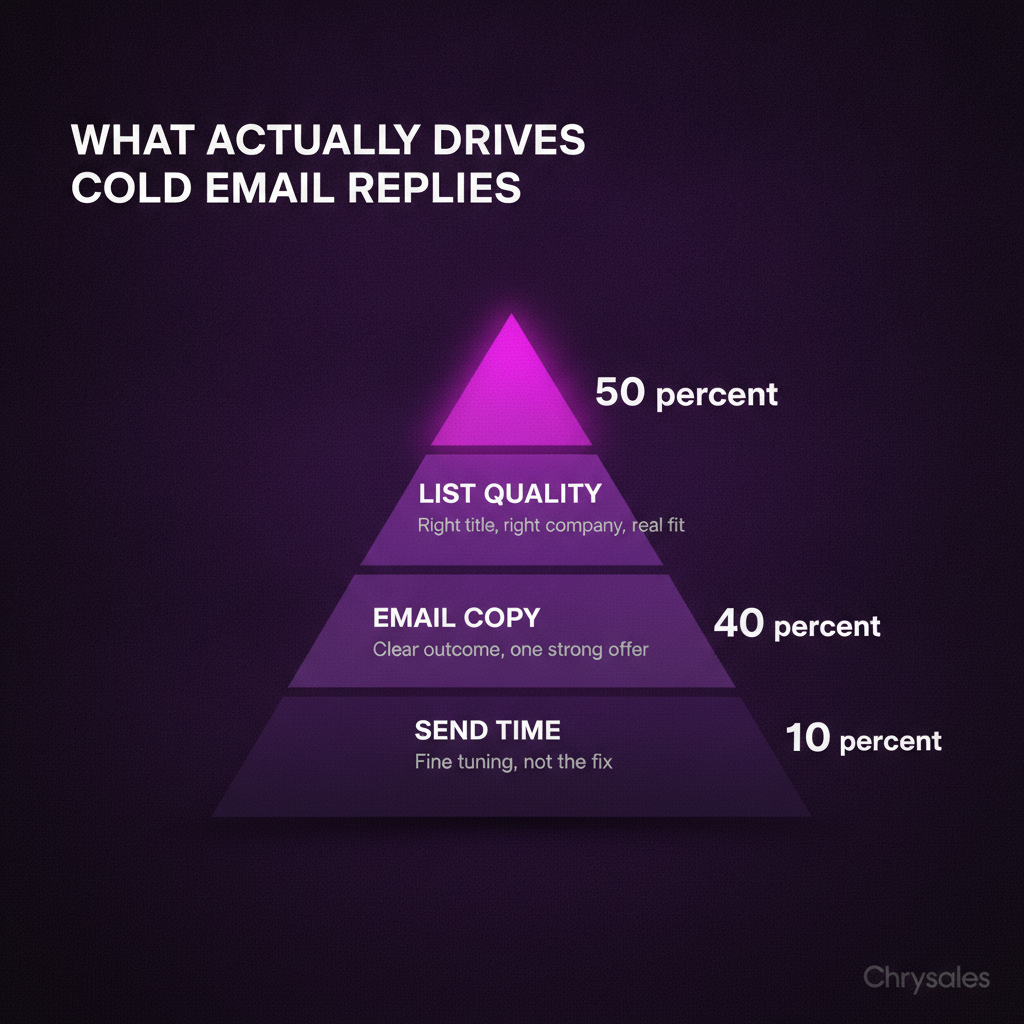
Here's the truth that most send time obsession misses: if your email is boring, your subject line is weak, or you're emailing the wrong people, no send time will save you. The best time to send an email matters, but it's maybe 10% of what determines whether someone replies. The other 90% is whether your email is relevant, clear, and sent to someone who actually has the problem you solve.
We see this pattern constantly. A team will spend two weeks testing send times trying to improve a 2% reply rate. They'll optimize from Tuesday to Thursday and get to 2.4%. Then we look at their list and find that 40% of the contacts aren't even the right job title. We clean the list, tighten the messaging, and the reply rate jumps to 6%, regardless of send time.
List Quality Is the Foundation
A great email sent at the perfect time to the wrong person gets zero response. A decent email sent at a random time to the right person can book a meeting.
If your list is full of outdated contacts, wrong titles, or companies that aren't a fit, you're wasting time worrying about whether to send at 8 AM or 10 AM.
Start here: make sure every prospect on your list matches your ideal client profile. Right company size, right industry, right role, real pain point that your service solves. If you're selling sales coaching to B2B companies and half your list is B2C e commerce brands, your send time won't matter.
Watch out: Teams often use send time optimization as a distraction from the harder work of building a clean, targeted list. Fix the list first, then fine tune the timing.
Email Copy and Offer Clarity Trump Everything
The second biggest factor is whether your email clearly explains what you're offering and why it matters to that specific person. Most cold emails fail because they're vague, too long, or lead with features instead of outcomes.
If your email says "We help companies optimize their sales processes" without explaining what that means in concrete terms, send time doesn't matter. If your subject line is "Quick question" or "Touching base," you've already lost.
A marketing agency rewrote their cold email template to focus on one specific outcome: helping consulting firms book 10+ qualified sales calls per month without hiring more salespeople. They didn't change their send time. Reply rate went from 3% to 9% in the first week of the new copy.
Pro Tip: Before you test send times, test two different subject lines and two different email body versions. Get your copy dialed in first. Then layer on send time optimization.
How to Build a Cold Outreach System That Works Across Time Zones
If you're reaching prospects across multiple time zones, the best time to send an email becomes a logistics puzzle. Sending at 8 AM in your time zone might mean 5 AM or 11 AM for half your list. This is where simple automation and segmentation save hours of manual scheduling.
Most email automation tools let you set send times based on the recipient's time zone. If you're using something like HubSpot, Lemlist, or even basic email scheduling in Gmail with plugins, you can define "send at 7 AM recipient local time" instead of sending everything at once.
Segment Your List by Geography First
Before you schedule anything, split your prospect list into time zone groups: East Coast, Central, Mountain, West Coast, or if you're international, by major regions like EU, UK, US, APAC. Each group gets the same email, just sent at the optimal local time.
One sales team targeting tech companies across the US and Europe used to send everything at 9 AM Berlin time. That meant their US East Coast prospects got emails at 3 AM. West Coast at midnight. Open rates were terrible. They switched to time zone based sending: 7 AM local time for each region. Open rates doubled from 12% to 24% without changing a single word of the email.
Use Automation but Keep It Simple
You don't need a complicated multi step workflow. Set up three to four simple automations, one per time zone or region. Load the right contacts into each automation. Set the send time. Done.
If you're looking to send cold emails at scale while maintaining personalization and timing precision, automation paired with proper segmentation is the only sustainable approach.
Common mistake: Building a 40 step automation sequence with dynamic time zones, A/B tests, and conditional logic that breaks every other week. Start simple. Get it working. Add complexity only if you need it.
What the Data Actually Says About B2B Email Send Times
Let's look at what real studies show when they focus on B2B cold outreach specifically, not general email marketing. The patterns are pretty consistent once you filter out the newsletter noise.
Most research focused on B2B sales emails shows Tuesday through Thursday as the strongest days, with Wednesday slightly outperforming. Mornings between 8 and 10 AM and late afternoons between 3 and 5 PM show higher open and reply rates than mid day sends. Mondays before 10 AM and Fridays after 2 PM underperform across the board.
The Mobile Email Factor
One shift worth noting: mobile email opens have grown massively. More than 50% of B2B email opens now happen on a phone, often outside traditional work hours, as recent B2B sales trend research confirms. People check email from their phone at 6 AM before getting out of bed, during commutes, and in the evening after dinner.
This doesn't mean you should send emails at 9 PM. It means your email needs to look good and make sense on a phone screen. Short paragraphs. Clear subject line. Obvious call to action. If someone opens your cold email on their phone at 7 PM and it's a wall of text, they'll skip it.
Email Send Time Optimization Tools
Some platforms now offer send time optimization features that analyze when each individual contact typically opens emails and auto schedule sends for those windows. Mailchimp has this. HubSpot has a version. Salesforce Einstein has predictive send times.
These tools work well for marketing emails to large engaged lists. For cold outreach, the data pool is smaller since you're often emailing someone for the first time. The tool has no history to learn from. They can still help, but don't expect magic. Testing your own segments manually often gives you better insight faster.
Pro Tip: If you're sending to a list under 500 contacts, manual time zone segmentation and day of week testing will give you clearer results than an AI send time tool trying to predict with no data.
How Chrysales Builds Cold Outreach Systems That Don't Depend on Timing Tricks
At Chrysales, we've trained over 500 sales teams and helped generate more than €10M in client revenue. One thing we see across every successful engagement: teams that win with cold outreach build systems, not hacks.
Send time optimization is part of the system, but it's never the foundation.
The teams that book 15, 20, 30 qualified calls a month from cold outreach do five things consistently well. They build hyper targeted prospect lists with strong fit criteria. They write clear, outcome focused emails that address real pain points. They follow up with a sequence, not just one email. They test and iterate based on real data from their audience. And yes, they send at smart times, usually early morning or late afternoon mid week.
Our 4 Step Approach to Predictable Client Acquisition
We don't teach cold email tactics in isolation. We build full client acquisition systems that integrate list building, offer positioning, outreach messaging, follow up sequences, and conversion processes into one repeatable engine.
The methodology is simple: Learn your market and ideal client. Build the systems that generate and qualify leads. Automate the repeatable parts so your team focuses on high value conversations. Then hire and train the right people to scale it without breaking what works.
For cold outreach specifically, that means spending more time on list quality and message clarity than on whether to send Tuesday or Wednesday. Both matter. One is 10X more important than the other. You can watch how to build a sales system so powerful clients come to you to see our full approach in action.
Watch out: If a cold outreach strategy relies entirely on perfect timing to work, the strategy is weak. Strong offers and relevant messaging work across a range of send times. Timing is the fine tuning that takes you from good to great, not from broken to working.
Frequently Asked Questions
Q: What is the absolute best time to send a cold email for B2B sales?
There's no universal best time that works for everyone, but early morning between 6 and 8 AM or late afternoon between 4 and 5 PM on Wednesday or Thursday consistently perform well for B2B cold outreach. The key is testing with your specific audience because a tech startup founder checks email differently than a corporate procurement manager. Run a simple test with 300 prospects split across different time windows and use the data from your actual list, not generic marketing benchmarks.
Q: Does send time really matter if my email copy is bad?
No. Send time is maybe 10% of what drives reply rates. If your email is sent to the wrong people, uses a boring subject line, or doesn't clearly explain what you're offering and why it matters, perfect timing won't save it. To understand how to write cold emails that actually get replies, fix your list quality first, then tighten your messaging and offer clarity, then optimize send times. We've seen teams obsess over Tuesday versus Wednesday while ignoring that 40% of their list is the wrong job title. Clean the foundation before you worry about the fine tuning.
Q: Should I avoid Mondays and Fridays completely for cold outreach?
Monday mornings are rough because inboxes are flooded after the weekend, so your email gets buried fast. Friday afternoons are weak because people are mentally checked out and not making decisions about new vendors or booking calls. That said, early Friday morning around 7 to 8 AM can actually work because the inbox is quieter and some people use Friday morning to catch up on things they ignored all week. Test it, but expect Wednesday and Thursday to outperform consistently.
Q: How do I handle send times when my prospects are in different time zones?
Segment your prospect list by time zone or region first. Use email automation tools that let you schedule sends based on recipient local time, so you can set "7 AM local time" instead of sending everything at once. If you're reaching US East Coast and West Coast prospects, set up two separate sends three hours apart. If you're international, create regional segments for US, EU, UK, and APAC and schedule each for early morning in that region. Most CRMs and cold email tools have this built in now.
Q: Can email send time optimization tools actually improve my results?
They can help, especially if you're sending to a large list of warm contacts where the platform has historical open data. For cold outreach to brand new prospects, these tools have less data to work with since you're emailing people for the first time. Manual testing by day and time window usually gives faster, clearer insights for cold email, and you should apply the same thinking found in outbound email marketing best practices to optimize both timing and targeting. Use send time tools as one input among many, but don't rely on them to fix weak targeting or messaging. Test your own audience and build your strategy from real performance data.
Best Time to Send an Email: Why That Tuesday Morning Myth Is Hurting Your Cold Outreach
The best time to send an email is the send window that gets the most opens and replies from your specific audience, based on their inbox habits and buyer role.
Picture this: you spend three hours perfecting a cold email. You wait until 10 AM on a Tuesday because that's what every marketing blog says is the best time to send an email. You hit send to 200 prospects. Six people open it. One replies asking to unsubscribe.
Sound familiar?
Here's the thing nobody tells you: the timing advice you've been following is built on data that has nothing to do with how B2B cold outreach actually works. Most of those "best time" studies look at newsletter subscribers who already want to hear from brands, not strangers trying to book a sales call.
The real answer is messier, smarter, and way more useful once you get it.
The Tuesday 10 AM Rule Is Based on Marketing Data, Not Sales Data
Walk into any sales team meeting and someone will mention the magic Tuesday morning send time. It's become sales gospel.
The problem? That advice comes from email marketing platforms analyzing millions of newsletter sends to subscribed audiences.
A person who signed up for a brand's newsletter behaves completely differently than a prospect getting a cold email from someone they've never heard of. Marketing emails go to warm audiences. People on those lists expect the email. They might even look forward to it. Cold outreach is the opposite. You're reaching out to someone who didn't ask to hear from you. The inbox psychology is totally different.
Why Marketing Benchmarks Don't Transfer to Cold Email
When MailerLite or Mailchimp publish studies showing Tuesday through Thursday mornings get the best open rates, they're measuring opted in subscribers. These people tolerate more email volume. They check their inbox with a different mindset.
A B2B decision maker sorting through 80 unopened emails at 10 AM on a Tuesday isn't thinking "I wonder which newsletters arrived today." They're thinking "which of these actually matters to my job right now?"
One consulting firm we worked with tested this exact thing. They sent the same cold email to 400 prospects, split into four time blocks: Tuesday 10 AM, Wednesday 2 PM, Thursday 8 AM, and Friday 4 PM. The Tuesday 10 AM batch had the worst open rate at 11%. Thursday 8 AM and Friday 4 PM both hit 23%. Same email. Same list. Different timing.
Watch out: If you're using send time advice built for newsletters, you're optimizing for the wrong inbox behavior.
Early Morning and End of Day Actually Work Better for B2B Cold Outreach
Most sales pros who've done serious cold outreach will tell you the same thing: early morning before meetings start, or late afternoon when people are wrapping up, tend to perform best.
The reason makes sense when you think about how busy people manage their inbox. Between 9 AM and 4 PM, most people at growing companies are in back to back meetings, working on projects, or firefighting problems. Email becomes a quick scan for urgent items only. A cold outreach message doesn't register as urgent, so it gets skipped. By the time they circle back, your email is buried under 30 new ones.
The 6 to 8 AM Window
Send before the workday chaos starts and your email sits near the top of the inbox when someone first opens their laptop with coffee. They're in scanning mode, but they haven't been pulled into meetings yet. There's a small window where they're processing overnight emails and deciding what the day looks like.
A 15 person tech consulting firm tested early sends for a month. Their average open rate jumped from 14% to 26% just by moving their cold email sends from 11 AM to 7 AM. Same subject lines. Same prospects. The inbox position made the difference.
The 4 to 5 PM Window
End of day works for a different reason. People are wrapping up, checking email one last time before they log off. They're often in a clearer headspace than mid morning when they're slammed. Some will leave interesting emails unread to deal with tomorrow morning, which means your message stays near the top overnight.
Pro Tip: If you send at 4:30 PM, your email is often still in the top 10 unread messages when someone opens their inbox at 8 AM the next day. You get two visibility windows for one send.
Wednesday and Thursday Beat Tuesday for B2B Sales Emails
Here's where the conventional wisdom gets one thing half right: mid week sends do perform better than Mondays or Fridays, but Tuesday isn't the magic day for cold outreach. Wednesday and Thursday consistently show stronger performance in B2B sales contexts.
Monday inboxes are a war zone. People return from the weekend to 100+ emails. Nobody has mental space for a cold pitch. Friday afternoons, people are checking out mentally. They're not making decisions about new vendors or booking calls for next week.
Why Wednesday Works
By Wednesday, the Monday email avalanche is cleared. People are in the flow of their work week. They're thinking about the quarter, about projects, about problems they need to solve. A well timed cold email that addresses a real pain point has a better chance of landing.
One marketing agency tracked 90 days of cold email sends across different days and tracked detailed cold email response rate benchmarks by day of week. Their Wednesday sends had a 19% open rate and a 4.2% reply rate. Tuesday sends hit 16% open and 3.1% reply. Not a massive difference, but consistent week after week.
Thursday as the Sleeper Best Day
Thursday has one underrated advantage: it's late enough in the week that people are thinking about wrapping projects, but early enough that they're still making decisions. If someone sees your email Thursday afternoon and thinks "this could be useful," they're more likely to reply or book a call for the following week than if they see it on Friday.
Common mistake: Assuming the day matters more than the actual email quality. A great offer sent Thursday will beat a weak offer sent Tuesday every single time. Timing is the fine tuning, not the foundation.
Testing Your Actual Audience Beats Following Generic Best Practices
The single biggest mistake teams make with email send times is treating it like a one size fits all question. The best time to send cold emails depends entirely on who you're emailing and what they do all day.
A sales director at a SaaS company has a completely different inbox rhythm than a partner at a consulting firm. Someone managing a remote team across time zones checks email differently than someone in an office from 9 to 5. Your best send time is whatever works for your specific audience, and the only way to know is to test.
How to Run a Simple Send Time Test
Pick 300 to 400 prospects from your list. Split them into three or four equal groups. Send the same email to each group at different times over the same week. Track open rates and reply rates for each batch.
Don't overthink the test. You're not looking for scientific perfection. You're looking for a pattern. If one time window consistently beats the others by 5 percentage points or more, that's your signal.
A 30 person consulting firm ran this test over two weeks. They tested Tuesday 10 AM, Wednesday 7 AM, Thursday 3 PM, and Friday 8 AM. Wednesday 7 AM won both weeks with a 22% open rate compared to 14 to 16% for the other windows. They shifted all cold outreach to Wednesday early mornings and saw their monthly booked calls increase from 8 to 14.
Segment by Job Role and Industry
Different buyer types have different schedules. Executives often check email early morning and late evening from their phone. Mid level managers are in meetings all day and batch process email in chunks. Founders of small companies might have totally erratic schedules.
If you're reaching out to IT directors at mid size companies, their inbox behavior will be different than CMOs at agencies. Test across segments, not just across your whole list.
Pro Tip: If you're using a CRM or sales automation tool, tag each prospect with the send time they received. After 60 days, filter by reply rate and see which send times performed best for which segments. That's your roadmap.
Email Quality and List Accuracy Matter 10X More Than Send Time
Here's the truth that most send time obsession misses: if your email is boring, your subject line is weak, or you're emailing the wrong people, no send time will save you. The best time to send an email matters, but it's maybe 10% of what determines whether someone replies. The other 90% is whether your email is relevant, clear, and sent to someone who actually has the problem you solve.
We see this pattern constantly. A team will spend two weeks testing send times trying to improve a 2% reply rate. They'll optimize from Tuesday to Thursday and get to 2.4%. Then we look at their list and find that 40% of the contacts aren't even the right job title. We clean the list, tighten the messaging, and the reply rate jumps to 6%, regardless of send time.
List Quality Is the Foundation
A great email sent at the perfect time to the wrong person gets zero response. A decent email sent at a random time to the right person can book a meeting.
If your list is full of outdated contacts, wrong titles, or companies that aren't a fit, you're wasting time worrying about whether to send at 8 AM or 10 AM.
Start here: make sure every prospect on your list matches your ideal client profile. Right company size, right industry, right role, real pain point that your service solves. If you're selling sales coaching to B2B companies and half your list is B2C e commerce brands, your send time won't matter.
Watch out: Teams often use send time optimization as a distraction from the harder work of building a clean, targeted list. Fix the list first, then fine tune the timing.
Email Copy and Offer Clarity Trump Everything
The second biggest factor is whether your email clearly explains what you're offering and why it matters to that specific person. Most cold emails fail because they're vague, too long, or lead with features instead of outcomes.
If your email says "We help companies optimize their sales processes" without explaining what that means in concrete terms, send time doesn't matter. If your subject line is "Quick question" or "Touching base," you've already lost.
A marketing agency rewrote their cold email template to focus on one specific outcome: helping consulting firms book 10+ qualified sales calls per month without hiring more salespeople. They didn't change their send time. Reply rate went from 3% to 9% in the first week of the new copy.
Pro Tip: Before you test send times, test two different subject lines and two different email body versions. Get your copy dialed in first. Then layer on send time optimization.
How to Build a Cold Outreach System That Works Across Time Zones
If you're reaching prospects across multiple time zones, the best time to send an email becomes a logistics puzzle. Sending at 8 AM in your time zone might mean 5 AM or 11 AM for half your list. This is where simple automation and segmentation save hours of manual scheduling.
Most email automation tools let you set send times based on the recipient's time zone. If you're using something like HubSpot, Lemlist, or even basic email scheduling in Gmail with plugins, you can define "send at 7 AM recipient local time" instead of sending everything at once.
Segment Your List by Geography First
Before you schedule anything, split your prospect list into time zone groups: East Coast, Central, Mountain, West Coast, or if you're international, by major regions like EU, UK, US, APAC. Each group gets the same email, just sent at the optimal local time.
One sales team targeting tech companies across the US and Europe used to send everything at 9 AM Berlin time. That meant their US East Coast prospects got emails at 3 AM. West Coast at midnight. Open rates were terrible. They switched to time zone based sending: 7 AM local time for each region. Open rates doubled from 12% to 24% without changing a single word of the email.
Use Automation but Keep It Simple
You don't need a complicated multi step workflow. Set up three to four simple automations, one per time zone or region. Load the right contacts into each automation. Set the send time. Done.
If you're looking to send cold emails at scale while maintaining personalization and timing precision, automation paired with proper segmentation is the only sustainable approach.
Common mistake: Building a 40 step automation sequence with dynamic time zones, A/B tests, and conditional logic that breaks every other week. Start simple. Get it working. Add complexity only if you need it.
What the Data Actually Says About B2B Email Send Times
Let's look at what real studies show when they focus on B2B cold outreach specifically, not general email marketing. The patterns are pretty consistent once you filter out the newsletter noise.
Most research focused on B2B sales emails shows Tuesday through Thursday as the strongest days, with Wednesday slightly outperforming. Mornings between 8 and 10 AM and late afternoons between 3 and 5 PM show higher open and reply rates than mid day sends. Mondays before 10 AM and Fridays after 2 PM underperform across the board.
The Mobile Email Factor
One shift worth noting: mobile email opens have grown massively. More than 50% of B2B email opens now happen on a phone, often outside traditional work hours, as recent B2B sales trend research confirms. People check email from their phone at 6 AM before getting out of bed, during commutes, and in the evening after dinner.
This doesn't mean you should send emails at 9 PM. It means your email needs to look good and make sense on a phone screen. Short paragraphs. Clear subject line. Obvious call to action. If someone opens your cold email on their phone at 7 PM and it's a wall of text, they'll skip it.
Email Send Time Optimization Tools
Some platforms now offer send time optimization features that analyze when each individual contact typically opens emails and auto schedule sends for those windows. Mailchimp has this. HubSpot has a version. Salesforce Einstein has predictive send times.
These tools work well for marketing emails to large engaged lists. For cold outreach, the data pool is smaller since you're often emailing someone for the first time. The tool has no history to learn from. They can still help, but don't expect magic. Testing your own segments manually often gives you better insight faster.
Pro Tip: If you're sending to a list under 500 contacts, manual time zone segmentation and day of week testing will give you clearer results than an AI send time tool trying to predict with no data.
How Chrysales Builds Cold Outreach Systems That Don't Depend on Timing Tricks
At Chrysales, we've trained over 500 sales teams and helped generate more than €10M in client revenue. One thing we see across every successful engagement: teams that win with cold outreach build systems, not hacks.
Send time optimization is part of the system, but it's never the foundation.
The teams that book 15, 20, 30 qualified calls a month from cold outreach do five things consistently well. They build hyper targeted prospect lists with strong fit criteria. They write clear, outcome focused emails that address real pain points. They follow up with a sequence, not just one email. They test and iterate based on real data from their audience. And yes, they send at smart times, usually early morning or late afternoon mid week.
Our 4 Step Approach to Predictable Client Acquisition
We don't teach cold email tactics in isolation. We build full client acquisition systems that integrate list building, offer positioning, outreach messaging, follow up sequences, and conversion processes into one repeatable engine.
The methodology is simple: Learn your market and ideal client. Build the systems that generate and qualify leads. Automate the repeatable parts so your team focuses on high value conversations. Then hire and train the right people to scale it without breaking what works.
For cold outreach specifically, that means spending more time on list quality and message clarity than on whether to send Tuesday or Wednesday. Both matter. One is 10X more important than the other. You can watch how to build a sales system so powerful clients come to you to see our full approach in action.
Watch out: If a cold outreach strategy relies entirely on perfect timing to work, the strategy is weak. Strong offers and relevant messaging work across a range of send times. Timing is the fine tuning that takes you from good to great, not from broken to working.
Frequently Asked Questions
Q: What is the absolute best time to send a cold email for B2B sales?
There's no universal best time that works for everyone, but early morning between 6 and 8 AM or late afternoon between 4 and 5 PM on Wednesday or Thursday consistently perform well for B2B cold outreach. The key is testing with your specific audience because a tech startup founder checks email differently than a corporate procurement manager. Run a simple test with 300 prospects split across different time windows and use the data from your actual list, not generic marketing benchmarks.
Q: Does send time really matter if my email copy is bad?
No. Send time is maybe 10% of what drives reply rates. If your email is sent to the wrong people, uses a boring subject line, or doesn't clearly explain what you're offering and why it matters, perfect timing won't save it. To understand how to write cold emails that actually get replies, fix your list quality first, then tighten your messaging and offer clarity, then optimize send times. We've seen teams obsess over Tuesday versus Wednesday while ignoring that 40% of their list is the wrong job title. Clean the foundation before you worry about the fine tuning.
Q: Should I avoid Mondays and Fridays completely for cold outreach?
Monday mornings are rough because inboxes are flooded after the weekend, so your email gets buried fast. Friday afternoons are weak because people are mentally checked out and not making decisions about new vendors or booking calls. That said, early Friday morning around 7 to 8 AM can actually work because the inbox is quieter and some people use Friday morning to catch up on things they ignored all week. Test it, but expect Wednesday and Thursday to outperform consistently.
Q: How do I handle send times when my prospects are in different time zones?
Segment your prospect list by time zone or region first. Use email automation tools that let you schedule sends based on recipient local time, so you can set "7 AM local time" instead of sending everything at once. If you're reaching US East Coast and West Coast prospects, set up two separate sends three hours apart. If you're international, create regional segments for US, EU, UK, and APAC and schedule each for early morning in that region. Most CRMs and cold email tools have this built in now.
Q: Can email send time optimization tools actually improve my results?
They can help, especially if you're sending to a large list of warm contacts where the platform has historical open data. For cold outreach to brand new prospects, these tools have less data to work with since you're emailing people for the first time. Manual testing by day and time window usually gives faster, clearer insights for cold email, and you should apply the same thinking found in outbound email marketing best practices to optimize both timing and targeting. Use send time tools as one input among many, but don't rely on them to fix weak targeting or messaging. Test your own audience and build your strategy from real performance data.
Scaling Is Not Hard If You Have The Right Systems
If you’re serious about leveling up your scaling game, you need the right system, the right training, and the right team behind you. We're here to give you the exact tools and strategies top entrepreneurs use to dominate.

Discover the latest tips
View All.avif)
Chrysales was formed from the words "chrysalis" the stage where a caterpillar transforms into a butterfly and "sales".
It stands for one thing: sales transformation.Because scaling doesn’t happen by doing more of the same. Scaling only happens when you go through real transformation in your systems, your offer, team and the way you sell.
.avif)


