
B2B positioning statement: how to write one buyers believe
A B2B positioning statement is an internal sentence that names who you sell to, the problem they hire you for, what they'd do without you, what you do differently and what proves it. It's a working tool for your team, and buyers rarely read it word for word. Fill it from your recent won and lost deals, test it against what buyers actually say, then use it as the source for your outreach, website and proposals. If you can't name the alternative you beat or show any proof, it isn't ready yet.
Below you'll find a fill-in template, a worksheet for your deal notes, one fictional company carried from raw notes to a finished outreach line, real public examples and a short test you can run alone.
What is a B2B positioning statement?
A positioning statement is one or two sentences for your own team. They pin down who buys from you, what they would use instead, why you're the better choice for them and what backs that up. Buyers rarely see it as written. It sits behind everything they do see: the first line of an email, the website headline, the opening of a proposal.
The idea comes from Al Ries and Jack Trout, who wrote about positioning back in 1969 and 1972. The fill-in format most templates copy today is Geoffrey Moore's, from his book Crossing the Chasm. The University of Cambridge's Institute for Manufacturing prints it in six lines. They read: for (target customer), who (need or opportunity), the (product name) is a (product category), that (key benefit), unlike (primary competitive alternative), our product (primary differentiation).
April Dunford, author of Obviously Awesome, draws a clear line around the term in her quickstart guide to positioning. In her definition, positioning is separate from messaging, and it is neither a tagline nor a brand story, a vision or a "why". In our view, the messaging and the tagline get written from the positioning, not the other way round.
The differences are easiest to see side by side. The example column uses one fictional company that we'll follow through the whole post: Acme Reporting, an illustrative 25-person B2B company that runs month-end reporting for mid-sized firms.
| Item | Who reads it | What it does | Acme Reporting (fictional) |
|---|---|---|---|
| Positioning statement | Your team | Fixes the buyer, the alternative you beat, the difference and the proof | For finance leads whose month-end close depends on two people working late... (full version in the finished-statement section) |
| Value proposition | The buyer | Promises the result in the buyer's words | Your board pack on the same date every month, even when someone is out |
| Tagline | Anyone who sees the brand | A short line people remember | Month-end, on time |
| Offer | A buyer ready to decide | Scope, terms and price of what they buy | Monthly close and board pack, fixed scope, fixed monthly fee |
| Mission | Your team and future hires | Why the company exists, long term | Make month-end boring for mid-sized companies |
You're most likely to mix up the offer with positioning. Positioning decides who you're for and why you win; the offer packages it into something a buyer can say yes to. If that's your next step, here is how to write a B2B offer that doesn't need a discount.
How long should it be? One or two sentences that someone on your team can say from memory. A statement nobody can recite stays in a document and never reaches a sales call.
Why do B2B buyers struggle to tell vendors apart?
Most vendors describe themselves with the same words, and chances are your website does too. Quality, experience, a great team and fast replies are what a buyer expects from anyone on the shortlist, so those words separate you from nobody. When buyers can't see a real difference, price, the vendor they already have and doing nothing all start to look as good as you.
Research backs up how little difference buyers see. In a 2013 study, Google and CEB's Marketing Leadership Council worked with Motista to survey 3,000 purchasers of 36 B2B brands. They found that perceived business value barely differed between leading brands within a given industry, and that where differentiation did exist, only 14% of decision makers were willing to pay a premium for it. The study is from 2013 and Google sells advertising, so read it as a direction rather than a law.
Marketing researchers call the basics everyone must have points of parity. Keller, Sternthal and Tybout wrote in Harvard Business Review in 2002 that points of difference alone aren't enough to hold a position. A brand also has to "break even" with competitors on the basics. For a B2B company, quality, experience and responsiveness are those basics: you need them to stay on the shortlist, and they won't get you picked.
Hinge, a branding firm for professional services, lists "our people are better", "our process is better", "committed to excellence", "better service" and "we're different" as positions that fail. On the service claim, Lee Frederiksen of Hinge writes: "Strong positioning is built on attributes that are either self-evident or can be proved. But 'service' is just a word until it is experienced."
This matters more in B2B because the person who likes you is rarely the only one deciding. April Dunford points out in The "No Differentiation" Illusion that in any B2B deal of a decent size, your champion has to justify the choice to someone else. A bad choice has consequences for them. A vague reason is hard to defend in that meeting.
At Chrysales we think founder-led sales hides weak positioning, because your own credibility makes up for it. When you're on the call, the buyer trusts you and the vague words do little harm. When a new seller runs the call, or a cold email has to do the work alone, the gap shows.
Writing the positioning down is one piece of a wider shift: growth that runs on a system rather than on you working harder. Sabir's video on the new rules of sales explains why effort-based growth models are failing and introduces a framework built for a volatile market.
What goes into each part of the statement?
The statement has six parts: who it's for, the problem or trigger that makes them look, the category they'd put you in, the alternative they'd pick without you, what you do differently, and the proof. Each part answers one plain question you can check against your deals. Leave one out and the sentence drifts back into generic claims any competitor could sign.
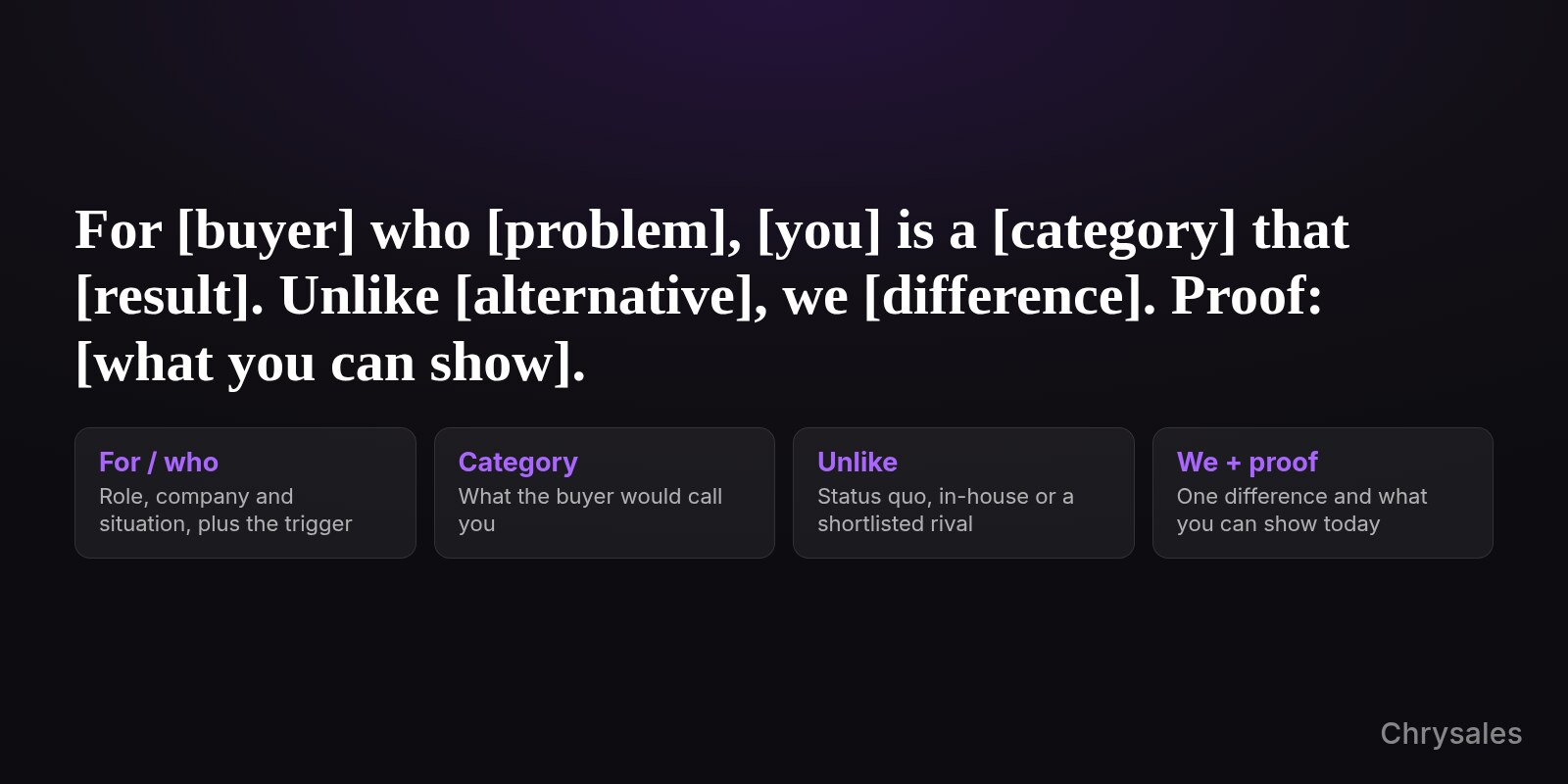
Here is the template. It follows Moore's classic format with two changes for a B2B company. The "who" line names what the buyer is unhappy with, as in the elevator test version of Moore's template that Unusual Ventures summarizes ("who are dissatisfied with [the current market alternative]"). And there is a proof line, because the same summary describes Moore's view of positioning as a claim backed by evidence.
For [buyer: role, company and situation]
who [the trigger or problem, in the buyer's words],
[your company] is a [category: what the buyer would call you]
that [the result they get].
Unlike [the alternative: status quo, in-house or a shortlisted rival],
we [one difference, in plain words].
Proof: [what you can show today].
Each slot has a typical way to go wrong:
| Slot | Plain question | Common failure | Better |
|---|---|---|---|
| For | Who buys, and in which situation? | "Small and mid-sized businesses" | Role, company and situation, for example a finance lead whose close depends on two people |
| Who | What made them start looking? | A list of your services | The trigger or problem in the buyer's words |
| Category | What would the buyer call you? | A new category nobody uses | The words a buyer would use to describe you to a colleague |
| Unlike | What would they do without you? | A famous competitor they never considered | Status quo, in-house or a shortlisted rival |
| We | What do you do that the alternative can't? | "Quality, experience, great service" | One difference the buyer can see or check |
| Proof | What can you show today? | Numbers you can't back up | What you can show today: a named client with permission, a sample of the work, a reference, your process |
The "unlike" slot is easy to get wrong. Dunford writes in Positioning and Competition that the first alternative you have to beat is the status quo: the buyer doing nothing, working around the problem, or doing the work in-house. A rival counts only if buyers actually put you side by side with them. She spells it out in The "No Differentiation" Illusion: "They are not a true alternative if they don't show up on a shortlist."
For Acme Reporting, the honest alternative is rarely another reporting firm. Most of its buyers would hire one more accountant, or keep asking two people to work late at month-end.
How do you fill it in from your won and lost deals?
Pull your recent won and lost deals, ask the same six questions about each, group the answers by slot, and only then write. Work from the alternatives first, then the difference, then who cares most about it, and settle the category last. The answers buyers gave you are the evidence; your own opinion of your company is a first guess at most.
Dunford calls the parts of positioning "the blanks in the positioning statement", and in her quickstart guide she works through them in a fixed order. First come the alternatives a customer would turn to without you, then what you have that those alternatives lack, then the value that creates. After that she asks who cares most about that value, and the market category comes last.
She calls the classic fill-in-the-blanks exercise "potentially dangerous", because it assumes each blank has one answer you already know. So do the deal work first and fill in the template last.
- Pick the deals. Start with your last 5 to 8 won deals and 3 to 5 lost or stalled ones. That range is a practical starting point, not a research figure; if you have fewer, use what you have and treat the result as a first draft.
- Get the answers. A short call with the buyer is best. Where you can't get one, use your call notes and emails, and mark which answers are your guess.
- Ask the same questions every time, using the worksheet below, so the answers can be compared.
- Group the answers by slot. Put every alternative in one list, every reason for choosing you in another, and so on. Look for words that come up more than once.
- Write the slots in Dunford's order: alternatives, difference, value, buyer, category.
- Write the full sentence, then cut every word a buyer wouldn't use.
- Read it against your lost deals. If a buyer who said no would recognize their problem in it, you are close.
Won / lost deal worksheet (one per deal)

Deal: ________   Won / Lost / Stalled   Buyer's role: ________

1. Why did you start looking when you did? What happened?
2. What else did you consider, including doing nothing or doing it yourselves?
3. If you hadn't hired anyone, what would you have done?
4. Why did you pick us (or why not)?
5. What almost stopped you from going ahead?
6. How did you explain the choice to your boss or your team?

Slots it feeds:
1 -> who (trigger)    2 and 3 -> unlike    4 -> we
5 -> proof            6 -> category and proof
Grouped notes for Acme Reporting might look like this. The company and its answers are made up for illustration.
- Triggers: a key person on the finance team resigned and month-end slipped; the board asked for reports earlier.
- Alternatives considered: hire another accountant; ask the auditor for help; keep going and work late.
- Why buyers chose Acme: it showed its close checklist on the first call, with a named backup for every task.
- Why deals were lost: one buyer went with a large firm because the board wanted a known name; another hired in-house.
- How buyers described Acme to their boss: "an outsourced month-end team".
What does a finished statement look like?
A finished statement is specific enough that a poor-fit buyer would say "not for us" and a good-fit buyer would say "that's us". It names the buyer's situation, the alternative, one difference and the proof. Below is the fictional Acme Reporting version with a spoken version and a before and after, followed by real public examples worth studying.
This is Acme Reporting's generic line before the work (fictional).
Acme Reporting delivers high-quality financial reporting with an experienced team, tailored solutions and a commitment to excellent service.And this is the statement after the work, built from those fictional notes.
For finance leads at mid-sized companies whose month-end close depends on two people working late, Acme Reporting is an outsourced month-end team that delivers the board pack on an agreed date every month.
Unlike hiring one more accountant, which leaves the close just as fragile, we run every close from a written checklist with a named backup for each task.
Proof: we show the checklist on the first call, and clients who moved from an in-house close take reference calls.
The spoken version is shorter, for a call or an event.
We run month-end reporting for mid-sized companies whose close depends on two people staying late, so the board pack lands on the same date every month, even when someone is out.What changed: "high-quality" became a named situation, "experienced team" became a checklist with a backup for each task, and "tailored solutions" was cut. Two things the old line lacked were added, the alternative and the proof.
HubSpot: the alternative was a pile of tools
HubSpot's 2014 S-1 filing is a securities document, not a published positioning statement, but it reads like one. It calls the product "a cloud-based, all-in-one inbound marketing and sales software platform", describes the alternative as a "disparate collection of point applications", and names its target as "mid-sized businesses". The alternative it beats is the status quo, many separate tools, rather than a named rival.
Janna Systems: a narrower "for whom"
Dunford tells this story from her own time running marketing at Janna Systems, in her quickstart guide. The company moved from "Enterprise CRM" to "CRM for Investment Banks". She writes that the shift "allowed us to grow very quickly over the next 18 months from under $2M to close to $80M". That's one company's account, told by one person, and no forecast for yours; what carries over is the move, a smaller and sharper "for whom" that made the difference easy to see.
Duckbill: the problem in the buyer's words
On Hacker News in 2020, Corey Quinn of Duckbill argued that a more effective positioning statement might have been "I fix the horrifying AWS bill for SaaS companies in the Pacific Northwest". It leads with the problem as the buyer feels it and names a narrow group. Duckbill's own site says something different today (as of November 2026), which fits Dunford's observation in Shifting Positioning that most successful, established B2B companies have shifted their positioning several times.
Hinge: the "only" test
Hinge suggests a one-line stress test. It credits the format to Marty Neumeier: "We are the only [your category] that [your primary differentiator]." If you can't finish that sentence truthfully for your company, the "we" slot needs more work.
How do you know your positioning statement works?
Run six checks before you use it. You can name the alternative you beat and show the proof today. A buyer who said no would recognize the problem, a poor-fit buyer would rule themselves out, and a new hire can repeat it. The sixth check comes later: on early sales calls, prospects should start describing their problem the way your statement does.
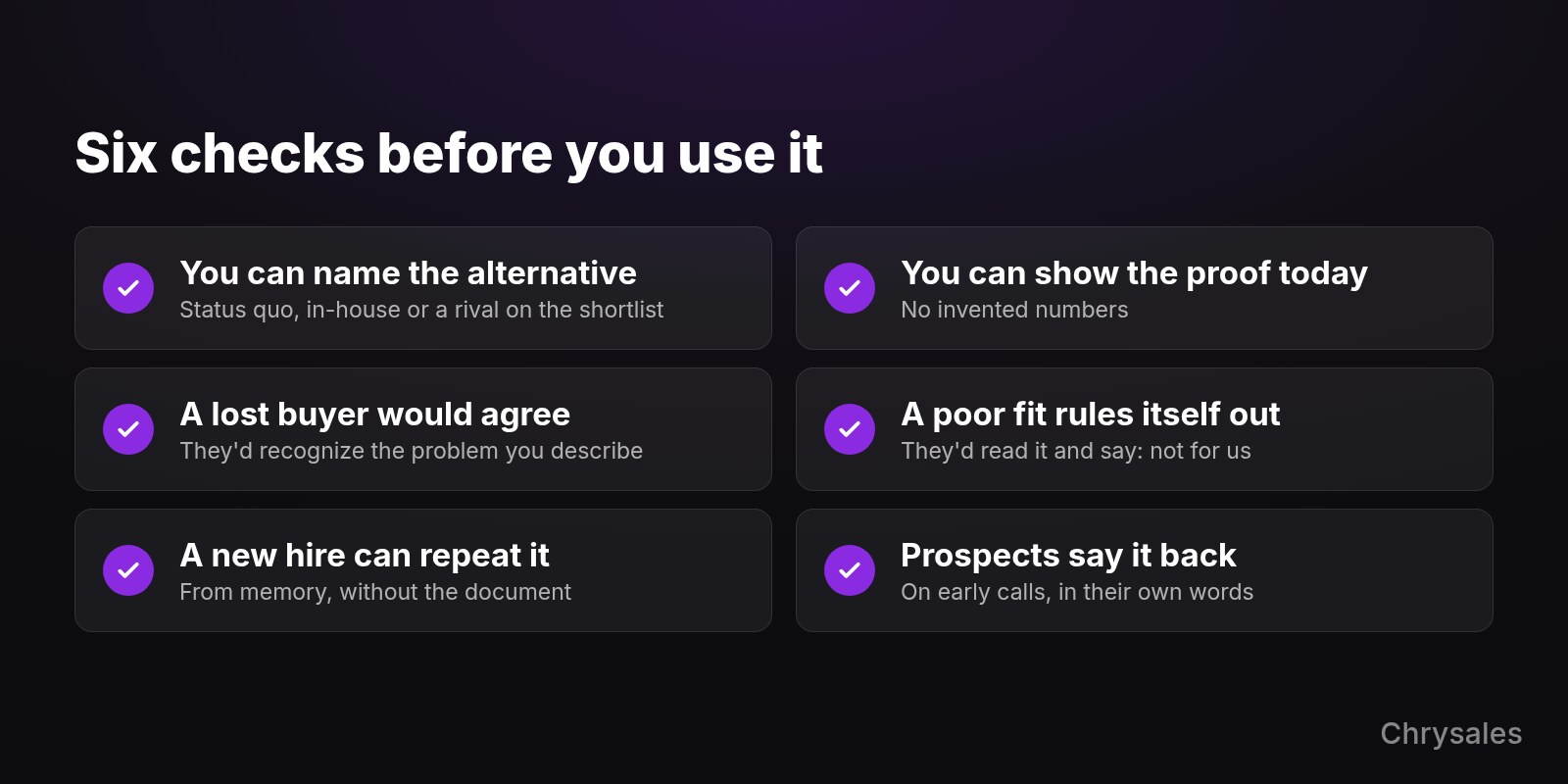
- You can name the alternative. Status quo, in-house or a rival on the shortlist. If the "unlike" line says "other providers", go back to your deal notes.
- You can show the proof today, with no invented numbers. A smaller company can show named clients who agreed to be named, a sample of the work, a reference call, or its process laid out step by step. For what buyers need to see at each stage, read the proof buyers need before they book a call.
- A lost buyer would agree. Read it as one of your lost deals would. They'd recognize the problem you describe, even if they picked someone else.
- A poor fit rules itself out. If nobody would read it and say "not for us", it's too broad.
- A new hire can repeat it. From memory, without the document, in their own words.
- Prospects say it back. On early calls, listen for buyers repeating your framing of the problem in their own words.
The sixth check is the real test. Asked by a reader how to measure positioning, Dunford replied that if you test positioning through a sales pitch, you should see an effect on your numbers right after the first sales call. For a small company, that means watching how first calls go in the weeks after the change, not waiting a quarter for a brand survey.
Where does the positioning statement go next?
The statement stays internal, but every line a buyer sees should come from it. That covers the first line of your outreach, your LinkedIn headline and About section, the website hero, the opening of your proposal and your answer to "why you?". Use the same story in every place, so a buyer hears one consistent message from the first email to the first call.
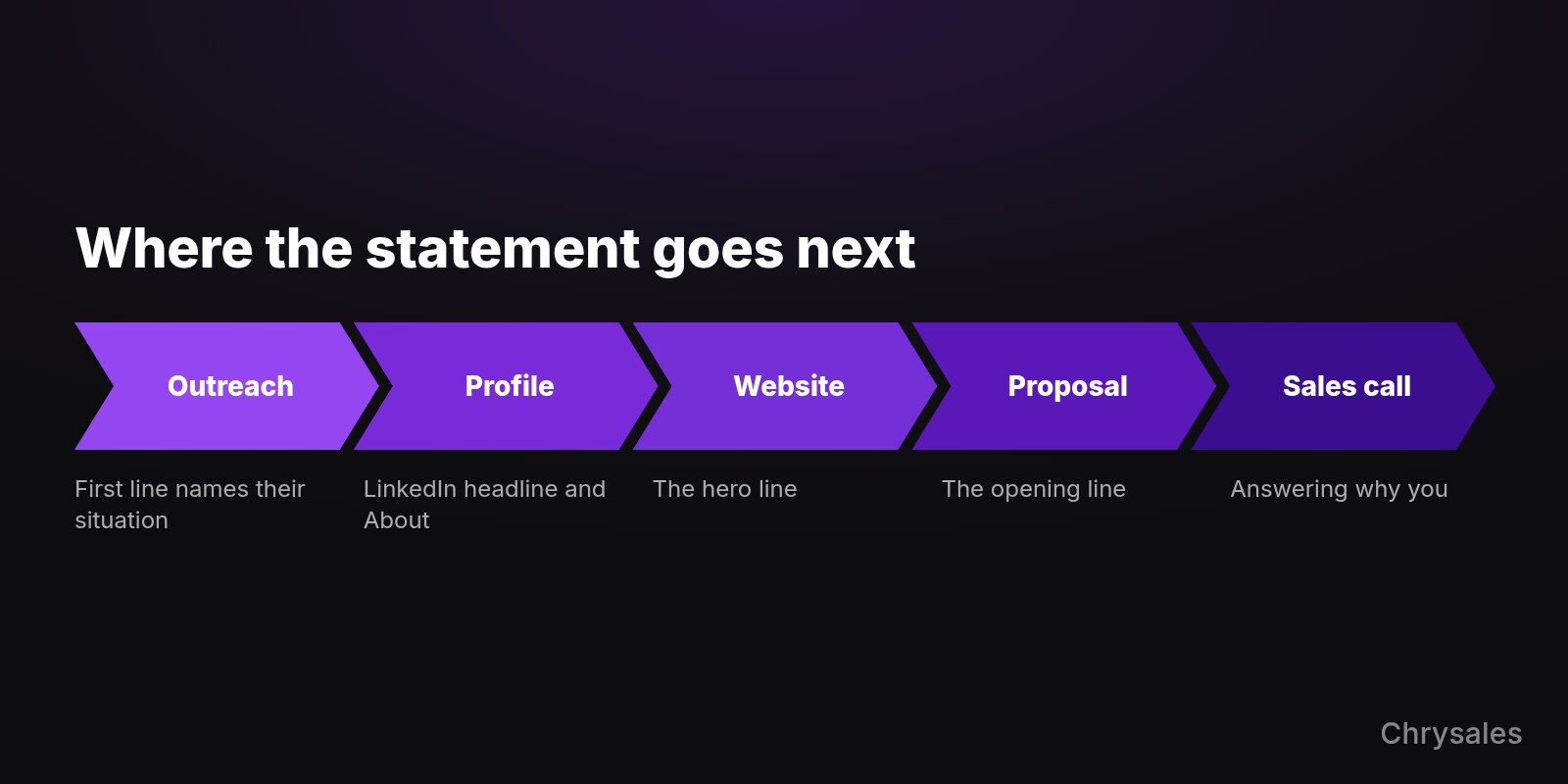
Dunford makes the case for one story in Why Positioning Fails to Make the Jump from Marketing to Sales. She writes: "Consistency trumps customization in very early sales interactions." Tailor the details to each buyer later, once you know them.
Turned into each line a buyer would see, the fictional Acme Reporting statement looks like this:
| Where | What it takes from the statement | Acme Reporting line (fictional) |
|---|---|---|
| Outreach opener | The buyer's situation | Does your month-end close still depend on two people staying late? |
| LinkedIn headline | Buyer + result | Month-end reporting for mid-sized companies, on the same date every month |
| Website hero | The value proposition | Your board pack on the same date every month, even when someone is out |
| Proposal opening | The trigger they told you | You asked us in because the close slipped after your senior accountant left |
| "Why you?" on a call | The alternative + difference | You could hire one more accountant, but the close would still hang on people. We run it from a checklist with a backup for each task |
| "We already have someone" | The difference + proof | Happy to show you our close checklist so you can compare it with how it runs today |
For the outreach line, the rules for writing a cold email opener still apply: one sentence about their situation, not about you. The headline and About section feed your LinkedIn profile for B2B sales. And when a buyer says they're covered, your "unlike" line is the starting point for answering "we already have a vendor".
Common mistakes with B2B positioning statements
Most weak statements fail in the same few ways: claims nobody can check, a list of every service, a buyer described as "everyone", an alternative nobody really considers, or proof that can't be shown. Each has a simple fix, and nearly all of them come back to the same habit: start from what buyers told you in real deals.
- Generic claims. "Quality" and "great service" are basics every shortlisted vendor claims. Swap each one for something the buyer can see or check.
- Listing every service. A statement that covers everything says nothing. Pick the problem most of your won deals started with; the rest of your services belong in the offer.
- Writing for everyone. "For businesses of all sizes" rules nobody out. Use your ideal customer profile to name the role, the company and the situation.
- Fighting a phantom competitor. Naming a famous rival your buyers never shortlisted, while the real alternative (doing nothing or doing it in-house) goes unanswered.
- Claiming proof you can't show. If a buyer asks to see it and you can't, the statement loses trust on the spot. Use only proof you could put on the table tomorrow.
- Leaving out the people who sell. A statement written without anyone who talks to buyers ends up in words buyers don't use. Write it with whoever runs your sales calls, even if that's only you.
- Writing it once and filing it away. Read it again when your deals change: a new type of buyer, a new alternative you keep losing to, or a new offer.
- Copying a competitor's line. If their sentence fits you too, neither of you has a position yet.
FAQ
What is the difference between a positioning statement and a value proposition?
A positioning statement is internal: it tells your team who you're for, what you beat and why you win. A value proposition is external: it tells the buyer what result they get, in their words. The value proposition is written from the positioning statement, usually as a website headline or the first line of a pitch.
How long should a positioning statement be?
One or two sentences. The test is whether someone on your team can say it from memory. Keep a short spoken version next to the full one for calls and introductions.
Who should write the positioning statement?
You, together with whoever talks to buyers most, working from real deal notes. An outside writer can help with the wording later, but the inputs have to come from people who hear why buyers say yes and no.
Can a small company with few case studies still have one?
Yes. Proof can be a sample of the work, a reference call, a named client who agreed to it, or a process the buyer can see. Think you have no difference at all? Dunford argues in The "No Differentiation" Illusion that either that's true, and positioning won't help, or you haven't yet understood how your customers see the difference.
How often should you update a positioning statement?
Whenever your deals tell you something changed: you start winning a different type of buyer, you keep losing to an alternative that isn't in the statement, or your offer changes. Reading it against the last few won and lost deals once a quarter is a simple habit.
Sources
- University of Cambridge, Institute for Manufacturing - The elevator speech (Moore's template)
- Unusual Ventures - Crossing the enterprise chasm: lessons from Geoffrey Moore
- April Dunford - A quickstart guide to positioning
- April Dunford - Positioning and competition
- April Dunford - The "No Differentiation" Illusion
- April Dunford - Why positioning fails to make the jump from marketing to sales
- April Dunford - Shifting positioning: why B2B tech is different
- Think with Google (archived) - From promotion to emotion: connecting B2B customers to brands
- Harvard Business Review - Three questions you need to ask about your brand
- Hinge - Positioning strategy: 5 common-sense approaches that never work
- Hinge - What's your "only"?
- SEC - HubSpot, Inc. Form S-1 (2014)
- Hacker News - Corey Quinn's comment on positioning (2020)
- Ries - Positioning articles (Ries and Trout, 1969 and 1972)
Can't say in one sentence yet why buyers should pick you over the other vendor? You can talk it through with the Chrysales team. Book a free strategy call
A B2B positioning statement is an internal sentence that names who you sell to, the problem they hire you for, what they'd do without you, what you do differently and what proves it. It's a working tool for your team, and buyers rarely read it word for word. Fill it from your recent won and lost deals, test it against what buyers actually say, then use it as the source for your outreach, website and proposals. If you can't name the alternative you beat or show any proof, it isn't ready yet.
Below you'll find a fill-in template, a worksheet for your deal notes, one fictional company carried from raw notes to a finished outreach line, real public examples and a short test you can run alone.
What is a B2B positioning statement?
A positioning statement is one or two sentences for your own team. They pin down who buys from you, what they would use instead, why you're the better choice for them and what backs that up. Buyers rarely see it as written. It sits behind everything they do see: the first line of an email, the website headline, the opening of a proposal.
The idea comes from Al Ries and Jack Trout, who wrote about positioning back in 1969 and 1972. The fill-in format most templates copy today is Geoffrey Moore's, from his book Crossing the Chasm. The University of Cambridge's Institute for Manufacturing prints it in six lines. They read: for (target customer), who (need or opportunity), the (product name) is a (product category), that (key benefit), unlike (primary competitive alternative), our product (primary differentiation).
April Dunford, author of Obviously Awesome, draws a clear line around the term in her quickstart guide to positioning. In her definition, positioning is separate from messaging, and it is neither a tagline nor a brand story, a vision or a "why". In our view, the messaging and the tagline get written from the positioning, not the other way round.
The differences are easiest to see side by side. The example column uses one fictional company that we'll follow through the whole post: Acme Reporting, an illustrative 25-person B2B company that runs month-end reporting for mid-sized firms.
| Item | Who reads it | What it does | Acme Reporting (fictional) |
|---|---|---|---|
| Positioning statement | Your team | Fixes the buyer, the alternative you beat, the difference and the proof | For finance leads whose month-end close depends on two people working late... (full version in the finished-statement section) |
| Value proposition | The buyer | Promises the result in the buyer's words | Your board pack on the same date every month, even when someone is out |
| Tagline | Anyone who sees the brand | A short line people remember | Month-end, on time |
| Offer | A buyer ready to decide | Scope, terms and price of what they buy | Monthly close and board pack, fixed scope, fixed monthly fee |
| Mission | Your team and future hires | Why the company exists, long term | Make month-end boring for mid-sized companies |
You're most likely to mix up the offer with positioning. Positioning decides who you're for and why you win; the offer packages it into something a buyer can say yes to. If that's your next step, here is how to write a B2B offer that doesn't need a discount.
How long should it be? One or two sentences that someone on your team can say from memory. A statement nobody can recite stays in a document and never reaches a sales call.
Why do B2B buyers struggle to tell vendors apart?
Most vendors describe themselves with the same words, and chances are your website does too. Quality, experience, a great team and fast replies are what a buyer expects from anyone on the shortlist, so those words separate you from nobody. When buyers can't see a real difference, price, the vendor they already have and doing nothing all start to look as good as you.
Research backs up how little difference buyers see. In a 2013 study, Google and CEB's Marketing Leadership Council worked with Motista to survey 3,000 purchasers of 36 B2B brands. They found that perceived business value barely differed between leading brands within a given industry, and that where differentiation did exist, only 14% of decision makers were willing to pay a premium for it. The study is from 2013 and Google sells advertising, so read it as a direction rather than a law.
Marketing researchers call the basics everyone must have points of parity. Keller, Sternthal and Tybout wrote in Harvard Business Review in 2002 that points of difference alone aren't enough to hold a position. A brand also has to "break even" with competitors on the basics. For a B2B company, quality, experience and responsiveness are those basics: you need them to stay on the shortlist, and they won't get you picked.
Hinge, a branding firm for professional services, lists "our people are better", "our process is better", "committed to excellence", "better service" and "we're different" as positions that fail. On the service claim, Lee Frederiksen of Hinge writes: "Strong positioning is built on attributes that are either self-evident or can be proved. But 'service' is just a word until it is experienced."
This matters more in B2B because the person who likes you is rarely the only one deciding. April Dunford points out in The "No Differentiation" Illusion that in any B2B deal of a decent size, your champion has to justify the choice to someone else. A bad choice has consequences for them. A vague reason is hard to defend in that meeting.
At Chrysales we think founder-led sales hides weak positioning, because your own credibility makes up for it. When you're on the call, the buyer trusts you and the vague words do little harm. When a new seller runs the call, or a cold email has to do the work alone, the gap shows.
Writing the positioning down is one piece of a wider shift: growth that runs on a system rather than on you working harder. Sabir's video on the new rules of sales explains why effort-based growth models are failing and introduces a framework built for a volatile market.
What goes into each part of the statement?
The statement has six parts: who it's for, the problem or trigger that makes them look, the category they'd put you in, the alternative they'd pick without you, what you do differently, and the proof. Each part answers one plain question you can check against your deals. Leave one out and the sentence drifts back into generic claims any competitor could sign.
Here is the template. It follows Moore's classic format with two changes for a B2B company. The "who" line names what the buyer is unhappy with, as in the elevator test version of Moore's template that Unusual Ventures summarizes ("who are dissatisfied with [the current market alternative]"). And there is a proof line, because the same summary describes Moore's view of positioning as a claim backed by evidence.
For [buyer: role, company and situation]
who [the trigger or problem, in the buyer's words],
[your company] is a [category: what the buyer would call you]
that [the result they get].
Unlike [the alternative: status quo, in-house or a shortlisted rival],
we [one difference, in plain words].
Proof: [what you can show today].
Each slot has a typical way to go wrong:
| Slot | Plain question | Common failure | Better |
|---|---|---|---|
| For | Who buys, and in which situation? | "Small and mid-sized businesses" | Role, company and situation, for example a finance lead whose close depends on two people |
| Who | What made them start looking? | A list of your services | The trigger or problem in the buyer's words |
| Category | What would the buyer call you? | A new category nobody uses | The words a buyer would use to describe you to a colleague |
| Unlike | What would they do without you? | A famous competitor they never considered | Status quo, in-house or a shortlisted rival |
| We | What do you do that the alternative can't? | "Quality, experience, great service" | One difference the buyer can see or check |
| Proof | What can you show today? | Numbers you can't back up | What you can show today: a named client with permission, a sample of the work, a reference, your process |
The "unlike" slot is easy to get wrong. Dunford writes in Positioning and Competition that the first alternative you have to beat is the status quo: the buyer doing nothing, working around the problem, or doing the work in-house. A rival counts only if buyers actually put you side by side with them. She spells it out in The "No Differentiation" Illusion: "They are not a true alternative if they don't show up on a shortlist."
For Acme Reporting, the honest alternative is rarely another reporting firm. Most of its buyers would hire one more accountant, or keep asking two people to work late at month-end.
How do you fill it in from your won and lost deals?
Pull your recent won and lost deals, ask the same six questions about each, group the answers by slot, and only then write. Work from the alternatives first, then the difference, then who cares most about it, and settle the category last. The answers buyers gave you are the evidence; your own opinion of your company is a first guess at most.
Dunford calls the parts of positioning "the blanks in the positioning statement", and in her quickstart guide she works through them in a fixed order. First come the alternatives a customer would turn to without you, then what you have that those alternatives lack, then the value that creates. After that she asks who cares most about that value, and the market category comes last.
She calls the classic fill-in-the-blanks exercise "potentially dangerous", because it assumes each blank has one answer you already know. So do the deal work first and fill in the template last.
- Pick the deals. Start with your last 5 to 8 won deals and 3 to 5 lost or stalled ones. That range is a practical starting point, not a research figure; if you have fewer, use what you have and treat the result as a first draft.
- Get the answers. A short call with the buyer is best. Where you can't get one, use your call notes and emails, and mark which answers are your guess.
- Ask the same questions every time, using the worksheet below, so the answers can be compared.
- Group the answers by slot. Put every alternative in one list, every reason for choosing you in another, and so on. Look for words that come up more than once.
- Write the slots in Dunford's order: alternatives, difference, value, buyer, category.
- Write the full sentence, then cut every word a buyer wouldn't use.
- Read it against your lost deals. If a buyer who said no would recognize their problem in it, you are close.
Won / lost deal worksheet (one per deal)

Deal: ________   Won / Lost / Stalled   Buyer's role: ________

1. Why did you start looking when you did? What happened?
2. What else did you consider, including doing nothing or doing it yourselves?
3. If you hadn't hired anyone, what would you have done?
4. Why did you pick us (or why not)?
5. What almost stopped you from going ahead?
6. How did you explain the choice to your boss or your team?

Slots it feeds:
1 -> who (trigger)    2 and 3 -> unlike    4 -> we
5 -> proof            6 -> category and proof
Grouped notes for Acme Reporting might look like this. The company and its answers are made up for illustration.
- Triggers: a key person on the finance team resigned and month-end slipped; the board asked for reports earlier.
- Alternatives considered: hire another accountant; ask the auditor for help; keep going and work late.
- Why buyers chose Acme: it showed its close checklist on the first call, with a named backup for every task.
- Why deals were lost: one buyer went with a large firm because the board wanted a known name; another hired in-house.
- How buyers described Acme to their boss: "an outsourced month-end team".
What does a finished statement look like?
A finished statement is specific enough that a poor-fit buyer would say "not for us" and a good-fit buyer would say "that's us". It names the buyer's situation, the alternative, one difference and the proof. Below is the fictional Acme Reporting version with a spoken version and a before and after, followed by real public examples worth studying.
This is Acme Reporting's generic line before the work (fictional).
Acme Reporting delivers high-quality financial reporting with an experienced team, tailored solutions and a commitment to excellent service.And this is the statement after the work, built from those fictional notes.
For finance leads at mid-sized companies whose month-end close depends on two people working late, Acme Reporting is an outsourced month-end team that delivers the board pack on an agreed date every month.
Unlike hiring one more accountant, which leaves the close just as fragile, we run every close from a written checklist with a named backup for each task.
Proof: we show the checklist on the first call, and clients who moved from an in-house close take reference calls.
The spoken version is shorter, for a call or an event.
We run month-end reporting for mid-sized companies whose close depends on two people staying late, so the board pack lands on the same date every month, even when someone is out.What changed: "high-quality" became a named situation, "experienced team" became a checklist with a backup for each task, and "tailored solutions" was cut. Two things the old line lacked were added, the alternative and the proof.
HubSpot: the alternative was a pile of tools
HubSpot's 2014 S-1 filing is a securities document, not a published positioning statement, but it reads like one. It calls the product "a cloud-based, all-in-one inbound marketing and sales software platform", describes the alternative as a "disparate collection of point applications", and names its target as "mid-sized businesses". The alternative it beats is the status quo, many separate tools, rather than a named rival.
Janna Systems: a narrower "for whom"
Dunford tells this story from her own time running marketing at Janna Systems, in her quickstart guide. The company moved from "Enterprise CRM" to "CRM for Investment Banks". She writes that the shift "allowed us to grow very quickly over the next 18 months from under $2M to close to $80M". That's one company's account, told by one person, and no forecast for yours; what carries over is the move, a smaller and sharper "for whom" that made the difference easy to see.
Duckbill: the problem in the buyer's words
On Hacker News in 2020, Corey Quinn of Duckbill argued that a more effective positioning statement might have been "I fix the horrifying AWS bill for SaaS companies in the Pacific Northwest". It leads with the problem as the buyer feels it and names a narrow group. Duckbill's own site says something different today (as of November 2026), which fits Dunford's observation in Shifting Positioning that most successful, established B2B companies have shifted their positioning several times.
Hinge: the "only" test
Hinge suggests a one-line stress test. It credits the format to Marty Neumeier: "We are the only [your category] that [your primary differentiator]." If you can't finish that sentence truthfully for your company, the "we" slot needs more work.
How do you know your positioning statement works?
Run six checks before you use it. You can name the alternative you beat and show the proof today. A buyer who said no would recognize the problem, a poor-fit buyer would rule themselves out, and a new hire can repeat it. The sixth check comes later: on early sales calls, prospects should start describing their problem the way your statement does.
- You can name the alternative. Status quo, in-house or a rival on the shortlist. If the "unlike" line says "other providers", go back to your deal notes.
- You can show the proof today, with no invented numbers. A smaller company can show named clients who agreed to be named, a sample of the work, a reference call, or its process laid out step by step. For what buyers need to see at each stage, read the proof buyers need before they book a call.
- A lost buyer would agree. Read it as one of your lost deals would. They'd recognize the problem you describe, even if they picked someone else.
- A poor fit rules itself out. If nobody would read it and say "not for us", it's too broad.
- A new hire can repeat it. From memory, without the document, in their own words.
- Prospects say it back. On early calls, listen for buyers repeating your framing of the problem in their own words.
The sixth check is the real test. Asked by a reader how to measure positioning, Dunford replied that if you test positioning through a sales pitch, you should see an effect on your numbers right after the first sales call. For a small company, that means watching how first calls go in the weeks after the change, not waiting a quarter for a brand survey.
Where does the positioning statement go next?
The statement stays internal, but every line a buyer sees should come from it. That covers the first line of your outreach, your LinkedIn headline and About section, the website hero, the opening of your proposal and your answer to "why you?". Use the same story in every place, so a buyer hears one consistent message from the first email to the first call.
Dunford makes the case for one story in Why Positioning Fails to Make the Jump from Marketing to Sales. She writes: "Consistency trumps customization in very early sales interactions." Tailor the details to each buyer later, once you know them.
Turned into each line a buyer would see, the fictional Acme Reporting statement looks like this:
| Where | What it takes from the statement | Acme Reporting line (fictional) |
|---|---|---|
| Outreach opener | The buyer's situation | Does your month-end close still depend on two people staying late? |
| LinkedIn headline | Buyer + result | Month-end reporting for mid-sized companies, on the same date every month |
| Website hero | The value proposition | Your board pack on the same date every month, even when someone is out |
| Proposal opening | The trigger they told you | You asked us in because the close slipped after your senior accountant left |
| "Why you?" on a call | The alternative + difference | You could hire one more accountant, but the close would still hang on people. We run it from a checklist with a backup for each task |
| "We already have someone" | The difference + proof | Happy to show you our close checklist so you can compare it with how it runs today |
For the outreach line, the rules for writing a cold email opener still apply: one sentence about their situation, not about you. The headline and About section feed your LinkedIn profile for B2B sales. And when a buyer says they're covered, your "unlike" line is the starting point for answering "we already have a vendor".
Common mistakes with B2B positioning statements
Most weak statements fail in the same few ways: claims nobody can check, a list of every service, a buyer described as "everyone", an alternative nobody really considers, or proof that can't be shown. Each has a simple fix, and nearly all of them come back to the same habit: start from what buyers told you in real deals.
- Generic claims. "Quality" and "great service" are basics every shortlisted vendor claims. Swap each one for something the buyer can see or check.
- Listing every service. A statement that covers everything says nothing. Pick the problem most of your won deals started with; the rest of your services belong in the offer.
- Writing for everyone. "For businesses of all sizes" rules nobody out. Use your ideal customer profile to name the role, the company and the situation.
- Fighting a phantom competitor. Naming a famous rival your buyers never shortlisted, while the real alternative (doing nothing or doing it in-house) goes unanswered.
- Claiming proof you can't show. If a buyer asks to see it and you can't, the statement loses trust on the spot. Use only proof you could put on the table tomorrow.
- Leaving out the people who sell. A statement written without anyone who talks to buyers ends up in words buyers don't use. Write it with whoever runs your sales calls, even if that's only you.
- Writing it once and filing it away. Read it again when your deals change: a new type of buyer, a new alternative you keep losing to, or a new offer.
- Copying a competitor's line. If their sentence fits you too, neither of you has a position yet.
FAQ
What is the difference between a positioning statement and a value proposition?
A positioning statement is internal: it tells your team who you're for, what you beat and why you win. A value proposition is external: it tells the buyer what result they get, in their words. The value proposition is written from the positioning statement, usually as a website headline or the first line of a pitch.
How long should a positioning statement be?
One or two sentences. The test is whether someone on your team can say it from memory. Keep a short spoken version next to the full one for calls and introductions.
Who should write the positioning statement?
You, together with whoever talks to buyers most, working from real deal notes. An outside writer can help with the wording later, but the inputs have to come from people who hear why buyers say yes and no.
Can a small company with few case studies still have one?
Yes. Proof can be a sample of the work, a reference call, a named client who agreed to it, or a process the buyer can see. Think you have no difference at all? Dunford argues in The "No Differentiation" Illusion that either that's true, and positioning won't help, or you haven't yet understood how your customers see the difference.
How often should you update a positioning statement?
Whenever your deals tell you something changed: you start winning a different type of buyer, you keep losing to an alternative that isn't in the statement, or your offer changes. Reading it against the last few won and lost deals once a quarter is a simple habit.
Sources
- University of Cambridge, Institute for Manufacturing - The elevator speech (Moore's template)
- Unusual Ventures - Crossing the enterprise chasm: lessons from Geoffrey Moore
- April Dunford - A quickstart guide to positioning
- April Dunford - Positioning and competition
- April Dunford - The "No Differentiation" Illusion
- April Dunford - Why positioning fails to make the jump from marketing to sales
- April Dunford - Shifting positioning: why B2B tech is different
- Think with Google (archived) - From promotion to emotion: connecting B2B customers to brands
- Harvard Business Review - Three questions you need to ask about your brand
- Hinge - Positioning strategy: 5 common-sense approaches that never work
- Hinge - What's your "only"?
- SEC - HubSpot, Inc. Form S-1 (2014)
- Hacker News - Corey Quinn's comment on positioning (2020)
- Ries - Positioning articles (Ries and Trout, 1969 and 1972)
Can't say in one sentence yet why buyers should pick you over the other vendor? You can talk it through with the Chrysales team. Book a free strategy call
Scaling Is Not Hard If You Have The Right Systems
If you’re serious about leveling up your scaling game, you need the right system, the right training, and the right team behind you. We're here to give you the exact tools and strategies top entrepreneurs use to dominate.

Discover the latest tips
View All
Chrysales was formed from the words "chrysalis" the stage where a caterpillar transforms into a butterfly and "sales".
It stands for one thing: sales transformation.Because scaling doesn’t happen by doing more of the same. Scaling only happens when you go through real transformation in your systems, your offer, team and the way you sell.


