.avif)
How to Do B2B Lead Generation Without Cold Email
B2B lead generation without cold email is a way to find and qualify business leads using AI, human sales, and other channels instead of relying on cold outreach alone. Picture this: you spend six months building an outbound sales team. Three SDRs, a manager, tech stack, training, the works. Then one day, a tool promises to do the same job for $300 a month. Sounds crazy, right? We've seen five B2B companies try this in the last year. Some won big. Others crashed hard. Here's what really happens when you swap human SDRs for AI, what works, what doesn't, and how to think about lead generation without relying on either extreme.
The Promise vs. Reality of AI-Powered Lead Generation
AI tools for B2B sales sound amazing on paper. Scrape 10,000 contacts in minutes. Personalize emails at scale. Book meetings while you sleep. The pitch is simple: fire your SDR team, plug in some software, watch the leads roll in. Here's what actually happened with the companies we tracked.
A 25-person tech consulting firm replaced two SDRs with a combo of Apollo, Instantly, and ChatGPT-powered personalization. First month? 47 meetings booked. They were pumped. By month three? Reply rates dropped from 8% to 1.2%. Turns out, their AI setup was burning through domains, getting flagged as spam, and their "personalized" emails all sounded exactly the same. The AI wasn't learning. It was just repeating patterns.
Another marketing agency kept their SDR but added AI as a research assistant. The SDR spent 30 minutes a day reviewing AI-generated lead lists and personalization suggestions, then sent emails manually with real human touches. Their close rate went up 22% in two months.
The difference? One team treated AI as a full replacement. The other used it as a tool inside a bigger sales system.
Why Full Replacement Usually Fails
Most AI tools for cold outreach are good at one thing: volume. They can send 10,000 emails faster than any human. But B2B lead generation isn't a numbers game anymore. Cold email deliverability in 2024 is brutal. Google and Yahoo cracked down hard on bulk senders, as detailed in new rules for bulk email senders from Google and Yahoo. If your AI blasts 500 emails a day from one domain, you're getting filtered before anyone even sees your message.
The other problem? AI doesn't understand context yet. It can pull data points like job title and company size, but it can't tell if a company just laid off half their team or if they're actually in buying mode. A 200-person company that just did layoffs is not a "hot lead." It's a bad fit, full stop.
Where AI Actually Shines
AI is incredible for the boring, repetitive stuff:
- Scraping and enriching lead lists
- Scoring leads based on signals (funding rounds, hiring spikes, tech stack changes)
- Writing first-draft emails that a human then edits
- Tracking reply patterns and suggesting follow-up timing
- Pulling research on companies faster than any person could
One client of ours built an AI workflow using Gemini that scores every lead on a 100-point scale based on 12 buying signals. Anything scoring above 70 goes to the top of the call list. That's smart. It frees up the human to focus on the highest-value conversations, not digging through databases.
What Happens to Your Sales Pipeline When You Go Full AI

Let's talk about what actually breaks when you remove humans completely. A 40-person IT services company tried this. They automated everything: lead generation, email sequences, even calendar booking. For six weeks, they had no SDRs. Just AI and automations running 24/7. Here's what fell apart:
- Reply handling: AI can send emails, but it can't handle nuanced replies. Someone writes back "maybe next quarter," and the AI either ignores it or sends a canned response that feels robotic.
- Objection handling: Real sales conversations involve pushback. "Your pricing is too high." "We already have a vendor." AI tools aren't built to navigate that. They script responses, but they don't adapt in real time.
- Relationship building: B2B sales for higher ticket services (anything over $5K) require trust. People buy from people. An AI can book a meeting, but if the first human conversation is with a closer who knows nothing about the lead's situation, the deal dies fast.
After six weeks, that IT services company brought back one SDR. Not three. Just one, working alongside the AI. Meetings booked stayed high, but now reply quality went up and deals started closing again.
Common mistake: Thinking B2B client acquisition is just about getting meetings on the calendar. The meeting is step one. If the lead shows up confused or skeptical because the AI overpromised, you've wasted everyone's time.
The Hybrid Model That Actually Works
Here's the setup we've seen work consistently across different types of B2B companies: tech firms, consulting groups, agencies, you name it. For a deep dive into building this kind of system, you can watch an AI sales system get you record revenue that walks through the practical architecture.
Step 1: AI Handles Research and List Building
Use AI to scrape, enrich, and score your lead lists. Tools like Apollo, Clay, and ZoomInfo combined with GPT or Gemini can pull together solid data in minutes. Set up filters for your ideal customer profile: company size, industry, recent funding, tech stack, whatever matters for your offer.
Don't just accept the raw AI output. Have a human (or your SDR) spot-check the top 50 leads every week. AI makes weird mistakes. It'll mark a company as "high-growth" because they posted one job listing, even if they're struggling.
Step 2: AI Drafts, Human Edits and Sends
Let AI write your first draft cold emails. Give it a prompt with your offer, your ICP, and 3-4 sample emails you've sent before. It'll spit out something decent. Then edit it. Every single one. Look for:
- Anything that sounds robotic or overly formal
- Personalization that doesn't make sense ("I saw you recently posted about X" when X is generic)
- CTAs that are too aggressive (nobody clicks a Calendly link in a cold email from a stranger)
One marketing agency we worked with cut their AI drafted email editing time to under 2 minutes per email. Their SDR reviewed 40 emails in 90 minutes, tweaked the weird parts, and sent them manually through a warmed up domain. Reply rates: 5-7%, way higher than fully automated blasts.
Step 3: Human Handles All Replies
This is non-negotiable. When someone replies to your cold outreach, a real person needs to respond. Fast. Within 2 hours if possible. AI can help by flagging high-priority replies or suggesting response templates, but the actual reply should come from a human who understands your sales process. This is where you build trust, ask discovery questions, and figure out if this lead is worth a full sales call.
Step 4: AI Tracks and Optimizes
Use AI to analyze what's working. Which subject lines get opened? Which CTAs get replies? What time of day sees the most engagement? Feed that data back into your process. Most teams build a 40 step workflow when 12 steps would do the job. Keep it simple. AI should make your sales system easier to run, not more complicated.
Pro Tip: Set a simple rule for your team: if you spend more than 10 minutes figuring out how an AI tool works, it's too complex. Swap it for something simpler or just do that step manually.
The Real Cost Breakdown: Humans vs. AI vs. Hybrid
Let's get into numbers. What does each approach actually cost for a B2B company trying to generate 20-30 qualified sales meetings per month?
Full SDR Team (Traditional Setup)
- 2 SDRs: $6,000-$10,000/month (salary + benefits)
- Sales tools (CRM, Apollo, Instantly, email warmup): $500-$800/month
- Training and management time: 10-15 hours/week
- Total monthly cost: $6,500-$10,800
- Output: 20-40 meetings/month if trained well
Full AI Automation (No Humans)
- AI tools (Clay, Instantly, ChatGPT API, scraping tools): $300-$600/month
- Domain setup and warmup: $100-$200/month
- Setup time and maintenance: 5-8 hours/week
- Total monthly cost: $400-$800
- Output: 30-60 meetings booked, but 40-60% no-shows or low-quality leads
Hybrid Model (1 SDR + AI Tools)
- 1 SDR: $3,000-$5,000/month
- AI tools (research, scoring, drafting): $400-$700/month
- CRM and email infrastructure: $300-$500/month
- Total monthly cost: $3,700-$6,200
- Output: 25-45 meetings/month, higher show rate (70-80%), better lead quality
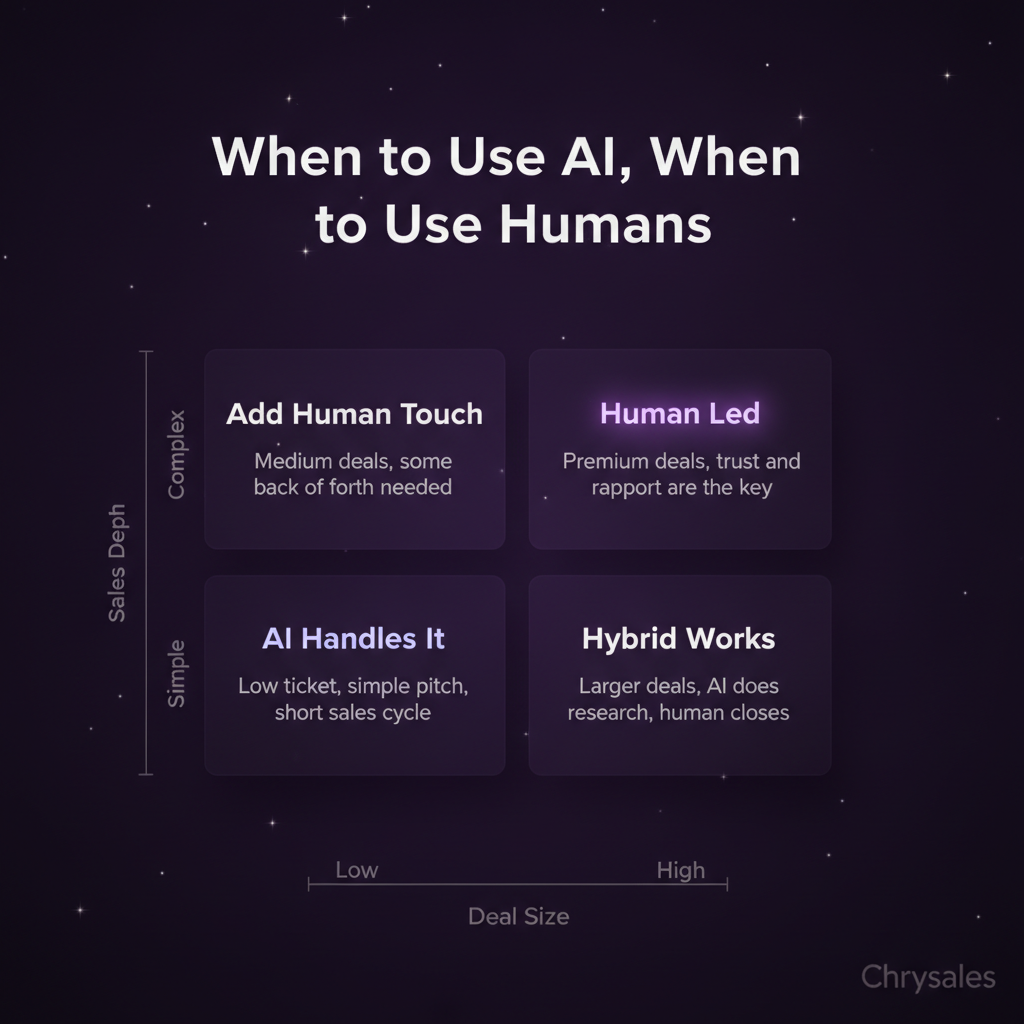
The hybrid model costs about 40% less than a full SDR team and produces better results than full automation. Why? Because you're using AI for what it's good at (speed and data processing) and humans for what they're good at (judgment and relationship building).
Watch out: The "cheap" full AI approach looks great on paper, but if 60% of your meetings are junk, you're wasting your closer's time. That hidden cost (burned sales hours on bad leads) often makes full automation more expensive in the end.
When AI Alone Is Enough (and When It's Not)
There are situations where you can get away with mostly AI outreach, and others where you absolutely need human SDRs. Understanding AI SDR limitations through an honest assessment helps you make the right choice for your business.
AI Works Well When:
- Your offer is transactional and low ticket (under $2K)
- You're selling to a huge market with clear buying signals (e.g., e-commerce brands doing over $1M in revenue)
- Your sales cycle is short (one or two calls to close)
- You're okay with higher volume and lower conversion rates
A SaaS tool selling a $300/month product to small online stores? AI can handle 90% of that outbound sales system. The leads are abundant, the pitch is simple, and people are used to buying software without much human interaction.
You Need Humans When:
- Your deal size is over $5K
- Your sales cycle involves multiple stakeholders
- You're selling custom work (consulting, agency services, implementation)
- Your ICP is narrow (under 5,000 total companies)
- Trust and credibility are major buying factors
A consulting firm selling $50K engagements to Fortune 500 IT departments? You're not closing that with an AI drafted cold email and a Calendly link. You need an SDR who can navigate replies, build rapport over multiple touches, and warm up the lead before they ever talk to a closer.
Here's a quick test: if your sales process requires more than two emails back and forth before booking a call, you need a human in the loop.
How to Build a Modern B2B Outbound Sales System (With or Without AI)
Whether you go full AI, full human, or hybrid, the structure underneath matters more than the tools. A bad sales system doesn't get better just because you add AI. It gets faster at failing. Here's the framework that works for predictable B2B client acquisition, and you can also see how to build a sales system so powerful clients come to you for a systems-level walkthrough.
1. Nail Your ICP and Offer First
Before you write a single cold email or turn on any AI tool, get crystal clear on who you're selling to and what you're offering. Most cold outreach strategy flops because the targeting is loose. "We sell to B2B companies" is not an ICP. "We sell to 50-200 person IT consulting firms in the US that have raised Series A funding in the last 18 months" is.
Your offer needs to be dead simple to understand. If you can't explain what you do and why someone should care in one sentence, your SDR (human or AI) has no chance.
2. Build a Lead Scoring System
You can't treat all leads the same. A company that just raised $10M and is hiring like crazy is hotter than a company that's been quiet for two years. Use AI to score leads based on:
- Funding events
- Hiring velocity (are they adding headcount?)
- Tech stack changes (did they just adopt your competitor or a complementary tool?)
- Leadership changes (new VP of Sales often means new vendor opportunities)
Set a simple rule: anything scoring above 70 goes to the top of your call list. Anything below 40 gets a generic nurture sequence.
3. Map Out Your Multichannel B2B Outreach
Cold email alone doesn't cut it anymore. Neither does LinkedIn alone. The companies winning at B2B pipeline generation are using 3-4 channels in parallel:
- Cold email (personalized, low volume)
- LinkedIn connection requests and messages
- Phone calls (yes, actual calls)
- Direct mail for high value targets (handwritten notes, small gifts)
An agency we know sends a cold email, waits three days, sends a LinkedIn request with a voice note, waits another week, then calls. Their reply rate across all channels: 12%. That's insane for cold outreach. For more tactical guidance on structuring this approach, check out multichannel outbound email marketing best practices.
4. Script Your Responses and Objections
AI or human, you need a playbook. What do you say when someone replies "not interested"? What about "send me more info"? What about "maybe next quarter"? Write out 8-10 common replies and objections, then script your best responses. If you're using AI, feed these into your prompts. If you're using humans, put them in a shared doc your SDR can reference.
Speed matters. Reply within two hours and your chance of booking a meeting doubles.
5. Track What Actually Moves the Needle
Most teams track vanity metrics: emails sent, open rates, click rates. Those don't matter. The only metrics that matter for B2B lead generation:
- Reply rate (how many people write back)
- Meeting booking rate (how many replies turn into calendar holds)
- Show rate (how many booked meetings actually happen)
- Qualified lead rate (how many meetings turn into real opportunities)
If you're booking 50 meetings a month but only 10 are qualified, your targeting or messaging is broken. Fix that before you add more volume. To understand what good performance looks like, see our cold email response rates benchmarks for hard data on B2B markets.
Pro Tip: Run a weekly 15 minute review with your SDR (or review your AI output if you're solo). Look at the last 50 emails sent. Did they sound good? Did the personalization make sense? Did you target the right people? Tweak and repeat.
The Biggest Mistakes Teams Make When Adding AI to Sales
We've seen companies mess this up in predictable ways. Here are the top five traps:
1. Thinking AI Is Plug and Play
AI tools need setup, testing, and constant tweaking. You don't just turn on Clay or Instantly and walk away. You need to dial in your targeting, test your messaging, warm up your domains, and monitor for spam flags. Budget at least 10-20 hours upfront and 3-5 hours a week ongoing.
2. Burning Domains with Aggressive Sending
If you send 500 cold emails a day from one domain, you're getting spam filtered within a week. The fix: send lower volume (30-50/day per domain), use multiple domains, warm them up properly, and rotate sending patterns. Cold email deliverability in 2024 is a technical game. You can't brute force it.
3. Letting AI Write Everything with No Human Review
AI generated emails have tells. They overuse certain phrases. They make weird logical jumps. They personalize in ways that feel creepy ("I saw your dog's Instagram" level stuff). A human needs to review and edit. Every. Single. Email. At least until your AI prompts are dialed in perfectly, which takes months.
4. Ignoring the Follow Up Sequences
Most deals happen in the follow ups, not the first email. AI tools are great at sending sequences, but terrible at knowing when to stop. If someone replies "not interested," your AI shouldn't send four more emails. You need logic and rules built in.
A tech company we worked with had their AI sending follow up emails to people who'd already booked meetings. Awkward. The fix: better workflow logic and a human checking the "sent" list weekly.
5. Forgetting That Sales Training Still Matters
If you're using AI to book meetings but your sales team doesn't know how to close, you're just filling your calendar with dead ends. AI can help with lead generation, but it won't fix weak discovery questions, bad pitch structure, or poor objection handling. That requires real sales training and coaching. For a comprehensive framework on building an AI-led system that preserves human judgment where it counts, explore the only AI sales system you need in 2026.
Frequently Asked Questions
Q: Can AI completely replace a human SDR in 2024?
For most B2B companies selling anything over $5K, no. AI can handle research, list building, and first draft emails, but it can't navigate nuanced conversations, build trust, or handle complex objections. The hybrid model (one SDR plus AI tools) outperforms both full human and full AI setups in terms of cost, lead quality, and meeting show rates. If you're selling a low ticket, high volume product with a simple sales process, full AI might work, but you'll deal with higher no show rates and more junk leads.
Q: What's the best way to stop AI generated emails from sounding robotic?
Edit every email before it goes out, at least for your first few months. Look for overly formal language, weird personalization, and generic CTAs. Use contractions (don't, you're, it's), short sentences, and casual openers like "Quick question" or "Noticed you just..." Instead of "I hope this email finds you well," try "Saw you're hiring for X role." Train your AI with examples of emails that actually got replies. The more you tweak your prompts with real voice, the better your AI output gets over time.
Q: How do I measure if adding AI to my sales process is actually working?
Track four things: reply rate, meeting booking rate, meeting show rate, and qualified lead rate. Compare those numbers before and after adding AI. If your reply rate drops or your no show rate spikes, your AI setup is hurting more than helping. A good hybrid system should increase meetings booked by 20-40% and keep show rates above 70%. Also track time saved. If your SDR used to spend 15 hours a week on research and now spends 3, that's 12 hours freed up for actual conversations and follow ups.
Q: What AI tools actually work for B2B lead generation in 2024?
For research and list building: Apollo, Clay, and ZoomInfo are solid. For email sending and sequences: Instantly and Lemlist handle deliverability better than most. For AI writing: ChatGPT or Gemini with custom prompts. For lead scoring: build a simple workflow in Clay or n8n that pulls signals from multiple sources and scores them. Don't fall for all in one "AI SDR" tools that promise to do everything. They usually do a mediocre job at all of it. Pick specialized tools and connect them.
Q: Should I fire my SDR team and switch to AI to save money?
Not unless you're okay with a big dip in lead quality and a messy three month transition. A better move: keep one strong SDR and add AI tools to make them 3x more productive. That SDR handles replies, relationship building, and quality control while AI handles the grunt work. If you're currently paying two SDRs and getting 30 meetings a month, try cutting to one SDR plus $500-700 in AI tools. You'll likely keep 25-35 meetings a month, save $3K-5K monthly, and improve lead quality because your remaining SDR has time to focus on the best prospects.
B2B lead generation without cold email is a way to find and qualify business leads using AI, human sales, and other channels instead of relying on cold outreach alone. Picture this: you spend six months building an outbound sales team. Three SDRs, a manager, tech stack, training, the works. Then one day, a tool promises to do the same job for $300 a month. Sounds crazy, right? We've seen five B2B companies try this in the last year. Some won big. Others crashed hard. Here's what really happens when you swap human SDRs for AI, what works, what doesn't, and how to think about lead generation without relying on either extreme.
The Promise vs. Reality of AI-Powered Lead Generation
AI tools for B2B sales sound amazing on paper. Scrape 10,000 contacts in minutes. Personalize emails at scale. Book meetings while you sleep. The pitch is simple: fire your SDR team, plug in some software, watch the leads roll in. Here's what actually happened with the companies we tracked.
A 25-person tech consulting firm replaced two SDRs with a combo of Apollo, Instantly, and ChatGPT-powered personalization. First month? 47 meetings booked. They were pumped. By month three? Reply rates dropped from 8% to 1.2%. Turns out, their AI setup was burning through domains, getting flagged as spam, and their "personalized" emails all sounded exactly the same. The AI wasn't learning. It was just repeating patterns.
Another marketing agency kept their SDR but added AI as a research assistant. The SDR spent 30 minutes a day reviewing AI-generated lead lists and personalization suggestions, then sent emails manually with real human touches. Their close rate went up 22% in two months.
The difference? One team treated AI as a full replacement. The other used it as a tool inside a bigger sales system.
Why Full Replacement Usually Fails
Most AI tools for cold outreach are good at one thing: volume. They can send 10,000 emails faster than any human. But B2B lead generation isn't a numbers game anymore. Cold email deliverability in 2024 is brutal. Google and Yahoo cracked down hard on bulk senders, as detailed in new rules for bulk email senders from Google and Yahoo. If your AI blasts 500 emails a day from one domain, you're getting filtered before anyone even sees your message.
The other problem? AI doesn't understand context yet. It can pull data points like job title and company size, but it can't tell if a company just laid off half their team or if they're actually in buying mode. A 200-person company that just did layoffs is not a "hot lead." It's a bad fit, full stop.
Where AI Actually Shines
AI is incredible for the boring, repetitive stuff:
- Scraping and enriching lead lists
- Scoring leads based on signals (funding rounds, hiring spikes, tech stack changes)
- Writing first-draft emails that a human then edits
- Tracking reply patterns and suggesting follow-up timing
- Pulling research on companies faster than any person could
One client of ours built an AI workflow using Gemini that scores every lead on a 100-point scale based on 12 buying signals. Anything scoring above 70 goes to the top of the call list. That's smart. It frees up the human to focus on the highest-value conversations, not digging through databases.
What Happens to Your Sales Pipeline When You Go Full AI
Let's talk about what actually breaks when you remove humans completely. A 40-person IT services company tried this. They automated everything: lead generation, email sequences, even calendar booking. For six weeks, they had no SDRs. Just AI and automations running 24/7. Here's what fell apart:
- Reply handling: AI can send emails, but it can't handle nuanced replies. Someone writes back "maybe next quarter," and the AI either ignores it or sends a canned response that feels robotic.
- Objection handling: Real sales conversations involve pushback. "Your pricing is too high." "We already have a vendor." AI tools aren't built to navigate that. They script responses, but they don't adapt in real time.
- Relationship building: B2B sales for higher ticket services (anything over $5K) require trust. People buy from people. An AI can book a meeting, but if the first human conversation is with a closer who knows nothing about the lead's situation, the deal dies fast.
After six weeks, that IT services company brought back one SDR. Not three. Just one, working alongside the AI. Meetings booked stayed high, but now reply quality went up and deals started closing again.
Common mistake: Thinking B2B client acquisition is just about getting meetings on the calendar. The meeting is step one. If the lead shows up confused or skeptical because the AI overpromised, you've wasted everyone's time.
The Hybrid Model That Actually Works
Here's the setup we've seen work consistently across different types of B2B companies: tech firms, consulting groups, agencies, you name it. For a deep dive into building this kind of system, you can watch an AI sales system get you record revenue that walks through the practical architecture.
Step 1: AI Handles Research and List Building
Use AI to scrape, enrich, and score your lead lists. Tools like Apollo, Clay, and ZoomInfo combined with GPT or Gemini can pull together solid data in minutes. Set up filters for your ideal customer profile: company size, industry, recent funding, tech stack, whatever matters for your offer.
Don't just accept the raw AI output. Have a human (or your SDR) spot-check the top 50 leads every week. AI makes weird mistakes. It'll mark a company as "high-growth" because they posted one job listing, even if they're struggling.
Step 2: AI Drafts, Human Edits and Sends
Let AI write your first draft cold emails. Give it a prompt with your offer, your ICP, and 3-4 sample emails you've sent before. It'll spit out something decent. Then edit it. Every single one. Look for:
- Anything that sounds robotic or overly formal
- Personalization that doesn't make sense ("I saw you recently posted about X" when X is generic)
- CTAs that are too aggressive (nobody clicks a Calendly link in a cold email from a stranger)
One marketing agency we worked with cut their AI drafted email editing time to under 2 minutes per email. Their SDR reviewed 40 emails in 90 minutes, tweaked the weird parts, and sent them manually through a warmed up domain. Reply rates: 5-7%, way higher than fully automated blasts.
Step 3: Human Handles All Replies
This is non-negotiable. When someone replies to your cold outreach, a real person needs to respond. Fast. Within 2 hours if possible. AI can help by flagging high-priority replies or suggesting response templates, but the actual reply should come from a human who understands your sales process. This is where you build trust, ask discovery questions, and figure out if this lead is worth a full sales call.
Step 4: AI Tracks and Optimizes
Use AI to analyze what's working. Which subject lines get opened? Which CTAs get replies? What time of day sees the most engagement? Feed that data back into your process. Most teams build a 40 step workflow when 12 steps would do the job. Keep it simple. AI should make your sales system easier to run, not more complicated.
Pro Tip: Set a simple rule for your team: if you spend more than 10 minutes figuring out how an AI tool works, it's too complex. Swap it for something simpler or just do that step manually.
The Real Cost Breakdown: Humans vs. AI vs. Hybrid
Let's get into numbers. What does each approach actually cost for a B2B company trying to generate 20-30 qualified sales meetings per month?
Full SDR Team (Traditional Setup)
- 2 SDRs: $6,000-$10,000/month (salary + benefits)
- Sales tools (CRM, Apollo, Instantly, email warmup): $500-$800/month
- Training and management time: 10-15 hours/week
- Total monthly cost: $6,500-$10,800
- Output: 20-40 meetings/month if trained well
Full AI Automation (No Humans)
- AI tools (Clay, Instantly, ChatGPT API, scraping tools): $300-$600/month
- Domain setup and warmup: $100-$200/month
- Setup time and maintenance: 5-8 hours/week
- Total monthly cost: $400-$800
- Output: 30-60 meetings booked, but 40-60% no-shows or low-quality leads
Hybrid Model (1 SDR + AI Tools)
- 1 SDR: $3,000-$5,000/month
- AI tools (research, scoring, drafting): $400-$700/month
- CRM and email infrastructure: $300-$500/month
- Total monthly cost: $3,700-$6,200
- Output: 25-45 meetings/month, higher show rate (70-80%), better lead quality
The hybrid model costs about 40% less than a full SDR team and produces better results than full automation. Why? Because you're using AI for what it's good at (speed and data processing) and humans for what they're good at (judgment and relationship building).
Watch out: The "cheap" full AI approach looks great on paper, but if 60% of your meetings are junk, you're wasting your closer's time. That hidden cost (burned sales hours on bad leads) often makes full automation more expensive in the end.
When AI Alone Is Enough (and When It's Not)
There are situations where you can get away with mostly AI outreach, and others where you absolutely need human SDRs. Understanding AI SDR limitations through an honest assessment helps you make the right choice for your business.
AI Works Well When:
- Your offer is transactional and low ticket (under $2K)
- You're selling to a huge market with clear buying signals (e.g., e-commerce brands doing over $1M in revenue)
- Your sales cycle is short (one or two calls to close)
- You're okay with higher volume and lower conversion rates
A SaaS tool selling a $300/month product to small online stores? AI can handle 90% of that outbound sales system. The leads are abundant, the pitch is simple, and people are used to buying software without much human interaction.
You Need Humans When:
- Your deal size is over $5K
- Your sales cycle involves multiple stakeholders
- You're selling custom work (consulting, agency services, implementation)
- Your ICP is narrow (under 5,000 total companies)
- Trust and credibility are major buying factors
A consulting firm selling $50K engagements to Fortune 500 IT departments? You're not closing that with an AI drafted cold email and a Calendly link. You need an SDR who can navigate replies, build rapport over multiple touches, and warm up the lead before they ever talk to a closer.
Here's a quick test: if your sales process requires more than two emails back and forth before booking a call, you need a human in the loop.
How to Build a Modern B2B Outbound Sales System (With or Without AI)
Whether you go full AI, full human, or hybrid, the structure underneath matters more than the tools. A bad sales system doesn't get better just because you add AI. It gets faster at failing. Here's the framework that works for predictable B2B client acquisition, and you can also see how to build a sales system so powerful clients come to you for a systems-level walkthrough.
1. Nail Your ICP and Offer First
Before you write a single cold email or turn on any AI tool, get crystal clear on who you're selling to and what you're offering. Most cold outreach strategy flops because the targeting is loose. "We sell to B2B companies" is not an ICP. "We sell to 50-200 person IT consulting firms in the US that have raised Series A funding in the last 18 months" is.
Your offer needs to be dead simple to understand. If you can't explain what you do and why someone should care in one sentence, your SDR (human or AI) has no chance.
2. Build a Lead Scoring System
You can't treat all leads the same. A company that just raised $10M and is hiring like crazy is hotter than a company that's been quiet for two years. Use AI to score leads based on:
- Funding events
- Hiring velocity (are they adding headcount?)
- Tech stack changes (did they just adopt your competitor or a complementary tool?)
- Leadership changes (new VP of Sales often means new vendor opportunities)
Set a simple rule: anything scoring above 70 goes to the top of your call list. Anything below 40 gets a generic nurture sequence.
3. Map Out Your Multichannel B2B Outreach
Cold email alone doesn't cut it anymore. Neither does LinkedIn alone. The companies winning at B2B pipeline generation are using 3-4 channels in parallel:
- Cold email (personalized, low volume)
- LinkedIn connection requests and messages
- Phone calls (yes, actual calls)
- Direct mail for high value targets (handwritten notes, small gifts)
An agency we know sends a cold email, waits three days, sends a LinkedIn request with a voice note, waits another week, then calls. Their reply rate across all channels: 12%. That's insane for cold outreach. For more tactical guidance on structuring this approach, check out multichannel outbound email marketing best practices.
4. Script Your Responses and Objections
AI or human, you need a playbook. What do you say when someone replies "not interested"? What about "send me more info"? What about "maybe next quarter"? Write out 8-10 common replies and objections, then script your best responses. If you're using AI, feed these into your prompts. If you're using humans, put them in a shared doc your SDR can reference.
Speed matters. Reply within two hours and your chance of booking a meeting doubles.
5. Track What Actually Moves the Needle
Most teams track vanity metrics: emails sent, open rates, click rates. Those don't matter. The only metrics that matter for B2B lead generation:
- Reply rate (how many people write back)
- Meeting booking rate (how many replies turn into calendar holds)
- Show rate (how many booked meetings actually happen)
- Qualified lead rate (how many meetings turn into real opportunities)
If you're booking 50 meetings a month but only 10 are qualified, your targeting or messaging is broken. Fix that before you add more volume. To understand what good performance looks like, see our cold email response rates benchmarks for hard data on B2B markets.
Pro Tip: Run a weekly 15 minute review with your SDR (or review your AI output if you're solo). Look at the last 50 emails sent. Did they sound good? Did the personalization make sense? Did you target the right people? Tweak and repeat.
The Biggest Mistakes Teams Make When Adding AI to Sales
We've seen companies mess this up in predictable ways. Here are the top five traps:
1. Thinking AI Is Plug and Play
AI tools need setup, testing, and constant tweaking. You don't just turn on Clay or Instantly and walk away. You need to dial in your targeting, test your messaging, warm up your domains, and monitor for spam flags. Budget at least 10-20 hours upfront and 3-5 hours a week ongoing.
2. Burning Domains with Aggressive Sending
If you send 500 cold emails a day from one domain, you're getting spam filtered within a week. The fix: send lower volume (30-50/day per domain), use multiple domains, warm them up properly, and rotate sending patterns. Cold email deliverability in 2024 is a technical game. You can't brute force it.
3. Letting AI Write Everything with No Human Review
AI generated emails have tells. They overuse certain phrases. They make weird logical jumps. They personalize in ways that feel creepy ("I saw your dog's Instagram" level stuff). A human needs to review and edit. Every. Single. Email. At least until your AI prompts are dialed in perfectly, which takes months.
4. Ignoring the Follow Up Sequences
Most deals happen in the follow ups, not the first email. AI tools are great at sending sequences, but terrible at knowing when to stop. If someone replies "not interested," your AI shouldn't send four more emails. You need logic and rules built in.
A tech company we worked with had their AI sending follow up emails to people who'd already booked meetings. Awkward. The fix: better workflow logic and a human checking the "sent" list weekly.
5. Forgetting That Sales Training Still Matters
If you're using AI to book meetings but your sales team doesn't know how to close, you're just filling your calendar with dead ends. AI can help with lead generation, but it won't fix weak discovery questions, bad pitch structure, or poor objection handling. That requires real sales training and coaching. For a comprehensive framework on building an AI-led system that preserves human judgment where it counts, explore the only AI sales system you need in 2026.
Frequently Asked Questions
Q: Can AI completely replace a human SDR in 2024?
For most B2B companies selling anything over $5K, no. AI can handle research, list building, and first draft emails, but it can't navigate nuanced conversations, build trust, or handle complex objections. The hybrid model (one SDR plus AI tools) outperforms both full human and full AI setups in terms of cost, lead quality, and meeting show rates. If you're selling a low ticket, high volume product with a simple sales process, full AI might work, but you'll deal with higher no show rates and more junk leads.
Q: What's the best way to stop AI generated emails from sounding robotic?
Edit every email before it goes out, at least for your first few months. Look for overly formal language, weird personalization, and generic CTAs. Use contractions (don't, you're, it's), short sentences, and casual openers like "Quick question" or "Noticed you just..." Instead of "I hope this email finds you well," try "Saw you're hiring for X role." Train your AI with examples of emails that actually got replies. The more you tweak your prompts with real voice, the better your AI output gets over time.
Q: How do I measure if adding AI to my sales process is actually working?
Track four things: reply rate, meeting booking rate, meeting show rate, and qualified lead rate. Compare those numbers before and after adding AI. If your reply rate drops or your no show rate spikes, your AI setup is hurting more than helping. A good hybrid system should increase meetings booked by 20-40% and keep show rates above 70%. Also track time saved. If your SDR used to spend 15 hours a week on research and now spends 3, that's 12 hours freed up for actual conversations and follow ups.
Q: What AI tools actually work for B2B lead generation in 2024?
For research and list building: Apollo, Clay, and ZoomInfo are solid. For email sending and sequences: Instantly and Lemlist handle deliverability better than most. For AI writing: ChatGPT or Gemini with custom prompts. For lead scoring: build a simple workflow in Clay or n8n that pulls signals from multiple sources and scores them. Don't fall for all in one "AI SDR" tools that promise to do everything. They usually do a mediocre job at all of it. Pick specialized tools and connect them.
Q: Should I fire my SDR team and switch to AI to save money?
Not unless you're okay with a big dip in lead quality and a messy three month transition. A better move: keep one strong SDR and add AI tools to make them 3x more productive. That SDR handles replies, relationship building, and quality control while AI handles the grunt work. If you're currently paying two SDRs and getting 30 meetings a month, try cutting to one SDR plus $500-700 in AI tools. You'll likely keep 25-35 meetings a month, save $3K-5K monthly, and improve lead quality because your remaining SDR has time to focus on the best prospects.
Scaling Is Not Hard If You Have The Right Systems
If you’re serious about leveling up your scaling game, you need the right system, the right training, and the right team behind you. We're here to give you the exact tools and strategies top entrepreneurs use to dominate.

Discover the latest tips
View All.avif)
Chrysales was formed from the words "chrysalis" the stage where a caterpillar transforms into a butterfly and "sales".
It stands for one thing: sales transformation.Because scaling doesn’t happen by doing more of the same. Scaling only happens when you go through real transformation in your systems, your offer, team and the way you sell.
.avif)


