
Account-based selling for small B2B teams: start with 20 accounts
Account-based selling means you pick a short list of companies you really want as clients. You learn who decides there and reach several of them with outreach written for that company.
A small team can start with about 20 accounts per person, using a spreadsheet, email, LinkedIn and the phone. It usually only pays off when one deal is big enough to cover the research. You don't need expensive account-based marketing (ABM) software or a marketing team.
What account-based selling is
Account-based selling puts your sales effort on a few high-value companies. Pipedrive calls it treating each one as "a market of one": its own small market, with its own message.
You may also hear ABM, short for account-based marketing. In Pipedrive's words, "ABM is marketing-led while account-based sales is sales-led". In a small team, one person often does both, so the label matters less than the method.
The bigger contrast is with regular outbound, where you send one message to many companies from a list.
| What differs | Account-based selling | Regular outbound |
|---|---|---|
| Companies | A short, named list | Hundreds from a list |
| People per company | Several | Usually one |
| Message | Written for that company | One template per group |
| Main measure | Meetings and deals per account | Reply rate |
When it is worth the effort
Account-based selling is worth it when one deal is big enough to pay for hours of research. If your deals are small, normal volume outreach is usually the better choice.
HubSpot reports that Trish Bertuzzi, author of The Sales Development Playbook, recommends an account-based approach when the average deal is above $50,000. Treat that number as one expert's rule of thumb.
Your buyers matter too. HubSpot warns that if you sell to small businesses, this is likely the wrong approach.
So ask yourself three questions.
Are your deals big? Could only a limited number of companies buy? Do several people sign off on each deal?
If the answer is yes to all three, this method fits. If not, put your time into steady volume outreach.
Pick your first 20 accounts
Start with about 20 accounts per person and keep one row per company in a simple sheet. Twenty is a starting size, and the list can grow once the work runs.
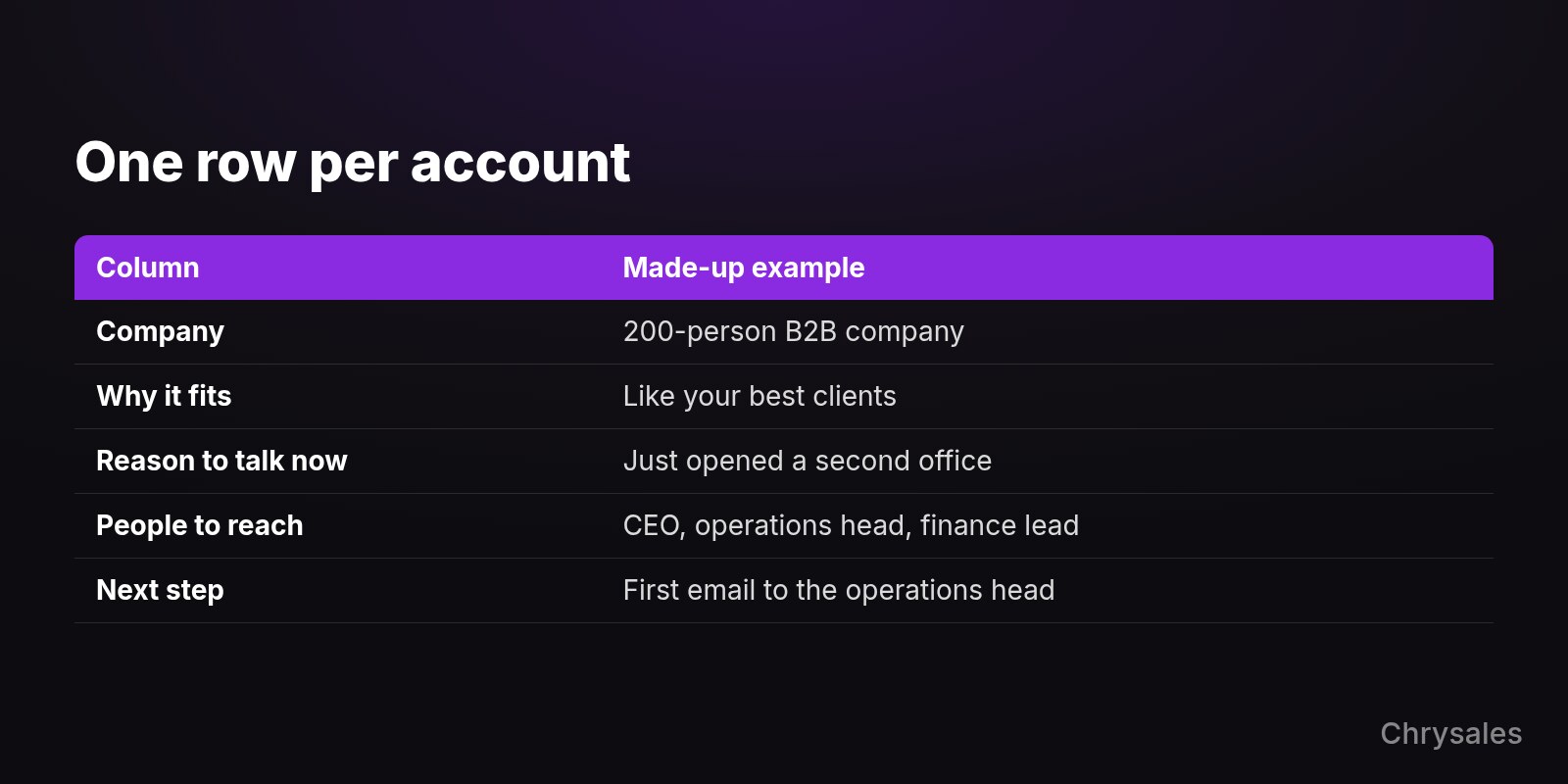
The image shows one row of that sheet for a made-up company.
Kiran Shahid, a content strategist, says to "start with 10 to 15 target accounts" in her HubSpot article. By her own account, the approach helped her land six clients in under four months.
At the top end, Hightouch caps each account executive at 20 accounts. Its CMO, Brian Kotlyar, explained why to Exit Five. He doesn't believe a person, even with AI tools, "can do a good job working more than 20 accounts".
So 20 is a sensible first batch for one person. A full list for large deals can be longer later, and our guide to account list tools compared covers that stage.
Pick companies that fit you, even if they aren't famous. Start from your ideal customer profile, the short description of who buys from you.
Then look for a reason to talk now, such as a new leader or a new office. Drop any company where you can't find the people who decide.
Build this list yourself instead of buying one. A bought list gives you names, but not the reasons to call.
Reach several people in each account
Contact several people in each account, because several people decide each B2B purchase. A Gartner survey of 632 B2B buyers found buying groups ranging "from five to 16 people across as many as four functions".
Keep one story about the company's problem, and change only the opening for each role. Gartner found that messages built around one person's own concerns can cause conflict inside the buying group.
Here is a made-up example: a 200-person B2B company that just opened a second office. The CEO cares about growth, the operations head about extra work, and the finance lead about cost. All three hear the same story about the new office, each starting from their own concern.
The first email to the operations head could look like this:
Hi Anna,

I saw that your company opened a second office this month.
A new site usually means more work for operations before
new staff are in place.

We help companies take some of that work off the team while
they grow. Would a short call next week be useful to see
if this fits you?

Best,
Tom
Spread your messages and calls over a few weeks:
- Connect on LinkedIn with the people you mapped, without a pitch.
- Send the first email to the person closest to the problem.
- A few days later, write to a second person with the same story from their side.
- Call whoever opened or replied, and mention what you sent.
- Share something useful about their situation before you ask again.
Rules for cold email and cold calls to businesses differ by country, and Germany is strict. Check what applies to you before you send.
To find names and contact details, see how to build the contact list. If you're not sure which channel to lead with, this video from Sabir compares cold email and cold calling.
Measure progress per account
Judge account-based selling by what happens inside each account: meetings and deals, plus how many people you reached. Counting leads or replies won't tell you if it works.
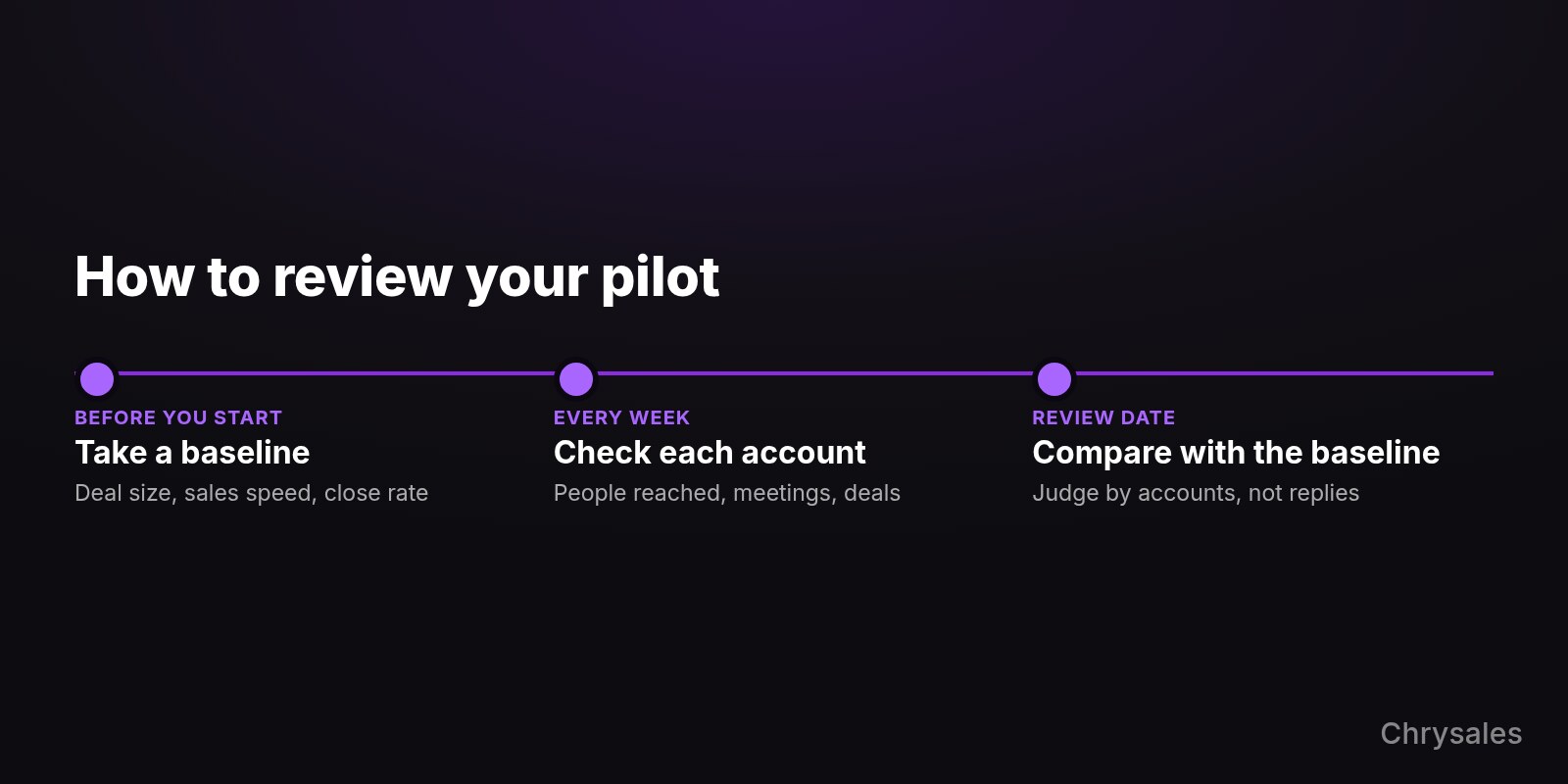
The timeline shows a simple rhythm for your first test run, often called a pilot. It gives you a fair comparison instead of a gut feeling.
Forrester's Laura Ramos lists "Measuring leads, not account-based engagement" as a common pitfall.
Set a baseline before you start, so you have numbers to compare against. Peter Isaacson, then CMO of Demandbase, advised in MarTech in 2019 to measure current deal size, sales speed and close rates first. If no account has moved by your review date, fix the list and the message before you add more names.
Watch for two mistakes. The first is letting the list grow: Snowflake's director of ABM told Exit Five that at 200 accounts per manager, "That's not ABM anymore".
The second mistake is one pitch for everyone, which Shahid says gave her a 2% response rate.
When an account starts to show interest, move fast and follow up on buying signals, the signs that a company is ready to talk.
Conclusion: Check your deal size first
Start small and on paper:
- Check your average deal size and who buys. If deals are small, use volume outreach instead.
- Write down 20 companies that fit, each with a reason to talk now.
- Find the people who decide in each one.
- Plan your messages across email and LinkedIn, then the phone.
- Note your baseline and pick a review date.
Want a second opinion on which 20 companies belong on your list? On a free strategy call, Chrysales can go through your target accounts and the outreach plan around them with you. Review your first 20 accounts on a free call
Account-based selling means you pick a short list of companies you really want as clients. You learn who decides there and reach several of them with outreach written for that company.
A small team can start with about 20 accounts per person, using a spreadsheet, email, LinkedIn and the phone. It usually only pays off when one deal is big enough to cover the research. You don't need expensive account-based marketing (ABM) software or a marketing team.
What account-based selling is
Account-based selling puts your sales effort on a few high-value companies. Pipedrive calls it treating each one as "a market of one": its own small market, with its own message.
You may also hear ABM, short for account-based marketing. In Pipedrive's words, "ABM is marketing-led while account-based sales is sales-led". In a small team, one person often does both, so the label matters less than the method.
The bigger contrast is with regular outbound, where you send one message to many companies from a list.
| What differs | Account-based selling | Regular outbound |
|---|---|---|
| Companies | A short, named list | Hundreds from a list |
| People per company | Several | Usually one |
| Message | Written for that company | One template per group |
| Main measure | Meetings and deals per account | Reply rate |
When it is worth the effort
Account-based selling is worth it when one deal is big enough to pay for hours of research. If your deals are small, normal volume outreach is usually the better choice.
HubSpot reports that Trish Bertuzzi, author of The Sales Development Playbook, recommends an account-based approach when the average deal is above $50,000. Treat that number as one expert's rule of thumb.
Your buyers matter too. HubSpot warns that if you sell to small businesses, this is likely the wrong approach.
So ask yourself three questions.
Are your deals big? Could only a limited number of companies buy? Do several people sign off on each deal?
If the answer is yes to all three, this method fits. If not, put your time into steady volume outreach.
Pick your first 20 accounts
Start with about 20 accounts per person and keep one row per company in a simple sheet. Twenty is a starting size, and the list can grow once the work runs.
The image shows one row of that sheet for a made-up company.
Kiran Shahid, a content strategist, says to "start with 10 to 15 target accounts" in her HubSpot article. By her own account, the approach helped her land six clients in under four months.
At the top end, Hightouch caps each account executive at 20 accounts. Its CMO, Brian Kotlyar, explained why to Exit Five. He doesn't believe a person, even with AI tools, "can do a good job working more than 20 accounts".
So 20 is a sensible first batch for one person. A full list for large deals can be longer later, and our guide to account list tools compared covers that stage.
Pick companies that fit you, even if they aren't famous. Start from your ideal customer profile, the short description of who buys from you.
Then look for a reason to talk now, such as a new leader or a new office. Drop any company where you can't find the people who decide.
Build this list yourself instead of buying one. A bought list gives you names, but not the reasons to call.
Reach several people in each account
Contact several people in each account, because several people decide each B2B purchase. A Gartner survey of 632 B2B buyers found buying groups ranging "from five to 16 people across as many as four functions".
Keep one story about the company's problem, and change only the opening for each role. Gartner found that messages built around one person's own concerns can cause conflict inside the buying group.
Here is a made-up example: a 200-person B2B company that just opened a second office. The CEO cares about growth, the operations head about extra work, and the finance lead about cost. All three hear the same story about the new office, each starting from their own concern.
The first email to the operations head could look like this:
Hi Anna,

I saw that your company opened a second office this month.
A new site usually means more work for operations before
new staff are in place.

We help companies take some of that work off the team while
they grow. Would a short call next week be useful to see
if this fits you?

Best,
Tom
Spread your messages and calls over a few weeks:
- Connect on LinkedIn with the people you mapped, without a pitch.
- Send the first email to the person closest to the problem.
- A few days later, write to a second person with the same story from their side.
- Call whoever opened or replied, and mention what you sent.
- Share something useful about their situation before you ask again.
Rules for cold email and cold calls to businesses differ by country, and Germany is strict. Check what applies to you before you send.
To find names and contact details, see how to build the contact list. If you're not sure which channel to lead with, this video from Sabir compares cold email and cold calling.
Measure progress per account
Judge account-based selling by what happens inside each account: meetings and deals, plus how many people you reached. Counting leads or replies won't tell you if it works.
The timeline shows a simple rhythm for your first test run, often called a pilot. It gives you a fair comparison instead of a gut feeling.
Forrester's Laura Ramos lists "Measuring leads, not account-based engagement" as a common pitfall.
Set a baseline before you start, so you have numbers to compare against. Peter Isaacson, then CMO of Demandbase, advised in MarTech in 2019 to measure current deal size, sales speed and close rates first. If no account has moved by your review date, fix the list and the message before you add more names.
Watch for two mistakes. The first is letting the list grow: Snowflake's director of ABM told Exit Five that at 200 accounts per manager, "That's not ABM anymore".
The second mistake is one pitch for everyone, which Shahid says gave her a 2% response rate.
When an account starts to show interest, move fast and follow up on buying signals, the signs that a company is ready to talk.
Conclusion: Check your deal size first
Start small and on paper:
- Check your average deal size and who buys. If deals are small, use volume outreach instead.
- Write down 20 companies that fit, each with a reason to talk now.
- Find the people who decide in each one.
- Plan your messages across email and LinkedIn, then the phone.
- Note your baseline and pick a review date.
Want a second opinion on which 20 companies belong on your list? On a free strategy call, Chrysales can go through your target accounts and the outreach plan around them with you. Review your first 20 accounts on a free call
Scaling Is Not Hard If You Have The Right Systems
If you’re serious about leveling up your scaling game, you need the right system, the right training, and the right team behind you. We're here to give you the exact tools and strategies top entrepreneurs use to dominate.

Discover the latest tips
View All
Chrysales was formed from the words "chrysalis" the stage where a caterpillar transforms into a butterfly and "sales".
It stands for one thing: sales transformation.Because scaling doesn’t happen by doing more of the same. Scaling only happens when you go through real transformation in your systems, your offer, team and the way you sell.


