
Weekly sales meeting agenda: what a small B2B team should cover
A good weekly sales meeting agenda for a small B2B team fits in 30 minutes and keeps the same order every week. Start with numbers against target, then discuss only the deals that are stuck or about to close, then one skill or message topic, then owners and dates for every next step. Sellers update the CRM before the meeting, so nobody reads out status in the room. Once deal discussions keep overrunning, move deep deal work into one-on-ones or a separate deal review.
This is written for teams of 2-8 sellers where you still close the biggest deals yourself. The agenda, the deal rule and the checks below are our recommended starting point, not a measured result. Adjust them to your sales cycle.
What a weekly sales meeting is for, and what it isn't
A weekly sales meeting exists to keep deals from drifting. The team looks at the numbers and a few chosen deals, then agrees who does what before the next meeting. Larger companies run full pipeline walks, deep coaching and forecasting as separate meetings. A small team can run one meeting with separate blocks, as long as each block keeps its own job.
A few terms first. Your pipeline is the list of open deals, sorted by stage, and the CRM is the system where those deals are logged. A forecast is the revenue you expect to close in a period. A one-on-one is a meeting between a manager and a single seller.
In the meeting itself, the chair runs the agenda and the note-taker writes down who owns what.
Dave Kellogg is a former CEO and board member who writes about sales management. He separates three kinds of sales meetings.
In his words, "Pipeline scrubs are about scrubbing, deal reviews are about winning, and forecast calls are about forecasting." On mixing them he is short: "Blend them at your peril." He writes for larger startups. A team of four can run one meeting that keeps those jobs in separate blocks.
| Meeting | Its job | Where it sits in a team of 2-8 sellers |
|---|---|---|
| Weekly team meeting | Numbers, a few stuck or closing deals, one skill topic, next steps | 30 minutes, same slot every week |
| Pipeline scrub | Check each deal's stage, value and close date in the CRM | Each seller does it alone before the meeting |
| Deal review | Work out how to win one specific deal | Up to 3 deals in the meeting's deal block; longer cases in a separate session |
| Forecast call | Estimate what closes this period | The 5-minute numbers block |
| One-on-one | Coaching and the seller's full pipeline | A separate meeting with each seller |
Pete Kazanjy, author of Founding Sales, calls weekly pipeline reviews and forecast calls "a forcing function to make sure that deals are not going sideways." If a deal hasn't moved, someone has to notice it this week, not at the end of the quarter.
A 30-minute weekly sales meeting agenda for 2-8 sellers
Run four blocks in a fixed order. Spend 5 minutes on numbers against target and 12 minutes on up to three stuck or closing-soon deals. Then take 8 minutes for one skill or message topic and 5 minutes to confirm owners and dates, which adds up to 30 minutes. Each block answers one question and ends with something written down, so people leave with decisions they can act on.
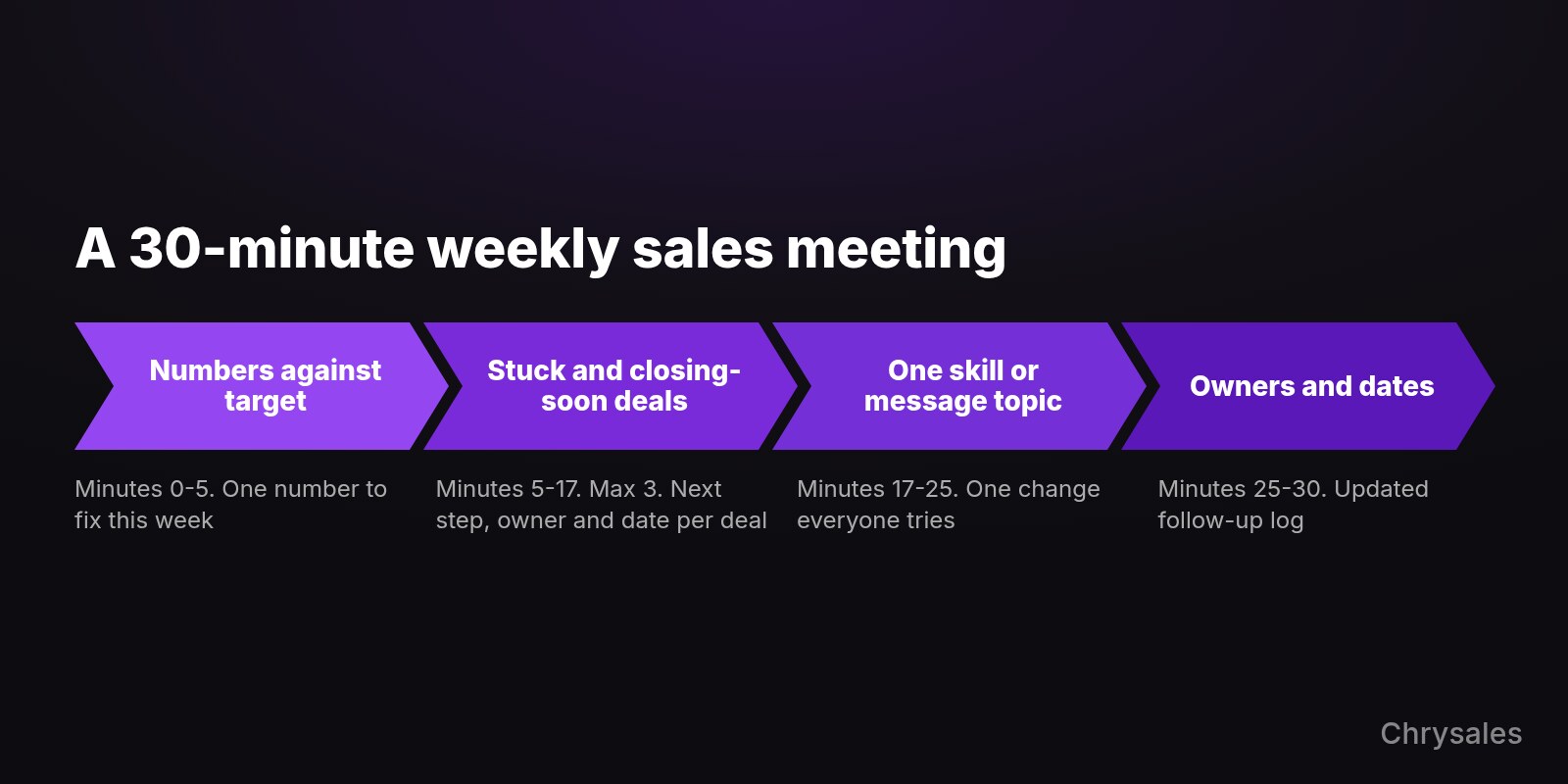
| Minutes | Block | Question to answer | Led by | Output |
|---|---|---|---|---|
| 0-5 | Numbers against target | Are we on track this month, and which number is off? | Whoever chairs | One number to fix this week |
| 5-17 | Stuck and closing-soon deals (max 3) | What would move each deal this week? | The seller who owns the deal | Next step, owner and date per deal |
| 17-25 | One skill or message topic | What will we say or do differently this week? | A different seller each week | One change everyone tries |
| 25-30 | Owners and dates | Who does what by when? | The note-taker | Updated follow-up log |
| Total: 30 |
The order matters. Steven Rogelberg, an organizational psychologist who studies meetings, reports that "items early in the agenda received a disproportionate amount of time and attention," so the blocks that move revenue come first. He also suggests "framing your agendas not as topics to be addressed, but as questions to be answered." Every block in the table has a question for that reason.
He is blunt about agendas on their own: they "do little to fundamentally improve meetings." A list of topics in the invite won't fix a meeting. What helps is the order, the questions and the written output.
For the numbers block, pick three or four numbers you already track, such as meetings booked and closed revenue against the monthly target. If you aren't sure which ones say something, start with the lead generation metrics that tie to B2B results. Show them on one screen. Nobody explains a number unless it's off target.
The skill block takes its topic from a real deal. It could be an objection that came up twice, a proposal that won or a first call that went nowhere. Whatever the team agrees on goes into a sales playbook built from your won deals, so the lesson outlives the meeting.
With 2-3 sellers the deal block often needs less than 12 minutes. End early instead of filling the slot. With more sellers, the deal block is the first part to come under pressure. Once it keeps running over, move deep deal work into one-on-ones or a separate deal review.
Which deals to discuss, and which to leave in the CRM
Discuss only two kinds of deals: deals with no logged movement for two weeks or more, and deals expected to close in the next two weeks. Cap it at three per meeting. Every other deal stays in the CRM, where the chair reads it before the meeting. Picking the deals in advance stops the round-robin through everyone's pipeline and keeps the 12 minutes for the deals that need help.
If a deal needs the whole room for half an hour, it needs its own meeting.
The two-week limit is a starting point. With a sales cycle of several months, a deal can sit quietly for longer without being stuck, so use the time a deal normally spends in its stage instead.
- The day before, filter the CRM for open deals with no logged activity in the last 14 days, and for deals with a close date in the next 14 days.
- From that list, pick up to three. Take the largest value at risk first, then the deals a seller asked for help on.
- Send the three deal names with the meeting invite, so their owners come ready.
- In the meeting, give each deal about four minutes. Each deal leaves with a next step, an owner and a date.
- If a deal needs more than that, book a one-on-one or a separate deal review for it that week.
The rule only works if the CRM is current, which depends on clear stages and the habit of updating them the same day. If that part is shaky, fix it first with pipeline stages and CRM habits that keep the data clean.
Other teams use similar filters. HubSpot's 20-minute meeting template limits its pipeline block to two or three critical or stalling deals. PostHog's public sales handbook describes a weekly review. Every other week, a randomly picked seller walks through their pipeline "Starting with later stage opportunities" and checks each one's "Progress towards exit criteria of the current stage." Its CRM check has a one-line rule: "No story time here, just data." Fabian Prudhomme of CHILI publish told Built In in 2020: "we only discuss opportunities that are duly logged into our CRM system."
Two questions keep the deal block honest. Devin Reed at Gong writes, "Instead of focusing on deal history, focus on deal momentum." Heather Gipson at Sandler suggests asking "Why does this opportunity deserve a place in the pipeline?" A deal that has no answer to that gets marked lost.
Here is what the difference sounds like. The company and the numbers are invented for illustration.
Illustrative example (fictional company and numbers)

Status read-out (avoid)
"Northfield Supplies: good call last week, they liked the demo,
waiting to hear back. Should close this quarter."

Momentum version (ask for this)
Deal: Northfield Supplies (fictional), proposal sent 18 days ago
Why it's on the list: no reply for 18 days, close date in 10 days
What changed since last week: nothing logged
What would move it: a call with the finance lead, who hasn't seen the proposal
Next step: seller asks the contact to set up a 20-minute call with finance
Owner: the seller
Date: ThursdayWhat each seller prepares before the meeting
Ask each seller to do four things before the meeting. They update every deal in the CRM and check their own numbers against target. They name up to two deals they want help on, and bring one lesson from a deal they won or lost. The chair keeps a follow-up log that records every next step from the meeting and gets reviewed at the start of the next one.
Without that log, next steps get lost. Atlassian surveyed 5,000 knowledge workers. 54% said they frequently leave meetings "without a clear idea of next steps or who owns which task." The survey covers meetings in general, not sales teams, but a deal block that ends without an owner has the same problem.
Copy this into your meeting invite or shared doc:
PRE-MEETING CHECKLIST (each seller, the day before)

[ ] Every open deal updated in the CRM: stage, value, close date, next step
[ ] Deals marked lost where the buyer has gone quiet for good
[ ] My numbers against target this month, and which one is off
[ ] Up to 2 deals I want help on, with the question I want answered
[ ] One lesson from a deal I won or lost this week (for the skill block)
FOLLOW-UP LOG (kept by the note-taker, reviewed at the next meeting's start)
Date of meeting | Deal or topic | Next step | Owner | Due date | Done at review? (yes / no / moved)
----------------|---------------|-----------|-------|----------|-----------------------------------
| | | | |
| | | | |The log opens the next meeting's owners-and-dates block in a minute: the note-taker reads the open items, each owner says done or not done, and anything not done gets a new date or gets dropped. Keep it in a shared doc or as tasks in the CRM, wherever your team already looks.
How long, which day and how often
Thirty minutes once a week, in the same slot, is a sensible default for 2-8 sellers. Published advice ranges from 20 minutes to two hours, and we found no study on the ideal length of a sales meeting. Rogelberg's view is that booked time tends to get used, so book the shortest slot your agenda fits.
| Source | Length | What it applies to |
|---|---|---|
| HubSpot meeting template | 20 minutes, "Hard stop at 20 minutes" | Vendor template |
| Jeff Barnes, Modernize, and Rob Kenny, Dosh (Built In, 2020) | "a short 30-minute standup meeting on Wednesdays" / "usually about 30 to 45 minutes" | Self-reports from 2020 |
| Chris O'Shea, BDC | One hour | BDC senior business advisor |
| EOS Level 10 meeting | 90 minutes | Leadership team meeting, not sales-specific |
| Pete Kazanjy, at TalentBin | Two hours | Whole-team pipeline review |
Rogelberg explains why longer slots rarely help: "If you schedule something for an hour, magically it takes an hour." His advice in Knowledge at Wharton is to "dial that amount down five to 10 minutes" from what you think the agenda needs. Salesforce's 2024 State of Sales survey adds the cost side: reps report spending 70% of their time on non-selling tasks. A weekly meeting adds to that pile, so it has to earn its slot.
On frequency, Steli Efti of Close gives a simple test. If sellers come with nothing to add, meet less often. If you always run out of time, meet more often.
For the day, we found no evidence that one weekday works better. Kazanjy ran his two-hour review on Wednesday afternoons, and Barnes also used Wednesdays.
Monday sets up the week, midweek leaves days to act on what you agreed, and Friday afternoons tend to compete with closing out the week. Pick one and keep it, along with the start time and the agenda.
Who runs it when the founder is still the top closer
Hand the chair to someone else as early as you can, and stop solving every deal live while you still sit in. If you answer every question, sellers may start bringing you problems instead of proposals, and the meeting stalls whenever you're busy closing. Start by rotating the skill block, then hand over the follow-up log, then the chair itself.
A handover over a few weeks could look like this:
- In the first two meetings you chair, but in the deal block you ask the seller "what would you do?" before you give your view.
- From the second meeting on, a different seller runs the skill block each week.
- By the third or fourth meeting, one person owns the follow-up log and opens each meeting with last week's open items.
- After that, hand the chair to whoever runs the pipeline day to day: a sales lead, an operations person or a Chief of Staff. You join as a seller with your own deals on the list.
The last step matches the final stage of Chrysales' 4-step method: Learn, Build Systems, Automate, Hire Chief of Staff. Someone other than you runs the weekly rhythm, and this meeting is part of it. If most decisions in your company still wait for you, start with why sales growth stalls when everything runs through the founder.
Two habits make the meeting safer for sellers to speak up. The first is the old rule Chris O'Shea of BDC repeats, "praise in public, correct in private." A seller whose deal went wrong hears about it in the one-on-one, not in front of the team. The second habit is asking the team how the meeting went. Rogelberg's research, summarized in Harvard Business Review, found that leaders rate their own meetings far more positively than attendees do, so your own impression isn't enough.
In this video Sabir walks through three sales systems, for outreach, closing and scaling, including the scaling system for adding more people without more chaos.
When to split deal review out of the team meeting
Split deal work into its own meeting when the deal block keeps running over or more deals qualify than three slots hold. The same goes for single deals that regularly need more than the four minutes the block gives them. Until then, one meeting with separate blocks is enough for 2-8 sellers. After the split, the team meeting keeps the numbers, the skill topic and the next steps.
Kellogg's view is clear: "I cannot overstate the importance of separating these three types of meetings." Other practitioners disagree about where deal work belongs. Jeffrey Steen writes on the Salesforce blog: "Group pipeline reviews are almost always a waste of time." PostHog does the opposite: its handbook describes a 30-minute group review in which "A Technical AE is picked at random" (AE is PostHog's term for a seller), with the team going through that seller's deals.
In our view, a group walk through every deal wastes most people's time. A group look at a few chosen deals lets sellers learn from each other's problems. So the 30-minute agenda keeps a small deal block with a few chosen deals, and everything else stays in the CRM.
When you split, you have two places to send deal work:
- One-on-ones. Each seller's full pipeline and coaching. This is also where you spot patterns, such as a seller who loses deals at the same stage every time. If that seller is your first hire, the usual reasons a first sales hire misses are worth reading before the next one-on-one.
- A separate deal review. Sellers bring the deals they most want to win, and the team spends real time on each one. Run it on a different day from the team meeting.
The Salesforce article gives a useful rule for either format: every pipeline review "should focus on action items for the week ahead, not what happened the week before."
How to tell after 4-6 weeks whether the meeting works
After four to six meetings, judge the meeting by what it produced, not by how it felt to you. Check whether discussed deals left with a dated next step, whether stuck deals moved or were marked lost, whether the meeting ended on time and whether sellers updated the CRM beforehand. Then ask the sellers to score it. These are Chrysales' own checks, not industry benchmarks.
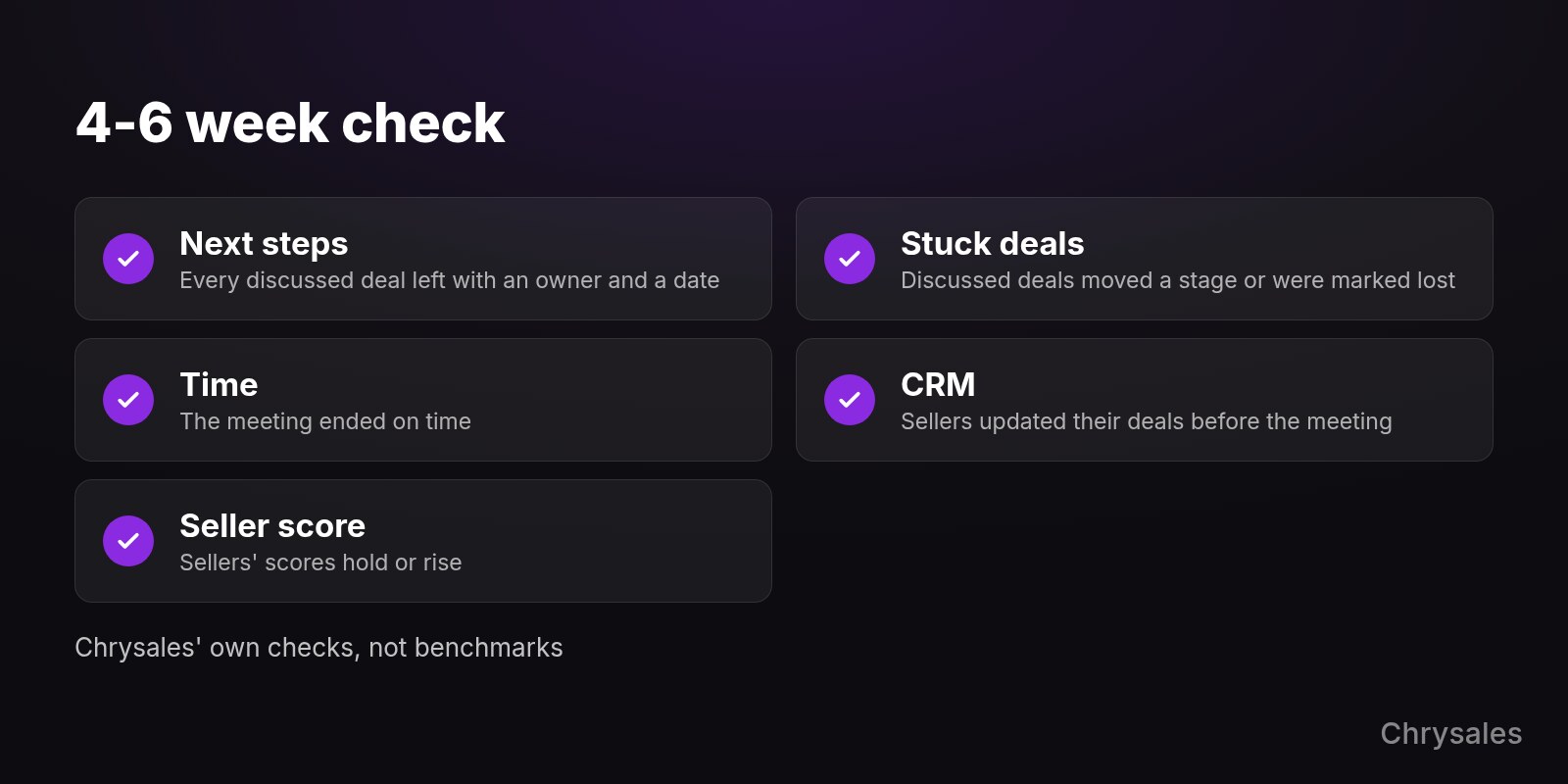
4-6 WEEK CHECK

[ ] Next steps: every discussed deal left with an owner and a date
[ ] Stuck deals: discussed deals moved a stage or were marked lost
[ ] Time: the meeting ended on time
[ ] CRM: sellers updated their deals before the meeting
[ ] Seller score: sellers' scores hold or rise
For the seller score, ask each person at the end of the meeting for a number from 1 to 10 and one thing to change. EOS builds the same step into its Level 10 meeting, which ends with attendees rating it. Write the scores into the follow-up log so you can compare them week by week.
If a check fails, change one thing at a time:
- If next steps are missing, the note-taker doesn't let a deal leave the block without an owner and a date.
- If stuck deals don't move, look at what the next steps were. Vague steps ("follow up") rarely move a deal, while a named call with a named person can.
- If the meeting runs over, cut to two deals, or move long cases to a separate deal review.
- If the CRM isn't updated, start the meeting from the CRM view on screen, so a missing update is visible to everyone.
- If scores are low, ask what the sellers would drop, and drop it for a month.
Common mistakes in weekly sales meetings
Weekly sales meetings tend to go wrong in a few familiar ways. Every deal gets read out, nobody leaves with a next step, and you end up doing the thinking for everyone. Each of these has a small fix that fits into the 30-minute format.
- Going round the room through every deal. It uses a lot of time for little discussion per deal. Pick up to three deals in advance with the two-week rule.
- Status read-outs. Mike Weinberg describes the result this way. "Oh, there's a meeting, but very little of it has to do with how to sell (or sell more)." Ask for momentum and the next step, and keep the skill block every week.
- Booking 60 minutes by default. The meeting will use them. Book 30 and end early when you can.
- Mixing forecast, coaching and deal-winning in one discussion. Keep them in separate blocks, or separate meetings once the team grows.
- Correcting a seller in front of the team. Save it for the one-on-one.
- Ending without owners and dates. If the follow-up log is empty, the meeting didn't produce anything.
- Updating the CRM during the meeting. That work belongs to the day before.
FAQ
How long should a weekly sales meeting be?
For 2-8 sellers, 30 minutes is a sensible default. Published advice runs from 20 minutes (HubSpot's template) to two hours (Pete Kazanjy at TalentBin), and we found no study that settles it. Book the shortest slot your agenda fits, and end early when there is nothing left to decide.
Should the weekly sales meeting be on Monday?
It can be, but we found no evidence that any weekday works better. Monday helps plan the week, while a midweek slot leaves days to act on what you agreed before the week ends. What matters more is that it's the same day and time every week.
Is a daily stand-up better than a weekly sales meeting?
For a small B2B team with longer sales cycles, deals rarely change enough day to day to fill a daily meeting, so a weekly meeting is usually enough. Short does help: in a 1999 lab study by Bluedorn and colleagues, sit-down meetings ran 34% longer than stand-up ones with no better decisions. Read it as support for a short, focused meeting.
Do I still need one-on-ones if we have a weekly sales meeting?
Yes. The team meeting covers a few selected deals and one shared skill topic. A seller's full pipeline and personal coaching belong in a one-on-one, so the team meeting can stay at 30 minutes.
How do I run a weekly sales meeting with a remote team?
Use the same agenda and the same slot, with the CRM view and the follow-up log on screen for everyone. Ask sellers to finish the pre-meeting checklist in writing the day before, so the call starts from current data. We'd suggest cameras on during the deal block, where reading people's reactions helps most.
Sources
- Steven Rogelberg - On meeting agendas
- Knowledge at Wharton - Less fluff, more stuff: how to make meetings more productive
- Harvard Business Review - Why your meetings stink and what to do about it
- Atlassian - Workplace woes: meetings
- Salesforce - State of Sales statistics 2024
- Never Work in Theory - Stand-up and sit-down meeting formats (Bluedorn et al.)
- Dave Kellogg - A ten-point sales management framework for enterprise SaaS startups
- Pete Kazanjy, Founding Sales - Pipeline management
- PostHog handbook - New business: how we work
- Salesforce blog - Sales pipeline review
- Gong - Pipeline review
- Built In - How sales leaders run their sales meetings
- HubSpot - How to run an effective sales meeting in under 20 minutes
- BDC - Why everyone hates sales meetings and what to do about it
- EOS Worldwide - The Level 10 meeting
- Sales Gravy, Mike Weinberg - 5 agenda topics for your next sales team meeting
- Close, Steli Efti - How to run sales meetings
- Sandler - The number one reason most pipeline meetings fail
Does every deal in your weekly meeting still wait for your answer? On a free strategy call, Chrysales can go through your meeting rhythm, your pipeline stages and who could run the meeting in your place. Plan a sales rhythm that runs without you on a free call

A good weekly sales meeting agenda for a small B2B team fits in 30 minutes and keeps the same order every week. Start with numbers against target, then discuss only the deals that are stuck or about to close, then one skill or message topic, then owners and dates for every next step. Sellers update the CRM before the meeting, so nobody reads out status in the room. Once deal discussions keep overrunning, move deep deal work into one-on-ones or a separate deal review.
This is written for teams of 2-8 sellers where you still close the biggest deals yourself. The agenda, the deal rule and the checks below are our recommended starting point, not a measured result. Adjust them to your sales cycle.
What a weekly sales meeting is for, and what it isn't
A weekly sales meeting exists to keep deals from drifting. The team looks at the numbers and a few chosen deals, then agrees who does what before the next meeting. Larger companies run full pipeline walks, deep coaching and forecasting as separate meetings. A small team can run one meeting with separate blocks, as long as each block keeps its own job.
A few terms first. Your pipeline is the list of open deals, sorted by stage, and the CRM is the system where those deals are logged. A forecast is the revenue you expect to close in a period. A one-on-one is a meeting between a manager and a single seller.
In the meeting itself, the chair runs the agenda and the note-taker writes down who owns what.
Dave Kellogg is a former CEO and board member who writes about sales management. He separates three kinds of sales meetings.
In his words, "Pipeline scrubs are about scrubbing, deal reviews are about winning, and forecast calls are about forecasting." On mixing them he is short: "Blend them at your peril." He writes for larger startups. A team of four can run one meeting that keeps those jobs in separate blocks.
| Meeting | Its job | Where it sits in a team of 2-8 sellers |
|---|---|---|
| Weekly team meeting | Numbers, a few stuck or closing deals, one skill topic, next steps | 30 minutes, same slot every week |
| Pipeline scrub | Check each deal's stage, value and close date in the CRM | Each seller does it alone before the meeting |
| Deal review | Work out how to win one specific deal | Up to 3 deals in the meeting's deal block; longer cases in a separate session |
| Forecast call | Estimate what closes this period | The 5-minute numbers block |
| One-on-one | Coaching and the seller's full pipeline | A separate meeting with each seller |
Pete Kazanjy, author of Founding Sales, calls weekly pipeline reviews and forecast calls "a forcing function to make sure that deals are not going sideways." If a deal hasn't moved, someone has to notice it this week, not at the end of the quarter.
A 30-minute weekly sales meeting agenda for 2-8 sellers
Run four blocks in a fixed order. Spend 5 minutes on numbers against target and 12 minutes on up to three stuck or closing-soon deals. Then take 8 minutes for one skill or message topic and 5 minutes to confirm owners and dates, which adds up to 30 minutes. Each block answers one question and ends with something written down, so people leave with decisions they can act on.
| Minutes | Block | Question to answer | Led by | Output |
|---|---|---|---|---|
| 0-5 | Numbers against target | Are we on track this month, and which number is off? | Whoever chairs | One number to fix this week |
| 5-17 | Stuck and closing-soon deals (max 3) | What would move each deal this week? | The seller who owns the deal | Next step, owner and date per deal |
| 17-25 | One skill or message topic | What will we say or do differently this week? | A different seller each week | One change everyone tries |
| 25-30 | Owners and dates | Who does what by when? | The note-taker | Updated follow-up log |
| Total: 30 |
The order matters. Steven Rogelberg, an organizational psychologist who studies meetings, reports that "items early in the agenda received a disproportionate amount of time and attention," so the blocks that move revenue come first. He also suggests "framing your agendas not as topics to be addressed, but as questions to be answered." Every block in the table has a question for that reason.
He is blunt about agendas on their own: they "do little to fundamentally improve meetings." A list of topics in the invite won't fix a meeting. What helps is the order, the questions and the written output.
For the numbers block, pick three or four numbers you already track, such as meetings booked and closed revenue against the monthly target. If you aren't sure which ones say something, start with the lead generation metrics that tie to B2B results. Show them on one screen. Nobody explains a number unless it's off target.
The skill block takes its topic from a real deal. It could be an objection that came up twice, a proposal that won or a first call that went nowhere. Whatever the team agrees on goes into a sales playbook built from your won deals, so the lesson outlives the meeting.
With 2-3 sellers the deal block often needs less than 12 minutes. End early instead of filling the slot. With more sellers, the deal block is the first part to come under pressure. Once it keeps running over, move deep deal work into one-on-ones or a separate deal review.
Which deals to discuss, and which to leave in the CRM
Discuss only two kinds of deals: deals with no logged movement for two weeks or more, and deals expected to close in the next two weeks. Cap it at three per meeting. Every other deal stays in the CRM, where the chair reads it before the meeting. Picking the deals in advance stops the round-robin through everyone's pipeline and keeps the 12 minutes for the deals that need help.
If a deal needs the whole room for half an hour, it needs its own meeting.
The two-week limit is a starting point. With a sales cycle of several months, a deal can sit quietly for longer without being stuck, so use the time a deal normally spends in its stage instead.
- The day before, filter the CRM for open deals with no logged activity in the last 14 days, and for deals with a close date in the next 14 days.
- From that list, pick up to three. Take the largest value at risk first, then the deals a seller asked for help on.
- Send the three deal names with the meeting invite, so their owners come ready.
- In the meeting, give each deal about four minutes. Each deal leaves with a next step, an owner and a date.
- If a deal needs more than that, book a one-on-one or a separate deal review for it that week.
The rule only works if the CRM is current, which depends on clear stages and the habit of updating them the same day. If that part is shaky, fix it first with pipeline stages and CRM habits that keep the data clean.
Other teams use similar filters. HubSpot's 20-minute meeting template limits its pipeline block to two or three critical or stalling deals. PostHog's public sales handbook describes a weekly review. Every other week, a randomly picked seller walks through their pipeline "Starting with later stage opportunities" and checks each one's "Progress towards exit criteria of the current stage." Its CRM check has a one-line rule: "No story time here, just data." Fabian Prudhomme of CHILI publish told Built In in 2020: "we only discuss opportunities that are duly logged into our CRM system."
Two questions keep the deal block honest. Devin Reed at Gong writes, "Instead of focusing on deal history, focus on deal momentum." Heather Gipson at Sandler suggests asking "Why does this opportunity deserve a place in the pipeline?" A deal that has no answer to that gets marked lost.
Here is what the difference sounds like. The company and the numbers are invented for illustration.
Illustrative example (fictional company and numbers)

Status read-out (avoid)
"Northfield Supplies: good call last week, they liked the demo,
waiting to hear back. Should close this quarter."

Momentum version (ask for this)
Deal: Northfield Supplies (fictional), proposal sent 18 days ago
Why it's on the list: no reply for 18 days, close date in 10 days
What changed since last week: nothing logged
What would move it: a call with the finance lead, who hasn't seen the proposal
Next step: seller asks the contact to set up a 20-minute call with finance
Owner: the seller
Date: ThursdayWhat each seller prepares before the meeting
Ask each seller to do four things before the meeting. They update every deal in the CRM and check their own numbers against target. They name up to two deals they want help on, and bring one lesson from a deal they won or lost. The chair keeps a follow-up log that records every next step from the meeting and gets reviewed at the start of the next one.
Without that log, next steps get lost. Atlassian surveyed 5,000 knowledge workers. 54% said they frequently leave meetings "without a clear idea of next steps or who owns which task." The survey covers meetings in general, not sales teams, but a deal block that ends without an owner has the same problem.
Copy this into your meeting invite or shared doc:
PRE-MEETING CHECKLIST (each seller, the day before)

[ ] Every open deal updated in the CRM: stage, value, close date, next step
[ ] Deals marked lost where the buyer has gone quiet for good
[ ] My numbers against target this month, and which one is off
[ ] Up to 2 deals I want help on, with the question I want answered
[ ] One lesson from a deal I won or lost this week (for the skill block)
FOLLOW-UP LOG (kept by the note-taker, reviewed at the next meeting's start)
Date of meeting | Deal or topic | Next step | Owner | Due date | Done at review? (yes / no / moved)
----------------|---------------|-----------|-------|----------|-----------------------------------
| | | | |
| | | | |The log opens the next meeting's owners-and-dates block in a minute: the note-taker reads the open items, each owner says done or not done, and anything not done gets a new date or gets dropped. Keep it in a shared doc or as tasks in the CRM, wherever your team already looks.
How long, which day and how often
Thirty minutes once a week, in the same slot, is a sensible default for 2-8 sellers. Published advice ranges from 20 minutes to two hours, and we found no study on the ideal length of a sales meeting. Rogelberg's view is that booked time tends to get used, so book the shortest slot your agenda fits.
| Source | Length | What it applies to |
|---|---|---|
| HubSpot meeting template | 20 minutes, "Hard stop at 20 minutes" | Vendor template |
| Jeff Barnes, Modernize, and Rob Kenny, Dosh (Built In, 2020) | "a short 30-minute standup meeting on Wednesdays" / "usually about 30 to 45 minutes" | Self-reports from 2020 |
| Chris O'Shea, BDC | One hour | BDC senior business advisor |
| EOS Level 10 meeting | 90 minutes | Leadership team meeting, not sales-specific |
| Pete Kazanjy, at TalentBin | Two hours | Whole-team pipeline review |
Rogelberg explains why longer slots rarely help: "If you schedule something for an hour, magically it takes an hour." His advice in Knowledge at Wharton is to "dial that amount down five to 10 minutes" from what you think the agenda needs. Salesforce's 2024 State of Sales survey adds the cost side: reps report spending 70% of their time on non-selling tasks. A weekly meeting adds to that pile, so it has to earn its slot.
On frequency, Steli Efti of Close gives a simple test. If sellers come with nothing to add, meet less often. If you always run out of time, meet more often.
For the day, we found no evidence that one weekday works better. Kazanjy ran his two-hour review on Wednesday afternoons, and Barnes also used Wednesdays.
Monday sets up the week, midweek leaves days to act on what you agreed, and Friday afternoons tend to compete with closing out the week. Pick one and keep it, along with the start time and the agenda.
Who runs it when the founder is still the top closer
Hand the chair to someone else as early as you can, and stop solving every deal live while you still sit in. If you answer every question, sellers may start bringing you problems instead of proposals, and the meeting stalls whenever you're busy closing. Start by rotating the skill block, then hand over the follow-up log, then the chair itself.
A handover over a few weeks could look like this:
- In the first two meetings you chair, but in the deal block you ask the seller "what would you do?" before you give your view.
- From the second meeting on, a different seller runs the skill block each week.
- By the third or fourth meeting, one person owns the follow-up log and opens each meeting with last week's open items.
- After that, hand the chair to whoever runs the pipeline day to day: a sales lead, an operations person or a Chief of Staff. You join as a seller with your own deals on the list.
The last step matches the final stage of Chrysales' 4-step method: Learn, Build Systems, Automate, Hire Chief of Staff. Someone other than you runs the weekly rhythm, and this meeting is part of it. If most decisions in your company still wait for you, start with why sales growth stalls when everything runs through the founder.
Two habits make the meeting safer for sellers to speak up. The first is the old rule Chris O'Shea of BDC repeats, "praise in public, correct in private." A seller whose deal went wrong hears about it in the one-on-one, not in front of the team. The second habit is asking the team how the meeting went. Rogelberg's research, summarized in Harvard Business Review, found that leaders rate their own meetings far more positively than attendees do, so your own impression isn't enough.
In this video Sabir walks through three sales systems, for outreach, closing and scaling, including the scaling system for adding more people without more chaos.
When to split deal review out of the team meeting
Split deal work into its own meeting when the deal block keeps running over or more deals qualify than three slots hold. The same goes for single deals that regularly need more than the four minutes the block gives them. Until then, one meeting with separate blocks is enough for 2-8 sellers. After the split, the team meeting keeps the numbers, the skill topic and the next steps.
Kellogg's view is clear: "I cannot overstate the importance of separating these three types of meetings." Other practitioners disagree about where deal work belongs. Jeffrey Steen writes on the Salesforce blog: "Group pipeline reviews are almost always a waste of time." PostHog does the opposite: its handbook describes a 30-minute group review in which "A Technical AE is picked at random" (AE is PostHog's term for a seller), with the team going through that seller's deals.
In our view, a group walk through every deal wastes most people's time. A group look at a few chosen deals lets sellers learn from each other's problems. So the 30-minute agenda keeps a small deal block with a few chosen deals, and everything else stays in the CRM.
When you split, you have two places to send deal work:
- One-on-ones. Each seller's full pipeline and coaching. This is also where you spot patterns, such as a seller who loses deals at the same stage every time. If that seller is your first hire, the usual reasons a first sales hire misses are worth reading before the next one-on-one.
- A separate deal review. Sellers bring the deals they most want to win, and the team spends real time on each one. Run it on a different day from the team meeting.
The Salesforce article gives a useful rule for either format: every pipeline review "should focus on action items for the week ahead, not what happened the week before."
How to tell after 4-6 weeks whether the meeting works
After four to six meetings, judge the meeting by what it produced, not by how it felt to you. Check whether discussed deals left with a dated next step, whether stuck deals moved or were marked lost, whether the meeting ended on time and whether sellers updated the CRM beforehand. Then ask the sellers to score it. These are Chrysales' own checks, not industry benchmarks.
4-6 WEEK CHECK

[ ] Next steps: every discussed deal left with an owner and a date
[ ] Stuck deals: discussed deals moved a stage or were marked lost
[ ] Time: the meeting ended on time
[ ] CRM: sellers updated their deals before the meeting
[ ] Seller score: sellers' scores hold or rise
For the seller score, ask each person at the end of the meeting for a number from 1 to 10 and one thing to change. EOS builds the same step into its Level 10 meeting, which ends with attendees rating it. Write the scores into the follow-up log so you can compare them week by week.
If a check fails, change one thing at a time:
- If next steps are missing, the note-taker doesn't let a deal leave the block without an owner and a date.
- If stuck deals don't move, look at what the next steps were. Vague steps ("follow up") rarely move a deal, while a named call with a named person can.
- If the meeting runs over, cut to two deals, or move long cases to a separate deal review.
- If the CRM isn't updated, start the meeting from the CRM view on screen, so a missing update is visible to everyone.
- If scores are low, ask what the sellers would drop, and drop it for a month.
Common mistakes in weekly sales meetings
Weekly sales meetings tend to go wrong in a few familiar ways. Every deal gets read out, nobody leaves with a next step, and you end up doing the thinking for everyone. Each of these has a small fix that fits into the 30-minute format.
- Going round the room through every deal. It uses a lot of time for little discussion per deal. Pick up to three deals in advance with the two-week rule.
- Status read-outs. Mike Weinberg describes the result this way. "Oh, there's a meeting, but very little of it has to do with how to sell (or sell more)." Ask for momentum and the next step, and keep the skill block every week.
- Booking 60 minutes by default. The meeting will use them. Book 30 and end early when you can.
- Mixing forecast, coaching and deal-winning in one discussion. Keep them in separate blocks, or separate meetings once the team grows.
- Correcting a seller in front of the team. Save it for the one-on-one.
- Ending without owners and dates. If the follow-up log is empty, the meeting didn't produce anything.
- Updating the CRM during the meeting. That work belongs to the day before.
FAQ
How long should a weekly sales meeting be?
For 2-8 sellers, 30 minutes is a sensible default. Published advice runs from 20 minutes (HubSpot's template) to two hours (Pete Kazanjy at TalentBin), and we found no study that settles it. Book the shortest slot your agenda fits, and end early when there is nothing left to decide.
Should the weekly sales meeting be on Monday?
It can be, but we found no evidence that any weekday works better. Monday helps plan the week, while a midweek slot leaves days to act on what you agreed before the week ends. What matters more is that it's the same day and time every week.
Is a daily stand-up better than a weekly sales meeting?
For a small B2B team with longer sales cycles, deals rarely change enough day to day to fill a daily meeting, so a weekly meeting is usually enough. Short does help: in a 1999 lab study by Bluedorn and colleagues, sit-down meetings ran 34% longer than stand-up ones with no better decisions. Read it as support for a short, focused meeting.
Do I still need one-on-ones if we have a weekly sales meeting?
Yes. The team meeting covers a few selected deals and one shared skill topic. A seller's full pipeline and personal coaching belong in a one-on-one, so the team meeting can stay at 30 minutes.
How do I run a weekly sales meeting with a remote team?
Use the same agenda and the same slot, with the CRM view and the follow-up log on screen for everyone. Ask sellers to finish the pre-meeting checklist in writing the day before, so the call starts from current data. We'd suggest cameras on during the deal block, where reading people's reactions helps most.
Sources
- Steven Rogelberg - On meeting agendas
- Knowledge at Wharton - Less fluff, more stuff: how to make meetings more productive
- Harvard Business Review - Why your meetings stink and what to do about it
- Atlassian - Workplace woes: meetings
- Salesforce - State of Sales statistics 2024
- Never Work in Theory - Stand-up and sit-down meeting formats (Bluedorn et al.)
- Dave Kellogg - A ten-point sales management framework for enterprise SaaS startups
- Pete Kazanjy, Founding Sales - Pipeline management
- PostHog handbook - New business: how we work
- Salesforce blog - Sales pipeline review
- Gong - Pipeline review
- Built In - How sales leaders run their sales meetings
- HubSpot - How to run an effective sales meeting in under 20 minutes
- BDC - Why everyone hates sales meetings and what to do about it
- EOS Worldwide - The Level 10 meeting
- Sales Gravy, Mike Weinberg - 5 agenda topics for your next sales team meeting
- Close, Steli Efti - How to run sales meetings
- Sandler - The number one reason most pipeline meetings fail
Does every deal in your weekly meeting still wait for your answer? On a free strategy call, Chrysales can go through your meeting rhythm, your pipeline stages and who could run the meeting in your place. Plan a sales rhythm that runs without you on a free call
Scaling Is Not Hard If You Have The Right Systems
If you’re serious about leveling up your scaling game, you need the right system, the right training, and the right team behind you. We're here to give you the exact tools and strategies top entrepreneurs use to dominate.

Discover the latest tips
View All
Chrysales was formed from the words "chrysalis" the stage where a caterpillar transforms into a butterfly and "sales".
It stands for one thing: sales transformation.Because scaling doesn’t happen by doing more of the same. Scaling only happens when you go through real transformation in your systems, your offer, team and the way you sell.


