.avif)
What Is an Appointment Setter in B2B Sales?
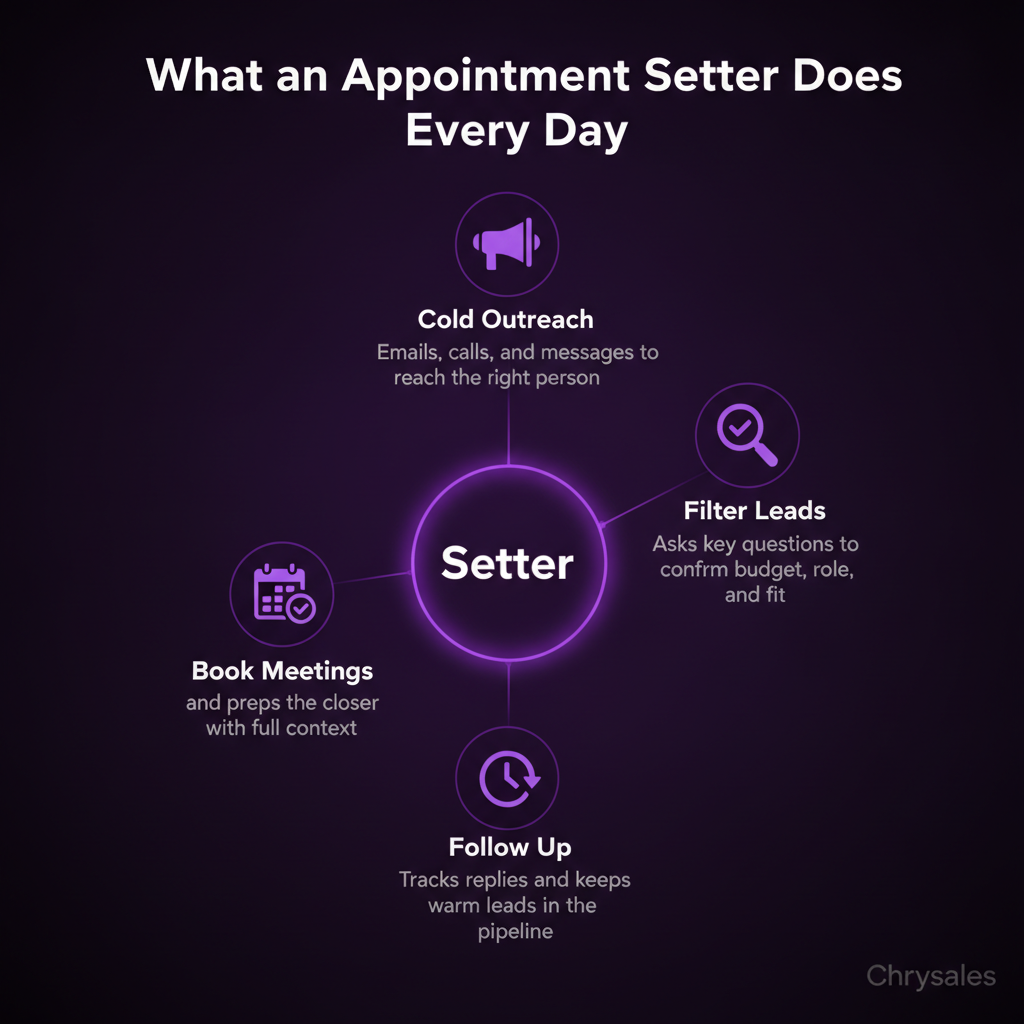
An appointment setter is the person who finds the right people, starts the conversation, gets them interested, and books the meeting in B2B sales. They do lead generation and fill the calendar so closers can do what they do best.
Picture this: you have a killer product, a solid offer, and a closer who can turn meetings into deals. But your calendar is empty. No one's booking calls. That's the gap an appointment setter fills.
In B2B sales, this role is the engine that keeps the pipeline moving. Without it, even the best sales teams run out of opportunities.
What Does an Appointment Setter Actually Do?
An appointment setter handles the top of the sales funnel. They're the first touch point between your company and a potential client. Their job is to reach out, qualify leads, and schedule meetings for your sales team or closers.
Here's what that looks like day to day:
Cold Outreach Across Multiple Channels
Appointment setters don't just make cold calls. They work across email, LinkedIn, phone, and sometimes even SMS. The goal is to reach the right person where they're most likely to respond. Learn more about multichannel vs omnichannel outreach and how it impacts meeting rates.
A 15-person consulting firm might have their setter send 50 emails, 20 LinkedIn messages, and make 30 calls in a single day.
Qualifying Leads Before They Hit the Calendar
Not everyone who responds is worth a meeting. A good appointment setter asks the right questions to figure out if someone is a fit. Do they have the budget? Are they the decision maker? Is the timing right?
If the answer is no, the setter moves on. If yes, they book the call.
Pro Tip: A qualified lead is better than ten random meetings. Train your setter to disqualify fast.
Managing Follow-Ups and Keeping the Pipeline Warm
Most people don't book a meeting on the first touch. Appointment setters track every conversation, send follow-ups, and keep prospects warm until they're ready to talk.
They live in the CRM, updating notes, setting reminders, and making sure nothing falls through the cracks.
Booking Meetings That Actually Show Up
Getting someone to say yes is one thing. Getting them to show up is another. Good appointment setters confirm meetings, send reminders, and prep the prospect so the closer walks into a warm conversation.
We worked with a tech company that had a 40% no-show rate. After their setter started sending confirmation messages and calendar holds, it dropped to 12%.
Appointment Setter vs. Closer: What's the Difference?
A lot of people confuse these roles. They're not the same.
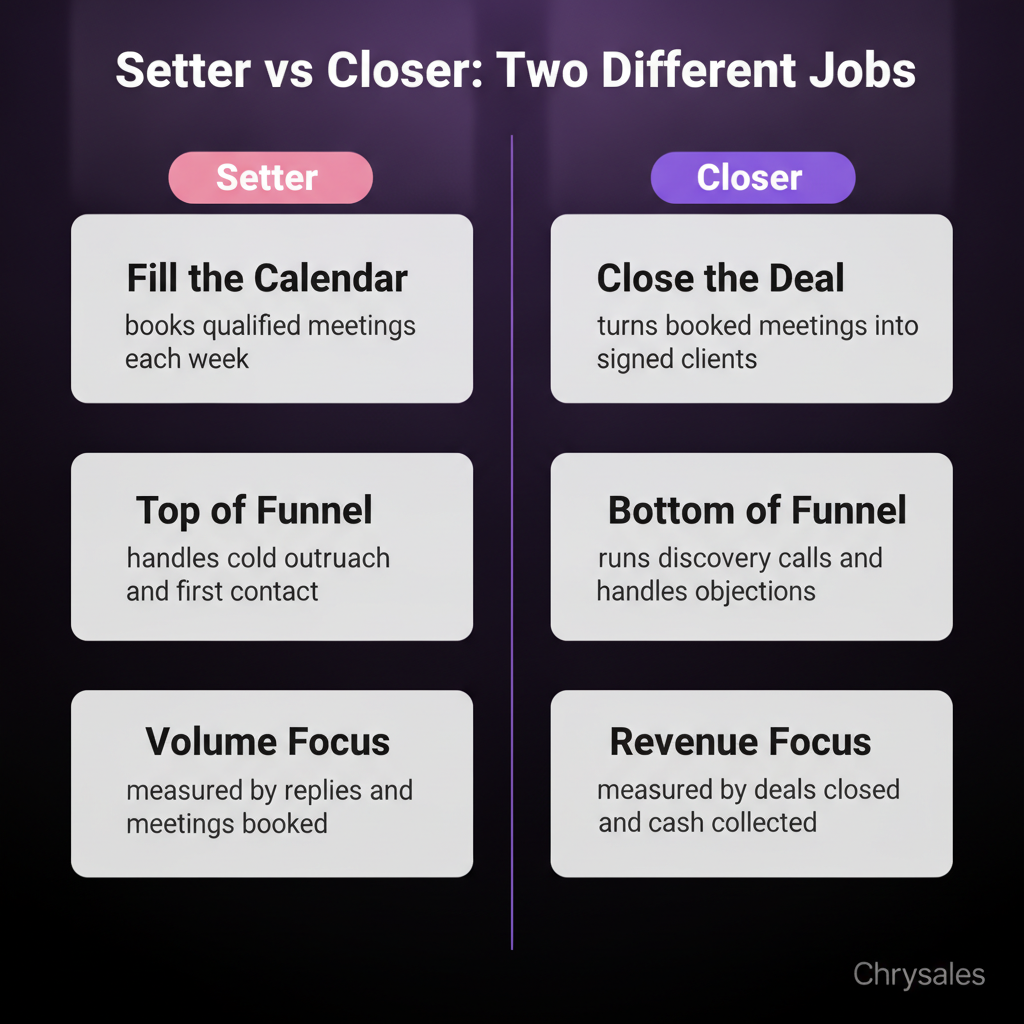
An appointment setter books meetings. A closer turns those meetings into deals.
Think of it like a restaurant. The setter is the host who greets people, checks the reservation list, and seats them at the table. The closer is the chef who makes the meal.
Both are critical, but they do completely different things.
Appointment Setters Focus on Volume and Qualification
Setters are measured by how many qualified meetings they book. They're optimizing for reach, response rates, and calendar fill.
They don't need to know every detail about your product or pricing. They need to know enough to get someone interested and qualified.
Closers Focus on Conversion and Revenue
Closers are measured by how many deals they close and how much revenue they bring in. They need deep product knowledge, objection handling skills, and the ability to guide a decision.
They're not built to spend their day sending cold emails or making 50 dials.
Watch out: If your closer is also doing appointment setting, they're spending half their time on low-value tasks. That's a bad use of talent.
Why You Need Both Roles in a Scalable Sales System
Small sales teams often start with one person doing both. That works for a while. But once you're booking more than 10 meetings a week, splitting the roles makes sense.
Your closer stays focused on high-value conversations. Your setter keeps the pipeline full. The system becomes predictable. If you're unsure whether to hire appointment setter or closer first, consider your current bottleneck: leads or conversions.
Key Skills Every Good Appointment Setter Needs
Not everyone can do this job well. Appointment setting for B2B is different from retail or consumer sales.
Here are the skills that separate great setters from mediocre ones.
Communication That Sounds Real, Not Scripted
Cold outreach fails when it sounds like a robot wrote it. Good setters know how to personalize messages, match the tone to the prospect, and sound like a human having a real conversation.
They don't copy-paste templates word for word. They adjust based on who they're talking to.
Research Skills to Find and Vet the Right Leads
A 200-person company that just did layoffs is not a hot lead. It's a bad fit, full stop.
Good setters do basic research before they reach out. They check LinkedIn, company news, recent funding, job postings. They build lists that make sense, not random spray-and-pray contact dumps.
Persistence Without Being Annoying
Most people don't respond the first time. Or the second. Or the third.
Appointment setters need to follow up without being pushy. They space out touches, switch channels, and know when to move on.
Following up seven times over three weeks is normal. Sending seven emails in three days is spam.
Common mistake: Giving up after one or two tries. According to research on B2B sales statistics, the average B2B lead generation campaign needs 5-7 touches to get a response.
CRM and Tool Fluency
Appointment setters live in tools. They need to know how to use a CRM, email sequencing software, LinkedIn automation, and call tracking tools.
They log every interaction, update lead status, and keep the data clean so the closer has full context when the meeting starts.
Should You Hire an In-House Appointment Setter or Outsource?
This is the question most teams wrestle with. The answer depends on your size, budget, and how fast you want to scale.
Hiring In-House Gives You Control and Integration
When you hire an appointment setter directly, they're fully embedded in your team. They understand your product, your voice, and your ideal customer.
You can train them exactly how you want. They're easier to manage and adjust as your offer or positioning changes.
A 30-person consulting firm hired an in-house setter last quarter. They booked 15 qualified calls in the first three weeks because the setter was trained on the exact pain points their clients face.
Outsourcing Appointment Setting Can Be Faster to Start
Outsourced appointment setting services give you a trained setter or team right away. You don't have to recruit, onboard, or build the scripts.
You hand them a list, a target profile, and a goal. They start booking meetings. For guidance on choosing a provider, explore top b2b appointment setting companies and their service models.
It's faster, but you lose some control over the messaging and qualification process.
AI Appointment Setters Are a New Option Worth Watching
AI appointment setter tools are getting better. They can handle cold calling, basic lead qualification, and calendar booking without a human involved.
They work 24/7, never get tired, and scale instantly. But they lack the nuance and relationship-building skills a good human setter brings.
Right now, AI setters work best for high-volume, low-complexity outreach. For B2B deals with long sales cycles, human setters still win.
Pro Tip: If you're testing AI, use it for initial outreach and hand-offs to a human setter for qualification. Hybrid models work well.
How to Build an Appointment Setting System That Actually Works
Hiring an appointment setter is not enough. You need a system around them.
Without the right lists, scripts, tracking, and handoff process, even a great setter will struggle.
Start with a Clean, Targeted Lead List
Most cold emails flop because the list is bad, not the words. Your setter needs a list of people who actually fit your ideal customer profile.
That means filtering by company size, industry, role, recent activity, and pain points. A bad list wastes time and burns your sender reputation.
Write Scripts and Templates That Sound Like You
Your setter needs a starting point. Write email templates, cold call scripts, and LinkedIn message frameworks that match your brand voice.
But don't make them rigid. Good setters adjust based on the prospect. Scripts are training wheels, not handcuffs. To compare which channels work best for your team, watch this breakdown of cold email vs cold calling and their relative ROI.
Set Clear Qualification Criteria
What makes a lead qualified? Write it down.
Is it budget, authority, need, and timeline? Is it company size and recent funding? Your setter should know exactly what questions to ask and what answers disqualify someone.
Clear criteria means less wasted meetings.
Watch out: Vague qualification leads to low-quality meetings. Your closer gets frustrated and the setter gets confused.
Track Metrics That Matter
Appointment setters should be measured on:
- Number of outreach attempts (emails, calls, messages)
- Response rate
- Qualified meetings booked
- Show-up rate
- Feedback from closers on lead quality
If you're not tracking these, you can't improve the system. Set a simple rule: anything scoring above 70 goes to the top of your call list.
Build a Smooth Handoff to Your Closer
The setter books the meeting. Then what?
The closer needs context. Who is this person? What did they say? What are they interested in? What objections came up?
A good handoff includes CRM notes, a quick Slack message, or a shared doc with all the details. The closer should never walk into a meeting blind.
Common Mistakes Teams Make with Appointment Setters
We see this all the time with new clients. They hire an appointment setter, expect magic, and end up disappointed.
Here are the traps to avoid.
Hiring Without Training or Systems
Handing someone a phone and a list is not a system. Even experienced setters need to learn your offer, your positioning, and your objection responses.
Training should cover your ideal customer, your value message, and how to qualify. Most teams skip this and wonder why results are weak.
Measuring Only Meetings Booked, Not Quality
If your setter books 20 meetings but only two show up or none close, the problem is qualification. Don't just count meetings. Track show rates and feedback from closers. Understanding the broader context of emerging B2B sales trends can help you set realistic benchmarks.
One marketing agency had a 0.5% reply rate. After fixing their list and messaging, it jumped to 4%. Quality always beats quantity.
Not Giving Setters the Right Tools
Setters need a CRM, email automation, a dialer, and LinkedIn tools. If they're manually copying and pasting everything, they're slow.
Speed matters in appointment setting. The right tools let them reach 3x more people in the same time.
Letting Setters Work in a Silo
Your setter should talk to your closer every week. What objections are coming up? What messaging is landing? What types of leads are converting?
That feedback loop makes the whole system better. Most teams build a 40-step workflow when 12 steps would do the job.
How Appointment Setters Fit Into a Full Sales System
Appointment setting is not a standalone fix. It's one piece of a bigger sales machine.
At Chrysales, we build custom sales systems that include lead generation, appointment setting, closing frameworks, and sales team scaling. Here's how it all fits together:
An appointment setter fills the top of the funnel with qualified meetings. The closer turns those meetings into clients. But both need the right offers, scripts, positioning, and automation to work efficiently. For a complete overview, read our guide on how to build a sales system that actually scales beyond just appointment setting.
We've trained over 500 sales teams to build systems like this. When the pieces connect, client acquisition becomes predictable.
Quick example: a B2B tech company came to us with no pipeline. We helped them build a lead scoring system, hire and train an appointment setter, and set up an outbound sequence that books 12 calls a week. Three months in, they're closing 30% of those calls.
That's what a full system looks like.
Frequently Asked Questions
Q: How much does an appointment setter typically cost?
In-house appointment setters usually earn between $40,000 and $60,000 per year, plus commission or bonuses tied to meetings booked. Outsourced appointment setting services charge per meeting or a monthly retainer, often ranging from $1,500 to $5,000 depending on volume and industry. AI appointment setter tools are cheaper upfront but lack the nuance for complex B2B sales.
Q: What's the difference between an appointment setter and an SDR?
An SDR (Sales Development Representative) typically does both appointment setting and some lead qualification or research. An appointment setter focuses purely on booking meetings. In practice, the roles overlap a lot. Some companies use the terms interchangeably. The key is clarity on what you want the person to do: just book meetings, or also handle inbound leads and deeper qualification.
Q: Can one appointment setter handle multiple closers?
Yes, but it depends on meeting volume and lead flow. A good appointment setter can usually support 2-3 closers if each closer takes 8-12 meetings per week. Beyond that, you risk bottlenecks. If your closers are sitting empty or your setter is overwhelmed, the ratio is off. Track it and adjust.
Q: How long does it take to train a new appointment setter?
Most setters need 1-2 weeks to get up to speed on your offer, ideal customer, and messaging. After that, expect another 2-4 weeks before they're booking meetings consistently. Total ramp time is usually 4-6 weeks. If you have strong scripts, a clean list, and clear qualification criteria, it's faster. Without those, it drags.
Q: Should I use AI or hire a human appointment setter?
If your outreach is high volume, simple, and transactional, AI can work. If your sales cycle is long, your product is complex, or your buyer needs real conversation, hire a human. Right now, AI appointment setters are best for initial touches and basic qualification. Humans still win on relationship building and handling objections. A hybrid approach is smart: AI for scale, human for the important stuff.
An appointment setter is the person who finds the right people, starts the conversation, gets them interested, and books the meeting in B2B sales. They do lead generation and fill the calendar so closers can do what they do best.
Picture this: you have a killer product, a solid offer, and a closer who can turn meetings into deals. But your calendar is empty. No one's booking calls. That's the gap an appointment setter fills.
In B2B sales, this role is the engine that keeps the pipeline moving. Without it, even the best sales teams run out of opportunities.
What Does an Appointment Setter Actually Do?
An appointment setter handles the top of the sales funnel. They're the first touch point between your company and a potential client. Their job is to reach out, qualify leads, and schedule meetings for your sales team or closers.
Here's what that looks like day to day:
Cold Outreach Across Multiple Channels
Appointment setters don't just make cold calls. They work across email, LinkedIn, phone, and sometimes even SMS. The goal is to reach the right person where they're most likely to respond. Learn more about multichannel vs omnichannel outreach and how it impacts meeting rates.
A 15-person consulting firm might have their setter send 50 emails, 20 LinkedIn messages, and make 30 calls in a single day.
Qualifying Leads Before They Hit the Calendar
Not everyone who responds is worth a meeting. A good appointment setter asks the right questions to figure out if someone is a fit. Do they have the budget? Are they the decision maker? Is the timing right?
If the answer is no, the setter moves on. If yes, they book the call.
Pro Tip: A qualified lead is better than ten random meetings. Train your setter to disqualify fast.
Managing Follow-Ups and Keeping the Pipeline Warm
Most people don't book a meeting on the first touch. Appointment setters track every conversation, send follow-ups, and keep prospects warm until they're ready to talk.
They live in the CRM, updating notes, setting reminders, and making sure nothing falls through the cracks.
Booking Meetings That Actually Show Up
Getting someone to say yes is one thing. Getting them to show up is another. Good appointment setters confirm meetings, send reminders, and prep the prospect so the closer walks into a warm conversation.
We worked with a tech company that had a 40% no-show rate. After their setter started sending confirmation messages and calendar holds, it dropped to 12%.
Appointment Setter vs. Closer: What's the Difference?
A lot of people confuse these roles. They're not the same.
An appointment setter books meetings. A closer turns those meetings into deals.
Think of it like a restaurant. The setter is the host who greets people, checks the reservation list, and seats them at the table. The closer is the chef who makes the meal.
Both are critical, but they do completely different things.
Appointment Setters Focus on Volume and Qualification
Setters are measured by how many qualified meetings they book. They're optimizing for reach, response rates, and calendar fill.
They don't need to know every detail about your product or pricing. They need to know enough to get someone interested and qualified.
Closers Focus on Conversion and Revenue
Closers are measured by how many deals they close and how much revenue they bring in. They need deep product knowledge, objection handling skills, and the ability to guide a decision.
They're not built to spend their day sending cold emails or making 50 dials.
Watch out: If your closer is also doing appointment setting, they're spending half their time on low-value tasks. That's a bad use of talent.
Why You Need Both Roles in a Scalable Sales System
Small sales teams often start with one person doing both. That works for a while. But once you're booking more than 10 meetings a week, splitting the roles makes sense.
Your closer stays focused on high-value conversations. Your setter keeps the pipeline full. The system becomes predictable. If you're unsure whether to hire appointment setter or closer first, consider your current bottleneck: leads or conversions.
Key Skills Every Good Appointment Setter Needs
Not everyone can do this job well. Appointment setting for B2B is different from retail or consumer sales.
Here are the skills that separate great setters from mediocre ones.
Communication That Sounds Real, Not Scripted
Cold outreach fails when it sounds like a robot wrote it. Good setters know how to personalize messages, match the tone to the prospect, and sound like a human having a real conversation.
They don't copy-paste templates word for word. They adjust based on who they're talking to.
Research Skills to Find and Vet the Right Leads
A 200-person company that just did layoffs is not a hot lead. It's a bad fit, full stop.
Good setters do basic research before they reach out. They check LinkedIn, company news, recent funding, job postings. They build lists that make sense, not random spray-and-pray contact dumps.
Persistence Without Being Annoying
Most people don't respond the first time. Or the second. Or the third.
Appointment setters need to follow up without being pushy. They space out touches, switch channels, and know when to move on.
Following up seven times over three weeks is normal. Sending seven emails in three days is spam.
Common mistake: Giving up after one or two tries. According to research on B2B sales statistics, the average B2B lead generation campaign needs 5-7 touches to get a response.
CRM and Tool Fluency
Appointment setters live in tools. They need to know how to use a CRM, email sequencing software, LinkedIn automation, and call tracking tools.
They log every interaction, update lead status, and keep the data clean so the closer has full context when the meeting starts.
Should You Hire an In-House Appointment Setter or Outsource?
This is the question most teams wrestle with. The answer depends on your size, budget, and how fast you want to scale.
Hiring In-House Gives You Control and Integration
When you hire an appointment setter directly, they're fully embedded in your team. They understand your product, your voice, and your ideal customer.
You can train them exactly how you want. They're easier to manage and adjust as your offer or positioning changes.
A 30-person consulting firm hired an in-house setter last quarter. They booked 15 qualified calls in the first three weeks because the setter was trained on the exact pain points their clients face.
Outsourcing Appointment Setting Can Be Faster to Start
Outsourced appointment setting services give you a trained setter or team right away. You don't have to recruit, onboard, or build the scripts.
You hand them a list, a target profile, and a goal. They start booking meetings. For guidance on choosing a provider, explore top b2b appointment setting companies and their service models.
It's faster, but you lose some control over the messaging and qualification process.
AI Appointment Setters Are a New Option Worth Watching
AI appointment setter tools are getting better. They can handle cold calling, basic lead qualification, and calendar booking without a human involved.
They work 24/7, never get tired, and scale instantly. But they lack the nuance and relationship-building skills a good human setter brings.
Right now, AI setters work best for high-volume, low-complexity outreach. For B2B deals with long sales cycles, human setters still win.
Pro Tip: If you're testing AI, use it for initial outreach and hand-offs to a human setter for qualification. Hybrid models work well.
How to Build an Appointment Setting System That Actually Works
Hiring an appointment setter is not enough. You need a system around them.
Without the right lists, scripts, tracking, and handoff process, even a great setter will struggle.
Start with a Clean, Targeted Lead List
Most cold emails flop because the list is bad, not the words. Your setter needs a list of people who actually fit your ideal customer profile.
That means filtering by company size, industry, role, recent activity, and pain points. A bad list wastes time and burns your sender reputation.
Write Scripts and Templates That Sound Like You
Your setter needs a starting point. Write email templates, cold call scripts, and LinkedIn message frameworks that match your brand voice.
But don't make them rigid. Good setters adjust based on the prospect. Scripts are training wheels, not handcuffs. To compare which channels work best for your team, watch this breakdown of cold email vs cold calling and their relative ROI.
Set Clear Qualification Criteria
What makes a lead qualified? Write it down.
Is it budget, authority, need, and timeline? Is it company size and recent funding? Your setter should know exactly what questions to ask and what answers disqualify someone.
Clear criteria means less wasted meetings.
Watch out: Vague qualification leads to low-quality meetings. Your closer gets frustrated and the setter gets confused.
Track Metrics That Matter
Appointment setters should be measured on:
- Number of outreach attempts (emails, calls, messages)
- Response rate
- Qualified meetings booked
- Show-up rate
- Feedback from closers on lead quality
If you're not tracking these, you can't improve the system. Set a simple rule: anything scoring above 70 goes to the top of your call list.
Build a Smooth Handoff to Your Closer
The setter books the meeting. Then what?
The closer needs context. Who is this person? What did they say? What are they interested in? What objections came up?
A good handoff includes CRM notes, a quick Slack message, or a shared doc with all the details. The closer should never walk into a meeting blind.
Common Mistakes Teams Make with Appointment Setters
We see this all the time with new clients. They hire an appointment setter, expect magic, and end up disappointed.
Here are the traps to avoid.
Hiring Without Training or Systems
Handing someone a phone and a list is not a system. Even experienced setters need to learn your offer, your positioning, and your objection responses.
Training should cover your ideal customer, your value message, and how to qualify. Most teams skip this and wonder why results are weak.
Measuring Only Meetings Booked, Not Quality
If your setter books 20 meetings but only two show up or none close, the problem is qualification. Don't just count meetings. Track show rates and feedback from closers. Understanding the broader context of emerging B2B sales trends can help you set realistic benchmarks.
One marketing agency had a 0.5% reply rate. After fixing their list and messaging, it jumped to 4%. Quality always beats quantity.
Not Giving Setters the Right Tools
Setters need a CRM, email automation, a dialer, and LinkedIn tools. If they're manually copying and pasting everything, they're slow.
Speed matters in appointment setting. The right tools let them reach 3x more people in the same time.
Letting Setters Work in a Silo
Your setter should talk to your closer every week. What objections are coming up? What messaging is landing? What types of leads are converting?
That feedback loop makes the whole system better. Most teams build a 40-step workflow when 12 steps would do the job.
How Appointment Setters Fit Into a Full Sales System
Appointment setting is not a standalone fix. It's one piece of a bigger sales machine.
At Chrysales, we build custom sales systems that include lead generation, appointment setting, closing frameworks, and sales team scaling. Here's how it all fits together:
An appointment setter fills the top of the funnel with qualified meetings. The closer turns those meetings into clients. But both need the right offers, scripts, positioning, and automation to work efficiently. For a complete overview, read our guide on how to build a sales system that actually scales beyond just appointment setting.
We've trained over 500 sales teams to build systems like this. When the pieces connect, client acquisition becomes predictable.
Quick example: a B2B tech company came to us with no pipeline. We helped them build a lead scoring system, hire and train an appointment setter, and set up an outbound sequence that books 12 calls a week. Three months in, they're closing 30% of those calls.
That's what a full system looks like.
Frequently Asked Questions
Q: How much does an appointment setter typically cost?
In-house appointment setters usually earn between $40,000 and $60,000 per year, plus commission or bonuses tied to meetings booked. Outsourced appointment setting services charge per meeting or a monthly retainer, often ranging from $1,500 to $5,000 depending on volume and industry. AI appointment setter tools are cheaper upfront but lack the nuance for complex B2B sales.
Q: What's the difference between an appointment setter and an SDR?
An SDR (Sales Development Representative) typically does both appointment setting and some lead qualification or research. An appointment setter focuses purely on booking meetings. In practice, the roles overlap a lot. Some companies use the terms interchangeably. The key is clarity on what you want the person to do: just book meetings, or also handle inbound leads and deeper qualification.
Q: Can one appointment setter handle multiple closers?
Yes, but it depends on meeting volume and lead flow. A good appointment setter can usually support 2-3 closers if each closer takes 8-12 meetings per week. Beyond that, you risk bottlenecks. If your closers are sitting empty or your setter is overwhelmed, the ratio is off. Track it and adjust.
Q: How long does it take to train a new appointment setter?
Most setters need 1-2 weeks to get up to speed on your offer, ideal customer, and messaging. After that, expect another 2-4 weeks before they're booking meetings consistently. Total ramp time is usually 4-6 weeks. If you have strong scripts, a clean list, and clear qualification criteria, it's faster. Without those, it drags.
Q: Should I use AI or hire a human appointment setter?
If your outreach is high volume, simple, and transactional, AI can work. If your sales cycle is long, your product is complex, or your buyer needs real conversation, hire a human. Right now, AI appointment setters are best for initial touches and basic qualification. Humans still win on relationship building and handling objections. A hybrid approach is smart: AI for scale, human for the important stuff.
Scaling Is Not Hard If You Have The Right Systems
If you’re serious about leveling up your scaling game, you need the right system, the right training, and the right team behind you. We're here to give you the exact tools and strategies top entrepreneurs use to dominate.

Discover the latest tips
View All.avif)
Chrysales was formed from the words "chrysalis" the stage where a caterpillar transforms into a butterfly and "sales".
It stands for one thing: sales transformation.Because scaling doesn’t happen by doing more of the same. Scaling only happens when you go through real transformation in your systems, your offer, team and the way you sell.
.avif)


