
Appointment setter to closer handoff: what to pass on
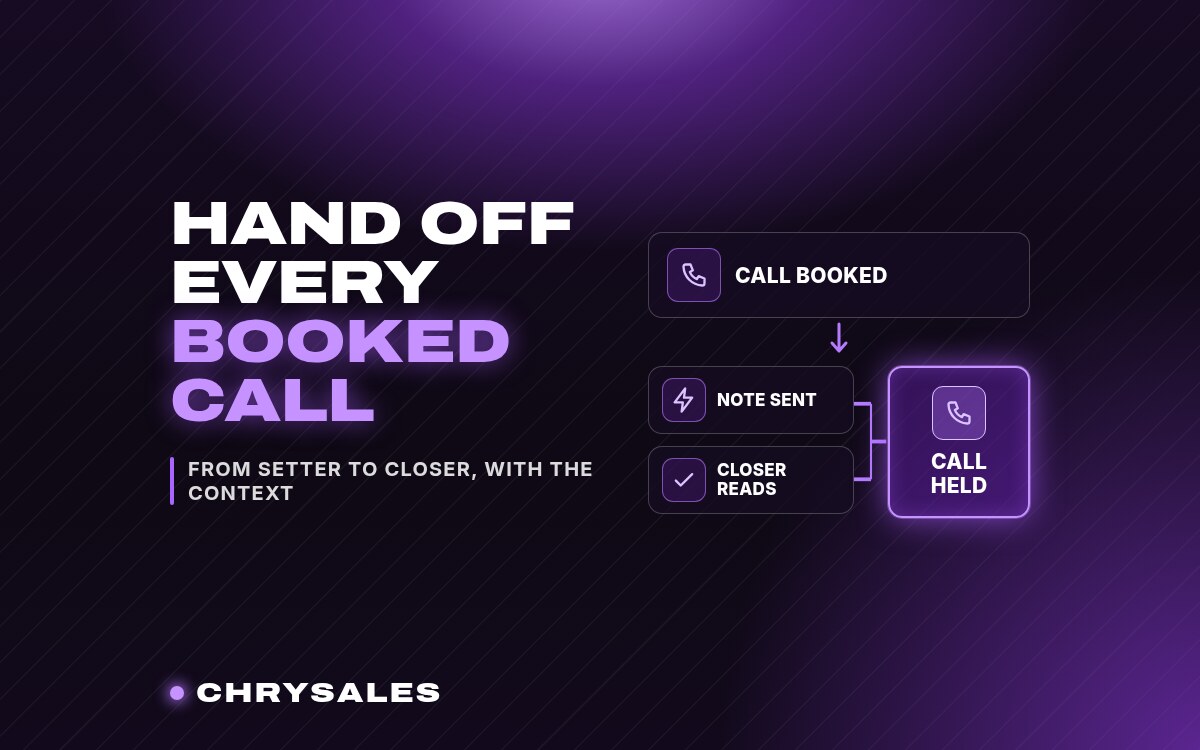
A good appointment setter to closer handoff is a short written note. The setter sends it on the day the call is booked. It tells the closer who the buyer is, why they said yes, what they said in their own words and what was promised. The setter then confirms the meeting, and the closer reads the note before the call.
The setter books the meetings (see what an appointment setter does), and the closer runs the sales call. In a small company, the closer is often you.
Agree what a qualified call is
Write down one shared rule for which calls count. Without it, the setter books anyone to fill the calendar, and the closer stops trusting the bookings.
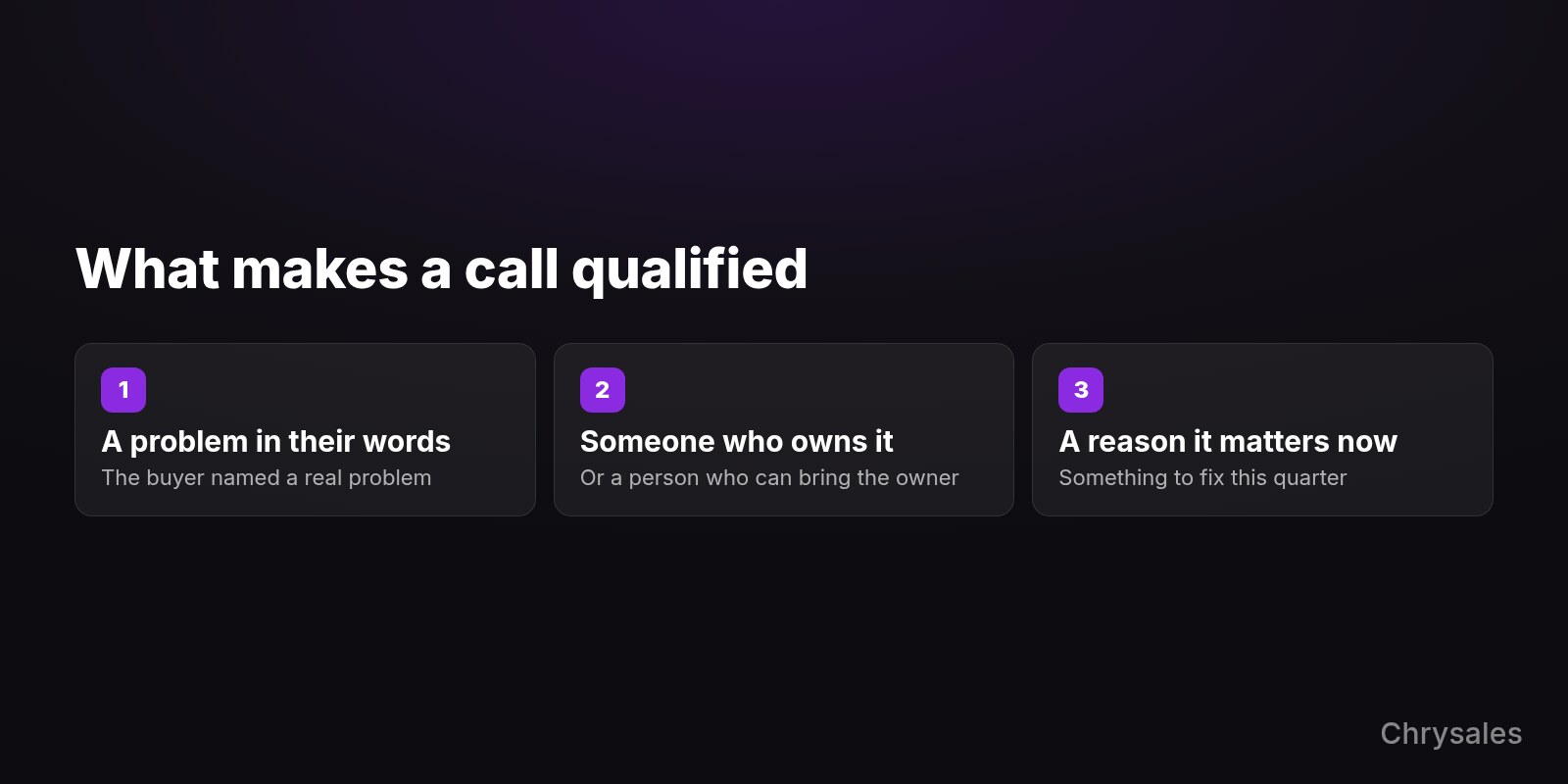
A good starting point is the three-part definition from Tenbound, a sales development research and advisory firm (the article is published on CIENCE's site). Adapt it to your offer in four lines or fewer.
Marylou Tyler, co-author of Predictable Revenue, wrote in a RevGenius community thread that "qualified" should become "an observable, measurable state". In other words, something two people can check the same way.
When the setter and closer disagree on whether a call qualifies and there is no sales manager, you decide. Write that into the rule, so the argument doesn't come back.
Watch no-shows here too. A no-show is a buyer who doesn't join the booked call. Tenbound sees the no-show rate largely as a sign of weak qualification: someone who said yes only to end a call often doesn't attend.
Do your setter's calls come from cold outreach? In this video, Sabir explains when cold email or cold calling works better. He also shows how to combine both into one system that books qualified meetings every week.
The handoff note your setter fills in
The note is six short lines the setter fills in after every call they book. Tenbound's test is simple. The closer shouldn't have to "rediscover anything in the first ten minutes."
Our version builds on Tenbound's five-line note and adds what is still unknown. Keep it in a shared doc or your CRM (where you store contacts and deals).
Buyer: name, role, company
Why now: what made them take the call
Their words: one sentence they said or wrote, quoted as is
Who else decides: people or roles they mentioned
What I promised: the agenda and anything I said we would show
Still unknown: what I could not find out
The line that matters most is the buyer's own words. According to Woodpecker, one of the most valuable parts of a handoff "is often the sentence the buyer wrote themselves." Copy it as written.
Here it is filled in for a made-up buyer (fictional example).
Buyer: Lena Hart, Head of Operations, a 40-person B2B company
Why now: their only salesperson is leaving after the holidays
Their words: "We get referrals, but nobody follows up on them."
Who else decides: the CEO signs; finance was not mentioned
What I promised: a short call, no slides, a look at their follow-up
Still unknown: budget and the tools they use today
Now the closer can run the discovery call, the first sales call with the buyer, without asking Lena the same questions again.
Send the note the same day
Send the note on the day the call is booked, while the conversation is still fresh. Then give the closer time to read it, and keep the wait until the meeting short.
Funnel Clarity, a sales training firm, advises sending the handoff email as soon as the setter knows the lead is ready. We suggest the setter sends a note for every booking before the day ends.
GitLab's public sales handbook has setters ask the buyer to accept the calendar invite while still on the phone. It also asks for at least 24 hours' notice to the closer, so there is time to prepare.
Don't book weeks out, though. Growth Cab, an agency that books meetings for clients, studied B2B meetings booked by cold calling. Meetings held within two days of booking took place 85.4% of the time.
Meetings booked more than a month ahead took place far less often. That is one agency's data, and it doesn't prove the short wait caused the better turnout. Still, next week beats next month.
Last, decide how the buyer meets the closer. Funnel Clarity says the setter should ideally join that first call. If that isn't possible, make sure the buyer knows who the closer is before the call, so a new face is no surprise.
Who owns reminders and no-shows
Before the call, the setter owns the meeting: confirming it and sending the reminders. After a no-show, one named person follows up, and you write down who.
Reminders are worth the effort. In healthcare trials reviewed by Cochrane, patients with a text reminder showed up 78.6% of the time, more often than patients with none. Those were patients, not buyers, so treat it as a hint and not as a sales benchmark.
Some scheduling tools can also ask the buyer to confirm they're coming. Senior buyers need extra care. In Growth Cab's sample, CEOs, founders and owners had the highest no-show rate, at 18.9%.
Who follows up after a no-show is a choice. GitLab gives it back to the setter, who tries to rebook for up to two weeks.
We'd give the follow-up to the closer, so the buyer isn't sent back through another handoff. Our guide on who owns a no-show already keeps the lead with the closer when that buyer comes back.
Pick one. Write it down and tell both people. Once the call has happened, the closer owns the buyer.
Check the handoff every week
Spend 15 minutes a week with the setter and the closer on a few recent handoffs.
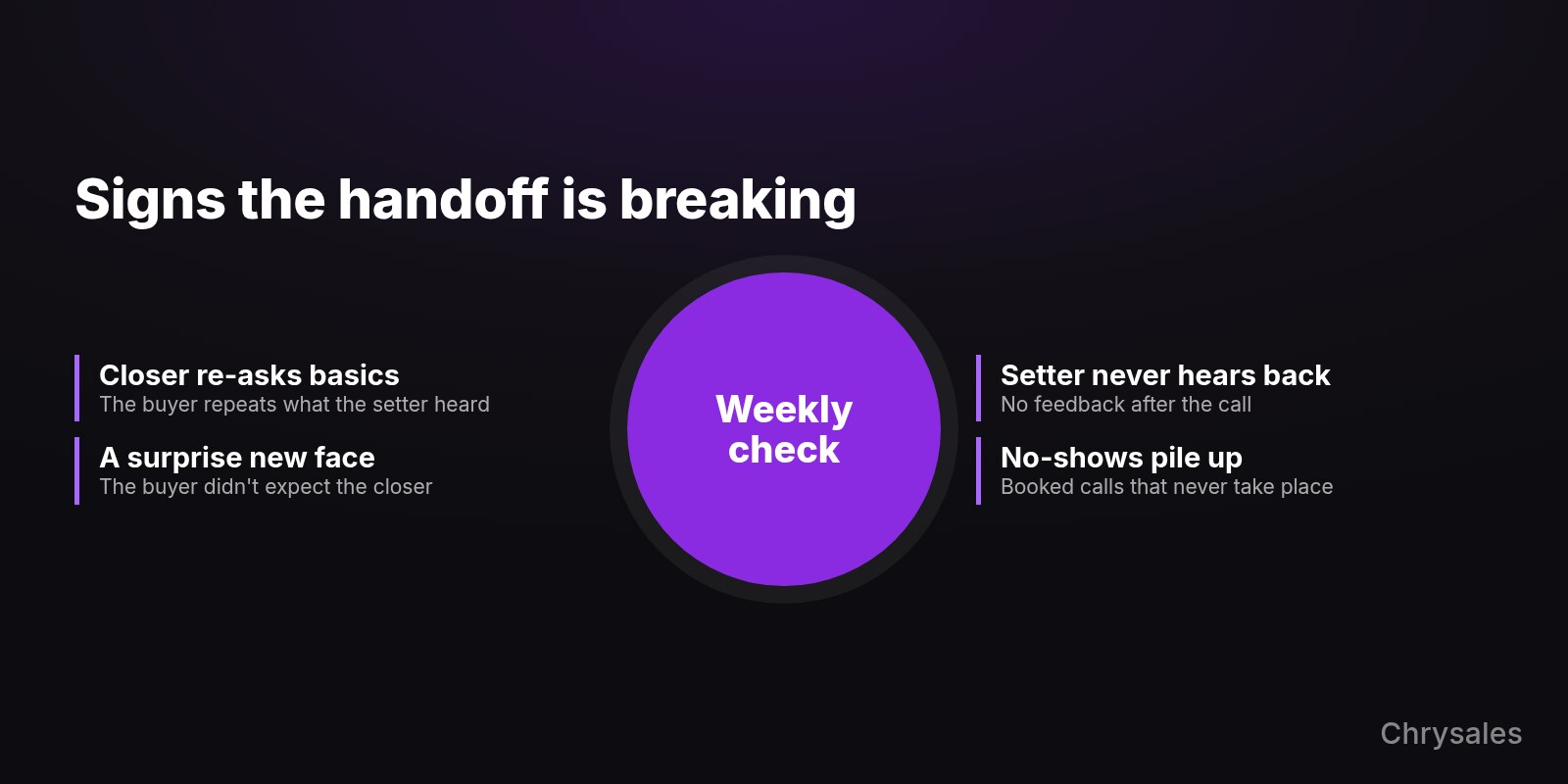
Tenbound's version of this review covers one meeting that went well, one that didn't and one change to the rule or the note. A routine we suggest is to pick three to five booked calls and ask the closer, for each one, what they wish they had known.
Ask the closer for short written feedback after each call too, so the setter learns what happened.
Count held calls, meaning booked calls that actually took place. A booking alone proves little. Woodpecker warns that a lead marked as assigned in your CRM is no proof the handoff happened.
The same goes for pay. In Tenbound's words, "Meetings booked rewards volume." If you pay your setter for results, think about paying per held, qualified meeting instead.
Conclusion: start with the handoff note
Fixing the handoff takes a few rules both people follow.
- Agree in writing what a qualified call is, and who decides when you disagree.
- Copy the six-line note and have the setter fill it in for every booking.
- Send the note the same day and keep bookings close.
- Name who owns reminders and who follows up after a no-show.
- Put a 15-minute handoff review in the calendar for next week.
Want a setter and closer setup that doesn't need you in every call? On a free strategy call, Chrysales can look at how your calls get booked and passed on today. Map out your handoff on a free call
A good appointment setter to closer handoff is a short written note. The setter sends it on the day the call is booked. It tells the closer who the buyer is, why they said yes, what they said in their own words and what was promised. The setter then confirms the meeting, and the closer reads the note before the call.
The setter books the meetings (see what an appointment setter does), and the closer runs the sales call. In a small company, the closer is often you.
Agree what a qualified call is
Write down one shared rule for which calls count. Without it, the setter books anyone to fill the calendar, and the closer stops trusting the bookings.
A good starting point is the three-part definition from Tenbound, a sales development research and advisory firm (the article is published on CIENCE's site). Adapt it to your offer in four lines or fewer.
Marylou Tyler, co-author of Predictable Revenue, wrote in a RevGenius community thread that "qualified" should become "an observable, measurable state". In other words, something two people can check the same way.
When the setter and closer disagree on whether a call qualifies and there is no sales manager, you decide. Write that into the rule, so the argument doesn't come back.
Watch no-shows here too. A no-show is a buyer who doesn't join the booked call. Tenbound sees the no-show rate largely as a sign of weak qualification: someone who said yes only to end a call often doesn't attend.
Do your setter's calls come from cold outreach? In this video, Sabir explains when cold email or cold calling works better. He also shows how to combine both into one system that books qualified meetings every week.
The handoff note your setter fills in
The note is six short lines the setter fills in after every call they book. Tenbound's test is simple. The closer shouldn't have to "rediscover anything in the first ten minutes."
Our version builds on Tenbound's five-line note and adds what is still unknown. Keep it in a shared doc or your CRM (where you store contacts and deals).
Buyer: name, role, company
Why now: what made them take the call
Their words: one sentence they said or wrote, quoted as is
Who else decides: people or roles they mentioned
What I promised: the agenda and anything I said we would show
Still unknown: what I could not find out
The line that matters most is the buyer's own words. According to Woodpecker, one of the most valuable parts of a handoff "is often the sentence the buyer wrote themselves." Copy it as written.
Here it is filled in for a made-up buyer (fictional example).
Buyer: Lena Hart, Head of Operations, a 40-person B2B company
Why now: their only salesperson is leaving after the holidays
Their words: "We get referrals, but nobody follows up on them."
Who else decides: the CEO signs; finance was not mentioned
What I promised: a short call, no slides, a look at their follow-up
Still unknown: budget and the tools they use today
Now the closer can run the discovery call, the first sales call with the buyer, without asking Lena the same questions again.
Send the note the same day
Send the note on the day the call is booked, while the conversation is still fresh. Then give the closer time to read it, and keep the wait until the meeting short.
Funnel Clarity, a sales training firm, advises sending the handoff email as soon as the setter knows the lead is ready. We suggest the setter sends a note for every booking before the day ends.
GitLab's public sales handbook has setters ask the buyer to accept the calendar invite while still on the phone. It also asks for at least 24 hours' notice to the closer, so there is time to prepare.
Don't book weeks out, though. Growth Cab, an agency that books meetings for clients, studied B2B meetings booked by cold calling. Meetings held within two days of booking took place 85.4% of the time.
Meetings booked more than a month ahead took place far less often. That is one agency's data, and it doesn't prove the short wait caused the better turnout. Still, next week beats next month.
Last, decide how the buyer meets the closer. Funnel Clarity says the setter should ideally join that first call. If that isn't possible, make sure the buyer knows who the closer is before the call, so a new face is no surprise.
Who owns reminders and no-shows
Before the call, the setter owns the meeting: confirming it and sending the reminders. After a no-show, one named person follows up, and you write down who.
Reminders are worth the effort. In healthcare trials reviewed by Cochrane, patients with a text reminder showed up 78.6% of the time, more often than patients with none. Those were patients, not buyers, so treat it as a hint and not as a sales benchmark.
Some scheduling tools can also ask the buyer to confirm they're coming. Senior buyers need extra care. In Growth Cab's sample, CEOs, founders and owners had the highest no-show rate, at 18.9%.
Who follows up after a no-show is a choice. GitLab gives it back to the setter, who tries to rebook for up to two weeks.
We'd give the follow-up to the closer, so the buyer isn't sent back through another handoff. Our guide on who owns a no-show already keeps the lead with the closer when that buyer comes back.
Pick one. Write it down and tell both people. Once the call has happened, the closer owns the buyer.
Check the handoff every week
Spend 15 minutes a week with the setter and the closer on a few recent handoffs.
Tenbound's version of this review covers one meeting that went well, one that didn't and one change to the rule or the note. A routine we suggest is to pick three to five booked calls and ask the closer, for each one, what they wish they had known.
Ask the closer for short written feedback after each call too, so the setter learns what happened.
Count held calls, meaning booked calls that actually took place. A booking alone proves little. Woodpecker warns that a lead marked as assigned in your CRM is no proof the handoff happened.
The same goes for pay. In Tenbound's words, "Meetings booked rewards volume." If you pay your setter for results, think about paying per held, qualified meeting instead.
Conclusion: start with the handoff note
Fixing the handoff takes a few rules both people follow.
- Agree in writing what a qualified call is, and who decides when you disagree.
- Copy the six-line note and have the setter fill it in for every booking.
- Send the note the same day and keep bookings close.
- Name who owns reminders and who follows up after a no-show.
- Put a 15-minute handoff review in the calendar for next week.
Want a setter and closer setup that doesn't need you in every call? On a free strategy call, Chrysales can look at how your calls get booked and passed on today. Map out your handoff on a free call
Scaling Is Not Hard If You Have The Right Systems
If you’re serious about leveling up your scaling game, you need the right system, the right training, and the right team behind you. We're here to give you the exact tools and strategies top entrepreneurs use to dominate.

Discover the latest tips
View All
Chrysales was formed from the words "chrysalis" the stage where a caterpillar transforms into a butterfly and "sales".
It stands for one thing: sales transformation.Because scaling doesn’t happen by doing more of the same. Scaling only happens when you go through real transformation in your systems, your offer, team and the way you sell.


