
Sales rep onboarding plan: the first 90 days in a small B2B team
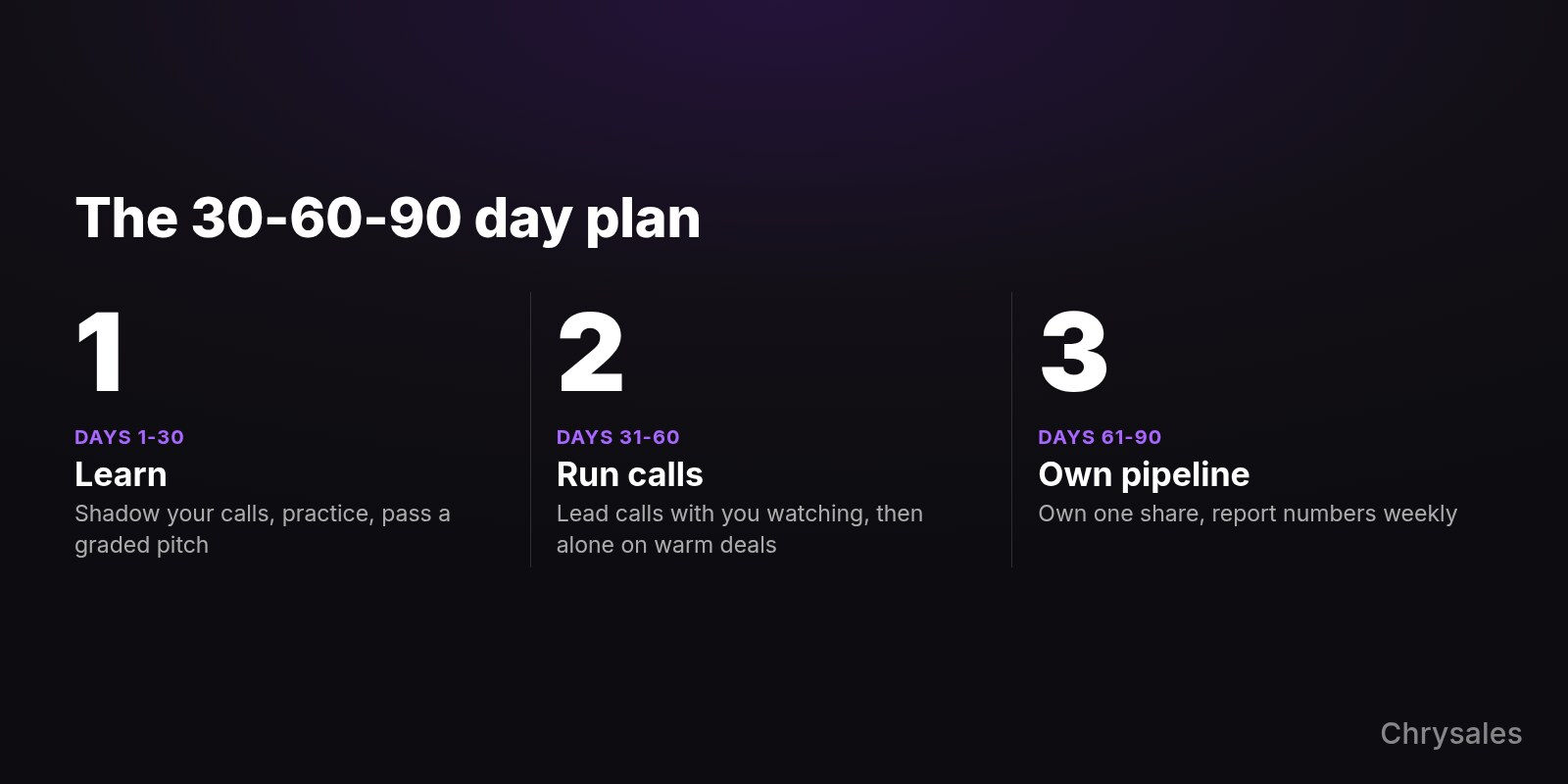
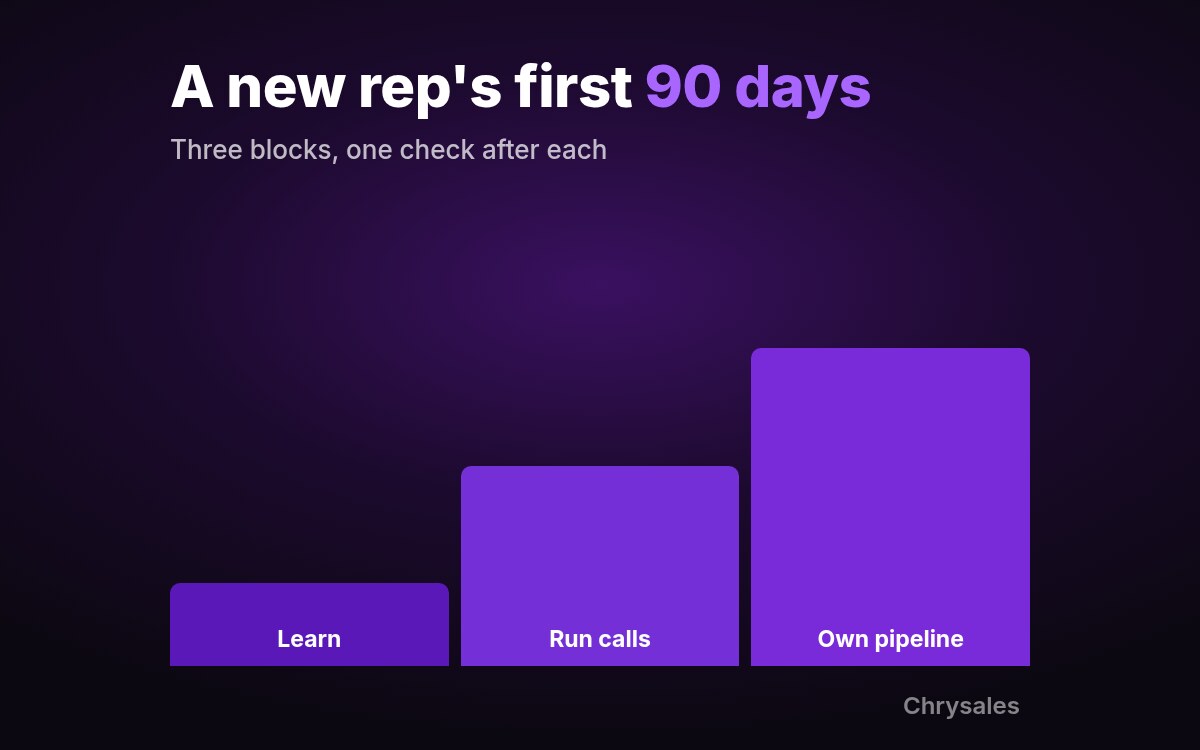
A sales rep onboarding plan for a small B2B team splits the first 90 days into three blocks, and each block ends with a check you run. In days 1-30 your new seller learns how you win deals. In days 31-60 they run real conversations while you review them, and in days 61-90 they own a share of the pipeline and report weekly numbers.
Two conditions decide whether the plan works. You write down how your deals are won before day 1, and you judge day 90 on activity and quality rather than quota. The Bridge Group's 2026 survey puts ramp time to full productivity at 6.2 months on average, so a seller still short of full revenue at day 90 is normal.
This is for you if you still close most deals yourself and there's no sales manager between you and the person you just brought in. The blocks, checks and tables below are our recommended format, built from the named sources linked throughout. Any number you aim for inside them comes from your own deals.
What a 30-60-90 day plan for a sales rep is, and what it can't do
A 30-60-90 day plan is a written schedule of what a newcomer learns, does and gets checked on in each of their opening three months. It gives you both the same picture of what good looks like at day 30, 60 and 90. What it can't do is get a typical seller to full quota in 90 days, so the checks measure progress.
A few terms first. Ramp is the time a new seller needs to reach full productivity, and quota is the sales target a fully ramped seller is measured on. Your pipeline is the list of open deals, sorted by stage. Shadowing means the newcomer sits in on your calls and only watches.
Two surveys give two different answers. A 2026 survey of 158 B2B companies by the Bridge Group found that account executives, the reps who close deals, need 6.2 months on average to reach full productivity. That's the highest figure in the study's history.
RAIN Group asked 423 sales leaders and heard about three months until a new seller is ready to talk to buyers, nine months to be competent and 15 months to become a top performer. The Bridge Group sample leans toward companies with engaged revenue leadership, and RAIN Group sells sales training, so treat both as a rough range for your own business.
Jason Lemkin, founder of SaaStr, ties ramp to your sales cycle. In his view, reps should close deals within one sales cycle and be ramped by two. If your deals take three weeks from first call to signature, day 90 can show real closes. If they take four months, day 90 mostly shows activity and the quality of conversations.
So this onboarding plan judges each block on what the seller does and how well, against targets you set from your own numbers. For the money side of those months, read what a rep costs during ramp. If you're still choosing who to bring in, start with how to hire sales people who close deals.
What should you prepare before the rep's first day?
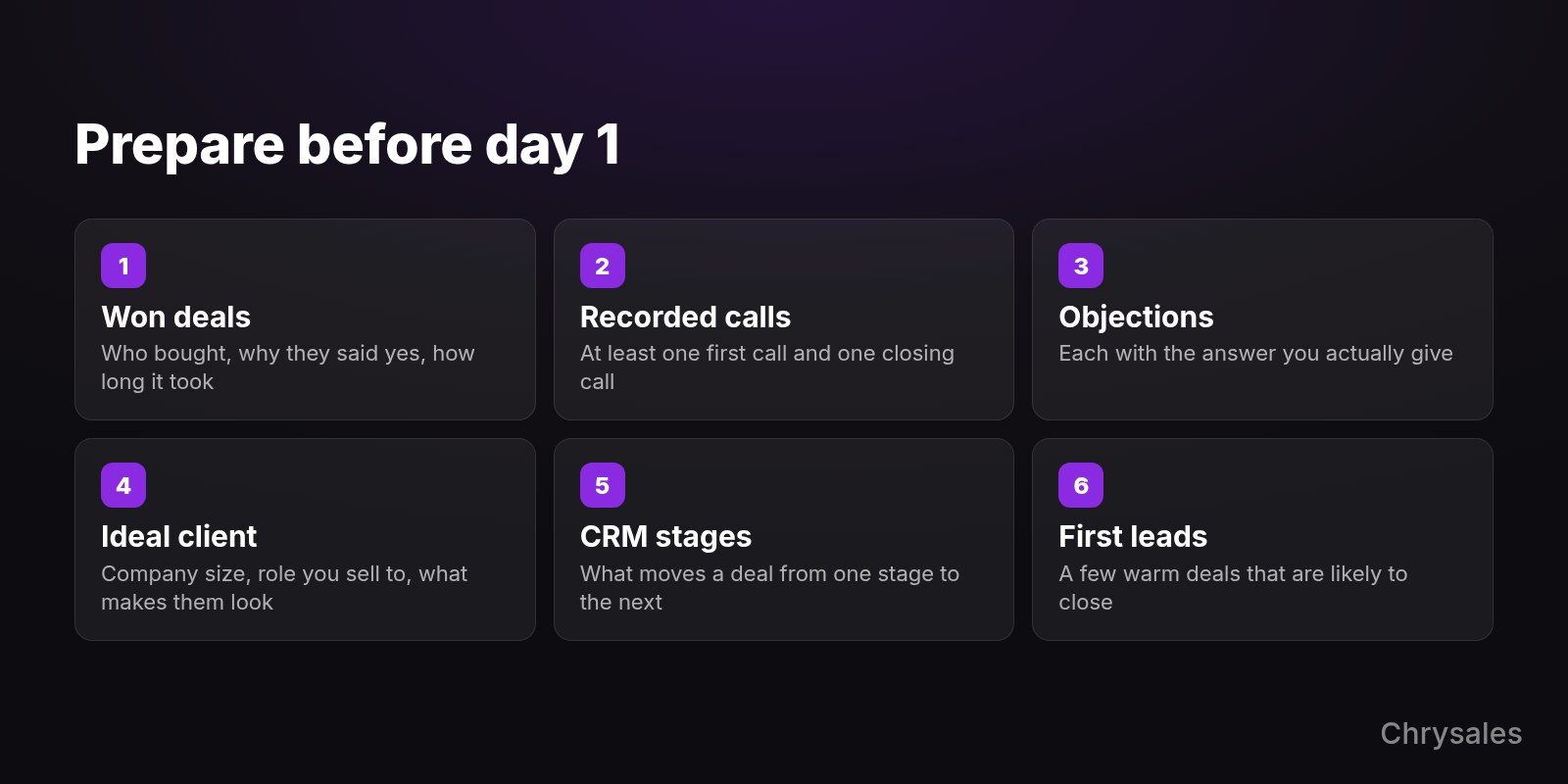
Before day 1, write down how your deals are actually won, so the newcomer learns from your real deals. If you can't say how your last five deals were won, a new seller won't figure it out either. The pack covers your recent won deals, recorded calls, your top objections with your answers, a description of your ideal client, a CRM with clear stages and a first set of leads. Part of it can go to the rep as pre-work.
Pete Kazanjy, co-founder of TalentBin, made the case for this in First Round Review. In his words, "It doesn't matter how much experience or skill a sales rep brings with them, they need to go through training to work at your company." An experienced seller knows how to sell. They don't yet know your buyer, your offer or why your clients said yes.
In his book Founding Sales, Kazanjy suggests about ten hours of pre-work spread over the two weeks before the start date. He also says the first curriculum can be one big Google Doc that you copy for each newcomer. You don't need a learning platform for one or two reps.
Penny Mares, VP of Sales at Unusual Ventures, adds a step you'll be tempted to skip. In an interview with Mercury, she recommends a baseline from your founder-led deals, set before the newcomer joins. It records how long deals took, which activities moved them forward, when opportunities entered the pipeline and where prospects slowed down. Without it, you'll judge the rep against how you remember your own deals.
Copy this list into the document you hand the rep:
BEFORE DAY 1 - ONBOARDING PACK

[ ] Your last 5-10 won deals: who bought, what problem they had,
    why they said yes, how long it took from first call to signature
[ ] Recordings of your own calls, at least one first call
    and one call that ended in a signed deal
[ ] Your top objections, each with the answer you actually give
[ ] A one-page ideal client description: company size, the role
    you sell to, the event that makes them start looking
[ ] CRM access, your pipeline stages, and what moves a deal
    from one stage to the next
[ ] A first lead list, with a few warm deals that are likely to close
[ ] Your baseline: deal length, the activities that moved deals,
    where deals stall
[ ] The 90-day plan with the three checks written out
[ ] Pre-work for the two weeks before the start date
If the playbook part is missing, build it from the same won deals with this guide to a written sales playbook. A rough first version is enough to start. The rep will help you fix it in the first month.
Days 1-30: learn how you win deals
In days 1-30 the rep learns your offer, your buyer and how your deals are won. They shadow your calls, keep a log of each one, study your won deals and objections, and run practice calls with you. By day 30 they should pitch your offer in a recorded practice call that you grade, and explain your buyer in their own words.
Pete Kazanjy recommends a boot camp of one to two weeks for every newcomer. Treat this first-week schedule as the start of that boot camp, then repeat the shadow and practice cycle in week two with harder calls.
| Day | The rep does | You do |
|---|---|---|
| Day 1 | Sets up CRM and tools, reads the onboarding pack | Walk through the 90-day plan and the three checks |
| Day 2 | Studies your won deals and listens to your recorded calls, writes down questions | Answer the questions in one sitting before the day ends |
| Day 3 | Shadows your live calls and fills in the shadow log after each one | Explain after each call why you asked what you asked |
| Day 4 | Writes your top objections and answers in their own words | Role-play the objections with the rep as the seller |
| Day 5 | Runs a first practice call, pitching your offer to you as the buyer | Give one or two points of feedback and agree on week two |
Steli Efti, co-founder and CEO of Close, has new reps shadow you early, right after their first homework and before they practice. Watching you work is only the start, because a rep learns the job by doing it with feedback. GitLab's public handbook adds a useful gate. New account executives keep a log of the calls they shadow, and their manager reviews that log at the week-3 checkpoint.
A shared document is enough for the log, and the rep fills in one entry per call in this format.
SHADOW LOG - call no. ___
Date and type of call (first call / follow-up / closing):
Buyer: role and company size (no names needed)
What the buyer cared about most:
Questions that moved the call forward:
Objection raised, and how it was answered:
Next step agreed, with a date:
What I didn't understand / would ask about:
Practice calls matter as much as shadowing. You play a buyer from one of your won deals, the rep sells, and you give feedback. Efti also warns against unloading a hundred things after a mock call. Pick the one or two changes that would have moved the call most.
The rep also needs to understand why a deal moves at all. In this video from Sabir's channel, he explains the Sales Thermometer framework for moving a prospect from zero trust to a closed deal, and why treating sales like a product demo makes deals die.
The day-30 check
GitLab ends its onboarding with a recorded pitch that the manager grades, and a passing score is required to graduate. You can use the same idea at a smaller scale. The rep passes day 30 when all of these are true:
- The rep pitches your offer in a recorded practice call, and you grade it against what you'd say on a real call.
- The rep explains who buys, why they buy and your top objections with answers, in their own words.
- The shadow log is complete and you've gone through it together.
- Deals and calls in the CRM are logged at the right stage.
Days 31-60: real conversations, with you reviewing them
In days 31-60 the rep moves from watching to leading. First they lead calls while you sit in and step in only if a deal is at risk, which is called reverse shadowing. Then they take first calls alone on easier deals and take over follow-ups. You review one recorded call a week and give one or two points each time.
Start the block with reverse shadowing. The rep runs the call from opening to next step. You stay quiet unless the deal is about to go wrong, and you talk it through right after the call.
Pete Kazanjy's advice for the first live deals is to give new reps "bluebird" opportunities, which are prospects with a high likelihood of closing. Early wins teach a new seller what a good deal feels like. Hard, cold deals can wait until your new seller has had some success.
Use a simple rule for the first call the rep takes alone. All three of these should be true:
- The rep passed the day-30 check.
- The rep led the number of calls in a row you wrote into the plan, with you watching, and you didn't need to step in.
- The deal is warm, so a mistake costs you little.
Some companies move faster. PostHog's public sales handbook routes real leads to new reps from the end of week 1, with a teammate booked on the same calls as backup. By the end of month 1, new reps there should lead calls and demos on their own. The handbook tells them to jump in sooner than feels comfortable, because it's the fastest way to learn.
Follow-up work moves early too. Penny Mares says follow-up steps, emails and similar actions should quickly be taken over by the salesperson. Hand them over in this block, which frees your time for reviews.
Run the weekly call review the same way each time:
- The rep picks one recorded call from the week, ideally one that didn't go well.
- You both listen to it, and the rep says first what they would change.
- You add one or two points, no more.
- The rep tries the change on the next calls, and you check it at the next review.
The day-60 check
Jason Lemkin's questions for a new rep are useful at this check. Are they learning, are they scared, are they discounting heavily, and do they answer common objections right? Day 60 counts as a pass when:
- The rep leads first calls alone, and you no longer step in on routine calls.
- All follow-ups after calls are owned by the rep and sent on time.
- Every deal the rep touches is in the CRM at the right stage.
- Your top objections get handled without falling back on discounts.
- A point from one review shows up as a change by the next review.
Days 61-90: own a share of the pipeline
In days 61-90 the rep owns a defined share of the pipeline, such as one lead source, one client segment or all new inbound leads, and reports on it every week. You step back from routine calls and join only the hard ones. By day 90 you check activity, new pipeline and how fast deals move, against targets you set from your own numbers.
Pick a share the rep can own completely, from first contact to next step. A share with a clear source of leads is easiest to judge, because you can compare it with how the same source performed when you ran it.
The rep's numbers go into your weekly sales meeting, next to everyone else's. Pete Kazanjy's point is that as the seller ramps, you can ease off the close coaching and watch a few numbers instead. Pick them now, such as first calls held and new deals created, because they move earlier than revenue.
Recall.ai's co-founder and COO Amanda Zhu used the same order with a VP of Sales hire, a bigger role than a first rep. Her new sales leader shadowed every sales call, standup, pipeline review and deal debate for the first 60 days, and around the 90-day mark she started shifting ownership off her plate. She explained the reason to Bessemer Venture Partners: "The goal was to make sure deals didn't slow down because every hard call still flowed through me."
The day-90 check
Set each target from your baseline before day 61, write it down, and show it to the rep. For a pass at day 90, look for all of these:
- Activity in their share, such as first calls and follow-ups, reaches the level you set from your won deals.
- New pipeline is being created in their share every week.
- Deals in their share move through your stages at or near your baseline speed.
- The rep has first closes, if your sales cycle is shorter than about 90 days.
- The rep presents their own numbers in the weekly meeting without you filling in.
The full sales rep onboarding plan on one page
Here is the whole plan in one table: what the rep does, what you do and the check at the end of each block. Copy it into a shared document on their first day, so both of you know what passing looks like before work starts. The targets in the last row come from your own baseline.
| Block | The rep does | You do | Check at the end (pass if) |
|---|---|---|---|
| Before day 1 | Pre-work from the onboarding pack | Write down won deals, objections, ideal client, baseline; set up CRM and first leads | Pack is complete and the rep has read it |
| Days 1-30: learn | Shadows your calls, keeps a shadow log, studies won deals and objections, practices with you | Explain your calls, run practice calls, give one or two points per call | Graded practice pitch passed; explains buyer and objections; log reviewed; CRM used right |
| Days 31-60: run calls | Leads calls with you watching, then alone on warm deals; owns follow-ups | Sit in, step in only if a deal is at risk; one recorded call review per week | Leads first calls alone; follow-ups owned; objections handled without discounting; feedback applied |
| Days 61-90: own pipeline | Owns one lead source, segment or inbound; reports numbers weekly | Join hard calls only; review the rep's numbers in the weekly meeting | Activity, new pipeline and deal speed meet the targets you set from your own numbers |
System fault or hire fault: what to do when a check fails
When a check fails, look at the system before the person. Ask whether the seller had a clear process and the right leads, and compare their numbers with your real baseline instead of your memory. If the system holds up and the seller still doesn't apply feedback from one review to the next, you most likely have the wrong person.
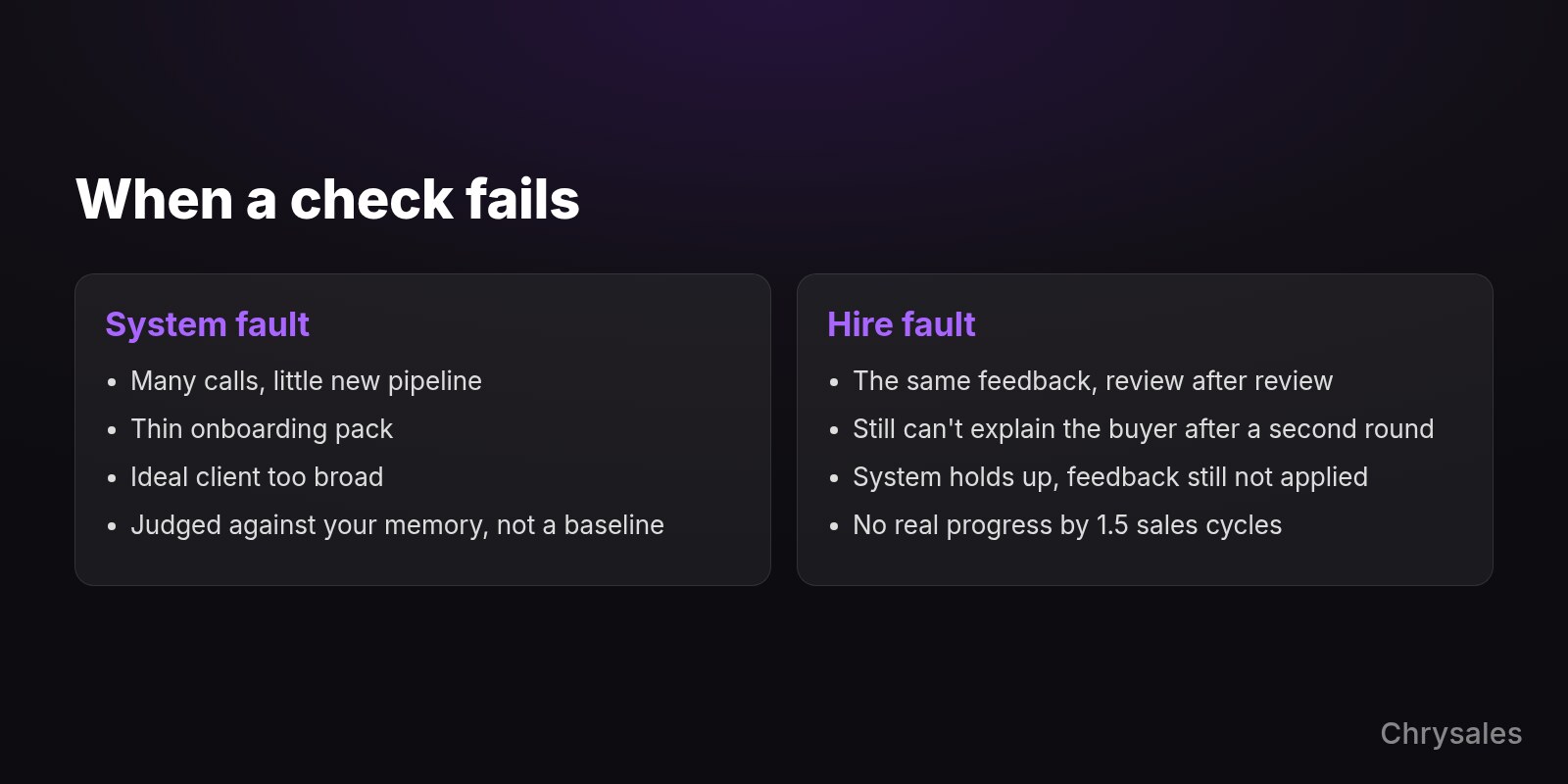
Our view at Chrysales is that a slow ramp usually points to a gap in your client acquisition system around the seller, which is why the system questions go first. Mercury's article built on Penny Mares's advice lists these questions. Is the person the wrong fit, is the sales process unclear, is the ideal client still too broad, is the product not compelling enough yet? And are you comparing the rep with a flawed memory of how your founder-led deals actually went?
| What you see | Likely cause | What to do |
|---|---|---|
| Plenty of calls and messages, little new pipeline | Targeting: wrong leads or an ideal client that's too broad (system) | Narrow the ideal client, check the lead list together, give warmer leads for two weeks |
| Meetings happen, deals don't move | The offer, or closing skill | Listen to stalled calls together; check whether your own deals stalled at the same stage |
| Can't explain the buyer or objections at day 30 | Thin onboarding pack (system), or fit | Fix the pack, repeat the learning block once; if it still doesn't stick, treat it as fit |
| Rep looks slow next to you | Comparison with memory | Compare with your baseline data before deciding |
| Avoids calls, discounts to get a yes | Fear or a skill gap | More reverse shadowing on warm deals, role-play the price conversation |
| The same feedback, review after review | Hire | Write the pattern down, agree a short deadline, then decide |
Jason Lemkin is direct about timing. He writes, "You'll actually know halfway through one sales cycle if you pay attention." He also says that when real progress is missing by about one and a half sales cycles, it's usually time to move on. Measure that against your own cycle length, which may run well past day 90.
When a check fails, work through it in this order:
- Name the check that failed and the evidence: calls, log entries, CRM records.
- Go through the system questions with your baseline open.
- Fix the system part you found, and give the rep a set extension of the block that you agree on together.
- If the system holds up and the rep doesn't apply feedback, decide on the person within your cycle-based limit. Before you end a contract, check the probation and notice rules in your country, with a lawyer if needed.
For the parts of the system that usually fail before anyone is even brought in, see these first sales hire mistakes.
Common mistakes when onboarding a new sales rep
Onboarding mistakes often start with treating the new rep as a finished seller on day one. You'll be tempted to judge revenue too early, skip training for an experienced seller, let shadowing run with no end date or hand over the worst leads.
- Judging revenue in the first weeks. With ramp at 6.2 months on average, early weeks show learning and activity. Judge them on the day-30 check.
- Skipping onboarding because the rep has experience. As Pete Kazanjy argues, experience doesn't teach your buyer or your offer. Shorten the shadow block if you like, but keep the checks.
- Shadowing with no end. A rep who only watches never gets practice. Give shadowing a gate, the day-30 check, and move to reverse shadowing after it.
- Giving the worst leads first. Old, cold leads teach a new rep that nothing works. Start them on warm, likely deals.
- Unloading all feedback at once. A long list after a practice call buries the one change that matters. Give one or two points and check them next time.
- Comparing the rep with your memory. Memories of founder-led deals can be flawed, so judge the rep against a baseline written down before day 1.
- Keeping the onboarding in your head. If the plan, the pack and the checks aren't written, the second rep starts from zero again.
FAQ
How long should sales onboarding take?
The structured part usually fits in the first 90 days. In a survey of 350 US HR leaders published in 2018 by Kronos and the Human Capital Institute, reported by SHRM, 53% of employers with onboarding programs, across all roles, ran them for 30 to 90 days. Full ramp for a closing rep takes longer: 6.2 months on average in the Bridge Group's 2026 survey. Plan 90 days of onboarding and expect ramp to continue after it.
How long until a new rep closes a first deal?
It depends on your sales cycle more than on the rep. Jason Lemkin's rule of thumb is that reps should close deals within one sales cycle and be ramped by two. If your cycle is a month, look for first closes by the end of the first cycle after onboarding starts; if it's six months, look at pipeline and deal progress instead.
Who onboards a new rep when there's no sales manager?
You do, because you know how your deals are won. RAIN Group's research found that sales managers play a major role in whether new sellers become top performers, and in a small team that role is yours. Block fixed time each week for call reviews and keep it even in busy weeks.
Should an experienced rep get the same onboarding?
Yes, with a shorter shadow block if they learn fast. An experienced rep knows how to sell but doesn't know your buyer, your offer or your objections. Keep all three checks the same, so you judge every seller the same way.
Should a new rep get a lower quota during ramp?
With ramp averaging 6.2 months in the Bridge Group survey, a quota that steps up over the first months makes more sense than a full target on day one. Set the steps from your own baseline and write them into the plan. How you pay during those months is a separate decision; this guide to a commission structure that works for sales reps covers it.
Sources
- The Bridge Group - 2026 AE Models, Motions & Metrics
- RAIN Group - How long rep onboarding really takes
- SHRM - Employers Risk Driving New Hires Away with Poor Onboarding
- First Round Review - Pete Kazanjy on the cost of poor onboarding
- Holloway - Founding Sales: Why onboarding matters
- Holloway - Founding Sales: Sales onboarding 101
- SaaStr - When do you know a new rep isn't working out?
- SaaStr - How long should new account execs get to make quota?
- Mercury - How to hand off founder-led sales without guesswork
- Close - Steli Efti on onboarding new hires
- GitLab Handbook - The customer-ready shadow program
- PostHog Handbook - New starter onboarding
- Bessemer Venture Partners - How Recall.ai's Amanda Zhu went from founder-led sales to building out GTM
Does every new rep still have to ask you how a deal gets done? Book a free strategy call with Chrysales to talk through the sales system your next seller will need. Plan your new rep's first 90 days on a free call
A sales rep onboarding plan for a small B2B team splits the first 90 days into three blocks, and each block ends with a check you run. In days 1-30 your new seller learns how you win deals. In days 31-60 they run real conversations while you review them, and in days 61-90 they own a share of the pipeline and report weekly numbers.
Two conditions decide whether the plan works. You write down how your deals are won before day 1, and you judge day 90 on activity and quality rather than quota. The Bridge Group's 2026 survey puts ramp time to full productivity at 6.2 months on average, so a seller still short of full revenue at day 90 is normal.
This is for you if you still close most deals yourself and there's no sales manager between you and the person you just brought in. The blocks, checks and tables below are our recommended format, built from the named sources linked throughout. Any number you aim for inside them comes from your own deals.
What a 30-60-90 day plan for a sales rep is, and what it can't do
A 30-60-90 day plan is a written schedule of what a newcomer learns, does and gets checked on in each of their opening three months. It gives you both the same picture of what good looks like at day 30, 60 and 90. What it can't do is get a typical seller to full quota in 90 days, so the checks measure progress.
A few terms first. Ramp is the time a new seller needs to reach full productivity, and quota is the sales target a fully ramped seller is measured on. Your pipeline is the list of open deals, sorted by stage. Shadowing means the newcomer sits in on your calls and only watches.
Two surveys give two different answers. A 2026 survey of 158 B2B companies by the Bridge Group found that account executives, the reps who close deals, need 6.2 months on average to reach full productivity. That's the highest figure in the study's history.
RAIN Group asked 423 sales leaders and heard about three months until a new seller is ready to talk to buyers, nine months to be competent and 15 months to become a top performer. The Bridge Group sample leans toward companies with engaged revenue leadership, and RAIN Group sells sales training, so treat both as a rough range for your own business.
Jason Lemkin, founder of SaaStr, ties ramp to your sales cycle. In his view, reps should close deals within one sales cycle and be ramped by two. If your deals take three weeks from first call to signature, day 90 can show real closes. If they take four months, day 90 mostly shows activity and the quality of conversations.
So this onboarding plan judges each block on what the seller does and how well, against targets you set from your own numbers. For the money side of those months, read what a rep costs during ramp. If you're still choosing who to bring in, start with how to hire sales people who close deals.
What should you prepare before the rep's first day?
Before day 1, write down how your deals are actually won, so the newcomer learns from your real deals. If you can't say how your last five deals were won, a new seller won't figure it out either. The pack covers your recent won deals, recorded calls, your top objections with your answers, a description of your ideal client, a CRM with clear stages and a first set of leads. Part of it can go to the rep as pre-work.
Pete Kazanjy, co-founder of TalentBin, made the case for this in First Round Review. In his words, "It doesn't matter how much experience or skill a sales rep brings with them, they need to go through training to work at your company." An experienced seller knows how to sell. They don't yet know your buyer, your offer or why your clients said yes.
In his book Founding Sales, Kazanjy suggests about ten hours of pre-work spread over the two weeks before the start date. He also says the first curriculum can be one big Google Doc that you copy for each newcomer. You don't need a learning platform for one or two reps.
Penny Mares, VP of Sales at Unusual Ventures, adds a step you'll be tempted to skip. In an interview with Mercury, she recommends a baseline from your founder-led deals, set before the newcomer joins. It records how long deals took, which activities moved them forward, when opportunities entered the pipeline and where prospects slowed down. Without it, you'll judge the rep against how you remember your own deals.
Copy this list into the document you hand the rep:
BEFORE DAY 1 - ONBOARDING PACK

[ ] Your last 5-10 won deals: who bought, what problem they had,
    why they said yes, how long it took from first call to signature
[ ] Recordings of your own calls, at least one first call
    and one call that ended in a signed deal
[ ] Your top objections, each with the answer you actually give
[ ] A one-page ideal client description: company size, the role
    you sell to, the event that makes them start looking
[ ] CRM access, your pipeline stages, and what moves a deal
    from one stage to the next
[ ] A first lead list, with a few warm deals that are likely to close
[ ] Your baseline: deal length, the activities that moved deals,
    where deals stall
[ ] The 90-day plan with the three checks written out
[ ] Pre-work for the two weeks before the start date
If the playbook part is missing, build it from the same won deals with this guide to a written sales playbook. A rough first version is enough to start. The rep will help you fix it in the first month.
Days 1-30: learn how you win deals
In days 1-30 the rep learns your offer, your buyer and how your deals are won. They shadow your calls, keep a log of each one, study your won deals and objections, and run practice calls with you. By day 30 they should pitch your offer in a recorded practice call that you grade, and explain your buyer in their own words.
Pete Kazanjy recommends a boot camp of one to two weeks for every newcomer. Treat this first-week schedule as the start of that boot camp, then repeat the shadow and practice cycle in week two with harder calls.
| Day | The rep does | You do |
|---|---|---|
| Day 1 | Sets up CRM and tools, reads the onboarding pack | Walk through the 90-day plan and the three checks |
| Day 2 | Studies your won deals and listens to your recorded calls, writes down questions | Answer the questions in one sitting before the day ends |
| Day 3 | Shadows your live calls and fills in the shadow log after each one | Explain after each call why you asked what you asked |
| Day 4 | Writes your top objections and answers in their own words | Role-play the objections with the rep as the seller |
| Day 5 | Runs a first practice call, pitching your offer to you as the buyer | Give one or two points of feedback and agree on week two |
Steli Efti, co-founder and CEO of Close, has new reps shadow you early, right after their first homework and before they practice. Watching you work is only the start, because a rep learns the job by doing it with feedback. GitLab's public handbook adds a useful gate. New account executives keep a log of the calls they shadow, and their manager reviews that log at the week-3 checkpoint.
A shared document is enough for the log, and the rep fills in one entry per call in this format.
SHADOW LOG - call no. ___
Date and type of call (first call / follow-up / closing):
Buyer: role and company size (no names needed)
What the buyer cared about most:
Questions that moved the call forward:
Objection raised, and how it was answered:
Next step agreed, with a date:
What I didn't understand / would ask about:
Practice calls matter as much as shadowing. You play a buyer from one of your won deals, the rep sells, and you give feedback. Efti also warns against unloading a hundred things after a mock call. Pick the one or two changes that would have moved the call most.
The rep also needs to understand why a deal moves at all. In this video from Sabir's channel, he explains the Sales Thermometer framework for moving a prospect from zero trust to a closed deal, and why treating sales like a product demo makes deals die.
The day-30 check
GitLab ends its onboarding with a recorded pitch that the manager grades, and a passing score is required to graduate. You can use the same idea at a smaller scale. The rep passes day 30 when all of these are true:
- The rep pitches your offer in a recorded practice call, and you grade it against what you'd say on a real call.
- The rep explains who buys, why they buy and your top objections with answers, in their own words.
- The shadow log is complete and you've gone through it together.
- Deals and calls in the CRM are logged at the right stage.
Days 31-60: real conversations, with you reviewing them
In days 31-60 the rep moves from watching to leading. First they lead calls while you sit in and step in only if a deal is at risk, which is called reverse shadowing. Then they take first calls alone on easier deals and take over follow-ups. You review one recorded call a week and give one or two points each time.
Start the block with reverse shadowing. The rep runs the call from opening to next step. You stay quiet unless the deal is about to go wrong, and you talk it through right after the call.
Pete Kazanjy's advice for the first live deals is to give new reps "bluebird" opportunities, which are prospects with a high likelihood of closing. Early wins teach a new seller what a good deal feels like. Hard, cold deals can wait until your new seller has had some success.
Use a simple rule for the first call the rep takes alone. All three of these should be true:
- The rep passed the day-30 check.
- The rep led the number of calls in a row you wrote into the plan, with you watching, and you didn't need to step in.
- The deal is warm, so a mistake costs you little.
Some companies move faster. PostHog's public sales handbook routes real leads to new reps from the end of week 1, with a teammate booked on the same calls as backup. By the end of month 1, new reps there should lead calls and demos on their own. The handbook tells them to jump in sooner than feels comfortable, because it's the fastest way to learn.
Follow-up work moves early too. Penny Mares says follow-up steps, emails and similar actions should quickly be taken over by the salesperson. Hand them over in this block, which frees your time for reviews.
Run the weekly call review the same way each time:
- The rep picks one recorded call from the week, ideally one that didn't go well.
- You both listen to it, and the rep says first what they would change.
- You add one or two points, no more.
- The rep tries the change on the next calls, and you check it at the next review.
The day-60 check
Jason Lemkin's questions for a new rep are useful at this check. Are they learning, are they scared, are they discounting heavily, and do they answer common objections right? Day 60 counts as a pass when:
- The rep leads first calls alone, and you no longer step in on routine calls.
- All follow-ups after calls are owned by the rep and sent on time.
- Every deal the rep touches is in the CRM at the right stage.
- Your top objections get handled without falling back on discounts.
- A point from one review shows up as a change by the next review.
Days 61-90: own a share of the pipeline
In days 61-90 the rep owns a defined share of the pipeline, such as one lead source, one client segment or all new inbound leads, and reports on it every week. You step back from routine calls and join only the hard ones. By day 90 you check activity, new pipeline and how fast deals move, against targets you set from your own numbers.
Pick a share the rep can own completely, from first contact to next step. A share with a clear source of leads is easiest to judge, because you can compare it with how the same source performed when you ran it.
The rep's numbers go into your weekly sales meeting, next to everyone else's. Pete Kazanjy's point is that as the seller ramps, you can ease off the close coaching and watch a few numbers instead. Pick them now, such as first calls held and new deals created, because they move earlier than revenue.
Recall.ai's co-founder and COO Amanda Zhu used the same order with a VP of Sales hire, a bigger role than a first rep. Her new sales leader shadowed every sales call, standup, pipeline review and deal debate for the first 60 days, and around the 90-day mark she started shifting ownership off her plate. She explained the reason to Bessemer Venture Partners: "The goal was to make sure deals didn't slow down because every hard call still flowed through me."
The day-90 check
Set each target from your baseline before day 61, write it down, and show it to the rep. For a pass at day 90, look for all of these:
- Activity in their share, such as first calls and follow-ups, reaches the level you set from your won deals.
- New pipeline is being created in their share every week.
- Deals in their share move through your stages at or near your baseline speed.
- The rep has first closes, if your sales cycle is shorter than about 90 days.
- The rep presents their own numbers in the weekly meeting without you filling in.
The full sales rep onboarding plan on one page
Here is the whole plan in one table: what the rep does, what you do and the check at the end of each block. Copy it into a shared document on their first day, so both of you know what passing looks like before work starts. The targets in the last row come from your own baseline.
| Block | The rep does | You do | Check at the end (pass if) |
|---|---|---|---|
| Before day 1 | Pre-work from the onboarding pack | Write down won deals, objections, ideal client, baseline; set up CRM and first leads | Pack is complete and the rep has read it |
| Days 1-30: learn | Shadows your calls, keeps a shadow log, studies won deals and objections, practices with you | Explain your calls, run practice calls, give one or two points per call | Graded practice pitch passed; explains buyer and objections; log reviewed; CRM used right |
| Days 31-60: run calls | Leads calls with you watching, then alone on warm deals; owns follow-ups | Sit in, step in only if a deal is at risk; one recorded call review per week | Leads first calls alone; follow-ups owned; objections handled without discounting; feedback applied |
| Days 61-90: own pipeline | Owns one lead source, segment or inbound; reports numbers weekly | Join hard calls only; review the rep's numbers in the weekly meeting | Activity, new pipeline and deal speed meet the targets you set from your own numbers |
System fault or hire fault: what to do when a check fails
When a check fails, look at the system before the person. Ask whether the seller had a clear process and the right leads, and compare their numbers with your real baseline instead of your memory. If the system holds up and the seller still doesn't apply feedback from one review to the next, you most likely have the wrong person.
Our view at Chrysales is that a slow ramp usually points to a gap in your client acquisition system around the seller, which is why the system questions go first. Mercury's article built on Penny Mares's advice lists these questions. Is the person the wrong fit, is the sales process unclear, is the ideal client still too broad, is the product not compelling enough yet? And are you comparing the rep with a flawed memory of how your founder-led deals actually went?
| What you see | Likely cause | What to do |
|---|---|---|
| Plenty of calls and messages, little new pipeline | Targeting: wrong leads or an ideal client that's too broad (system) | Narrow the ideal client, check the lead list together, give warmer leads for two weeks |
| Meetings happen, deals don't move | The offer, or closing skill | Listen to stalled calls together; check whether your own deals stalled at the same stage |
| Can't explain the buyer or objections at day 30 | Thin onboarding pack (system), or fit | Fix the pack, repeat the learning block once; if it still doesn't stick, treat it as fit |
| Rep looks slow next to you | Comparison with memory | Compare with your baseline data before deciding |
| Avoids calls, discounts to get a yes | Fear or a skill gap | More reverse shadowing on warm deals, role-play the price conversation |
| The same feedback, review after review | Hire | Write the pattern down, agree a short deadline, then decide |
Jason Lemkin is direct about timing. He writes, "You'll actually know halfway through one sales cycle if you pay attention." He also says that when real progress is missing by about one and a half sales cycles, it's usually time to move on. Measure that against your own cycle length, which may run well past day 90.
When a check fails, work through it in this order:
- Name the check that failed and the evidence: calls, log entries, CRM records.
- Go through the system questions with your baseline open.
- Fix the system part you found, and give the rep a set extension of the block that you agree on together.
- If the system holds up and the rep doesn't apply feedback, decide on the person within your cycle-based limit. Before you end a contract, check the probation and notice rules in your country, with a lawyer if needed.
For the parts of the system that usually fail before anyone is even brought in, see these first sales hire mistakes.
Common mistakes when onboarding a new sales rep
Onboarding mistakes often start with treating the new rep as a finished seller on day one. You'll be tempted to judge revenue too early, skip training for an experienced seller, let shadowing run with no end date or hand over the worst leads.
- Judging revenue in the first weeks. With ramp at 6.2 months on average, early weeks show learning and activity. Judge them on the day-30 check.
- Skipping onboarding because the rep has experience. As Pete Kazanjy argues, experience doesn't teach your buyer or your offer. Shorten the shadow block if you like, but keep the checks.
- Shadowing with no end. A rep who only watches never gets practice. Give shadowing a gate, the day-30 check, and move to reverse shadowing after it.
- Giving the worst leads first. Old, cold leads teach a new rep that nothing works. Start them on warm, likely deals.
- Unloading all feedback at once. A long list after a practice call buries the one change that matters. Give one or two points and check them next time.
- Comparing the rep with your memory. Memories of founder-led deals can be flawed, so judge the rep against a baseline written down before day 1.
- Keeping the onboarding in your head. If the plan, the pack and the checks aren't written, the second rep starts from zero again.
FAQ
How long should sales onboarding take?
The structured part usually fits in the first 90 days. In a survey of 350 US HR leaders published in 2018 by Kronos and the Human Capital Institute, reported by SHRM, 53% of employers with onboarding programs, across all roles, ran them for 30 to 90 days. Full ramp for a closing rep takes longer: 6.2 months on average in the Bridge Group's 2026 survey. Plan 90 days of onboarding and expect ramp to continue after it.
How long until a new rep closes a first deal?
It depends on your sales cycle more than on the rep. Jason Lemkin's rule of thumb is that reps should close deals within one sales cycle and be ramped by two. If your cycle is a month, look for first closes by the end of the first cycle after onboarding starts; if it's six months, look at pipeline and deal progress instead.
Who onboards a new rep when there's no sales manager?
You do, because you know how your deals are won. RAIN Group's research found that sales managers play a major role in whether new sellers become top performers, and in a small team that role is yours. Block fixed time each week for call reviews and keep it even in busy weeks.
Should an experienced rep get the same onboarding?
Yes, with a shorter shadow block if they learn fast. An experienced rep knows how to sell but doesn't know your buyer, your offer or your objections. Keep all three checks the same, so you judge every seller the same way.
Should a new rep get a lower quota during ramp?
With ramp averaging 6.2 months in the Bridge Group survey, a quota that steps up over the first months makes more sense than a full target on day one. Set the steps from your own baseline and write them into the plan. How you pay during those months is a separate decision; this guide to a commission structure that works for sales reps covers it.
Sources
- The Bridge Group - 2026 AE Models, Motions & Metrics
- RAIN Group - How long rep onboarding really takes
- SHRM - Employers Risk Driving New Hires Away with Poor Onboarding
- First Round Review - Pete Kazanjy on the cost of poor onboarding
- Holloway - Founding Sales: Why onboarding matters
- Holloway - Founding Sales: Sales onboarding 101
- SaaStr - When do you know a new rep isn't working out?
- SaaStr - How long should new account execs get to make quota?
- Mercury - How to hand off founder-led sales without guesswork
- Close - Steli Efti on onboarding new hires
- GitLab Handbook - The customer-ready shadow program
- PostHog Handbook - New starter onboarding
- Bessemer Venture Partners - How Recall.ai's Amanda Zhu went from founder-led sales to building out GTM
Does every new rep still have to ask you how a deal gets done? Book a free strategy call with Chrysales to talk through the sales system your next seller will need. Plan your new rep's first 90 days on a free call
Scaling Is Not Hard If You Have The Right Systems
If you’re serious about leveling up your scaling game, you need the right system, the right training, and the right team behind you. We're here to give you the exact tools and strategies top entrepreneurs use to dominate.

Discover the latest tips
View All
Chrysales was formed from the words "chrysalis" the stage where a caterpillar transforms into a butterfly and "sales".
It stands for one thing: sales transformation.Because scaling doesn’t happen by doing more of the same. Scaling only happens when you go through real transformation in your systems, your offer, team and the way you sell.


