
Sales job description: how to write one that screens applicants
A good sales job description shows the job as it really is. Say who the person sells to and where the leads come from. Describe a normal week, how you measure success and how the pay is split.
Then add one small task to the application. You should get fewer applicants, and more of them should fit.
Write the ad only once there is a lead source and a sales process for the new person to step into. If those aren't in place yet, start with what to build before your first sales hire.
What a sales job description must include
Your sales ad needs seven parts, in this order. Each answers a question good applicants ask anyway.
- A plain job title that people search for.
- Say who they sell to: the type of company and the role of the buyer.
- Say whether leads come to them or they must find their own.
- Describe a normal week with calls, meetings, follow-ups and admin.
- Name the two or three numbers you will use to measure success.
- Give the pay: base salary, commission and the total at target.
- List every step to apply, including the small task.
For the title, Indeed's employer guide advises keeping it the clear, searchable name of the role. Don't combine jobs in one title, such as "Sales / Customer Service / Admin".
"Account Executive" usually means a seller who runs deals to the close. A sales development rep (SDR) usually finds prospects and books meetings for others.
For the normal week, look at Hyperbound's account executive ad. It has a section called "What your regular Thursday looks like". Use it as a model for structure and leave its pay aside.
Interviews, trial work and the offer are covered in how to hire sales people who close deals.
Be honest about leads and hard parts
Say plainly whether leads come to the rep or the rep must find them. This one line does a lot of the screening.
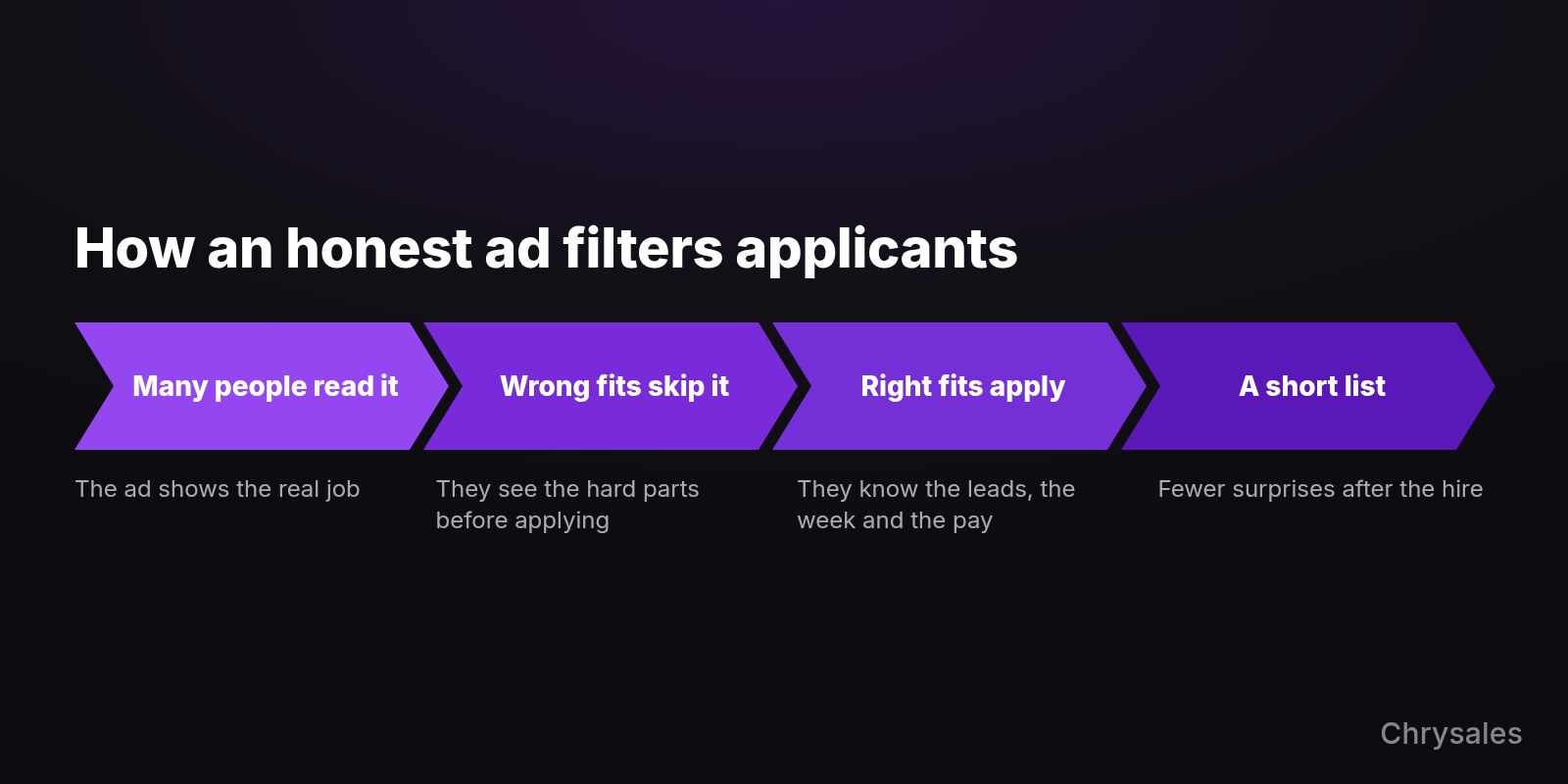
A plain ad lets some of the wrong people drop out early, before you pay them a salary.
Hyperbound says it openly in the same ad: its reps build "a pipeline of opportunities you sourced yourself". In plain words, they must find their own possible deals. Someone used to warm leads (people who contacted the company first) may struggle if they must find every prospect alone.
At Chrysales, we think a rep executes the sales system, and you build it first. In our view, bad leads and mismatched expectations are among the top reasons new sales hires fail.
So name the hard parts too: cold outreach (writing to strangers), buyers who take months to decide, a market where nobody knows your name yet. A 1998 review of 40 studies linked realistic job previews to lower turnover. A realistic job preview is an honest picture of the job before you hire.
In this video, Sabir breaks down why someone's outreach stopped working. He also covers that person's team situation and why the pipeline was inconsistent.
Put the pay in plain numbers
Write the base salary, the expected commission and the total at target. Ranges are fine.
That total is called OTE, or on-target earnings. As Salesforce explains it, OTE is the fixed base salary plus the commission a rep expects to earn, which is not certain. QuotaPath puts it bluntly: "Clearly state the on-target earnings (OTE) in the job description!"
A pay line can be this short. Fill in your own numbers.
Pay: [base range] base salary per year + commission on closed deals.
On-target earnings (OTE): [OTE range] in year one.
Many workers say a pay range makes them more likely to apply. In an Indeed survey from January 2025, between 61% (Germany) and 82% (Ireland) said so.
Rules about pay in job ads differ by place. The EU Pay Transparency Directive gives applicants a right to the starting pay or its range, for example in the ad or before the interview. It works through national law, and EU countries had to apply it by 7 June 2026.
In New York State, employers with four or more employees must list pay ranges and clearly state if a job is commission-based.
This is not legal advice. Check the rules where you hire with a lawyer or your national authority.
How to split base and commission is a topic of its own. See a commission structure for sales reps that works.
Words that attract the wrong people
Hype words and vague praise bring in the wrong people. Some can also break hiring rules where you hire. Swap them for plain facts.
| Avoid | What it signals | Write instead |
|---|---|---|
| "Sales ninja", "rockstar" | Nobody searches for it | "Account Executive" |
| "Uncapped commission" (no upper limit) | Says nothing about base pay | Base, commission and OTE |
| "Competitive salary" | Pay is hidden | A real pay range |
| "Recent graduate", "highly experienced" | Age bias risk (UK guidance) | The skills the job needs |
| "German sales rep" | Race bias risk (UK guidance) | "German-speaking sales rep" |
| "Self-starter" | Nothing concrete | What they do without help |
The ninja point comes from LinkedIn's talent blog. QuotaPath says listing uncapped commission as a perk is like listing "desk and phone". The age and language rows come from UK guidance by Acas.
Add one small task to the application
A short task in the application screens out people who don't want the real work. The answers can also show who can think about a buyer.
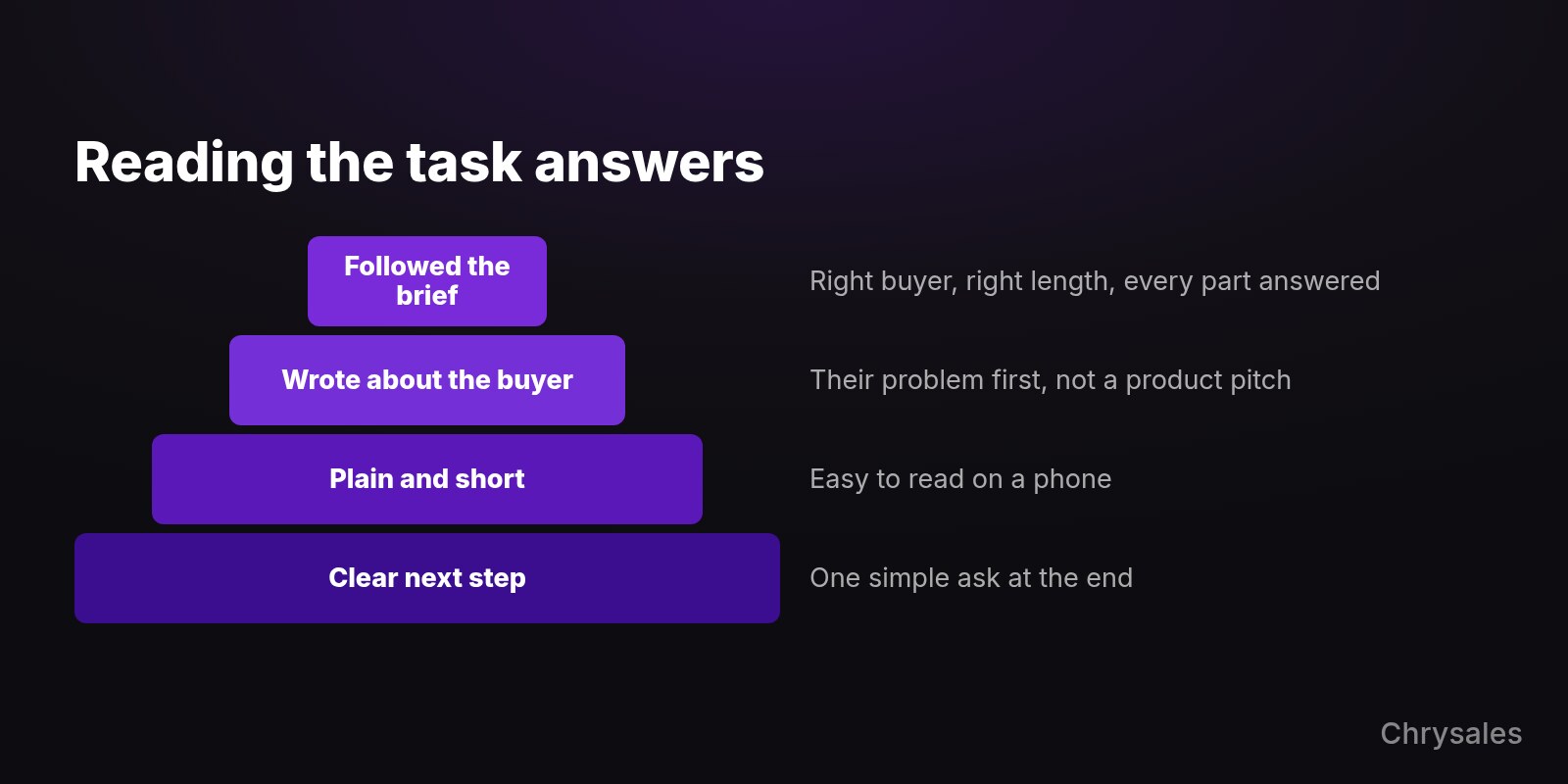
Read each answer from the top layer of the pyramid down. Stop at the first layer it fails.
Pete Kazanjy, co-founder of TalentBin and author of Founding Sales, suggests stating your screening steps in the posting. People who like a challenge get excited, and people who don't want the work tend to stay away. If too many unqualified people still apply, he suggests saying more in the ad about how demanding the screening is.
Hyperbound does this too: its interview steps include a take-home assessment, work done on the applicant's own time. Here is a made-up example for a fictional company; change the buyer to yours.
How to apply (example)
Send your resume and a short answer to this task. It takes about 30 minutes.

Task: Write a first message of 5 sentences or fewer to the head of
operations at a 50-person B2B company. Say why you are writing, ask
one question, and suggest a next step.
Then tell us in 2-3 lines who else at that company you would contact, and why.

Next steps: a 20-minute call, then a role-play of a first sales call.
Conclusion: Write the lead-source line first
Work in this order.
- Write one or two sentences on where leads come from and how many the rep must find alone.
- Write the pay line: base, commission and OTE as ranges.
- Add the small task and the steps that follow it.
- Fill in the other sections, check your words against the table, and post.
Once someone says yes, plan their first weeks with a 90-day sales rep onboarding plan.
Not sure your leads and sales process are ready for a new rep? On a free strategy call, Chrysales can look with you at the system your first salesperson would step into. Check your sales system before you hire on a free call

A good sales job description shows the job as it really is. Say who the person sells to and where the leads come from. Describe a normal week, how you measure success and how the pay is split.
Then add one small task to the application. You should get fewer applicants, and more of them should fit.
Write the ad only once there is a lead source and a sales process for the new person to step into. If those aren't in place yet, start with what to build before your first sales hire.
What a sales job description must include
Your sales ad needs seven parts, in this order. Each answers a question good applicants ask anyway.
- A plain job title that people search for.
- Say who they sell to: the type of company and the role of the buyer.
- Say whether leads come to them or they must find their own.
- Describe a normal week with calls, meetings, follow-ups and admin.
- Name the two or three numbers you will use to measure success.
- Give the pay: base salary, commission and the total at target.
- List every step to apply, including the small task.
For the title, Indeed's employer guide advises keeping it the clear, searchable name of the role. Don't combine jobs in one title, such as "Sales / Customer Service / Admin".
"Account Executive" usually means a seller who runs deals to the close. A sales development rep (SDR) usually finds prospects and books meetings for others.
For the normal week, look at Hyperbound's account executive ad. It has a section called "What your regular Thursday looks like". Use it as a model for structure and leave its pay aside.
Interviews, trial work and the offer are covered in how to hire sales people who close deals.
Be honest about leads and hard parts
Say plainly whether leads come to the rep or the rep must find them. This one line does a lot of the screening.
A plain ad lets some of the wrong people drop out early, before you pay them a salary.
Hyperbound says it openly in the same ad: its reps build "a pipeline of opportunities you sourced yourself". In plain words, they must find their own possible deals. Someone used to warm leads (people who contacted the company first) may struggle if they must find every prospect alone.
At Chrysales, we think a rep executes the sales system, and you build it first. In our view, bad leads and mismatched expectations are among the top reasons new sales hires fail.
So name the hard parts too: cold outreach (writing to strangers), buyers who take months to decide, a market where nobody knows your name yet. A 1998 review of 40 studies linked realistic job previews to lower turnover. A realistic job preview is an honest picture of the job before you hire.
In this video, Sabir breaks down why someone's outreach stopped working. He also covers that person's team situation and why the pipeline was inconsistent.
Put the pay in plain numbers
Write the base salary, the expected commission and the total at target. Ranges are fine.
That total is called OTE, or on-target earnings. As Salesforce explains it, OTE is the fixed base salary plus the commission a rep expects to earn, which is not certain. QuotaPath puts it bluntly: "Clearly state the on-target earnings (OTE) in the job description!"
A pay line can be this short. Fill in your own numbers.
Pay: [base range] base salary per year + commission on closed deals.
On-target earnings (OTE): [OTE range] in year one.
Many workers say a pay range makes them more likely to apply. In an Indeed survey from January 2025, between 61% (Germany) and 82% (Ireland) said so.
Rules about pay in job ads differ by place. The EU Pay Transparency Directive gives applicants a right to the starting pay or its range, for example in the ad or before the interview. It works through national law, and EU countries had to apply it by 7 June 2026.
In New York State, employers with four or more employees must list pay ranges and clearly state if a job is commission-based.
This is not legal advice. Check the rules where you hire with a lawyer or your national authority.
How to split base and commission is a topic of its own. See a commission structure for sales reps that works.
Words that attract the wrong people
Hype words and vague praise bring in the wrong people. Some can also break hiring rules where you hire. Swap them for plain facts.
| Avoid | What it signals | Write instead |
|---|---|---|
| "Sales ninja", "rockstar" | Nobody searches for it | "Account Executive" |
| "Uncapped commission" (no upper limit) | Says nothing about base pay | Base, commission and OTE |
| "Competitive salary" | Pay is hidden | A real pay range |
| "Recent graduate", "highly experienced" | Age bias risk (UK guidance) | The skills the job needs |
| "German sales rep" | Race bias risk (UK guidance) | "German-speaking sales rep" |
| "Self-starter" | Nothing concrete | What they do without help |
The ninja point comes from LinkedIn's talent blog. QuotaPath says listing uncapped commission as a perk is like listing "desk and phone". The age and language rows come from UK guidance by Acas.
Add one small task to the application
A short task in the application screens out people who don't want the real work. The answers can also show who can think about a buyer.
Read each answer from the top layer of the pyramid down. Stop at the first layer it fails.
Pete Kazanjy, co-founder of TalentBin and author of Founding Sales, suggests stating your screening steps in the posting. People who like a challenge get excited, and people who don't want the work tend to stay away. If too many unqualified people still apply, he suggests saying more in the ad about how demanding the screening is.
Hyperbound does this too: its interview steps include a take-home assessment, work done on the applicant's own time. Here is a made-up example for a fictional company; change the buyer to yours.
How to apply (example)
Send your resume and a short answer to this task. It takes about 30 minutes.

Task: Write a first message of 5 sentences or fewer to the head of
operations at a 50-person B2B company. Say why you are writing, ask
one question, and suggest a next step.
Then tell us in 2-3 lines who else at that company you would contact, and why.

Next steps: a 20-minute call, then a role-play of a first sales call.
Conclusion: Write the lead-source line first
Work in this order.
- Write one or two sentences on where leads come from and how many the rep must find alone.
- Write the pay line: base, commission and OTE as ranges.
- Add the small task and the steps that follow it.
- Fill in the other sections, check your words against the table, and post.
Once someone says yes, plan their first weeks with a 90-day sales rep onboarding plan.
Not sure your leads and sales process are ready for a new rep? On a free strategy call, Chrysales can look with you at the system your first salesperson would step into. Check your sales system before you hire on a free call
Scaling Is Not Hard If You Have The Right Systems
If you’re serious about leveling up your scaling game, you need the right system, the right training, and the right team behind you. We're here to give you the exact tools and strategies top entrepreneurs use to dominate.

Discover the latest tips
View All
Chrysales was formed from the words "chrysalis" the stage where a caterpillar transforms into a butterfly and "sales".
It stands for one thing: sales transformation.Because scaling doesn’t happen by doing more of the same. Scaling only happens when you go through real transformation in your systems, your offer, team and the way you sell.


