
Sales coach, consultant or agency: who should fix your sales?
The sales coach vs sales consultant choice comes down to what is broken in your sales. A coach improves how people sell, once there are real conversations with buyers. A consultant finds out why deals are stuck and designs the fix. An agency does the outreach for you, meaning it contacts possible buyers, when your process already works and you lack hours.
Many firms mix these roles, so check what they deliver and what stays with you when they leave. We sell help of this kind ourselves, and we say where it fits below.
Sales coach vs sales consultant vs agency
Each one starts from a different idea of who has the answers.
The International Coaching Federation, the largest professional body for coaches, described the difference in 2022. A consultant will "diagnose problems and prescribe and, sometimes, implement solutions." A coach assumes your team can find its own answers.
Many sales coaches do give advice, so ask which kind you are buying. Michael Zipursky of Consulting Success says a sales coach usually helps one salesperson. A sales consultant usually works with a whole sales team.
An agency does the work itself: its people write to prospects and book meetings for you. More in when outsourcing sales works.
| Option | Fixes | Cannot fix |
|---|---|---|
| Coach | How your people sell | No process, no leads |
| Consultant | Your process and plan | Work nobody on your team does |
| Agency | Hours for outreach and booking | A weak offer or weak closing |
Which problem do you actually have?
Look at where your deals stall this month. The cause often falls into one of three kinds, and you can test it with three questions.
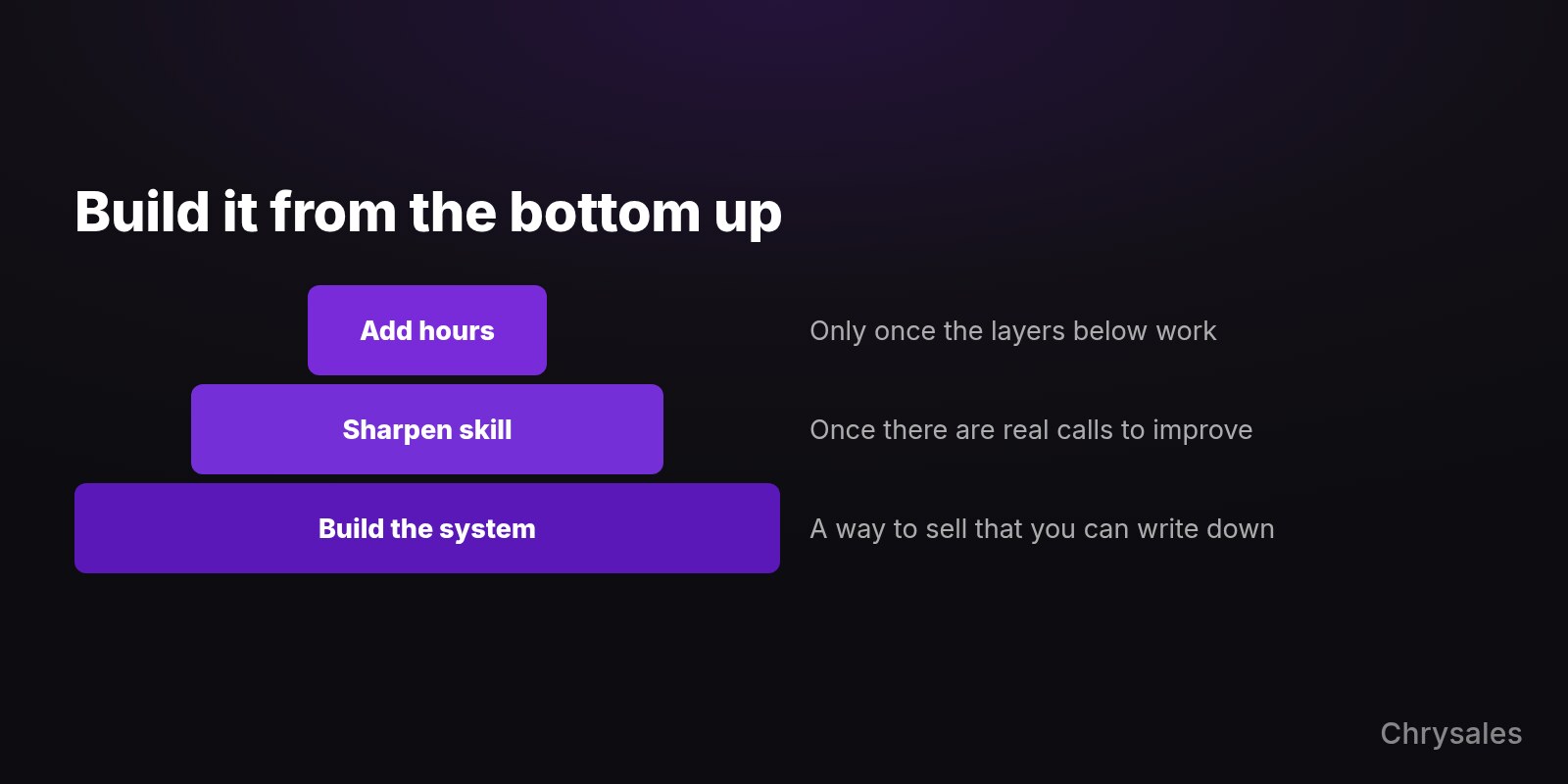
In our view, the system comes first, then skill, then hours. Extra hours on a weak system tend to bring more weak meetings. That is our opinion, not a studied result.
Answer these three questions in order:
- Plenty of calls with buyers, but too many end with no deal? That is a skill gap, so a coach fits.
- No repeatable process, and nobody knows why deals stall? That points to the system, so you want a consultant.
- Your process works and you close well, but there's no time to find buyers? You lack hours, and an agency can supply them.
With almost no conversations at all, start with the steps for an empty sales pipeline before you hire anyone.
JJ La Pata of The Starr Conspiracy says meeting-booking agencies earn their fee only once a few things are in place. You need a message that already gets replies and a clear picture of your ideal customer.
You also need a team that can turn booked meetings into deals.
A fictional example: a 20-person B2B company gets plenty of first calls, but only the founder closes. That points to skill, so coaching the two salespeople comes before buying more meetings.
How each option goes wrong
Each one goes wrong in its own way. Usually it was bought for the wrong problem.
Coaching fails when the sessions stay general, with no single skill to work on each week.
A consultant's plan fails when it stays on paper, because nobody on your team has the time or skill to carry it out.
Agencies run into trouble when meetings arrive and nobody closes them. Alex Galkin, founder of Competera, wrote about this. In 9 months he closed three deals himself, worth almost $1 million a year.
His outsourced team then closed one deal in a year, though he says it helped improve the sales plan.
"It's just hard in practice to outsource something you don't already know well yourself," writes SaaStr founder Jason Lemkin. In his 2023 reader poll of 1,200+ people, only 7% said outsourced SDRs (reps who book meetings) had really worked. Another 26% said it had sort of worked.
It was a self-selected online poll of a mostly software audience, so don't treat it as proof.
What to ask before you sign
Ask a coach, a consultant and an agency the same questions. A vague answer now usually means a vague result later.
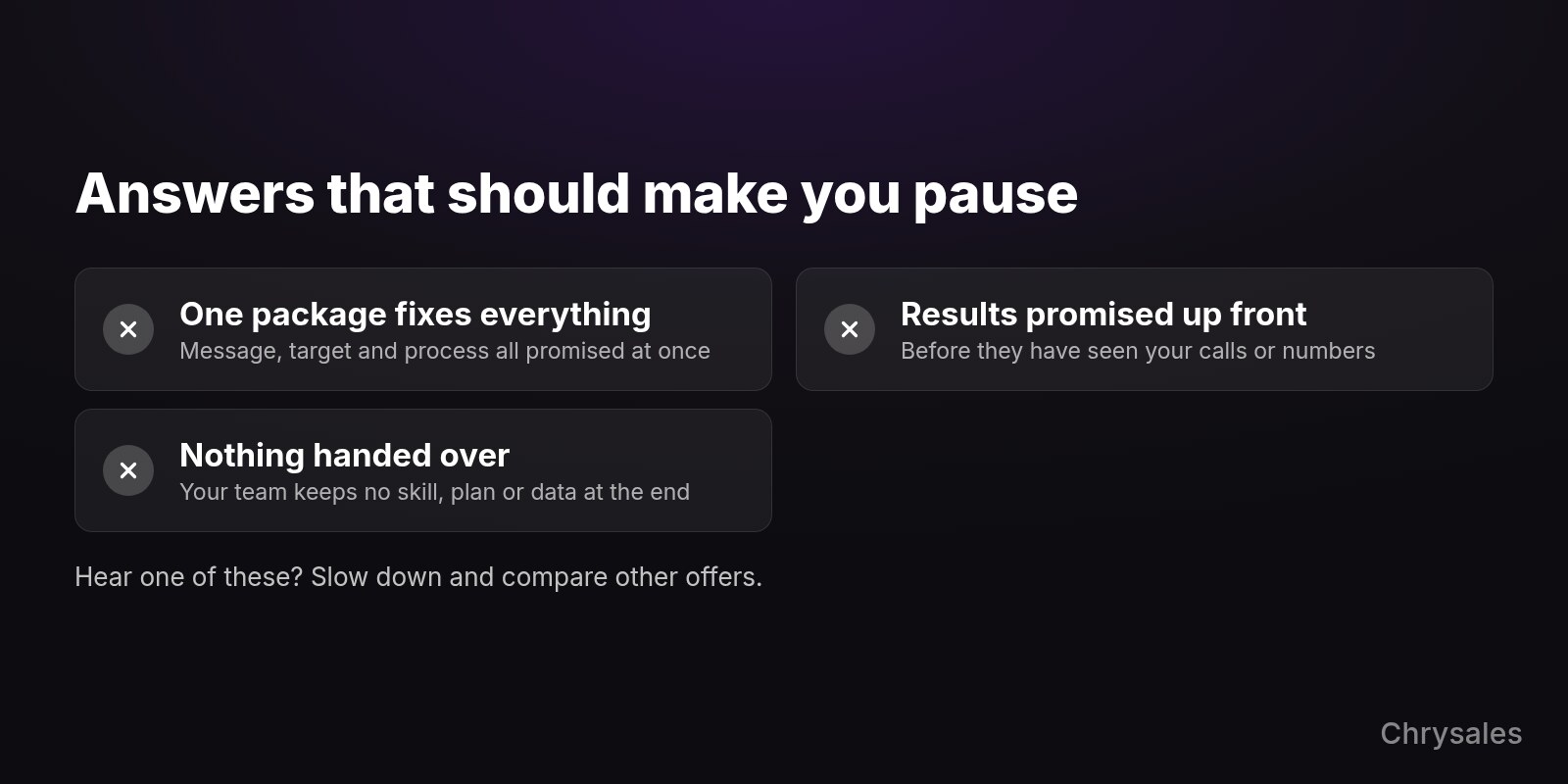
Three things in an offer should make you pause. The first comes from The Starr Conspiracy, which warns against partners promising to fix your messaging, target customer and sales process in one package.
The questions:
- What exactly will you deliver, and who does the work each week?
- What counts as success, written down before we start?
- When do we check results, and how do we stop if they are poor?
- Who owns the lists, messages and sending domains when we part?
- What will my team be able to do without you at the end?
For an agency, question 2 means a written definition of a qualified meeting: a meeting with someone who can buy and has a real need. For question 3, we suggest agreeing on a checkpoint date up front, such as day 60 or 90.
Vendisys, itself an outsourced outreach vendor, says default agency contracts often treat your prospect list, messages and reply data as the agency's.
The agency may also keep the sending domains, the extra web addresses used for cold email. For prices, see what appointment setting costs.
Where Chrysales fits
We sell one kind of this help, so keep that in mind. Chrysales is "a Berlin-based sales agency," says our about page.
The same page describes the goal. We turn "a company that depends on the founder to grow" into "one that has a system doing it". We build that system with you and your team, so we don't fit one clean label.
A pure option can fit better. If one salesperson struggles on calls, a focused coach may be enough. If your process works and you only lack hours, a well-run agency is a simpler buy.
Need someone to lead selling from inside the team? Look at a fractional sales leader. Whatever you pick, ask us the same questions as anyone else.
Conclusion: name your problem before you hire
Before you sign with anyone, do these three things.
- Write down where your last five lost deals stalled.
- Name the gap as skill, system or hours, and pick the help that matches it.
- Put the same questions to every option, get the answers in writing, and keep looking if they stay vague.
Not sure if your gap is skill, system or hours? On a free strategy call, we can look at where your deals stall and talk through which kind of help fits. Work out what help you need on a free call
The sales coach vs sales consultant choice comes down to what is broken in your sales. A coach improves how people sell, once there are real conversations with buyers. A consultant finds out why deals are stuck and designs the fix. An agency does the outreach for you, meaning it contacts possible buyers, when your process already works and you lack hours.
Many firms mix these roles, so check what they deliver and what stays with you when they leave. We sell help of this kind ourselves, and we say where it fits below.
Sales coach vs sales consultant vs agency
Each one starts from a different idea of who has the answers.
The International Coaching Federation, the largest professional body for coaches, described the difference in 2022. A consultant will "diagnose problems and prescribe and, sometimes, implement solutions." A coach assumes your team can find its own answers.
Many sales coaches do give advice, so ask which kind you are buying. Michael Zipursky of Consulting Success says a sales coach usually helps one salesperson. A sales consultant usually works with a whole sales team.
An agency does the work itself: its people write to prospects and book meetings for you. More in when outsourcing sales works.
| Option | Fixes | Cannot fix |
|---|---|---|
| Coach | How your people sell | No process, no leads |
| Consultant | Your process and plan | Work nobody on your team does |
| Agency | Hours for outreach and booking | A weak offer or weak closing |
Which problem do you actually have?
Look at where your deals stall this month. The cause often falls into one of three kinds, and you can test it with three questions.
In our view, the system comes first, then skill, then hours. Extra hours on a weak system tend to bring more weak meetings. That is our opinion, not a studied result.
Answer these three questions in order:
- Plenty of calls with buyers, but too many end with no deal? That is a skill gap, so a coach fits.
- No repeatable process, and nobody knows why deals stall? That points to the system, so you want a consultant.
- Your process works and you close well, but there's no time to find buyers? You lack hours, and an agency can supply them.
With almost no conversations at all, start with the steps for an empty sales pipeline before you hire anyone.
JJ La Pata of The Starr Conspiracy says meeting-booking agencies earn their fee only once a few things are in place. You need a message that already gets replies and a clear picture of your ideal customer.
You also need a team that can turn booked meetings into deals.
A fictional example: a 20-person B2B company gets plenty of first calls, but only the founder closes. That points to skill, so coaching the two salespeople comes before buying more meetings.
How each option goes wrong
Each one goes wrong in its own way. Usually it was bought for the wrong problem.
Coaching fails when the sessions stay general, with no single skill to work on each week.
A consultant's plan fails when it stays on paper, because nobody on your team has the time or skill to carry it out.
Agencies run into trouble when meetings arrive and nobody closes them. Alex Galkin, founder of Competera, wrote about this. In 9 months he closed three deals himself, worth almost $1 million a year.
His outsourced team then closed one deal in a year, though he says it helped improve the sales plan.
"It's just hard in practice to outsource something you don't already know well yourself," writes SaaStr founder Jason Lemkin. In his 2023 reader poll of 1,200+ people, only 7% said outsourced SDRs (reps who book meetings) had really worked. Another 26% said it had sort of worked.
It was a self-selected online poll of a mostly software audience, so don't treat it as proof.
What to ask before you sign
Ask a coach, a consultant and an agency the same questions. A vague answer now usually means a vague result later.
Three things in an offer should make you pause. The first comes from The Starr Conspiracy, which warns against partners promising to fix your messaging, target customer and sales process in one package.
The questions:
- What exactly will you deliver, and who does the work each week?
- What counts as success, written down before we start?
- When do we check results, and how do we stop if they are poor?
- Who owns the lists, messages and sending domains when we part?
- What will my team be able to do without you at the end?
For an agency, question 2 means a written definition of a qualified meeting: a meeting with someone who can buy and has a real need. For question 3, we suggest agreeing on a checkpoint date up front, such as day 60 or 90.
Vendisys, itself an outsourced outreach vendor, says default agency contracts often treat your prospect list, messages and reply data as the agency's.
The agency may also keep the sending domains, the extra web addresses used for cold email. For prices, see what appointment setting costs.
Where Chrysales fits
We sell one kind of this help, so keep that in mind. Chrysales is "a Berlin-based sales agency," says our about page.
The same page describes the goal. We turn "a company that depends on the founder to grow" into "one that has a system doing it". We build that system with you and your team, so we don't fit one clean label.
A pure option can fit better. If one salesperson struggles on calls, a focused coach may be enough. If your process works and you only lack hours, a well-run agency is a simpler buy.
Need someone to lead selling from inside the team? Look at a fractional sales leader. Whatever you pick, ask us the same questions as anyone else.
Conclusion: name your problem before you hire
Before you sign with anyone, do these three things.
- Write down where your last five lost deals stalled.
- Name the gap as skill, system or hours, and pick the help that matches it.
- Put the same questions to every option, get the answers in writing, and keep looking if they stay vague.
Not sure if your gap is skill, system or hours? On a free strategy call, we can look at where your deals stall and talk through which kind of help fits. Work out what help you need on a free call
Scaling Is Not Hard If You Have The Right Systems
If you’re serious about leveling up your scaling game, you need the right system, the right training, and the right team behind you. We're here to give you the exact tools and strategies top entrepreneurs use to dominate.

Discover the latest tips
View All
Chrysales was formed from the words "chrysalis" the stage where a caterpillar transforms into a butterfly and "sales".
It stands for one thing: sales transformation.Because scaling doesn’t happen by doing more of the same. Scaling only happens when you go through real transformation in your systems, your offer, team and the way you sell.


