.avif)
B2B Lead Generation Companies: Hire or Build Your Own?
B2B lead generation companies help businesses find potential customers, start conversations, and book sales calls through outreach, data, and appointment setting. Most B2B companies searching for lead generation help end up hiring an agency that sends them a few appointments, charges a fat retainer, and disappears when the contract ends. You're left with zero leads and no clue how they even got the ones that did show up. Here's a better way to think about it: what if instead of renting someone else's lead machine, you built your own?
What B2B Lead Generation Companies Actually Do
A B2B lead generation company finds potential customers for your business and gets them interested enough to book a call. Think of it like a matchmaking service for sales. They build lists, write emails, make calls, send LinkedIn messages, and try to get meetings on your calendar. If you want to learn 4 Ways To Find Clients Who Need Your Services Right Now, watch our breakdown of what actually works when you take prospecting in-house.
Most B2B lead generation companies fall into three buckets:
Done-For-You Outbound Agencies
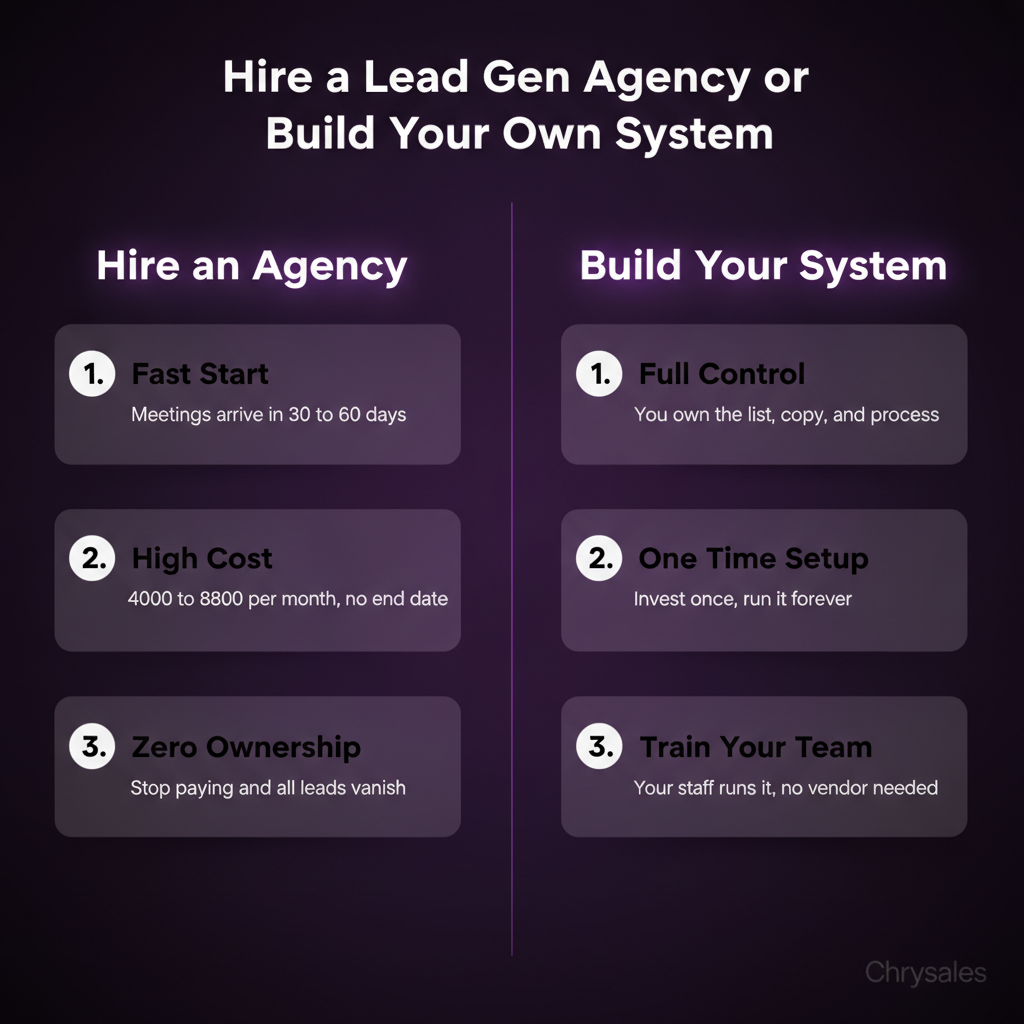
These teams handle everything. They build the list, write the cold emails, send the LinkedIn messages, and book appointments directly into your calendar. You pay a monthly retainer (usually $3,000 to $15,000) and they promise a certain number of meetings. The upside? You don't touch the work. The downside? When the contract ends, so does your pipeline. You learned nothing. You can't repeat it. You're back to square one.
Lead List and Data Providers
Companies like ZoomInfo or Apollo sell you access to contact databases. They give you names, emails, phone numbers, and company info. You still have to do the outreach yourself. This works if you already have a sales team that knows how to write emails and follow up. If you don't, you just bought an expensive phone book with no clue how to use it. Comparing ZoomInfo and Apollo features and pricing helps you understand which data platform fits your budget and use case.
Appointment Setting Services
These companies focus purely on booking meetings. You give them your offer, your target customer profile, and they handle the first conversation. If someone says yes, they pass the lead to you. It's a middle ground. You still close the deals, but they do the heavy lifting on outreach. Pricing usually ties to results (pay per appointment) or a hybrid retainer plus performance model.
Watch out: Most appointment setters optimize for quantity, not quality. You might get 20 meetings a month, but if 15 are terrible fits, you wasted your time on bad calls.
Top B2B Lead Generation Companies You'll See Everywhere
If you Google "B2B lead generation companies," the same names pop up over and over. Here's what each one actually does and who they work best for. Understanding outbound sales strategy, platforms, and agencies will help you evaluate which model fits your business best.
Belkins
Belkins runs multi-channel outbound campaigns (email, LinkedIn, calls) and assigns you a dedicated team. They work mostly with SaaS companies, tech firms, and professional services. Pricing starts around $5,000 per month. They're solid if you have a big budget and want a full team managing outreach. The problem? You're totally dependent on them. If you pause the contract, your pipeline dries up instantly.
SalesAR
SalesAR focuses on cold email and LinkedIn outreach for B2B companies. They build lists, write sequences, and book appointments. Pricing is similar to Belkins, starting at $4,000 to $6,000 monthly. They're transparent about metrics and share campaign data openly, which is rare in this space. Still, it's the same outsourcing model. When they leave, so does your lead flow.
Callbox
Callbox has been around forever. They do cold calling, email, and LinkedIn outreach. They work with bigger companies (enterprise and mid-market) and have teams across different time zones. Good for high-volume outbound to large accounts. Not great for small teams or companies with tight budgets. Retainers often start at $7,000+ per month.
SalesBread
SalesBread specializes in hyper-personalized cold email and LinkedIn messages. They write custom copy for each prospect and focus on quality over volume. Best for service businesses, consultancies, and agencies. Pricing starts around $3,500 per month. The emails are good, but again, when the contract ends, you're stuck. You don't learn the system. You just rent theirs.
Pro Tip: If you're comparing B2B lead generation companies, ask them one question: "If we cancel in six months, what can we still use?" If the answer is nothing, you're renting, not building.
The Real Problem with Outsourcing Lead Generation
Hiring a B2B lead generation company feels like the fast solution. Pay someone, get leads, book calls, close deals. But most teams hit the same wall six to twelve months in.
You Never Learn the System
When an agency handles everything, you have no idea what works. What list did they use? What subject lines got replies? Which follow-up sequence booked the most calls? You're in the dark. A 30-person consulting firm we worked with spent $60,000 over a year with an appointment setting service. They got 40 meetings total. When the contract ended, they tried to do it themselves and had zero clue where to start. No templates. No process. No list-building method. Just an empty calendar.
The Quality Problem
Most outsourced lead generation services get paid whether the leads are good or not. They optimize for volume because that's what looks good in a monthly report. You end up with a calendar full of tire-kickers, junior people with no budget, or companies that aren't even a fit. One marketing agency hired a lead gen company that booked 15 calls in the first month. Sounds great, right? Twelve of those calls were with companies too small to afford their services. Three ghosted after the first conversation. Zero became clients.
It's Expensive and Never Ends
A decent B2B lead generation company charges $4,000 to $8,000 per month minimum. That's $48,000 to $96,000 per year. And the second you stop paying, the leads stop coming. Compare that to building your own system. You invest once in training, tools, and setup. Then you run it forever. You control the message. You control the list. You control the follow-up. And when you hire someone, you train them on your system, not someone else's. This is why how to build a sales system that actually scales matters more than renting short-term capacity.
When Outsourcing Actually Makes Sense
Look, outsourcing B2B lead generation isn't always a bad move. There are situations where it works.
You Have Zero Bandwidth
If your team is slammed and you need leads right now, hiring help can buy you time. Just know it's a short-term fix. Use that time to build your own process in parallel so you're not stuck paying forever.
You're Testing a New Market
If you want to test a new industry or region and don't want to commit internal resources yet, an agency can run a pilot campaign. If it works, great. Take what you learned and bring it in-house.
You Already Have a System and Need Extra Volume
If you've already built your own outbound process, trained your team, and just need more hands to scale, outsourcing can work. You're not dependent on them for the strategy. You're just scaling execution.
Common mistake: Hiring a lead gen company before you know what a good lead looks like. If you don't know your ideal customer profile, offer, or messaging yet, the agency will guess. And they'll guess wrong. Learn how to create an ideal customer profile for B2B lead generation before you commit to any vendor.
How to Build Your Own B2B Lead Generation System
This is where most companies should focus. Instead of renting someone else's lead machine, build your own. It's faster than you think, cheaper in the long run, and you own it forever.
Start with a Tight List
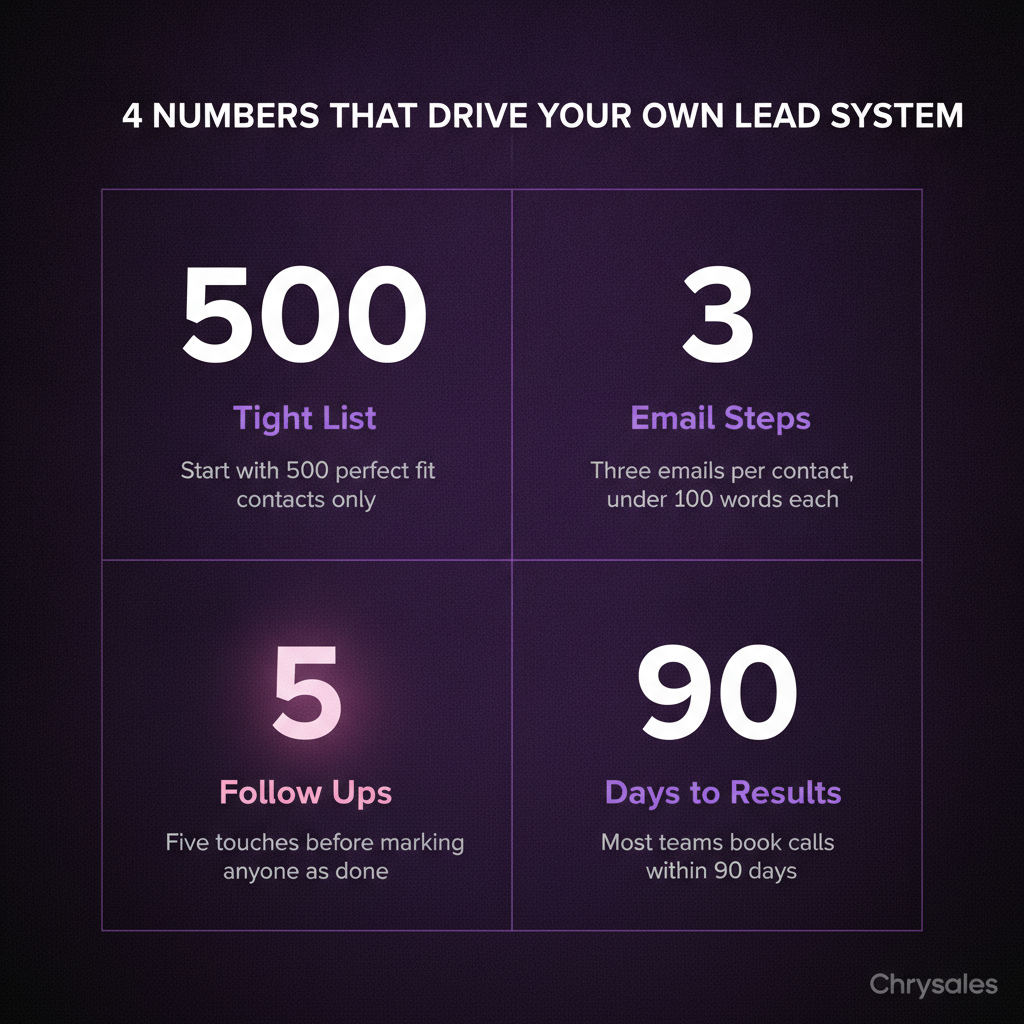
Your list does 80% of the work. If you're reaching out to the wrong people, the best email in the world won't save you. Start by defining your ideal customer: company size, industry, role, location, and any other factors that matter. Use tools like Apollo, LinkedIn Sales Navigator, or ZoomInfo to build a list of 500 to 1,000 contacts that fit your profile. Don't go for volume yet. Go for fit. A tech company we worked with had a list of 5,000 contacts. Sounds impressive. But 3,000 of them were in industries they'd never sold to before. When they cleaned the list down to 800 perfect-fit contacts, their reply rate jumped from 1.2% to 6%.
Write a Simple Cold Email Sequence
You don't need a 12-email sequence with fancy automation. Start with three emails:
- Email 1: Short intro. What you do, who you help, one specific result.
- Email 2 (3 days later): Quick follow-up. Ask a question or share a case study.
- Email 3 (5 days later): Last check-in. Simple yes or no.
Keep each email under 100 words. No walls of text. No jargon. Just clear, direct, and useful. Most teams overcomplicate this. They think they need AI-written hyper-personalized essays. They don't. A simple, relevant email to the right person beats a perfect email to the wrong person every time. For a detailed walkthrough, check out how to write cold emails that actually get replies.
Set Up a Basic Outreach System
Pick one tool and stick with it. Instantly, Lemlist, Smartlead, or even plain Gmail with a mail merge extension works fine to start. Set up your sending domains, warm them up for two weeks, and start sending 50 emails per day. Track your open rate, reply rate, and meeting-booked rate. Tweak the copy based on what you see. If your reply rate is under 2%, your list or message is off. If it's above 5%, you're in good shape. If it's above 10%, you nailed it.
Pro Tip: Most people obsess over email copy and ignore the list. Flip that. Spend 70% of your time on list quality and 30% on the message. The right person will reply to an average email. The wrong person won't reply to Shakespeare.
Add LinkedIn Outreach
Once your email system is working, layer in LinkedIn. Find the same people from your email list on LinkedIn and send connection requests with a short note. When they accept, send one message. Keep it casual. Reference something real (a post they made, a company update, a mutual connection). Then ask if they're open to a quick conversation. Don't spam. Don't pitch in the first message. Just start a real conversation.
Build a Follow-Up System
Most deals happen after the fifth follow-up. Most people give up after the second. Set a rule: follow up at least five times over 30 days before you mark someone as unresponsive. Use a simple CRM (HubSpot, Pipedrive, Salesforce, even a Google Sheet works) to track where each person is in the process. If they replied but didn't book a call, follow up three days later. If they booked and ghosted, follow up the next week. Research shows that sales follow-up statistics prove persistence wins, with most sales happening after multiple touchpoints.
What Chrysales Does Differently (And When It Makes Sense)
Most B2B lead generation companies sell you leads or appointments. Chrysales builds you the system to generate your own leads forever. We've trained over 1,000 business owners and 500+ sales teams, with a 99.4% client satisfaction rate and over €10M in client revenue generated. The difference? We don't do the outreach for you. We teach you how to do it, build the system with you, and train your team to run it.
The 4-Step Process
- Learn: We break down your offer, positioning, and ideal customer. If your offer isn't clear, outreach won't work no matter who does it.
- Build Systems: We build your outbound process from scratch. List-building method, email sequences, LinkedIn playbook, CRM setup, follow-up cadence. Everything.
- Automate: We plug in AI where it makes sense (lead scoring, email personalization, pipeline tracking) so you're not doing everything manually.
- Hire Chief of Staff: Once the system works, we help you hire and train someone to run it full-time.
This isn't a course you watch and forget. It's 1-on-1 coaching. We work with you until the system is live and running. To see the full approach, watch How To Build a Sales System So Powerful Clients Come To You for a detailed walkthrough.
Who This Works For
If you want someone to send you leads every month and you never want to think about it, hire a traditional lead gen agency. If you want to own the process, control the message, and never depend on a vendor again, build your own system. We work mostly with B2B companies between 5 and 50 people: consulting firms, marketing agencies, tech companies, professional services. Teams that need predictable pipeline but don't want to pay $6,000 per month forever for someone else to own it.
A 15-person consulting firm worked with us for three months. We built their outbound system, trained their ops person to run it, and within 90 days they were booking 8 to 12 qualified calls per month. Cost? A fraction of what they would've spent on a year-long agency retainer. And now they own the whole thing.
Watch out: If you don't have time to learn the system or don't want to be involved, outsourcing might still be your best bet. Building your own system requires a few hours a week for setup and training. It's an investment, not a magic button.
How to Pick the Right B2B Lead Generation Company (If You're Outsourcing)
If you've decided outsourcing is the right move for now, here's how to pick a company that won't waste your money.
Ask for Real Numbers
Don't accept vague promises like "we'll get you more leads." Ask: What's your average reply rate? What's your average meeting-booked rate? What percentage of those meetings turn into real opportunities? If they won't share numbers, walk away. Any legit B2B lead generation company tracks this stuff.
Check Client Fit
Ask to see case studies or client examples in your industry or with companies your size. A company that crushes it for enterprise SaaS might flop for a 10-person consultancy. Make sure they've done this before with someone like you.
Understand What Happens When You Leave
Ask: "If we work together for six months and then cancel, what do we keep?" If the answer is "nothing," you're renting. If they say "you keep the list, the templates, the process docs," that's better.
Pricing Transparency
Good companies tell you what it costs upfront. Bad companies hide pricing behind "book a call to learn more." If they're dodging the pricing question, they're either overpriced or inconsistent. Most B2B lead generation companies charge $3,000 to $10,000 per month depending on services, volume, and team size. Some charge per appointment ($150 to $500 per meeting booked). Know what model you're paying for before you sign.
Combining Lead Generation with a Real Sales System
Lead generation is just step one. If you book 20 calls a month but can't close any of them, the problem isn't lead generation. It's your sales process. Most companies focus all their energy on getting more meetings and zero energy on what happens during the call. That's backwards. A great sales call with 10 leads beats a terrible sales call with 50 leads every time.
Train Your Team to Close
If you're booking meetings but not closing deals, the issue is usually one of three things:
- Your offer isn't clear. If the prospect doesn't understand what you're selling or why it's better, they won't buy.
- You're not qualifying. You're taking calls with anyone who says yes, even if they're a terrible fit.
- Your pitch is weak. You're not asking the right discovery questions, handling objections, or creating urgency.
This is where sales training comes in. At Chrysales, we build custom sales call structures, discovery question scripts, objection-handling frameworks, and pitch templates. It's not generic sales advice. It's built for your offer, your price point, and your customer. One marketing agency was booking 15 calls a month but closing zero. We rebuilt their discovery process, tightened their pitch, and added a follow-up sequence. Same leads. Same offer. Close rate went from 0% to 22% in six weeks.
Use AI to Score and Prioritize Leads
Not every lead is equal. Some are ready to buy. Some are curious. Some are bored and killing time. Set up a simple lead scoring system (manual or AI-based). Assign points based on company size, reply speed, role, and engagement. Anything scoring above 70 goes straight to your calendar. Anything below 50 gets nurtured with email follow-ups. We use Gemini-based AI workflows to auto-score leads, flag high-intent signals, and prioritize who to call first. It takes 10 minutes to set up and saves hours every week.
Frequently Asked Questions
Q: How much do B2B lead generation companies cost?
Most B2B lead generation companies charge between $3,000 and $10,000 per month for done-for-you services. Appointment setting agencies often charge $150 to $500 per booked meeting. Data providers like ZoomInfo or Apollo charge $1,200 to $15,000 per year depending on seat count and access level. Pay-per-lead models exist but are less common in B2B. Always ask for pricing upfront and compare what's included (list building, email writing, CRM setup, reporting).
Q: What's the difference between hiring a lead gen company and building your own system?
Hiring a B2B lead generation company is like renting. You pay monthly and get leads as long as you keep paying. When you stop, the leads stop. Building your own system is like buying. You invest time and money upfront to create a process you own forever. The cost to build a system is usually $5,000 to $15,000 (tools, training, setup), but after that, you control everything. Outsourcing costs $4,000+ per month with no end date.
Q: How long does it take to see results from a lead generation company?
Most B2B lead generation companies take 30 to 60 days to ramp up. The first month is usually setup (list building, email domain warmup, messaging). Real meetings start showing up in month two. If you're not seeing booked calls by day 90, something is wrong. Ask for a campaign review or pivot the strategy. Some agencies guarantee a certain number of meetings within 90 days or offer partial refunds.
Q: Can small companies afford to hire a lead generation agency?
It depends on your budget and goals. If you're a small team (under 10 people) with limited cash flow, spending $5,000 per month on lead gen might not make sense. Building your own system is cheaper and gives you more control. If you have the budget and need leads fast, some agencies offer lower-cost packages starting around $2,500 to $3,500 per month for smaller volumes. Just make sure the cost per lead makes sense for your deal size.
Q: What should I look for in a B2B lead generation company?
Look for transparency (real numbers, case studies, clear pricing), client fit (they've worked with companies like yours), and retention (what happens when you leave). Ask about their process: How do they build lists? How do they write emails? What tools do they use? How do they track results? Avoid companies that promise vague results like "more leads" without defining what that means. Good companies will tell you expected reply rates, meeting-booked rates, and average time to first appointment. You can also review lead generation metrics for B2B results to understand what numbers matter most when evaluating vendor performance.
B2B lead generation companies help businesses find potential customers, start conversations, and book sales calls through outreach, data, and appointment setting. Most B2B companies searching for lead generation help end up hiring an agency that sends them a few appointments, charges a fat retainer, and disappears when the contract ends. You're left with zero leads and no clue how they even got the ones that did show up. Here's a better way to think about it: what if instead of renting someone else's lead machine, you built your own?
What B2B Lead Generation Companies Actually Do
A B2B lead generation company finds potential customers for your business and gets them interested enough to book a call. Think of it like a matchmaking service for sales. They build lists, write emails, make calls, send LinkedIn messages, and try to get meetings on your calendar. If you want to learn 4 Ways To Find Clients Who Need Your Services Right Now, watch our breakdown of what actually works when you take prospecting in-house.
Most B2B lead generation companies fall into three buckets:
Done-For-You Outbound Agencies
These teams handle everything. They build the list, write the cold emails, send the LinkedIn messages, and book appointments directly into your calendar. You pay a monthly retainer (usually $3,000 to $15,000) and they promise a certain number of meetings. The upside? You don't touch the work. The downside? When the contract ends, so does your pipeline. You learned nothing. You can't repeat it. You're back to square one.
Lead List and Data Providers
Companies like ZoomInfo or Apollo sell you access to contact databases. They give you names, emails, phone numbers, and company info. You still have to do the outreach yourself. This works if you already have a sales team that knows how to write emails and follow up. If you don't, you just bought an expensive phone book with no clue how to use it. Comparing ZoomInfo and Apollo features and pricing helps you understand which data platform fits your budget and use case.
Appointment Setting Services
These companies focus purely on booking meetings. You give them your offer, your target customer profile, and they handle the first conversation. If someone says yes, they pass the lead to you. It's a middle ground. You still close the deals, but they do the heavy lifting on outreach. Pricing usually ties to results (pay per appointment) or a hybrid retainer plus performance model.
Watch out: Most appointment setters optimize for quantity, not quality. You might get 20 meetings a month, but if 15 are terrible fits, you wasted your time on bad calls.
Top B2B Lead Generation Companies You'll See Everywhere
If you Google "B2B lead generation companies," the same names pop up over and over. Here's what each one actually does and who they work best for. Understanding outbound sales strategy, platforms, and agencies will help you evaluate which model fits your business best.
Belkins
Belkins runs multi-channel outbound campaigns (email, LinkedIn, calls) and assigns you a dedicated team. They work mostly with SaaS companies, tech firms, and professional services. Pricing starts around $5,000 per month. They're solid if you have a big budget and want a full team managing outreach. The problem? You're totally dependent on them. If you pause the contract, your pipeline dries up instantly.
SalesAR
SalesAR focuses on cold email and LinkedIn outreach for B2B companies. They build lists, write sequences, and book appointments. Pricing is similar to Belkins, starting at $4,000 to $6,000 monthly. They're transparent about metrics and share campaign data openly, which is rare in this space. Still, it's the same outsourcing model. When they leave, so does your lead flow.
Callbox
Callbox has been around forever. They do cold calling, email, and LinkedIn outreach. They work with bigger companies (enterprise and mid-market) and have teams across different time zones. Good for high-volume outbound to large accounts. Not great for small teams or companies with tight budgets. Retainers often start at $7,000+ per month.
SalesBread
SalesBread specializes in hyper-personalized cold email and LinkedIn messages. They write custom copy for each prospect and focus on quality over volume. Best for service businesses, consultancies, and agencies. Pricing starts around $3,500 per month. The emails are good, but again, when the contract ends, you're stuck. You don't learn the system. You just rent theirs.
Pro Tip: If you're comparing B2B lead generation companies, ask them one question: "If we cancel in six months, what can we still use?" If the answer is nothing, you're renting, not building.
The Real Problem with Outsourcing Lead Generation
Hiring a B2B lead generation company feels like the fast solution. Pay someone, get leads, book calls, close deals. But most teams hit the same wall six to twelve months in.
You Never Learn the System
When an agency handles everything, you have no idea what works. What list did they use? What subject lines got replies? Which follow-up sequence booked the most calls? You're in the dark. A 30-person consulting firm we worked with spent $60,000 over a year with an appointment setting service. They got 40 meetings total. When the contract ended, they tried to do it themselves and had zero clue where to start. No templates. No process. No list-building method. Just an empty calendar.
The Quality Problem
Most outsourced lead generation services get paid whether the leads are good or not. They optimize for volume because that's what looks good in a monthly report. You end up with a calendar full of tire-kickers, junior people with no budget, or companies that aren't even a fit. One marketing agency hired a lead gen company that booked 15 calls in the first month. Sounds great, right? Twelve of those calls were with companies too small to afford their services. Three ghosted after the first conversation. Zero became clients.
It's Expensive and Never Ends
A decent B2B lead generation company charges $4,000 to $8,000 per month minimum. That's $48,000 to $96,000 per year. And the second you stop paying, the leads stop coming. Compare that to building your own system. You invest once in training, tools, and setup. Then you run it forever. You control the message. You control the list. You control the follow-up. And when you hire someone, you train them on your system, not someone else's. This is why how to build a sales system that actually scales matters more than renting short-term capacity.
When Outsourcing Actually Makes Sense
Look, outsourcing B2B lead generation isn't always a bad move. There are situations where it works.
You Have Zero Bandwidth
If your team is slammed and you need leads right now, hiring help can buy you time. Just know it's a short-term fix. Use that time to build your own process in parallel so you're not stuck paying forever.
You're Testing a New Market
If you want to test a new industry or region and don't want to commit internal resources yet, an agency can run a pilot campaign. If it works, great. Take what you learned and bring it in-house.
You Already Have a System and Need Extra Volume
If you've already built your own outbound process, trained your team, and just need more hands to scale, outsourcing can work. You're not dependent on them for the strategy. You're just scaling execution.
Common mistake: Hiring a lead gen company before you know what a good lead looks like. If you don't know your ideal customer profile, offer, or messaging yet, the agency will guess. And they'll guess wrong. Learn how to create an ideal customer profile for B2B lead generation before you commit to any vendor.
How to Build Your Own B2B Lead Generation System
This is where most companies should focus. Instead of renting someone else's lead machine, build your own. It's faster than you think, cheaper in the long run, and you own it forever.
Start with a Tight List
Your list does 80% of the work. If you're reaching out to the wrong people, the best email in the world won't save you. Start by defining your ideal customer: company size, industry, role, location, and any other factors that matter. Use tools like Apollo, LinkedIn Sales Navigator, or ZoomInfo to build a list of 500 to 1,000 contacts that fit your profile. Don't go for volume yet. Go for fit. A tech company we worked with had a list of 5,000 contacts. Sounds impressive. But 3,000 of them were in industries they'd never sold to before. When they cleaned the list down to 800 perfect-fit contacts, their reply rate jumped from 1.2% to 6%.
Write a Simple Cold Email Sequence
You don't need a 12-email sequence with fancy automation. Start with three emails:
- Email 1: Short intro. What you do, who you help, one specific result.
- Email 2 (3 days later): Quick follow-up. Ask a question or share a case study.
- Email 3 (5 days later): Last check-in. Simple yes or no.
Keep each email under 100 words. No walls of text. No jargon. Just clear, direct, and useful. Most teams overcomplicate this. They think they need AI-written hyper-personalized essays. They don't. A simple, relevant email to the right person beats a perfect email to the wrong person every time. For a detailed walkthrough, check out how to write cold emails that actually get replies.
Set Up a Basic Outreach System
Pick one tool and stick with it. Instantly, Lemlist, Smartlead, or even plain Gmail with a mail merge extension works fine to start. Set up your sending domains, warm them up for two weeks, and start sending 50 emails per day. Track your open rate, reply rate, and meeting-booked rate. Tweak the copy based on what you see. If your reply rate is under 2%, your list or message is off. If it's above 5%, you're in good shape. If it's above 10%, you nailed it.
Pro Tip: Most people obsess over email copy and ignore the list. Flip that. Spend 70% of your time on list quality and 30% on the message. The right person will reply to an average email. The wrong person won't reply to Shakespeare.
Add LinkedIn Outreach
Once your email system is working, layer in LinkedIn. Find the same people from your email list on LinkedIn and send connection requests with a short note. When they accept, send one message. Keep it casual. Reference something real (a post they made, a company update, a mutual connection). Then ask if they're open to a quick conversation. Don't spam. Don't pitch in the first message. Just start a real conversation.
Build a Follow-Up System
Most deals happen after the fifth follow-up. Most people give up after the second. Set a rule: follow up at least five times over 30 days before you mark someone as unresponsive. Use a simple CRM (HubSpot, Pipedrive, Salesforce, even a Google Sheet works) to track where each person is in the process. If they replied but didn't book a call, follow up three days later. If they booked and ghosted, follow up the next week. Research shows that sales follow-up statistics prove persistence wins, with most sales happening after multiple touchpoints.
What Chrysales Does Differently (And When It Makes Sense)
Most B2B lead generation companies sell you leads or appointments. Chrysales builds you the system to generate your own leads forever. We've trained over 1,000 business owners and 500+ sales teams, with a 99.4% client satisfaction rate and over €10M in client revenue generated. The difference? We don't do the outreach for you. We teach you how to do it, build the system with you, and train your team to run it.
The 4-Step Process
- Learn: We break down your offer, positioning, and ideal customer. If your offer isn't clear, outreach won't work no matter who does it.
- Build Systems: We build your outbound process from scratch. List-building method, email sequences, LinkedIn playbook, CRM setup, follow-up cadence. Everything.
- Automate: We plug in AI where it makes sense (lead scoring, email personalization, pipeline tracking) so you're not doing everything manually.
- Hire Chief of Staff: Once the system works, we help you hire and train someone to run it full-time.
This isn't a course you watch and forget. It's 1-on-1 coaching. We work with you until the system is live and running. To see the full approach, watch How To Build a Sales System So Powerful Clients Come To You for a detailed walkthrough.
Who This Works For
If you want someone to send you leads every month and you never want to think about it, hire a traditional lead gen agency. If you want to own the process, control the message, and never depend on a vendor again, build your own system. We work mostly with B2B companies between 5 and 50 people: consulting firms, marketing agencies, tech companies, professional services. Teams that need predictable pipeline but don't want to pay $6,000 per month forever for someone else to own it.
A 15-person consulting firm worked with us for three months. We built their outbound system, trained their ops person to run it, and within 90 days they were booking 8 to 12 qualified calls per month. Cost? A fraction of what they would've spent on a year-long agency retainer. And now they own the whole thing.
Watch out: If you don't have time to learn the system or don't want to be involved, outsourcing might still be your best bet. Building your own system requires a few hours a week for setup and training. It's an investment, not a magic button.
How to Pick the Right B2B Lead Generation Company (If You're Outsourcing)
If you've decided outsourcing is the right move for now, here's how to pick a company that won't waste your money.
Ask for Real Numbers
Don't accept vague promises like "we'll get you more leads." Ask: What's your average reply rate? What's your average meeting-booked rate? What percentage of those meetings turn into real opportunities? If they won't share numbers, walk away. Any legit B2B lead generation company tracks this stuff.
Check Client Fit
Ask to see case studies or client examples in your industry or with companies your size. A company that crushes it for enterprise SaaS might flop for a 10-person consultancy. Make sure they've done this before with someone like you.
Understand What Happens When You Leave
Ask: "If we work together for six months and then cancel, what do we keep?" If the answer is "nothing," you're renting. If they say "you keep the list, the templates, the process docs," that's better.
Pricing Transparency
Good companies tell you what it costs upfront. Bad companies hide pricing behind "book a call to learn more." If they're dodging the pricing question, they're either overpriced or inconsistent. Most B2B lead generation companies charge $3,000 to $10,000 per month depending on services, volume, and team size. Some charge per appointment ($150 to $500 per meeting booked). Know what model you're paying for before you sign.
Combining Lead Generation with a Real Sales System
Lead generation is just step one. If you book 20 calls a month but can't close any of them, the problem isn't lead generation. It's your sales process. Most companies focus all their energy on getting more meetings and zero energy on what happens during the call. That's backwards. A great sales call with 10 leads beats a terrible sales call with 50 leads every time.
Train Your Team to Close
If you're booking meetings but not closing deals, the issue is usually one of three things:
- Your offer isn't clear. If the prospect doesn't understand what you're selling or why it's better, they won't buy.
- You're not qualifying. You're taking calls with anyone who says yes, even if they're a terrible fit.
- Your pitch is weak. You're not asking the right discovery questions, handling objections, or creating urgency.
This is where sales training comes in. At Chrysales, we build custom sales call structures, discovery question scripts, objection-handling frameworks, and pitch templates. It's not generic sales advice. It's built for your offer, your price point, and your customer. One marketing agency was booking 15 calls a month but closing zero. We rebuilt their discovery process, tightened their pitch, and added a follow-up sequence. Same leads. Same offer. Close rate went from 0% to 22% in six weeks.
Use AI to Score and Prioritize Leads
Not every lead is equal. Some are ready to buy. Some are curious. Some are bored and killing time. Set up a simple lead scoring system (manual or AI-based). Assign points based on company size, reply speed, role, and engagement. Anything scoring above 70 goes straight to your calendar. Anything below 50 gets nurtured with email follow-ups. We use Gemini-based AI workflows to auto-score leads, flag high-intent signals, and prioritize who to call first. It takes 10 minutes to set up and saves hours every week.
Frequently Asked Questions
Q: How much do B2B lead generation companies cost?
Most B2B lead generation companies charge between $3,000 and $10,000 per month for done-for-you services. Appointment setting agencies often charge $150 to $500 per booked meeting. Data providers like ZoomInfo or Apollo charge $1,200 to $15,000 per year depending on seat count and access level. Pay-per-lead models exist but are less common in B2B. Always ask for pricing upfront and compare what's included (list building, email writing, CRM setup, reporting).
Q: What's the difference between hiring a lead gen company and building your own system?
Hiring a B2B lead generation company is like renting. You pay monthly and get leads as long as you keep paying. When you stop, the leads stop. Building your own system is like buying. You invest time and money upfront to create a process you own forever. The cost to build a system is usually $5,000 to $15,000 (tools, training, setup), but after that, you control everything. Outsourcing costs $4,000+ per month with no end date.
Q: How long does it take to see results from a lead generation company?
Most B2B lead generation companies take 30 to 60 days to ramp up. The first month is usually setup (list building, email domain warmup, messaging). Real meetings start showing up in month two. If you're not seeing booked calls by day 90, something is wrong. Ask for a campaign review or pivot the strategy. Some agencies guarantee a certain number of meetings within 90 days or offer partial refunds.
Q: Can small companies afford to hire a lead generation agency?
It depends on your budget and goals. If you're a small team (under 10 people) with limited cash flow, spending $5,000 per month on lead gen might not make sense. Building your own system is cheaper and gives you more control. If you have the budget and need leads fast, some agencies offer lower-cost packages starting around $2,500 to $3,500 per month for smaller volumes. Just make sure the cost per lead makes sense for your deal size.
Q: What should I look for in a B2B lead generation company?
Look for transparency (real numbers, case studies, clear pricing), client fit (they've worked with companies like yours), and retention (what happens when you leave). Ask about their process: How do they build lists? How do they write emails? What tools do they use? How do they track results? Avoid companies that promise vague results like "more leads" without defining what that means. Good companies will tell you expected reply rates, meeting-booked rates, and average time to first appointment. You can also review lead generation metrics for B2B results to understand what numbers matter most when evaluating vendor performance.
Scaling Is Not Hard If You Have The Right Systems
If you’re serious about leveling up your scaling game, you need the right system, the right training, and the right team behind you. We're here to give you the exact tools and strategies top entrepreneurs use to dominate.

Discover the latest tips
View All.avif)
Chrysales was formed from the words "chrysalis" the stage where a caterpillar transforms into a butterfly and "sales".
It stands for one thing: sales transformation.Because scaling doesn’t happen by doing more of the same. Scaling only happens when you go through real transformation in your systems, your offer, team and the way you sell.
.avif)


