.avif)
10 Retail Commission Structures for B2B Sales Teams
Retail commission structures are ways to pay salespeople variable compensation based on sales, goals, and behavior. They help businesses match pay with results in a simple way. Most sales teams guess their way through commission design. They copy a competitor, pick a random percentage, or worse, change the plan every quarter and wonder why everyone's confused.
Here's the thing: your commission structure isn't just about paying people. It's the invisible system that tells your team what you actually care about. Get it wrong, and you'll watch good salespeople leave or, worse, stick around and game the system. Get it right, and commission becomes the engine that drives predictable growth.
Why Your Commission Structure Matters More Than You Think
The retail commission structures you choose send a signal louder than any team meeting. If you pay purely on closed deals, your team will chase quick wins and ignore long-term accounts. If you pay on activity, they'll book useless meetings just to hit numbers. The best sales commission structure aligns what's good for the business with what's good for your sales rep's wallet.
Most teams build commission plans in a vacuum. They forget that commission isn't just compensation. It's behavior design. A 30-person consulting firm we worked with had seven salespeople all working different commission plans. No one could explain why. When we rebuilt their system with one clear structure tied to qualified pipeline and closed revenue, their sales cycle dropped by 18 days and revenue jumped 34% in two quarters.
Watch out: Changing your commission structure every few months destroys trust faster than anything else. Sales reps need stability to plan their own finances.
What Makes a Commission Structure Actually Work
A good commission structure for sales reps does three things. First, it's simple enough that anyone can calculate their own pay without a spreadsheet. Second, it rewards the behaviors that actually move the needle for your business, whether that's new logos, upsells, or contract renewals. Third, it scales with your growth without needing constant tweaks.
The mistake most teams make is building a commission plan that works great for one rep but breaks when you hire your third or fourth person. You want a system that fits your business model now and still makes sense when you're twice your current size.
The 10 Commission Structures That Actually Work
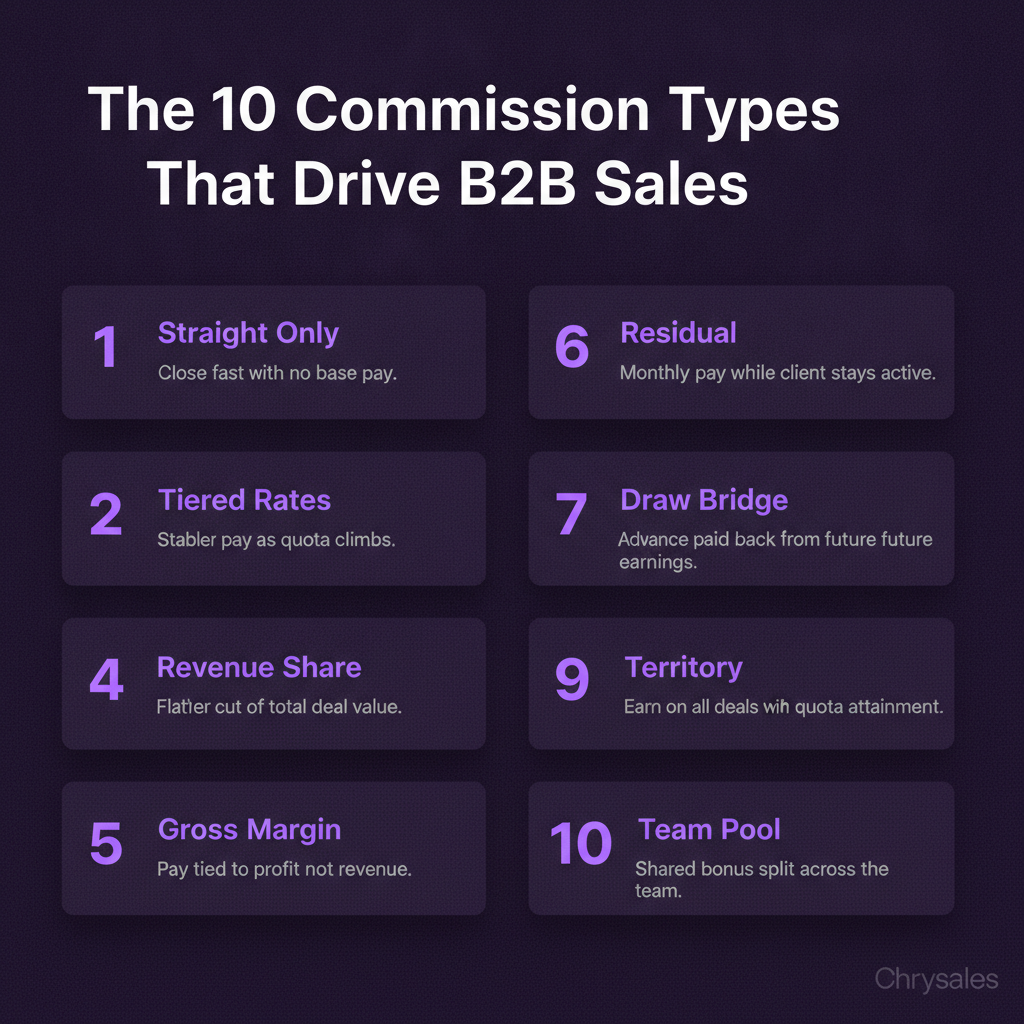
Let's break down the ten most common sales commission percentage models, when to use each one, and what to watch out for. Think of these as building blocks. Most strong commission plans mix two or three of these together.
1. Straight Commission (Commission-Only)
This is the simplest model. No base salary. Your sales rep gets paid purely on what they close. Usually 5% to 20% of deal value, depending on your margins and sales cycle.
A commission only structure works when you're hiring experienced closers who have their own pipeline or when your product sells fast with short cycles. The upside: you only pay when revenue comes in. The downside: good salespeople with bills to pay won't take the risk unless your product is proven and deals close quickly.
This model attracts hunters but also attracts people who'll burn through your prospect list in 60 days and disappear.
Pro Tip: If you're using straight commission, your onboarding and training need to be flawless. Reps won't stick around through a slow learning curve if they're not getting paid.
2. Base Salary Plus Commission
This is the most common B2B sales compensation model. Your rep gets a guaranteed base salary (often $40K to $80K depending on role and market) plus commission on closed deals. The split is usually 50/50 or 60/40 (base to commission), meaning if total on-target earnings (OTE) are $100K, they get $50K base and can earn another $50K in commission.
Base salary plus commission gives reps financial stability while still motivating them to close. It works well for longer sales cycles, complex products, and when you need reps to do non-closing work like demos, follow-ups, and account management. Most SaaS companies, consulting firms, and B2B service businesses use this model.
The trick is setting the base high enough to attract talent but low enough that commission still feels urgent. If base is too high, reps coast. If it's too low, you won't get quality applicants.
3. Tiered Commission Structure
This is where commission rates increase as reps hit higher revenue thresholds. For example, 5% on the first $50K closed, 8% on the next $50K, and 10% on everything above $100K.
Tiered commission structures reward top performers and push everyone to beat their quota. A marketing agency we worked with switched to a tiered model and saw their average deal size jump 22% in one quarter. Reps stopped settling at quota and started pushing for one more close to hit the next tier.
Common mistake: Making the tiers too complicated. If your rep needs a calculator and three coffee breaks to figure out what they'll earn, simplify it. Three tiers max.
4. Revenue Commission
Your rep earns a flat percentage of total revenue they bring in. Simple. Clean. Most common in industries with consistent margins. If you close a $10K deal and the commission is 10%, the rep makes $1K. If they close $100K, they make $10K.
Revenue based commission is easy to explain and easy to calculate. The downside: it doesn't account for profitability. If one rep keeps discounting to close deals, they still get paid the same as the rep who closes at full price.
5. Gross Margin Commission
Instead of paying on revenue, you pay commission based on profit margin. If a deal brings in $10K but costs $7K to deliver, the gross margin is $3K. The rep earns a percentage of that $3K, not the full $10K.
This model keeps your sales team focused on profitable deals, not just big numbers. Gross margin commission works best when your cost of delivery varies a lot between deals or when you want to stop reps from over-discounting.
One consulting firm we worked with had reps closing huge projects at 10% margin. When they switched to margin based commission, discounting dropped by half and profit per deal doubled.
The challenge: reps need to understand your cost structure, and you need transparent reporting so they trust the numbers.
6. Residual Commission (Recurring Revenue)
If your business runs on monthly or annual contracts, residual commission rewards reps for as long as the customer stays active. Close a client paying $1K/month, earn 10% of that $1K every month they stay. This is standard in SaaS, agencies with retainers, and any subscription model.
Residual commission structures align your sales team with long term customer success. Reps stop churning through bad fit clients because they want those recurring checks. A SaaS company switched from one time commission to residual, and their customer retention jumped from 68% to 84% in a year.
Watch out: Residual commission can feel like free money after a while, especially if customer success handles all retention. Some companies cap residual at 12 or 24 months to keep reps motivated to hunt new business.
7. Draw Against Commission
This is a hybrid safety net. You give reps an advance (the "draw") at the start of each month, and they pay it back with their earned commission. If they earn more than the draw, they keep the extra. If they earn less, they owe the difference (recoverable draw) or you forgive it (non recoverable draw).
Draw against commission helps new reps survive their ramp up period without going broke. It's common in industries with long sales cycles where it takes 60 to 90 days to close the first deal. After three or four months, most reps are earning above the draw and it becomes invisible.
The risk: if reps never earn above the draw, you're essentially paying a base salary with extra paperwork. And recoverable draws can create resentment if someone has a bad quarter and feels like they're working for free to pay back the company.
8. Territory Volume Commission
Your rep owns a region or account list, and they earn commission on all revenue from that territory, whether they closed it themselves or not. This works when you want reps to focus on account growth, not just net new deals. It's common in field sales, distributor models, and companies with geographic sales territories.
Territory volume commission pushes reps to think like business owners. They'll nurture existing accounts, manage renewals, and coordinate with account managers because everything in their territory affects their paycheck. A 50-person tech company used this model and saw upsell revenue from existing accounts grow 40% year over year.
The downside: if a territory is loaded with great accounts from before the rep started, they get paid for work they didn't do. You need clear rules about inherited accounts and territory transfers.
9. Multiplier Commission
This one's clever. Your rep has a quota. If they hit 100% of quota, they earn their standard commission rate. If they hit 120%, their commission rate multiplies by 1.2x on all deals. If they hit 80%, it drops to 0.8x.
The multiplier can go up or down based on quota attainment. Multiplier commission structures reward consistency and punish underperformance. It's a way to create urgency without building complex tiers. Most reps love it because one great month can pay off big.
The risk: a rep who knows they'll miss quota might coast for the rest of the quarter instead of grinding.
Pro Tip: Use multipliers carefully. If your quota is unrealistic, the multiplier just demoralizes people faster.
10. Team-Based Commission
Instead of paying individual reps, you pool commission and split it across the team based on contribution or evenly. This works in complex sales environments where deals require multiple people (SDRs, closers, account managers) or when you want collaboration over competition.
A B2B lead generation agency we worked with had setters and closers fighting over credit for deals. When we moved to a team based commission pool where setters got 30%, closers got 50%, and account managers got 20%, the infighting stopped and revenue grew 28% in six months.
The downside: top performers often hate team based commission because they feel like they're carrying weaker teammates. It works best in smaller teams with shared goals and high trust.
How to Choose the Right Commission Structure for Your Team
Most teams pick a commission structure because it's what they've seen before, not because it fits their business. Here's how to actually choose.
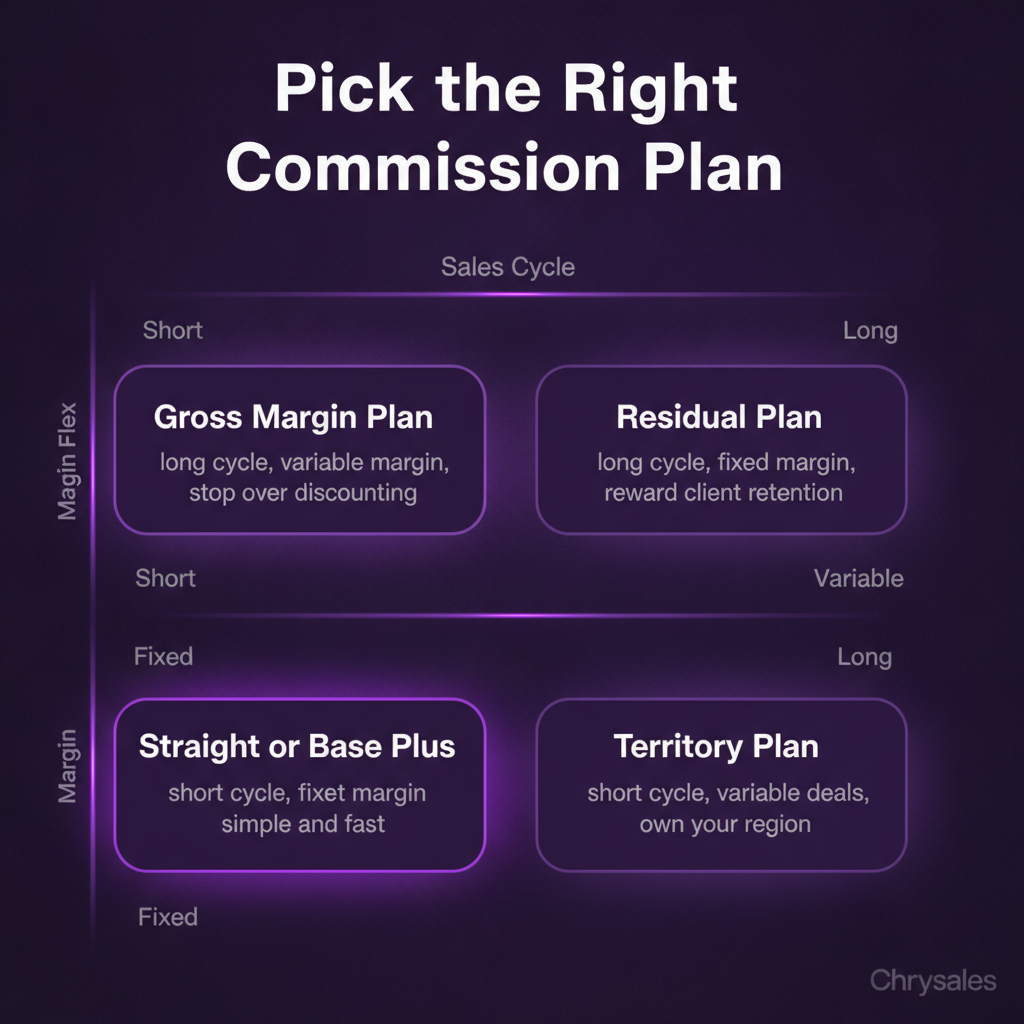
Start with your sales cycle. If deals close in under 30 days, straight commission or base plus commission works great. If your cycle is 90+ days, you need a base salary or draw to keep reps alive while they build pipeline. If you're selling subscriptions or retainers, residual commission aligns incentives with retention.
Next, look at your margins. If margins vary a lot deal to deal, gross margin commission stops reps from discounting everything. If margins are consistent, revenue commission is simpler and just as effective.
Finally, think about what behavior you need. If you want reps hunting new logos, weight commission toward new business. If you need account growth, add bonuses for upsells and renewals. If your team is fighting over leads, consider team based commission.
For b2b sales teams, the right mix often supports lead generation and client acquisition at the same time. You can watch this breakdown of the seven levels of sales performance to understand how different closing abilities affect the commission structures that work best for each rep.
Testing and Adjusting Your Commission Plan
No commission plan is perfect on day one. Build in a review every quarter for the first year. Track three things: are reps hitting quota, is revenue growing, and are reps gaming the system in ways you didn't predict.
A 15-person consulting firm tried a complex tiered model with bonuses for margin, contract length, and referrals. After two months, no one could explain how they got paid. We simplified it to base plus 10% revenue commission with a 1.5x multiplier at quota. Revenue jumped, confusion dropped, and the founder stopped answering commission questions in Slack every Friday.
Common mistake: Changing the plan mid-quarter when someone finds a loophole. Unless it's costing you real money, let the quarter finish and fix it for the next one. Reps need predictability.
What Standard Sales Commission Rates Actually Look Like
Most B2B roles fall into predictable ranges. Inside sales reps with short cycles earn 5% to 15% commission on deals, with OTEs around $50K to $80K. Account executives closing bigger deals earn 8% to 12%, with OTEs between $80K and $150K. Senior closers or sales leaders might earn 3% to 8% but on much bigger contracts, with OTEs over $150K.
The standard sales commission for most B2B models is 10%. That's a safe starting point. If your margins are higher than 50%, you can go to 12% or 15%. If margins are tight, drop to 5% or 8% and raise the base salary instead.
Service businesses and agencies often pay lower commission percentages (3% to 8%) because deals are bigger and sales cycles are longer. SaaS companies with monthly contracts pay higher percentages on annual contract value (10% to 20%) because they want to reward upfront effort that drives recurring revenue.
Pro Tip: Don't just copy competitor commission rates. Your margin, sales cycle, and deal size are unique. Build your structure around your numbers, not someone else's.
Building a Commission Structure That Scales
The trap most small sales teams fall into is building a commission plan that works for one or two people but breaks at five. You want a system that doesn't need a full rewrite every time you hire someone new.
Start simple. Base plus commission with a single multiplier at quota works for 80% of B2B businesses. Add one layer of complexity only if you have a specific problem to solve, like reps ignoring renewals (add residual commission) or discounting too much (switch to margin based).
Document everything. Write down how commission is calculated, when it's paid, what happens if a customer refunds, and how disputes get handled. Put it in a one page document every rep gets when they're hired. If you can't explain it in one page, it's too complicated.
We worked with a tech company that had a nine page commission policy with 14 different bonus triggers. Reps spent more time arguing about edge cases than selling. We condensed it to one page with three rules: 10% on closed revenue, 1.5x multiplier at quota, paid monthly. Disputes dropped to zero and revenue grew 19% that quarter.
Integrating Commission with Your Full Sales System
Commission doesn't exist in a vacuum. It's one piece of a full sales system that includes lead generation, pitch structure, objection handling, follow up cadences, and sales training. We've trained over 500 sales teams, and the ones that grow fastest treat commission as part of the system, not a standalone policy.
Your commission structure should support your sales process. If you need reps doing discovery calls before demos, pay a small bonus for qualified discovery calls. If you need detailed CRM notes for handoffs, tie part of commission to pipeline hygiene. If you want reps closing at full price, reward margin instead of revenue.
At Chrysales, we build custom sales systems that connect lead generation, closing frameworks, and hiring processes into one predictable machine. Understanding how to build a sales system that actually scales means aligning your commission design with your broader growth strategy, not just copying what other companies do.
Commission design is always part of that. We've helped clients go from inconsistent months to predictable growth by aligning how they pay their team with how they actually want to sell. You can also watch how to build a sales system so powerful clients come to you to see how the right incentive structure supports the entire client acquisition process.
Frequently Asked Questions
Q: What is the average commission rate for sales reps in B2B?
Most B2B sales reps earn between 5% and 15% commission on closed deals, with 10% being the most common baseline. Inside sales roles with shorter cycles and smaller deals tend toward the higher end (10% to 15%), while enterprise sales roles with longer cycles and bigger contracts sit lower (5% to 10%). Your margin, deal size, and sales cycle length should guide your final number more than any industry average.
Q: Should I use a commission-only structure for new sales hires?
Commission-only structures work best for experienced reps with proven track records, established networks, and high risk tolerance. For most B2B businesses, especially those with sales cycles longer than 30 days, base salary plus commission reduces turnover and attracts higher-quality candidates. If you do go commission-only, expect longer hiring timelines and be ready to lose reps quickly if your product or process isn't dialed in.
Q: How do tiered commission structures affect sales performance?
Tiered commission structures create urgency and reward top performers by increasing commission rates as reps hit higher revenue thresholds. Most teams see a 15% to 25% boost in deals closed near the end of quarters as reps push to hit the next tier. The key is keeping tiers simple and the gap between levels small enough that hitting the next one feels achievable, not impossible.
Q: When should I pay commission on gross margin instead of revenue?
Switch to gross margin commission when your cost of delivery varies significantly between deals, or when reps are over-discounting to close business. If every deal has roughly the same margin, revenue commission is simpler and just as effective. Margin based plans work best in consulting, agencies, and custom service businesses where pricing flexibility can destroy profitability if left unchecked.
Q: How often should I review and update my sales commission structure?
Review your commission plan quarterly for the first year, then twice a year once it's stable. Track whether reps are hitting quota, if revenue is growing predictably, and if anyone's gaming the system in ways you didn't anticipate. Avoid changing the structure mid-quarter unless there's a critical issue. Stability builds trust, and trust keeps good salespeople on your team longer than any commission rate ever will.
Retail commission structures are ways to pay salespeople variable compensation based on sales, goals, and behavior. They help businesses match pay with results in a simple way. Most sales teams guess their way through commission design. They copy a competitor, pick a random percentage, or worse, change the plan every quarter and wonder why everyone's confused.
Here's the thing: your commission structure isn't just about paying people. It's the invisible system that tells your team what you actually care about. Get it wrong, and you'll watch good salespeople leave or, worse, stick around and game the system. Get it right, and commission becomes the engine that drives predictable growth.
Why Your Commission Structure Matters More Than You Think
The retail commission structures you choose send a signal louder than any team meeting. If you pay purely on closed deals, your team will chase quick wins and ignore long-term accounts. If you pay on activity, they'll book useless meetings just to hit numbers. The best sales commission structure aligns what's good for the business with what's good for your sales rep's wallet.
Most teams build commission plans in a vacuum. They forget that commission isn't just compensation. It's behavior design. A 30-person consulting firm we worked with had seven salespeople all working different commission plans. No one could explain why. When we rebuilt their system with one clear structure tied to qualified pipeline and closed revenue, their sales cycle dropped by 18 days and revenue jumped 34% in two quarters.
Watch out: Changing your commission structure every few months destroys trust faster than anything else. Sales reps need stability to plan their own finances.
What Makes a Commission Structure Actually Work
A good commission structure for sales reps does three things. First, it's simple enough that anyone can calculate their own pay without a spreadsheet. Second, it rewards the behaviors that actually move the needle for your business, whether that's new logos, upsells, or contract renewals. Third, it scales with your growth without needing constant tweaks.
The mistake most teams make is building a commission plan that works great for one rep but breaks when you hire your third or fourth person. You want a system that fits your business model now and still makes sense when you're twice your current size.
The 10 Commission Structures That Actually Work
Let's break down the ten most common sales commission percentage models, when to use each one, and what to watch out for. Think of these as building blocks. Most strong commission plans mix two or three of these together.
1. Straight Commission (Commission-Only)
This is the simplest model. No base salary. Your sales rep gets paid purely on what they close. Usually 5% to 20% of deal value, depending on your margins and sales cycle.
A commission only structure works when you're hiring experienced closers who have their own pipeline or when your product sells fast with short cycles. The upside: you only pay when revenue comes in. The downside: good salespeople with bills to pay won't take the risk unless your product is proven and deals close quickly.
This model attracts hunters but also attracts people who'll burn through your prospect list in 60 days and disappear.
Pro Tip: If you're using straight commission, your onboarding and training need to be flawless. Reps won't stick around through a slow learning curve if they're not getting paid.
2. Base Salary Plus Commission
This is the most common B2B sales compensation model. Your rep gets a guaranteed base salary (often $40K to $80K depending on role and market) plus commission on closed deals. The split is usually 50/50 or 60/40 (base to commission), meaning if total on-target earnings (OTE) are $100K, they get $50K base and can earn another $50K in commission.
Base salary plus commission gives reps financial stability while still motivating them to close. It works well for longer sales cycles, complex products, and when you need reps to do non-closing work like demos, follow-ups, and account management. Most SaaS companies, consulting firms, and B2B service businesses use this model.
The trick is setting the base high enough to attract talent but low enough that commission still feels urgent. If base is too high, reps coast. If it's too low, you won't get quality applicants.
3. Tiered Commission Structure
This is where commission rates increase as reps hit higher revenue thresholds. For example, 5% on the first $50K closed, 8% on the next $50K, and 10% on everything above $100K.
Tiered commission structures reward top performers and push everyone to beat their quota. A marketing agency we worked with switched to a tiered model and saw their average deal size jump 22% in one quarter. Reps stopped settling at quota and started pushing for one more close to hit the next tier.
Common mistake: Making the tiers too complicated. If your rep needs a calculator and three coffee breaks to figure out what they'll earn, simplify it. Three tiers max.
4. Revenue Commission
Your rep earns a flat percentage of total revenue they bring in. Simple. Clean. Most common in industries with consistent margins. If you close a $10K deal and the commission is 10%, the rep makes $1K. If they close $100K, they make $10K.
Revenue based commission is easy to explain and easy to calculate. The downside: it doesn't account for profitability. If one rep keeps discounting to close deals, they still get paid the same as the rep who closes at full price.
5. Gross Margin Commission
Instead of paying on revenue, you pay commission based on profit margin. If a deal brings in $10K but costs $7K to deliver, the gross margin is $3K. The rep earns a percentage of that $3K, not the full $10K.
This model keeps your sales team focused on profitable deals, not just big numbers. Gross margin commission works best when your cost of delivery varies a lot between deals or when you want to stop reps from over-discounting.
One consulting firm we worked with had reps closing huge projects at 10% margin. When they switched to margin based commission, discounting dropped by half and profit per deal doubled.
The challenge: reps need to understand your cost structure, and you need transparent reporting so they trust the numbers.
6. Residual Commission (Recurring Revenue)
If your business runs on monthly or annual contracts, residual commission rewards reps for as long as the customer stays active. Close a client paying $1K/month, earn 10% of that $1K every month they stay. This is standard in SaaS, agencies with retainers, and any subscription model.
Residual commission structures align your sales team with long term customer success. Reps stop churning through bad fit clients because they want those recurring checks. A SaaS company switched from one time commission to residual, and their customer retention jumped from 68% to 84% in a year.
Watch out: Residual commission can feel like free money after a while, especially if customer success handles all retention. Some companies cap residual at 12 or 24 months to keep reps motivated to hunt new business.
7. Draw Against Commission
This is a hybrid safety net. You give reps an advance (the "draw") at the start of each month, and they pay it back with their earned commission. If they earn more than the draw, they keep the extra. If they earn less, they owe the difference (recoverable draw) or you forgive it (non recoverable draw).
Draw against commission helps new reps survive their ramp up period without going broke. It's common in industries with long sales cycles where it takes 60 to 90 days to close the first deal. After three or four months, most reps are earning above the draw and it becomes invisible.
The risk: if reps never earn above the draw, you're essentially paying a base salary with extra paperwork. And recoverable draws can create resentment if someone has a bad quarter and feels like they're working for free to pay back the company.
8. Territory Volume Commission
Your rep owns a region or account list, and they earn commission on all revenue from that territory, whether they closed it themselves or not. This works when you want reps to focus on account growth, not just net new deals. It's common in field sales, distributor models, and companies with geographic sales territories.
Territory volume commission pushes reps to think like business owners. They'll nurture existing accounts, manage renewals, and coordinate with account managers because everything in their territory affects their paycheck. A 50-person tech company used this model and saw upsell revenue from existing accounts grow 40% year over year.
The downside: if a territory is loaded with great accounts from before the rep started, they get paid for work they didn't do. You need clear rules about inherited accounts and territory transfers.
9. Multiplier Commission
This one's clever. Your rep has a quota. If they hit 100% of quota, they earn their standard commission rate. If they hit 120%, their commission rate multiplies by 1.2x on all deals. If they hit 80%, it drops to 0.8x.
The multiplier can go up or down based on quota attainment. Multiplier commission structures reward consistency and punish underperformance. It's a way to create urgency without building complex tiers. Most reps love it because one great month can pay off big.
The risk: a rep who knows they'll miss quota might coast for the rest of the quarter instead of grinding.
Pro Tip: Use multipliers carefully. If your quota is unrealistic, the multiplier just demoralizes people faster.
10. Team-Based Commission
Instead of paying individual reps, you pool commission and split it across the team based on contribution or evenly. This works in complex sales environments where deals require multiple people (SDRs, closers, account managers) or when you want collaboration over competition.
A B2B lead generation agency we worked with had setters and closers fighting over credit for deals. When we moved to a team based commission pool where setters got 30%, closers got 50%, and account managers got 20%, the infighting stopped and revenue grew 28% in six months.
The downside: top performers often hate team based commission because they feel like they're carrying weaker teammates. It works best in smaller teams with shared goals and high trust.
How to Choose the Right Commission Structure for Your Team
Most teams pick a commission structure because it's what they've seen before, not because it fits their business. Here's how to actually choose.
Start with your sales cycle. If deals close in under 30 days, straight commission or base plus commission works great. If your cycle is 90+ days, you need a base salary or draw to keep reps alive while they build pipeline. If you're selling subscriptions or retainers, residual commission aligns incentives with retention.
Next, look at your margins. If margins vary a lot deal to deal, gross margin commission stops reps from discounting everything. If margins are consistent, revenue commission is simpler and just as effective.
Finally, think about what behavior you need. If you want reps hunting new logos, weight commission toward new business. If you need account growth, add bonuses for upsells and renewals. If your team is fighting over leads, consider team based commission.
For b2b sales teams, the right mix often supports lead generation and client acquisition at the same time. You can watch this breakdown of the seven levels of sales performance to understand how different closing abilities affect the commission structures that work best for each rep.
Testing and Adjusting Your Commission Plan
No commission plan is perfect on day one. Build in a review every quarter for the first year. Track three things: are reps hitting quota, is revenue growing, and are reps gaming the system in ways you didn't predict.
A 15-person consulting firm tried a complex tiered model with bonuses for margin, contract length, and referrals. After two months, no one could explain how they got paid. We simplified it to base plus 10% revenue commission with a 1.5x multiplier at quota. Revenue jumped, confusion dropped, and the founder stopped answering commission questions in Slack every Friday.
Common mistake: Changing the plan mid-quarter when someone finds a loophole. Unless it's costing you real money, let the quarter finish and fix it for the next one. Reps need predictability.
What Standard Sales Commission Rates Actually Look Like
Most B2B roles fall into predictable ranges. Inside sales reps with short cycles earn 5% to 15% commission on deals, with OTEs around $50K to $80K. Account executives closing bigger deals earn 8% to 12%, with OTEs between $80K and $150K. Senior closers or sales leaders might earn 3% to 8% but on much bigger contracts, with OTEs over $150K.
The standard sales commission for most B2B models is 10%. That's a safe starting point. If your margins are higher than 50%, you can go to 12% or 15%. If margins are tight, drop to 5% or 8% and raise the base salary instead.
Service businesses and agencies often pay lower commission percentages (3% to 8%) because deals are bigger and sales cycles are longer. SaaS companies with monthly contracts pay higher percentages on annual contract value (10% to 20%) because they want to reward upfront effort that drives recurring revenue.
Pro Tip: Don't just copy competitor commission rates. Your margin, sales cycle, and deal size are unique. Build your structure around your numbers, not someone else's.
Building a Commission Structure That Scales
The trap most small sales teams fall into is building a commission plan that works for one or two people but breaks at five. You want a system that doesn't need a full rewrite every time you hire someone new.
Start simple. Base plus commission with a single multiplier at quota works for 80% of B2B businesses. Add one layer of complexity only if you have a specific problem to solve, like reps ignoring renewals (add residual commission) or discounting too much (switch to margin based).
Document everything. Write down how commission is calculated, when it's paid, what happens if a customer refunds, and how disputes get handled. Put it in a one page document every rep gets when they're hired. If you can't explain it in one page, it's too complicated.
We worked with a tech company that had a nine page commission policy with 14 different bonus triggers. Reps spent more time arguing about edge cases than selling. We condensed it to one page with three rules: 10% on closed revenue, 1.5x multiplier at quota, paid monthly. Disputes dropped to zero and revenue grew 19% that quarter.
Integrating Commission with Your Full Sales System
Commission doesn't exist in a vacuum. It's one piece of a full sales system that includes lead generation, pitch structure, objection handling, follow up cadences, and sales training. We've trained over 500 sales teams, and the ones that grow fastest treat commission as part of the system, not a standalone policy.
Your commission structure should support your sales process. If you need reps doing discovery calls before demos, pay a small bonus for qualified discovery calls. If you need detailed CRM notes for handoffs, tie part of commission to pipeline hygiene. If you want reps closing at full price, reward margin instead of revenue.
At Chrysales, we build custom sales systems that connect lead generation, closing frameworks, and hiring processes into one predictable machine. Understanding how to build a sales system that actually scales means aligning your commission design with your broader growth strategy, not just copying what other companies do.
Commission design is always part of that. We've helped clients go from inconsistent months to predictable growth by aligning how they pay their team with how they actually want to sell. You can also watch how to build a sales system so powerful clients come to you to see how the right incentive structure supports the entire client acquisition process.
Frequently Asked Questions
Q: What is the average commission rate for sales reps in B2B?
Most B2B sales reps earn between 5% and 15% commission on closed deals, with 10% being the most common baseline. Inside sales roles with shorter cycles and smaller deals tend toward the higher end (10% to 15%), while enterprise sales roles with longer cycles and bigger contracts sit lower (5% to 10%). Your margin, deal size, and sales cycle length should guide your final number more than any industry average.
Q: Should I use a commission-only structure for new sales hires?
Commission-only structures work best for experienced reps with proven track records, established networks, and high risk tolerance. For most B2B businesses, especially those with sales cycles longer than 30 days, base salary plus commission reduces turnover and attracts higher-quality candidates. If you do go commission-only, expect longer hiring timelines and be ready to lose reps quickly if your product or process isn't dialed in.
Q: How do tiered commission structures affect sales performance?
Tiered commission structures create urgency and reward top performers by increasing commission rates as reps hit higher revenue thresholds. Most teams see a 15% to 25% boost in deals closed near the end of quarters as reps push to hit the next tier. The key is keeping tiers simple and the gap between levels small enough that hitting the next one feels achievable, not impossible.
Q: When should I pay commission on gross margin instead of revenue?
Switch to gross margin commission when your cost of delivery varies significantly between deals, or when reps are over-discounting to close business. If every deal has roughly the same margin, revenue commission is simpler and just as effective. Margin based plans work best in consulting, agencies, and custom service businesses where pricing flexibility can destroy profitability if left unchecked.
Q: How often should I review and update my sales commission structure?
Review your commission plan quarterly for the first year, then twice a year once it's stable. Track whether reps are hitting quota, if revenue is growing predictably, and if anyone's gaming the system in ways you didn't anticipate. Avoid changing the structure mid-quarter unless there's a critical issue. Stability builds trust, and trust keeps good salespeople on your team longer than any commission rate ever will.
Scaling Is Not Hard If You Have The Right Systems
If you’re serious about leveling up your scaling game, you need the right system, the right training, and the right team behind you. We're here to give you the exact tools and strategies top entrepreneurs use to dominate.

Discover the latest tips
View All.avif)
Chrysales was formed from the words "chrysalis" the stage where a caterpillar transforms into a butterfly and "sales".
It stands for one thing: sales transformation.Because scaling doesn’t happen by doing more of the same. Scaling only happens when you go through real transformation in your systems, your offer, team and the way you sell.
.avif)


