.avif)
How to Remove Yourself From Sales Without Revenue Dropping
Removing yourself from sales means building a system that generates leads and closes deals without you personally managing every step. It is the process of creating predictable b2b sales results so your business grows even when you are not in the room.
You just closed three deals in a week. Feels good. Then you realize: if you stop selling, the pipeline goes dry. That's the trap most small sales teams fall into. The person who knows how to close becomes the bottleneck. Growth stalls because you can't clone yourself.
But here's the thing nobody tells you: removing yourself from sales isn't about finding a mini-you. It's about building a sales system that actually scales. Let's walk through how to do that without watching your revenue collapse.
Why most attempts to step back from sales fail fast
Most people try to remove themselves from sales by hiring someone and hoping they figure it out. That almost always flops. The new hire doesn't have your years of experience, your gut instincts, or your personal relationships with clients. They wing it for a few weeks, close nothing, and either quit or get let go.
The real problem isn't the person. It's that there's no system to follow. Picture this: you hand someone your car keys and say "drive to the store." If they've never driven before and you don't explain how the pedals work, they're not getting anywhere. Sales works the same way. Without a documented process, training, and clear steps, nobody can replicate what you do.
The hidden cost of staying in sales forever
When you stay glued to every sales call, a few things happen. First, you can't focus on anything else. No time to improve the product, hire better people, or think about strategy. Second, your team never learns to sell without you. They lean on you for every objection, every pricing question, every tough negotiation. Third, your revenue caps out at however many hours you can personally work. A 30-person consulting firm can't grow past a certain point if the same person has to close every deal.
Watch out: Even if you're great at sales, being the only one who can do it is a business risk. What happens if you get sick, take a vacation, or just burn out? This founder-led sales growth bottleneck is one of the most common reasons B2B companies stall.
What actually works when you step back
The teams that successfully remove themselves from sales do three things before they hire anyone. They document their process in simple terms. They build lists and outreach systems that feed the pipeline without manual work. And they create a way to measure what's working so they can coach instead of doing everything themselves. That's the difference between handing someone a mess and handing them a playbook.
Build the system before you hire anyone
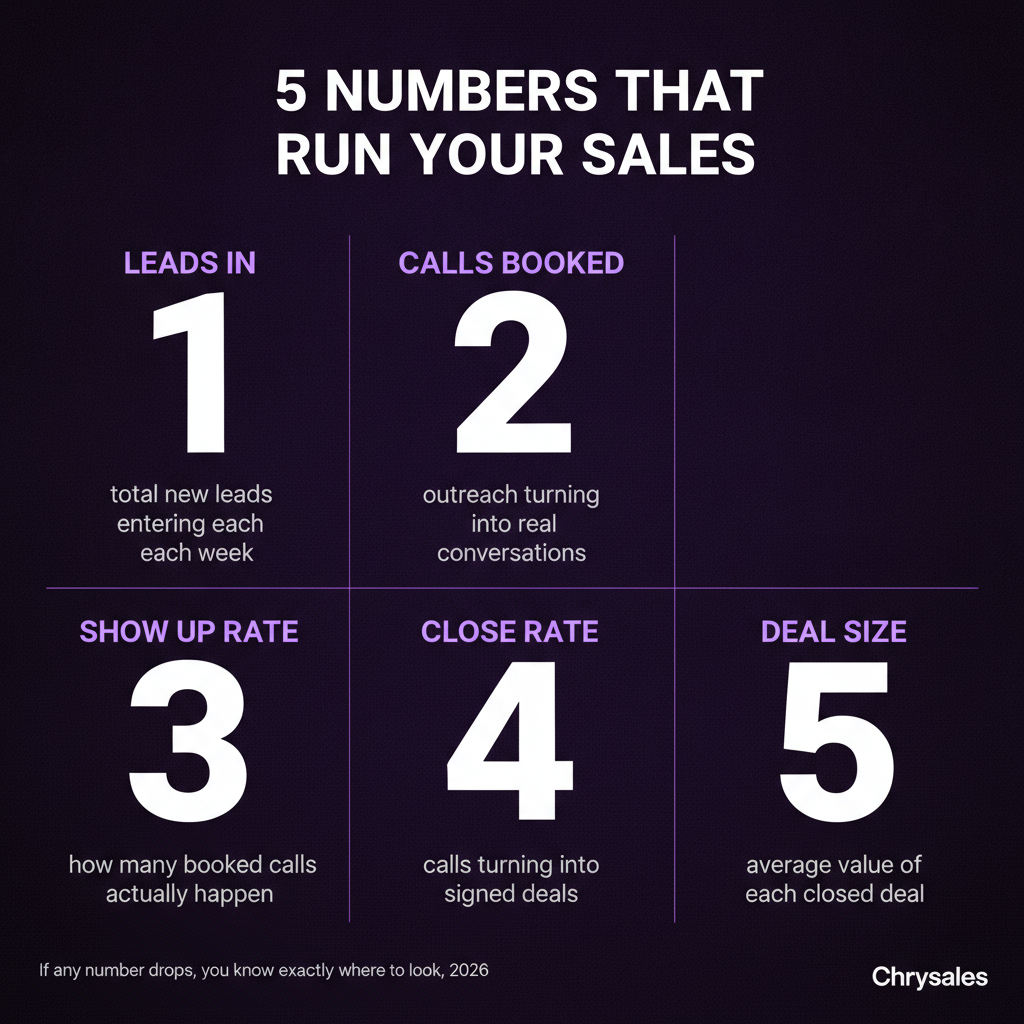
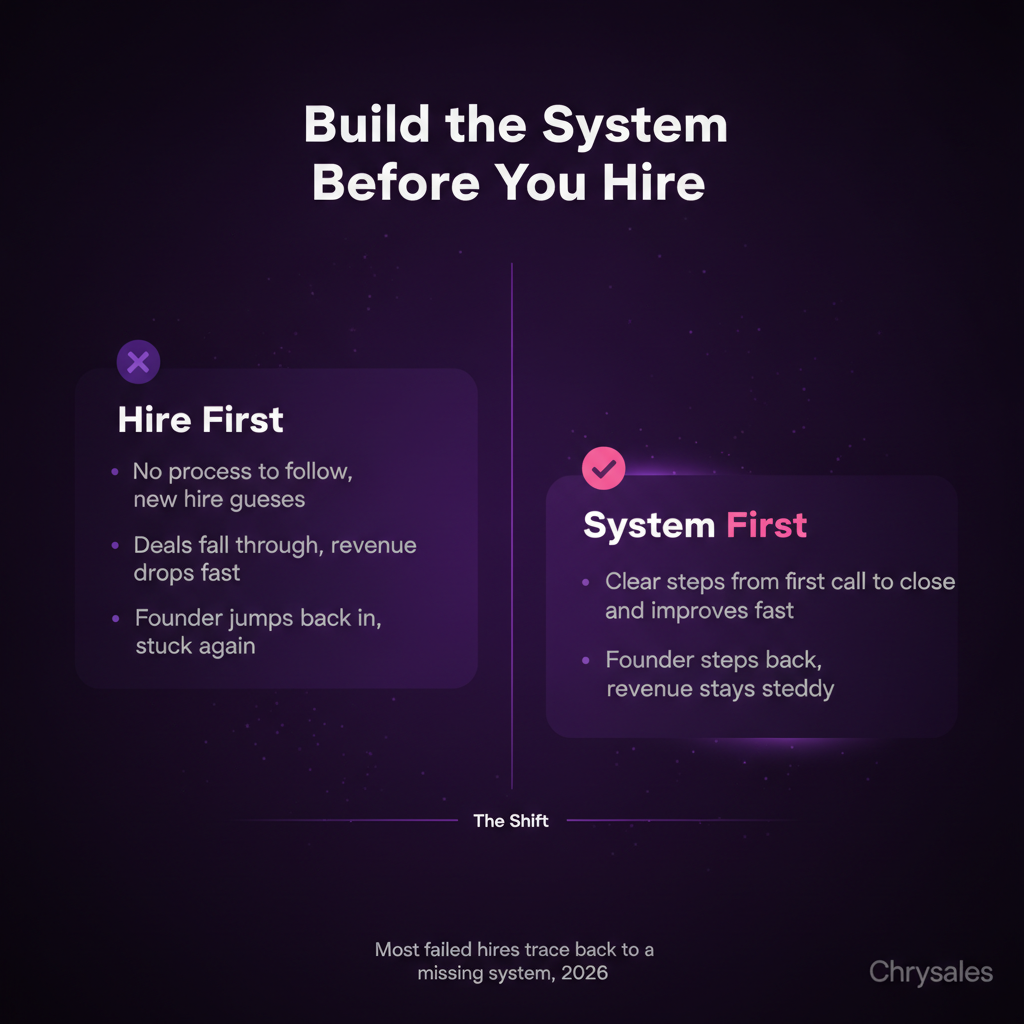
Most people get this backwards. They hire a salesperson, then try to build the system around that person. By the time the system is ready, the hire has already failed or left. Start with the system. Once it's running, the right person can step in and execute.
Step one: write down your current sales process
Open a doc and map out every step you take from first contact to signed deal. Be specific. What do you say in the first 30 seconds of a call? What questions do you ask in discovery? How do you handle the "it's too expensive" objection? What does your follow-up sequence look like?
This doesn't have to be fancy. Bullet points and short sentences work fine. A marketing agency we worked with spent two hours doing this. They realized they had 11 steps in their process, but they'd never written any of them down. Once documented, they could see where deals fell apart. Turned out their follow-up after the first call was weak. Fixing that one step increased their close rate by 15%.
Pro tip: Record yourself on your next three sales calls. Watch them back and write down exactly what you did. That's your process.
Step two: create templates and scripts for every stage
Take your process and turn it into templates. Cold email templates. Discovery call scripts. Objection handling responses. Proposal outlines. Follow-up sequences. These aren't rigid word-for-word scripts. They're starting points. A good template gives the structure so someone new doesn't have to guess what to say.
We see this all the time with new clients. They're great at sales, but it's all in their head. When they try to explain it to someone else, it comes out vague. "Just be friendly and figure out what they need." That's not a system. A system is: "Ask these five questions. If they say X, respond with Y. If they hesitate, send this follow-up email."
Step three: set up lead generation that runs without you
If your pipeline depends on you personally reaching out to people, you're stuck. Build a system that generates leads on autopilot. That could be cold outreach with a good list and email sequence. Inbound content that attracts the right people. Referral programs. Paid ads. Whatever fits your business.
The key is predictable revenue. You should be able to look at your system and say, "If we send 500 emails to this list with this message, we'll book 10 calls." That's repeatable. That's what lets someone else step in.
Common mistake: Trying to remove yourself from sales before your lead generation is stable. If the pipeline is inconsistent, stepping back just means no deals close. Fix the flow of leads first.
Document your offer and positioning so it's crystal clear
Your offer is what you're selling and why someone should buy it. If that's not clear, nobody can sell it except you. A lot of small sales teams run into this. The founder has a great sense of how to position the company, but it's all intuition. When someone else tries to pitch, it sounds off.
Turn your pitch into a one-pager
Write out your offer in simple terms. Who it's for. What problem it solves. Why it's different from other options. What it costs. What the next step is. Make it so clear that someone reading it for the first time could explain it to a stranger.
One tech company we worked with had three different salespeople pitching three different versions of the same service. Leads got confused. Revenue was all over the place. We helped them create one clear positioning doc. Everyone used the same pitch. Close rate went up. Training new people got way easier.
Build a no-brainer offer that makes the decision easy
A no-brainer offer is when the value is so obvious that saying yes feels like a safe bet. That could be a strong guarantee. A clear ROI. A fast result. A low-risk trial. Whatever makes the buyer think, "Okay, this makes sense."
If your offer is confusing or risky-sounding, even a great salesperson will struggle. A 15-person consulting firm can't just say "we do consulting." That's vague. "We build custom sales systems for B2B companies that want to close 20% more deals in 90 days" is specific. It tells you who it's for, what you get, and when you'll see results.
Train someone to close like you (without becoming you)
Once your system is documented, you can train someone to follow it. The goal isn't to turn them into a clone. It's to give them the tools and steps that work, then let them add their own style.
Hire for coachability, not experience
A lot of people think they need to hire someone with 10 years of sales experience. That's not always true. What matters more is whether they can follow a system and take feedback. Someone who's coachable and hungry will usually outperform someone experienced but set in their ways.
Look, the truth is this: if your system is strong, a decent salesperson can get results fast. If your system is weak, even a top closer will struggle. Focus on the system first. Then hire someone who can execute it. To see why your first sales hire fails when the system isn't ready, check out the common pitfalls.
Pro tip: During interviews, walk candidates through a piece of your process and ask how they'd handle it. See if they listen, ask good questions, and adapt. That's coachability.
Shadow calls, then reverse shadows, then solo
Start by having the new hire listen to your calls. Then have them take calls while you listen. Give feedback after each one. Once they're consistent, let them run calls solo while you review recordings. This three-step process is how most successful sales training works.
A 200-person company tried to remove their head of sales by throwing a new hire into calls on day one. The hire lasted three weeks. When they rebuilt the process with proper training, the next hire stayed and started closing deals in week four.
Create a feedback loop so they improve fast
Set up a simple way to review performance. Weekly one-on-ones. Call recordings. Pipeline reviews. Look at what's working and what's not. If they're losing deals at the same stage every time, that's a pattern you can fix. If they're booking calls but not closing, maybe discovery needs work. The faster you can spot the gap, the faster they improve.
Automate the repetitive stuff so humans focus on closing
A lot of sales tasks don't need a human. Following up. Sending reminders. Scoring leads. Updating the CRM. These eat up hours every week. Automate them and your team can spend more time actually talking to buyers.
Use AI to score and prioritize leads
Not every lead is worth the same effort. Some are ready to buy. Some are just browsing. Some will never close. AI tools can score leads based on behavior, company size, engagement, and other signals. Set a simple rule: anything scoring above 70 goes to the top of your call list. Everything else gets an automated email sequence first.
We've seen teams cut their manual research time in half by letting AI handle lead scoring. A marketing agency used to spend 10 hours a week sorting through leads. After setting up AI lead scoring, that dropped to under two hours. Their closers spent the saved time on actual calls. Learn more about automated lead generation for B2B sales with AI.
Build email sequences that nurture without manual work
Most deals don't close on the first call. They need follow-up. A lot of follow-up. Instead of manually sending emails every few days, build automated sequences. If someone books a call but doesn't show, trigger a re-engagement sequence. If they say "not now," put them in a nurture sequence for three months. If they go dark after a proposal, send a breakup email series.
Think of it like this: your brain is expensive. Use it for strategy, closing, and solving hard problems. Let automation handle the repetitive stuff. Check out these lead generation automation tools to get started.
Keep your CRM updated automatically
Nobody likes updating the CRM. But if your pipeline data is messy, you can't see what's working. Use tools that log emails, calls, and meetings automatically. Integrate your calendar so booked calls show up in the CRM without manual entry. The less friction, the more likely your team will actually use it.
Watch out: Over-automating can make your outreach feel robotic. Automate the repetitive tasks, but keep the human touch on actual conversations.
Measure the right numbers so you know what's working
You can't improve what you don't measure. When you're personally doing all the sales, you have a gut sense of what's working. When someone else takes over, you need data to coach them and keep revenue predictable.
Track these five sales metrics every week
Most small sales teams track way too much or way too little. Focus on five numbers. Number of leads in the pipeline. Number of calls booked. Show-up rate for calls. Close rate. Average deal size. These five tell you almost everything you need to know.
If leads are up but calls are flat, your outreach isn't working. If calls are up but close rate is down, training or offer needs work. If close rate is steady but deal size is shrinking, you're attracting the wrong leads. A 30-person consulting firm can manage the whole sales process by watching these five numbers weekly. For a deeper dive into tracking performance, see how to measure sales performance effectively.
Set a baseline before you hand off sales
Before you step back, track your own performance for a month. What's your close rate? Your average deal size? Your call-to-close time? That's your baseline. When the new person takes over, compare their numbers to yours. If they're way off, dig into why. Maybe they need better training. Maybe the leads got worse. Maybe the offer changed. You can't fix it if you don't know what normal looks like.
Run weekly pipeline reviews with your team
Spend 30 minutes every week looking at the pipeline together. What deals moved forward? Which ones stalled? Why? What objections came up? What's the plan for next week? This isn't about micromanaging. It's about staying close enough to the process that you can spot problems early and coach through them. Effective B2B sales pipeline management is critical to maintaining predictable revenue.
Common mistake: Only checking in when revenue drops. By then, the damage is done. Weekly reviews catch issues while they're small.
Hire a Chief of Staff or Sales Ops role when you're ready to scale
Once your system is running and one or two people are closing deals without you, the next bottleneck is coordination. Who's managing the pipeline? Who's hiring the next salesperson? Who's updating the process as things change? That's where a Chief of Staff or Sales Ops person comes in.
What this role actually does
This person isn't a closer. They're the one making sure the system runs smoothly. They handle recruiting. They onboard new hires. They track metrics. They spot problems before they blow up. They update templates and scripts as the market changes. They run weekly pipeline reviews. They take all the operational load off you so you can focus on strategy or other parts of the business.
Think of it like a restaurant. You're the head chef. Your closers are the line cooks. The Chief of Staff is the kitchen manager who makes sure everyone has ingredients, the schedule is set, and the health inspector isn't about to shut you down.
When to make this hire
If you have two or more people selling and you're spending more than 10 hours a week managing the sales process, it's time. If you're about to hire a third or fourth salesperson, definitely time. This role pays for itself fast because it frees you up to work on growth instead of daily sales operations.
A 40-person tech company tried to scale from two salespeople to six without this role. The founder spent 25 hours a week just managing the team. Hiring, training, pipeline reviews, fixing CRM issues. It was a mess. They brought in a Sales Ops lead. Within two months, the founder's sales time dropped to under five hours a week. The team kept growing. Revenue stayed predictable.
Keep refining the system as you grow
Removing yourself from sales isn't a one-time project. It's ongoing. Your market changes. Your offer evolves. Your team grows. The system that worked at two salespeople might not work at five. Keep testing, measuring, and improving.
Run quarterly process audits
Every three months, sit down and review the whole sales process. What's working? What's breaking? Where are deals getting stuck? What feedback is the team giving? Update your templates. Adjust your scripts. Fix bottlenecks. A good sales system is like a recipe you keep tweaking until it's perfect.
Stay close enough to coach, far enough to let them own it
You don't need to be on every call. But you should be close enough that your team can ask questions and get fast answers. Weekly one-on-ones. Monthly training sessions. Quarterly strategy reviews. That's usually enough. The goal is to be a coach, not a player. You can watch how to build a sales system so powerful clients come to you for a complete walkthrough of the process.
Pro tip: Block one hour every week for sales coaching. Even if you're not actively selling, that one hour keeps you connected to what's happening and helps your team improve faster.
Celebrate wins and learn from losses
When someone closes a big deal, make noise about it. When a deal falls apart, dig into why without blaming. A healthy sales culture is one where people feel safe trying new things, asking for help, and learning from mistakes. That culture comes from the top. If you freak out every time revenue dips, your team will hide problems. If you stay calm and focus on fixing the system, they'll bring you issues early.
Frequently Asked Questions
Q: How long does it take to remove yourself from sales without losing revenue?
For most small sales teams, plan on three to six months. The first month is documenting your process and building templates. The next two months are training someone and shadowing their work. After that, you can start stepping back while staying close enough to coach. If you rush it, revenue usually drops. If you take it slow and build the system right, the transition is smooth.
Q: What if I can't afford to hire a salesperson right now?
Start by documenting your process and automating lead generation. Even if you're still the one closing deals, having a clear system makes everything faster. When you're ready to hire, you'll have a playbook ready to go. You can also test the system yourself first. If it works for you, it'll work for someone else.
Q: Should I hire a junior salesperson or someone experienced?
Depends on your system. If your process is well-documented and you can coach, a junior hire works great. They're cheaper, more coachable, and hungry to prove themselves. If your process is still messy or you don't have time to train, hire someone with experience who can help you build the system. Just make sure they're willing to follow a process, not do everything their own way.
Q: What's the biggest mistake people make when stepping back from sales?
Handing off sales before the system is ready. They hire someone, dump them into calls with no training, and hope it works. It almost never does. The hire struggles, revenue drops, and the founder jumps back in. Build the system first. Then hire someone to run it.
Q: How do I know if my sales system is ready for someone else to run?
Ask yourself: could someone read my documentation and follow the process without asking me a hundred questions? If yes, you're ready. If no, keep documenting. Another test: can you point to consistent numbers? If your close rate, deal size, and pipeline flow are predictable, that's a good sign the system works.
Q: What if my new salesperson isn't closing deals after a few weeks?
First, check the training. Did they get enough shadowing and feedback? Second, check the leads. Are they talking to the right people? Third, listen to their calls. Are they following the process or winging it? Most early struggles come from unclear training or bad leads, not the person. Fix those first before you decide the hire was wrong.
Q: Can I remove myself from sales if I'm the face of the company?
Yes, but it takes longer. Start by having someone else handle discovery and qualification. You jump in for final closing calls. Over time, bring in a senior closer who can handle the whole process. Your personal brand still helps with marketing and first impressions, but someone else can run the actual sales process. We've seen this work with consulting firms and agencies where the founder is well-known but wants to step back from day-to-day selling.
Removing yourself from sales means building a system that generates leads and closes deals without you personally managing every step. It is the process of creating predictable b2b sales results so your business grows even when you are not in the room.
You just closed three deals in a week. Feels good. Then you realize: if you stop selling, the pipeline goes dry. That's the trap most small sales teams fall into. The person who knows how to close becomes the bottleneck. Growth stalls because you can't clone yourself.
But here's the thing nobody tells you: removing yourself from sales isn't about finding a mini-you. It's about building a sales system that actually scales. Let's walk through how to do that without watching your revenue collapse.
Why most attempts to step back from sales fail fast
Most people try to remove themselves from sales by hiring someone and hoping they figure it out. That almost always flops. The new hire doesn't have your years of experience, your gut instincts, or your personal relationships with clients. They wing it for a few weeks, close nothing, and either quit or get let go.
The real problem isn't the person. It's that there's no system to follow. Picture this: you hand someone your car keys and say "drive to the store." If they've never driven before and you don't explain how the pedals work, they're not getting anywhere. Sales works the same way. Without a documented process, training, and clear steps, nobody can replicate what you do.
The hidden cost of staying in sales forever
When you stay glued to every sales call, a few things happen. First, you can't focus on anything else. No time to improve the product, hire better people, or think about strategy. Second, your team never learns to sell without you. They lean on you for every objection, every pricing question, every tough negotiation. Third, your revenue caps out at however many hours you can personally work. A 30-person consulting firm can't grow past a certain point if the same person has to close every deal.
Watch out: Even if you're great at sales, being the only one who can do it is a business risk. What happens if you get sick, take a vacation, or just burn out? This founder-led sales growth bottleneck is one of the most common reasons B2B companies stall.
What actually works when you step back
The teams that successfully remove themselves from sales do three things before they hire anyone. They document their process in simple terms. They build lists and outreach systems that feed the pipeline without manual work. And they create a way to measure what's working so they can coach instead of doing everything themselves. That's the difference between handing someone a mess and handing them a playbook.
Build the system before you hire anyone
Most people get this backwards. They hire a salesperson, then try to build the system around that person. By the time the system is ready, the hire has already failed or left. Start with the system. Once it's running, the right person can step in and execute.
Step one: write down your current sales process
Open a doc and map out every step you take from first contact to signed deal. Be specific. What do you say in the first 30 seconds of a call? What questions do you ask in discovery? How do you handle the "it's too expensive" objection? What does your follow-up sequence look like?
This doesn't have to be fancy. Bullet points and short sentences work fine. A marketing agency we worked with spent two hours doing this. They realized they had 11 steps in their process, but they'd never written any of them down. Once documented, they could see where deals fell apart. Turned out their follow-up after the first call was weak. Fixing that one step increased their close rate by 15%.
Pro tip: Record yourself on your next three sales calls. Watch them back and write down exactly what you did. That's your process.
Step two: create templates and scripts for every stage
Take your process and turn it into templates. Cold email templates. Discovery call scripts. Objection handling responses. Proposal outlines. Follow-up sequences. These aren't rigid word-for-word scripts. They're starting points. A good template gives the structure so someone new doesn't have to guess what to say.
We see this all the time with new clients. They're great at sales, but it's all in their head. When they try to explain it to someone else, it comes out vague. "Just be friendly and figure out what they need." That's not a system. A system is: "Ask these five questions. If they say X, respond with Y. If they hesitate, send this follow-up email."
Step three: set up lead generation that runs without you
If your pipeline depends on you personally reaching out to people, you're stuck. Build a system that generates leads on autopilot. That could be cold outreach with a good list and email sequence. Inbound content that attracts the right people. Referral programs. Paid ads. Whatever fits your business.
The key is predictable revenue. You should be able to look at your system and say, "If we send 500 emails to this list with this message, we'll book 10 calls." That's repeatable. That's what lets someone else step in.
Common mistake: Trying to remove yourself from sales before your lead generation is stable. If the pipeline is inconsistent, stepping back just means no deals close. Fix the flow of leads first.
Document your offer and positioning so it's crystal clear
Your offer is what you're selling and why someone should buy it. If that's not clear, nobody can sell it except you. A lot of small sales teams run into this. The founder has a great sense of how to position the company, but it's all intuition. When someone else tries to pitch, it sounds off.
Turn your pitch into a one-pager
Write out your offer in simple terms. Who it's for. What problem it solves. Why it's different from other options. What it costs. What the next step is. Make it so clear that someone reading it for the first time could explain it to a stranger.
One tech company we worked with had three different salespeople pitching three different versions of the same service. Leads got confused. Revenue was all over the place. We helped them create one clear positioning doc. Everyone used the same pitch. Close rate went up. Training new people got way easier.
Build a no-brainer offer that makes the decision easy
A no-brainer offer is when the value is so obvious that saying yes feels like a safe bet. That could be a strong guarantee. A clear ROI. A fast result. A low-risk trial. Whatever makes the buyer think, "Okay, this makes sense."
If your offer is confusing or risky-sounding, even a great salesperson will struggle. A 15-person consulting firm can't just say "we do consulting." That's vague. "We build custom sales systems for B2B companies that want to close 20% more deals in 90 days" is specific. It tells you who it's for, what you get, and when you'll see results.
Train someone to close like you (without becoming you)
Once your system is documented, you can train someone to follow it. The goal isn't to turn them into a clone. It's to give them the tools and steps that work, then let them add their own style.
Hire for coachability, not experience
A lot of people think they need to hire someone with 10 years of sales experience. That's not always true. What matters more is whether they can follow a system and take feedback. Someone who's coachable and hungry will usually outperform someone experienced but set in their ways.
Look, the truth is this: if your system is strong, a decent salesperson can get results fast. If your system is weak, even a top closer will struggle. Focus on the system first. Then hire someone who can execute it. To see why your first sales hire fails when the system isn't ready, check out the common pitfalls.
Pro tip: During interviews, walk candidates through a piece of your process and ask how they'd handle it. See if they listen, ask good questions, and adapt. That's coachability.
Shadow calls, then reverse shadows, then solo
Start by having the new hire listen to your calls. Then have them take calls while you listen. Give feedback after each one. Once they're consistent, let them run calls solo while you review recordings. This three-step process is how most successful sales training works.
A 200-person company tried to remove their head of sales by throwing a new hire into calls on day one. The hire lasted three weeks. When they rebuilt the process with proper training, the next hire stayed and started closing deals in week four.
Create a feedback loop so they improve fast
Set up a simple way to review performance. Weekly one-on-ones. Call recordings. Pipeline reviews. Look at what's working and what's not. If they're losing deals at the same stage every time, that's a pattern you can fix. If they're booking calls but not closing, maybe discovery needs work. The faster you can spot the gap, the faster they improve.
Automate the repetitive stuff so humans focus on closing
A lot of sales tasks don't need a human. Following up. Sending reminders. Scoring leads. Updating the CRM. These eat up hours every week. Automate them and your team can spend more time actually talking to buyers.
Use AI to score and prioritize leads
Not every lead is worth the same effort. Some are ready to buy. Some are just browsing. Some will never close. AI tools can score leads based on behavior, company size, engagement, and other signals. Set a simple rule: anything scoring above 70 goes to the top of your call list. Everything else gets an automated email sequence first.
We've seen teams cut their manual research time in half by letting AI handle lead scoring. A marketing agency used to spend 10 hours a week sorting through leads. After setting up AI lead scoring, that dropped to under two hours. Their closers spent the saved time on actual calls. Learn more about automated lead generation for B2B sales with AI.
Build email sequences that nurture without manual work
Most deals don't close on the first call. They need follow-up. A lot of follow-up. Instead of manually sending emails every few days, build automated sequences. If someone books a call but doesn't show, trigger a re-engagement sequence. If they say "not now," put them in a nurture sequence for three months. If they go dark after a proposal, send a breakup email series.
Think of it like this: your brain is expensive. Use it for strategy, closing, and solving hard problems. Let automation handle the repetitive stuff. Check out these lead generation automation tools to get started.
Keep your CRM updated automatically
Nobody likes updating the CRM. But if your pipeline data is messy, you can't see what's working. Use tools that log emails, calls, and meetings automatically. Integrate your calendar so booked calls show up in the CRM without manual entry. The less friction, the more likely your team will actually use it.
Watch out: Over-automating can make your outreach feel robotic. Automate the repetitive tasks, but keep the human touch on actual conversations.
Measure the right numbers so you know what's working
You can't improve what you don't measure. When you're personally doing all the sales, you have a gut sense of what's working. When someone else takes over, you need data to coach them and keep revenue predictable.
Track these five sales metrics every week
Most small sales teams track way too much or way too little. Focus on five numbers. Number of leads in the pipeline. Number of calls booked. Show-up rate for calls. Close rate. Average deal size. These five tell you almost everything you need to know.
If leads are up but calls are flat, your outreach isn't working. If calls are up but close rate is down, training or offer needs work. If close rate is steady but deal size is shrinking, you're attracting the wrong leads. A 30-person consulting firm can manage the whole sales process by watching these five numbers weekly. For a deeper dive into tracking performance, see how to measure sales performance effectively.
Set a baseline before you hand off sales
Before you step back, track your own performance for a month. What's your close rate? Your average deal size? Your call-to-close time? That's your baseline. When the new person takes over, compare their numbers to yours. If they're way off, dig into why. Maybe they need better training. Maybe the leads got worse. Maybe the offer changed. You can't fix it if you don't know what normal looks like.
Run weekly pipeline reviews with your team
Spend 30 minutes every week looking at the pipeline together. What deals moved forward? Which ones stalled? Why? What objections came up? What's the plan for next week? This isn't about micromanaging. It's about staying close enough to the process that you can spot problems early and coach through them. Effective B2B sales pipeline management is critical to maintaining predictable revenue.
Common mistake: Only checking in when revenue drops. By then, the damage is done. Weekly reviews catch issues while they're small.
Hire a Chief of Staff or Sales Ops role when you're ready to scale
Once your system is running and one or two people are closing deals without you, the next bottleneck is coordination. Who's managing the pipeline? Who's hiring the next salesperson? Who's updating the process as things change? That's where a Chief of Staff or Sales Ops person comes in.
What this role actually does
This person isn't a closer. They're the one making sure the system runs smoothly. They handle recruiting. They onboard new hires. They track metrics. They spot problems before they blow up. They update templates and scripts as the market changes. They run weekly pipeline reviews. They take all the operational load off you so you can focus on strategy or other parts of the business.
Think of it like a restaurant. You're the head chef. Your closers are the line cooks. The Chief of Staff is the kitchen manager who makes sure everyone has ingredients, the schedule is set, and the health inspector isn't about to shut you down.
When to make this hire
If you have two or more people selling and you're spending more than 10 hours a week managing the sales process, it's time. If you're about to hire a third or fourth salesperson, definitely time. This role pays for itself fast because it frees you up to work on growth instead of daily sales operations.
A 40-person tech company tried to scale from two salespeople to six without this role. The founder spent 25 hours a week just managing the team. Hiring, training, pipeline reviews, fixing CRM issues. It was a mess. They brought in a Sales Ops lead. Within two months, the founder's sales time dropped to under five hours a week. The team kept growing. Revenue stayed predictable.
Keep refining the system as you grow
Removing yourself from sales isn't a one-time project. It's ongoing. Your market changes. Your offer evolves. Your team grows. The system that worked at two salespeople might not work at five. Keep testing, measuring, and improving.
Run quarterly process audits
Every three months, sit down and review the whole sales process. What's working? What's breaking? Where are deals getting stuck? What feedback is the team giving? Update your templates. Adjust your scripts. Fix bottlenecks. A good sales system is like a recipe you keep tweaking until it's perfect.
Stay close enough to coach, far enough to let them own it
You don't need to be on every call. But you should be close enough that your team can ask questions and get fast answers. Weekly one-on-ones. Monthly training sessions. Quarterly strategy reviews. That's usually enough. The goal is to be a coach, not a player. You can watch how to build a sales system so powerful clients come to you for a complete walkthrough of the process.
Pro tip: Block one hour every week for sales coaching. Even if you're not actively selling, that one hour keeps you connected to what's happening and helps your team improve faster.
Celebrate wins and learn from losses
When someone closes a big deal, make noise about it. When a deal falls apart, dig into why without blaming. A healthy sales culture is one where people feel safe trying new things, asking for help, and learning from mistakes. That culture comes from the top. If you freak out every time revenue dips, your team will hide problems. If you stay calm and focus on fixing the system, they'll bring you issues early.
Frequently Asked Questions
Q: How long does it take to remove yourself from sales without losing revenue?
For most small sales teams, plan on three to six months. The first month is documenting your process and building templates. The next two months are training someone and shadowing their work. After that, you can start stepping back while staying close enough to coach. If you rush it, revenue usually drops. If you take it slow and build the system right, the transition is smooth.
Q: What if I can't afford to hire a salesperson right now?
Start by documenting your process and automating lead generation. Even if you're still the one closing deals, having a clear system makes everything faster. When you're ready to hire, you'll have a playbook ready to go. You can also test the system yourself first. If it works for you, it'll work for someone else.
Q: Should I hire a junior salesperson or someone experienced?
Depends on your system. If your process is well-documented and you can coach, a junior hire works great. They're cheaper, more coachable, and hungry to prove themselves. If your process is still messy or you don't have time to train, hire someone with experience who can help you build the system. Just make sure they're willing to follow a process, not do everything their own way.
Q: What's the biggest mistake people make when stepping back from sales?
Handing off sales before the system is ready. They hire someone, dump them into calls with no training, and hope it works. It almost never does. The hire struggles, revenue drops, and the founder jumps back in. Build the system first. Then hire someone to run it.
Q: How do I know if my sales system is ready for someone else to run?
Ask yourself: could someone read my documentation and follow the process without asking me a hundred questions? If yes, you're ready. If no, keep documenting. Another test: can you point to consistent numbers? If your close rate, deal size, and pipeline flow are predictable, that's a good sign the system works.
Q: What if my new salesperson isn't closing deals after a few weeks?
First, check the training. Did they get enough shadowing and feedback? Second, check the leads. Are they talking to the right people? Third, listen to their calls. Are they following the process or winging it? Most early struggles come from unclear training or bad leads, not the person. Fix those first before you decide the hire was wrong.
Q: Can I remove myself from sales if I'm the face of the company?
Yes, but it takes longer. Start by having someone else handle discovery and qualification. You jump in for final closing calls. Over time, bring in a senior closer who can handle the whole process. Your personal brand still helps with marketing and first impressions, but someone else can run the actual sales process. We've seen this work with consulting firms and agencies where the founder is well-known but wants to step back from day-to-day selling.
Scaling Is Not Hard If You Have The Right Systems
If you’re serious about leveling up your scaling game, you need the right system, the right training, and the right team behind you. We're here to give you the exact tools and strategies top entrepreneurs use to dominate.

Discover the latest tips
View All.avif)
Chrysales was formed from the words "chrysalis" the stage where a caterpillar transforms into a butterfly and "sales".
It stands for one thing: sales transformation.Because scaling doesn’t happen by doing more of the same. Scaling only happens when you go through real transformation in your systems, your offer, team and the way you sell.
.avif)


