.avif)
5 Reasons for Slow Sales and How to Fix Them

Reasons for slow sales business challenges are the common issues that hold sales back, like weak lists, unclear offers, poor follow-up, and the wrong target market. You've done everything right. The product works. The team shows up. The website looks good. But sales are still slow. Most people assume it's a marketing problem or bad timing. The truth is simpler. Slow sales usually come from one of five fixable problems: your list is bad, your offer is unclear, your follow-up process doesn't exist, you're talking to the wrong people, or your sales process is a mess. Let's break down each one and how to fix it.
Your Lead List Is Doing Most of the Damage
Here's the thing nobody tells you: the list does most of the heavy lifting. You can write the best cold email in the world, but if you send it to 500 people who aren't buyers, you'll get zero replies. Most slow sales in business start here.
Bad Data Kills Good Outreach
Picture this: you spend two weeks writing perfect emails, but your list is full of people who left the company six months ago. Or they're junior employees with no budget. Or they work at companies too small to afford what you sell. That's not a messaging problem. It's a list problem.
We see this all the time with new clients. They come in frustrated because their reply rates are under 1%. Then we look at the list. Half the contacts are outdated. A third are the wrong job title. The rest work at companies that don't match the ideal customer profile.
Pro Tip: Before you write a single email, clean your list. Remove anyone who doesn't match your buyer profile. Use tools like Apollo or ZoomInfo to verify emails and job titles.
How to Build a List That Actually Converts
Start with a tight ideal customer profile. Write down the exact company size, industry, and job titles you need. Then build the list around that. Don't go wide. Go deep.
A 30-person consulting firm tried this last quarter. They narrowed their list from 2,000 contacts to 400 highly targeted ones. Reply rates jumped from 0.8% to 5.2%. Same email. Better list.
If you're buying lists, ask for samples first. Check five random contacts. If two are wrong, the whole list is probably bad. Walk away. You can also watch 4 Ways To Find Clients Who Need Your Services Right Now for a deeper walkthrough on targeting the right prospects.
Your Offer Sounds Like Everyone Else's
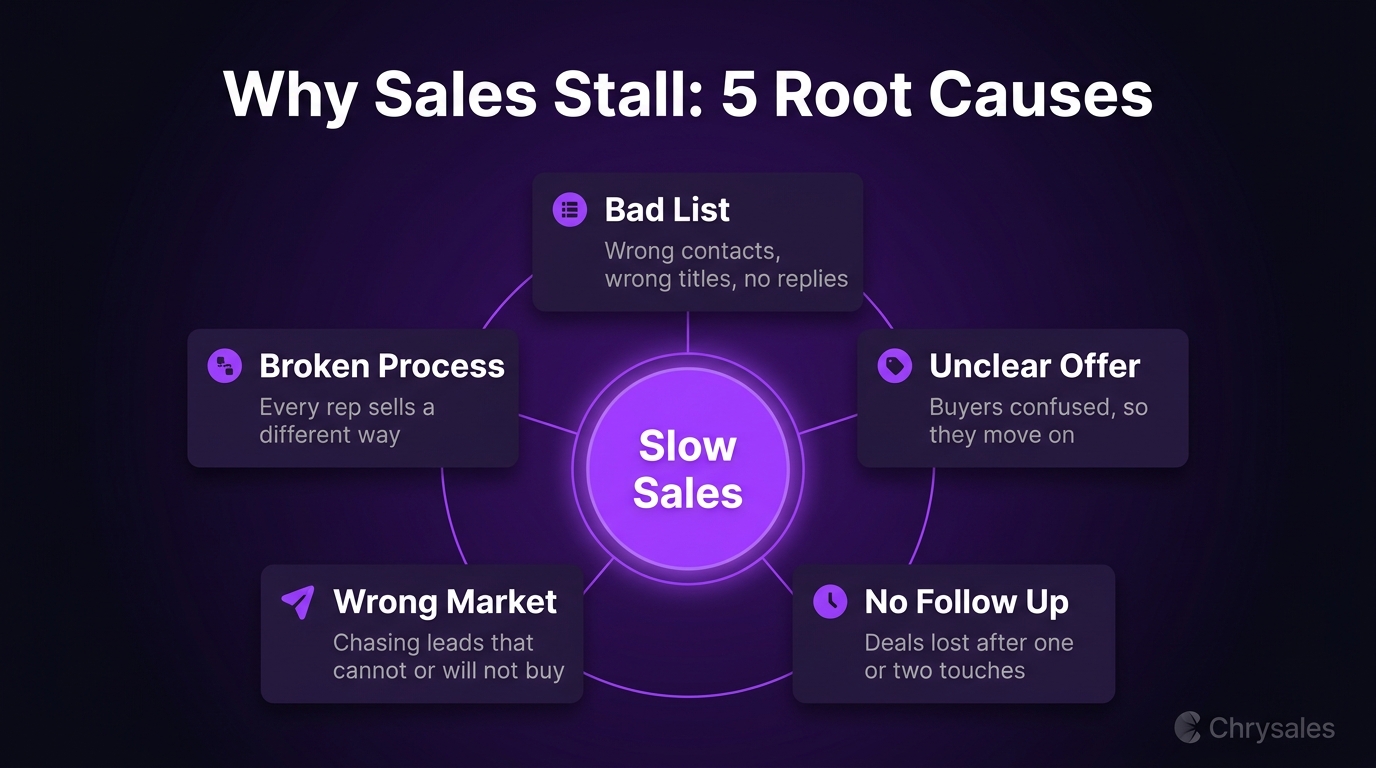
Most B2B sales problems start with an unclear offer. You know what you do. The market doesn't. If someone reads your website or hears your pitch and thinks "okay, but what do you actually do?" you've got an offer problem.
The Offer Is Not the Service
Your offer is not "we do sales consulting" or "we help with lead generation." That's a category, not an offer. The offer is the specific outcome someone gets when they work with you, packaged in a way that makes them want to say yes right now.
Think of your offer like a menu at a restaurant. If the menu just says "food," nobody orders. If it says "wood-fired margherita pizza with San Marzano tomatoes, fresh mozzarella, and basil," people order. The second one is clear. The first one is confusing.
How to Make Your Offer a No-Brainer
Good offers include three things: a clear outcome, a clear timeline, and a reason to act now. "We'll build you a repeatable sales system in 90 days" is better than "we help companies grow sales." One is specific. The other could mean anything.
Common mistake: Adding too many things to the offer. Most teams think more features make the offer better. It doesn't. It makes it confusing. Pick one main outcome. Make it obvious.
One marketing agency we worked with had seven different services on their homepage. Reply rates were low. We helped them build one clear offer around client acquisition. They removed everything else from the pitch. Booked 12 calls in three weeks.
You're Not Following Up (Or You're Doing It Wrong)
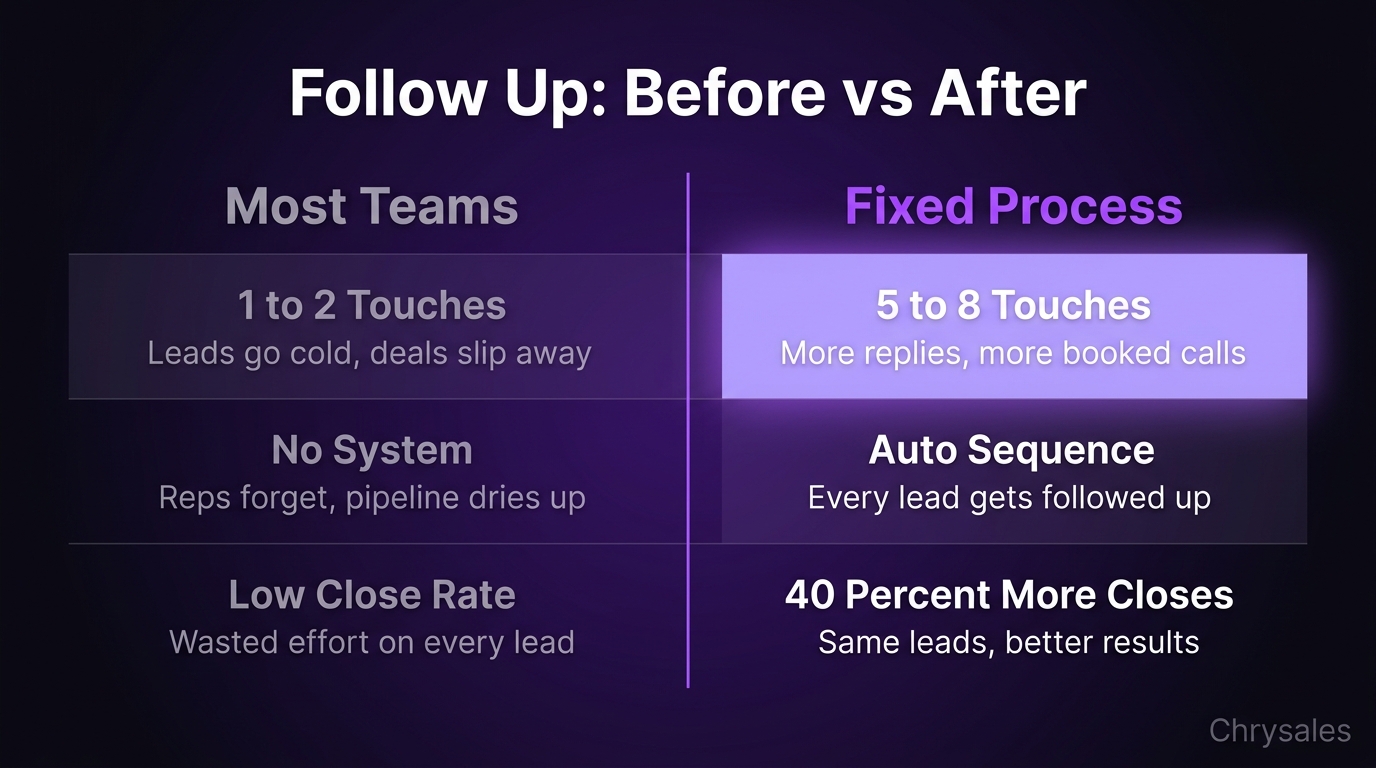
Most deals don't close on the first call. Or the second. But most teams stop following up after one or two tries. That's where poor sales performance starts.
The Follow-Up Process Most Teams Skip
Look, the truth is most people are busy. A prospect can be interested and still forget to reply. If you send one email and give up, you're leaving money on the table. Studies show it takes an average of five to eight touchpoints to close a B2B deal. Most teams stop at two.
Here's what a real follow-up process looks like:
- Day 1: First email
- Day 3: Short follow-up (did you get my last message?)
- Day 7: Share a case study or quick win
- Day 14: Ask a direct question
- Day 21: Last attempt with a clear deadline
That's five touches in three weeks. Simple. Repeatable. Most teams don't do it.
Automate the Follow-Up So It Actually Happens
If you're relying on salespeople to remember to follow up, it won't happen. People get busy. Deals slip through. Use a CRM or email automation tool to schedule follow-ups automatically.
A 15-person consulting firm set up a five-step follow-up sequence last year. They didn't change the messaging. Just made sure every lead got followed up with five times instead of once. Close rates went up 40%. If you need help crafting those messages, check out these proven cold email follow-up templates.
Watch out: Don't spam people. Space out your follow-ups. Make each one add value. If someone says "not interested," stop.
You're Talking to the Wrong People
Sometimes slow sales happen because you're selling to companies that don't need what you offer. Or can't afford it. Or aren't ready to buy.
Targeting the Wrong Segment Wastes Time
A 200-person company that just did layoffs is not a hot lead. It's a bad fit, full stop. But most teams waste weeks chasing deals like that because the company name sounds good.
Targeting mistakes look like this:
- Selling to companies too small to afford your service
- Pitching to people who can't make buying decisions
- Going after industries where your solution doesn't fit
- Chasing companies in the middle of budget freezes
Every hour you spend on a bad-fit prospect is an hour you're not spending on someone who actually wants to buy.
How to Tighten Your Targeting
Go back to your best three clients. Write down everything they have in common. Company size, industry, revenue, team structure, pain points. That's your real target. Now look at your current pipeline. How many leads match that profile? If the answer is less than half, you've found the problem.
Pro Tip: Run a quick qualification checklist before you add anyone to your pipeline. If they don't check at least four out of five boxes, don't waste time on them.
We worked with a tech company that was pitching to everyone. They narrowed their focus to SaaS companies with 20 to 100 employees in three specific industries. Sales cycles got shorter. Close rates doubled.
Your Sales Process Is a Black Box
Most small sales teams don't have a documented process. Every salesperson wings it. One person does discovery their way. Another skips it entirely. Someone else closes with a different pitch every time. That's a recipe for causes of low sales.
What a Real Sales Process Looks Like
A good sales process is like a recipe. Follow the steps, get the same result every time. It doesn't have to be complicated. Most teams build a 40-step workflow when 12 steps would do the job.
Here's a simple B2B sales process that works:
- Lead comes in (cold outreach, referral, inbound)
- Qualification call (do they fit the profile?)
- Discovery call (what's the real problem?)
- Custom pitch (how we solve it)
- Objection handling (answer concerns)
- Close or follow-up
- Onboarding handoff
That's it. Six or seven steps. Everyone follows the same steps. You can train new hires on it in a day.
Document It So You Can Scale It
Write down every step. What questions do you ask in discovery? What objections come up most? How do you handle pricing questions? Turn all of that into a simple doc or checklist.
Once it's documented, new hires can ramp up faster. You can spot where deals are falling apart. You can improve the process based on data, not guesses. Learn more about how to build a sales system that actually scales for your team.
Common mistake: Overcomplicating the process. If your sales process doc is 30 pages long, nobody will use it. Keep it simple. One page is fine.
You're Not Using Data to Improve
Most teams run the same sales process month after month without checking what's working. That's how sales decrease happens slowly over time. You don't notice until the pipeline is empty.
Track the Basics
You don't need a fancy analytics dashboard. Just track these five numbers every week:
- Number of new leads added
- Percentage of leads that book a call
- Percentage of calls that turn into proposals
- Percentage of proposals that close
- Average deal size
If you track those five, you'll spot problems early. Maybe your leads are good but nobody's booking calls. That's a messaging problem. Maybe people book calls but don't close. That's a closing problem.
Fix One Thing at a Time
Once you see where the breakdown is, fix that part first. Don't try to overhaul everything at once. If your email reply rate is low, test new subject lines. If discovery calls aren't converting, rewrite your pitch.
A marketing agency we worked with had a 60% show-up rate for booked calls. That's terrible. Most people were booking and ghosting. We added a reminder sequence and a confirmation call. Show-up rate jumped to 85%. Same leads. Better process.
Pro Tip: Set a simple rule for scoring leads. Anything scoring above 70 goes to the top of your call list. Anything below 40 gets a nurture sequence, not a sales call.
You Haven't Invested in Sales Training
Here's a hard truth: hiring a salesperson without training them is like giving someone car keys and saying "figure out how to drive." It doesn't work. Most B2B sales problems come from undertrained teams.
What Good Sales Training Looks Like
Sales training isn't a one-day workshop. It's ongoing coaching on the skills that matter: how to run discovery calls, how to handle objections, how to close without being pushy, how to position the offer.
Most companies skip this. They hire someone with "five years of sales experience" and assume they'll figure it out. Then six months later, the person quits or underperforms.
Good sales training covers:
- Discovery question frameworks
- Objection scripts for the top five objections
- Pitch structure and delivery
- Follow-up cadences
- CRM and automation tool usage
Train people on your specific process, not generic sales tactics. What works at a SaaS company might not work at a consulting firm. You can also watch how to build a sales system so powerful clients come to you to understand the framework better.
Ongoing Coaching Beats One-Time Training
The best sales teams do weekly coaching sessions. Review calls. Role-play tough objections. Share what's working. It doesn't take long. Thirty minutes a week is enough.
One consulting firm we worked with hired three salespeople in a month. Two quit within 60 days. The fix wasn't more hiring. It was the system around the hires. We built a training program and a coaching rhythm. The next three hires stayed and hit quota within 90 days.
Watch out: Don't assume experience equals skill. Even experienced salespeople need training on your offer, your market, and your process. Avoid these 5 costly mistakes killing your deals by implementing proper training from day one.
Frequently Asked Questions
Q: What's the number one reason for slow sales in most businesses?
Bad lead lists. You can have a great offer and a solid pitch, but if you're talking to the wrong people or outdated contacts, nothing else matters. Start by cleaning your list and tightening your ideal customer profile. Most teams see results within two weeks just from fixing this.
Q: How many follow-ups should I send before giving up on a lead?
Five to eight touchpoints over three to four weeks is the sweet spot for B2B lead generation. Most deals don't close on the first or second contact. Space them out, add value in each message, and stop if someone says they're not interested. Automate the sequence so it actually happens.
Q: How do I know if my offer is the problem?
If people are opening your emails but not replying, or booking calls but not closing, your offer is probably unclear. Test this: explain your offer to someone outside your industry in one sentence. If they don't get it immediately, rewrite it. A good offer is specific, outcome-focused, and easy to understand.
Q: What should I track to spot sales problems early?
Track five things every week: new leads added, percentage that book calls, percentage of calls that turn into proposals, percentage of proposals that close, and average deal size. If one of those numbers drops, you know exactly where the breakdown is happening.
Q: Can I fix slow sales without hiring more people?
Yes. Most slow sales come from process problems, not headcount problems. Fix your list, clarify your offer, build a follow-up system, and document your sales process. We've seen teams double revenue without adding a single hire just by tightening those four things.
Q: How long does it take to see results after fixing these issues?
Most teams see improvement within two to four weeks if they fix the list and follow-up process. Bigger changes like repositioning your offer or training your team take 60 to 90 days. The key is to fix one thing at a time and measure the results before moving to the next.
Q: Should I use AI or automation tools to speed up client acquisition?
Absolutely. Automation tools handle follow-ups, lead scoring, and email sequences so your team can focus on calls and closing. AI tools can help with lead research and personalization at scale. Just don't automate the human parts like discovery calls and relationship building. Use automation to handle repetitive tasks, not replace real conversations.
Reasons for slow sales business challenges are the common issues that hold sales back, like weak lists, unclear offers, poor follow-up, and the wrong target market. You've done everything right. The product works. The team shows up. The website looks good. But sales are still slow. Most people assume it's a marketing problem or bad timing. The truth is simpler. Slow sales usually come from one of five fixable problems: your list is bad, your offer is unclear, your follow-up process doesn't exist, you're talking to the wrong people, or your sales process is a mess. Let's break down each one and how to fix it.
Your Lead List Is Doing Most of the Damage
Here's the thing nobody tells you: the list does most of the heavy lifting. You can write the best cold email in the world, but if you send it to 500 people who aren't buyers, you'll get zero replies. Most slow sales in business start here.
Bad Data Kills Good Outreach
Picture this: you spend two weeks writing perfect emails, but your list is full of people who left the company six months ago. Or they're junior employees with no budget. Or they work at companies too small to afford what you sell. That's not a messaging problem. It's a list problem.
We see this all the time with new clients. They come in frustrated because their reply rates are under 1%. Then we look at the list. Half the contacts are outdated. A third are the wrong job title. The rest work at companies that don't match the ideal customer profile.
Pro Tip: Before you write a single email, clean your list. Remove anyone who doesn't match your buyer profile. Use tools like Apollo or ZoomInfo to verify emails and job titles.
How to Build a List That Actually Converts
Start with a tight ideal customer profile. Write down the exact company size, industry, and job titles you need. Then build the list around that. Don't go wide. Go deep.
A 30-person consulting firm tried this last quarter. They narrowed their list from 2,000 contacts to 400 highly targeted ones. Reply rates jumped from 0.8% to 5.2%. Same email. Better list.
If you're buying lists, ask for samples first. Check five random contacts. If two are wrong, the whole list is probably bad. Walk away. You can also watch 4 Ways To Find Clients Who Need Your Services Right Now for a deeper walkthrough on targeting the right prospects.
Your Offer Sounds Like Everyone Else's
Most B2B sales problems start with an unclear offer. You know what you do. The market doesn't. If someone reads your website or hears your pitch and thinks "okay, but what do you actually do?" you've got an offer problem.
The Offer Is Not the Service
Your offer is not "we do sales consulting" or "we help with lead generation." That's a category, not an offer. The offer is the specific outcome someone gets when they work with you, packaged in a way that makes them want to say yes right now.
Think of your offer like a menu at a restaurant. If the menu just says "food," nobody orders. If it says "wood-fired margherita pizza with San Marzano tomatoes, fresh mozzarella, and basil," people order. The second one is clear. The first one is confusing.
How to Make Your Offer a No-Brainer
Good offers include three things: a clear outcome, a clear timeline, and a reason to act now. "We'll build you a repeatable sales system in 90 days" is better than "we help companies grow sales." One is specific. The other could mean anything.
Common mistake: Adding too many things to the offer. Most teams think more features make the offer better. It doesn't. It makes it confusing. Pick one main outcome. Make it obvious.
One marketing agency we worked with had seven different services on their homepage. Reply rates were low. We helped them build one clear offer around client acquisition. They removed everything else from the pitch. Booked 12 calls in three weeks.
You're Not Following Up (Or You're Doing It Wrong)
Most deals don't close on the first call. Or the second. But most teams stop following up after one or two tries. That's where poor sales performance starts.
The Follow-Up Process Most Teams Skip
Look, the truth is most people are busy. A prospect can be interested and still forget to reply. If you send one email and give up, you're leaving money on the table. Studies show it takes an average of five to eight touchpoints to close a B2B deal. Most teams stop at two.
Here's what a real follow-up process looks like:
- Day 1: First email
- Day 3: Short follow-up (did you get my last message?)
- Day 7: Share a case study or quick win
- Day 14: Ask a direct question
- Day 21: Last attempt with a clear deadline
That's five touches in three weeks. Simple. Repeatable. Most teams don't do it.
Automate the Follow-Up So It Actually Happens
If you're relying on salespeople to remember to follow up, it won't happen. People get busy. Deals slip through. Use a CRM or email automation tool to schedule follow-ups automatically.
A 15-person consulting firm set up a five-step follow-up sequence last year. They didn't change the messaging. Just made sure every lead got followed up with five times instead of once. Close rates went up 40%. If you need help crafting those messages, check out these proven cold email follow-up templates.
Watch out: Don't spam people. Space out your follow-ups. Make each one add value. If someone says "not interested," stop.
You're Talking to the Wrong People
Sometimes slow sales happen because you're selling to companies that don't need what you offer. Or can't afford it. Or aren't ready to buy.
Targeting the Wrong Segment Wastes Time
A 200-person company that just did layoffs is not a hot lead. It's a bad fit, full stop. But most teams waste weeks chasing deals like that because the company name sounds good.
Targeting mistakes look like this:
- Selling to companies too small to afford your service
- Pitching to people who can't make buying decisions
- Going after industries where your solution doesn't fit
- Chasing companies in the middle of budget freezes
Every hour you spend on a bad-fit prospect is an hour you're not spending on someone who actually wants to buy.
How to Tighten Your Targeting
Go back to your best three clients. Write down everything they have in common. Company size, industry, revenue, team structure, pain points. That's your real target. Now look at your current pipeline. How many leads match that profile? If the answer is less than half, you've found the problem.
Pro Tip: Run a quick qualification checklist before you add anyone to your pipeline. If they don't check at least four out of five boxes, don't waste time on them.
We worked with a tech company that was pitching to everyone. They narrowed their focus to SaaS companies with 20 to 100 employees in three specific industries. Sales cycles got shorter. Close rates doubled.
Your Sales Process Is a Black Box
Most small sales teams don't have a documented process. Every salesperson wings it. One person does discovery their way. Another skips it entirely. Someone else closes with a different pitch every time. That's a recipe for causes of low sales.
What a Real Sales Process Looks Like
A good sales process is like a recipe. Follow the steps, get the same result every time. It doesn't have to be complicated. Most teams build a 40-step workflow when 12 steps would do the job.
Here's a simple B2B sales process that works:
- Lead comes in (cold outreach, referral, inbound)
- Qualification call (do they fit the profile?)
- Discovery call (what's the real problem?)
- Custom pitch (how we solve it)
- Objection handling (answer concerns)
- Close or follow-up
- Onboarding handoff
That's it. Six or seven steps. Everyone follows the same steps. You can train new hires on it in a day.
Document It So You Can Scale It
Write down every step. What questions do you ask in discovery? What objections come up most? How do you handle pricing questions? Turn all of that into a simple doc or checklist.
Once it's documented, new hires can ramp up faster. You can spot where deals are falling apart. You can improve the process based on data, not guesses. Learn more about how to build a sales system that actually scales for your team.
Common mistake: Overcomplicating the process. If your sales process doc is 30 pages long, nobody will use it. Keep it simple. One page is fine.
You're Not Using Data to Improve
Most teams run the same sales process month after month without checking what's working. That's how sales decrease happens slowly over time. You don't notice until the pipeline is empty.
Track the Basics
You don't need a fancy analytics dashboard. Just track these five numbers every week:
- Number of new leads added
- Percentage of leads that book a call
- Percentage of calls that turn into proposals
- Percentage of proposals that close
- Average deal size
If you track those five, you'll spot problems early. Maybe your leads are good but nobody's booking calls. That's a messaging problem. Maybe people book calls but don't close. That's a closing problem.
Fix One Thing at a Time
Once you see where the breakdown is, fix that part first. Don't try to overhaul everything at once. If your email reply rate is low, test new subject lines. If discovery calls aren't converting, rewrite your pitch.
A marketing agency we worked with had a 60% show-up rate for booked calls. That's terrible. Most people were booking and ghosting. We added a reminder sequence and a confirmation call. Show-up rate jumped to 85%. Same leads. Better process.
Pro Tip: Set a simple rule for scoring leads. Anything scoring above 70 goes to the top of your call list. Anything below 40 gets a nurture sequence, not a sales call.
You Haven't Invested in Sales Training
Here's a hard truth: hiring a salesperson without training them is like giving someone car keys and saying "figure out how to drive." It doesn't work. Most B2B sales problems come from undertrained teams.
What Good Sales Training Looks Like
Sales training isn't a one-day workshop. It's ongoing coaching on the skills that matter: how to run discovery calls, how to handle objections, how to close without being pushy, how to position the offer.
Most companies skip this. They hire someone with "five years of sales experience" and assume they'll figure it out. Then six months later, the person quits or underperforms.
Good sales training covers:
- Discovery question frameworks
- Objection scripts for the top five objections
- Pitch structure and delivery
- Follow-up cadences
- CRM and automation tool usage
Train people on your specific process, not generic sales tactics. What works at a SaaS company might not work at a consulting firm. You can also watch how to build a sales system so powerful clients come to you to understand the framework better.
Ongoing Coaching Beats One-Time Training
The best sales teams do weekly coaching sessions. Review calls. Role-play tough objections. Share what's working. It doesn't take long. Thirty minutes a week is enough.
One consulting firm we worked with hired three salespeople in a month. Two quit within 60 days. The fix wasn't more hiring. It was the system around the hires. We built a training program and a coaching rhythm. The next three hires stayed and hit quota within 90 days.
Watch out: Don't assume experience equals skill. Even experienced salespeople need training on your offer, your market, and your process. Avoid these 5 costly mistakes killing your deals by implementing proper training from day one.
Frequently Asked Questions
Q: What's the number one reason for slow sales in most businesses?
Bad lead lists. You can have a great offer and a solid pitch, but if you're talking to the wrong people or outdated contacts, nothing else matters. Start by cleaning your list and tightening your ideal customer profile. Most teams see results within two weeks just from fixing this.
Q: How many follow-ups should I send before giving up on a lead?
Five to eight touchpoints over three to four weeks is the sweet spot for B2B lead generation. Most deals don't close on the first or second contact. Space them out, add value in each message, and stop if someone says they're not interested. Automate the sequence so it actually happens.
Q: How do I know if my offer is the problem?
If people are opening your emails but not replying, or booking calls but not closing, your offer is probably unclear. Test this: explain your offer to someone outside your industry in one sentence. If they don't get it immediately, rewrite it. A good offer is specific, outcome-focused, and easy to understand.
Q: What should I track to spot sales problems early?
Track five things every week: new leads added, percentage that book calls, percentage of calls that turn into proposals, percentage of proposals that close, and average deal size. If one of those numbers drops, you know exactly where the breakdown is happening.
Q: Can I fix slow sales without hiring more people?
Yes. Most slow sales come from process problems, not headcount problems. Fix your list, clarify your offer, build a follow-up system, and document your sales process. We've seen teams double revenue without adding a single hire just by tightening those four things.
Q: How long does it take to see results after fixing these issues?
Most teams see improvement within two to four weeks if they fix the list and follow-up process. Bigger changes like repositioning your offer or training your team take 60 to 90 days. The key is to fix one thing at a time and measure the results before moving to the next.
Q: Should I use AI or automation tools to speed up client acquisition?
Absolutely. Automation tools handle follow-ups, lead scoring, and email sequences so your team can focus on calls and closing. AI tools can help with lead research and personalization at scale. Just don't automate the human parts like discovery calls and relationship building. Use automation to handle repetitive tasks, not replace real conversations.
Scaling Is Not Hard If You Have The Right Systems
If you’re serious about leveling up your scaling game, you need the right system, the right training, and the right team behind you. We're here to give you the exact tools and strategies top entrepreneurs use to dominate.

Discover the latest tips
View All.avif)
Chrysales was formed from the words "chrysalis" the stage where a caterpillar transforms into a butterfly and "sales".
It stands for one thing: sales transformation.Because scaling doesn’t happen by doing more of the same. Scaling only happens when you go through real transformation in your systems, your offer, team and the way you sell.
.avif)


