.avif)
Best Outbound Sales Strategy Platforms for Agencies 2025
Best outbound sales strategy platforms for agencies 2025 are tools and systems that help agencies turn cold outreach into predictable client acquisition through better lead generation and follow-up. Most outbound sales strategies fail before the first email even lands. The problem isn't the message. It's the system. Or the lack of one. If you're sending cold emails without a real process behind them, you're basically throwing darts in the dark and hoping one sticks. The truth is, the best outbound sales strategy platforms for agencies 2025 aren't just tools. They're frameworks that turn messy outreach into predictable client acquisition. This guide breaks down what works, what doesn't, and how to build a sales system that actually scales and books meetings.
Why Most Outbound Sales Strategies Fall Apart Before They Start
Here's the thing nobody tells you: the strategy matters more than the tools. A shiny sales engagement platform won't fix a broken process. We see this all the time with new clients. They've got the software. They've got the leads. But they're still stuck at a 1% reply rate because they skipped the fundamentals.
The Real Problem With Most B2B Outbound Sales Strategies
Picture this: you spend two weeks writing perfect cold emails, but your list is full of people who aren't even buyers. That's the trap. Most teams build their outbound sales plan around what they want to sell, not who actually needs it. A 200-person company that just did layoffs is not a "hot lead." It's a bad fit, full stop. The best outbound sales strategy starts with a clear ICP. Not "everyone in tech." Not "companies with 10 to 500 employees." That's too wide. You need to know the exact profile of companies that will actually buy from you. The tighter your targeting, the better your outbound prospecting strategy performs. If you're looking for hands-on guidance, watch how to find clients who need your services right now for a practical walkthrough on sourcing better-fit prospects.
Pro Tip: If your ideal customer profile fits more than 10,000 companies, it's too broad. Narrow it down.
Why Cold Email Outreach B2B Still Works
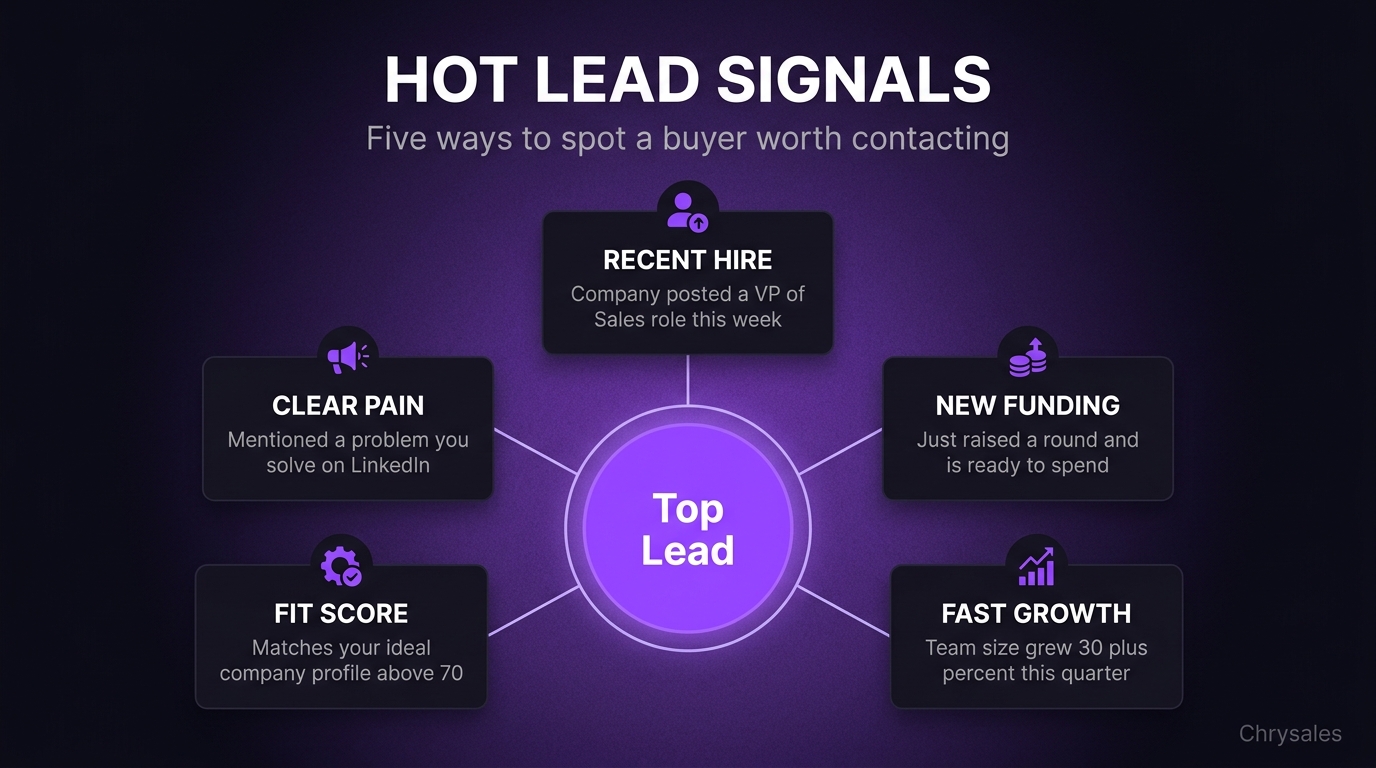
Cold email isn't dead. But cold email done badly is worse than useless. It hurts your domain reputation and wastes time. The difference between a 1% reply rate and a 10% reply rate comes down to three things: list quality, signal based prospecting, and actual personalization. Signal based prospecting means you're reaching out when something just happened. A company raised funding. They posted a job for a VP of Sales. They mentioned a problem you solve on LinkedIn. That's a signal. Sending a generic email to a static list is not a strategy. It's spam.
How to Build an Outbound Sales System That Actually Books Meetings
Think of your sales pipeline like a phone contact list. If half the numbers don't work, no message gets through. The same applies to outbound. A bad list kills everything downstream. Here's how to build it right.
Step 1: Start With List Quality, Not List Size
Most people think bigger lists mean more leads. Wrong. A 500 person list of perfect fit buyers beats a 10,000 person list of random contacts every single time. The best outbound sales strategy platforms for agencies 2025 all start with data enrichment and list cleaning. Use tools that score leads based on fit. Is the company growing? Did they just hire? Are they in your target industry? Set a simple rule: anything scoring above 70 goes to the top of your call list. Everything else gets a slower, less hands on sequence.
Watch out: Most sales engagement platforms let you import huge lists. Just because you can doesn't mean you should.
Step 2: Build Multi-Channel Outbound Sequencing
One cold email doesn't cut it. One LinkedIn message doesn't either. The best B2B lead generation systems use multi channel outbound sequencing. That means email, LinkedIn, and sometimes even cold calling, all working together. Learn more about coordinated multichannel vs omnichannel outreach to see how multi-touch sequences outperform single-channel efforts. Here's what a solid sequence looks like:
- Day 1: Cold email
- Day 3: LinkedIn connection request
- Day 6: Follow up email
- Day 9: LinkedIn message if they accepted
- Day 12: Final email or call attempt
You're not spamming. You're showing up in different places at different times. Most decision makers don't respond to the first touchpoint. They respond to the third or fourth.
Step 3: Personalize Without Losing Your Mind
Effective personalization tactics for outbound sales don't mean writing a unique essay for every prospect. That doesn't scale. But generic templates don't work either. The middle ground is dynamic personalization. Pull in one specific detail per email. Their company name. A recent LinkedIn post. A funding announcement. That's enough to make it feel real. We worked with a tech company that switched from fully generic emails to adding one personalized sentence per message. Their reply rate went from 0.8% to 4.2% in two weeks.
Common mistake: Over personalizing. Mentioning their dog's name from Instagram feels creepy, not thoughtful.
The Role of AI Outbound Sales Automation in 2025
AI is changing how outbound works, but not in the way most people think. AI outbound sales automation isn't about replacing humans. It's about doing the boring stuff faster so humans can focus on actual conversations.
What AI Actually Does Well in Outbound Sales
AI is great at three things: lead scoring, email personalization at scale, and follow up sequencing. It can analyze thousands of data points to tell you which leads are most likely to respond. It can write first drafts of emails that sound human. It can remind you to follow up at the right time. What AI can't do: close deals. Handle objections. Build relationships. That's still on you. The best AI SDR tools for 2025 use AI to speed up the manual work, not replace the sales skills that actually matter. A 15 person consulting firm we worked with started using AI for lead scoring. Before, their team was calling everyone on the list in random order. After AI ranked the leads, they focused on the top 20% first. Meeting bookings doubled in the first month.
How to Add AI to Your Outbound Sales Plan Without Overcomplicating It
You don't need ten AI tools. Start with one or two. Use AI for lead scoring. Use it to suggest email subject lines. Use it to flag high intent prospects based on website visits or LinkedIn activity. Most teams build a 40 step workflow when 12 steps would do the job. Keep it simple. AI should make your life easier, not add another layer of complexity.
Comparing the Best Outbound Sales Strategy Software for B2B
Not all sales engagement platforms are built the same. Some are great for cold email. Some are better for LinkedIn. Some handle calling. Here's how to pick the right one.
What to Look for in Sales Engagement Platforms
You need a platform that handles multi channel outbound sequencing without making you log into five different tools. Look for these features:
- Email tracking and deliverability monitoring
- LinkedIn integration for connection requests and messages
- Built in CRM or strong CRM sync
- A/B testing for subject lines and message variants
- Lead scoring and prioritization
If the platform doesn't track deliverability, walk away. Sending emails that land in spam is worse than not sending them at all.
Popular Platforms and What They're Actually Good For
Some platforms focus on volume. Others focus on precision. The right choice depends on your outbound sales techniques and how hands on your team wants to be. High volume platforms work if you have a big list and want to automate most of the outreach. Precision platforms work better if you're targeting a small number of high value accounts and want to customize every step. Understanding how to structure your sales sequence strategy will help you choose the right platform for your needs.
Pro Tip: Test two platforms for 30 days before committing. Most offer free trials. See which one your team actually uses.
How to Build an Outbound Sales Team That Doesn't Fall Apart
Tools are half the equation. The other half is people. Hiring the wrong salesperson can set you back months. Hiring the right one and not training them is just as bad.
When to Hire for Outbound Sales and What Roles to Start With
Most small sales teams start with one person doing everything: prospecting, calling, closing. That works until it doesn't. The moment you hit capacity, it's time to split roles. Start with a setter. Their job is booking meetings, not closing deals. They handle cold outreach, follow ups, and qualifying leads. Once you're booking more meetings than your closer can handle, add another closer. Don't hire three people at once and hope it works out. Understanding why your first sales hire fails can help you avoid common hiring mistakes. One marketing agency hired three salespeople in a month. Two quit within 60 days. The problem wasn't the hires. It was the lack of a system around them.
The Ideal Outbound Sales Team Structure for Growing B2B Companies
For most teams under 20 people, this structure works:
- 1-2 setters handling all outbound prospecting
- 1 closer running discovery calls and demos
- 1 person (often the founder early on) managing the overall sales process and training
As you scale past 20, you can add specialized roles like a sales ops person to manage the tools and data, or a head of sales to run the whole function. But early on, keep it simple. Three roles, clear responsibilities, and a repeatable process.
How Chrysales Builds Custom Outbound Programs That Actually Scale
Most agencies and consulting firms try to copy paste someone else's outbound sales strategy. It doesn't work. What works for a SaaS company won't work for a consulting firm. What works for a $50k deal won't work for a $5k one. Chrysales builds custom outbound systems based on how your business actually sells. Not a generic template. We start with your offer, your ICP, and your close rate. Then we build the lead generation system, the messaging, and the follow up sequences around that. We've trained 1,000+ business owners and 500+ sales teams. We know what works. And more importantly, we know what doesn't. The difference between a 2% close rate and a 20% close rate usually isn't the pitch. It's the system that got the lead to the call in the first place. If your outbound isn't booking enough meetings, or your sales team is inconsistent, or you're stuck doing all the selling yourself, that's what we fix. We don't sell you a course. We build the system with you, 1 on 1, and make sure it actually works before we move on.
Outbound Sales Best Practices That Never Change
Platforms change. Tools change. But some things stay the same. Follow these and your outbound will always outperform most competitors.
Consistency Beats Perfection
A good outbound sales plan run every week beats a perfect plan run once a month. Most teams spend two months building the perfect sequence, send it once, get mediocre results, and give up. Don't do that. Send your first version. Track the results. Tweak it. Send it again. A/B testing B2B outbound sales sequences benefits you only if you actually run the tests. Send version A to half your list, version B to the other half. See which one gets more replies. Use the winner. Repeat.
Watch out: Changing too much too fast. Test one variable at a time or you won't know what's working.
Always Follow Up More Than You Think You Should
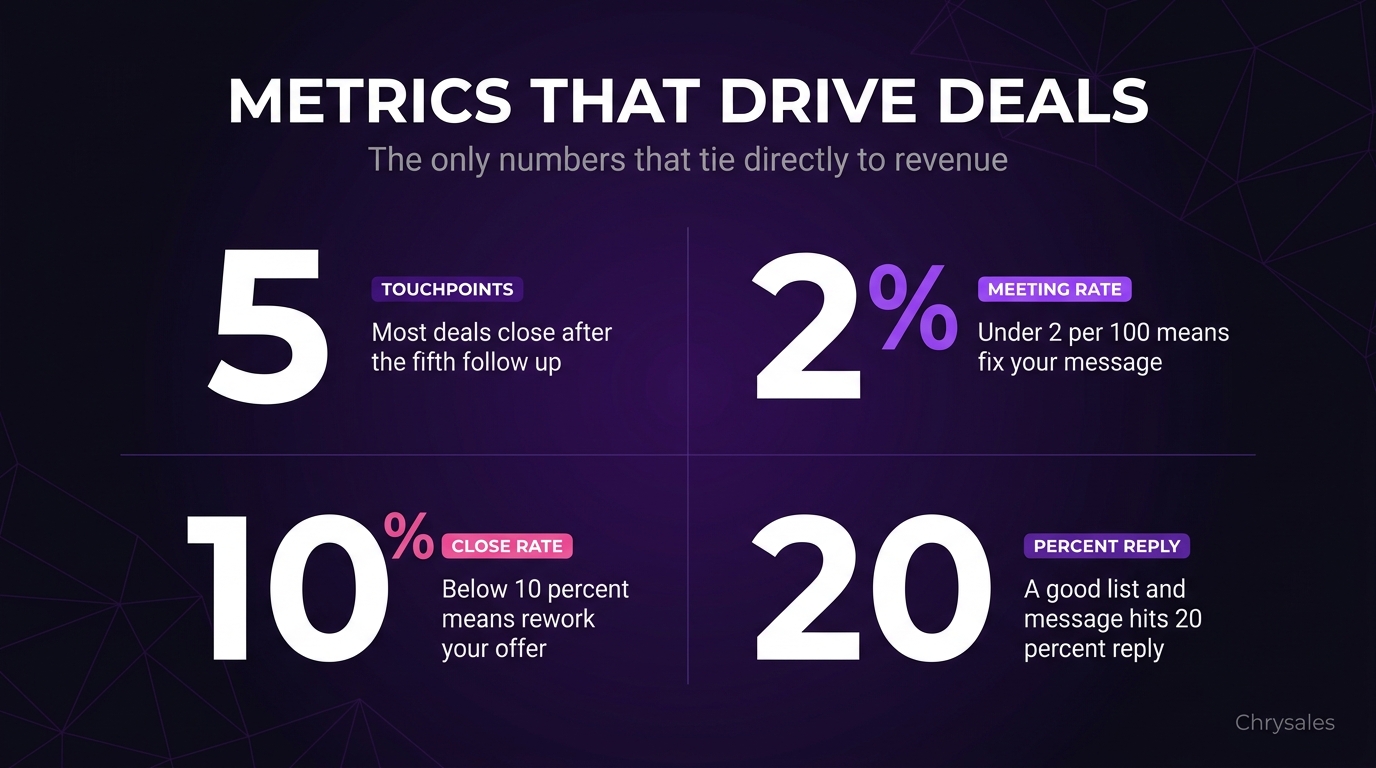
Most people give up after two emails. The best SDR outbound strategy involves at least five touchpoints. We've seen deals close on the eighth follow up. Not because the prospect was ignoring the first seven. They were just busy. Set up your sequences to follow up automatically. Don't rely on memory. If someone doesn't reply, the system should ping them again in three days. Then a week. Then two weeks. Until they reply or opt out.
Track the Right Metrics, Not Just Vanity Numbers
Open rates don't matter if no one replies. Reply rates don't matter if no one books a call. The only metrics that actually matter for predictable client acquisition are:
- Meetings booked per 100 leads contacted
- Show up rate for booked meetings
- Close rate from meeting to deal
Everything else is noise. Track the numbers that tie directly to revenue. If your meetings booked per 100 leads is under 2, your targeting or messaging is off. If your close rate is under 10%, your offer or discovery process needs work.
Common Mistakes That Kill Outbound Sales Strategies
Even good teams make these mistakes. The faster you catch them, the faster your results improve.
Mistake 1: Sending High Volume Without Testing First
Sending 10,000 emails before you know your message works is a great way to burn your domain and get zero results. Start small. Send 100 emails. See what happens. If your reply rate is under 2%, don't scale. Fix the message first.
Mistake 2: Ignoring Deliverability
Your cold email outreach B2B means nothing if your emails land in spam. Warm up your domain. Use a dedicated sending domain. Monitor your sender score. Most platforms have deliverability tools built in. Use them. Following proven outbound email marketing best practices can help you avoid these common pitfalls. One 30 person consulting firm we worked with had a 0% reply rate. Turns out, 90% of their emails were going to spam. They fixed their domain setup, warmed it up for two weeks, and their reply rate jumped to 3.5%.
Mistake 3: No Clear Next Step
Every email, every LinkedIn message, every call should end with a clear next step. "Let me know if you're interested" is not a next step. "Are you free Tuesday at 2pm for a quick 15 minute call?" is. Make it easy for the prospect to say yes. The harder you make it, the fewer yeses you'll get.
Frequently Asked Questions
Q: What's the best outbound sales strategy for agencies starting from zero?
Start with a tight ICP and a small, high quality list. Don't buy a list of 50,000 contacts. Build a list of 200 companies that perfectly match your ideal customer. Then reach out with a simple, personalized email offering one clear value point. Track replies and meetings. Once you hit 5% reply rate and 20% meeting to close rate, scale the volume. Most teams skip the testing phase and wonder why nothing works.
Q: How long does it take to see results from a new outbound sales plan?
If your list and offer are solid, you should see replies within the first week. Meetings booked within two weeks. Deals closed within 30 to 60 days depending on your sales cycle. If you're not seeing any replies in the first two weeks, something's off. Either the targeting, the message, or the deliverability. Don't wait three months to find out.
Q: Do I need expensive software to run a successful outbound sales strategy?
No. You need a good process first. Software helps you scale it. You can start with basic tools like a CRM, a simple email platform, and LinkedIn. As you grow and want to automate more, add a sales engagement platform. But don't buy ten tools before you've proven your message works. Expensive software won't fix a weak offer or bad targeting.
Q: How do I know if my outbound sales team structure is working?
Look at activity and results. Are your setters booking enough meetings? Are your closers converting those meetings into deals? If setters are booking meetings but closers aren't closing, the problem is your sales process or offer. If setters aren't booking meetings, the problem is targeting or messaging. Track meetings per setter per week and close rate per closer. If those numbers are flat or dropping, your structure needs a fix.
Q: What's the difference between inbound and outbound for B2B lead generation?
Inbound is when leads come to you. They find your content, your website, your LinkedIn posts. Outbound is when you go to them. Cold emails, cold calls, LinkedIn messages. Inbound takes longer to build but converts better because leads are warmer. Outbound gives you control and speed but requires more effort per lead. Most growing B2B companies use both. Outbound fills the pipeline while inbound builds over time.
Q: Can AI really replace human salespeople in outbound?
Not even close. AI can automate lead scoring, email drafts, and follow up reminders. It can save time on repetitive tasks. But it can't handle real objections, build trust, or close complex deals. The best outbound sales strategy tools 2025 use AI to support salespeople, not replace them. Think of AI as the assistant that does the boring stuff so your team can focus on the conversations that actually matter.
Q: How do I fix inconsistent messaging in sales across my outbound team?
Build a playbook. Write down your pitch, your discovery questions, your objection responses, and your email templates. Make sure everyone uses the same core message but personalizes delivery. Record your best sales calls and have the team listen. Run weekly role plays. Inconsistent messaging usually means no clear process. Once you document what works and train everyone on it, consistency follows.
Best outbound sales strategy platforms for agencies 2025 are tools and systems that help agencies turn cold outreach into predictable client acquisition through better lead generation and follow-up. Most outbound sales strategies fail before the first email even lands. The problem isn't the message. It's the system. Or the lack of one. If you're sending cold emails without a real process behind them, you're basically throwing darts in the dark and hoping one sticks. The truth is, the best outbound sales strategy platforms for agencies 2025 aren't just tools. They're frameworks that turn messy outreach into predictable client acquisition. This guide breaks down what works, what doesn't, and how to build a sales system that actually scales and books meetings.
Why Most Outbound Sales Strategies Fall Apart Before They Start
Here's the thing nobody tells you: the strategy matters more than the tools. A shiny sales engagement platform won't fix a broken process. We see this all the time with new clients. They've got the software. They've got the leads. But they're still stuck at a 1% reply rate because they skipped the fundamentals.
The Real Problem With Most B2B Outbound Sales Strategies
Picture this: you spend two weeks writing perfect cold emails, but your list is full of people who aren't even buyers. That's the trap. Most teams build their outbound sales plan around what they want to sell, not who actually needs it. A 200-person company that just did layoffs is not a "hot lead." It's a bad fit, full stop. The best outbound sales strategy starts with a clear ICP. Not "everyone in tech." Not "companies with 10 to 500 employees." That's too wide. You need to know the exact profile of companies that will actually buy from you. The tighter your targeting, the better your outbound prospecting strategy performs. If you're looking for hands-on guidance, watch how to find clients who need your services right now for a practical walkthrough on sourcing better-fit prospects.
Pro Tip: If your ideal customer profile fits more than 10,000 companies, it's too broad. Narrow it down.
Why Cold Email Outreach B2B Still Works
Cold email isn't dead. But cold email done badly is worse than useless. It hurts your domain reputation and wastes time. The difference between a 1% reply rate and a 10% reply rate comes down to three things: list quality, signal based prospecting, and actual personalization. Signal based prospecting means you're reaching out when something just happened. A company raised funding. They posted a job for a VP of Sales. They mentioned a problem you solve on LinkedIn. That's a signal. Sending a generic email to a static list is not a strategy. It's spam.
How to Build an Outbound Sales System That Actually Books Meetings
Think of your sales pipeline like a phone contact list. If half the numbers don't work, no message gets through. The same applies to outbound. A bad list kills everything downstream. Here's how to build it right.
Step 1: Start With List Quality, Not List Size
Most people think bigger lists mean more leads. Wrong. A 500 person list of perfect fit buyers beats a 10,000 person list of random contacts every single time. The best outbound sales strategy platforms for agencies 2025 all start with data enrichment and list cleaning. Use tools that score leads based on fit. Is the company growing? Did they just hire? Are they in your target industry? Set a simple rule: anything scoring above 70 goes to the top of your call list. Everything else gets a slower, less hands on sequence.
Watch out: Most sales engagement platforms let you import huge lists. Just because you can doesn't mean you should.
Step 2: Build Multi-Channel Outbound Sequencing
One cold email doesn't cut it. One LinkedIn message doesn't either. The best B2B lead generation systems use multi channel outbound sequencing. That means email, LinkedIn, and sometimes even cold calling, all working together. Learn more about coordinated multichannel vs omnichannel outreach to see how multi-touch sequences outperform single-channel efforts. Here's what a solid sequence looks like:
- Day 1: Cold email
- Day 3: LinkedIn connection request
- Day 6: Follow up email
- Day 9: LinkedIn message if they accepted
- Day 12: Final email or call attempt
You're not spamming. You're showing up in different places at different times. Most decision makers don't respond to the first touchpoint. They respond to the third or fourth.
Step 3: Personalize Without Losing Your Mind
Effective personalization tactics for outbound sales don't mean writing a unique essay for every prospect. That doesn't scale. But generic templates don't work either. The middle ground is dynamic personalization. Pull in one specific detail per email. Their company name. A recent LinkedIn post. A funding announcement. That's enough to make it feel real. We worked with a tech company that switched from fully generic emails to adding one personalized sentence per message. Their reply rate went from 0.8% to 4.2% in two weeks.
Common mistake: Over personalizing. Mentioning their dog's name from Instagram feels creepy, not thoughtful.
The Role of AI Outbound Sales Automation in 2025
AI is changing how outbound works, but not in the way most people think. AI outbound sales automation isn't about replacing humans. It's about doing the boring stuff faster so humans can focus on actual conversations.
What AI Actually Does Well in Outbound Sales
AI is great at three things: lead scoring, email personalization at scale, and follow up sequencing. It can analyze thousands of data points to tell you which leads are most likely to respond. It can write first drafts of emails that sound human. It can remind you to follow up at the right time. What AI can't do: close deals. Handle objections. Build relationships. That's still on you. The best AI SDR tools for 2025 use AI to speed up the manual work, not replace the sales skills that actually matter. A 15 person consulting firm we worked with started using AI for lead scoring. Before, their team was calling everyone on the list in random order. After AI ranked the leads, they focused on the top 20% first. Meeting bookings doubled in the first month.
How to Add AI to Your Outbound Sales Plan Without Overcomplicating It
You don't need ten AI tools. Start with one or two. Use AI for lead scoring. Use it to suggest email subject lines. Use it to flag high intent prospects based on website visits or LinkedIn activity. Most teams build a 40 step workflow when 12 steps would do the job. Keep it simple. AI should make your life easier, not add another layer of complexity.
Comparing the Best Outbound Sales Strategy Software for B2B
Not all sales engagement platforms are built the same. Some are great for cold email. Some are better for LinkedIn. Some handle calling. Here's how to pick the right one.
What to Look for in Sales Engagement Platforms
You need a platform that handles multi channel outbound sequencing without making you log into five different tools. Look for these features:
- Email tracking and deliverability monitoring
- LinkedIn integration for connection requests and messages
- Built in CRM or strong CRM sync
- A/B testing for subject lines and message variants
- Lead scoring and prioritization
If the platform doesn't track deliverability, walk away. Sending emails that land in spam is worse than not sending them at all.
Popular Platforms and What They're Actually Good For
Some platforms focus on volume. Others focus on precision. The right choice depends on your outbound sales techniques and how hands on your team wants to be. High volume platforms work if you have a big list and want to automate most of the outreach. Precision platforms work better if you're targeting a small number of high value accounts and want to customize every step. Understanding how to structure your sales sequence strategy will help you choose the right platform for your needs.
Pro Tip: Test two platforms for 30 days before committing. Most offer free trials. See which one your team actually uses.
How to Build an Outbound Sales Team That Doesn't Fall Apart
Tools are half the equation. The other half is people. Hiring the wrong salesperson can set you back months. Hiring the right one and not training them is just as bad.
When to Hire for Outbound Sales and What Roles to Start With
Most small sales teams start with one person doing everything: prospecting, calling, closing. That works until it doesn't. The moment you hit capacity, it's time to split roles. Start with a setter. Their job is booking meetings, not closing deals. They handle cold outreach, follow ups, and qualifying leads. Once you're booking more meetings than your closer can handle, add another closer. Don't hire three people at once and hope it works out. Understanding why your first sales hire fails can help you avoid common hiring mistakes. One marketing agency hired three salespeople in a month. Two quit within 60 days. The problem wasn't the hires. It was the lack of a system around them.
The Ideal Outbound Sales Team Structure for Growing B2B Companies
For most teams under 20 people, this structure works:
- 1-2 setters handling all outbound prospecting
- 1 closer running discovery calls and demos
- 1 person (often the founder early on) managing the overall sales process and training
As you scale past 20, you can add specialized roles like a sales ops person to manage the tools and data, or a head of sales to run the whole function. But early on, keep it simple. Three roles, clear responsibilities, and a repeatable process.
How Chrysales Builds Custom Outbound Programs That Actually Scale
Most agencies and consulting firms try to copy paste someone else's outbound sales strategy. It doesn't work. What works for a SaaS company won't work for a consulting firm. What works for a $50k deal won't work for a $5k one. Chrysales builds custom outbound systems based on how your business actually sells. Not a generic template. We start with your offer, your ICP, and your close rate. Then we build the lead generation system, the messaging, and the follow up sequences around that. We've trained 1,000+ business owners and 500+ sales teams. We know what works. And more importantly, we know what doesn't. The difference between a 2% close rate and a 20% close rate usually isn't the pitch. It's the system that got the lead to the call in the first place. If your outbound isn't booking enough meetings, or your sales team is inconsistent, or you're stuck doing all the selling yourself, that's what we fix. We don't sell you a course. We build the system with you, 1 on 1, and make sure it actually works before we move on.
Outbound Sales Best Practices That Never Change
Platforms change. Tools change. But some things stay the same. Follow these and your outbound will always outperform most competitors.
Consistency Beats Perfection
A good outbound sales plan run every week beats a perfect plan run once a month. Most teams spend two months building the perfect sequence, send it once, get mediocre results, and give up. Don't do that. Send your first version. Track the results. Tweak it. Send it again. A/B testing B2B outbound sales sequences benefits you only if you actually run the tests. Send version A to half your list, version B to the other half. See which one gets more replies. Use the winner. Repeat.
Watch out: Changing too much too fast. Test one variable at a time or you won't know what's working.
Always Follow Up More Than You Think You Should
Most people give up after two emails. The best SDR outbound strategy involves at least five touchpoints. We've seen deals close on the eighth follow up. Not because the prospect was ignoring the first seven. They were just busy. Set up your sequences to follow up automatically. Don't rely on memory. If someone doesn't reply, the system should ping them again in three days. Then a week. Then two weeks. Until they reply or opt out.
Track the Right Metrics, Not Just Vanity Numbers
Open rates don't matter if no one replies. Reply rates don't matter if no one books a call. The only metrics that actually matter for predictable client acquisition are:
- Meetings booked per 100 leads contacted
- Show up rate for booked meetings
- Close rate from meeting to deal
Everything else is noise. Track the numbers that tie directly to revenue. If your meetings booked per 100 leads is under 2, your targeting or messaging is off. If your close rate is under 10%, your offer or discovery process needs work.
Common Mistakes That Kill Outbound Sales Strategies
Even good teams make these mistakes. The faster you catch them, the faster your results improve.
Mistake 1: Sending High Volume Without Testing First
Sending 10,000 emails before you know your message works is a great way to burn your domain and get zero results. Start small. Send 100 emails. See what happens. If your reply rate is under 2%, don't scale. Fix the message first.
Mistake 2: Ignoring Deliverability
Your cold email outreach B2B means nothing if your emails land in spam. Warm up your domain. Use a dedicated sending domain. Monitor your sender score. Most platforms have deliverability tools built in. Use them. Following proven outbound email marketing best practices can help you avoid these common pitfalls. One 30 person consulting firm we worked with had a 0% reply rate. Turns out, 90% of their emails were going to spam. They fixed their domain setup, warmed it up for two weeks, and their reply rate jumped to 3.5%.
Mistake 3: No Clear Next Step
Every email, every LinkedIn message, every call should end with a clear next step. "Let me know if you're interested" is not a next step. "Are you free Tuesday at 2pm for a quick 15 minute call?" is. Make it easy for the prospect to say yes. The harder you make it, the fewer yeses you'll get.
Frequently Asked Questions
Q: What's the best outbound sales strategy for agencies starting from zero?
Start with a tight ICP and a small, high quality list. Don't buy a list of 50,000 contacts. Build a list of 200 companies that perfectly match your ideal customer. Then reach out with a simple, personalized email offering one clear value point. Track replies and meetings. Once you hit 5% reply rate and 20% meeting to close rate, scale the volume. Most teams skip the testing phase and wonder why nothing works.
Q: How long does it take to see results from a new outbound sales plan?
If your list and offer are solid, you should see replies within the first week. Meetings booked within two weeks. Deals closed within 30 to 60 days depending on your sales cycle. If you're not seeing any replies in the first two weeks, something's off. Either the targeting, the message, or the deliverability. Don't wait three months to find out.
Q: Do I need expensive software to run a successful outbound sales strategy?
No. You need a good process first. Software helps you scale it. You can start with basic tools like a CRM, a simple email platform, and LinkedIn. As you grow and want to automate more, add a sales engagement platform. But don't buy ten tools before you've proven your message works. Expensive software won't fix a weak offer or bad targeting.
Q: How do I know if my outbound sales team structure is working?
Look at activity and results. Are your setters booking enough meetings? Are your closers converting those meetings into deals? If setters are booking meetings but closers aren't closing, the problem is your sales process or offer. If setters aren't booking meetings, the problem is targeting or messaging. Track meetings per setter per week and close rate per closer. If those numbers are flat or dropping, your structure needs a fix.
Q: What's the difference between inbound and outbound for B2B lead generation?
Inbound is when leads come to you. They find your content, your website, your LinkedIn posts. Outbound is when you go to them. Cold emails, cold calls, LinkedIn messages. Inbound takes longer to build but converts better because leads are warmer. Outbound gives you control and speed but requires more effort per lead. Most growing B2B companies use both. Outbound fills the pipeline while inbound builds over time.
Q: Can AI really replace human salespeople in outbound?
Not even close. AI can automate lead scoring, email drafts, and follow up reminders. It can save time on repetitive tasks. But it can't handle real objections, build trust, or close complex deals. The best outbound sales strategy tools 2025 use AI to support salespeople, not replace them. Think of AI as the assistant that does the boring stuff so your team can focus on the conversations that actually matter.
Q: How do I fix inconsistent messaging in sales across my outbound team?
Build a playbook. Write down your pitch, your discovery questions, your objection responses, and your email templates. Make sure everyone uses the same core message but personalizes delivery. Record your best sales calls and have the team listen. Run weekly role plays. Inconsistent messaging usually means no clear process. Once you document what works and train everyone on it, consistency follows.
Scaling Is Not Hard If You Have The Right Systems
If you’re serious about leveling up your scaling game, you need the right system, the right training, and the right team behind you. We're here to give you the exact tools and strategies top entrepreneurs use to dominate.

Discover the latest tips
View All.avif)
Chrysales was formed from the words "chrysalis" the stage where a caterpillar transforms into a butterfly and "sales".
It stands for one thing: sales transformation.Because scaling doesn’t happen by doing more of the same. Scaling only happens when you go through real transformation in your systems, your offer, team and the way you sell.
.avif)


