
Mutual action plan: a one-page template for B2B deals
A mutual action plan is one shared page. It lists every step you and your buyer still need to take before the work starts. Each step has an owner and a due day.
You draft it after a good discovery call (the call where you learn about their problem). Then you agree on it with the buyer and update it after every meeting. Use it when a deal has several steps or several people.
It targets a familiar problem. The meeting went well, you sent the proposal, and then nothing happens for weeks. A plan you both agreed on gives you a reason to ask about the silence early, while you still can.
What a mutual action plan is
A mutual action plan is a written list of the steps both sides take to get from "this looks right" to "the work has started". The buyer sees it and edits it, and owns some of the steps.
Some companies call it a mutual close plan. GitLab's public handbook describes it as "a visual timeline of all the necessary tasks, individuals, and deadlines". It runs through closing and into rollout.
In GitLab's sales stages, the proposal stage only ends when both sides agree on the plan and its dates.
Often more people decide than you ever talk to. Gartner says buying groups range from five to 16 people, across as many as four functions, meaning different departments.
Many deals also never get a clear no. Matt Dixon's team studied about 2.5 million recorded sales conversations. In an interview about that research, he says between 40 and 60% of deals are lost to the customer doing nothing.
Keep your hopes realistic, though. We found no independent study showing that these plans help you win more deals. The figures we found online come from firms that sell plan software.
Use the page to spot early which deals are stuck, and judge it by that. When every stage of your deals drags, start with how to shorten a B2B sales cycle.
What to put on the page
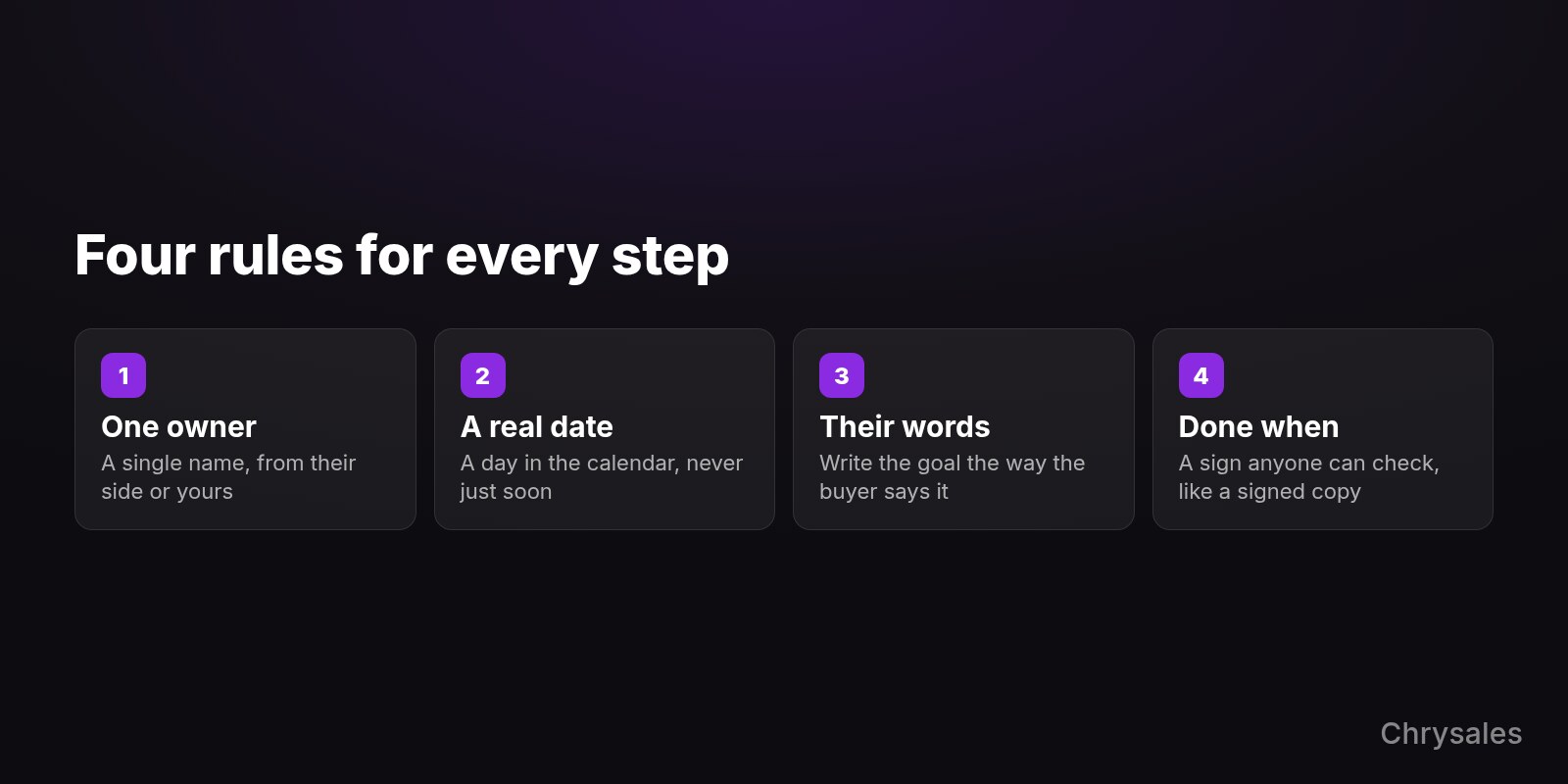
Put the buyer's goal and a date that matters to them at the top, then the steps that lead there. The image below shows the four rules every step should meet.
Here is a filled-in example. The company and people are made up: a 40-person B2B company buying a service from you.
OUR PLAN: [Your company] + a 40-person B2B company
Their goal: "the new process runs before our busy season"
Work starts: 2 March

1. Agree on the problem and what it costs them
   Who: Anna (operations lead) + you | By: 14 Jan
   Done when: Anna confirms it by email
2. Meet Tom, who approves the budget
   Who: Anna sets it up | By: 21 Jan
   Done when: the meeting has happened
3. Walk through the proposal together, live
   Who: you | By: 28 Jan
   Done when: Tom's questions are answered
4. Legal review of the contract
   Who: their lawyer | By: 11 Feb
   Done when: comments are sent back
5. Procurement paperwork (new supplier form)
   Who: their finance team | By: 18 Feb
   Done when: you are set up as a supplier
6. Contract signed
   Who: Tom | By: 23 Feb
   Done when: both sides have the signed copy
7. First work meeting
   Who: you + Anna | By: 2 March
   Done when: the work has started

Next check-in: 20 Jan, 10:00 (already in both calendars)
The decision-maker is the person who can say yes to the money. Here, that is Tom.
Legal review means their lawyer reads your contract. Procurement is the buying department's paperwork, such as the form that adds you as a supplier.
Check that both sides have names on it. "A plan where every owner is the rep is a to-do list, not a mutual plan," says Matt Bolian, co-founder of Supered. The rep is the salesperson, so here that means you.
A plan with no next meeting on the calendar "dies between calls", Bolian adds, so book the check-in before you share the page.
Step 3 is where your proposal comes in, so make sure you know what to put in the proposal itself.
When and how to bring it up
Bring it up once the buyer agrees the problem is worth solving and names a date that matters to them. That is usually the end of the discovery call or the meeting after it, and at the latest when you send the proposal.
Too early, and it feels like you're running their project before they have decided anything. If your calls don't get to that point yet, start with a discovery call that ends with a dated next step.
How you offer it matters as much as when. Dakota McKenzie writes that these plans feel awkward when the buyer feels "like they're being given homework or micromanaged by you". In other words, told what to do.
McKenzie's fix is to present the plan as a way to make sure the work both sides put in doesn't go to waste.
So don't send a finished plan. Draft the first few steps, suggest dates, and let the buyer correct them. You could say something like this:
"You said the new process has to run before your busy season.
A few things need to happen on both sides before then.
Can I write them on one page, with a name and a date for each?
I'll fill in what I know, and you fix what I got wrong."
Before you suggest a plan, you need a good conversation. In this video, Sabir goes through seven levels of a salesperson, from the Amateur to the Master. It's about selling in general, not about action plans.
When the buyer ignores the plan
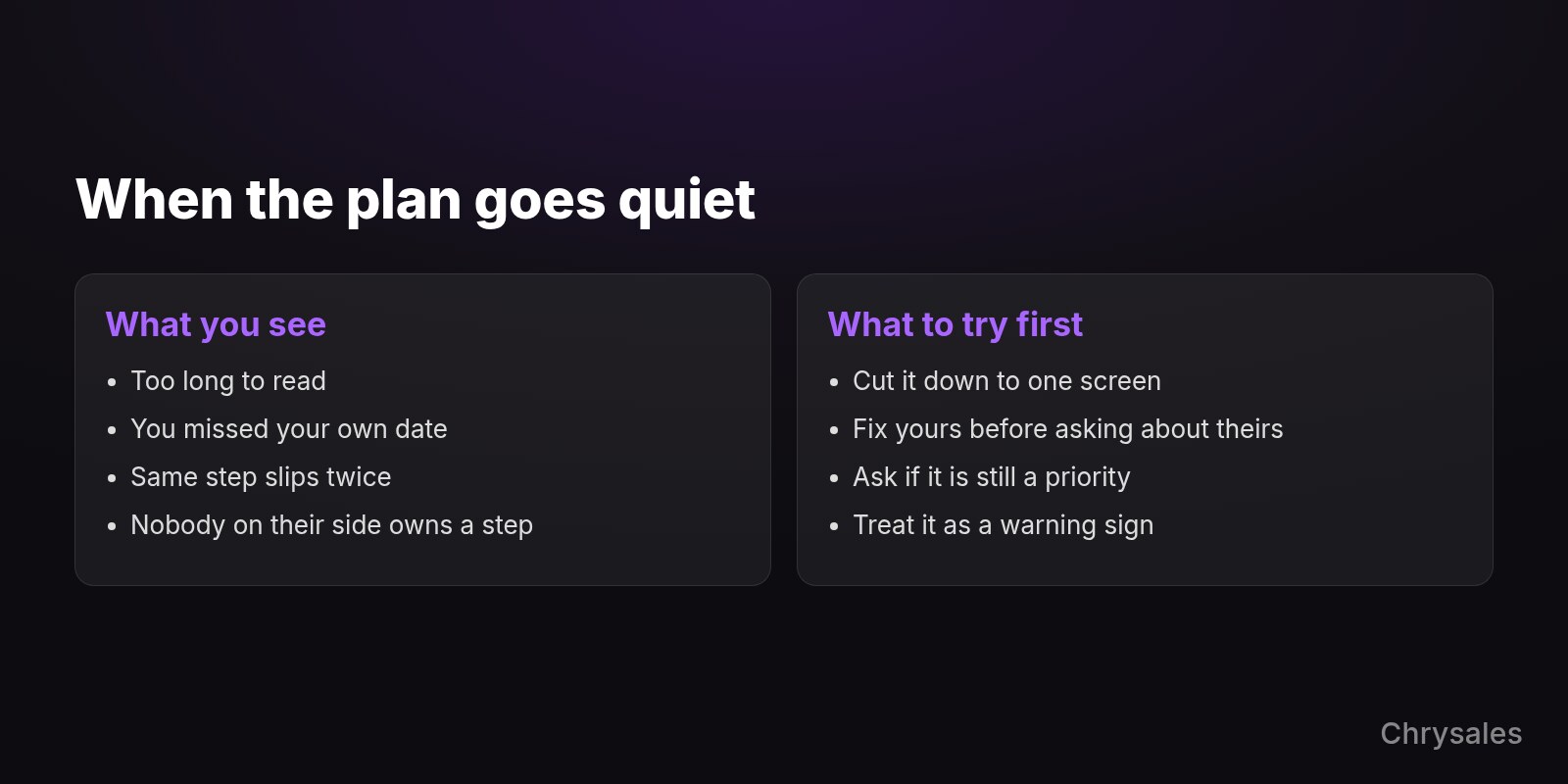
Check the plan first, then the deal. Someone who ignores a long, one-sided page may still want to buy. Someone who misses every deadline may not.
"Most of the time buyers just ignore them," wrote a seller on Reddit's r/sales.
The seller's fix was to make the plan useful to the buyer. When buyers asked for security documents, the seller put them in a folder and linked it from the security review step.
When a single deadline slips, ask about it the next day. Keep it short and give them an easy way to say what changed:
Hi Anna, the legal review was planned for 11 Feb and I haven't
seen comments yet. Has something changed on your side?
If early March no longer works, tell me and we'll move the
dates or pause the plan.
A clear answer, even a no, is better than months of silence. If the reply is a vague "we need more time", here is how to handle "I need to think about it".
When you don't need one
Skip the plan when one person decides and the process is simple. A guide from Rework names exactly that case: a "single decision-maker, simple process".
A small extra sale to a client you already have usually needs a single agreed next meeting, nothing more. Save the plan for deals with several people, paperwork or a fixed start date.
Rework also calls it "a planning tool, not a contract". Don't use it to pressure someone into promising to buy. Buyers move deadlines for good reasons, and the plan should move with them.
Conclusion: Start with one stalled deal
You don't need software for this. A shared doc or an email works. Start this week:
- Pick one open deal where the proposal is out and things have gone quiet.
- Write their goal and the date that matters to them at the top.
- List the steps you know, with a name and a date for each.
- Send it as a question: "Is this right, and what did I miss?"
- Put the next check-in in both calendars.
If the other side fills in their part, the deal has a clearer path to a signature. If they won't, you know early that the deal may not move, and you can plan around that.
Want deals to keep moving without you chasing each of them? On a free strategy call, Chrysales can look at the steps after your proposal and how your team keeps each deal on track. Talk through your stalled deals on a free call

A mutual action plan is one shared page. It lists every step you and your buyer still need to take before the work starts. Each step has an owner and a due day.
You draft it after a good discovery call (the call where you learn about their problem). Then you agree on it with the buyer and update it after every meeting. Use it when a deal has several steps or several people.
It targets a familiar problem. The meeting went well, you sent the proposal, and then nothing happens for weeks. A plan you both agreed on gives you a reason to ask about the silence early, while you still can.
What a mutual action plan is
A mutual action plan is a written list of the steps both sides take to get from "this looks right" to "the work has started". The buyer sees it and edits it, and owns some of the steps.
Some companies call it a mutual close plan. GitLab's public handbook describes it as "a visual timeline of all the necessary tasks, individuals, and deadlines". It runs through closing and into rollout.
In GitLab's sales stages, the proposal stage only ends when both sides agree on the plan and its dates.
Often more people decide than you ever talk to. Gartner says buying groups range from five to 16 people, across as many as four functions, meaning different departments.
Many deals also never get a clear no. Matt Dixon's team studied about 2.5 million recorded sales conversations. In an interview about that research, he says between 40 and 60% of deals are lost to the customer doing nothing.
Keep your hopes realistic, though. We found no independent study showing that these plans help you win more deals. The figures we found online come from firms that sell plan software.
Use the page to spot early which deals are stuck, and judge it by that. When every stage of your deals drags, start with how to shorten a B2B sales cycle.
What to put on the page
Put the buyer's goal and a date that matters to them at the top, then the steps that lead there. The image below shows the four rules every step should meet.
Here is a filled-in example. The company and people are made up: a 40-person B2B company buying a service from you.
OUR PLAN: [Your company] + a 40-person B2B company
Their goal: "the new process runs before our busy season"
Work starts: 2 March

1. Agree on the problem and what it costs them
   Who: Anna (operations lead) + you | By: 14 Jan
   Done when: Anna confirms it by email
2. Meet Tom, who approves the budget
   Who: Anna sets it up | By: 21 Jan
   Done when: the meeting has happened
3. Walk through the proposal together, live
   Who: you | By: 28 Jan
   Done when: Tom's questions are answered
4. Legal review of the contract
   Who: their lawyer | By: 11 Feb
   Done when: comments are sent back
5. Procurement paperwork (new supplier form)
   Who: their finance team | By: 18 Feb
   Done when: you are set up as a supplier
6. Contract signed
   Who: Tom | By: 23 Feb
   Done when: both sides have the signed copy
7. First work meeting
   Who: you + Anna | By: 2 March
   Done when: the work has started

Next check-in: 20 Jan, 10:00 (already in both calendars)
The decision-maker is the person who can say yes to the money. Here, that is Tom.
Legal review means their lawyer reads your contract. Procurement is the buying department's paperwork, such as the form that adds you as a supplier.
Check that both sides have names on it. "A plan where every owner is the rep is a to-do list, not a mutual plan," says Matt Bolian, co-founder of Supered. The rep is the salesperson, so here that means you.
A plan with no next meeting on the calendar "dies between calls", Bolian adds, so book the check-in before you share the page.
Step 3 is where your proposal comes in, so make sure you know what to put in the proposal itself.
When and how to bring it up
Bring it up once the buyer agrees the problem is worth solving and names a date that matters to them. That is usually the end of the discovery call or the meeting after it, and at the latest when you send the proposal.
Too early, and it feels like you're running their project before they have decided anything. If your calls don't get to that point yet, start with a discovery call that ends with a dated next step.
How you offer it matters as much as when. Dakota McKenzie writes that these plans feel awkward when the buyer feels "like they're being given homework or micromanaged by you". In other words, told what to do.
McKenzie's fix is to present the plan as a way to make sure the work both sides put in doesn't go to waste.
So don't send a finished plan. Draft the first few steps, suggest dates, and let the buyer correct them. You could say something like this:
"You said the new process has to run before your busy season.
A few things need to happen on both sides before then.
Can I write them on one page, with a name and a date for each?
I'll fill in what I know, and you fix what I got wrong."
Before you suggest a plan, you need a good conversation. In this video, Sabir goes through seven levels of a salesperson, from the Amateur to the Master. It's about selling in general, not about action plans.
When the buyer ignores the plan
Check the plan first, then the deal. Someone who ignores a long, one-sided page may still want to buy. Someone who misses every deadline may not.
"Most of the time buyers just ignore them," wrote a seller on Reddit's r/sales.
The seller's fix was to make the plan useful to the buyer. When buyers asked for security documents, the seller put them in a folder and linked it from the security review step.
When a single deadline slips, ask about it the next day. Keep it short and give them an easy way to say what changed:
Hi Anna, the legal review was planned for 11 Feb and I haven't
seen comments yet. Has something changed on your side?
If early March no longer works, tell me and we'll move the
dates or pause the plan.
A clear answer, even a no, is better than months of silence. If the reply is a vague "we need more time", here is how to handle "I need to think about it".
When you don't need one
Skip the plan when one person decides and the process is simple. A guide from Rework names exactly that case: a "single decision-maker, simple process".
A small extra sale to a client you already have usually needs a single agreed next meeting, nothing more. Save the plan for deals with several people, paperwork or a fixed start date.
Rework also calls it "a planning tool, not a contract". Don't use it to pressure someone into promising to buy. Buyers move deadlines for good reasons, and the plan should move with them.
Conclusion: Start with one stalled deal
You don't need software for this. A shared doc or an email works. Start this week:
- Pick one open deal where the proposal is out and things have gone quiet.
- Write their goal and the date that matters to them at the top.
- List the steps you know, with a name and a date for each.
- Send it as a question: "Is this right, and what did I miss?"
- Put the next check-in in both calendars.
If the other side fills in their part, the deal has a clearer path to a signature. If they won't, you know early that the deal may not move, and you can plan around that.
Want deals to keep moving without you chasing each of them? On a free strategy call, Chrysales can look at the steps after your proposal and how your team keeps each deal on track. Talk through your stalled deals on a free call
Scaling Is Not Hard If You Have The Right Systems
If you’re serious about leveling up your scaling game, you need the right system, the right training, and the right team behind you. We're here to give you the exact tools and strategies top entrepreneurs use to dominate.

Discover the latest tips
View All
Chrysales was formed from the words "chrysalis" the stage where a caterpillar transforms into a butterfly and "sales".
It stands for one thing: sales transformation.Because scaling doesn’t happen by doing more of the same. Scaling only happens when you go through real transformation in your systems, your offer, team and the way you sell.


