
How to motivate your sales team when sales are down
If you want to know how to motivate a sales team when sales are down, start with a quick check. Is the problem your pipeline, meaning the deals you are working on, or your people? Then tell the team the truth, set weekly goals they control, and praise progress every week.
Keep pay rules as they are while you do this. If one rep still doesn't improve after a fair plan, handle that rep separately. Don't pressure the whole team.
Is it the pipeline or the people?
It is a pipeline problem if there are too few good deals. It is a people problem if the deals are there but the work on them has slowed. Spend ten minutes in your CRM, the tool where you track deals, before you talk to anyone.
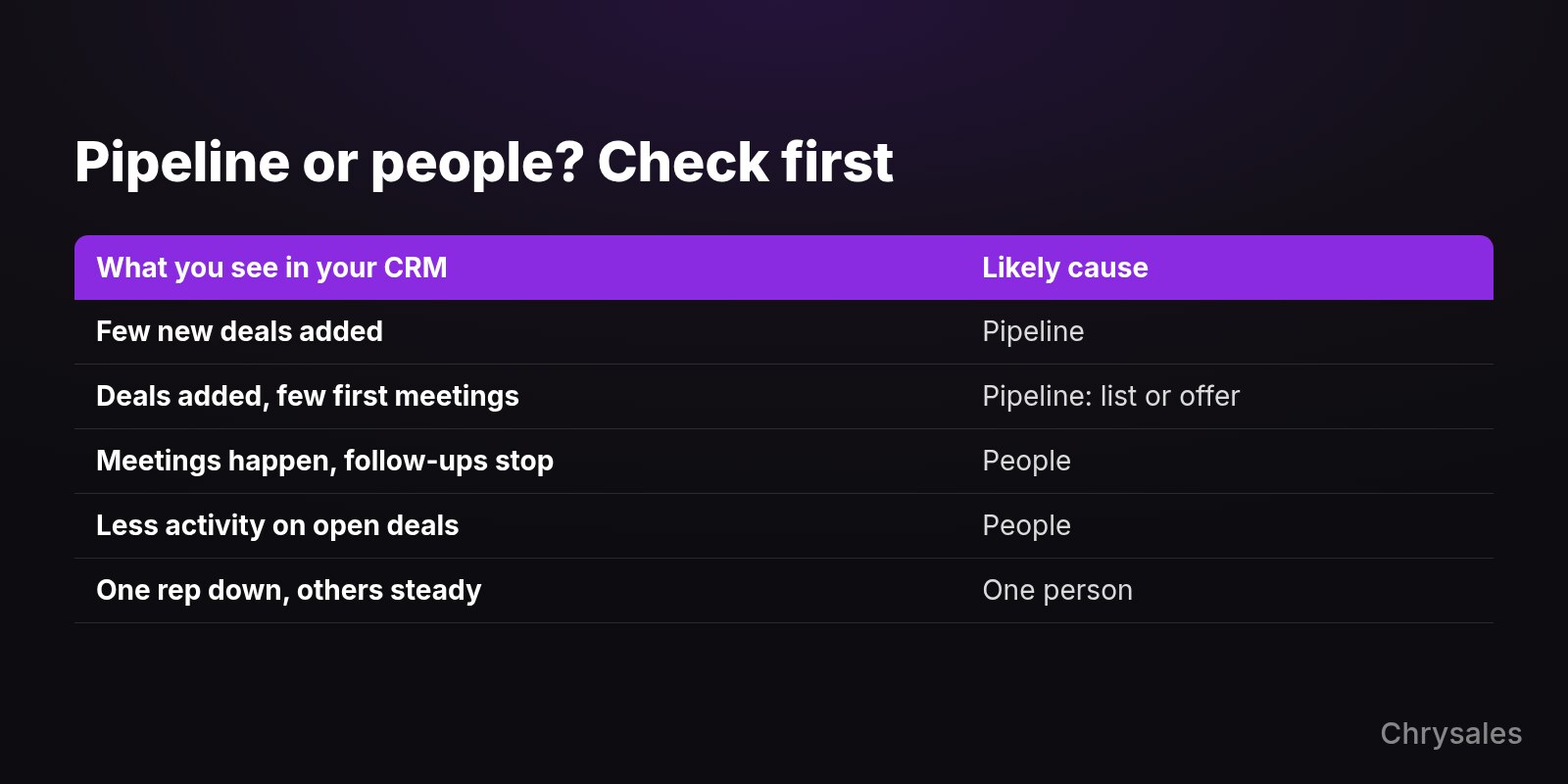
The table shows which CRM signs point to which problem, because the two need different fixes.
Here is a fictional example. A 30-person B2B company books far fewer first meetings this quarter, but every rep still follows up on time. That points to the pipeline.
If it is the pipeline, more pressure on the team won't help. Fix the list, the offer or the follow-up first, starting with why sales slow down and how to fix it. Often it is both, so fix the pipeline and lead the team at the same time.
Tell your team the truth early
Say what is going on at your next team meeting, in plain words. When you stay quiet, people guess, and their guesses are often worse than the facts.
Jason Lemkin, founder of SaaStr, puts it plainly: "Don't hide from bad sales". Lemkin also suggests asking the team how they could do a little better, instead of only handing them answers.
Here is a short script you can adapt:
Here is where we stand: we are behind our target this [month/quarter].
What I know: [one or two facts, e.g. fewer first meetings booked].
What I don't know yet: [the open question].
What stays the same: [e.g. how your pay works].
For the next four weeks, we focus on the work we control.
My question to you: what is one thing that would help you do a bit better?
Only promise what you can keep. If you aren't sure about something, say that too.
Swap big targets for weekly input goals
When results are down, set goals for the work your team controls each week. An input goal is an action, like follow-ups sent or first meetings booked. Deals closed come later.
Don't give someone a results goal until they know how to reach it. Researchers Gerard Seijts and Gary Latham say a results goal "should not be set until an employee has the knowledge to attain it". Big goals with no guidance often lead to stress and burnout, they write, and in some cases to unethical behavior.
Erik Poje, a sales director, had a rep at 20% of his quota, his sales target, for the quarter. Rather than put him on a formal written improvement plan, Poje worked with him on a weekly goal: book three demos a week.
According to Built In, the rep finished the year 20% over his annual target. That is one case, not a rule.
Simon Tecle tried another route. Tecle's team was at 35% of quota, so Tecle let them set their own quota, 30% lower. Built In reports they brought in more revenue that month than under the old number.
If your plan was too aggressive, reset it once and openly, then leave it alone.
Leave pay rules alone too. Bain's advice from 2020, for uncertain times: "this is not the time to reinvent an entire compensation system". When things calm down, read up on how to structure sales commission.
Count quality too. On a report, ten rushed calls look like ten good ones, so listen to a few each week before you praise the number.
Recognize progress every week
Praise progress on the input goals every week, not only closed deals. In a slow month, small steps forward are the wins your team can see.
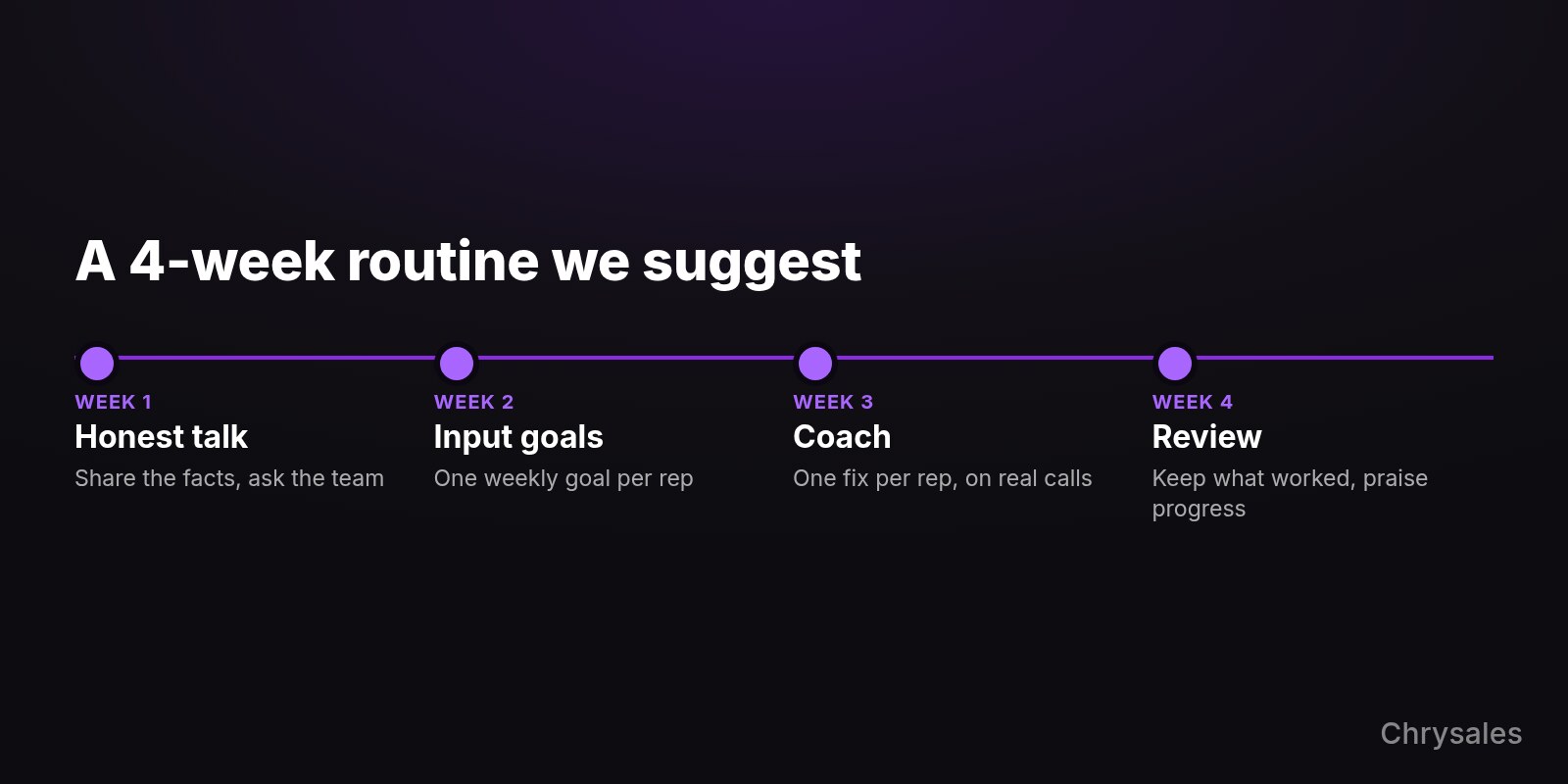
The timeline shows a simple routine we suggest for the next four weeks. It is not a tested method.
Teresa Amabile and Steven Kramer studied about 12,000 daily diaries from 238 employees at seven companies. In Amabile's words, "the single most important thing you can do is to help them make progress in work they perceive as valuable".
The study wasn't about salespeople, but it is about work in general. They also found that setbacks hurt more than progress helps. That's why we'd give a team extra support in a slow month.
Recognition may also help people stay. Gallup and Workhuman found that well-recognized employees were 45% less likely to have left after two years. That shows a link, but it doesn't prove praise is the reason.
Praise costs nothing. Name the exact action in your weekly sales meeting, and keep corrections for one-on-one talks.
Handle the rep who doesn't improve
Some reps won't pick up, even with clear goals and support. Coach them first with a short written plan, then review where things stand. Don't pressure the whole team because of one person.
A performance improvement plan, or PIP, is a written plan with clear goals and a deadline. A simple version we suggest has one or two input goals, a weekly check-in and a date to review progress.
Use those weeks to coach. Listen to one of their calls each week with a simple call review scorecard, and agree on one thing to fix.
If nothing changes, you may need to part ways. Lemkin warns that it "undermines morale to keep paying them in tougher times if everyone knows they aren't improving".
Employment rules differ by country and are strict in Germany and much of Europe. This isn't legal advice, so talk to an employment lawyer or HR adviser before you end a contract.
Watch your best rep too. In a slow month it is easy to lean on whoever still closes, so keep their goals realistic and ask how they are doing.
If you coach on real calls, this live session shows Sabir cold calling with clients and working through real objections and responses.
Conclusion: what to do this week
Start small. Today, open your CRM and decide if this is a pipeline problem, a people problem or both. Write down two or three facts you can share with the team.
This week, hold the honest meeting and keep pay rules as they are. The timeline above shows what can come after that.
Want a second pair of eyes on your team and pipeline during a slow stretch? On a free strategy call, Chrysales can go through how your team works and what feeds its pipeline. Talk through your slow quarter on a free call

If you want to know how to motivate a sales team when sales are down, start with a quick check. Is the problem your pipeline, meaning the deals you are working on, or your people? Then tell the team the truth, set weekly goals they control, and praise progress every week.
Keep pay rules as they are while you do this. If one rep still doesn't improve after a fair plan, handle that rep separately. Don't pressure the whole team.
Is it the pipeline or the people?
It is a pipeline problem if there are too few good deals. It is a people problem if the deals are there but the work on them has slowed. Spend ten minutes in your CRM, the tool where you track deals, before you talk to anyone.
The table shows which CRM signs point to which problem, because the two need different fixes.
Here is a fictional example. A 30-person B2B company books far fewer first meetings this quarter, but every rep still follows up on time. That points to the pipeline.
If it is the pipeline, more pressure on the team won't help. Fix the list, the offer or the follow-up first, starting with why sales slow down and how to fix it. Often it is both, so fix the pipeline and lead the team at the same time.
Tell your team the truth early
Say what is going on at your next team meeting, in plain words. When you stay quiet, people guess, and their guesses are often worse than the facts.
Jason Lemkin, founder of SaaStr, puts it plainly: "Don't hide from bad sales". Lemkin also suggests asking the team how they could do a little better, instead of only handing them answers.
Here is a short script you can adapt:
Here is where we stand: we are behind our target this [month/quarter].
What I know: [one or two facts, e.g. fewer first meetings booked].
What I don't know yet: [the open question].
What stays the same: [e.g. how your pay works].
For the next four weeks, we focus on the work we control.
My question to you: what is one thing that would help you do a bit better?
Only promise what you can keep. If you aren't sure about something, say that too.
Swap big targets for weekly input goals
When results are down, set goals for the work your team controls each week. An input goal is an action, like follow-ups sent or first meetings booked. Deals closed come later.
Don't give someone a results goal until they know how to reach it. Researchers Gerard Seijts and Gary Latham say a results goal "should not be set until an employee has the knowledge to attain it". Big goals with no guidance often lead to stress and burnout, they write, and in some cases to unethical behavior.
Erik Poje, a sales director, had a rep at 20% of his quota, his sales target, for the quarter. Rather than put him on a formal written improvement plan, Poje worked with him on a weekly goal: book three demos a week.
According to Built In, the rep finished the year 20% over his annual target. That is one case, not a rule.
Simon Tecle tried another route. Tecle's team was at 35% of quota, so Tecle let them set their own quota, 30% lower. Built In reports they brought in more revenue that month than under the old number.
If your plan was too aggressive, reset it once and openly, then leave it alone.
Leave pay rules alone too. Bain's advice from 2020, for uncertain times: "this is not the time to reinvent an entire compensation system". When things calm down, read up on how to structure sales commission.
Count quality too. On a report, ten rushed calls look like ten good ones, so listen to a few each week before you praise the number.
Recognize progress every week
Praise progress on the input goals every week, not only closed deals. In a slow month, small steps forward are the wins your team can see.
The timeline shows a simple routine we suggest for the next four weeks. It is not a tested method.
Teresa Amabile and Steven Kramer studied about 12,000 daily diaries from 238 employees at seven companies. In Amabile's words, "the single most important thing you can do is to help them make progress in work they perceive as valuable".
The study wasn't about salespeople, but it is about work in general. They also found that setbacks hurt more than progress helps. That's why we'd give a team extra support in a slow month.
Recognition may also help people stay. Gallup and Workhuman found that well-recognized employees were 45% less likely to have left after two years. That shows a link, but it doesn't prove praise is the reason.
Praise costs nothing. Name the exact action in your weekly sales meeting, and keep corrections for one-on-one talks.
Handle the rep who doesn't improve
Some reps won't pick up, even with clear goals and support. Coach them first with a short written plan, then review where things stand. Don't pressure the whole team because of one person.
A performance improvement plan, or PIP, is a written plan with clear goals and a deadline. A simple version we suggest has one or two input goals, a weekly check-in and a date to review progress.
Use those weeks to coach. Listen to one of their calls each week with a simple call review scorecard, and agree on one thing to fix.
If nothing changes, you may need to part ways. Lemkin warns that it "undermines morale to keep paying them in tougher times if everyone knows they aren't improving".
Employment rules differ by country and are strict in Germany and much of Europe. This isn't legal advice, so talk to an employment lawyer or HR adviser before you end a contract.
Watch your best rep too. In a slow month it is easy to lean on whoever still closes, so keep their goals realistic and ask how they are doing.
If you coach on real calls, this live session shows Sabir cold calling with clients and working through real objections and responses.
Conclusion: what to do this week
Start small. Today, open your CRM and decide if this is a pipeline problem, a people problem or both. Write down two or three facts you can share with the team.
This week, hold the honest meeting and keep pay rules as they are. The timeline above shows what can come after that.
Want a second pair of eyes on your team and pipeline during a slow stretch? On a free strategy call, Chrysales can go through how your team works and what feeds its pipeline. Talk through your slow quarter on a free call
Scaling Is Not Hard If You Have The Right Systems
If you’re serious about leveling up your scaling game, you need the right system, the right training, and the right team behind you. We're here to give you the exact tools and strategies top entrepreneurs use to dominate.

Discover the latest tips
View All
Chrysales was formed from the words "chrysalis" the stage where a caterpillar transforms into a butterfly and "sales".
It stands for one thing: sales transformation.Because scaling doesn’t happen by doing more of the same. Scaling only happens when you go through real transformation in your systems, your offer, team and the way you sell.


