.avif)
How to Get a High Linkedin Reply Rate on Cold Outreach
The LinkedIn Message That Gets a 25% Reply Rate Every Time
A high LinkedIn reply rate on cold outreach is the result of targeting the right people, writing like a human, and following up like you actually care about the conversation. Most people get a 2% reply rate and wonder if the platform even works anymore, but the truth is simpler: the message format matters less than what happens before you hit send. Let's break down exactly how to get there. A 25% LinkedIn reply rate isn't magic. It's built on three foundations: tight targeting, human-sounding messages, and consistent follow-ups that show you're serious about the relationship.
Why Most LinkedIn Messages Die in the Inbox
Picture this: you spend an hour writing the perfect cold outreach message. You send it to 100 people. Three reply. One of those is "not interested." The problem isn't your writing. It's everything that happened before you wrote a single word. Most LinkedIn outreach fails because of bad targeting. You're messaging people who don't need what you're offering, can't buy it, or won't see the message in the first place. A great message to the wrong person is still a waste of time.
The Real LinkedIn Reply Rate Benchmarks
Here's what actual B2B sales and lead generation looks like in 2025:
- Connection request acceptance rate: 20-35% average
- Cold InMail response rate: 10-25% average, up to 30-40% if you nail the targeting and message
- Direct message reply rate after connection: 15-30% average
Those numbers come from real sales teams running outbound campaigns. If you're below 10%, your targeting or message needs work. If you're above 25%, you're doing better than most B2B sales teams out there.
Watch out: Most people compare their results to someone on LinkedIn claiming a 65% reply rate. Those outliers usually involve video messages, hyper-personalized outreach to tiny lists, or warm introductions disguised as cold outreach. They're real, but not repeatable at scale.
Start With the List, Not the Message
A bad list kills your LinkedIn reply rate before you type a word. Think of your outreach list like a phone contact list. If half the numbers don't work, no message gets through. Here's what a good list looks like:
- Right job title: People who actually make or influence buying decisions
- Right company size: Companies that match your ideal client profile
- Right signals: Recent funding, job changes, growth indicators, or pain points you can spot
A 200-person company that just did layoffs is not a "hot lead." It's a bad fit, full stop. Most teams waste time messaging anyone with a pulse instead of building a tight list of people who actually match.
How to Build a High-Reply LinkedIn List
Sales Navigator makes this easy if you know what to filter for. Start with these:
- Job title filters: Be specific. "Head of Sales" is better than "Sales Professional."
- Company size: Pick a range that matches your past clients.
- Industry filters: Target 3-5 industries where you've seen success before.
- Activity signals: Posted in the last 30 days, changed jobs recently, company posted a job opening.
Small lists convert better than big ones. A list of 50 perfect-fit people will get you more replies than a list of 500 random contacts. You can watch 4 ways to find clients who need your services right now for a deeper walkthrough of building high-reply LinkedIn lists.
Pro Tip: If you're targeting multiple buyer types (like marketing directors and sales directors), build separate lists. The message that works for one won't land with the other.
The LinkedIn Outreach Message That Actually Works

Now that your list is solid, here's the message format that consistently hits 20-30% reply rates. It's not fancy. It's just human.
Keep It Short and Specific
Messages under 150 words perform better than long ones. People scan LinkedIn on their phone between meetings. A wall of text gets ignored. Here's the structure:
- Quick personalized opener (one sentence about them, not you)
- One-line reason you're reaching out (what you noticed, why it matters)
- Simple question or next step (not a pitch)
Example: "Saw your post about scaling your sales team last week. Most consulting firms hit a wall around 15-20 people because the systems that worked early stop working. Quick question: are you handling sales yourself right now, or do you have a team running it?"
That's 48 words. It references something real, connects to a pain point, and asks a question that requires a real answer.
Common mistake: Starting with "I help companies do X." Nobody cares what you do until they know why you're talking to them specifically.
Personalization That Takes 30 Seconds
You don't need to write a custom essay for every person. Good LinkedIn connection request tips focus on one personalized detail that shows you actually looked at their profile. Try these:
- Recent post or comment they made
- Job change in the last 90 days
- Company news (funding, new product, hiring)
- Mutual connection or shared background
One sentence is enough. "Saw you just joined as VP of Sales" works better than a generic "I'd love to connect." We worked with a tech company that was getting a 3% reply rate on cold LinkedIn outreach. They switched to this format and jumped to 22% in two weeks. Same offer. Same target audience. Better message.
The Follow-Up Sequence Nobody Does
Here's the thing: most people send one message and give up. A strong LinkedIn reply rate comes from following up like a normal human would.
The Three-Touch Rule
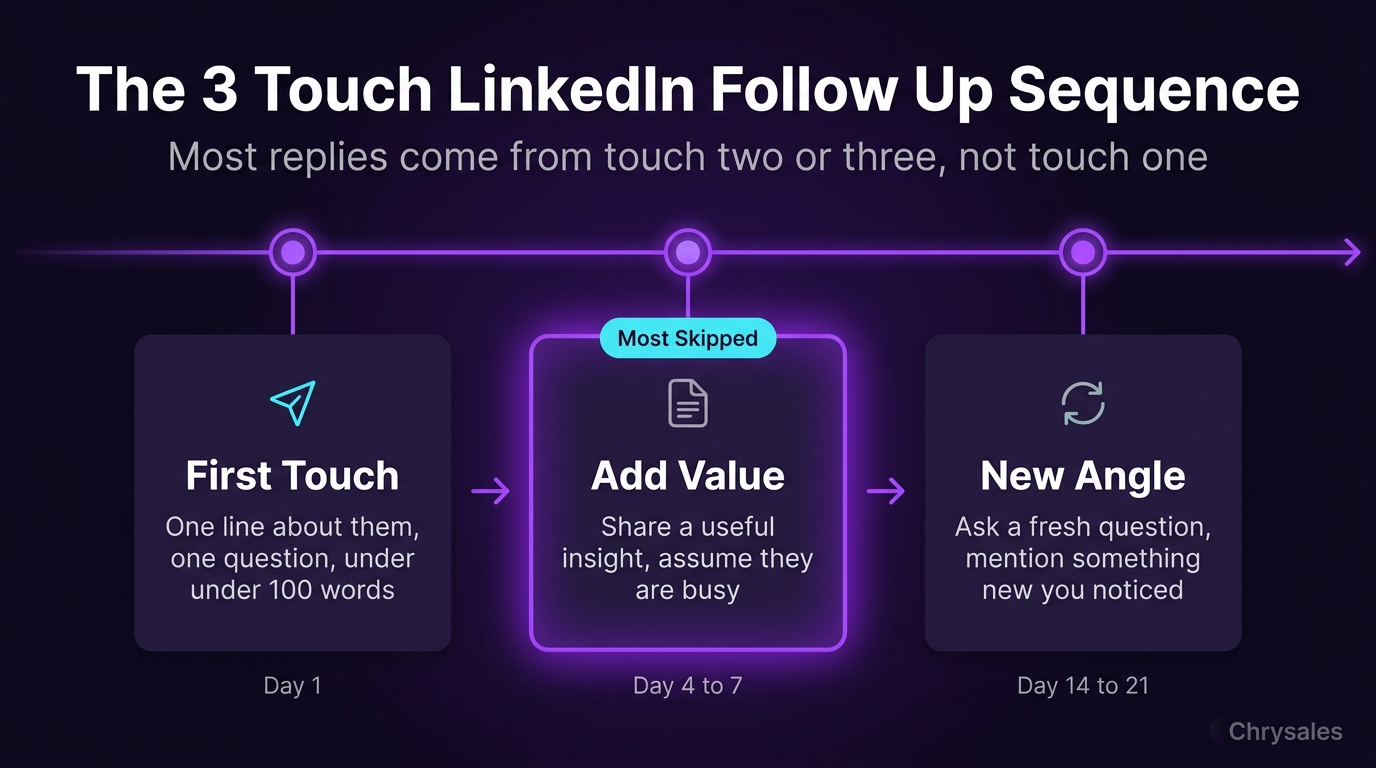
If someone doesn't reply to your first message, send a second one 4-7 days later. Then a third one 7-10 days after that. Most replies come from touch two or three, not touch one. Your follow-ups should add value, not repeat the first message. Try:
- Second message: Share a quick resource or insight related to their business
- Third message: Ask a different question or mention something new you noticed
Example second message: "No worries if you're swamped. I put together a quick breakdown of how three consulting firms fixed their outbound sales process last quarter. Want me to send it over?"
That's 30 words. It assumes they're busy (not ignoring you), offers something useful, and asks permission.
Pro Tip: Space your follow-ups out. Messaging someone three times in five days feels desperate. Three messages over three weeks feels persistent.
Timing and Profile Strength Matter More Than You Think
The best LinkedIn message templates won't save you if your profile looks like spam or you send messages at the wrong time.
When to Send LinkedIn Outreach
B2B sales and lead generation work best Tuesday through Thursday, between 8-10 AM or 4-6 PM in your prospect's timezone. Mondays are too chaotic. Fridays, people are checked out. That said, the timing difference is smaller than most people think. A great message on Monday still beats a bad message on Wednesday.
Your Profile Is Part of the Pitch
Before someone replies, they click your profile. If it looks empty, salesy, or fake, they won't respond. Fix these:
- Headline: Make it about what you do, not your job title. "I help B2B companies build repeatable sales systems" is better than "Sales Coach."
- About section: Keep it simple and benefit-focused. Who you help and what you help them do.
- Activity: Post or comment once a week minimum. A dead profile kills trust.
Quick scenario: A 15-person consulting firm was getting 18% reply rates. We looked at the profile of the person sending messages. No posts in six months. Headline said "Founder & CEO." We updated the headline to focus on client results and had them post twice a week. Reply rate went to 26% in three weeks. Same messages. Better profile.
What to Do When They Reply
A reply isn't a win. It's the start of the real work. Most people blow it here by jumping straight into a pitch.
The First Reply Should Qualify, Not Sell
When someone replies, your job is to figure out if they're a fit, not to book a call immediately. Ask one or two qualifying questions:
- "What does your sales process look like right now?"
- "Are you handling client acquisition yourself, or do you have a team?"
- "What's the biggest bottleneck you're seeing?"
Let them talk. If they're a fit, the call will be easy to book. If they're not, you saved both of you time.
Watch out: Don't send a calendar link in your first reply unless they specifically ask for it. It feels pushy and kills the conversation.
Moving from Message to Meeting
Once you've confirmed they're a good fit, make booking the call easy. Offer two specific times instead of "let me know what works." Try this:
"Makes sense. I can walk you through exactly how we'd build this for your team. I'm open Tuesday at 2 PM or Thursday at 10 AM EST. Either of those work?"
Specific times get more responses than open-ended questions. It removes decision fatigue.
The System Behind the 25% LinkedIn Reply Rate
Look, the truth is this: one good message won't fix a broken sales process. The teams consistently hitting 20-30% LinkedIn messaging benchmarks aren't just writing better messages. They've built a system. That system includes:
- Tight targeting (small lists of perfect-fit prospects)
- Message testing (trying 3-4 variations and tracking what works)
- Follow-up sequences (not giving up after one message)
- Profile optimization (looking like someone worth talking to)
- Lead scoring (prioritizing the best replies first)
Most B2B sales teams skip the system and wonder why the tactics don't work. We see this all the time with new clients. They have a decent offer and a decent message, but no process around it. Replies come in, and nobody follows up. Or the wrong person books a call and wastes everyone's time. Building a repeatable sales system means treating LinkedIn outreach as one step in a bigger process, not a standalone tactic. That's where real client acquisition happens.
How AI Makes This Easier
Here's where it gets interesting: AI tools like Gemini can handle parts of this process so you don't have to manually research every prospect or write every follow-up from scratch. Use AI for:
- List enrichment: Pull in company size, recent news, and contact details
- Message personalization: Generate the first line based on recent activity
- Follow-up reminders: Automate timing so nothing falls through the cracks
Set a simple rule: anything scoring above a 70 fit score goes to the top of your outreach list. That's how you keep the list tight and the reply rate high.
Common mistake: Using AI to blast 500 generic messages. That tanks your reply rate. Use it to make your targeting better, not your volume higher.
Why Most Cold Outreach Advice Fails in Practice
Most LinkedIn outreach strategy blogs tell you what to do, but not why it works or how to make it repeatable. That's the gap between a good reply rate one week and a system that works every week. The difference is process:
- Track your numbers. Reply rate, connection acceptance rate, meeting book rate. You can't improve what you don't measure.
- Test your messages. Try 3-4 variations and see which one performs better over 50+ sends.
- Refine your list. If your reply rate drops, the list is probably the issue, not the message.
A marketing agency we worked with was stuck at 8% reply rates. They were targeting "marketing managers" at companies with 10-500 employees. Way too broad. We narrowed the list to marketing directors at 30-70 person agencies in three specific industries. Reply rate jumped to 24%. Same message. Tighter list.
Building This Into a Full Sales System
A high LinkedIn reply rate is great. But replies don't pay the bills. Booked meetings do. And closed deals do. Here's what a full sales system looks like:
- Lead generation: Build the list, send the outreach, track replies
- Qualifying: Figure out who's a fit before you waste time on a call
- Sales calls: Run a structured call with discovery questions and a clear pitch
- Follow-up: Stay in touch with people who aren't ready yet
- Hiring and scaling: Bring in setters or closers when you're ready to grow
Most small sales teams try to do all of this without a system and burn out in three months. The teams that scale past that point treat each step like a repeatable process. That's exactly what we help B2B companies build at Chrysales: custom sales systems that take you from cold outreach to closed deals without wasting time on tactics that don't fit your business. Over 1,000+ business owners trained, 500+ sales teams scaled, and €10M+ in client revenue generated, all because the system works when the tactics don't.
Frequently Asked Questions
Q: What's a realistic LinkedIn reply rate for cold outreach?
For B2B lead generation, expect 15-25% reply rates on direct messages after connecting, and 10-20% on cold InMail. If you're below 10%, your targeting or message needs work. Above 25% means you're doing better than most sales teams. Don't compare yourself to outliers claiming 50-60% rates unless they're only messaging a handful of hyper-personalized prospects.
Q: Should I use LinkedIn InMail or connection requests for cold outreach?
Connection requests work better for most B2B sales and lead generation. Once they accept, you can send unlimited messages without paying for InMail credits. InMail response rates average 10-25%, while post-connection messages hit 15-30%. Save InMail for people who won't accept requests or when you need to reach someone fast.
Q: How many follow-up messages should I send before giving up?
Send three total touches: the initial message, a follow-up 4-7 days later, and a final follow-up 7-10 days after that. Most replies come from touches two or three. After three messages with no reply over 3-4 weeks, move on. More than that feels pushy and hurts your sender reputation. You can learn how to close busy CEOs who never reply to your messages for advanced follow-up strategies.
Q: What's the best length for a cold LinkedIn message?
Keep it under 150 words. Most people scan LinkedIn on mobile between meetings. Messages around 50-100 words perform best. Include one personalized line, one reason you're reaching out, and one clear question. Anything longer gets skimmed or ignored.
Q: How do I personalize LinkedIn outreach at scale?
You don't need a custom essay for every person. Pick one detail per prospect: a recent post, job change, company news, or shared connection. Write that in 10-15 seconds, then use a tested message template for the rest. AI tools can help pull recent activity and company details, so you're not manually researching every profile.
Q: Does posting on LinkedIn improve my outreach reply rate?
Yes. People check your profile before replying. If you post or comment once or twice a week, it builds credibility and makes you look active, not like a bot. You don't need to be a LinkedIn influencer. Just show you're a real person who knows your stuff. A 15-person consulting firm we worked with jumped from 18% to 26% reply rates just by updating their profile and posting weekly.
Q: How do I know if my LinkedIn reply rate is a targeting problem or a message problem?
If your connection request acceptance rate is below 20%, it's a targeting problem. If your acceptance rate is good but replies are under 10%, it's the message. If replies start strong but drop after two weeks, your list quality is slipping. Track both numbers separately so you know what to fix.
The LinkedIn Message That Gets a 25% Reply Rate Every Time
A high LinkedIn reply rate on cold outreach is the result of targeting the right people, writing like a human, and following up like you actually care about the conversation. Most people get a 2% reply rate and wonder if the platform even works anymore, but the truth is simpler: the message format matters less than what happens before you hit send. Let's break down exactly how to get there. A 25% LinkedIn reply rate isn't magic. It's built on three foundations: tight targeting, human-sounding messages, and consistent follow-ups that show you're serious about the relationship.
Why Most LinkedIn Messages Die in the Inbox
Picture this: you spend an hour writing the perfect cold outreach message. You send it to 100 people. Three reply. One of those is "not interested." The problem isn't your writing. It's everything that happened before you wrote a single word. Most LinkedIn outreach fails because of bad targeting. You're messaging people who don't need what you're offering, can't buy it, or won't see the message in the first place. A great message to the wrong person is still a waste of time.
The Real LinkedIn Reply Rate Benchmarks
Here's what actual B2B sales and lead generation looks like in 2025:
- Connection request acceptance rate: 20-35% average
- Cold InMail response rate: 10-25% average, up to 30-40% if you nail the targeting and message
- Direct message reply rate after connection: 15-30% average
Those numbers come from real sales teams running outbound campaigns. If you're below 10%, your targeting or message needs work. If you're above 25%, you're doing better than most B2B sales teams out there.
Watch out: Most people compare their results to someone on LinkedIn claiming a 65% reply rate. Those outliers usually involve video messages, hyper-personalized outreach to tiny lists, or warm introductions disguised as cold outreach. They're real, but not repeatable at scale.
Start With the List, Not the Message
A bad list kills your LinkedIn reply rate before you type a word. Think of your outreach list like a phone contact list. If half the numbers don't work, no message gets through. Here's what a good list looks like:
- Right job title: People who actually make or influence buying decisions
- Right company size: Companies that match your ideal client profile
- Right signals: Recent funding, job changes, growth indicators, or pain points you can spot
A 200-person company that just did layoffs is not a "hot lead." It's a bad fit, full stop. Most teams waste time messaging anyone with a pulse instead of building a tight list of people who actually match.
How to Build a High-Reply LinkedIn List
Sales Navigator makes this easy if you know what to filter for. Start with these:
- Job title filters: Be specific. "Head of Sales" is better than "Sales Professional."
- Company size: Pick a range that matches your past clients.
- Industry filters: Target 3-5 industries where you've seen success before.
- Activity signals: Posted in the last 30 days, changed jobs recently, company posted a job opening.
Small lists convert better than big ones. A list of 50 perfect-fit people will get you more replies than a list of 500 random contacts. You can watch 4 ways to find clients who need your services right now for a deeper walkthrough of building high-reply LinkedIn lists.
Pro Tip: If you're targeting multiple buyer types (like marketing directors and sales directors), build separate lists. The message that works for one won't land with the other.
The LinkedIn Outreach Message That Actually Works
Now that your list is solid, here's the message format that consistently hits 20-30% reply rates. It's not fancy. It's just human.
Keep It Short and Specific
Messages under 150 words perform better than long ones. People scan LinkedIn on their phone between meetings. A wall of text gets ignored. Here's the structure:
- Quick personalized opener (one sentence about them, not you)
- One-line reason you're reaching out (what you noticed, why it matters)
- Simple question or next step (not a pitch)
Example: "Saw your post about scaling your sales team last week. Most consulting firms hit a wall around 15-20 people because the systems that worked early stop working. Quick question: are you handling sales yourself right now, or do you have a team running it?"
That's 48 words. It references something real, connects to a pain point, and asks a question that requires a real answer.
Common mistake: Starting with "I help companies do X." Nobody cares what you do until they know why you're talking to them specifically.
Personalization That Takes 30 Seconds
You don't need to write a custom essay for every person. Good LinkedIn connection request tips focus on one personalized detail that shows you actually looked at their profile. Try these:
- Recent post or comment they made
- Job change in the last 90 days
- Company news (funding, new product, hiring)
- Mutual connection or shared background
One sentence is enough. "Saw you just joined as VP of Sales" works better than a generic "I'd love to connect." We worked with a tech company that was getting a 3% reply rate on cold LinkedIn outreach. They switched to this format and jumped to 22% in two weeks. Same offer. Same target audience. Better message.
The Follow-Up Sequence Nobody Does
Here's the thing: most people send one message and give up. A strong LinkedIn reply rate comes from following up like a normal human would.
The Three-Touch Rule
If someone doesn't reply to your first message, send a second one 4-7 days later. Then a third one 7-10 days after that. Most replies come from touch two or three, not touch one. Your follow-ups should add value, not repeat the first message. Try:
- Second message: Share a quick resource or insight related to their business
- Third message: Ask a different question or mention something new you noticed
Example second message: "No worries if you're swamped. I put together a quick breakdown of how three consulting firms fixed their outbound sales process last quarter. Want me to send it over?"
That's 30 words. It assumes they're busy (not ignoring you), offers something useful, and asks permission.
Pro Tip: Space your follow-ups out. Messaging someone three times in five days feels desperate. Three messages over three weeks feels persistent.
Timing and Profile Strength Matter More Than You Think
The best LinkedIn message templates won't save you if your profile looks like spam or you send messages at the wrong time.
When to Send LinkedIn Outreach
B2B sales and lead generation work best Tuesday through Thursday, between 8-10 AM or 4-6 PM in your prospect's timezone. Mondays are too chaotic. Fridays, people are checked out. That said, the timing difference is smaller than most people think. A great message on Monday still beats a bad message on Wednesday.
Your Profile Is Part of the Pitch
Before someone replies, they click your profile. If it looks empty, salesy, or fake, they won't respond. Fix these:
- Headline: Make it about what you do, not your job title. "I help B2B companies build repeatable sales systems" is better than "Sales Coach."
- About section: Keep it simple and benefit-focused. Who you help and what you help them do.
- Activity: Post or comment once a week minimum. A dead profile kills trust.
Quick scenario: A 15-person consulting firm was getting 18% reply rates. We looked at the profile of the person sending messages. No posts in six months. Headline said "Founder & CEO." We updated the headline to focus on client results and had them post twice a week. Reply rate went to 26% in three weeks. Same messages. Better profile.
What to Do When They Reply
A reply isn't a win. It's the start of the real work. Most people blow it here by jumping straight into a pitch.
The First Reply Should Qualify, Not Sell
When someone replies, your job is to figure out if they're a fit, not to book a call immediately. Ask one or two qualifying questions:
- "What does your sales process look like right now?"
- "Are you handling client acquisition yourself, or do you have a team?"
- "What's the biggest bottleneck you're seeing?"
Let them talk. If they're a fit, the call will be easy to book. If they're not, you saved both of you time.
Watch out: Don't send a calendar link in your first reply unless they specifically ask for it. It feels pushy and kills the conversation.
Moving from Message to Meeting
Once you've confirmed they're a good fit, make booking the call easy. Offer two specific times instead of "let me know what works." Try this:
"Makes sense. I can walk you through exactly how we'd build this for your team. I'm open Tuesday at 2 PM or Thursday at 10 AM EST. Either of those work?"
Specific times get more responses than open-ended questions. It removes decision fatigue.
The System Behind the 25% LinkedIn Reply Rate
Look, the truth is this: one good message won't fix a broken sales process. The teams consistently hitting 20-30% LinkedIn messaging benchmarks aren't just writing better messages. They've built a system. That system includes:
- Tight targeting (small lists of perfect-fit prospects)
- Message testing (trying 3-4 variations and tracking what works)
- Follow-up sequences (not giving up after one message)
- Profile optimization (looking like someone worth talking to)
- Lead scoring (prioritizing the best replies first)
Most B2B sales teams skip the system and wonder why the tactics don't work. We see this all the time with new clients. They have a decent offer and a decent message, but no process around it. Replies come in, and nobody follows up. Or the wrong person books a call and wastes everyone's time. Building a repeatable sales system means treating LinkedIn outreach as one step in a bigger process, not a standalone tactic. That's where real client acquisition happens.
How AI Makes This Easier
Here's where it gets interesting: AI tools like Gemini can handle parts of this process so you don't have to manually research every prospect or write every follow-up from scratch. Use AI for:
- List enrichment: Pull in company size, recent news, and contact details
- Message personalization: Generate the first line based on recent activity
- Follow-up reminders: Automate timing so nothing falls through the cracks
Set a simple rule: anything scoring above a 70 fit score goes to the top of your outreach list. That's how you keep the list tight and the reply rate high.
Common mistake: Using AI to blast 500 generic messages. That tanks your reply rate. Use it to make your targeting better, not your volume higher.
Why Most Cold Outreach Advice Fails in Practice
Most LinkedIn outreach strategy blogs tell you what to do, but not why it works or how to make it repeatable. That's the gap between a good reply rate one week and a system that works every week. The difference is process:
- Track your numbers. Reply rate, connection acceptance rate, meeting book rate. You can't improve what you don't measure.
- Test your messages. Try 3-4 variations and see which one performs better over 50+ sends.
- Refine your list. If your reply rate drops, the list is probably the issue, not the message.
A marketing agency we worked with was stuck at 8% reply rates. They were targeting "marketing managers" at companies with 10-500 employees. Way too broad. We narrowed the list to marketing directors at 30-70 person agencies in three specific industries. Reply rate jumped to 24%. Same message. Tighter list.
Building This Into a Full Sales System
A high LinkedIn reply rate is great. But replies don't pay the bills. Booked meetings do. And closed deals do. Here's what a full sales system looks like:
- Lead generation: Build the list, send the outreach, track replies
- Qualifying: Figure out who's a fit before you waste time on a call
- Sales calls: Run a structured call with discovery questions and a clear pitch
- Follow-up: Stay in touch with people who aren't ready yet
- Hiring and scaling: Bring in setters or closers when you're ready to grow
Most small sales teams try to do all of this without a system and burn out in three months. The teams that scale past that point treat each step like a repeatable process. That's exactly what we help B2B companies build at Chrysales: custom sales systems that take you from cold outreach to closed deals without wasting time on tactics that don't fit your business. Over 1,000+ business owners trained, 500+ sales teams scaled, and €10M+ in client revenue generated, all because the system works when the tactics don't.
Frequently Asked Questions
Q: What's a realistic LinkedIn reply rate for cold outreach?
For B2B lead generation, expect 15-25% reply rates on direct messages after connecting, and 10-20% on cold InMail. If you're below 10%, your targeting or message needs work. Above 25% means you're doing better than most sales teams. Don't compare yourself to outliers claiming 50-60% rates unless they're only messaging a handful of hyper-personalized prospects.
Q: Should I use LinkedIn InMail or connection requests for cold outreach?
Connection requests work better for most B2B sales and lead generation. Once they accept, you can send unlimited messages without paying for InMail credits. InMail response rates average 10-25%, while post-connection messages hit 15-30%. Save InMail for people who won't accept requests or when you need to reach someone fast.
Q: How many follow-up messages should I send before giving up?
Send three total touches: the initial message, a follow-up 4-7 days later, and a final follow-up 7-10 days after that. Most replies come from touches two or three. After three messages with no reply over 3-4 weeks, move on. More than that feels pushy and hurts your sender reputation. You can learn how to close busy CEOs who never reply to your messages for advanced follow-up strategies.
Q: What's the best length for a cold LinkedIn message?
Keep it under 150 words. Most people scan LinkedIn on mobile between meetings. Messages around 50-100 words perform best. Include one personalized line, one reason you're reaching out, and one clear question. Anything longer gets skimmed or ignored.
Q: How do I personalize LinkedIn outreach at scale?
You don't need a custom essay for every person. Pick one detail per prospect: a recent post, job change, company news, or shared connection. Write that in 10-15 seconds, then use a tested message template for the rest. AI tools can help pull recent activity and company details, so you're not manually researching every profile.
Q: Does posting on LinkedIn improve my outreach reply rate?
Yes. People check your profile before replying. If you post or comment once or twice a week, it builds credibility and makes you look active, not like a bot. You don't need to be a LinkedIn influencer. Just show you're a real person who knows your stuff. A 15-person consulting firm we worked with jumped from 18% to 26% reply rates just by updating their profile and posting weekly.
Q: How do I know if my LinkedIn reply rate is a targeting problem or a message problem?
If your connection request acceptance rate is below 20%, it's a targeting problem. If your acceptance rate is good but replies are under 10%, it's the message. If replies start strong but drop after two weeks, your list quality is slipping. Track both numbers separately so you know what to fix.
Scaling Is Not Hard If You Have The Right Systems
If you’re serious about leveling up your scaling game, you need the right system, the right training, and the right team behind you. We're here to give you the exact tools and strategies top entrepreneurs use to dominate.

Discover the latest tips
View All.avif)
Chrysales was formed from the words "chrysalis" the stage where a caterpillar transforms into a butterfly and "sales".
It stands for one thing: sales transformation.Because scaling doesn’t happen by doing more of the same. Scaling only happens when you go through real transformation in your systems, your offer, team and the way you sell.
.avif)


